Systems Biology vs Molecular Biology: A Comprehensive Guide for Modern Drug Discovery
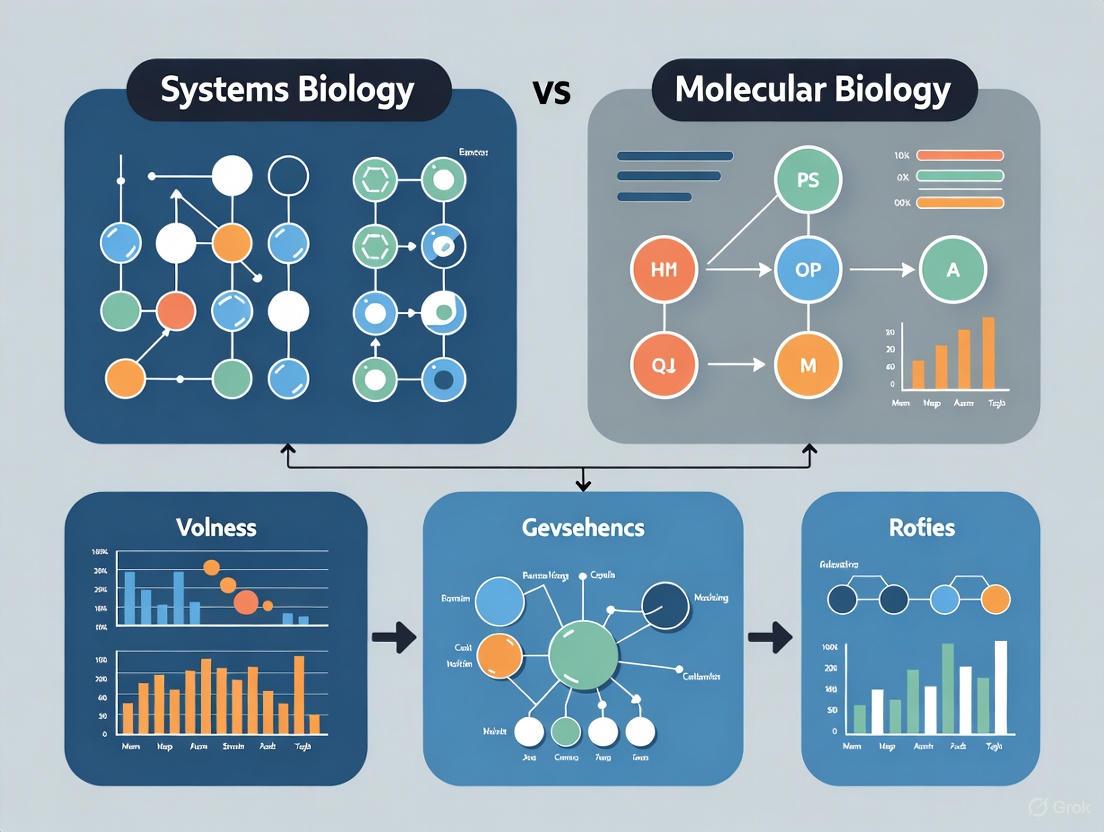
This article provides a detailed comparative analysis of molecular and systems biology, tailored for researchers and drug development professionals.
Systems Biology vs Molecular Biology: A Comprehensive Guide for Modern Drug Discovery
Abstract
This article provides a detailed comparative analysis of molecular and systems biology, tailored for researchers and drug development professionals. It explores the foundational philosophical distinctions, from molecular biology's reductionist focus on individual components to systems biology's holistic analysis of complex networks. The review covers cutting-edge methodological applications, including AI-driven network modeling, quantum computing for molecular simulations, and large language models in drug discovery. It addresses key challenges in both fields and evaluates validation frameworks, concluding with an integrative perspective on how their convergence is accelerating the development of precision therapeutics.
From Reductionism to Holism: Philosophical Roots and Core Principles
The pursuit of understanding life's mechanisms has bifurcated into two complementary yet distinct philosophical and methodological approaches: molecular biology and systems biology. Molecular biology adopts a reductionist focus, seeking to elucidate biological activity by isolating and studying individual cellular components and their specific functions [1] [2]. In stark contrast, systems biology employs an integrative, holistic perspective, aiming to understand how these molecular components interact within complex networks to produce emergent behaviors and functions [3] [4]. This whitepaper delineates the core principles, methodologies, and experimental paradigms that define and distinguish these two fundamental approaches to biological research, providing a framework for researchers and drug development professionals to leverage their respective strengths.
Molecular Biology: A Reductionist Paradigm
Core Principle and Historical Foundations
Molecular biology is fundamentally a reductionist discipline, investigating the structure, function, and interactions of the key macromolecules—DNA, RNA, and proteins—that constitute the foundational machinery of the cell [1] [2]. The field is built upon the premise that complex biological phenomena can be understood by examining their simplest, constituent parts. This paradigm was cemented by a series of landmark experiments in the 20th century that isolated the molecular basis of heredity.
Table 1: Foundational Experiments in Molecular Biology
| Experiment | Key Investigators (Year) | Core Finding | Methodological Innovation |
|---|---|---|---|
| Genetic Transformation | Frederick Griffith (1928) | Horizontal gene transfer between bacteria [2] | Use of virulent/avirulent pneumococcus strains in mice |
| Identification of Transforming Principle | Avery, MacLeod, McCarty (1944) | DNA is the substance responsible for genetic transformation [2] | Biochemical purification and enzymatic characterization |
| Confirmation of Genetic Material | Hershey and Chase (1952) | DNA, not protein, is the genetic material of a phage [2] | Use of radioactive isotopes (³²P and ³⁵S) and blender agitation |
| DNA Replication Model | Meselson and Stahl (1958) | DNA replication is semiconservative [2] | Density-gradient centrifugation with ¹⁵N isotope labeling |
Central Dogma and Key Methodologies
The conceptual framework of molecular biology is dominated by the Central Dogma, which describes the sequential flow of genetic information from DNA to RNA to protein. The field's techniques are designed to dissect this linear pathway, focusing on mechanisms such as DNA replication, transcription, and translation [1]. Standard methodologies include recombinant DNA technology, polymerase chain reaction (PCR), molecular cloning, blotting techniques, and gel electrophoresis. These tools allow for the precise manipulation and characterization of individual genes and their products.
Systems Biology: An Integrative Paradigm
Core Principle and Conceptual Shift
Systems biology represents a fundamental philosophical shift from reductionism to holism. It is defined as "an approach in biomedical research to understanding the larger picture—be it at the level of the organism, tissue, or cell—by putting its pieces together" [3]. Instead of isolating components, systems biology focuses on the interactions and networks between molecular parts to understand how they work together as a system to produce complex behaviors [4]. The core objective is to discern the emergent properties of a system that cannot be predicted by studying its parts in isolation.
Key Methodologies and the "Innovation Engine"
The practice of systems biology is characterized by its interdisciplinary nature, integrating biology, computer science, mathematics, and engineering. Its approach is often described as an "Innovation Engine," where biological questions drive the development of new technologies, which in turn necessitate novel computational tools, leading to new biological insights [4].
Table 2: Core Methodological Pillars of Systems Biology
| Methodological Pillar | Description | Application Example |
|---|---|---|
| Multi-Omics Data Integration | Combined analysis of multiple data types (e.g., genome, transcriptome, proteome, metabolome) to gain a comprehensive view of the system [4]. | Studying the human immune response to vaccination by correlating genomic variants with protein expression and metabolite levels. |
| Computational & Mathematical Modeling | Using quantitative models to simulate the behavior of biological systems, from metabolic networks to signaling pathways [3] [5]. | Developing predictive models of Toll-like receptor (TLR) signaling networks to understand inflammatory responses [3]. |
| High-Throughput Perturbation Analysis | Systematically perturbing biological systems (genetically, chemically, or environmentally) and measuring genome-wide responses to infer network structure [3]. | Genome-wide RNAi screens to identify key components in innate immune pathogen-sensing networks [3]. |
A Comparative Analysis: Molecular vs. Systems Biology
Table 3: A Direct Comparison of the Two Biological Paradigms
| Aspect | Molecular Biology | Systems Biology |
|---|---|---|
| Philosophical Approach | Reductionist | Holistic, Integrative |
| Primary Focus | Individual molecules (DNA, RNA, proteins) and linear pathways [2] | Networks, interactions, and emergent system-level properties [3] [4] |
| Typical Methods | Gene cloning, PCR, gel electrophoresis, blotting [1] | Multi-omics, high-throughput screening, computational modeling [3] [4] |
| View of a Cell | A collection of precisely engineered molecular machines | A complex, dynamic, and adaptive network of networks [4] |
| Model Output | Mechanism of a specific molecular interaction | Predictive, quantitative simulation of system behavior under various conditions [3] [4] |
| Team Structure | Often single-investigator or small, specialized groups | Requires large, cross-disciplinary teams (biologists, computer scientists, engineers, physicists) [3] [4] |
Experimental Protocols
Molecular Biology Protocol: The Hershey-Chase Experiment
This classic "blender experiment" definitively proved that DNA is the genetic material [2].
Detailed Methodology:
- Preparation of Phage Labels: Two separate samples of T2 bacteriophage were prepared.
- Protein Label: Phages were grown in a medium containing radioactive sulfur (³⁵S), which is incorporated into their protein coats but not their DNA.
- DNA Label: Phages were grown in a medium containing radioactive phosphorus (³²P), which is incorporated into their DNA but not their protein coats.
- Infection: Each sample of labeled phages was allowed to infect separate batches of E. coli bacteria.
- Agitation and Separation: The phage-bacteria mixtures were vigorously agitated in a kitchen blender. This mechanical shearing force detached the empty phage protein coats from the bacterial cell surfaces.
- Centrifugation: The mixtures were centrifuged. The heavier bacterial cells formed a pellet, while the lighter phage ghosts and other fragments remained in the supernatant.
- Measurement of Radioactivity: The radioactivity in the pellet and supernatant was measured for each experiment.
- In the ³²P (DNA) experiment, the radioactivity was found primarily in the bacterial pellet.
- In the ³⁵S (protein) experiment, the radioactivity was found primarily in the supernatant.
Interpretation: The results demonstrated that the phage's DNA, not its protein, entered the host cell to direct the synthesis of new phage particles, thereby identifying DNA as the genetic material.
Systems Biology Protocol: A Multi-Omics Workflow for Immune Response Analysis
This protocol outlines a modern systems biology approach to studying a complex phenomenon, such as the response to infection or vaccination [3].
Detailed Methodology:
- System Perturbation: A defined perturbation is applied to the biological system. Examples include:
- High-Throughput Multi-Omics Data Generation: At multiple time points post-perturbation, samples are collected for simultaneous, high-throughput analysis across different molecular layers:
- Genomics: Sequence the genome to identify genetic variations between subjects.
- Transcriptomics: Use microarrays or RNA-Seq to measure genome-wide changes in gene expression (mRNA and miRNA).
- Proteomics: Use mass spectrometry to identify and quantify protein abundance and post-translational modifications, such as phosphorylation [3].
- Metabolomics: Profile changes in small-molecule metabolites.
- Data Integration and Network Modeling: Computational and statistical tools are used to integrate the diverse omics datasets.
- Bioinformatics pipelines process raw data and identify significant changes.
- Network inference methods are used to reconstruct the wiring of molecular interactions (e.g., signaling pathways, gene regulatory networks) that underlie the observed response.
- Model Simulation and Prediction: The constructed network model is used to run in silico simulations. The model's predictions (e.g., how a different genetic background or a drug might alter the system's response) are then validated through further experimentation, creating an iterative cycle of model refinement.
The Scientist's Toolkit: Essential Research Reagents and Materials
Table 4: Key Research Reagents and Their Functions
| Reagent / Material | Field | Function |
|---|---|---|
| Plasmids and Vectors | Molecular Biology | Carrier molecules for storing, amplifying, and introducing recombinant DNA into host organisms for cloning and protein expression [1]. |
| Restriction Enzymes | Molecular Biology | Molecular scissors that cut DNA at specific recognition sequences, enabling recombinant DNA technology [2]. |
| Radioactive Isotopes (e.g., ³²P, ³⁵S) | Molecular Biology | Used as tracers to label and track specific molecules (like DNA or proteins) through complex biological processes, as in the Hershey-Chase experiment [2]. |
| Short Interfering RNA (siRNA) | Systems Biology | Used for genome-wide RNAi screens to systematically perturb (knock down) gene function and identify key network components [3]. |
| Mass Spectrometer | Systems Biology | A core analytical instrument for proteomics, used to identify and quantify proteins and their post-translational modifications (e.g., phosphorylation) [3]. |
| Computational Modeling Software (e.g., Simmune) | Systems Biology | Enables the construction and simulation of realistic, multiscale models of biological processes, such as cellular signaling pathways [3]. |
Visualizing the Paradigms: Signaling Pathways and Workflows
Molecular Biology: The Central Dogma Workflow
Systems Biology: A Multi-Omics Integration Network
An Integrated Signaling Network (TLR Pathway)
The landscape of biological research has undergone a profound transformation, shifting from a predominantly reductionist approach to an integrative, systems-level perspective. This evolution represents a fundamental change in how scientists conceptualize and investigate living organisms—from treating them as collections of isolated parts to understanding them as complex, interconnected systems whose properties emerge from dynamic interactions across multiple scales. Reductionist biology, often described as taking the pieces apart, successfully dominated decades of biomedical research, identifying most biological components and many of their interactions [3]. However, this approach offered limited capacity for understanding how system properties emerge from these interactions [6]. In stark contrast, systems biology has emerged as an interdisciplinary field that focuses on complex interactions within biological systems, using a holistic approach to research that emphasizes putting pieces together rather than taking them apart [3] [6].
This paradigm shift has been driven by the recognition that biological complexity cannot be fully understood by studying individual components in isolation. As one prominent researcher noted, "We all have slightly different interests, but there is enough overlap between those interests for us to develop those core projects and for us to be invested in them" [3]. This collaborative spirit reflects the essence of the systems biology approach, which integrates various fields of study including genomics, proteomics, metabolomics, and other "omics" areas to construct comprehensive predictive models of biological systems [4]. The transition from mechanistic decomposition to integrative modeling represents not merely a methodological change but a fundamental philosophical transformation in how we perceive and investigate the machinery of life [6].
Historical Foundations: From Reductionism to Systems Thinking
The Reductionist Era in Molecular Biology
The reductionist paradigm in biology has deep historical roots, with its philosophical foundations tracing back to the 17th century when the triumphs of physics and mechanical clockwork prompted a perspective of organisms as intricate machines made up of simpler elements [6]. This approach achieved remarkable success throughout the 20th century, particularly with the rise of molecular biology, which focused on understanding biological processes by breaking them down into their constituent molecular parts [6]. The reductionist approach proved exceptionally powerful for identifying and characterizing individual biological components—from genes and proteins to metabolic pathways—and formed the cornerstone of molecular biology research for decades.
Molecular biology operated on the premise that to understand how the body functions, one needed to comprehend the role of each component, from tissues and cells to the complete set of intracellular molecular building blocks [6]. This perspective was epitomized by what has been characterized as "atomism"—a view on which explanation proceeds by first discovering the intrinsic functional properties of the relevant lower-level parts, and then explaining the properties of the system as interactions between those intrinsic properties [7]. While this approach generated an enormous wealth of knowledge about biological components, it became increasingly apparent that possessing complete information about molecular components alone would not suffice to elucidate the workings of life [6].
Early Systems Thinking and Theoretical Foundations
Counterbalancing the reductionist perspective, holistic views of biological systems have existed for centuries. Greek, Roman, and East Asian medical traditions maintained comprehensive perspectives on the human body, with thinkers like Hippocrates believing that health and illness were linked to the equilibrium or disruption of bodily systems [6]. In the early 20th century, Jan Smuts coined the term "holism" to describe whole systems such as cells, tissues, organisms, and populations as having unique emergent properties that could not be understood by reassembling the behavior of the whole from the properties of individual components [6].
The term "systems biology" first appeared in 1968 at a scientific conference, but the field gained significant momentum near the turn of the millennium as technological advances enabled the comprehensive measurements necessary for systems-level approaches [6]. The completion of the Human Genome Project circa 2001 created a pivotal moment, making biology rich in genomic data while proteomics had come of age [3]. Despite this wealth of data, predicting complex biological behaviors remained elusive, highlighting the need for new approaches that could better embrace experimental and computational techniques to explore biological connections "in all their intricate glory" [3].
Table: Historical Evolution of Biological Research Paradigms
| Time Period | Dominant Paradigm | Key Focus | Primary Methodology | Limitations |
|---|---|---|---|---|
| 17th-19th Century | Holism | Organism as integrated whole | Observation of whole systems | Limited molecular mechanistic understanding |
| 1900s-1990s | Reductionism | Isolated components | Decomposition and isolation | Unable to predict emergent system behaviors |
| 2000s-Present | Systems Biology | Networks and interactions | Integration and computational modeling | Data integration challenges, computational complexity |
Core Philosophical and Methodological Differences
Philosophical Underpinnings: Emergence Versus Mechanism
The evolution from mechanistic decomposition to integrative modeling raises fundamental philosophical questions about emergence and reduction in complex biological systems. Standard arguments in philosophy of science have traditionally inferred from the complexity of biological and neural systems to the presence of emergence and failure of mechanistic/reductionist explanation [7]. Context-sensitivity—where larger-scale factors influence the functioning of lower-level parts—has been standardly taken to be incompatible with reductionistic explanation [7]. However, contemporary perspectives challenge this dichotomy, suggesting that widespread context sensitivity across scales is not tantamount to emergence if mechanisms underlying those context-specific reorganizations can be discovered [7].
The debate encompasses several key dimensions, including strong versus weak emergence, where strong emergence posits a discontinuity in nature between lower-level and higher-level phenomena, while weaker kinds of emergence maintain that there is no discontinuity in nature but instead that certain organizational features at higher levels are emergent even if they are ultimately the outcome of basic physical processes [7]. Similarly, the distinction between ontological emergence (a feature of the world) and epistemic emergence (a feature of human descriptions due to limitations) further refines this philosophical landscape [7]. A productive version of this debate focuses on whether functional decomposition and localization—the sine qua non of mechanistic explanation—remain viable in the face of widespread context sensitivity and multi-scale relations in neural and biological systems [7].
Methodological Approaches: From Isolation to Integration
Methodologically, the contrasts between traditional molecular biology and systems biology are profound and manifest across the entire research process:
Research Objectives: Molecular biology typically aims to characterize individual components and linear pathways, while systems biology seeks to understand complex interactions within networks and identify emergent properties [6].
Experimental Design: Reductionist approaches often involve isolating components from their natural context to study them in controlled settings, whereas systems biology employs high-throughput, genome-wide measurements that capture system states comprehensively [6].
Data Interpretation: Molecular biology traditionally uses qualitative or simple quantitative models, while systems biology relies heavily on computational modeling and simulation to interpret data and generate predictions [8] [6].
Validation Methods: Conventional approaches use direct experimental manipulation of individual components, while integrative approaches often employ iterative cycles of modeling and experimental perturbation to validate system behaviors [9].
The systems biology approach embodies what has been described as a "virtuous cycle where biology drives technology, and technology drives computation" [4]. New biological insights emerge from each iteration of this cycle, generating novel technologies and computational tools that further advance understanding. This methodology represents a fundamental shift from linear, hypothesis-driven research to iterative, discovery-oriented science that embraces complexity rather than seeking to eliminate it.
Integrative Modeling Methodologies and Workflows
The Integrative Modeling Workflow
Integrative modeling of complex biological systems follows a systematic workflow that combines various types of experimental data, prior knowledge, and existing models. Based on analysis of recent whole-cell modeling efforts, this workflow can be summarized in five essential steps [9]:
Gather Information: Collect multiple types of input information including experimental data (from cryo-ET, mass spectrometry, fluorescence microscopy), prior knowledge (statistical preferences, expert knowledge, physical theory), and prior models (from public databases such as wwPDB, BioModels) [9].
Represent System Modules: Decompose the complex system into manageable modules due to the high complexity of biological systems, particularly at the cellular level [9].
Translate Information to Scoring Functions: Convert input information into quantitative scoring functions that evaluate the compatibility of models with the input data and knowledge [9].
Sample Model Space: Generate an ensemble of models that represent the system by exploring the space of possible configurations and interactions [9].
Validate and Interpret: Assess model accuracy, precision, and completeness through comparison with experimental data not used in model building, followed by biological interpretation of the validated models [9].
This workflow emphasizes modular representation due to the high complexity of biological systems, where the output model is either built by constructing and integrating intermediate models for individual modules or by integrating information over modules directly [9]. The process is inherently iterative, with each cycle refining the model and potentially generating new biological insights and hypotheses for experimental testing.
Multi-Omics Integration and Network Analysis
A cornerstone of modern integrative modeling is the simultaneous analysis of multiple layers of biological information, known as multi-omics. The now-ubiquitous term "multiomics" describes the integration of information across various "-omes" of a biological system, including the genome, transcriptome (mRNAs), proteome (proteins), microbiome, epigenome, metabolome, and phenome [4]. Through examination of these interconnected layers of biological information, multiomics provides a deeper understanding of health and disease, driving advancements in research and healthcare [4].
Multi-omics data integration enables researchers to combine and analyze diverse types of biological data—from molecular measurements to electronic health records and quantified self-data that includes diet and fitness—allowing comprehensive insights into complex biological systems [4]. Integrating these diverse data sets facilitates the development of more accurate computational models and predictive tools, which is driving innovation in research and healthcare [4]. This approach has transformed systems biology by providing extensive datasets that cover different biological layers, leading to a more profound comprehension of biological processes and interactions [6]. Methods such as network analysis, machine learning, and pathway enrichment are increasingly utilized to integrate and interpret multi-omics data, thereby improving our understanding of biological functions and disease mechanisms [6].
Bayesian Meta-Modeling and Multi-Scale Integration
A significant recent development in integrative modeling is Bayesian metamodeling, which integrates heterogeneous models and datasets across multiple scales and representations [9]. This approach addresses the challenge of combining diverse modeling strategies—such as coarse-grained spatiotemporal simulations, ordinary differential equations (ODEs), and molecular network models—into a unified framework [9]. Bayesian metamodeling provides a principled statistical foundation for integrating models of varying granularity and from different domains, enabling researchers to construct more comprehensive representations of biological systems.
Multi-scale modeling represents another critical methodology in integrative systems biology, addressing biological questions that span multiple levels of organization through the integration of models and quantitative experiments [10]. These approaches capture cellular dynamics and regulation with particular emphasis on the role played by the spatial organization of cellular components [10]. For example, Ghaemi et al. revealed the influence of spatial organization on RNA splicing by incorporating complex biochemical networks into a spatially-resolved human cell model, creating what is known as a whole-cell compartment model [9]. Similarly, Thornburg et al. developed a whole-cell fully dynamical kinetic model of JCVi-syn3A to reveal how emergent imbalances lead to slowdowns in the rates of transcription and translation [9].
Table: Integrative Modeling Platforms and Their Applications
| Platform | Modeling Approach | Biological Scale | Key Applications | References |
|---|---|---|---|---|
| VCell | Molecular mechanisms simulation | Molecular to cellular | Biochemical network dynamics | [9] |
| MCELL | Ligand diffusion and reaction simulation | Molecular to cellular | Chemical signaling reactions | [9] |
| E-CELL | Differential equation-based simulation | Cellular | Minimal gene complement for self-replication | [9] |
| Vivarium | Heterogeneous model composition | Multi-scale | Integrated multi-scale modeling | [9] |
| CellPAINT | Molecular visualization | Molecular to cellular | Molecular organization illustration | [9] |
Experimental Protocols in Integrative Systems Biology
Protocol 1: Multi-Omics Data Integration for Cellular Network Reconstruction
Purpose: To reconstruct comprehensive molecular interaction networks by integrating multiple layers of omics data, enabling the identification of novel regulatory relationships and functional modules [4] [9].
Materials and Reagents:
- Cell or tissue samples representing the biological system of interest
- DNA/RNA extraction kits for genomic and transcriptomic analysis
- Mass spectrometry-grade solvents and reagents for proteomic and metabolomic profiling
- High-throughput sequencing platforms for genomic, transcriptomic, and epigenomic data generation
- Liquid chromatography-mass spectrometry (LC-MS/MS) systems for proteomic and metabolomic analysis
- Multiplexed immunoassay platforms for protein quantification and post-translational modification analysis
Procedure:
- Sample Preparation: Collect and process biological samples under standardized conditions to minimize technical variation. Divide aliquots for different omics analyses to ensure matched samples across data types.
Data Generation:
- Genomics: Perform whole-genome sequencing to identify genetic variants and structural variations.
- Transcriptomics: Conduct RNA sequencing (RNA-seq) to quantify gene expression levels and alternative splicing events.
- Proteomics: Implement LC-MS/MS-based shotgun proteomics to identify and quantify proteins and their post-translational modifications.
- Metabolomics: Apply targeted and untargeted LC-MS methods to profile metabolite abundances.
- Epigenomics: Utilize bisulfite sequencing or ChIP-seq to map DNA methylation patterns or histone modifications.
Data Preprocessing: Quality control, normalize, and annotate each omics dataset separately using platform-specific bioinformatics pipelines.
Data Integration: Employ statistical and network-based methods to integrate the multi-omics datasets:
- Perform multivariate analysis to identify correlated features across omics layers
- Construct multi-layered networks representing interactions between different molecular types
- Apply machine learning approaches to identify predictive relationships between molecular features and phenotypic outcomes
Network Validation: Use experimental perturbations (e.g., gene knockdown, pharmacological inhibition) to test predicted interactions and functional modules.
Model Refinement: Iteratively update network models based on validation results and incorporate additional data as needed.
Protocol 2: Whole-Cell Computational Modeling
Purpose: To develop a computational model that represents the structure and/or function of an entire cell by integrating all available information, including experimental data, prior knowledge, and existing models [9].
Materials and Computational Resources:
- High-performance computing cluster with sufficient memory and processing power for large-scale simulations
- Diverse experimental datasets characterizing cellular components and their interactions
- Curated biological knowledge bases (pathway databases, protein-protein interaction networks)
- Specialized modeling software (VCell, E-CELL, Simmune, or custom modeling frameworks)
- Data integration and visualization platforms
Procedure:
- Information Gathering: Compile all available information about the cellular system, including:
- Experimental data from structural biology, biochemistry, and cell biology studies
- Prior knowledge from literature and curated databases
- Existing computational models of cellular subsystems
System Modularization: Decompose the cell into functionally coherent modules based on:
- Cellular compartments and organelles
- Biochemical pathways and processes
- Temporal scales of dynamic processes
Module Modeling: Develop computational models for each module using appropriate representations:
- Ordinary differential equations (ODEs) for well-mixed biochemical reactions
- Partial differential equations (PDEs) for spatial processes
- Stochastic models for processes involving small molecule numbers
- Rule-based models for complex interaction networks
Model Integration: Combine module models into an integrated whole-cell model:
- Define interfaces and interactions between modules
- Ensure consistency in representation of shared components
- Implement cross-module regulatory mechanisms
Model Sampling: Explore the behavior of the integrated model under different conditions:
- Parameterize the model using experimental data
- Perform sensitivity analysis to identify key controlling factors
- Simulate wild-type and mutant conditions
Validation and Interpretation:
- Compare model predictions with experimental observations not used in model building
- Identify discrepancies and refine the model accordingly
- Extract biological insights from model behavior and predictions
Table: Key Research Reagent Solutions for Integrative Systems Biology
| Reagent/Resource | Category | Function in Research | Example Applications |
|---|---|---|---|
| Simmune | Computational Software | Facilitates construction and simulation of realistic multiscale biological processes | Modeling complex biochemical networks in immunology [3] |
| Mass Spectrometry Systems | Analytical Instrumentation | Enables system-wide analysis of proteome and metabolome with quantitative data | Protein phosphorylation studies, metabolomic profiling [3] |
| Genome-wide RNAi Screens | Functional Genomics Tool | Identifies key components in signaling networks through systematic perturbation | Characterizing innate immune pathogen-sensing networks [3] |
| SBML (Systems Biology Markup Language) | Data Standard | Encodes advanced models of cellular signaling pathways for sharing and reuse | Standardized representation of biological models [3] |
| Multi-omics Databases (OmicsDI, Datanator) | Data Resource | Curates diverse biological datasets to facilitate data interpretation and modeling | Integration of heterogeneous biological data types [9] |
| Bayesian Metamodeling Framework | Computational Method | Integrates heterogeneous models across different scales and representations | Combining ODE, PDE, and network models [9] |
| Single-cell RNA Sequencing | Genomics Technology | Measures gene expression at individual cell resolution to assess heterogeneity | Characterizing cell-to-cell variation in tissues [10] |
Applications and Impact on Drug Development and Medicine
The evolution from mechanistic decomposition to integrative modeling has profound implications for drug development and medicine. Systems biology approaches are increasingly demonstrating their value in predicting therapeutic responses, identifying novel drug targets, and enabling personalized treatment strategies [10]. In pharmaceutical research, systems biology provides "an unprecedented trove of data for the early detection of disease transitions, the prediction of therapeutic responses and clinical outcomes, and the design of personalised treatments" [10].
One significant application lies in the realm of predictive modeling, where simulations and analysis of complex biological interactions enable deeper understanding of life's complexities and support the development of innovative solutions to biological and medical challenges [4]. The concept of the "digital twin"—a virtual replica of a biological entity such as a patient that uses real-world data to run computer simulations under various conditions—represents a particularly promising application for predicting how individual patients will respond to different treatments [4]. This approach marks a radical departure from traditional one-size-fits-all medicine toward truly personalized healthcare.
In drug safety assessment, integrative modeling approaches enable researchers to "integrate and translate drug-specific in vitro findings to the in vivo human context" [6]. This encompasses data collected during early phases of drug development, including safety evaluations. When assessing cardiac safety, for example, a purely bottom-up modeling and simulation method entails reconstructing the processes that determine exposure, including plasma concentration-time profiles and their electrophysiological implications [6]. The separation of data related to the drug, system, and trial design—characteristic of the bottom-up approach—allows for predictions of exposure-response relationships considering both inter- and intra-individual variability, making it a valuable tool for evaluating drug effects at a population level [6].
The evolution from mechanistic decomposition to integrative modeling represents a fundamental transformation in biological research that reflects broader shifts in scientific philosophy and methodology. This transition acknowledges that while reductionist approaches successfully identified most biological components and their individual functions, they offered limited capacity for understanding how system properties emerge from dynamic interactions [6]. Integrative systems biology, by contrast, embraces complexity and focuses on the network properties that give rise to emergent behaviors in biological systems.
The future of integrative modeling lies in the continued development of multi-scale approaches that span from molecular to organismal levels, sophisticated computational frameworks that combine deep learning with traditional mechanistic modeling, and increasingly comprehensive single-cell analyses that capture biological heterogeneity [10]. As these methodologies mature, they promise to revolutionize our understanding of biological systems and transform how we approach the diagnosis and treatment of disease. The ultimate demonstration that we have fully understood a biological system may come when we can successfully reconstruct it—with the achievement of constructing an artificial living cell representing the definitive proof that life has been fully explained [8].
This ongoing evolution from mechanistic decomposition to integrative modeling represents not merely a change in techniques but a fundamental shift in perspective—from seeing biology as a collection of parts to understanding it as a complex, dynamic, and interconnected system. As this field advances, it promises to unlock new dimensions of biological understanding and therapeutic innovation that were previously inaccessible through reductionist approaches alone.
The fields of molecular biology and systems biology represent two distinct, yet complementary, approaches to understanding biological systems. Molecular biology, with its roots in reductionism, seeks to explain life processes by isolating and characterizing individual components such as genes, proteins, and pathways [11] [12]. This approach operates on the principle that complex phenomena can be understood by breaking them down into their constituent parts. In stark contrast, systems biology embraces holism, studying how these molecular components interact within networks to give rise to emergent properties—characteristics of the whole system that cannot be predicted from studying the parts in isolation [13] [12]. This paradigm shift from a reductionist to a systems perspective represents one of the most significant transformations in modern biological science, fundamentally changing how researchers approach problems in basic science and drug development [11] [3].
The completion of the Human Genome Project circa 2001 created both the opportunity and necessity for this shift, as biologists found themselves rich in genomic data but still unable to predict complex biological behaviors [3]. This limitation fueled the development of systems biology, which aims to understand the larger picture—at the level of organism, tissue, or cell—by putting the pieces together rather than taking them apart [3]. For research scientists and drug development professionals, understanding the core tenets, methodologies, and applications of both approaches is crucial for designing effective research strategies and therapeutic interventions.
Conceptual Foundations: Reductionism vs. Holism
Molecular Biology and the Reductionist Approach
Molecular biology emerged from a long tradition of reductionism in science, which dates back to seventeenth-century Cartesian rationalism that established complex problems should be broken down into simpler components for analysis [12]. The spectacular success of physics as the first modern science further sanctioned mechanistic thinking and reductionist methodology [12]. In its ultimate expression, radical reductionism viewed organisms as nothing but complex machines, exemplified by Jacques Loeb's "The Mechanistic Conception of Life" [12].
The reductionist approach has proven extraordinarily successful for molecular biology, enabling monumental achievements including:
- Gene cloning and characterization: Isolating individual genes to study their structure and function
- Enzyme kinetics: Analyzing purified proteins to understand catalytic mechanisms
- Signal transduction: Mapping linear pathways of molecular interactions
- Gene regulation: Understanding transcriptional control through promoter elements and transcription factors
This methodology operates on the fundamental premise that comprehensive knowledge of individual components will eventually lead to understanding of the entire system [12]. While this approach has generated profound insights into molecular mechanisms, its limitations become apparent when confronting complex biological systems where properties of the whole cannot be explained by the parts alone [13].
Systems Biology and the Holistic Framework
Systems biology represents a philosophical return to Aristotelian principle that "the whole is always above its parts and is more than the sum of them all" [12]. In 1926, Jan Smuts coined the term holism to refer to this principle, which asserts that the comprehension of systems as a whole is irreducible [12]. Systems biology formally recognizes that biological systems exhibit emergent properties—novel characteristics and behaviors that arise through the interactions of multiple components within a network [13].
A fundamental concept supporting systems biology is the notion of integrative levels of organization, where matter is organized and integrated into levels of increasing complexity [13]. This hierarchy ranges from subatomic particles to atoms, molecules, macromolecules, cells, tissues, organs, organ systems, organisms, populations, and biospheres [13]. Each successive level demonstrates more variation and characteristics than lower levels and exhibits properties not present in its constituent parts [13]. For instance, while macromolecules such as DNA and proteins are not themselves alive, they combine to form living cells—an emergent property of their specific organization [13].
Table 1: Key Characteristics of Molecular vs. Systems Biology Approaches
| Aspect | Molecular Biology | Systems Biology |
|---|---|---|
| Philosophical Basis | Reductionism | Holism |
| Primary Focus | Individual components (genes, proteins) | Networks, interactions, system behavior |
| Key Concept | Localization | Emergent properties |
| Methodology | Isolation, decomposition | Integration, synthesis |
| Time Perspective | Mostly static | Dynamic (temporal aspects essential) |
| Experimental Design | One variable at a time | Multiparameter perturbations |
| Data Output | Qualitative, low-throughput | Quantitative, high-throughput |
| Modeling Approach | Mental models, simple pathways | Mathematical, computational models |
Theoretical Framework: Integrative Levels and Emergence
The theory of integrative levels of organization provides a crucial framework for understanding the relationship between molecular biology and systems biology [13]. Each level in the biological hierarchy—from macromolecules to organisms—has its own particular structure and emergent properties [13]. Understanding physical and chemical properties at lower levels helps explain only some properties of living organisms, necessitating both reductionist and systems approaches [13].
A classic example of this principle can be seen in the effect of an allele at different organizational levels [13]. At the macromolecular level, an allele is encoded as DNA, transcribed to RNA, and translated to protein. At the cellular level, that protein (e.g., hexokinase) may function in a biochemical pathway like glycolysis. At the tissue level, these cells can be organized into structures like skeletal muscle. At the organism level, this enables complex behaviors like flight in birds—an emergent property that exists only at the organismal level, not at lower levels [13].
This hierarchical structure implies the existence of different levels within systems, with interactions not only between elements within each level but also between different levels, giving rise to upward and downward causation [12]. A change at any level can affect all higher levels of organization, as exemplified by how a single DNA base mutation can result in diseases such as cystic fibrosis at the organismal level [13].
Methodological Approaches: Experimental and Analytical Frameworks
Molecular Biology Techniques: Isolating Components
Traditional molecular biology methodologies focus on isolating and characterizing individual biological components:
- Gene cloning: Isolation and amplification of specific DNA sequences
- Protein purification: Chromatographic techniques to obtain homogeneous protein samples
- Blotting techniques: Western, Northern, and Southern blots to detect specific molecules
- PCR and qPCR: Amplification and quantification of DNA sequences
- Gel shift assays: Study protein-DNA interactions
- Enzyme assays: Characterize kinetic parameters of purified enzymes
These techniques share a common reductionist philosophy—simplifying biological systems to study components in isolation, free from the complexity of their native environment. While powerful for establishing molecular mechanisms, these methods typically examine one or a few components at a time, making it challenging to reconstruct how these pieces function together in living systems.
Systems Biology Technologies: Capturing Complexity
Systems biology employs high-throughput technologies that simultaneously measure thousands of molecular species, enabling researchers to capture system-wide behaviors:
Table 2: Core Methodologies in Systems Biology
| Methodology | What is Measured | Technologies | Applications |
|---|---|---|---|
| Genomics | DNA sequences, variations | Whole-genome sequencing, SNP arrays | Genetic basis of diseases, personalized medicine |
| Transcriptomics | RNA expression levels | Microarrays, RNA-Seq | Gene regulation networks, disease signatures |
| Proteomics | Protein identity, quantity, modifications | Mass spectrometry, protein arrays | Signaling networks, drug targets |
| Metabolomics | Small molecule metabolites | LC/MS, GC/MS, NMR | Metabolic fluxes, biomarker discovery |
| Interactomics | Molecular interactions | Yeast two-hybrid, AP-MS | Network topology, functional modules |
These technologies generate massive datasets that require sophisticated computational tools for analysis and interpretation [3] [14]. For example, RNA-Seq has revolutionized transcriptomics by enabling direct sequencing of RNA transcripts with single-base resolution, allowing precise detection and quantification of transcripts without requiring prior genome sequence information [14].
Computational and Modeling Approaches
A defining feature of systems biology is its reliance on computational modeling to understand system behavior [3]. Several modeling frameworks are employed:
- Network models: Represent interactions between components (e.g., protein-protein interaction networks, gene regulatory networks)
- Kinetic models: Mathematical equations describing reaction rates and dynamics
- Constraint-based models: Using physicochemical constraints to predict system behavior (e.g., flux balance analysis)
- Multiscale models: Integrating processes across different temporal and spatial scales
These models serve not just to describe systems but to predict their behavior under novel conditions—a crucial capability for drug development. For instance, sophisticated computational models and simulations are essential for understanding complex biochemical networks that regulate immune system interactions [3]. Software tools like Simmune facilitate the construction and simulation of realistic multiscale biological processes, making computational biology accessible to non-specialists [3].
Diagram 1: Systems Biology Workflow. This diagram illustrates the iterative cycle of systems biology research, from experimental design to biological insight, highlighting the central role of computational tools and perturbation experiments.
Case Studies: Contrasting Approaches to Biological Problems
The Mitotic Spindle: From Parts to Emergent Mechanics
The mitotic spindle represents a powerful example where both molecular and systems approaches have provided complementary insights:
Molecular Biology Perspective:
- Focuses on identifying and characterizing individual components: tubulin, molecular motors (kinesins, dyneins), centrosomal proteins
- Studies isolated proteins using biochemical assays to determine kinetic properties
- Uses genetic approaches to identify essential spindle assembly genes
- Examines pairwise interactions (e.g., between tubulin and microtubule-associated proteins)
Systems Biology Perspective: The spindle exhibits striking emergent mechanics: its size, dynamics, and mechanics are dramatically different from those of its parts [15]. How simple tubulin blocks, a few nanometers across, come together to form a machine ten or more microns across that coordinates chromosome segregation represents a fundamental question in emergent mechanics [15]. The spindle is a self-organizing structure whose components consume energy and constantly turn over while the whole structure persists and maintains mechanical integrity [15]. Understanding this requires considering:
- How the parallel orientation of microtubules results in a mechanically anisotropic structure [15]
- How energy consumption enables continuous building and unbuilding while maintaining force-generation capability
- How spatial and temporal coordination emerges from local interactions
The mechanical properties of the spindle—its ability to deform, change size, and generate force—are emergent properties that cannot be understood by studying tubulin alone [15].
Immune Signaling: TLR4 Pathway Analysis
Toll-like receptors (TLRs) trigger intricate cellular responses activating multiple intracellular signaling pathways, with excessive activation leading to chronic inflammation and insufficient activation rendering susceptibility to infection [3].
Traditional Molecular Approach:
- Identify individual pathway components through genetic screens
- Characterize pairwise interactions using co-immunoprecipitation
- Determine linear signaling cascades through phosphorylation studies
Systems Biology Approach: The NIAID Laboratory of Systems Biology employed a comprehensive strategy to understand TLR signaling [3]:
- High-throughput screening: Genome-wide RNAi screens to characterize signaling network relationships in hematopoietic cells [3]
- Quantitative proteomics: Mass spectrometry to investigate protein phosphorylation dynamics in response to stimuli [3]
- Computational modeling: Building quantitative models of signal flow through pathways using tools like Simmune [3]
- Integrative genomics: Analyzing gene expression, miRNAs, and epigenetic modifications to connect signaling to gene expression [3]
This systems approach identified how a single protein kinase can mediate anti-inflammatory effects through crosstalk with TLR4, demonstrating how unbiased screening approaches can identify components that maintain homeostatic balance [3].
Diagram 2: TLR4 Signaling Pathway. This diagram shows the core TLR4 signaling pathway, highlighting how systems biology reveals critical features like crosstalk and feedback regulation that are not apparent from studying individual components alone.
Cancer Associated Adipocytes: Tissue-Level Emergence
A systems biology study of adipose tissue in breast cancer demonstrated how local interactions give rise to emergent tissue-level behaviors [16]. Researchers analyzed adipose tissue samples from patients with ductal breast carcinoma, comparing samples close (proximal) and far (distal) from the tumor at the transcriptome level [16].
While both tissue types showed similar gene expression patterns, enrichment analysis revealed proximal samples had enriched estrogen signaling pathways and pathways related to epithelium [16]. Using ROMA analysis to determine pathway activation, researchers found thermogenesis and matrix metalloproteinases to be more active in proximal adipose tissues [16]. Specific genes (MMP7, MMP16, MMP3, SMARCC1, CREB3L4, MAPK13, RPS6KA6, SMARCA4, ZNF516, ACTG1, SLC25A9) emerged as major contributors to this emergent behavior of cancer-associated adipocytes [16].
This study illustrates how systems approaches can identify emergent properties in tissue microenvironments that would not be apparent from studying adipocytes in isolation.
The Scientist's Toolkit: Essential Research Reagents and Solutions
Table 3: Essential Research Reagents and Their Applications
| Reagent/Solution | Function | Molecular Biology Application | Systems Biology Application |
|---|---|---|---|
| siRNA/shRNA libraries | Gene knockdown | Study individual gene function | Genome-wide screening of network components |
| Mass spectrometry reagents | Protein identification and quantification | Identify binding partners | Proteome-wide quantification of expression and modifications |
| Next-generation sequencing kits | High-throughput DNA/RNA sequencing | Sequence specific clones | Transcriptomics, epigenomics, full genome sequencing |
| Phospho-specific antibodies | Detect protein phosphorylation | Confirm activation status of specific proteins | Phosphoproteomics to map signaling networks |
| Multiplex cytokine assays | Measure multiple cytokines simultaneously | Not typically used | Monitor system responses to perturbations |
| CRISPR-Cas9 systems | Genome editing | Create specific gene knockouts | Multiplexed editing for network analysis |
| Metabolic labeling reagents (SILAC) | Quantitative proteomics | Not typically used | Monitor protein dynamics and turnover |
| Flow cytometry antibodies | Cell surface and intracellular marker detection | Analyze specific cell populations | Single-cell proteomics and network analysis |
Integration in Biomedical Research: Bridging the Divide
Systems Pharmacology: Network-Based Drug Discovery
Systems pharmacology represents a powerful integration of both approaches in drug development. This emerging field uses network models to understand drug action at a systems level, moving beyond the traditional "one drug, one target" model to consider polypharmacology—how drugs affect multiple targets and how these multiple effects integrate to produce efficacy and toxicity.
Key applications include:
- Predicting side effects through analysis of network neighborhoods of drug targets
- Identifying drug repurposing opportunities by mapping drug effects onto disease networks
- Understanding mechanisms of drug resistance through adaptive network modeling
- Designing combination therapies that target emergent vulnerabilities in disease networks
Cancer Systems Biology: From Molecular Lesions to Network Pathology
Cancer has been extensively studied through both molecular and systems approaches. The molecular biology perspective has identified numerous oncogenes, tumor suppressor genes, and signaling pathways implicated in cancer [16]. Systems biology has revealed cancer as a network disease, where cellular networks are rewired to produce emergent hallmarks of cancer [12].
Resources like the Atlas of Cancer Signaling Network represent formalized knowledge of biological processes relevant for cancer development, depicting molecular interactions as maps that can be used to analyze transcriptomics data [16]. This approach has been used to explore relationships between processes like cellular senescence and epithelial-to-mesenchymal transition (EMT), identifying key players like NF-κB that connect these processes [16].
Host-Virus Interactions: COVID-19 Map
The COVID-19 pandemic demonstrated the power of systems approaches for rapidly understanding complex biological interactions. A multi-research group effort constructed a comprehensive map of host-virus interactions, including detailed networks of endoplasmic reticulum stress responses [16]. Such resources provide frameworks for analyzing how viral perturbation of host systems gives rise to disease phenotypes—a classic example of emergent properties resulting from pathogen-host interactions.
Molecular biology's focus on localization and systems biology's study of emergent properties represent complementary rather than opposing approaches to biological research [17]. Molecular biology provides the essential parts list and mechanistic understanding of individual components, while systems biology reveals how these components interact to produce higher-level functions and behaviors.
For research scientists and drug development professionals, leveraging both approaches is crucial for tackling the complexity of biological systems and disease processes. The reductionist approach remains essential for establishing molecular mechanism and causality, while the systems approach is necessary for understanding how these mechanisms operate in the context of intact biological systems and for predicting system-level responses to perturbations.
The future of biological research lies in the integration of these paradigms—using molecular techniques to manipulate individual components and systems approaches to observe the emergent consequences. This integration will be essential for addressing complex challenges in biomedical research, from understanding drug resistance to developing personalized medicine approaches that account for the unique network properties of individual patients.
The evolution of biological research from molecular biology to systems biology represents a fundamental paradigm shift in scientific inquiry. Traditional molecular biology employs a reductionist approach, focusing on isolating and studying individual biological components—single genes, proteins, or metabolic reactions—to understand their specific functions. This methodology has yielded tremendous insights into molecular mechanisms but provides an inherently limited view of the complex interactions within biological systems [18]. In contrast, systems biology embraces a holistic perspective, investigating how networks of molecular components interact dynamically to produce emergent biological functions. This approach recognizes that cellular behavior cannot be fully understood by studying parts in isolation but requires analyzing the system as an integrated whole [18]. The distinction between these frameworks is not merely methodological but philosophical: where molecular biology seeks to decompose biological complexity into manageable units, systems biology aims to understand how complexity itself gives rise to biological function.
Network theory provides the foundational language and analytical framework for systems biology, enabling researchers to represent biological systems as interconnected networks of nodes (biological components) and edges (their interactions). This network perspective has revealed fundamental organizational principles that govern biological systems across scales, from protein-protein interactions to ecological relationships. Within this framework, the concept of scale-free architectures has emerged as a powerful model for understanding the structural basis of biological robustness—the ability of biological systems to maintain functionality despite perturbations [19]. This technical guide explores the intersection of scale-free network topologies and biological robustness, providing researchers and drug development professionals with both theoretical foundations and practical methodologies for studying these critical system properties.
Scale-Free Networks: Definition, Identification, and Controversies
Mathematical Foundations and Properties
Scale-free networks represent a class of complex networks characterized by a specific topological organization: a power-law degree distribution in which the probability that a node has connections to k other nodes follows ( P(k) \sim k^{-\alpha} ), where α is the degree exponent. This mathematical structure distinguishes them from random networks, which typically exhibit Poisson degree distributions [20]. The defining feature of scale-free networks is their scale invariance—the absence of a characteristic node degree around which the distribution is centered. This property means these networks appear statistically similar regardless of the scale at which they are observed [20].
The topological structure of scale-free networks has profound implications for their functional properties. These networks typically contain a few highly connected hubs alongside numerous poorly connected nodes. This heterogeneous architecture creates short path lengths between arbitrary nodes, facilitating efficient communication across the network. The most famous mechanism for generating scale-free networks is preferential attachment, whereby new nodes connecting to the network tend to link preferentially to already well-connected nodes [20]. This "rich-get-richer" dynamic naturally produces the characteristic power-law degree distribution.
Table 1: Key Properties of Scale-Free Networks
| Property | Mathematical Description | Biological Example | Functional Implication |
|---|---|---|---|
| Power-law degree distribution | ( P(k) \sim k^{-\alpha} ) | Protein-protein interaction networks | Few hub proteins with many interactions |
| Scale invariance | ( f(ck) = g(c)f(k) ) | Metabolic networks | Self-similar topology across scales |
| Presence of hubs | ( k_{hub} >> \langle k \rangle ) | Transcription factors in gene regulatory networks | Critical control points in cellular processes |
| Short average path length | ( L \sim \frac{\ln(\ln N)}{\ln N} ) | Neuronal networks | Rapid information propagation |
| Robustness to random failure | ( f_c \to 1 ) as ( N \to \infty ) | Genetic interaction networks | Tolerance to most random mutations |
Empirical Evidence and the Universality Debate
Despite widespread claims of universality, rigorous statistical analysis of nearly 1000 networks across social, biological, technological, transportation, and information domains has challenged the ubiquity of strongly scale-free structures. When evaluated using state-of-the-art statistical tools, strongly scale-free structure appears empirically rare, with most real-world networks being equally well or better fit by log-normal distributions [20]. The evidence for scale-free organization varies substantially across network domains:
- Social networks: Display at best weakly scale-free properties
- Biological networks: A handful appear strongly scale-free, particularly some protein-protein interaction and metabolic networks
- Technological networks: Include the strongest examples of scale-free structures (e.g., World Wide Web, internet infrastructure)
These findings highlight the structural diversity of real-world networks and suggest the need for theoretical explanations beyond the scale-free paradigm [20]. When analyzing potential scale-free networks, researchers must employ rigorous statistical methods including goodness-of-fit tests and likelihood-ratio comparisons with alternative distributions to avoid mischaracterizing network topology.
Methodological Framework for Identifying Scale-Free Networks
Figure 1: Statistical Framework for Scale-Free Network Identification. The flowchart outlines the rigorous methodology required to identify scale-free networks, emphasizing parameter estimation, goodness-of-fit testing, and comparison with alternative distributions.
Biological Robustness: Paradigms and Mechanisms
Defining Robustness in Biological Systems
Biological robustness represents the ability of systems to maintain specific functions or traits when exposed to perturbations. As formally defined by Alderson and Doyle, "a (property) of a (system) is robust if it is (invariant) with respect to a (set of perturbations)" [19]. This conceptual framework highlights that conclusions about robustness depend critically on how each element in this definition is specified. Robustness is observed throughout biological organization, from protein folding and gene expression to metabolic flux, physiological homeostasis, development, and ecological resilience [19].
A crucial aspect of biological robustness is its context-dependent nature. For instance, populations in their native habitat may exhibit considerable genetic diversity with minimal phenotypic differences, demonstrating robustness to these genetic variants. However, when exposed to novel environments, these same populations may reveal phenotypic differences and reduced mutational robustness—a phenomenon known as cryptic genetic variation (CGV) [19]. This context dependence underscores that robustness is not an absolute property but depends on the specific traits measured, environments considered, and genetic background.
Network Topologies Supporting Biological Robustness
Research has identified several network architectures and system properties that promote robust biological functions:
- Modularity: Decomposable functional units limit the propagation of perturbations
- Bow-tie architectures: Multiple inputs and regulatory processes converge on a core conserved function with multiple outputs
- Degeneracy: Structurally different elements can perform similar functions under varying conditions
- Feedback loops: Negative feedback maintains stability; positive feedback enables switching between states
These topological features often support robustness through two primary mechanisms: functional redundancy (multiple identical elements can perform the same function) and response diversity (different elements with similar functional capabilities regulated by competitive exclusion and cooperative facilitation) [19]. The specific combination of these mechanisms varies across biological systems and organizational levels.
Table 2: Network Properties Associated with Biological Robustness
| Network Property | Structural Description | Role in Robustness | Experimental Example |
|---|---|---|---|
| Modularity | Sparsely connected dense subgraphs | Contains perturbations within modules | Developmental gene regulatory networks [19] |
| Bow-tie architecture | Multiple inputs/outputs with conserved core | Maintains core function despite varying conditions | Metabolic networks with conserved central metabolism [19] |
| Degeneracy | Structurally distinct elements with overlapping functions | Functional backup under different conditions | Genetic code redundancy [19] |
| Feedback loops | Circular connections between components | Enables homeostasis and state transitions | Bacterial chemotaxis [19] |
| Scale-free topology | Power-law degree distribution | Robustness to random node removal | Protein interaction networks [19] |
Alternative Strategies for Achieving Robustness
Biological systems employ multiple strategic approaches to achieve robustness, each with distinct mechanisms and evolutionary implications:
- Homeostasis: Maintenance of internal stability through compensatory processes
- Adaptive plasticity: The ability to adjust phenotypes in response to environmental cues
- Environment shaping: Active modification of external conditions to maintain function
- Environment tracking: Movement to or attraction of favorable conditions
These strategies share similarities in their utilization of adaptive and self-organization processes that may represent reusable building blocks for generating robust behaviors [19]. Understanding these alternative strategies provides a more comprehensive framework for analyzing biological robustness beyond structural network properties alone.
Intersection of Scale-Free Architectures and Biological Robustness
Theoretical Foundations of Robustness in Scale-Free Networks
The relationship between scale-free architectures and biological robustness represents an active area of research in systems biology. The heterogeneous degree distribution of scale-free networks confers differential robustness properties depending on the type of perturbation. These networks demonstrate exceptional resilience to random failures because most randomly removed nodes are likely low-degree nodes with minimal impact on network connectivity. However, this same architecture creates heightened vulnerability to targeted attacks on hub nodes, whose removal can catastrophically fragment the network [19] [20].
This differential robustness profile aligns with observations in biological systems, where random mutations often have minimal phenotypic impact (genetic buffering) while perturbations to critical hub components can be lethal. The theoretical basis for this behavior stems from the topological placement of hubs in scale-free networks, which often serve as bridges connecting otherwise separate network modules. The percolation theory framework provides mathematical tools for quantifying this robustness profile, analyzing how network connectivity changes as nodes or edges are removed [21].
Case Studies of Robustness in Biological Networks
Empirical research has documented robust traits across diverse biological networks:
- Protein folding: Chaperone-assisted maintenance of conformation despite temperature fluctuations and molecular noise [19]
- Circadian rhythms: Maintenance of oscillation period in Drosophila despite molecular noise [19]
- Bacterial chemotaxis: Stable tumbling frequency despite variations in biochemical parameters [19]
- Metabolic networks: Maintenance of flux ratios optimal for growth despite knockout mutations [19]
- Developmental patterning: Consistent cell fate determination in Drosophila embryos despite parameter variations [19]
These examples demonstrate that different types of perturbations (mutational, environmental, parametric) are often stabilized by similar mechanisms, and system sensitivities typically display long-tailed distributions with relatively few perturbations responsible for most sensitivities [19].
Percolation Theory and Network Robustness
Percolation theory provides a powerful mathematical framework for analyzing the robustness of complex networks. The shortest-path percolation (SPP) model has been developed to describe the consumption and eventual exhaustion of network resources. In this model, random node pairs are sequentially selected, and if the shortest path length between them is below a budget parameter C, all edges along that path are removed [21]. Recent research has revealed that the SPP transition on scale-free networks displays surprising homogeneity: despite the radical differences between scale-free and random networks in ordinary percolation, the SPP critical exponents on scale-free networks are identical to those for Erdős-Rényi networks when C>1, regardless of the degree exponent λ [21]. This finding suggests that the SPP process homogenizes heterogeneous network structure before the percolation transition occurs.
Figure 2: Network Homogenization under Shortest-Path Percolation. The diagram illustrates how the SPP process with C>1 homogenizes scale-free network structure by preferentially removing paths between nodes, ultimately creating a more uniform topology before network fragmentation.
Experimental and Computational Methods
Protocols for Analyzing Network Robustness
Computational Analysis of Network Robustness
- Network Reconstruction: Compile interaction data from relevant databases (STRING for protein-protein interactions, KEGG for metabolic pathways, TRRUST for transcriptional regulation)
- Topological Characterization: Calculate degree distribution, clustering coefficient, modularity, and betweenness centrality
- Perturbation Simulation:
- Random failure: Iteratively remove randomly selected nodes/edges
- Targeted attack: Remove nodes in order of decreasing centrality measures
- Parameter perturbation: Systematically vary kinetic parameters in computational models
- Robustness Quantification: Measure preservation of network connectivity (giant component size), metabolic flux, or signal propagation capability post-perturbation
- Statistical Analysis: Fit robustness distributions and identify critical thresholds for function loss
Experimental Validation of Robustness Predictions
- Genetic Perturbation: Use CRISPR/Cas9 or RNAi to systematically knock down hub versus peripheral genes identified through network analysis
- Phenotypic Screening: Measure fitness, growth rate, or specific functional outputs under controlled perturbations
- High-Throughput Measurement: Employ transcriptomics, proteomics, or metabolomics to assess molecular-level responses
- Data Integration: Correlate experimental results with computational predictions to refine models
Table 3: Key Research Resources for Network Analysis and Robustness Studies
| Resource Category | Specific Tools/Databases | Primary Function | Application in Robustness Studies |
|---|---|---|---|
| Chemical Databases | ChEMBL, PubChem, DrugBank | Bioactive compound data | Identify compounds for perturbation experiments [22] |
| Biological Databases | STRING, UniProt, DisGeNET | Protein interactions and disease associations | Network reconstruction and validation [22] |
| Pathway Resources | Reactome, KEGG, WikiPathways | Curated biological pathways | Context for network analysis [22] |
| Computational Tools | Cytoscape, NetworkX, igraph | Network visualization and analysis | Topological analysis and robustness quantification [22] |
| Modeling Frameworks | Boolean networks, ODE modeling | Dynamic simulation of network behavior | Prediction of system responses to perturbations [22] |
Applications in Pharmaceutical Research and Drug Development
Network Pharmacology and Polypharmacology
The systems biology perspective has catalyzed a paradigm shift in drug discovery from the traditional "one drug–one target" model to network pharmacology, which acknowledges that most drugs act on multiple targets and that disease phenotypes emerge from network perturbations [22]. This approach leverages network theory to investigate drug-related systems, identifying putative drug-target interactions and understanding complex mechanisms of action.
Network pharmacology offers particular promise for addressing drug resistance and side effects by considering the broader network context of drug targets. By analyzing the position of drug targets within biological networks, researchers can predict which targets might yield desired therapeutic effects with minimal disruption to overall system function [22]. This approach aligns with the observed robustness of biological systems and seeks to identify points of controlled fragility that can be therapeutically exploited.
Target Identification and Drug Repurposing
Network-based methods have become indispensable tools for target identification and drug repurposing, both central to modern pharmaceutical research. By constructing networks that integrate information on compounds, targets, and diseases, researchers can identify novel therapeutic targets and discover new uses for existing drugs [22]. These approaches are particularly valuable in complex diseases like cancer, where network analysis of multi-omics data (genomics, proteomics, metabolomics) can reveal critical network hubs whose perturbation may have therapeutic value [23].
Boolean network dynamics represent an emerging framework that shows promise for developing in silico screening protocols capable of simulating phenotypic screening experiments [22]. These models can simulate network behavior under various perturbations, helping prioritize experimental targets and predict compound effects before costly wet-lab experiments.
The integration of network theory with systems biology has fundamentally transformed our understanding of biological organization, particularly the relationship between scale-free architectures and biological robustness. While strongly scale-free networks appear less common than initially proposed, the principles of heterogeneous connectivity continue to provide valuable insights into biological robustness mechanisms [20]. The unique robustness profile of scale-free-like architectures—resilience to random failures coupled with sensitivity to targeted attacks—aligns with empirical observations across biological domains.
Future research directions will likely focus on multi-layer networks that capture interactions across different biological scales (genetic, protein, metabolic, regulatory), dynamic network models that incorporate temporal changes in connectivity, and machine learning approaches that can predict robustness properties from network features. The continued development of network-based therapeutic strategies promises to address complex diseases through multi-target interventions that respect the robustness principles of biological systems [22] [23].
For drug development professionals, understanding these network principles provides a conceptual framework for navigating the complexity of biological systems and designing more effective therapeutic interventions. By appreciating how biological robustness emerges from network architecture, researchers can develop strategies that either exploit existing robustness (minimizing side effects) or overcome it (combating drug resistance), ultimately leading to more successful therapeutic outcomes.
In the landscape of contemporary biological research, a fundamental epistemological divide shapes investigative approaches: the hypothesis-oriented, knowledge-driven framework versus the data-rich, application-driven paradigm. This whitepaper delineates the core principles, methodologies, and applications of these contrasting approaches, contextualized within the distinct domains of systems biology and molecular biology. We provide a rigorous technical analysis for researchers and drug development professionals, supplemented by quantitative comparisons, experimental protocols, and essential toolkits. The synthesis of these epistemologies is increasingly critical for advancing biomedical discovery, particularly in the development of targeted therapies and understanding complex disease mechanisms.
Biological research is increasingly defined by two complementary yet distinct philosophical approaches. The knowledge-driven approach is predicated on the use of prior knowledge, established principles, and hypothesis generation to guide scientific inquiry. It is fundamentally deductive, seeking to validate or refute specific mechanistic models derived from existing understanding. In contrast, the application-driven (or data-driven) approach is characterized by the collection and computational analysis of large-scale datasets to identify patterns, generate hypotheses, and build predictive models, often without a priori theoretical constraints [24] [25]. This paradigm is inherently inductive, allowing the data itself to guide the discovery process.
These epistemological stances are embodied in the primary focuses of molecular and systems biology. Molecular biology traditionally investigates the mechanisms of specific biological processes, such as gene expression and protein function, in fine detail [26]. Its applications in drug development often involve targeting specific pathways with high precision. Systems biology, however, studies biological systems as integrated networks, whose behavior cannot be reduced to the linear sum of their parts' functions [27]. It leverages quantitative modeling to understand the emergent properties of these complex networks.
Table 1: Core Epistemological Distinctions
| Feature | Knowledge-Driven Approach | Application-Driven (Data-Driven) Approach |
|---|---|---|
| Primary Logic | Deductive | Inductive |
| Starting Point | Hypothesis, prior knowledge, theory | Data collection, pattern recognition |
| Model Foundation | Causal, mechanistic relationships derived from established principles | Statistical correlations derived from data analysis |
| Key Strength | Interpretability, causal reasoning, alignment with human intuition | Scalability, freedom from human bias, discovery of novel patterns |
| Inherent Challenge | Potential for confirmation bias, limited scope for novel discovery | "Black box" models, risk of overfitting to training data |
The Knowledge-Driven Approach: Principles and Applications
The knowledge-driven approach leverages existing understanding to reason about and investigate new problems. It is central to human cognition and has been successfully formalized in computational frameworks.
Core Principles and Workflow
This approach utilizes a structured chain of reasoning. It begins with the recall of relevant knowledge and experiences from memory. This information is then processed through a reasoning module, where common-sense logic and established causal relationships are applied to a novel scenario to generate a decision or hypothesis. Finally, a reflection module assesses the outcome, leading to the refinement of strategies and the updating of the knowledge base for future use [28]. This creates a continuous feedback loop for system improvement.
Diagram 1: Knowledge-Driven Feedback Loop
Exemplar in Biology: Targeted Drug Development
Molecular biology is inherently knowledge-driven. The development of a new pharmaceutical compound exemplifies this workflow. The process starts with the identification of a specific molecular target (e.g., a protein critical to a disease pathway), based on deep prior knowledge of disease mechanisms [26]. Researchers then use their understanding of molecular interactions to design a compound, such as a small molecule or monoclonal antibody, that precisely modulates the target's activity. This application of established principles to engineer a solution is a hallmark of the knowledge-driven paradigm [26].
The Application-Driven Approach: Principles and Applications
The application-driven, or data-driven, approach leverages computational power and large-scale data analysis to generate insights and build predictive models.
Core Principles and Workflow
This paradigm is defined by the data-to-value chain. It begins with the generation and collection of raw data. This data is then processed and analyzed to create meaningful information, such as trends and patterns. In a purely data-driven system, this information is fed into machine learning models which act as the primary decision-makers, recommending or prescribing actions. These automated decisions lead directly to actions and outcomes, creating value [24]. Human involvement is minimal in the decision loop.
Diagram 2: Application-Driven Automated Chain
Exemplar in Biology: Systems Biology and Drug Discovery
Systems biology is a quintessential application-driven field, relying on high-throughput technologies and computational modeling to understand complex biological networks [27]. In drug discovery, machine learning (ML) is applied across the pipeline. This includes target validation, where ML analyzes diverse datasets to find novel associations between biological targets and diseases; bioactivity prediction, where deep learning models like Graph Convolutional Networks predict how compounds will interact with proteins; and analysing digital pathology data from clinical trials [29]. These models learn directly from the data, often revealing patterns not immediately apparent through traditional knowledge-driven methods.
Quantitative Comparison and Research Context
The differences between these approaches can be quantified through their publication output, methodological focus, and performance characteristics. Systems biology journals, such as Quantitative Biology, showcase a strong emphasis on modeling, simulation, and computational applications, reflecting its data-driven nature [30].
Table 2: Quantitative Profile of a Systems Biology Journal (Quantitative Biology)
| Metric | Value / Characteristic |
|---|---|
| SJR 2024 | 0.328 (Q3) [30] |
| H-Index | 24 [30] |
| Total Documents (2013-2024) | ~374 [30] |
| Cites/Doc (4 years, 2024) | 1.959 [30] |
| Primary Categories | Applied Mathematics, Computer Science Applications, Modeling and Simulation [30] |
Table 3: Approach Comparison in a Research Context
| Aspect | Knowledge-Driven | Application-Driven |
|---|---|---|
| Generalization | High (Leverages common sense) [28] | Variable (Prone to dataset bias) [28] |
| Interpretability | High (Explainable reasoning) [28] | Low ("Black box" models) [29] |
| Data Requirement | Lower (Leverages existing knowledge) | Very High (Requires large, curated datasets) [29] |
| Best-Suited Application | Scenarios requiring causal understanding and safety (e.g., clinical decision-making) [24] | Pattern recognition at scale (e.g., fraud detection, initial drug screening) [25] |
Experimental Protocols and Methodologies
This section outlines detailed protocols emblematic of each approach.
Knowledge-Driven Protocol: Contrast Sensitivity Preparation
This cognitive neuroscience protocol investigates how prior knowledge prepares the visual system.
Table 4: Research Reagent Solutions for Contrast Sensitivity Experiment
| Reagent / Material | Function / Description |
|---|---|
| Visual Cue Stimuli | Pre-trial visual signals that predict the contrast level (high or low) of an upcoming target grating. |
| Grating Stimuli Set | A set of visual patterns, including four low-contrast (difficult to identify) and one high-contrast (easy to identify) grating. |
| EEG/ERP Setup | Electroencephalography/Event-Related Potential equipment to record electrophysiological brain activity time-locked to the cue. |
| Independent Components Analysis (ICA) | Computational method to isolate spatiotemporal patterns of brain activity related to preparatory states. |
Workflow:
- Participant Preparation: Fit participants with an EEG cap and provide task instructions.
- Condition Block Presentation: Systematically present trials from three conditions in a blocked design:
- Baseline: Only the four low-contrast gratings are presented.
- Uninformative Cue: The high-contrast grating is presented occasionally but is not predicted by a cue.
- Informative Cue: A specific cue reliably predicts the occurrence of the high-contrast grating.
- Data Acquisition: For each trial, present the cue, followed by the target grating. Record participant identification accuracy and high-density EEG.
- Data Analysis: Use multivariate analysis (e.g., Partial Least Squares - PLS) on cue-locked ERP data to isolate brain activity patterns that differentiate between cues predicting high vs. low contrast, specifically in the Informative condition [31].
Diagram 3: Knowledge-Driven Experiment Workflow
Application-Driven Protocol: ML-Based Bioactivity Prediction
This protocol uses a data-driven approach to predict the biological activity of a compound.
Workflow:
- Data Curation and Cleaning: Collect and clean a large, high-quality dataset of chemical compounds and their associated biological activities (e.g., IC50, Ki). This step is critical and can consume 80% of the project time [29].
- Feature Engineering: Represent each compound using relevant features, such as molecular descriptors, fingerprints, or directly as a graph structure for Graph Convolutional Networks.
- Model Selection and Training: Select an appropriate ML algorithm (e.g., Deep Neural Network, Random Forest). Split data into training, validation, and test sets. Train the model on the training set.
- Hyperparameter Tuning and Validation: Use the validation set to tune model hyperparameters and avoid overfitting. Techniques like dropout or regularization are applied [29].
- Model Evaluation and Interpretation: Evaluate the final model on the held-out test set using metrics like AUC, accuracy, or logarithmic loss. Attempt to interpret the model using feature importance measures, though this remains a challenge [29].
The Scientist's Toolkit: Essential Research Reagents and Materials
Table 5: Key Research Reagent Solutions
| Item | Function in Research |
|---|---|
| CRISPR-Cas9 Systems | Enables precise knowledge-driven gene editing for functional validation, and is also a key tool in generating data for application-driven screens [26]. |
| Monoclonal Antibodies | Used in knowledge-driven studies to inhibit specific protein functions and as reagents in application-driven techniques like immunofluorescence [26]. |
| mRNA Vaccines | A therapeutic application built on deep molecular biology knowledge (of mRNA and lipid nanoparticles) [26]. |
| Single-Cell RNA Sequencing Kits | A core technology for application-driven research, generating high-dimensional data to understand cellular heterogeneity at scale. |
| Differentiable Simulators (e.g., JAXLEY) | A tool for application-driven modeling that combines biological accuracy with machine learning optimization for simulating complex systems like neurons [27]. |
Synthesis and Future Perspectives: The Hybrid Paradigm
The dichotomy between knowledge-driven and application-driven approaches is increasingly blurred by a powerful synthesis: the data-informed approach. This paradigm strategically integrates data analysis with human expertise and judgment [24] [25]. In this framework, data and information are processed computationally, but this output is combined with the experiential knowledge of researchers to guide decision-making. This hybrid model mitigates the risks of purely data-driven black boxes while overcoming the biases and scalability limits of purely knowledge-driven reasoning. The future of biological research, particularly in complex domains like drug development, lies in leveraging the scalability of data-driven models while grounding their insights and predictions in the causal, interpretable framework of established biological knowledge.
Cutting-Edge Tools and Transformative Applications in Biomedical Research
Molecular biology and systems biology represent complementary paradigms for biological research. While molecular biology focuses on the detailed study of individual biological molecules and their specific interactions, systems biology seeks to understand how these components work together as an integrated network to produce complex biological functions. The experimental arsenal of molecular biology—including CRISPR-based genome editing, X-ray crystallography, and computational enzyme targeting—provides the foundational data and precise perturbations necessary for building and validating sophisticated systems biology models. These techniques enable researchers to move from observing correlations to establishing causality, thereby bridging the gap between molecular components and system-level behaviors. This guide details the core methodologies that empower modern molecular biology research and their essential role in informing systems-level understanding.
CRISPR-Cas9 Genome Engineering: Precision DNA Editing
Core Principles and Mechanisms
The CRISPR-Cas9 system is a revolutionary genome-editing tool derived from a bacterial adaptive immune mechanism. The system functions as a programmable DNA-targeting platform that uses a guide RNA (gRNA) to direct the Cas9 nuclease to a specific genomic locus. The key to its specificity lies in the complementary base pairing between the gRNA and the target DNA sequence, followed by recognition of a short Protospacer Adjacent Motif (PAM) sequence, which is NGG for the standard Streptococcus pyogenes Cas9 [32]. Upon binding, Cas9 creates a double-strand break (DSB) in the DNA, which the cell repairs through one of two primary pathways: the error-prone Non-Homologous End Joining (NHEJ) or the high-fidelity Homology-Directed Repair (HDR) [33]. NHEJ often results in small insertions or deletions (indels) that disrupt the gene, while HDR can be co-opted to insert a desired DNA template, enabling precise genetic modifications.
Quantitative Landscape of CRISPR Applications
Table 1: Efficiency and Key Applications of CRISPR-Cas Systems
| CRISPR System/Application | Efficiency Range | Key Use Cases | Notable Advantages |
|---|---|---|---|
| CRISPR-Cas9 (HDR) | 0–81% [32] | Gene correction, precise knock-in | High precision with donor template |
| CRISPR-Cas9 (NHEJ) | High (varies) [33] | Gene knockouts, functional screening | Highly efficient for gene disruption |
| CRISPR-based Gene Insertion | Up to ~3% in human cells (CAST systems) [34] | Large-scale DNA engineering (up to 30 kb) | Avoids double-strand breaks; inserts large fragments |
| Prime Editing | Varies by cell type | Point mutations, small insertions/deletions | Reduces off-target effects; versatile editing |
| In Vivo Therapy (hATTR) | ~90% protein reduction [35] | Therapeutic protein reduction (e.g., TTR for amyloidosis) | Single-dose, systemic administration via LNP |
Detailed Experimental Protocol: CRISPR Knockout and Knock-in
A. Guide RNA (gRNA) Design and Preparation
- Target Selection: Identify a 20-nucleotide target sequence immediately 5' to an NGG PAM site in the exon of your gene of interest.
- Specificity Check: Use tools like BLAST or dedicated CRISPR design platforms (e.g., CRISPOR) to minimize off-target effects by ensuring sequence uniqueness in the genome.
- Oligonucleotide Synthesis: Synthesize a pair of DNA oligonucleotides encoding the target sequence with the appropriate overhangs for your chosen cloning vector (e.g., BsmBI sites for the pLentiCRISPRv2 backbone).
- Plasmid Construction: Anneal and phosphorylate the oligonucleotides, then ligate them into a Cas9/gRNA expression vector. Transform the ligation product into competent E. coli, screen colonies, and sequence-validate the final plasmid.
B. Delivery into Target Cells
- Cell Preparation: Seed HEK293T or other relevant cells to reach 60-80% confluency at the time of transfection.
- Transfection: For knock-in, prepare a mixture containing the validated gRNA plasmid, a Cas9 expression plasmid (if not combined), and a donor DNA template containing your desired insertion flanked by homology arms (800-1000 bp each). Use a transfection reagent like Lipofectamine 3000 according to the manufacturer's protocol.
- Selection and Cloning: At 48 hours post-transfection, begin selection with the appropriate antibiotic (e.g., Puromycin). Maintain selection for 3-5 days until distinct colonies form. For clonal isolation, trypsinize and serially dilute the cells to seed into 96-well plates.
C. Validation and Analysis
- Genomic DNA Extraction: Harvest cells from clonal populations and extract genomic DNA.
- PCR Screening: Design primers flanking the target site and perform PCR amplification.
- Analysis: For knockouts, use T7 Endonuclease I or SURVEYOR assays to detect indels, followed by Sanger sequencing to characterize the exact mutations. For knock-ins, use PCR with one primer inside the inserted sequence and one outside the homology arm to confirm correct integration. Western blotting can further confirm protein-level knockout or expression.
Workflow Visualization: CRISPR-Cas9 Genome Editing
X-ray Crystallography: Determining Atomic-Level Structures
Core Principles and Workflow
X-ray crystallography is a powerful technique for determining the three-dimensional structures of biological macromolecules, such as proteins and nucleic acids, at atomic resolution. The fundamental principle involves growing a highly ordered crystal of the target molecule and exposing it to an X-ray beam. The crystal lattice causes the X-rays to diffract, producing a characteristic pattern of spots. The intensities and positions of these diffraction spots are used to calculate an electron density map, into which an atomic model of the molecule is built and iteratively refined [36] [37]. The quality of the final structure is highly dependent on the quality of the crystals, making crystallization the most critical and often most challenging step.
Key Metrics in Data Collection and Processing
Table 2: Key Metrics and Parameters in X-ray Crystallography
| Parameter | Typical Target/Value | Significance in Structure Determination |
|---|---|---|
| Crystal Size | > 0.1 mm [37] | Sufficient volume for diffraction signal |
| Resolution | < 3.0 Å (better than 1.5 Å ideal) [37] | Determines atomic detail; lower values are better |
| Unit Cell Dimensions | a, b, c, α, β, γ [37] | Defines crystal lattice symmetry and repeating unit |
| Space Group | One of 65 possible for proteins [37] | Describes the symmetry of the crystal packing |
| R-factor / R-free | < 0.2 / Difference < 0.05 | Measures model agreement with data and overfitting |
Detailed Experimental Protocol: Protein Crystallization and Structure Solution
A. Protein Purification and Crystallization
- Sample Preparation: Express and purify the target protein to high homogeneity (>95% purity). Concentrate the protein to a high concentration (typically 5-20 mg/mL) in a suitable buffer using centrifugal concentrators.
- Initial Crystallization Screening: Set up sparse-matrix screens (e.g., using a Mosquito robot [36]) via the vapor-diffusion method in sitting-drop or hanging-drop formats. Mix nanoliter volumes of the protein solution with an equal volume of precipitant solution and equilibrate against a reservoir containing the precipitant.
- Optimization: Once initial crystal "hits" are obtained, systematically optimize conditions by varying pH, precipitant concentration, protein concentration, and temperature. Techniques like seeding may be used to improve crystal size and quality.
B. Data Collection and Processing
- Crystal Harvesting: For cryo-data collection, flash-cool the crystal in liquid nitrogen using a cryoprotectant.
- X-ray Exposure: Mount the crystal on a goniometer in the X-ray beam path (from an in-house generator or synchrotron source). Collect a series of diffraction images as the crystal is rotated [37].
- Data Integration and Scaling: Use software (e.g., XDS, HKL-2000) to process the diffraction images, index the spots, determine the unit cell and space group, and integrate the intensities of all diffraction spots to generate a dataset of structure factors.
C. Model Building and Refinement
- Phasing: Solve the "phase problem" using molecular replacement (if a similar structure exists), heavy-atom soaking (MIR/SIR), or anomalous scattering (SAD/MAD).
- Map Interpretation: Calculate an electron density map and build an atomic model into it using programs like Coot. The amino acid sequence of the protein is used as a guide.
- Refinement and Validation: Iteratively refine the model against the diffraction data using refinement software (e.g., Phenix, Refmac) to improve the fit while maintaining realistic geometry. Validate the final model using tools like MolProbity.
Workflow Visualization: X-ray Crystallography
Computational Enzyme Targeting: Identifying Allosteric Sites
Core Principles and Strategies
Enzyme targeting has evolved beyond traditional active-site inhibition to include the modulation of allosteric sites—regulatory pockets distinct from the active site. Allosteric modulators offer advantages like enhanced specificity and the potential to fine-tune, rather than completely abolish, enzymatic activity [38]. The identification of these often cryptic and transient sites is a complex challenge that is increasingly addressed by computational methods. These techniques leverage molecular dynamics, evolutionary analysis, and machine learning to predict and characterize allosteric pockets based on principles of energy propagation, residue co-evolution, and structural conservation.
Quantitative Framework for Allosteric Site Prediction
Table 3: Computational Methods for Allosteric Site Identification
| Computational Method | Key Measurable Output | Application in Drug Discovery |
|---|---|---|
| Molecular Dynamics (MD) Simulations | Root Mean Square Fluctuation (RMSF), Correlation Networks | Identifies flexible regions and communication pathways within the enzyme [38]. |
| Normal Mode Analysis (NMA) | Low-frequency mode shapes | Predicts collective motions relevant to allosteric regulation [38]. |
| Evolutionary Analysis | Conservation scores, Statistical Coupling Analysis | Highlights evolutionarily coupled residue networks that can be allosteric hotspots [38]. |
| Machine Learning (ML) | Prediction score for allosteric site probability | Integrates structural and evolutionary features for de novo prediction (e.g., PASSer) [38]. |
| Combined Workflows | E.g., Pathway Closeness Centrality [39] | Evaluates a node's importance in a biological network to identify targets with minimal disruptive side-effects. |
Detailed Protocol: Predicting Allosteric Sites via MD and Analysis
A. System Preparation and Dynamics Simulation
- Structure Preparation: Obtain a crystal structure of the target enzyme (e.g., from the PDB). Use a tool like PDBFixer or the Protein Preparation Wizard (Schrödinger) to add missing atoms, side chains, and hydrogen atoms, and assign correct protonation states.
- System Building: Place the protein in a solvation box (e.g., TIP3P water model) and add ions to neutralize the system and achieve a physiological salt concentration (e.g., 150 mM NaCl) using tools like tleap (AmberTools) or CHAR-GUI.
- Energy Minimization and Equilibration: Run a series of simulations to first minimize the energy of the system, then gradually heat it to 310 K and equilibrate the density under NPT conditions (constant number of particles, pressure, and temperature) for at least 100 ps.
- Production MD: Run an unrestrained MD simulation for a timescale relevant to the biological process (typically hundreds of nanoseconds to microseconds). Use a software package like GROMACS, NAMD, or AMBER.
B. Trajectory Analysis for Allosteric Propensity
- Identify Conformational States: Use principal component analysis (PCA) or clustering (e.g., using root-mean-square deviation, RMSD) to identify the major conformational states sampled during the simulation.
- Calculate Residue Dynamics and Correlations: Compute the Root Mean Square Fluctuation (RMSF) of each residue to identify flexible regions. Generate a dynamical cross-correlation matrix (DCCM) to map how the motions of different residues are correlated.
- Detect Cryptic Pockets: Use a tool like POVME or MDTraj to analyze the trajectory for the formation and collapse of cavities on the protein surface that are not apparent in the static crystal structure.
C. Integration and Validation
- Conservation Analysis: Perform a multiple sequence alignment of the enzyme's homologs and map the conservation scores onto the protein structure. Correlate conserved but flexible regions with predicted cryptic pockets.
- Prediction Prioritization: Integrate results from MD (flexibility, correlation, pockets) and evolutionary analysis to generate a ranked list of putative allosteric sites.
- Experimental Validation: Design mutagenesis experiments (e.g., using CRISPR) to disrupt key residues in the predicted site and assay for changes in enzyme activity or allosteric regulation. Pursue compound screening against the predicted pocket.
Workflow Visualization: Allosteric Site Prediction
Table 4: Key Reagents and Resources for Molecular Biology Techniques
| Reagent/Resource | Function/Description | Example Applications |
|---|---|---|
| Cas9 Nuclease | RNA-guided endonuclease that creates double-strand breaks in DNA [33]. | Gene knockout, knock-in, and activation/repression. |
| Guide RNA (gRNA) | Short RNA sequence that confers target specificity to Cas9 by complementary base pairing [32]. | Directing Cas9 to a unique genomic locus. |
| Lipid Nanoparticles (LNPs) | Delivery vehicle for in vivo transport of CRISPR components [35]. | Systemic administration of CRISPR therapies (e.g., for hATTR). |
| Homology-Directed Repair (HDR) Donor Template | DNA template containing the desired sequence flanked by homology arms. | Precise gene correction or insertion of tags. |
| Crystallization Screens | Pre-formulated solutions (e.g., sparse matrix) varying precipitant, pH, and salt [37]. | Initial and optimized crystallization condition finding. |
| Synchrotron Beamline | High-intensity X-ray source for diffraction data collection [37]. | Collecting high-resolution data from small or difficult crystals. |
| Cryo-Protectant | Chemical (e.g., glycerol, ethylene glycol) that prevents ice formation during crystal freezing. | Preserving crystal order during cryo-cooling for data collection. |
| Molecular Dynamics Software | Suite for simulating atomic-level movements of biomolecules (e.g., GROMACS, NAMD) [38]. | Studying protein dynamics, flexibility, and allosteric pathways. |
| Allosteric Prediction Servers | Web-based tools (e.g., PASSer, AlloReverse) that identify potential allosteric sites [38]. | Initial, rapid computational screening for drug targets. |
The sophisticated molecular techniques detailed in this guide—CRISPR, crystallography, and computational targeting—are far from isolated tools. They form an integrated arsenal that enables a powerful reverse-engineering approach to biological complexity. CRISPR creates precise genetic perturbations, crystallography provides static snapshots of the resulting molecular machines, and computational modeling simulates their dynamic interactions. Together, they generate the critical, quantitative data on causality, structure, and dynamics that are the essential inputs for building and validating predictive models in systems biology. As these methods continue to advance, particularly with the integration of machine learning and automation, their combined application will be fundamental to bridging the gap between molecular detail and system-level physiology, ultimately accelerating therapeutic discovery and the development of personalized medicine.
Systems biology represents a fundamental paradigm shift from traditional molecular biology. While molecular biology primarily focuses on isolating and studying individual biological components—such as single genes or proteins—systems biology investigates how these components interact to form functional networks and give rise to emergent behaviors [40]. This computational framework integrates heterogeneous datasets across multiple scales of biological organization, from molecular interactions to organism-level physiology, enabled by powerful computing platforms and quantitative data from high-throughput experiments [41]. The core computational methodologies that define this approach are network modeling, which maps the relationships between biological components, and multi-scale simulations, which integrate processes across different temporal and spatial domains to provide a more comprehensive understanding of biological systems [41].
The ascent of computational systems biology has been remarkable, transforming it into a central methodology for biological and medical research [40]. This transformation addresses the inherent complexity of biological systems, which operate through multiple functional networks across diverse temporal and spatial domains to sustain growth, development, and reproductive potential [41]. This review provides an in-depth technical examination of the computational framework underpinning modern systems biology, with specific focus on network modeling methodologies and multi-scale simulation approaches, their applications in biomedical research, and detailed experimental protocols for implementation.
Network Modeling in Systems Biology
Formalisms for Biological Network Modeling
Network modeling provides the foundational architecture for representing biological systems as interconnected components. Different formalisms are employed based on the biological question and available data:
Ordinary Differential Equations (ODEs) form a cornerstone of dynamic network modeling, particularly for representing intracellular signaling networks and metabolic pathways. Systems of ODEs using mass action kinetics effectively capture chemical reactions within cellular compartments [41]. These continuous models assume steady-state conditions and are deterministic in nature, obeying the Picard-Lindelöf Existence and Uniqueness Theorem [41]. For biological networks where concentration changes occur over relatively short timescales compared to the overall system dynamics, ODEs provide a robust mathematical framework for simulating network behavior.
Boolean and Logic-Based Networks offer a simplified approach for large-scale networks where comprehensive kinetic parameters are unavailable. These discrete models represent component states as binary values (active/inactive) and use logical rules to describe interactions. While sacrificing quantitative precision, they capture essential network topology and dynamics, making them particularly valuable for modeling gene regulatory networks where precise kinetic data may be limited.
Stochastic Models account for random fluctuations in biological systems, especially important when modeling systems with small molecular counts or where noise significantly influences behavior. These models employ techniques such as the Gillespie algorithm to simulate random reaction events, providing more realistic representations of cellular processes where deterministic approaches may fail.
Network Inference and Reconstruction
A critical challenge in network modeling is the inference of network structures from experimental data. Several computational approaches have been developed:
The Inferelator Algorithm is designed for inferring predictive regulatory networks from gene expression data [42]. This method combines time-series expression data with promoter sequence information to reconstruct gene regulatory networks, successfully applied to organisms from bacteria to humans.
cMonkey and cMonkey2 represent machine learning algorithms for data integration and network inference [42]. These implementations identify co-regulated modules (biclusters) in gene expression profiles by integrating multiple data types, including sequence data and gene expression compendia.
Differential Rank Conservation (DIRAC) provides quantitative measures of how network ordering differs within and between phenotypes [42]. This approach analyzes the conservation of regulatory relationships across conditions, identifying network-level changes associated with disease states or environmental perturbations.
Table 1: Quantitative Analysis of Network Modeling Software Platforms
| Software Tool | Primary Function | Network Type | Implementation |
|---|---|---|---|
| Cytoscape | Network visualization and analysis | Molecular interaction networks | Java-based platform |
| BioTapestry | Building, visualizing, simulating genetic regulatory networks | Genetic regulatory networks | Interactive tool |
| BioFabric | Network visualization with novel presentation | General networks | Java application |
| Inferelator | Inference of predictive regulatory networks | Gene regulatory networks | Computational algorithm |
| cMonkey2 | Bicluster identification in gene expression | Co-regulation networks | Python implementation |
Experimental Protocol: Gene Regulatory Network Inference
Objective: Reconstruct a gene regulatory network from time-series gene expression data using integrative computational methods.
Materials and Reagents:
- High-throughput gene expression data (RNA-seq or microarray time series)
- Genomic sequences for transcription factor binding site identification
- Computational resources (minimum 16GB RAM, multi-core processor)
- Software: cMonkey2 or Inferelator implementation, R/Bioconductor environment
Methodology:
Data Preprocessing and Normalization
- Obtain time-series gene expression data across multiple conditions or time points
- Perform quality control, normalization, and batch effect correction
- Log-transform expression values to stabilize variance
- For cMonkey2, compile additional data types including:
- Upstream sequences for motif detection
- Chromatin accessibility data (if available)
- Protein-protein interaction networks
Initial Network Generation
- Identify co-expression modules using correlation-based clustering
- For each potential module, search for enriched transcription factor binding motifs in promoter regions
- Establish preliminary regulator-target relationships based on motif enrichment and expression correlations
Network Refinement
- Integrate prior knowledge from databases (RegulonDB, TRANSFAC)
- Apply regulatory rules using dynamic Bayesian networks or ODE frameworks
- Optimize network parameters through iterative learning procedures
- Validate predictions using held-out data or experimental validation sets
Network Visualization and Analysis
- Export network in standard formats (SIF, GraphML)
- Visualize using Cytoscape with attribute mapping
- Calculate network topology metrics (degree distribution, centrality measures)
- Identify key regulatory hubs and network motifs
Troubleshooting:
- Poor network connectivity may indicate insufficient data diversity—expand experimental conditions
- Overly dense networks suggest inadequate statistical thresholds—adjust p-value cutoffs
- Lack of validation may require integration of additional data types (ChIP-seq, DNase hypersensitivity)
Multi-scale Simulation Frameworks
Foundations of Multi-scale Modeling
Multi-scale computational models explicitly account for more than one level of resolution across measurable domains of time, space, and/or function [41]. Unlike traditional models that may implicitly handle multiple scales through simplified boundary conditions, true multi-scale models maintain explicit representations across tiers of biological organization, enabling investigation of cross-scale interactions that would otherwise be inaccessible.
Spatial and Temporal Scaling presents fundamental challenges in multi-scale modeling. Biological processes operate across dramatically different scales—from nanoseconds for molecular interactions to years for organismal development [41]. Similarly, spatial domains range from nanometers ( molecular structures) to meters (organ systems). Effective multi-scale frameworks must bridge these domains through carefully designed coupling mechanisms that maintain biological fidelity while ensuring computational tractability.
Continuous-Discrete Hybrid Models have emerged as particularly powerful approaches for multi-scale biological simulation. These frameworks typically combine:
- Continuous PDEs for molecular diffusion and concentration gradients
- Discrete agent-based models for cellular behaviors and interactions
- Continuum approximations for tissue-level properties
This hybrid approach successfully captures biological information across spatial scales by selecting modeling techniques specifically suited to each organizational tier [41].
Multi-scale Modeling Techniques
Ordinary and Partial Differential Equations form the mathematical foundation for many multi-scale frameworks. Systems of ODEs using mass action kinetics typically represent chemical reactions within cellular compartments [41], while PDEs model reaction-diffusion kinetics for intra- and extracellular molecular binding and diffusion [41]. These continuous systems are often solved using numerical approaches like finite element methods, which are particularly suited for geometrically-constrained properties such as cell surface interfaces and tissue mechanical properties [41].
Agent-Based Models provide a natural framework for representing individual cells and their interactions within larger systems. Each agent (cell) operates according to rule-based behaviors that may include:
- Response to environmental cues (soluble factors, extracellular matrix)
- Cell-cycle progression and division
- Migration and adhesion behaviors
- Cell fate decisions (differentiation, apoptosis)
These models capture emergent tissue-level behaviors from individual cellular interactions, making them invaluable for studying development, cancer progression, and immune responses.
Hybrid Methodologies leverage the strengths of multiple approaches. For example, the Virtual Liver initiative combines PDEs for metabolic zonation with agent-based models for hepatocyte organization and function [40]. Similarly, heart models in the Physiome Project integrate electrophysiological models of individual cardiomyocytes with tissue-level mechanics to simulate cardiac function and pathology [40].
Table 2: Multi-scale Modeling Applications in Biomedical Research
| Biological System | Modeling Approach | Spatial Scales | Application Examples |
|---|---|---|---|
| Diabetic Retinopathy | Hybrid PDE-Agent Model | Molecular → Tissue | Pericyte apoptosis, vascular permeability [41] |
| Epidermal Wound Healing | ODE Systems (COMPASI) | Cellular → Tissue | TGF-β1 effects on migration and proliferation [41] |
| Whole-Cell Models | Integrated Multiple Methods | Molecular → Cellular | M. genitalium complete cell simulation [40] |
| Cardiac Electrophysiology | PDE-Finite Element | Protein → Organ | Myocardial infarction, arrhythmia mechanisms [40] |
| Cancer Metastasis | Hybrid Continuum-Discrete | Cellular → Organ | Tumor growth, angiogenesis, invasion [41] |
Experimental Protocol: Multi-scale Tissue Modeling
Objective: Develop a multi-scale model of tissue response to inflammatory signaling integrating intracellular NF-κB dynamics with tissue-level cytokine diffusion.
Materials and Reagents:
- Experimental data: time-course NF-κB activation (Western blot, immunofluorescence)
- Tissue geometry data (histology, imaging)
- Cytokine diffusion coefficients (literature or FRAP measurements)
- Software: COMSOL Multiphysics, Chaste, or custom MATLAB/Python code
- Computational resources: High-performance computing cluster recommended
Methodology:
Intracellular Scale Model Development
- Implement NF-κB signaling network using ODE framework:
- IκB-NF-κB binding and dissociation
- IKK activation cascade
- Negative feedback through IκBα synthesis
- Parameterize model using published kinetic constants
- Validate against experimental NF-κB oscillation data
- Implement NF-κB signaling network using ODE framework:
Tissue Scale Model Implementation
- Import tissue geometry from imaging data
- Implement cytokine diffusion using reaction-diffusion PDE:
- Diffusion term: D∇²C(x,t)
- Source/sink terms based on cellular secretion/uptake
- Set boundary conditions based on tissue vasculature
Multi-scale Coupling
- Implement scale-bridging interface:
- Extracellular cytokine concentrations → IKK activation in cellular models
- Cellular NF-κB activity → cytokine secretion rates
- Establish temporal coupling schedule:
- Intracellular models: sub-second timesteps
- Tissue diffusion: minute-level timesteps
- Implement spatial discretization matching cellular dimensions
- Implement scale-bridging interface:
Model Simulation and Analysis
- Run simulations under inflammatory stimuli (e.g., TNF-α gradient)
- Analyze spatial patterns of NF-κB activation
- Quantify wave propagation of inflammatory response
- Perform parameter sensitivity analysis to identify critical regulators
Validation Framework:
- Compare simulated NF-κB dynamics to single-cell imaging data
- Validate cytokine diffusion patterns against experimental measurements
- Test predictions using pharmacological inhibitors of key pathway components
Successful implementation of systems biology computational frameworks requires specialized software tools and resources. The following table details essential components of the computational systems biology toolkit:
Table 3: Research Reagent Solutions for Computational Systems Biology
| Resource Category | Specific Tools | Function | Application Context |
|---|---|---|---|
| Network Analysis & Visualization | Cytoscape, BioFabric, BioTapestry | Network visualization, topological analysis | Pathway mapping, regulatory network analysis [42] |
| Multi-scale Simulation Platforms | Virtual Liver, Virtual Brain, Physiome Project | Organ-specific multiscale modeling | Disease mechanisms, drug effects [40] |
| Model Construction & Simulation | COPASI, BioNetGen, VCell | Biochemical network modeling, simulation | Metabolic pathways, signaling networks [41] |
| Data Integration & Analysis | SBEAMS, ISB-CGC, cMonkey | Multi-omics data management, integration | Cross-platform data analysis, biclustering [42] |
| Specialized Analysis Tools | ASAPRatio, ATAQS, Corra | Proteomic data analysis, quantification | MS data processing, targeted proteomics [42] |
| Model Repositories | BioModels Database, CellML | Curated model storage, sharing | Model reuse, standardization [40] |
Future Directions and Applications
Emerging Frontiers in Computational Systems Biology
The field of computational systems biology is rapidly evolving toward increasingly ambitious goals. Two complementary research thrusts have emerged that will guide future developments [40]. The first focuses on increasing model realism and scope, with targets including whole-cell models, digital twins, and in silico clinical trials. The second pursues fundamental understanding of biological design principles, abstracting core features from complex systems to reveal essential operating strategies employed by nature.
Whole-Cell and Digital Twin Models represent the frontier of realistic biological simulation. The whole-cell model of Mycoplasma genitalium demonstrated the feasibility of comprehensive cellular simulation, integrating all cellular functions into a unified computational framework [40]. Expanding on this achievement, digital twins—computational analogs of individual patients—are envisioned as tools for personalized medicine, enabling in silico testing of treatments before clinical application [40]. These efforts build on existing organ-scale projects like the Virtual Liver, Virtual Brain, and Physiome heart models [40].
Automated Data Pipelines are becoming increasingly crucial for bridging experimental data and computational models. Future methodologies will emphasize dynamic integration of statistics, machine learning, and artificial intelligence to streamline model development [40]. These pipelines will facilitate the transition from raw biomedical data to spatiotemporal mechanistic models, striking a balance between realistic complexity and abstracted simplicity appropriate for specific research questions.
Translational Applications in Drug Development
Computational systems biology approaches are transforming drug development through:
In Silico Clinical Trials that leverage virtual patient populations to predict drug efficacy and safety, potentially reducing the cost and duration of clinical development. These trials use sophisticated multi-scale models to simulate drug pharmacokinetics and pharmacodynamics across heterogeneous virtual populations, identifying potential adverse effects and optimal dosing strategies before human trials begin [40].
Network Pharmacology approaches that move beyond single-target drug discovery to develop compounds that modulate network behavior. By modeling how perturbations propagate through biological networks, researchers can identify combination therapies and predict resistance mechanisms, particularly in complex diseases like cancer and neurological disorders.
Quantitative Systems Pharmacology integrates systems biology models with pharmacokinetic-pharmacodynamic modeling to predict drug behavior across scales—from molecular interactions to organism-level effects. This approach has shown particular promise in optimizing clinical trial design and identifying biomarkers for patient stratification.
The computational framework of systems biology, centered on network modeling and multi-scale simulations, represents a transformative approach to understanding biological complexity. By integrating across spatial, temporal, and functional scales, this methodology provides insights inaccessible to traditional reductionist approaches. The continued development of sophisticated computational tools, coupled with increasingly abundant experimental data, promises to further bridge the gap between isolated molecular observations and integrated physiological function. As these capabilities mature, computational systems biology will play an increasingly central role in biomedical research, therapeutic development, and ultimately clinical practice through personalized medical applications.
The integration of Artificial Intelligence (AI), particularly large language models (LLMs) and generative AI, into biological research marks a pivotal shift in how scientists approach the complexity of living systems. This evolution bridges the historical divide between molecular biology and systems biology. Traditional molecular biology often focuses on a reductionist paradigm, investigating individual biological components—such as single genes or proteins—in isolation. In contrast, systems biology is an interdisciplinary approach that seeks to understand how biological components interact and function together as an integrated system [4]. It focuses on untangling the complex web of molecular, genetic, and environmental interactions to predict behavior in living organisms [4].
AI and machine learning are the perfect conduits for this systems-level approach. They can analyze massive, multi-dimensional multiomics datasets—encompassing genomics, proteomics, and metabolomics—to construct predictive models of biological systems [4]. This review will explore how LLMs and generative AI are revolutionizing drug discovery and molecular design, moving beyond single-target approaches to a more holistic, systems pharmacology perspective that optimizes for efficacy, toxicity, and synthesis simultaneously [43] [44].
Core AI Technologies: LLMs and Generative AI for Molecular Systems
Large Language Models (LLMs) in Drug Discovery
LLMs, like GPT-4, are demonstrating remarkable utility beyond natural language processing, extending into the molecular sciences. A key innovation is their adaptation to understand and reason about molecular structures. Since molecules are inherently graph structures with no natural sequential order, a significant challenge has been enabling LLMs to process them as effectively as they do text [45].
Advanced frameworks like Llamole address this by augmenting a base LLM with specialized graph-based models. In this setup, the LLM acts as an interpreter, processing natural language queries from scientists (e.g., "design a molecule that inhibits HIV and penetrates the blood-brain barrier"). It then intelligently switches between specialized modules for structure generation and synthesis planning, seamlessly interleaving text, graph data, and chemical reactions [45]. This multimodal approach has significantly improved the success rate for generating valid synthesis plans from 5% to 35% compared to text-only LLMs [45].
Furthermore, applications like ChatChemTS demonstrate the role of LLMs as an accessible interface for complex AI tools. This chatbot allows chemists to design new molecules through simple chat interactions, without needing deep expertise in machine learning or coding. It can automatically construct reward functions for desired molecular properties and configure parameters for AI-based molecule generators, thereby democratizing access to advanced in-silico design [46].
Generative AI for Molecular Design
Generative AI for molecules moves beyond analysis to the creation of novel molecular structures with specified properties, a task known as inverse molecular design. These models learn the underlying rules of chemistry and structural biology to generate viable drug candidates.
Multi-agent generative AI frameworks, such as the X-LoRA-Gemma model, illustrate a sophisticated approach to this challenge. This system uses a "self-driving multi-agent" process where different AI components work together to identify targets for molecular optimization, generate candidate molecules, and analyze their properties, such as dipole moment and polarizability [47]. The process often involves sampling from the distribution of known molecular properties to ensure generated molecules are realistic and synthesizable [47].
Another powerful strategy combines generative models with molecular dynamics (MD) simulations. This synergy allows researchers to leverage the creative power of AI while grounding the results in biophysical principles. Interpretable machine learning (IML) and deep learning (DL) methods further contribute by providing insights into the rationale behind the generated structures, making the design process more transparent and trustworthy [43].
Quantitative Data and Performance of AI Tools
The performance of AI tools in drug discovery is measured by their accuracy in predicting molecular properties, the validity of generated structures, and the success of subsequent synthesis plans. The table below summarizes key quantitative data from recent research.
Table 1: Performance Metrics of AI Tools in Molecular Design and Discovery
| AI Tool / Model | Key Function | Reported Performance / Outcome | Source |
|---|---|---|---|
| Llamole Framework | Multimodal molecule design & synthesis | Improved retrosynthetic planning success from 5% to 35%; generates higher-quality molecules with simpler structures. | [45] |
| Deep Learning Algorithm | Prediction of drug efficacy | Demonstrated high accuracy in predicting the biological activity of novel drug compounds. | [43] |
| Machine Learning Algorithm | Prediction of drug toxicity | Accurately predicted toxicity of drug candidates using large databases of known toxic/non-toxic compounds. | [43] |
| AI-based Molecule Generator | De novo chromophore design | Successfully designed molecules with a target absorption wavelength of 600 nm (correlation coefficient of prediction model: 0.93). | [46] |
| Machine Learning Model | Drug-drug interaction prediction | Accurately predicted interactions of novel drug pairs by analyzing large datasets of known interactions. | [43] |
Experimental Protocols and Workflows
Implementing AI for molecular design involves a structured, iterative workflow that integrates data preparation, model interaction, and validation. The following protocol details the use of a chatbot-assisted generator, a representative example of a modern, accessible AI tool.
Protocol: ChatBot-Assisted de novo Molecular Design
This protocol outlines the steps for using a system like ChatChemTS to design a molecule with target properties, exemplified by the design of an EGFR inhibitor [46].
1. Define Objective and Requirements: Clearly articulate the goal in natural language. For example: "Design a novel epidermal growth factor receptor (EGFR) inhibitor with high inhibitory activity and high drug-likeness." This is a multi-objective optimization problem [46].
2. Prepare Input Data: Gather the necessary data for the AI to learn the structure-activity relationship. * For Target-Specific Activity: Identify the Universal Protein Resource ID (UniProt ID), e.g., P00533 for EGFR. * For General Properties: Prepare a comma-separated values (CSV) file containing a dataset of molecules and their associated properties (e.g., absorption wavelengths for chromophores) [46].
3. Build Predictive Model: Use the chatbot's integrated tool to build a machine learning model. * Input the UniProt ID or custom dataset. * The tool will automatically retrieve relevant bioactivity data (e.g., pChEMBL values from ChEMBL database) and preprocess it (deduplication, filtering irrelevant assays). * An AutoML process (e.g., using FLAML) is run to select and train the best model (e.g., LightGBM). The model predicts the desired property (e.g., pChEMBL value) from an input molecular structure [46].
4. Configure Molecule Generation via Chat: Interact with the chatbot to set up the reward function and parameters.
* Reward Function: The LLM automatically constructs a function that quantifies "goodness," combining predictions for inhibitory activity and drug-likeness.
* Parameters: Specify via chat, including:
* Exploration parameter (c): Balances diversity (c=1.0) vs. optimization (c=0.1).
* Number of molecules to generate (e.g., 30,000).
* Filters: Apply rules like Lipinski's Rule of Five or a Synthetic Accessibility Score (SAscore) threshold (e.g., 4.5) [46].
5. Execute Generation and Analyze Results: The chatbot executes the ChemTSv2 generator. Upon completion, use the analysis tool to: * Review the top-generated candidate structures. * Analyze the optimization process over time to see how the model converged on solutions. * Examine the properties of the generated molecules against the initial objectives [46].
Diagram 1: AI-Driven Molecular Design Workflow
Successful AI-driven molecular discovery relies on a suite of computational tools and data resources.
Table 2: Essential Research Reagents and Computational Tools for AI-Driven Discovery
| Tool / Resource | Type | Function in Research | |
|---|---|---|---|
| Large Language Model (e.g., GPT-4) | Software Model | Interprets natural language queries, orchestrates multi-step molecular design workflows, and generates synthetic plans. | [45] [46] |
| Graph-Based AI Model | Software Model | Represents and generates molecular structures as graphs of atoms and bonds, enabling accurate structural design. | [45] |
| ChemTSv2 | Software API | An AI-based molecule generator that performs de novo design based on user-defined reward functions and constraints. | [46] |
| ChEMBL / PubChem / DrugBank | Bioactivity Database | Curated databases of drug-like molecules and their biological activities; used to train predictive ML models for target engagement. | [44] [46] |
| UniProt ID | Database Identifier | A unique identifier for a protein target; used to automatically retrieve relevant bioactivity data for ML model training. | [46] |
| Synthetic Accessibility Score (SAscore) | Computational Filter | A metric that estimates the ease of synthesizing a proposed molecule, used to filter out impractical AI-generated candidates. | [46] |
| AlphaFold | Software Algorithm | Predicts the 3D structure of proteins from their amino acid sequence, revolutionizing target identification and structure-based design. | [43] |
The integration of LLMs and generative AI into drug discovery and molecular design fundamentally aligns with the principles of systems biology. These technologies provide the computational power to move from a narrow, single-target view to a holistic, network-based perspective—modeling the complex interactions between drugs, multiple targets, and entire biological pathways [44] [4]. This shift enables the pursuit of polypharmacology, where drugs are intentionally designed to interact with multiple targets for improved efficacy and reduced side effects [44].
Framed within the broader thesis of molecular versus systems biology, AI acts as a powerful unifier. It empowers researchers to take the detailed, component-level knowledge generated by molecular biology and scale it into system-wide, predictive models. As these models become more sophisticated, they pave the way for personalized medicine and the development of digital twins—virtual patient replicas to simulate treatment responses [4]. The future of drug discovery lies in this iterative, AI-powered cycle, where biology drives technological innovation, and technology, in return, delivers deeper biological understanding [4].
The fields of molecular and systems biology represent two complementary approaches to understanding life's processes. Molecular biology focuses on the detailed study of individual biological molecules and their specific interactions, exemplified by the precise binding of a drug compound (ligand) to its protein target. In contrast, systems biology investigates how these molecular components work together as networks to produce emergent biological functions [48]. Both disciplines face profound computational challenges when modeling biological complexity at scale. Traditional classical computing methods often struggle with the immense complexity of molecular interactions, particularly when investigating intricate processes like protein-ligand binding and hydration dynamics [48].
Quantum computing is emerging as a transformative technology capable of bridging these disciplinary approaches by solving computationally intractable problems in molecular biology while providing insights relevant to systems-level understanding. By leveraging quantum mechanical principles such as superposition and entanglement, quantum computers can evaluate numerous molecular configurations far more efficiently than classical systems [48]. This capability enables researchers to model biological systems with unprecedented accuracy across multiple scales, from atomic-level interactions to network-level behaviors. The integration of quantum computing into biological research represents a paradigm shift that could accelerate drug discovery and deepen our understanding of complex biological systems.
Quantum Computing Fundamentals for Biological Applications
Core Quantum Principles
Quantum computing harnesses fundamental principles of quantum mechanics to process information in ways fundamentally different from classical computers. Quantum superposition allows qubits (quantum bits) to exist in multiple states simultaneously, enabling quantum computers to explore vast solution spaces in parallel. Quantum entanglement creates correlations between qubits such that the state of one qubit instantly influences another, regardless of physical separation [48]. These properties give quantum computers particular advantage in simulating molecular systems, which are themselves governed by quantum mechanics.
For biological applications, these capabilities translate to more accurate and efficient modeling of molecular interactions. Where classical computers must approximate quantum phenomena, quantum computers can simulate them naturally, potentially providing exponential speedup for specific computational tasks in drug discovery and molecular biology [49].
Hybrid Quantum-Classical Approaches
Current quantum hardware, known as noisy intermediate-scale quantum (NISQ) devices, faces significant constraints including limited qubit counts, vulnerability to computational errors, and short coherence times [49]. To overcome these limitations while still leveraging quantum advantages, researchers have developed hybrid quantum-classical approaches that distribute computational tasks between classical and quantum processors.
In these hybrid frameworks, classical computers typically handle data preprocessing, initial simulations, and post-processing of quantum results, while quantum processors focus on specific computationally intensive subtasks such as evaluating molecular configurations or optimizing parameters [48]. This synergistic approach maintains feasibility on current NISQ devices while demonstrating the potential of quantum computing to enhance computational biology.
Enhancing Protein Hydration Analysis
The Critical Role of Water in Molecular Interactions
Water molecules serve as critical mediators of protein-ligand interactions, significantly influencing protein shape, stability, and the success of ligand binding [48]. Inside a cell, water molecules penetrate protein pockets, creating a complex hydration landscape that determines binding thermodynamics and kinetics. Mapping the distribution of water molecules within protein cavities is essential for accurate drug design but computationally demanding—particularly when investigating buried or occluded pockets where water plays a decisive role in binding affinity [48].
Traditional molecular dynamics simulations face significant challenges in modeling these hydration networks due to the extensive sampling required to capture water dynamics accurately. The explicit treatment of thousands of water molecules dramatically increases computational complexity, often limiting simulation timescales or forcing approximations that reduce accuracy.
Quantum-Enhanced Hydration Mapping
A collaboration between quantum computing specialists Pasqal and Qubit Pharmaceuticals has developed a hybrid quantum-classical approach for analyzing protein hydration that addresses these limitations [48]. This innovative methodology combines classical algorithms to generate initial water density data with quantum algorithms to precisely place water molecules inside protein pockets, even in challenging regions with limited accessibility.
The quantum component utilizes algorithms implemented on Pasqal's neutral-atom quantum computer, Orion, marking the first time a quantum algorithm has been used for a molecular biology task of this importance [48]. By employing quantum principles to evaluate numerous water configurations simultaneously, this approach achieves greater efficiency than classical systems in identifying optimal hydration sites.
Table 1: Quantum-Enhanced Protein Hydration Analysis
| Aspect | Classical Approach | Quantum-Enhanced Approach | Advantage |
|---|---|---|---|
| Water Placement | Sequential evaluation of configurations | Parallel evaluation of multiple configurations | Exponential speedup in sampling |
| Accuracy in Occluded Pockets | Approximate due to computational constraints | Precise placement even in buried regions | Improved prediction of binding sites |
| Computational Demand | High for complex hydration networks | Reduced through quantum efficiency | Enables study of larger systems |
| Methodology | Molecular dynamics/Monte Carlo simulations | Hybrid quantum-classical algorithm | Combines strengths of both paradigms |
Experimental Protocol for Quantum Hydration Analysis
The standard workflow for quantum-enhanced hydration analysis involves these key methodological steps:
Protein Preparation: Obtain and preprocess the protein structure from sources like the Protein Data Bank, including hydrogen addition and charge assignment using classical molecular modeling tools.
Initial Hydation Site Detection: Use classical algorithms (such as Placevent) to generate probabilistic water density maps identifying potential hydration sites.
Quantum Optimization: Implement a quantum algorithm on a neutral-atom quantum computer to optimize water molecule placement, particularly focusing on challenging regions with ambiguous classical predictions.
Validation: Compare predicted hydration sites with experimental crystallographic data where available to assess accuracy.
This protocol represents a significant advancement in computational hydrology, potentially reducing the time required for accurate hydration mapping from days to hours for complex protein systems [48].
Advancing Protein-Ligand Binding Affinity Prediction
Challenges in Binding Affinity Prediction
Accurately predicting the binding affinity between a protein and ligand is a cornerstone of drug discovery, as this metric determines the potential efficacy of a therapeutic compound [49]. Traditional methods for determining binding affinity—including molecular docking and molecular dynamics simulations—face limitations in both accuracy and computational efficiency. While artificial intelligence has accelerated this process, the increasing size and complexity of AI models demand substantial computational resources and training time [49].
The binding affinity is quantitatively expressed through dissociation (Kd), half inhibition concentrations (IC50), and inhibition (Ki) constants, which have traditionally been determined experimentally [49]. However, experimental determination is time-consuming and expensive, creating a critical need for computational approaches that can accurately predict these values before synthesis and testing.
Hybrid Quantum Neural Networks for Binding Affinity Prediction
Recent research has explored hybrid quantum neural networks (HQNNs) as a promising solution to the computational challenges of binding affinity prediction. A study published in EPJ Quantum Technology proposed a novel HQNN framework called hybrid quantum DeepDTAF (HQDeepDTAF) for predicting protein-ligand binding affinity [49].
This architecture replaces specific classical neural network components with hybrid quantum equivalents to achieve parameter efficiency while maintaining or improving performance. The model consists of three separate modules that process different molecular representations: the entire protein structure, local binding pocket features, and ligand SMILES (Simplified Molecular Input Line Entry System) strings [49]. By implementing a hybrid embedding scheme, the approach reduces the required qubit counts, making it more feasible for NISQ devices.
Table 2: Quantum Approaches for Protein-Ligand Binding Affinity Prediction
| Method | Key Features | Quantum Advantage | Performance |
|---|---|---|---|
| HQDeepDTAF | Hybrid quantum-classical architecture with three modular components | 30-50% parameter reduction compared to classical models | Comparable or superior to classical DeepDTAF [49] |
| Quantum Machine Learning | Combines quantum processing with classical machine learning | More efficient exploration of chemical space | Reduces computational resources for screening [50] |
| Variational Quantum Algorithms | Parameterized quantum circuits optimized classically | Enhanced sampling of binding configurations | Improved accuracy for complex binding sites [49] |
The HQNN framework demonstrates the capability to approximate non-linear functions in the latent feature space derived from classical embedding, addressing a key limitation of pure quantum neural networks [49]. Numerical results indicate that HQNN achieves comparable or superior performance and parameter efficiency compared to classical neural networks, underscoring its potential as a viable replacement in computational drug discovery pipelines.
Experimental Protocol for Binding Affinity Prediction
The standard methodology for implementing hybrid quantum models in binding affinity prediction includes:
Data Preparation: Curate protein-ligand complex structures from databases like PDBbind, separating training and validation sets.
Feature Extraction: Process structural data to generate relevant features including atomic coordinates, interaction fingerprints, and physicochemical descriptors.
Hybrid Model Training: Implement a variational quantum circuit with data re-uploading strategies to enhance expressivity without increasing qubit requirements.
Noise Simulation: Incorporate noise models representative of NISQ devices to evaluate real-world feasibility and error resilience.
Performance Validation: Compare predicted binding affinities against experimentally determined values using metrics including root mean square error and Pearson correlation coefficient.
This protocol has demonstrated particular effectiveness in predicting binding affinities for protein targets relevant to cancer and neurological disorders, potentially reducing screening times for candidate compounds by orders of magnitude [49].
The Scientist's Toolkit: Essential Research Reagents and Solutions
Table 3: Key Research Reagents and Computational Tools for Quantum-Enhanced Drug Discovery
| Reagent/Solution | Function | Application Context |
|---|---|---|
| Quantum Processing Units | Execute quantum algorithms for molecular simulations | Protein hydration mapping and binding affinity prediction [48] |
| Hybrid Quantum-Classical Algorithms | Distribute computational tasks between classical and quantum processors | Maintaining feasibility on NISQ devices while leveraging quantum advantage [49] |
| PDBbind Database | Provides curated protein-ligand complexes with binding affinity data | Training and validation of quantum machine learning models [49] |
| Quantum Neural Networks | Replace classical neural network components with parameter-efficient quantum equivalents | Reducing model complexity while maintaining performance [49] |
| OncoPro Tumoroid Culture Medium | Enables 3D tumor culture models for validation | Testing predicted compounds in biologically relevant cancer models [51] |
Integration with Systems Biology
The integration of quantum computing with biological research creates unique opportunities to bridge molecular and systems biology. While molecular biology focuses on isolated molecular interactions, systems biology investigates how these components function collectively as networks [48]. Quantum computing enhances both perspectives by providing more accurate molecular-level information that can inform systems-level models.
For instance, precisely quantifying protein-ligand binding affinities and hydration dynamics at the molecular level enables more accurate construction of signaling networks and metabolic pathways at the systems level. This multi-scale integration is particularly valuable for understanding complex diseases like cancer, where perturbations at the molecular level propagate through biological networks to produce emergent pathological states [51].
The advent of multi-omics technologies—which integrate genomics, epigenomics, transcriptomics, proteomics, and metabolomics—provides a comprehensive view of biological systems that benefits enormously from quantum-enhanced computational analysis [51]. As these datasets continue to grow in size and complexity, quantum computing may offer the only viable approach to extracting meaningful insights within practical timeframes.
Visualizing Quantum-Enhanced Workflows
Hybrid Quantum-Classical Protocol for Drug Discovery
Molecular vs Systems Biology Context
Quantum computing represents a transformative advancement for both molecular and systems biology, offering unprecedented capabilities for modeling biological complexity across multiple scales. By providing more accurate simulations of protein-ligand interactions and hydration dynamics, quantum approaches address fundamental challenges in drug discovery and systems biology. The development of hybrid quantum-classical methods makes these advantages accessible despite current hardware limitations, paving the way for broader adoption as quantum technology matures.
As quantum computing continues to evolve, its integration with biological research promises to accelerate the development of novel therapeutics while deepening our understanding of biological systems. This synergy between quantum physics and biology may ultimately enable researchers to address currently intractable questions in both molecular and systems biology, potentially revolutionizing approaches to human health and disease.
Modern cancer research is undergoing a fundamental transformation, moving from a traditional molecular biology approach to a comprehensive systems biology perspective. Molecular biology has historically focused on isolating and studying individual biological components—single genes, proteins, or enzymatic pathways—to understand their specific functions and develop targeted interventions. While this reductionist approach has yielded critical discoveries and successful therapeutics, it inherently limits our understanding of the complex, interconnected networks that drive cancer biology.
In contrast, systems biology represents a holistic framework that investigates biological systems as integrated wholes, focusing on the complex interactions between multiple components and across different biological scales. This paradigm leverages high-throughput technologies, computational modeling, and interdisciplinary approaches to decipher emergent properties that cannot be predicted from studying individual elements in isolation [52]. The core distinction lies in their fundamental questions: molecular biology asks "What is this component and what does it do?" while systems biology asks "How do these components interact to generate system-level behavior?"
This whitepaper examines two transformative case studies that exemplify this paradigm shift: the development of enzyme-targeted cancer therapies and the emergence of spatial biology technologies. These case studies demonstrate how integrating molecular precision with systems-level context is advancing our understanding of cancer and creating new opportunities for therapeutic intervention.
Case Study 1: Enzyme-Targeted Drug Development in Cancer
Targeting Glucose Metabolism Enzymes in Cancer
Cancer cells reprogram their glucose metabolism to support rapid proliferation, survival, and metastasis—a phenomenon known as the Warburg effect or aerobic glycolysis. This metabolic rewiring creates dependencies on specific metabolic enzymes that represent promising therapeutic targets [53].
Key Targetable Enzymes in Cancer Glucose Metabolism:
Table 1: Key Enzymes in Cancer Glucose Metabolism as Therapeutic Targets
| Enzyme | Function in Glucose Metabolism | Cancer Relevance | Therapeutic Approach |
|---|---|---|---|
| Hexokinase (HK) | First committed step of glycolysis; phosphorylates glucose to glucose-6-phosphate | Highly upregulated in cancers; mitochondrial binding inhibits apoptosis | Small-molecule inhibitors (e.g., 2-deoxyglucose) |
| Pyruvate Kinase (PK) | Catalyzes final step of glycolysis; generates pyruvate and ATP | PKM2 isoform promotes Warburg effect and nucleotide synthesis | PKM2 activators to reverse Warburg effect |
| Lactate Dehydrogenase (LDH) | Converts pyruvate to lactate, regenerating NAD+ | Critical for maintaining glycolytic flux; linked to immune evasion | Small-molecule inhibitors (e.g., FX-11) |
| Malic Enzyme 1 (ME1) | Generates NADPH for antioxidant defense | Supports redox homeostasis in aggressive tumors; promotes stemness | ME1 inhibitors to increase oxidative stress [54] |
The development of Ivosidenib and Enasidenib, approved for cancer treatment, demonstrates the clinical potential of targeting metabolic enzymes. These inhibitors specifically target mutant forms of isocitrate dehydrogenase (IDH) found in certain leukemias and gliomas, reversing the production of the oncometabolite 2-hydroxyglutarate and promoting cancer cell differentiation [53].
Targeting the NEDD8-Activating Enzyme (NAE)
Protein NEDDylation is a crucial post-translational modification that regulates the activity of Cullin-RING ligases (CRLs), the largest family of E3 ubiquitin ligases. The NEDD8-activating enzyme (NAE) initiates the NEDDylation cascade, making it an attractive target for cancer therapy [55].
Mechanism of NEDD8 Activation by NAE:
The covalent NAE inhibitor MLN4924 (Pevonedistat) represents a breakthrough in targeting this pathway. MLN4924 forms a covalent adduct with NEDD8, blocking its transfer to cullin substrates. This inhibition causes accumulation of CRL substrates that regulate cell cycle progression, DNA damage response, and cell survival, ultimately inducing cancer cell death [55]. A second-generation NAE inhibitor, TAS4464, has demonstrated enhanced potency and is also undergoing clinical evaluation for hematological malignancies and solid tumors.
Experimental Protocol for NAE Inhibitor Evaluation:
- In vitro NEDDylation Assay: Recombinant NAE incubated with NEDD8, ATP, and UBC12 (E2) with/without inhibitor; reaction monitored via Western blot for NEDD8-UBC12 conjugate formation
- Cellular Thermal Shift Assay: Treatment of cancer cells with NAE inhibitors; measurement of target engagement through thermal stability profiling
- Co-immunoprecipitation: Assessment of cullin NEDDylation status and CRL substrate accumulation in treated cells
- Proliferation Assays: Dose-response evaluation across cancer cell lines to determine IC50 values
- In vivo Efficacy Studies: Xenograft models to assess antitumor activity and pharmacokinetic/pharmacodynamic relationships
Case Study 2: Spatial Biology in Cancer Research
Spatial Transcriptomics and Multi-Omics Technologies
Spatial biology technologies have emerged as powerful tools for preserving the architectural context of tissues while generating comprehensive molecular profiles. These approaches represent the epitome of systems biology by maintaining the spatial relationships between cells and their microenvironment [56].
Key Spatial Biology Platforms and Applications:
Table 2: Spatial Biology Technologies and Their Research Applications
| Technology Platform | Molecular Coverage | Spatial Resolution | Key Cancer Research Applications |
|---|---|---|---|
| CosMx Spatial Molecular Imager | Whole transcriptome (20,000+ RNAs); 100+ proteins | Single-cell and subcellular | Tumor heterogeneity, immune microenvironment, cell-cell interactions [57] |
| CellScape Precise Spatial Proteomics | High-plex protein detection (65+ markers) | Single-cell | CAR-T cell tracking, immune checkpoint localization, tumor-immune interfaces [57] |
| GeoMx Digital Spatial Profiler | Whole transcriptome (18,000+ RNAs); 1,100+ proteins | Region of interest (tissue segmentation) | Biomarker discovery, tumor compartment analysis, drug target validation [57] |
| PaintScape Platform | 3D genome architecture | Single-cell | Chromatin organization, structural variations, extrachromosomal DNA in cancer [57] |
Spatial Biology Experimental Workflow
Application in Clinical Translation: Predicting Immunotherapy Response
Spatial biology has demonstrated particular value in understanding and predicting response to cancer immunotherapy. Researchers at the Francis Crick Institute employed spatial transcriptomics to analyze bowel cancer samples from patients receiving immunotherapy. They discovered that responding tumors exhibited higher levels of CD74, a protein stimulated by T cell activity in specific spatial contexts. This spatial pattern of CD74 expression served as a predictive biomarker for immunotherapy response, demonstrating how spatial context informs treatment stratification [58].
In ovarian cancer, spatial genomics revealed how cancer cells produce Interleukin-4 (IL-4) to create a protective microenvironment that excludes killer immune cells, conferring immunotherapy resistance. This finding identified IL-4 blockade as a potential combination strategy to overcome resistance, with the FDA-approved drug dupilumab representing a promising repurposing opportunity [58].
Experimental Protocol for Spatial Transcriptomics:
- Tissue Preparation: Fresh frozen or FFPE tissue sections mounted on specialized slides; UV cross-linking for RNA preservation
- Probe Hybridization: Incubation with barcoded oligonucleotide probes targeting transcripts of interest; tissue permeabilization to enable probe binding
- Imaging and Sequencing: Cyclical imaging of fluorescently labeled probes; high-resolution scanning to determine spatial coordinates; sequencing-based signal amplification
- Data Processing: Computational alignment of imaging data with sequence information; generation of spatial gene expression matrices
- Spatial Analysis: Identification of spatially variable genes; cell type deconvolution; neighborhood analysis of cell-cell interactions
Integrated Analysis: Connecting Enzyme Targeting and Spatial Biology
The true power of systems biology emerges when integrating targeted therapeutic approaches with spatial context. The combination of enzyme-targeted drugs with spatial profiling technologies creates a feedback loop for understanding drug mechanisms, resistance pathways, and patient stratification strategies.
Spatial Pharmacodynamics of Enzyme-Targeted Therapies: Spatial biology enables researchers to monitor the effects of enzyme inhibition within the architectural context of tumors. For NAE inhibitors, spatial proteomics can reveal how drug treatment alters the distribution and activity of immune cell populations relative to cancer cells. Similarly, spatial metabolomics can map the metabolic consequences of targeting glucose metabolism enzymes, revealing compartment-specific adaptations that may underlie treatment resistance [59].
The Scientist's Toolkit: Essential Research Reagents and Platforms
Table 3: Key Research Reagents and Platforms for Enzyme and Spatial Studies
| Category | Specific Product/Platform | Research Application |
|---|---|---|
| Enzyme Activity Assays | Homogeneous Time-Resolved Fluorescence (HTRF) NEDDylation Assay | Quantify NAE inhibition potency and mechanism [55] |
| Spatial Transcriptomics | 10x Genomics Visium | Whole transcriptome mapping in tissue context [60] |
| Spatial Proteomics | Akoya PhenoCycler-Fusion (CODEX) | High-plex protein detection (100+ markers) with single-cell resolution [58] |
| Metabolic Imaging | DESI-MSI (Desorption Electrospray Ionization Mass Spec Imaging) | Spatial mapping of metabolic distributions in tissue [59] |
| Computational Tools | SpatialData Framework | Unified analysis of multimodal spatial omics data [58] |
The integration of enzyme-targeted therapeutics with spatial biology platforms represents the future of systems biology in cancer research. Emerging directions include:
- Dynamic Spatial Profiling: Combining enzyme-targeted therapies with temporal spatial analyses to understand how tumor ecosystems evolve during treatment
- Multi-scale Modeling: Integrating spatial molecular data with computational models of enzyme kinetics and metabolic flux to predict therapeutic efficacy
- Spatial Biomarker Discovery: Leveraging spatial patterns to identify novel biomarkers for patient stratification to enzyme-targeted therapies
- Microenvironment Engineering: Using spatial insights to design combination therapies that simultaneously target cancer cell-intrinsic enzymes and modify the tumor microenvironment
In conclusion, the evolution from molecular to systems biology is fundamentally transforming cancer research and therapeutic development. Enzyme-targeted approaches provide precise molecular interventions, while spatial biology technologies offer the contextual framework to understand these interventions within the complex system of the tumor microenvironment. Together, these approaches exemplify how systems biology integrates molecular precision with network-level understanding to advance cancer therapeutics, moving us closer to personalized, predictive, and effective cancer treatments.
Addressing Computational Challenges and Methodological Limitations
The exponential development of highly advanced scientific and medical research technologies throughout the past 30 years has revealed a fundamental challenge: the high number of characterized molecular agents related to pathogenesis cannot be readily integrated or processed by conventional analytical approaches [61]. This realization has underscored the critical distinction between molecular biology and systems biology research paradigms.
Molecular biology traditionally employs a reductionist approach, investigating biological systems by isolating and studying individual molecular components—such as single genes or proteins—in isolation [61]. This method focuses on understanding the precise mechanisms of discrete elements but struggles to capture the emergent properties of complex biological systems.
In contrast, systems biology represents a paradigm shift toward a holistic perspective, founded on the principle that an organism's phenotype reflects the simultaneous multitude of molecular interactions from various levels occurring at any one time [61]. Rather than studying isolated molecular dysregulations, systems biology pools data from multiple key molecular players across varying cellular levels, studying them in their entirety to identify distinct changes in patterns of intermolecular relationships [61]. This approach requires integrating diverse, large-scale data types accessible from clinical registries, preclinical studies, biomarker databases, and computational models to decode complex biological systems implicated in disease [62].
Table 1: Fundamental Differences Between Molecular and Systems Biology Approaches
| Aspect | Molecular Biology | Systems Biology |
|---|---|---|
| Primary Focus | Individual molecular components | Complex networks and interactions |
| Methodology | Reductionist | Holistic |
| Data Integration | Limited, focused on specific molecules | Extensive, multi-omics integration |
| Analytical Approach | Linear causality | Network dynamics and emergent properties |
| Research Output | Detailed mechanism of single elements | System-level understanding |
The Multi-omics Data Integration Challenge
The Nature and Scale of Multi-omics Data
Modern systems biology leverages diverse omics technologies that generate massive, heterogeneous datasets. These include genomics (DNA sequencing, structure, function), transcriptomics (RNA sequencing quantifying gene expression), proteomics (mass spectrometry and affinity-based protein quantification), and metabolomics (quantification of metabolites representing substrates and products of metabolism) [62]. The integration of these multidimensional data types is essential for constructing comprehensive models of biological systems.
The volume and complexity of these datasets present significant computational challenges. High-throughput technologies can generate terabytes of data in a single experiment, making comprehensive quality assurance time-consuming and computationally intensive [63]. Furthermore, biological data presents several unique challenges that expand the gamut of integration strategies required to address each specific issue [64].
Table 2: Characteristics of Multi-omics Data Types
| Data Type | What It Measures | Common Technologies | Key Challenges |
|---|---|---|---|
| Genomics | DNA sequence, structure, variation | Next-generation sequencing | Variant interpretation, structural variations |
| Transcriptomics | RNA expression levels | RNA-seq, single-cell RNA-seq | Alternative splicing, isoform quantification |
| Proteomics | Protein abundance, modifications | Mass spectrometry, affinity assays | Dynamic range, post-translational modifications |
| Metabolomics | Small molecule metabolites | Mass spectrometry, NMR | Metabolic flux, chemical diversity |
| Epigenomics | Chemical modifications to DNA | ChIP-seq, bisulfite sequencing | Cellular heterogeneity, modification patterns |
Technical Hurdles in Data Integration
Data Heterogeneity and Missing Values
Multi-omics datasets are broadly organized as horizontal or vertical, corresponding to their complexity and heterogeneity [64]. Horizontal datasets are typically generated from one or two technologies for a specific research question from a diverse population, representing a high degree of real-world biological and technical heterogeneity. Vertical data refers to data generated using multiple technologies, probing different aspects of the research question, and traversing the possible range of omics variables including the genome, metabolome, transcriptome, epigenome, proteome, and microbiome [64].
A fundamental challenge is the sheer heterogeneity of omics data, comprising a variety of datasets originating from a range of data modalities with completely different data distributions and types that must be handled appropriately [64]. This heterogeneity requires unique data scaling, normalization, and transformation for each individual dataset.
Additionally, omics datasets often contain missing values, which can hamper downstream integrative bioinformatics analyses [64]. This requires an additional imputation process to infer the missing values in these incomplete datasets before statistical analyses can be applied, introducing potential sources of error or bias.
High-Dimensionality and Sample Size Limitations
Multi-omics analysis frequently encounters the high-dimension low sample size (HDLSS) problem, where the variables significantly outnumber samples [64]. This imbalance leads machine learning algorithms to overfit these datasets, decreasing their generalizability on new data and reducing the reliability of predictive models.
Diagram: Multi-omics Data Integration Workflow and Challenges
Methodologies for Multi-omics Data Integration
Data Integration Strategies
A 2021 mini-review of general approaches to vertical data integration for machine learning analysis defined five distinct integration strategies based not just on the underlying mathematics but on a variety of factors including how they were applied [64]. Each approach offers different advantages and limitations for specific research scenarios.
Early integration is a simple and easy-to-implement approach that concatenates all omics datasets into a single large matrix. This increases the number of variables without altering the number of observations, resulting in a complex, noisy, and high-dimensional matrix that discounts dataset size differences and data distribution [64].
Mixed integration addresses the limitations of the early model by separately transforming each omics dataset into a new representation and then combining them for analysis. This approach reduces noise, dimensionality, and dataset heterogeneities, offering a more refined integration framework [64].
Intermediate integration simultaneously integrates multi-omics datasets to output multiple representations—one common and some omics-specific. However, this approach often requires robust pre-processing due to potential problems arising from data heterogeneity [64].
Late integration circumvents the challenges of assembling different types of omics datasets by analyzing each omics separately and combining the final predictions. While this multiple single-omics approach simplifies analysis, it does not capture inter-omics interactions, potentially missing crucial biological insights [64].
Hierarchical integration focuses on the inclusion of prior regulatory relationships between different omics layers so that analysis can reveal the interactions across layers. Though this strategy truly embodies the intent of trans-omics analysis, this is still a nascent field with many hierarchical methods focusing on specific omics types, thereby making them less generalizable [64].
Table 3: Comparison of Multi-omics Data Integration Strategies
| Integration Strategy | Methodology | Advantages | Limitations |
|---|---|---|---|
| Early Integration | Concatenates all datasets into single matrix | Simple implementation | High dimensionality, noise amplification |
| Mixed Integration | Transforms datasets before combination | Reduces noise and dimensionality | Requires careful parameter tuning |
| Intermediate Integration | Simultaneous integration with multiple representations | Captures shared and specific patterns | Requires robust pre-processing |
| Late Integration | Analyzes datasets separately, combines results | Avoids dataset alignment issues | Misses inter-omics interactions |
| Hierarchical Integration | Incorporates regulatory relationships | Reflects biological reality | Limited generalizability |
Standards and Data Management Practices
The interdisciplinary nature of systems biology requires data, models, and other research assets to be formatted and described in standard ways to enable exchange and reuse [65]. Community surveys conducted by Infrastructure for Systems Biology Europe (ISBE) have evaluated the uptake of available standards and current practices of researchers in data and model management [65].
Three major types of standards are essential for effective data integration:
Standard formats for representing data and models, such as Systems Biology Markup Language (SBML) and Systems Biology Graphical Notation (SBGN), allow easy exchange between software tools and databases, improving reusability [65].
Standard metadata checklists for describing particular types of data and models, including minimum information checklists that consistently structure the least amount of information required to interpret a dataset [65].
Controlled vocabularies and ontologies to provide a common notation and annotation vocabulary, such as Gene Ontology (GO) for annotating gene functions and ChEBI for small molecules [65].
Despite growing availability and uptake of standards, surveys indicate that the majority of researchers still store their work on local hard disks (71%) or shared file systems within their institute (58%), creating barriers for sharing with collaborators and maintaining data provenance [65].
Ensuring Data Quality in Multi-omics Studies
Quality Assurance Frameworks
In the swiftly evolving field of bioinformatics, the integrity and reliability of data are paramount. Quality assurance (QA) in bioinformatics represents the systematic process of evaluating biological data to ensure its accuracy, completeness, and consistency before analysis [63]. As genomic technologies generate increasingly massive datasets, robust QA protocols have become essential for producing trustworthy scientific insights.
Quality assurance in bioinformatics typically includes [63]:
- Raw data quality metrics (e.g., sequencing quality scores, read depth)
- Processing validation parameters (e.g., alignment rates, coverage uniformity)
- Analysis verification metrics (e.g., statistical validity measures, model performance indicators)
- Metadata completeness and accuracy measures
- Provenance tracking information
The economic importance of quality assurance is significant. A study by the Tufts Center for the Study of Drug Development estimated that improving data quality could reduce drug development costs by up to 25 percent, highlighting why organizations should prioritize QA in their bioinformatics workflows [63].
Biology-Inspired Quality Control
Traditional quality control approaches have largely relied on arbitrarily fixed data-agnostic thresholds applied to QC metrics such as gene complexity and fraction of reads mapping to mitochondrial genes [66]. However, research has demonstrated that QC metrics vary with both tissue and cell types across technologies, study conditions, and species [66].
Biology-inspired data-driven QC frameworks perform flexible and data-driven quality control at the level of cell types while retaining critical biological insights and improving power for downstream analysis [66]. These approaches apply adaptive thresholds based on statistical measures like median absolute deviation on multiple QC metrics (gene and UMI complexity, fraction of reads mapping to mitochondrial and ribosomal genes).
This paradigm shift recognizes that biological variability significantly influences QC metrics. For example:
- Mitochondrial transcript abundance is dependent on cellular physiology, and metabolically active tissues (e.g., muscle, kidney) have higher mitochondrial transcript content [66]
- Ribosomal protein gene expression varies by tissue in human adults and mice [66]
- total number of genes expressed (gene complexity) varies with both cell type and cell state [66]
Diagram: Data-Driven Quality Control Workflow
Experimental Protocols and Implementation
Best Practices for Quality Assurance
Implementing robust QA protocols requires systematic approaches throughout the data lifecycle. Best practices include [63]:
Standardization and Automation Implementing standardized protocols and automated quality checks can significantly improve data reliability. Standard operating procedures (SOPs) ensure consistency across experiments and reduce human error. Automated QA pipelines can continuously monitor data quality and flag potential issues for human review.
Comprehensive Documentation Detailed documentation of all aspects of data generation, processing, and analysis is essential for quality assurance. This includes experimental protocols, processing workflows with version information, analysis parameters and statistical methods, and quality control decision points and criteria. This documentation enables reproducibility and provides transparency for regulatory review.
Validation with Reference Standards The use of reference standards—well-characterized samples with known properties—allows researchers to validate their bioinformatics pipelines. These standards can identify systematic errors or biases in data processing and analysis workflows.
Independent Verification Having independent teams verify critical results adds an additional layer of quality assurance. This approach is particularly important for findings that will inform significant decisions, such as target selection for drug development or biomarker identification for clinical applications.
The Scientist's Toolkit: Research Reagent Solutions
Table 4: Essential Tools and Resources for Multi-omics Data Integration
| Tool/Resource | Type | Function | Examples |
|---|---|---|---|
| Data Standards | Format/Protocol | Enable data exchange and interoperability | SBML, SBGN, FASTA [65] |
| Metadata Standards | Checklist | Ensure minimum information for interpretation | MIAME, MIRIAM, MIASE [65] |
| Ontologies | Vocabulary | Provide common annotation framework | Gene Ontology, ChEBI, KISAO [65] |
| QC Tools | Software | Assess data quality at various stages | FastQC, scater, miQC [63] [66] |
| Public Repositories | Database | Store and share data/models | BioModels, ArrayExpress, GEO [65] |
| Integration Platforms | Software | Enable multi-omics data analysis | SEEK, MindWalk HYFT platform [64] [65] |
Emerging Solutions and Technologies
The field of multi-omics data integration is rapidly evolving with several promising developments:
AI-Driven Quality Assessment Artificial intelligence and machine learning approaches are increasingly being applied to automate and enhance quality assessment in bioinformatics. These methods can identify patterns and anomalies that might be missed by traditional rule-based approaches, potentially improving the sensitivity and specificity of quality assurance [63].
Community-Driven Standards Collaborative efforts across the bioinformatics community are driving the development of shared standards for quality assurance. Initiatives like the Global Alliance for Genomics and Health (GA4GH) are working to establish common frameworks for data quality that can be adopted across the industry [63].
Novel Integration Methodologies New approaches to data integration are emerging that fundamentally rethink how biological information is processed. For example, the HYFT framework identifies atomic units of biological information that enable the tokenization of all biological data to a common omics data language, allowing instant normalization and integration of multi-omics research-relevant data and metadata [64].
Nonlinear Dimensionality Reduction Recent years have seen rapid uptake of nonlinear dimensionality reduction via methods such as t-distributed stochastic neighbor embedding (t-SNE) and uniform manifold approximation and projection (UMAP). These approaches have revolutionized our ability to visualize and interpret high-dimensional data and have rapidly become preferred methods for analysis of datasets containing an extremely high number of variables [67].
Data integration hurdles present significant challenges in managing multi-omics datasets and ensuring quality, but also offer tremendous opportunities for advancing systems biology research. The shift from reductionist molecular biology to holistic systems approaches necessitates sophisticated data integration strategies that can handle heterogeneous, high-dimensional data while maintaining biological relevance and data quality.
Successful navigation of these challenges requires:
- Implementation of appropriate data integration strategies matched to specific research questions
- Adoption of community standards and best practices for data management and quality assurance
- Development of biology-inspired quality control methods that account for biological variability
- Leveraging emerging technologies including AI-driven approaches and novel computational frameworks
As systems biology continues to evolve, overcoming data integration hurdles will be essential for unlocking the full potential of multi-omics approaches to understand complex biological systems, identify novel therapeutic targets, and advance personalized medicine. The continued development of innovative computational methods, combined with robust quality assurance frameworks, will enable researchers to transform massive, heterogeneous datasets into meaningful biological insights and clinical applications.
The distinction between molecular biology and systems biology is foundational to understanding modern biological research. Molecular biology traditionally focuses on the detailed study of individual components—genes, proteins, and pathways—often in isolation. In contrast, systems biology investigates biological systems whose behavior cannot be reduced to the linear sum of their parts' functions, requiring quantitative modeling methods borrowed from physics to understand emergent properties and network dynamics [68]. This fundamental philosophical difference creates distinct computational challenges. Where molecular biology might struggle with simulating a single protein's structure with quantum-mechanical accuracy, systems biology faces the challenge of integrating millions of molecular interactions into a coherent model of cellular behavior.
The central computational bottleneck in both fields stems from the inherent complexity of biological systems. Molecular dynamics (MD) simulations demand an unprecedented combination of accuracy and scalability to tackle grand challenges in catalysis and materials design [69]. Similarly, studying genome architecture reveals that chromosomes are spatially organized and functionally folded into specific macro-structures within the nucleus, requiring sophisticated modeling approaches that can capture both global organization and local interactions [70]. As we attempt to scale our models from molecular to cellular and organism-level complexity, we encounter fundamental limitations in computational resources, algorithm efficiency, and our ability to validate predictions experimentally.
Key Computational Bottlenecks in Biological Modeling
Scalability Limitations in Molecular Simulations
Traditional quantum mechanical approaches like density functional theory (DFT) provide high accuracy but suffer from severe computational constraints that limit applications to small-sized systems (~10³ atoms) and short timescales (~10¹ ps) [69]. This makes many biologically relevant phenomena inaccessible, even with powerful supercomputers. Classical force fields offer computational efficiency for larger systems but compromise accuracy through predefined mathematical forms that lack the flexibility to capture complex reactive chemistry [69].
Table 1: Comparison of Computational Approaches in Biological Modeling
| Method | System Size Limit | Timescale Limit | Accuracy | Primary Use Cases |
|---|---|---|---|---|
| Quantum Mechanical (DFT) | ~10³ atoms | ~10¹ ps | High | Electronic structure, reaction mechanisms |
| Classical Force Fields | ~10⁶ atoms | ~10³ ns | Medium | Protein folding, molecular dynamics |
| Neural Network Potentials | ~10⁵ atoms | ~10² ns | Medium-High | Catalysis, materials design, complex interfaces |
The advent of machine learning has introduced neural network interatomic potentials (NNIPs) as a promising solution. By training models on first-principles calculations, NNIPs potentially achieve quantum mechanical accuracy with classical force field efficiency [69]. However, these models introduce their own bottlenecks, including extensive training data requirements, computational overhead during inference, and challenges in maintaining physical consistency across diverse chemical environments.
Resolution and Complexity in Genomic Architecture
Studies of chromosomal organization reveal another dimension of computational complexity. The nucleus of eutherian mammals contains string-like genomic DNA macromolecules folded into sub-compartments, forming chromosome territories (CT) that occupy discrete regions [70]. Understanding this organizational pattern is crucial as it relates directly to functional implications like DNA modification, repair, and transcriptional activity.
The challenge lies in the probabilistic nature of chromosome localization. Techniques like mFISH (multifluorescence in situ hybridization) provide only partial snapshots, while bulk Hi-C dataset modeling fails to show appropriate spatial location of complex structures like fused chromosomes [70]. Single-cell Hi-C genome modeling can detect only a small fraction of interactions in a cell, requiring enormous resources to describe global genome characteristics [70]. This creates an unmet need for efficient methods that can visualize chromosomal organization at single-cell level with high global resolution—a classic systems biology challenge requiring innovative computational solutions.
Emerging Solutions and Methodologies
Neural Network Interatomic Potentials: AlphaNet Case Study
To address scalability-accuracy tradeoffs in molecular simulations, researchers have developed AlphaNet, a local-frame-based equivariant model that simultaneously improves computational efficiency and predictive precision for interatomic interactions [69]. The methodology employs several innovative strategies:
Equivariant Local Frames with Learnable Geometric Transitions: By constructing equivariant local frames, AlphaNet respects the fundamental symmetries of physical systems (rotation, translation, reflection) without expensive tensor products of irreducible representations used in spherical harmonics-based approaches [69]. This architectural choice significantly reduces computational overhead while maintaining expressiveness.
Rotary Position Embedding and Multi-body Message Passing: An additional rotary position embedding enables multi-body message passing and temporal connection for multi-scale modeling [69]. This enhances the representational capacity of atomic environments, capturing higher-order interactions critical for accurate force field predictions.
Experimental Protocol and Validation:
- Dataset Curation: Models are trained on diverse datasets including formate decomposition (catalytic surface reactions), defected graphenes (inter-layer interactions), zeolites (complex porous materials), and the Open Catalyst OC20 dataset (comprehensive catalysis structures) [69].
- Training Methodology: The model is trained using a combination of energy, force, and stress targets with strict conservation enforcement (forces computed as negative gradients of predicted energies: -∇xE(x)) [69].
- Quantitative Benchmarks: Performance is evaluated using mean absolute error (MAE) for energy and force predictions across all datasets, with additional validation through molecular dynamics simulations at extreme conditions (4500K) [69].
Table 2: Performance Comparison of Neural Network Interatomic Potentials
| Model | Force MAE (meV/Å) | Energy MAE (meV/atom) | Computational Efficiency | Key Innovation |
|---|---|---|---|---|
| AlphaNet | 19.4-42.5 | 0.23-1.2 | High | Local frames with rotary embedding |
| NequIP | 47.3-60.2 | 0.50-1.9 | Medium | Higher-order message passing |
| SchNet | >350 (eV) | N/A | High | Continuous-filter convolutional layers |
| DimeNet++ | >350 (eV) | N/A | Medium | Directional message passing |
K-matrix Approach for Genomic Architecture
To overcome limitations in chromosomal organization modeling, researchers developed a down-sampling method to convert populational Hi-C datasets into Genome Khimaira Matrix (K-matrix) mimicking single-cell Hi-C characteristics [70]. The methodological workflow involves:
Down-sampling of Populational Hi-C Data: Population datasets are abstracted as genome contact networks, with chromosome segments as vertices and interactions as edges [70]. Three sampling methods were evaluated:
- Random Selection: Edges are selected randomly, then all other edges sharing vertices of selected edges are removed [70].
- Max-Edge Selection: The edge with highest weight is selected first, then expanded by selecting next highest-weight edges [70].
- Max-Point Selection: The vertex with highest weight is selected first, its edge randomly selected, and all other edges removed [70].
The Max-Point method returned the most optimized models with minimal RMSD during model generation [70]. With initial 1 million reads, both coverage ratio and average contact counts in K-matrices (~94% and 4 contacts per 100Kb bin) were similar to single-cell data (~89.7% and 4.1 contacts respectively) [70].
Experimental Validation: The K-matrix approach was validated using datasets containing both bulk and single-cell Hi-C data. Results showed high correlation between K-matrices and original/sampled bulk data (~0.53/~0.7), demonstrating preservation of genome-wide features while introducing single-cell-like variations [70]. This enabled visualization of chromosomal reorganization with high resolution previously unattainable with existing methods.
Table 3: Key Research Reagent Solutions for Computational Biology
| Reagent/Resource | Function | Application Context |
|---|---|---|
| Hi-C Datasets | Captures chromosome conformation | Genomic architecture studies [70] |
| DFT Reference Calculations | Provides training data for NNIPs | Quantum-accurate force fields [69] |
| OC20 Dataset (OC2M subset) | Benchmarks catalyst surface interactions | Neural network interatomic potentials [69] |
| Matbench Discovery WBM Test Set | Validates materials property predictions | Transfer learning and model generalization [69] |
| nuc_dynamics Software | Generates 3D genome structures | Chromosomal organization modeling [70] |
Visualization of Computational Workflows and Architectures
Neural Network Interatomic Potential Architecture
Neural Network Interatomic Potential Architecture
K-matrix Down-sampling Workflow
K-matrix Down-sampling Workflow
Discussion: Implications for Biological Research and Drug Development
The advancements in computational methods described here have profound implications for both basic biological research and applied drug development. For molecular biology, accurate neural network potentials enable previously impossible simulations of complex biochemical reactions, protein-ligand interactions, and drug binding kinetics with near-quantum accuracy but dramatically reduced computational cost [69]. This accelerates structure-based drug design and personalized medicine approaches.
For systems biology, methods like the K-matrix approach provide unprecedented views of chromosomal organization and its functional implications for gene regulation, DNA repair, and epigenetic modifications [70]. Understanding these higher-order relationships is essential for developing novel therapeutic strategies that target regulatory networks rather than individual proteins.
The convergence of these computational approaches—from atomic-scale interactions to genome-scale organization—represents a fundamental shift in biological research. As these methods continue to mature, they will increasingly blur the traditional boundaries between molecular and systems biology, creating integrated computational frameworks that span multiple scales of biological organization. This integration is essential for tackling complex challenges in drug development, including polypharmacology, drug resistance, and patient-specific therapeutic responses.
Future directions will likely focus on further bridging these scales, developing multi-resolution models that can seamlessly transition from quantum mechanical accuracy to cellular-scale phenomena. Additionally, integration of machine learning approaches with experimental data will create powerful feedback loops, where computational predictions guide experimental design and experimental results refine computational models. For drug development professionals, these advances promise to reduce late-stage failures by providing more comprehensive understanding of drug mechanisms and toxicity profiles earlier in the development process.
The fundamental distinction between molecular biology and systems biology frames the critical challenge of validation. Traditional molecular biology research often employs a reductionist approach, investigating one gene or protein at a time to establish detailed causal mechanisms. In contrast, systems biology research adopts a holistic perspective, studying the emergent behaviors and properties of biological systems as a whole, frequently through computational modeling and high-throughput data integration [71] [72]. This paradigm shift is exemplified by the study of the cell cycle, where systems biology recognizes that "network complexity is required to lend cellular processes flexibility to respond timely to a variety of dynamic signals, while simultaneously warranting robustness" [72].
As systems biology increasingly relies on in silico predictions—from protein-protein interaction networks to whole-cell simulations—the reliability of these models becomes paramount. The core thesis of this whitepaper is that bridging the validation gap between computational predictions and experimental verification requires a rigorous, standardized framework that acknowledges both the power and limitations of each approach. This is not merely a technical necessity but a fundamental requirement for advancing drug development and biological discovery, as "computational predictions are only as good as the data and models used" [73].
The Credibility Assessment Framework for In Silico Models
Establishing Context and Risk-Based Evaluation
The ASME V&V 40 standard provides a methodological framework for assessing the credibility of computational models used in regulatory submissions for medical products [74]. This process begins with two critical definitions:
- Question of Interest: The specific safety or efficacy question the model aims to address regarding functional performance.
- Context of Use (COU): The precise role, scope, and limitations of the model in answering the question, including other evidence sources that will inform the decision [74].
With these defined, a risk analysis determines the consequence of an incorrect model prediction and the model's influence on the overall decision. This risk-informed approach then establishes credibility goals through Verification, Validation, and Uncertainty Quantification (VVUQ) activities [74]. The following workflow illustrates this comprehensive credibility assessment process:
Verification, Validation, and Uncertainty Quantification
The VVUQ process forms the technical core of credibility assessment:
- Verification: Ensures the computational model accurately represents the underlying mathematical model and its solution (solving the equations correctly).
- Validation: Determines how well the computational model describes the real-world biological phenomena (solving the correct equations).
- Uncertainty Quantification: Characterizes and propagates uncertainties from parameters, inputs, and model form to assess their impact on predictions [74].
For regulatory acceptance, this process must be transparent and comprehensive. As noted by regulatory experts, "before any method (experimental or computational) can be acceptable for regulatory submission, the method itself must be considered 'qualified' by the regulatory agency," which involves assessing the overall credibility for a specific Context of Use [74].
Quantitative Validation Methodologies and Protocols
Overcoming Limitations of Hold-Out Validation
Traditional hold-out validation, where a predetermined portion of data is reserved for testing, presents significant drawbacks for systems biology models. Research demonstrates that this approach "leads to biased conclusions, since it can lead to different validation and selection decisions when different partitioning schemes are used" [75]. The problem is particularly acute in biological systems where the underlying phenomena are not uniformly distributed across experimental conditions.
Stratified Random Cross-Validation (SRCV) has emerged as a superior alternative. This method:
- Randomly partitions data into training and test sets multiple times
- Ensures each partition can serve as a test set
- Provides more stable validation and selection decisions
- Reduces dependence on specific noise realizations in data [75]
A comparative analysis of validation approaches reveals distinct performance characteristics:
Table 1: Comparison of Model Validation Strategies for ODE-Based Systems Biology Models
| Validation Method | Implementation Approach | Stability of Decisions | Dependence on Biology | Best Use Cases |
|---|---|---|---|---|
| Hold-Out Validation | Single pre-determined split of data | Low - varies with partitioning | High - requires prior biological knowledge | Initial model screening with abundant, representative data |
| Stratified Random Cross-Validation (SRCV) | Multiple random partitions | High - consistent across partitions | Low - robust to biological variability | Final model assessment, small datasets, heterogeneous conditions |
| k-Fold Cross-Validation | Partition into k equal subsets | Moderate | Moderate | General purpose model selection |
| Leave-One-Out Cross-Validation | Each data point serves as test set once | Low to Moderate - high variance | Moderate | Very small datasets where every data point is critical |
Experimental Validation Protocols for Key Prediction Types
Protein-Protein Interaction Network Validation
Network analysis of protein interactions employs several visualization and analysis patterns to generate biological hypotheses:
- Layout Algorithms: Force-directed layouts organize connected nodes proximately to reveal structural relationships [76]
- Visual Features: Node color (subcellular localization), size (expression level), and edge thickness (expression correlation) integrate multiple data types [76]
- Guilt by Association: Unannotated proteins inherit functions from annotated interaction partners [76]
- Cluster Identification: Highly interconnected nodes identify protein complexes and pathways [76]
Experimental validation of predicted interactions should follow this multi-technique approach:
Table 2: Experimental Methods for Validating Protein-Protein Interactions
| Experimental Method | Principle | Key Applications | Technical Considerations |
|---|---|---|---|
| Yeast Two-Hybrid (Y2H) | Reconstitution of transcription factor via bait-prey interaction | High-throughput screening of binary interactions | High false-positive rate; limited to nuclear proteins |
| Co-Immunoprecipitation (Co-IP) | Antibody-mediated precipitation of protein complexes | Validation of in vivo interactions under physiological conditions | Requires specific, high-affinity antibodies; confirms association but not direct binding |
| Protein Pull-Down + Mass Spectrometry | Affinity purification with analytical identification | System-level mapping of protein complexes | Identifies both direct and indirect interactions; requires careful controls for specificity |
| Biomolecular Fluorescence Complementation (BiFC) | Reconstruction of fluorescent protein from fragments | Visualizing interactions in living cells | Can perturb native protein function; irreversible association possible |
Gene Essentiality Prediction Validation
In silico predictions of gene essentiality using metabolic network reconstructions and flux balance analysis achieve approximately 90% overall success rates, but performance drops significantly when considering only essential genes (as low as 20-60% across organisms) [77]. False negative predictions (genes essential in experiments but predicted non-essential) share three characteristics:
- Fewer network connections than correctly predicted essential genes
- Higher likelihood of associated reactions being flux-blocked
- Connection to less overcoupled metabolites [77]
These commonalities indicate incomplete knowledge of gene functions and surrounding metabolism rather than algorithmic limitations. Experimental validation requires:
- Essentiality Screening: Systematic gene knockout studies in defined media conditions
- Growth Phenotyping: Precise quantification of fitness defects under perturbation
- Multi-Condition Testing: Assessment across diverse environmental contexts
Common Failure Modes and Strategic Solutions
Addressing Incorrect In Silico Predictions
Analysis of failed predictions across multiple organisms reveals systematic patterns in computational biology:
Table 3: Root Causes and Solutions for Incorrect In Silico Predictions
| Failure Mode | Impact | Root Cause | Mitigation Strategy |
|---|---|---|---|
| False Negatives (Essential genes predicted as non-essential) | Missed therapeutic targets; incomplete biological understanding | Incomplete network knowledge; limited reaction connectivity | Expand network reconstruction; integrate multi-omics data; iterative model refinement |
| False Positives (Non-essential genes predicted as essential) | Inefficient experimental follow-up; erroneous pathway assignment | Unknown isozymes; incorrect biomass composition | Comprehensive isozyme mapping; condition-specific biomass definition |
| Context-Specific Errors | Limited model generalizability; poor translational potential | Overfitting to specific conditions; missing regulatory layers | Multi-condition validation; incorporation of regulatory constraints |
| Spatiotemporal Oversimplification | Inaccurate dynamic predictions | Static network modeling; ignoring protein localization | Incorporate spatial compartmentalization; dynamic flux balance analysis |
Incorporating Spatial and Temporal Dynamics
A critical limitation in many computational models is the neglect of protein localization dynamics. As demonstrated in cell cycle regulation, "proteins may have functions outside their cognate compartment, and computer models should appropriately include localization rather than emulating degradation simply by reducing to protein concentrations" [72]. For example, the cyclin-dependent kinase inhibitor p27 exerts distinct functions in the nucleus (inhibiting Cdk complexes) versus the cytoplasm (regulating centrosome duplication and cytokinesis) [72].
Advanced experimental technologies enable the quantitative measurements needed for spatially resolved models:
- CRISPR/Cas9-mediated gene tagging preserves native genomic context while enabling protein visualization [72]
- Quantitative fluorescence time-lapse microscopy captures protein localization and abundance dynamics in single cells [72]
- Separation-based protein tagging uses viral cleavage peptides to separate fluorescent reporters from proteins of interest, preserving native function [72]
The Scientist's Toolkit: Research Reagent Solutions
Implementing a robust validation pipeline requires specific research tools and reagents:
Table 4: Essential Research Reagents for Validation Studies
| Reagent/Tool | Function | Application Example | Technical Notes |
|---|---|---|---|
| Gibco OncoPro Tumoroid Culture Medium Kit | Standardized 3D cancer culture | Biologically relevant cancer models for drug validation | Improves reproducibility over DIY tumoroid systems [51] |
| DynaGreen Protein A Magnetic Beads | Sustainable protein purification | Immunoprecipitation with reduced environmental impact | Maintains performance while improving sustainability [51] |
| CRISPR/Cas9 Gene Editing Systems | Precise genome modification | Endogenous protein tagging; gene knockout validation | Preserves native genomic context and regulation [72] |
| AAV Vector Systems | Efficient gene delivery | Gene therapy validation; protein overexpression studies | High transduction efficiency; minimal immune response [51] |
| Single-Cell RNA Sequencing Kits | High-resolution transcriptomics | Validation of cell-type specific predictions | Reveals cellular heterogeneity masked in bulk analyses [72] |
Integrated Workflow for Bridging the Validation Gap
The complete iterative cycle for validating in silico predictions combines computational and experimental approaches throughout the model development process. The following workflow integrates the key components discussed into a systematic framework:
Bridging the validation gap between in silico predictions and experimental verification requires both technical rigor and conceptual shift. The integration of systems and molecular approaches enables researchers to leverage the predictive power of computational models while grounding them in biological reality. As the field advances, key developments will further close this gap:
Emerging Technologies: Multi-omics integration, single-cell spatial transcriptomics, and lab automation will generate more comprehensive validation datasets [51]. AI-powered analysis will enhance pattern recognition in complex validation outcomes [73] [51].
Regulatory Evolution: Standards like ASME V&V 40 provide frameworks for establishing model credibility for clinical and regulatory decision-making [74]. The continued adoption of these standards across research communities will normalize comprehensive validation practices.
Educational Shift: Training the next generation of scientists in both computational and experimental methodologies will break down disciplinary silos and facilitate more effective collaboration.
The future of biological discovery and therapeutic development depends on this iterative dialogue between prediction and validation. By implementing rigorous, transparent validation frameworks, the research community can accelerate the translation of computational insights into biological understanding and clinical applications.
The paradigms of biological research are shifting from a traditional, reductionist molecular biology approach to a holistic, systems-level framework. Molecular biology primarily investigates individual cellular components—such as genes, proteins, and signaling pathways—in isolation, focusing on precise mechanistic details. In contrast, systems biology integrates these components into complex network models to understand emergent behaviors and dynamic interactions across entire biological systems [78]. This transition necessitates advanced computational tools capable of handling immense complexity, multi-scale data integration, and privacy-aware collaboration.
Hybrid Quantum-Classical approaches, particularly when integrated with Federated Learning (FL), represent a frontier technology meeting this need. They leverage the unique capabilities of parameterized quantum circuits (PQCs) to represent complex data distributions in exponentially larger Hilbert spaces, while federated learning enables decentralized, privacy-preserving model training across multiple institutions without sharing raw data [79]. This convergence is particularly vital for drug discovery and healthcare, where the integration of multi-omics data, the need for accurate molecular simulations, and the imperative to protect sensitive patient information collide [80] [78]. This guide details the core principles, experimental protocols, and practical implementations of these strategies within modern systems biology research.
Core Concepts and Definitions
The Hybrid Quantum-Classical Paradigm
Hybrid models combine classical computing resources with quantum processing units (QPUs). In the Noisy Intermediate-Scale Quantum (NISQ) era, quantum hardware is limited in qubit count and susceptible to noise, making fully quantum algorithms impractical for large-scale problems. Hybrid solutions mitigate these limitations by using QPUs for specific, computationally demanding sub-tasks where they may provide an advantage, while classical processors handle the rest [80] [81].
- Parameterized Quantum Circuits (PQCs): A cornerstone of hybrid algorithms, PQCs are quantum circuits composed of fixed and parameterized gates. The parameters are optimized classically, often via gradient-based methods, to minimize a cost function. They act as powerful, trainable feature maps or ansätze within a larger machine-learning pipeline [79].
- Quantum Neural Networks (QNNs): QNNs use PQCs as their core computational unit, analogous to layers in a classical neural network. They can be integrated into classical architectures, for instance, by replacing a classical layer with a PQC to create a hybrid quantum-classical neural network [82].
Federated Learning in a Scientific Context
Federated Learning is a distributed machine learning approach where a global model is trained across multiple decentralized clients holding local data samples. The core principle is that no raw data is exchanged; instead, clients train the model locally and share only model updates (e.g., weights, gradients) which are aggregated on a central server [80].
- Privacy Preservation: FL provides a foundational layer of privacy, crucial for handling sensitive genomic or clinical data [82] [83]. This can be further enhanced with techniques like differential privacy or fully homomorphic encryption [79].
- Data Heterogeneity: A key challenge in scientific FL is that data across clients (e.g., different research labs or hospitals) is often non-IID (not independently and identically distributed), which can hinder model convergence. Advanced aggregation strategies are required to manage this [83].
Quantum Federated Learning (QFL)
Quantum Federated Learning merges the two concepts above. In a QFL setting, multiple clients, each potentially equipped with a quantum simulator or QPU, collaboratively train a hybrid quantum-classical model under the coordination of a central server [83]. Each client trains its local QNN on its private data and transmits the updated parameters of the quantum and/or classical model to the server for aggregation. This enables privacy-preserving collaboration while exploring potential quantum advantages in distributed learning systems [79].
Technical Architecture and Workflow
The integration of these technologies follows a structured workflow. The diagram below illustrates the logical architecture and data flow of a typical QFL system for a biological application, such as molecular property prediction.
Diagram 1: QFL Architecture for Collaborative Research. The central server orchestrates the training of a global hybrid model by aggregating parameter updates from clients that train locally on private biological data, without ever sharing the data itself.
Workflow Breakdown
- Initialization: The central server initializes a global hybrid quantum-classical model.
- Client Selection: A subset of available clients (e.g., research institutions) is selected for the current training round.
- Broadcast: The server sends the current global model parameters to the selected clients.
- Local Training: Each client trains the model on its local private dataset (e.g., genomic sequences, protein interaction graphs) using a classical optimizer (e.g., Adam, SGD). This involves forward passes through the hybrid model, including the PQC, and backward passes to compute gradients.
- Update Transmission: Clients send their updated model parameters back to the server.
- Aggregation: The server aggregates these updates, typically using Federated Averaging (FedAvg), to produce a new, improved global model.
- Iteration: Steps 2-6 are repeated until the model converges.
Experimental Protocols and Methodologies
This section provides a detailed methodology for implementing a QFL system, drawing from real-world case studies and frameworks.
Protocol 1: Implementing a Hybrid QNN with PennyLane and Flower
This protocol outlines the steps to set up and run a quantum federated learning experiment for an image classification task (e.g., CIFAR-10) as demonstrated in the Flower framework [79].
Objective: To collaboratively train a hybrid quantum-classical image classifier across multiple simulated clients in a privacy-preserving manner.
The Scientist's Toolkit
| Item/Category | Function in the Experiment | Specification Notes |
|---|---|---|
| PennyLane | Quantum ML Library | Used to define and simulate the parameterized quantum circuit (PQC). Default backend is a simulator. |
| Flower | Federated Learning Framework | Manages the client-server communication and aggregation logic (e.g., FedAvg). |
| PyTorch/TensorFlow | Classical ML Framework | Defines and trains the classical layers of the hybrid model. |
| Quantum Simulator | Execution Environment | Default device; can be swapped for actual QPU hardware by changing the PennyLane backend. |
| CIFAR-10 Dataset | Benchmark Data | 60,000 color images across 10 classes; partitioned across clients to simulate data heterogeneity. |
Methodology:
- Hybrid Model Design:
- Classical Encoder: A Convolutional Neural Network (CNN) with two convolutional layers and fully connected layers processes raw input images (e.g., 32x32x3 for CIFAR-10) to extract high-level features.
- Quantum Processor: The final classical layer reduces the feature dimension to match the number of qubits (e.g., 4-8 qubits). These features are then fed into a PQC. The PQC consists of:
- Embedding Layer: A fixed circuit (e.g., angle embedding) that encodes the classical feature vector into the quantum state of the qubits.
- Variational Layers: A series of parameterized single-qubit rotations (e.g., RY, RZ) and two-qubit entangling gates (e.g., CNOT) arranged in a repeating pattern. The parameters of these gates are the trainable weights.
- Measurement: The quantum circuit's output is measured, typically in the Pauli-Z basis, to obtain classical expectation values. These values are passed to a final softmax layer for classification.
- Federated Setup:
- Server: Configure a Flower server with the
FedAvgstrategy. - Clients: Create multiple client instances, each with:
- A unique, non-overlapping partition of the CIFAR-10 training dataset.
- A local copy of the hybrid model defined above.
- Training Loop: The server runs for a predefined number of communication rounds. In each round, it selects clients, sends the global model, waits for local training and updates, and then aggregates the received model parameters.
- Server: Configure a Flower server with the
Protocol 2: Quantum Federated Learning for DNA Mutation Prediction (QuanGAT)
This protocol is based on the QuanGAT framework, which integrates QNNs, Graph Attention Networks (GATs), and FL for predicting DNA mutations in biomedical graphs [82].
Objective: To predict DNA mutations in decentralized genomic environments (e.g., protein-protein interaction networks) while preserving data privacy and accounting for quantum noise.
Methodology:
- Data Preparation and Graph Construction:
- Use mutation-enriched protein-protein interaction networks from datasets like PPI, STRING, and OBGN-Proteins.
- Partition the graph data across multiple simulated clients to mimic a decentralized genomic data environment.
Model Architecture (QuanGAT):
- QNN Encoder: A parameterized quantum circuit is used as an encoder to process node features from the graph. The PQC explicitly incorporates models of quantum noise, such as depolarizing and amplitude damping channels, to improve robustness and simulate real-hardware conditions.
- Graph Attention Network (GAT): The classical GAT operates on the graph structure, using attention mechanisms to weigh the importance of neighboring nodes. It integrates the embeddings generated by the QNN encoder.
- Privacy Enforcement: Differential privacy is enforced by adding Laplace noise to the attention mechanisms of the GAT.
Federated Training and Evaluation:
- Train the QuanGAT model in a federated setting across the partitioned graph data clients.
- Evaluate performance against state-of-the-art classical graph neural networks on metrics like accuracy and macro F1-score in centralized, federated, and noisy scenarios.
Performance Comparison of Hybrid Approaches
The table below summarizes quantitative results from recent studies, demonstrating the performance of hybrid quantum-classical and QFL models.
Table 1: Performance Metrics of Hybrid Quantum-Classical Models in Biomedical Applications
| Application Area | Model / Framework | Key Performance Metrics | Comparative Outcome |
|---|---|---|---|
| DNA Mutation Prediction | QuanGAT (QNN+GAT+FL) [82] | Accuracy, Macro F1-score | Outperformed state-of-the-art GNNs by up to 4.5% in accuracy and 6.3% in macro F1-score in federated settings. |
| Oncology Drug Discovery | Insilico Medicine (Hybrid Quantum-Classical) [84] | Binding affinity (IC₅₀), Screening Efficiency | Identified novel KRAS-G12D inhibitor with 1.4 μM binding affinity; showed 21.5% improvement in filtering non-viable molecules vs. AI-only models. |
| Antiviral Drug Discovery | Model Medicines (GALILEO - Generative AI) [84] | Hit Rate, Chemical Novelty (Tanimoto Score) | Achieved a 100% hit rate in vitro; generated compounds with high chemical novelty (low Tanimoto similarity to known drugs). |
| Flood Analysis (Environmental) | QUAFFLE (Hybrid Quantum U-Net + FL) [79] | Computational Efficiency, Generalization | Enabled collaborative training on heterogeneous radar/optical imagery; achieved comparable accuracy with fewer parameters, suitable for NISQ devices. |
Successful implementation of these strategies requires a suite of specialized computational tools and resources.
Table 2: Essential Computational Tools for Hybrid Quantum-Classical and Federated Learning Research
| Tool / Resource | Category | Primary Function | Relevance to Systems Biology |
|---|---|---|---|
| PennyLane | Quantum ML Library | Cross-platform library for training hybrid quantum-classical models. Differentiates PQCs and integrates with ML frameworks. | Ideal for building QNNs for molecular property prediction or analyzing omics data. |
| Flower | Federated Learning Framework | Agnostic FL framework for building robust, scalable distributed learning systems. Compatible with PyTorch, TensorFlow, etc. | Enables secure, multi-institutional collaboration on sensitive genomic or clinical data. |
| QSimulate QUELO | Quantum-Enhanced Simulation | Platform for fast, quantum-mechanically accurate molecular simulations on classical HPC. | Provides high-fidelity data on protein-drug interactions, peptide folding, etc., for training AI models [81]. |
| Qubit FeNNix-Bio1 | Quantum-Accurate Foundation Model | AI model trained on synthetic quantum chemistry data for reactive molecular dynamics. | Simulates dynamic biological systems (up to 1M atoms) with quantum accuracy, capturing bond formation/breaking [81]. |
| IBM Qiskit | Quantum Computing SDK | Full-stack library for quantum circuit design, simulation, and execution on IBM QPUs. | Can be integrated into hybrid pipelines for quantum chemistry calculations relevant to drug discovery [80]. |
Security and Optimization Considerations
Deploying QFL in practice involves addressing key challenges related to security and performance.
Advanced Security Mechanisms: Basic FL provides a level of privacy, but it can be vulnerable to inference attacks. For highly sensitive data, additional techniques are critical.
- Differential Privacy: Adding carefully calibrated noise (e.g., Laplace noise) to the model updates or the data before training can formally guarantee privacy by bounding the influence of any single data point [82].
- Fully Homomorphic Encryption (FHE): FHE allows computations to be performed directly on encrypted data. In a QFL context, clients can send encrypted model updates to the server, which aggregates them without decryption, providing a stronger security guarantee [79].
Handling System and Statistical Heterogeneity:
- Client Selection: Strategies that proactively select clients based on resource capability, data distribution, or past contribution can improve training efficiency and fairness [83].
- Advanced Aggregation: Algorithms beyond FedAvg, such as those adaptive to client data distribution or those robust to malicious updates, can improve performance on non-IID data and enhance model convergence [83].
The following diagram illustrates a secure, optimized QFL workflow incorporating these advanced considerations.
Diagram 2: Secure and Optimized QFL Workflow. The system incorporates client selection strategies for efficiency, and security layers like differential privacy (adding noise) or Fully Homomorphic Encryption (FHE) to protect model updates during aggregation.
The integration of Hybrid Quantum-Classical approaches with Federated Learning marks a significant evolution in the computational toolkit for systems biology. This synergy directly addresses the core challenge of moving from a molecular biology perspective—studying components in isolation—to a systems biology paradigm—understanding complex, dynamic, and interconnected networks. By enabling the collaborative creation of powerful, privacy-preserving models on distributed, sensitive biological data, these strategies offer a concrete path toward accelerating drug discovery, personalizing therapeutics, and unlocking a deeper understanding of disease mechanisms at a system-wide level. As quantum hardware continues to mature and FL frameworks become more sophisticated, their combined role in deciphering biological complexity is poised to expand dramatically.
The prevailing reductionist paradigm in biomedical research, often characterized as the "one drug–one target–one disease" model, has delivered numerous successful therapies for infectious diseases and conditions with well-defined molecular etiology [85] [86]. However, this approach demonstrates significant limitations when addressing complex, multifactorial diseases such as cancer, neurodegenerative disorders, metabolic syndromes, and cardiovascular diseases, where pathogenesis is modulated by diverse biological processes and multiple molecular functions [87] [85] [86]. The success rate of drug development has experienced constant decline, with clinical trial failure rates approximating 60-70% for drugs developed through conventional approaches [86].
Systems biology represents a fundamental shift from this reductionist framework, viewing the body as a networked system of molecular interactions rather than a collection of isolated components [88]. This perspective recognizes that cellular processes are governed by complex, interconnected networks of proteins, genes, and other cellular components, where disturbances can produce far-reaching consequences that are challenging to predict through reductionist approaches alone [87] [88]. Network pharmacology has emerged as the therapeutic arm of systems biology, revolutionizing how we define, diagnose, treat, and ideally cure diseases by moving beyond single-target modulation to system-level interventions [89].
Table 1: Fundamental Contrasts Between Research Paradigms
| Aspect | Molecular Biology (Reductionist) | Systems Biology (Holistic) |
|---|---|---|
| Primary Focus | Isolated molecular components | Networks and system interactions |
| Disease Model | Linear causality | Network perturbations and emergent properties |
| Therapeutic Approach | Single-target drugs | Multi-target combinations |
| Methodology | Molecular biology techniques | Omics integration, computational modeling |
| Success Factors | Target specificity | Network stability and robustness |
The Theoretical Foundation of Network Pharmacology
Core Principles and Historical Development
Network pharmacology operates on the fundamental principle that both therapeutic outcomes and adverse effects of drugs arise from interactions with multiple proteins and pathways within cellular networks [87]. Rather than focusing on highly selective compounds against single targets, network pharmacology aims to identify multitarget drugs that can regulate multiple nodes in disease-related networks, potentially providing greater therapeutic benefits for complex diseases [90] [89].
The conceptual origins of network pharmacology can be traced to 1999, when Shao Li pioneered the connection between TCM "Syndromes" and biomolecular networks [85]. The term "network pharmacology" was formally introduced in 2007 by Andrew L. Hopkins, who emphasized the significance of considering drug action within biological networks rather than against isolated targets [85] [86]. This development coincided with growing recognition that most clinical drugs with definite efficacy do not act on single targets but exhibit polypharmacology, simultaneously modulating multiple targets to produce therapeutic effects [85].
Key Conceptual Advances
A pivotal concept in network pharmacology is the "network target" hypothesis, which proposes that disease phenotypes and drugs act on the same biological network, pathway, or set of targets, thereby affecting the balance of network targets and modulating disease phenotypes at multiple levels [85]. This framework replaces descriptive disease phenotypes with endotypes defined by causal, multitarget signaling modules that also explain respective comorbidities [89].
The approach has been successfully applied to understand and predict complex adverse drug events. For instance, research on the long-QT syndrome (LQTS) demonstrated that drugs causing this cardiac condition are enriched for protein targets within a specific LQTS-associated subnetwork of the human interactome, enabling prediction of arrhythmic side effects through network analysis [87].
Methodological Framework: Experimental Protocols and Workflows
Core Research Workflow in Network Pharmacology
The standard methodology for network pharmacology research comprises three integrated stages: (1) network construction through data collection and curation; (2) network analysis to identify key targets and mechanisms; and (3) experimental validation of predictions [85] [91].
Network Pharmacology Research Workflow
Data Retrieval and Curation Protocols
Data Collection Methodology: Researchers retrieve large-scale datasets from established databases covering drugs, disease-associated genes, and omics information [86]. Drug-related data (chemical structures, targets, pharmacokinetics) are sourced from DrugBank, PubChem, and ChEMBL [86]. Disease-associated genes and molecular targets are collected from DisGeNET, OMIM, and GeneCards [86]. Omics information encompassing genomics, transcriptomics, proteomics, and metabolomics is retrieved from repositories such as GEO, TCGA, and ProteomicsDB [86]. Critical data curation steps include standardizing identifiers, removing duplicates, and filtering based on confidence scores and disease relevance [86].
For traditional medicine research, specialized databases like the Traditional Chinese Medicine Systems Pharmacology Database and Analysis Platform (TCMSP) and HERB provide comprehensive information on herbal compounds and their putative targets [85] [91]. During database mining, specific filters are applied to prioritize biologically relevant compounds, including oral bioavailability (OB ≥ 30%) and drug-likeness (DL ≥ 0.18) criteria [91].
Target Prediction and Network Construction Protocols
Target Prediction Methodology: Future drug targets are anticipated through synergy of ligand-based and structure-based approaches [86]. Ligand-based strategies involve quantitative structure-activity relationship (QSAR) modeling and similarity ensemble approaches (SEA), while structure-based predictions employ molecular docking engines like AutoDock Vina and Glide [86]. Predicted targets are subsequently validated against binding profiles, expression patterns in disease-relevant tissues, and functional relevance based on Gene Ontology annotations [86].
Network Construction Protocol: Researchers construct three primary network types: drug-target, target-disease, and protein-protein interaction (PPI) maps [86]. Bipartite graphs for drug-target interactions are created using Cytoscape and NetworkX [86]. PPI networks are compiled from STRING, BioGRID, and IntAct databases with emphasis on high-confidence interactions [86]. Pathway and disease modules are mapped through KEGG and Reactome, enabling multi-layered network modeling [86].
Network Analysis and Validation Protocols
Topological Analysis Methodology: Network topology is examined using graph-theoretical measures including degree centrality, betweenness, closeness, and eigenvector centrality to detect hub nodes and bottleneck proteins [86]. Community detection algorithms like MCODE and Louvain identify functional modules within networks [86]. These modules undergo enrichment analysis using DAVID and g:Profiler to determine overrepresented pathways and biological processes [86].
Predictive Modeling and Validation: Machine learning algorithms including support vector machines (SVM), random forests (RF), and graph neural networks (GNN) are trained on specialized datasets like DeepPurpose and DeepDTnet to predict novel drug-target interactions [86]. Model performance is validated through cross-validation with metrics such as AUC and accuracy [86]. Promising predictions undergo experimental validation using methodologies including surface plasmon resonance (SPR) and qPCR for in vitro confirmation, followed by relevant in vivo models [86].
Table 2: Essential Research Resources for Network Pharmacology
| Category | Tool/Database | Primary Function |
|---|---|---|
| Drug Information | DrugBank, PubChem, ChEMBL | Drug structures, targets, pharmacokinetics |
| Gene-Disease Associations | DisGeNET, OMIM, GeneCards | Disease-linked genes, mutations |
| Target Prediction | SwissTargetPrediction, PharmMapper, SEA | Predicts protein targets from compound structures |
| Protein-Protein Interactions | STRING, BioGRID, IntAct | High-confidence PPI data |
| Pathway Enrichment | KEGG, Reactome, DAVID, GO | Identifies biological pathways and gene ontology |
| Network Visualization | Cytoscape, Gephi | Visual network construction, module analysis |
| Traditional Medicine | TCMSP, HERB, ETCM | Herbal compounds and target information |
Applications in Complex Disease Management
Case Study: Predicting and Understanding Drug-Induced Long-QT Syndrome
The application of network pharmacology to drug-induced long-QT syndrome (LQTS) provides a compelling example of its predictive power [87]. Researchers used 13 known LQTS gene products as seed nodes to identify a LQTS-associated subnetwork within the human interactome, which comprised 1,629 nodes and 9,675 interactions [87]. Through "leave-one-out" cross-validation analysis, excluded seed nodes were consistently ranked within the top 1% of the complete integrated mammalian protein-protein network, demonstrating the approach's ability to accurately predict LQTS disease genes [87].
This LQTS neighborhood was significantly enriched for protein targets of drugs known to cause LQTS or Torsades de Pointes (TdP) tachycardia, with receiver operator characteristic (ROC) analysis demonstrating an area under curve (AUC) of 0.67, substantially better than random classification (AUC = 0.5) [87]. The network approach successfully identified unexpected drugs with QT event reports, including oxcarbazepine, lamotrigine, loperamide, and dasatinib, and revealed how drugs for different conditions could converge through network interactions to produce similar pathophysiological effects [87].
Advancing Traditional Medicine through Network Pharmacology
Network pharmacology has found particularly fertile application in traditional Chinese medicine (TCM) research, providing a scientific framework to understand its "multi-component, multi-target, multi-pathway" therapeutic characteristics [92] [85] [91]. The approach has been used to elucidate the biological basis of TCM syndromes, predict TCM targets, screen active compounds, and decipher mechanisms of TCM in treating diseases [85].
For example, network pharmacology analysis revealed that the Jianpi-Yishen formula attenuates chronic kidney disease progression through betaine-mediated regulation of glycine/serine/threonine metabolism coupled with tryptophan metabolic reprogramming, synergistically modulating M1/M2 macrophage polarization to restore inflammatory microenvironment homeostasis [91]. Similarly, study of the β-sitosterol in rheumatoid arthritis treatment demonstrated its ability to bind to six core targets and regulate the FoxO and PI3K/AKT signaling pathways [90].
Integration with Artificial Intelligence and Multi-Omics Technologies
AI-Enhanced Network Analysis
The integration of artificial intelligence (AI) with network pharmacology has created a transformative methodology for decoding complex bioactive compound-target-pathway networks [92] [91]. Machine learning, particularly revolutionary deep learning methods, substantially enhances target prediction and network analysis capabilities [92]. Graph neural networks (GNNs) analyze complex component-target-disease networks, while AlphaFold3 predicts protein structures to optimize molecular docking [91]. AI-driven platforms like Chemistry42 use generative AI to facilitate molecular design and optimization, enabling structural refinement of novel derivatives for enhanced therapeutic efficacy and reduced toxicity [91].
Multi-Omics Integration Framework
The convergence of network pharmacology with multi-omics technologies (transcriptomics, proteomics, metabolomics) enables multidimensional validation and systematic drug discovery [91]. Transcriptomics reveals gene co-expression networks, proteomics maps disease-related protein networks influenced by bioactive components, and metabolomics rapidly identifies active molecules, while multi-omics integration with network pharmacology constructs dynamic "component-target-phenotype" networks [91].
AI and Multi-Omics Integration in Network Pharmacology
Network pharmacology represents a fundamental transformation in how we approach drug discovery and therapeutic intervention for complex diseases. By moving beyond the limitations of reductionist models to embrace the inherent complexity of biological systems, it offers a powerful framework for developing more effective, multi-target therapies [89]. The integration of network pharmacology with artificial intelligence and multi-omics technologies creates an unprecedented opportunity to decode the complex mechanisms underlying traditional medicine systems, accelerate drug discovery, and reduce reliance on resource-intensive trial-and-error approaches [91].
As the field continues to evolve, key challenges remain, including the complexity of data analysis, the need for advanced bioinformatics tools, and the requirement for rigorous validation of network-based hypotheses through preclinical and clinical studies [90]. However, the demonstrated success of network pharmacology in predicting adverse drug events, elucidating mechanisms of complex traditional formulations, and identifying novel therapeutic applications for existing drugs underscores its potential to revolutionize pharmaceutical research and development [87] [85] [89]. By embracing this paradigm, researchers and drug development professionals can usher in a new era of precision medicine that addresses the fundamental complexity of biological systems and the diseases that arise from their dysregulation.
Evaluating Predictive Power and Clinical Translation Success
The validation of scientific hypotheses in drug development is fundamentally shaped by the underlying research philosophy. Molecular biology, with its reductionist approach, focuses on isolating and studying individual biological components, relying heavily on wet-lab experimental assays for validation. In contrast, systems biology embraces a holistic perspective, seeking to understand emergent properties through the complex interactions within biological systems, increasingly leveraging computational models and digital twins for in silico validation [93]. This paradigm shift is transforming validation frameworks across the pharmaceutical development lifecycle.
As artificial intelligence and computational modeling advance, digital twins—virtual replicas of physical entities, processes, or systems—have emerged as powerful tools for creating virtual clinical trials and patient-specific predictive models [94] [95] [96]. These technologies enable researchers to simulate biological processes, predict treatment outcomes, and optimize trial designs without the traditional constraints of physical experiments. However, they require fundamentally different validation approaches from those used for conventional experimental assays, creating new challenges and opportunities for researchers, scientists, and drug development professionals [97] [98].
This technical guide examines the complementary validation frameworks for experimental assays and digital twins, providing detailed methodologies, comparative analysis, and practical implementation strategies for integrating these approaches within modern drug development pipelines.
Validation of Experimental Assays in Molecular Biology
Core Principles and Methodologies
Experimental assays in molecular biology are characterized by their focus on specific molecular entities and their functions within biological systems. The validation of these assays follows established protocols emphasizing precision, accuracy, and reproducibility under controlled laboratory conditions.
Key validation parameters for experimental assays include:
- Specificity: Ability to measure exclusively the target analyte in the presence of confounding factors
- Linearity and range: Demonstrable proportional relationship between response and analyte concentration
- Limit of detection (LOD) and quantification (LOQ): Lowest levels of analyte that can be reliably detected and quantified
- Precision: Repeatability and reproducibility across multiple experimental runs
- Robustness: Capacity to remain unaffected by small, deliberate variations in method parameters
These validation parameters ensure that experimental assays generate reliable, interpretable data about specific molecular mechanisms, typically through direct observation and measurement of biological phenomena in reduced systems.
Representative Experimental Protocols
Protocol 1: Gene Expression Analysis via Quantitative PCR (qPCR)
- Sample preparation: Extract RNA from tissue or cell samples, assess purity (A260/280 ratio ≥1.8), and quantify using spectrophotometry
- cDNA synthesis: Convert 1μg RNA to cDNA using reverse transcriptase with oligo(dT) primers at 42°C for 60 minutes
- qPCR reaction setup: Prepare reaction mix with SYBR Green master mix, gene-specific primers (200nM final concentration), and cDNA template (diluted 1:10)
- Amplification parameters: 95°C for 10 minutes (initial denaturation), followed by 40 cycles of 95°C for 15 seconds and 60°C for 1 minute
- Validation steps: Include no-template controls, standard curves for efficiency calculation (90-110% acceptable), and melt curve analysis to confirm primer specificity
- Data analysis: Calculate relative expression using the 2-ΔΔCt method with normalization to housekeeping genes
Protocol 2: Protein-Protein Interaction via Co-Immunoprecipitation (Co-IP)
- Cell lysis: Harvest cells and lyse in RIPA buffer containing protease and phosphatase inhibitors (incubate 30 minutes on ice)
- Pre-clearing: Incubate lysate with protein A/G beads for 30 minutes at 4°C to reduce non-specific binding
- Immunoprecipitation: Add specific antibody (1-5μg) to 500μg lysate and incubate overnight at 4°C with gentle rotation
- Bead capture: Add protein A/G beads, incubate 2-4 hours, then pellet beads and wash 3-4 times with lysis buffer
- Elution and analysis: Elute proteins with 2X Laemmli buffer at 95°C for 5 minutes, then analyze via Western blotting
- Validation controls: Include species-matched IgG control, input lysate (5-10% of IP volume), and target protein expression verification
Validation of Digital Twins in Systems Biology
Foundational Concepts and Framework
Digital twins in healthcare and clinical research are dynamic, virtual representations of physical entities (from cellular processes to whole human bodies) that enable simulation, prediction, and optimization of biological outcomes [94] [96]. Unlike static models, digital twins continuously update through bidirectional data flows between physical and virtual entities, creating increasingly accurate representations over time.
The validation framework for digital twins extends beyond traditional assay validation to encompass computational accuracy, predictive performance, and clinical relevance across diverse patient populations. This multi-layered approach requires both technical and clinical validation to establish trustworthiness for decision-making in drug development.
Digital Twin Development and Validation Methodology
Framework Implementation Workflow:
Digital Twin Validation Workflow
Validation Protocol for Clinical Trial Digital Twins:
Data integration and preprocessing
- Aggregate high-dimensional data from historical clinical trials, real-world evidence, and biomedical knowledge bases
- Implement rigorous data quality control, including assessment of missingness, outliers, and potential biases
- Apply appropriate normalization and transformation techniques for multi-modal data integration
Virtual patient cohort generation
- Employ deep generative models (e.g., variational autoencoders, generative adversarial networks) to create synthetic patient populations
- Ensure synthetic cohorts accurately reflect the statistical properties and clinical characteristics of target populations
- Validate cohort representativeness through statistical comparison with real-world patient distributions
Model training and calibration
- Implement appropriate machine learning architectures (e.g., neural networks, ensemble methods) for specific prediction tasks
- Utilize temporal modeling approaches for longitudinal outcome prediction
- Calibrate model outputs using Bayesian methods to ensure well-calibrated uncertainty estimates
Prospective validation framework
- Define context of use and corresponding performance requirements prior to validation
- Establish comparator arms using digital twins for synthetic control groups
- Implement covariate adjustment methods (e.g., PROCOVA) to reduce variability in treatment effect estimates [99] [100]
- Validate against traditional randomized controlled trials where ethically feasible
Comparative Analysis: Frameworks and Applications
Quantitative Comparison of Validation Metrics
Table 1: Comparative Validation Metrics for Experimental Assays vs. Digital Twins
| Validation Parameter | Experimental Assays | Digital Twins |
|---|---|---|
| Primary Validation Focus | Precision and accuracy of physical measurements | Predictive accuracy and clinical utility |
| Key Performance Metrics | Coefficient of variation, recovery rate, signal-to-noise ratio | Area under ROC curve, calibration metrics, net reclassification improvement |
| Time to Validation | Weeks to months | Months to years (including prospective clinical validation) |
| Regulatory Standards | FDA Bioanalytical Method Validation, CLSI guidelines | FDA AI/ML Action Plan, EMA Qualification of Novel Methodologies [97] |
| Required Infrastructure | Laboratory equipment, reagents, controlled environments | High-performance computing, data storage, interoperability frameworks |
| Success Criteria | Statistical significance in controlled experiments | Clinical outcome improvement, decision-making enhancement |
| Limitations | Reductionist approach, limited scalability, ethical constraints | Data quality dependencies, computational complexity, validation complexity [100] |
Application-Specific Performance Comparison
Table 2: Application-Specific Validation Performance Across Domains
| Application Domain | Experimental Assay Approach | Digital Twin Approach | Reported Performance |
|---|---|---|---|
| Cardiac Toxicity Assessment | hERG channel binding assays, action potential measurements | Virtual heart simulations predicting pro-arrhythmic risks | 85-95% concordance with clinical observations for drug safety [96] |
| Oncology Treatment Response | In vitro cell viability assays, patient-derived xenografts | AI-powered digital pathology, tumor dynamics modeling | 96.25% accuracy in biochemical recurrence prediction for prostate cancer [96] |
| Metabolic Disease Management | Glucose tolerance tests, insulin sensitivity assays | Multi-scale metabolic models integrating continuous monitoring | Time in target glucose range improved from 80.2% to 92.3% for T1D [96] |
| Neurological Disease Progression | Biomarker assays (e.g., tau, amyloid-beta) | Physics-based models simulating protein spread | 97.95% prediction accuracy for Parkinson's disease identification [96] |
| Clinical Trial Optimization | Phase I-III dose escalation and safety monitoring | Virtual control arms, synthetic cohort generation | 60% shorter procedure times in VT ablation trials [94] |
Regulatory Landscape and Implementation Challenges
Evolving Regulatory Frameworks
The regulatory environment for digital twins and virtual components in clinical trials is rapidly evolving, with significant differences emerging between major regulatory agencies:
FDA Approach: The US Food and Drug Administration has adopted a flexible, case-specific model for AI and digital twin technologies, focusing on individualized assessment through its Pre-Submission and Q-Submission pathways. This approach encourages innovation but can create uncertainty about general expectations [97].
EMA Framework: The European Medicines Agency has established a more structured, risk-tiered approach that explicitly addresses high patient risk and high regulatory impact applications. The EMA's 2024 Reflection Paper mandates pre-specified data curation pipelines, frozen and documented models, and prospective performance testing for clinical trial applications [97].
Qualification Pathways: Both agencies have developed novel methodology qualification pathways (e.g., FDA's Biomarker Qualification Program, EMA's Qualification of Novel Methodologies) that can be utilized for digital twin approaches, such as the qualification of Unlearn's PROCOVA methodology for covariate adjustment in neurodegenerative disease trials [99] [100].
Implementation Challenges and Solutions
Table 3: Key Implementation Challenges and Mitigation Strategies
| Challenge Category | Specific Challenges | Proposed Mitigation Strategies |
|---|---|---|
| Technical Hurdles | Model transparency, data quality, computational demands | Explainable AI techniques, rigorous data curation, cloud computing infrastructure |
| Regulatory Uncertainty | Evolving requirements, validation standards, documentation needs | Early regulatory engagement, comprehensive model documentation, adaptive validation frameworks |
| Operational Barriers | Integration with existing workflows, interoperability, skill gaps | Modular implementation, standardized data formats, cross-functional training programs |
| Ethical Considerations | Algorithmic bias, data privacy, equitable access | Bias detection algorithms, federated learning approaches, digital equity assessments |
Table 4: Essential Research Resources for Validation Frameworks
| Resource Category | Specific Tools/Reagents | Primary Function | Implementation Considerations |
|---|---|---|---|
| Experimental Assay Reagents | Specific antibodies, enzyme substrates, reference standards | Target detection and quantification in biological samples | Lot-to-lot variability testing, stability assessment, supplier qualification |
| Molecular Biology Tools | PCR primers/probes, restriction enzymes, cloning vectors | Genetic manipulation and analysis | Sequence verification, optimal reaction condition determination |
| Cell Culture Resources | Cell lines, culture media, growth factors, transfection reagents | In vitro model systems for biological testing | Authentication testing, contamination screening, passage number tracking |
| Computational Frameworks | TensorFlow, PyTorch, Stan, SNARK | Model development, training, and inference | Hardware compatibility, scalability, reproducibility features |
| Data Management Platforms | OMOP CDM, FHIR standards, data curation pipelines | Structured data representation for model training | Interoperability, privacy preservation, data quality assurance |
| Validation Software | MLflow, Weights & Biases, custom benchmarking suites | Experiment tracking, model versioning, performance assessment | Integration with existing workflows, reporting capabilities |
Integrated Validation Pathway
The convergence of molecular and systems biology approaches requires an integrated validation strategy that leverages the strengths of both experimental assays and digital twins:
Integrated Validation Pathway
This integrated approach enables:
- Mechanistic grounding of digital twins in molecular-level insights from experimental assays
- Iterative refinement of computational models based on experimental validation
- Accelerated hypothesis testing through in silico simulation before wet-lab confirmation
- Enhanced predictive power by combining reductionist and holistic perspectives
The evolution of validation frameworks from exclusively experimental assays to include digital twins and virtual clinical trials represents a fundamental shift in biological research and drug development. Rather than competing approaches, these methodologies offer complementary strengths: experimental assays provide mechanistic insights at molecular resolution, while digital twins enable system-level prediction and optimization across scales.
The most effective validation strategies will increasingly integrate both approaches, creating a continuous cycle where computational predictions inform targeted experimental validation, and experimental results refine computational models. This integrated framework is particularly powerful for addressing the complexity of human biology and disease, where emergent properties cannot be fully understood through reductionist approaches alone.
As regulatory agencies continue to develop specialized pathways for AI and digital health technologies, and as validation standards mature for in silico methods, the drug development pipeline will increasingly leverage both molecular biology's precision and systems biology's comprehensiveness. This convergence promises to accelerate therapeutic innovation while improving the efficiency and predictive power of clinical development.
The fundamental distinction between molecular biology and systems biology creates a critical tension in pharmaceutical research. Molecular biology traditionally focuses on isolated, linear pathways and single protein targets, prioritizing high target identification accuracy. In contrast, systems biology embraces complex network interactions, where interventions may propagate through biological systems, potentially sacrificing some accuracy for broader network efficacy.
Recent studies challenge the assumption that expanding target identification to include protein network partners increases viable drug targets. While this network-based approach increases sensitivity in identifying disease-associated genes, it comes with a significant precision tradeoff that limits its practical application in drug development [101].
Quantitative Performance Metrics: Accuracy vs. Efficacy Tradeoffs
Performance Comparison of Target Identification Methods
Table 1 summarizes the quantitative performance of three genetic evidence-based target identification methods, comparing their performance when used alone versus when expanded to include physically interacting network partners from the IntAct database [101].
Table 1: Performance metrics of target identification methods with and without network partner inclusion
| Method | Condition | Precision | Sensitivity | Specificity | True Positives | False Positives |
|---|---|---|---|---|---|---|
| ExWAS | Alone | High | Baseline | High | Baseline | Baseline |
| + Network Partners | 6x decrease | 5% increase | Stable | +48 | 13x increase | |
| Effector Index | Alone | High | Baseline | High | Baseline | Baseline |
| + Network Partners | 7x decrease | 10% increase | High | +35 | +1,554 | |
| Genetic Priority Score (GPS) | Alone | High | Baseline | High | Baseline | Baseline |
| + Network Partners | 10x decrease | 2% increase | High | +40 | +3,953 |
Functional versus Physical Interaction Networks
The precision tradeoff persists when using functional interaction data from the STRING database, which incorporates co-expression, genomic context, and curated pathway information alongside physical interactions [101]. As shown in Table 2, functional network data shows even more dramatic precision reductions than physical interaction data.
Table 2: Physical vs. functional network partner performance comparison
| Database | Interaction Type | ExWAS Precision Change | Effector Index Precision Change | GPS Precision Change |
|---|---|---|---|---|
| IntAct | Physical | 6x decrease | 7x decrease | 10x decrease |
| STRING | Functional | 10x decrease | 20x decrease | 10x decrease |
Experimental Protocols for Method Validation
Exome-Wide Association Study (ExWAS) Protocol
Objective: Identify coding variants associated with specific traits or diseases by focusing on exonic regions of the genome [101].
Methodology:
- Data Source: UK Biobank exome sequencing data
- Variant Masks: 4 distinct variant masking strategies
- Allele Frequency Thresholds: 5 different inclusion criteria
- Statistical Threshold: p < 1.25 × 10⁻⁷ (Bonferroni-corrected for 20,000 genes × 4 masks × 5 frequency thresholds)
- Network Expansion: Interactors with IntAct molecular interaction score > 0.42
- Validation: Precision, sensitivity, and specificity calculations against positive control genes
GWAS + Effector Index Protocol
Objective: Prioritize causal genes at GWAS loci using a computational algorithm that assigns probability scores for causality [101].
Methodology:
- Training Set: GWAS data for 12 common diseases and quantitative traits
- Algorithm: Effector Index scoring (range 0-1) for all genes at each GWAS locus
- Selection: Gene with highest score at each locus containing ≥1 positive control gene
- Network Expansion: Molecularly interacting genes with MI score > 0.42, restricted to human genes
- Validation: Enrichment assessment for known disease-causing genes among interactors
Genetic Priority Score (GPS) Protocol
Objective: Predict drug indications using phenotype-specific genetic data through a weighted model [101].
Methodology:
- Scope: 19,365 protein-coding genes × 399 drug indications
- Features: 8 genetic features from Open Targets and SIDER databases
- Model: Firth logistic regression with 5-fold cross-validation
- Selection: Top 0.19% of genes (11-fold increased indication likelihood)
- Network Expansion: IntAct partners with standardized interaction thresholds
- Validation: Drug target identification rate against established medicines
Visualization of Method Workflows and Network Relationships
Target Identification and Validation Workflow
Precision-Sensitivity Tradeoff in Network Pharmacology
The Scientist's Toolkit: Essential Research Reagents and Platforms
Table 3: Key research reagents and platforms for target identification and validation studies
| Reagent/Platform | Type | Primary Function | Application Context |
|---|---|---|---|
| IntAct Database | Molecular Interaction Database | Curated repository of physical molecular interactions | Network partner identification with molecular interaction scoring |
| STRING Database | Functional Interaction Database | Protein-protein associations from co-expression, text mining, genomic context | Functional network analysis beyond physical interactions |
| UK Biobank Exome Data | Genomic Dataset | Exome sequencing data for large population cohort | ExWAS burden tests for coding variant association |
| Open Targets Platform | Genetic Evidence Resource | Integrates genetic, genomic, and chemical data for target identification | Genetic feature sourcing for GPS algorithm development |
| CRISPR Screening Tools | Functional Genomics | Genome-wide gene knockout for functional assessment | High-throughput validation of candidate targets [102] |
| Single-Cell Sequencing | Genomic Analysis | Cellular diversity and function at single-cell resolution | Cellular ecosystem mapping for network pharmacology [102] |
| AlphaFold | AI Protein Structure | Protein structure prediction from sequence data | Structural context for network partner interactions [102] |
Discussion: Implications for Drug Development Strategy
The consistent precision tradeoff observed across multiple target identification methods suggests fundamental limitations in network-based approaches. While sensitivity improvements of 2-10% demonstrate the theoretical potential of network pharmacology, the 6-10 fold decreases in precision create substantial practical barriers for drug development pipelines.
The convergence of these findings across both physical (IntAct) and functional (STRING) interaction databases indicates this is not an artifact of specific database characteristics, but rather reflects the fundamental biological reality that most molecular interactions are not disease-relevant in specific pathological contexts [101]. This underscores the importance of context-aware network biology rather than purely topology-based approaches.
Future research directions should focus on contextualized network modeling that incorporates tissue-specific expression, cellular compartmentalization, and dynamic interaction changes in disease states. The integration of AI-powered protein folding predictions [102] with genetic evidence may enable more accurate discrimination of functionally relevant interactions from background molecular noise.
The tension between target identification accuracy and network intervention efficacy represents a fundamental challenge in translating systems biology approaches into successful therapeutic development. While molecular biology's focus on discrete targets provides higher precision, systems biology's network perspective offers broader potential efficacy. The optimal approach likely involves stratified strategies where high-precision molecular targeting is employed for well-validated targets, while network-based approaches are reserved for diseases with complex etiologies and limited treatment options. Success in this endeavor requires careful consideration of the precision-sensitivity tradeoff documented in this analysis when selecting target identification strategies for specific therapeutic development programs.
The field of drug discovery is undergoing a fundamental transformation, moving from a traditional reductionist approach toward a more holistic, systems-level perspective. For decades, the dominant "specificity paradigm" or "one target–one drug" model has guided pharmaceutical development, based on the assumption that disease symptoms could be effectively treated by precisely modulating a single biological target [103]. This molecular biology-focused approach emphasizes highly selective interactions with individual proteins, enzymes, or receptors. However, this strategy has proven insufficient for addressing complex diseases with multifactorial etiologies, such as Alzheimer's disease, Parkinson's disease, cancer, and epilepsy [103] [104] [105]. The limitations of single-target drugs have catalyzed the emergence of multi-target therapeutic strategies, which align with the principles of systems biology by addressing biological networks and pathways as integrated systems rather than isolated components [106].
The contrast between these approaches reflects a broader scientific tension between molecular biology and systems biology research. Molecular biology typically investigates individual biological components in isolation, while systems biology examines how these components interact within complex networks to produce emergent behaviors [107] [106]. This distinction is crucial for understanding the philosophical and methodological differences between single-target and multi-target drug development strategies. The growing recognition that complex diseases often involve dysregulation across multiple pathways has driven the pharmaceutical industry toward polypharmacology – the design of drugs that interact with multiple biological targets simultaneously [103]. Recent drug approval trends reflect this shift, with the European Medicines Agency identifying 18 out of 73 newly introduced drugs between 2023-2024 as aligning with polypharmacology principles, including ten antitumor agents and drugs for autoimmune/inflammatory diseases [103].
Theoretical Foundations and Definitions
Single-Target Drug Development
The single-target paradigm is rooted in molecular biology principles and the "lock and key" model proposed by Paul Ehrlich over a century ago [103]. This approach focuses on developing drugs that selectively interact with a specific biological target – typically a protein, enzyme, or receptor – with minimal off-target effects. The underlying hypothesis is that diseases can be treated by modulating single, well-defined molecular mechanisms. Target-based drug discovery begins with identifying and validating a specific biological target believed to be critically involved in a disease process, followed by high-throughput screening of compounds for selective interaction with this target [108]. This approach has produced successful treatments for many conditions, particularly those with simple, well-defined pathophysiologies and monogenic origins.
Multi-Target Therapeutic Strategies
Multi-target drugs, also known as designed multiple ligands (DMLs), are single chemical entities designed to interact with multiple biological targets simultaneously [103] [105]. These compounds incorporate pharmacophore groups for two or more biological targets within a single structure, enabling modulation of several pathways involved in complex diseases [103]. This strategy exemplifies polypharmacology and aligns with systems biology principles by addressing disease complexity through network modulation rather than single-target inhibition [103] [106].
Multi-target approaches can be categorized into several frameworks:
- Multi-Target-Directed Ligands (MTDLs): Single chemical entities designed to modulate multiple targets simultaneously [104]
- Multi-Target Compound Combinations (MTCCs): Combinations of multiple drugs, each with potentially different primary targets [104]
- Network Therapeutics: Approaches that specifically target disease-relevant biological networks [105]
The terminology has been standardized to facilitate scientific discussion, with researchers recommending "designed multiple ligands" as the preferred term for these intentionally designed multi-target compounds [103].
Table 1: Fundamental Characteristics of Drug Development Paradigms
| Characteristic | Single-Target Approach | Multi-Target Approach |
|---|---|---|
| Scientific Foundation | Molecular biology | Systems biology |
| Core Principle | "One target, one drug" | Polypharmacology |
| Target Selection | Isolated proteins/pathways | Network-level interventions |
| Disease Model | Simple, linear causality | Complex, multifactorial etiology |
| Design Strategy | High selectivity and specificity | Balanced activity at multiple targets |
| Primary Advantage | Clear mechanism of action, predictable toxicology | Broader efficacy, reduced resistance |
| Primary Limitation | Limited efficacy in complex diseases | Complex optimization, potential off-target effects |
Comparative Analysis: Advantages and Limitations
Efficacy in Complex Diseases
Single-target drugs have demonstrated significant limitations in treating complex diseases with multifactorial origins. In neurodegenerative disorders like Alzheimer's disease, single-target approaches have consistently failed to cure, halt, or reverse disease progression [104]. The complex pathology of Alzheimer's involves multiple processes including amyloid-beta accumulation, neurofibrillary tangles, neuroinflammation, cholinergic deficits, and oxidative stress [104]. Drugs targeting only one of these pathways have provided, at best, temporary symptomatic relief without addressing the underlying disease progression [104].
Multi-target strategies offer a promising alternative for complex diseases by addressing multiple pathological pathways concurrently. In cancer treatment, multi-target approaches can overcome the limitations of single-target drugs, which often face insufficient efficacy and rapid development of resistance [109]. The systems biology perspective underlying multi-target development recognizes that cancer, neurodegenerative diseases, and chronic inflammatory conditions arise from network-level dysregulation rather than single-point failures [106]. By modulating multiple targets simultaneously, these approaches can produce synergistic therapeutic effects that exceed what can be achieved with single-target interventions [103] [104].
Resistance Development
Drug resistance represents a significant challenge in many therapeutic areas, particularly oncology, infectious diseases, and epilepsy [103]. Resistance frequently develops against single-target drugs because pathogens or cancer cells can develop alternative metabolic pathways, modify drug targets, or activate efflux mechanisms [103]. This limitation is especially pronounced in antibacterial and anticancer therapies, where the "single target, single molecule" paradigm has failed to keep pace with resistance mechanisms [103].
Multi-target drugs are less susceptible to resistance arising from single-point mutations or pathway redundancies because simultaneous modulation of multiple targets creates a higher evolutionary barrier for resistance development [103]. In epilepsy treatment, where about one-third of patients prove resistant to available medications, multi-target approaches offer potential solutions for treatment-resistant cases [105]. The enhanced resilience against resistance makes multi-target strategies particularly valuable for chronic conditions requiring long-term therapy and diseases caused by rapidly evolving pathogens [103].
Safety and Toxicity Profiles
Single-target drugs theoretically offer favorable safety profiles due to their high specificity, minimizing off-target interactions. However, this advantage is often offset by inadequate efficacy, requiring higher doses that may lead to mechanism-based toxicities [105]. Additionally, the complex interplay of biological pathways means that highly specific modulation of one target can create unintended disturbances in connected systems.
Multi-target drugs present a more complex safety profile. While drug promiscuity can increase the risk of toxicity and adverse effects, properly designed multi-target agents may actually demonstrate improved safety through balanced modulation of multiple pathways at lower individual doses [103]. These agents can reduce treatment complexity and potential drug-drug interactions compared to combination therapies involving multiple single-target drugs [103] [105]. However, the risk of off-target interactions remains a significant concern in multi-target drug development, requiring careful optimization to avoid "chance polypharmacology" where unintended interactions produce adverse effects [103].
Table 2: Therapeutic Performance Comparison Across Disease Areas
| Disease Area | Single-Target Drug Limitations | Multi-Target Drug Advantages |
|---|---|---|
| Neurodegenerative Diseases | Inadequate efficacy against multifactorial pathology; cannot halt disease progression | Simultaneously targets protein aggregation, neuroinflammation, oxidative stress, and neurotransmitter deficits |
| Cancer | Rapid development of resistance; limited efficacy due to pathway redundancies | Attacks multiple survival pathways simultaneously; reduces resistance likelihood |
| Epilepsy | Approximately 30% of patients treatment-resistant; narrow spectrum of efficacy | Broader mechanism of action; enhanced efficacy in drug-resistant cases |
| Infectious Diseases | High frequency of resistance development; limited spectrum of activity | Multiple simultaneous mechanisms reduce resistance emergence |
| Cardiovascular Diseases | One-size-fits-all approach ineffective for diverse patient populations | Potential for personalized approaches based on systems-level understanding |
Methodological Approaches and Experimental Protocols
Single-Target Drug Development Workflow
The conventional single-target drug development process follows a linear, target-centric pathway grounded in molecular biology principles:
Single-Target Drug Development Workflow
Target Identification and Validation: This initial stage involves identifying potential molecular targets (receptors, enzymes, signaling proteins) through genomic, proteomic, and biochemical studies. Target validation confirms the target's role in disease pathophysiology using gene knockout/knockdown techniques (CRISPR-Cas9, RNAi), biochemical assays, and disease-relevant cellular models [109] [108].
High-Throughput Screening (HTS): Large compound libraries are screened against the validated target using automated assays. Binding assays (surface plasmon resonance, thermal shift assays) and functional assays (enzyme activity, cell signaling readouts) identify initial "hit" compounds with desired activity [110] [108].
Lead Optimization: Medicinal chemistry optimizes hit compounds for potency, selectivity, and drug-like properties. Structure-activity relationship (SAR) studies guide chemical modifications, while in silico tools predict absorption, distribution, metabolism, excretion, and toxicity (ADMET) properties [110]. Molecular docking and molecular dynamics simulations refine interactions with the target protein [109].
Preclinical and Clinical Development: Optimized lead candidates undergo safety and efficacy testing in animal models before progressing through phased clinical trials (Phase I-III) in humans [108].
Multi-Target Drug Development Workflow
Multi-target drug development employs a systems biology approach that integrates network-level analysis and parallel target engagement:
Multi-Target Drug Development Workflow
Disease Network Mapping: Systems biology approaches identify interconnected pathways and networks underlying disease pathology. Multi-omics technologies (genomics, proteomics, metabolomics) generate comprehensive molecular datasets, while bioinformatics and network analysis tools construct disease-relevant interaction networks [109] [106].
Target Combination Selection: Network pharmacology identifies optimal target combinations within disease networks. Target Combination Network (TCnet) and Target Combination Score (TCscore) algorithms prioritize target pairs with synergistic therapeutic potential [104]. Computational models simulate network responses to various target modulation patterns.
Rational Multi-Target Drug Design: Structure-based and ligand-based design approaches create compounds with balanced activity at multiple targets. Molecular hybridization combines pharmacophores from different single-target drugs into unified chemical structures [103]. Computational methods include molecular docking against multiple target structures, pharmacophore combination, and quantitative structure-activity relationship (QSAR) modeling for multi-target optimization [103] [104].
Multi-Target Activity Screening: Advanced screening paradigms simultaneously evaluate compound activity across multiple targets. Parallel assay systems measure engagement with all intended targets, while polypharmacology profiling assesses selectivity against off-targets [110]. Cellular models with multi-parameter readouts (e.g., high-content imaging) capture systems-level responses.
Systems Pharmacodynamics and Validation: In vitro and in vivo models evaluate multi-target engagement and network-level effects. Systems biology models quantify pathway modulation and predict emergent therapeutic effects [107]. Complex disease models (genetically engineered animals, patient-derived organoids) validate efficacy against multifactorial pathology [104].
Key Experimental Methodologies
Target Engagement Validation: Cellular Thermal Shift Assay (CETSA) and cellular target engagement assays confirm direct drug-target interactions in physiologically relevant environments [110]. Recent applications have quantified drug-target engagement in complex biological systems, including tissue samples, providing critical validation of mechanism of action [110].
Molecular Docking and Dynamics: Computational simulations predict and optimize binding interactions between drug candidates and their targets. Molecular docking screens compound libraries against target structures, while molecular dynamics simulations track atomic movements to assess binding stability and conformational changes [109]. Molecular Mechanics/Poisson-Boltzmann Surface Area (MM/PBSA) calculations quantify binding free energies [109].
Network Pharmacology Analysis: Systems biology methods construct and analyze drug-target-disease networks to identify multi-target intervention strategies [109]. This approach reveals potential synergies between targets and helps optimize target selection for enhanced efficacy and reduced toxicity.
Multi-Parameter Optimization: Balanced activity at multiple targets requires sophisticated optimization strategies. Multi-parameter optimization (MPO) algorithms simultaneously optimize potency, selectivity, and drug-like properties across multiple targets, often employing machine learning approaches to navigate complex design spaces [104].
The Scientist's Toolkit: Research Reagent Solutions
Table 3: Essential Research Tools for Single vs. Multi-Target Drug Development
| Research Tool Category | Specific Technologies/Reagents | Application in Drug Development |
|---|---|---|
| Target Identification | CRISPR-Cas9 kits; RNAi libraries; DNA microarrays; NGS platforms | Gene editing and functional genomics for target validation; gene expression profiling |
| Compound Screening | HTS assay kits; fluorescence polarization kits; SPR chips; thermal shift assay reagents | High-throughput screening of compound libraries; binding affinity measurements |
| Structural Biology | Protein expression systems; crystallization screens; cryo-EM reagents; NMR isotopes | Protein production and structural determination for rational drug design |
| Computational Modeling | Molecular docking software; MD simulation packages; QSAR modeling tools; AI/ML platforms | In silico screening and optimization of drug candidates; binding pose prediction |
| Multi-Target Validation | CETSA kits; multiplex assay kits; high-content screening systems; polypharmacology panels | Confirmation of multi-target engagement; systems-level activity profiling |
| ADMET Prediction | Metabolic stability assay kits; Caco-2 cell models; hepatotoxicity screening panels; plasma protein binding kits | Prediction of pharmacokinetic properties and toxicity liabilities |
| In Vivo Validation | Disease model organisms; PDX models; transgenic animals; metabolic cages; telemetry systems | Efficacy and safety assessment in complex biological systems |
Current Landscape and Clinical Evidence
Clinical Success Rates and Industry Trends
The pharmaceutical industry continues to face significant challenges in drug development efficiency. Overall clinical success rates remain low, with approximately 92% of drugs failing during clinical trials despite proven efficacy and safety in preclinical models [108]. Success rates vary by development phase: 52% for Phase I, 29% for Phase II, and 58% for Phase III transitions [108]. The primary reasons for clinical failure are lack of efficacy (approximately 50% of failures) and unexpected toxicity (approximately 25% of failures) [108].
Recent drug approval trends reflect a gradual shift toward polypharmacology approaches. A review of European Medicines Agency approvals between 2023-2024 identified 18 out of 73 newly introduced drugs as aligning with polypharmacology principles, including ten antitumor agents, five drugs for autoimmune/inflammatory diseases, one antidiabetic agent with antiobesity effects, and other specialized therapeutics [103]. This represents approximately 25% of new approvals, signaling growing acceptance of multi-target strategies.
The economic implications of drug development approaches are substantial. Bringing a single drug to market costs over $2 billion when accounting for failures, with approximately one-third of total costs incurred during discovery and preclinical phases before clinical trials begin [108]. Development timelines typically span 10-15 years from initial discovery to market approval, creating significant pressure to improve efficiency and success rates [108].
Case Studies: Therapeutic Area Applications
Neurodegenerative Diseases: Alzheimer's disease represents a compelling case for multi-target approaches. Traditional single-target drugs (acetylcholinesterase inhibitors, NMDA receptor antagonists) provide only temporary symptomatic relief without modifying disease progression [104]. Multi-target-directed ligands (MTDLs) simultaneously address multiple pathological processes including amyloid-beta aggregation, tau hyperphosphorylation, neuroinflammation, oxidative stress, and cholinergic deficits [104]. These systems-level interventions demonstrate the potential of network pharmacology for complex neurodegenerative conditions.
Oncology: Cancer treatment has increasingly embraced multi-target approaches to overcome resistance mechanisms and pathway redundancies. Network pharmacology strategies integrate multi-omics data to identify synergistic target combinations [109]. For example, Formononetin (FM) was shown to suppress liver cancer progression through multi-target effects involving DNA damage, cell cycle arrest, and regulation of glutathione metabolism to induce ferroptosis via the p53/xCT/GPX4 pathway [109]. Such multifaceted mechanisms exemplify the systems biology approach to oncotherapy.
Epilepsy: Approximately one-third of epilepsy patients remain resistant to available medications, highlighting the limitations of current mostly serendipitously discovered multi-target ASMs [105]. While only one antiseizure medication (padsevonil) was intentionally developed as a single molecular entity targeting two different mechanisms, its clinical development illustrates both the promise and challenges of rationally designed multi-target drugs [105]. Interestingly, the recently discovered ASM cenobamate, found through phenotypic screening, demonstrates superior efficacy in treatment-resistant patients, likely due to its multi-target activity, though its mechanisms were only elucidated after discovery [105].
Cardiovascular Diseases: Systems biology approaches are opening new possibilities for precision cardiovascular medicine. AI, omics technologies, and systems biology enable identification of novel drug targets within individual patients and design of targeted therapies [106]. RNA-based therapeutics represent a promising multi-target strategy, with the potential to influence almost any gene and tackle disease pathways previously considered "undruggable" [106].
The comparative analysis of single-target and multi-target therapeutic strategies reveals a complex landscape where both approaches retain important roles in the drug development arsenal. Single-target drugs, rooted in molecular biology principles, continue to offer advantages for diseases with simple, well-defined etiologies and when highly specific interventions are required. However, their limitations in treating complex, multifactorial diseases have become increasingly apparent.
Multi-target strategies, grounded in systems biology, represent a paradigm shift toward network-level interventions that better address the biological complexity of many chronic and progressive diseases. By simultaneously modulating multiple targets within disease-relevant pathways, these approaches offer potential solutions to challenges of efficacy, resistance, and disease modification that have plagued single-target therapies.
The future of drug development lies not in choosing one approach over the other, but in strategically applying each where most appropriate and developing integrated frameworks that leverage the strengths of both molecular and systems biology perspectives. Advances in artificial intelligence, multi-omics technologies, network pharmacology, and structural biology are creating new opportunities for rational drug design across the target spectrum. As these technologies mature, they promise to enhance the precision, efficiency, and success rates of both single-target and multi-target therapeutic development, ultimately delivering more effective treatments for patients across diverse disease areas.
The pursuit of biomarkers—objectively measurable indicators of biological processes, pathological states, or pharmacological responses—represents a cornerstone of modern precision medicine [111]. These molecular signposts guide critical decisions in disease diagnosis, prognosis, therapeutic selection, and treatment monitoring. The discovery and validation of biomarkers, however, can be approached through two fundamentally different philosophical and methodological frameworks: molecular biology and systems biology.
Molecular biology adopts a reductionist approach, focusing on isolating and intensively studying individual biomolecular components such as specific genes, proteins, or metabolites [112] [113]. This tradition has produced powerful, targeted assays that measure singular analytes with high precision. In contrast, systems biology embraces a holistic paradigm, seeking to understand how countless molecular components interact within complex networks to produce emergent physiological and pathological states [4] [6]. This approach leverages high-throughput "omics" technologies and computational modeling to capture system-wide dynamics.
This technical guide examines the complementary strengths, methodologies, and clinical translation pathways of both approaches in biomarker discovery, providing researchers and drug development professionals with a comprehensive framework for selecting and implementing appropriate strategies based on specific research objectives and clinical contexts.
Molecular Biology Approaches: Precision Through Reductionism
Core Principles and Historical Foundation
Molecular biology emerged in the mid-20th century with a fundamental focus on understanding the flow of genetic information and the specific mechanisms governing cellular function at the molecular level [112]. The field is built upon the central dogma—the concept that genetic information moves from DNA to RNA to protein—and has historically excelled through studying individual components in isolation [113]. This reductionist methodology has been remarkably successful in elucidating fundamental biological mechanisms, from the discovery of DNA's structure by Watson and Crick based on Rosalind Franklin's work, to the detailed characterization of gene regulation and protein synthesis [112] [114].
The molecular approach to biomarker discovery typically follows a hypothesis-driven path, beginning with a presupposed candidate molecule based on established understanding of disease mechanisms. Researchers then employ highly specific analytical techniques to quantify and validate the association between this candidate biomarker and the clinical phenotype of interest [112] [113]. This methodology produces biomarkers with well-understood biological functions and straightforward clinical interpretation.
Key Methodologies and Experimental Protocols
Molecular biomarker discovery relies on techniques that allow for precise interrogation of specific molecular targets:
1. Polymerase Chain Reaction (PCR) and Reverse Transcription PCR (RT-PCR)
- Protocol Principle: Amplification of specific DNA sequences (PCR) or conversion of RNA to DNA followed by amplification (RT-PCR) to detect and quantify nucleic acids [112] [113].
- Key Steps:
- DNA/RNA Extraction: Purification of nucleic acids from clinical specimens (tissue, blood, etc.)
- Primer Design: Creation of oligonucleotides complementary to the target gene sequence
- Thermal Cycling: Repetitive cycles of denaturation, annealing, and extension using a thermostable DNA polymerase
- Product Detection: Visualization via gel electrophoresis or quantitative measurement using fluorescent probes
- Biomarker Applications: Gene expression analysis, mutation detection, pathogen identification [112].
2. Blotting Techniques (Southern, Northern, Western)
- Protocol Principle: Separation of molecules by size followed by transfer to a membrane and detection with specific probes [113].
- Key Steps:
- Gel Electrophoresis: Size-based separation of DNA (Southern), RNA (Northern), or proteins (Western)
- Membrane Transfer: Capillary or electro-transfer of separated molecules to a solid support
- Probe Hybridization: Incubation with labeled DNA (Southern/Northern) or antibodies (Western)
- Signal Detection: Autoradiography, chemiluminescence, or fluorescence imaging
- Biomarker Applications: Detection of specific DNA modifications, RNA expression patterns, or protein expression and post-translational modifications [113].
3. DNA Sequencing
- Protocol Principle: Determination of the precise nucleotide sequence of a DNA fragment [112].
- Key Steps:
- Template Preparation: DNA fragmentation and library preparation
- Sequencing Reaction: Cycle sequencing (Sanger) or massively parallel sequencing (NGS)
- Fragment Analysis: Capillary electrophoresis (Sanger) or image acquisition (NGS)
- Sequence Assembly: Computational reconstruction of complete sequences from fragments
- Biomarker Applications: Identification of disease-associated mutations, single nucleotide polymorphisms (SNPs), and structural variants [112].
Clinical Translation Strengths and Limitations
The molecular approach offers distinct advantages for clinical translation but also faces significant constraints:
Table 1: Clinical Translation Profile of Molecular Biomarker Approaches
| Aspect | Strengths | Limitations |
|---|---|---|
| Analytical Validation | Well-established, standardized protocols; high analytical specificity and reproducibility [112] [113] | Limited capacity for discovering novel, unexpected biomarkers |
| Interpretation | Straightforward biological interpretation; clear connection to known pathways | Inability to capture complex interactions and emergent system properties |
| Regulatory Pathway | Familiar regulatory frameworks; clear validation requirements | Single-analyte focus may miss clinically relevant system perturbations |
| Implementation | Relatively simple to implement in clinical laboratories; lower technical barriers | Limited multiplexing capability; inefficient for comprehensive profiling |
| Clinical Utility | Targeted measurement directly linked to specific mechanisms | May lack sensitivity/specificity for complex, multifactorial diseases |
Systems Biology Approaches: Understanding Complexity Through Integration
Core Principles and Philosophical Foundation
Systems biology represents a fundamental paradigm shift from reductionism to holism in biological research [4] [6]. Rather than decomposing biological systems into their constituent parts, systems biology focuses on understanding how these components interact dynamically to produce emergent behaviors that cannot be predicted from studying individual elements in isolation [6]. This approach views living organisms as integrated networks of molecular interactions that span multiple scales—from genes and proteins to cells, tissues, and entire organisms [4].
The systems approach to biomarker discovery is inherently data-driven and discovery-oriented rather than hypothesis-limited [4] [111]. It begins with comprehensive, untargeted measurement of multiple molecular classes simultaneously, followed by computational integration and modeling to identify complex patterns and networks associated with health and disease states. This methodology has been accelerated by revolutionary advances in high-throughput technologies, computational power, and interdisciplinary collaboration [4] [40].
Key Methodologies and Experimental Protocols
Systems biomarker discovery employs technologies that capture biological complexity at multiple levels:
1. Multi-Omics Integration
- Protocol Principle: Simultaneous measurement and integration of multiple molecular data types to construct comprehensive biological networks [4] [111].
- Key Layers:
- Genomics: DNA sequencing to identify genetic variants and mutations
- Transcriptomics: RNA sequencing to quantify gene expression patterns
- Proteomics: Mass spectrometry to measure protein abundance and modifications
- Metabolomics: LC-MS/MS or NMR to profile metabolite concentrations
- Data Integration: Computational methods including network analysis, machine learning, and pathway enrichment to identify cross-omic signatures [4] [111].
2. High-Throughput Sequencing Technologies
- Protocol Principle: Massively parallel sequencing of entire genomes, transcriptomes, or epigenomes [111].
- Key Steps:
- Library Preparation: Fragmentation and adapter ligation for next-generation sequencing platforms
- Cluster Amplification: In situ amplification on flow cells (Illumina) or bead-based emulsions (Ion Torrent)
- Sequencing by Synthesis: Cyclical addition of fluorescently labeled nucleotides with image capture
- Base Calling: Computational translation of signal data to sequence information
- Biomarker Applications: Genome-wide association studies, transcriptome profiling, epigenetic mapping [111].
3. Computational Modeling and Network Analysis
- Protocol Principle: Construction of mathematical models that simulate biological system behavior [4] [40].
- Key Approaches:
- Network Inference: Reconstruction of interaction networks from correlation patterns in omics data
- Dynamic Modeling: Differential equation-based models of pathway dynamics
- Machine Learning: Pattern recognition algorithms for biomarker signature identification
- Digital Twins: Virtual replicas of biological systems for in silico experimentation [4] [40]
Clinical Translation Strengths and Limitations
The systems approach introduces powerful new capabilities but also presents unique challenges for clinical implementation:
Table 2: Clinical Translation Profile of Systems Biomarker Approaches
| Aspect | Strengths | Limitations |
|---|---|---|
| Discovery Power | Unbiased discovery of novel biomarker signatures; captures emergent properties [4] [6] | Complex data interpretation; requires specialized computational expertise |
| Biological Context | Reflects biological complexity; captures network perturbations and compensatory mechanisms | Validation requires sophisticated statistical and computational methods |
| Clinical Predictive Value | Multivariate signatures may offer superior sensitivity/specificity for complex diseases [111] | Regulatory pathways for multivariate biomarkers are less established |
| Technical Implementation | High-throughput platforms enable comprehensive profiling | High computational resource requirements; data storage and management challenges |
| Integration Potential | Naturally accommodates longitudinal monitoring and dynamic assessment [111] | Higher initial costs and infrastructure requirements |
Comparative Workflows: From Discovery to Clinical Application
Experimental Design and Execution
The fundamental differences between molecular and systems approaches manifest clearly in their respective workflows for biomarker discovery and validation. The diagram below contrasts these divergent pathways:
Diagram 1: Biomarker Discovery Workflow Comparison
Data Analysis and Interpretation Frameworks
The analytical strategies employed by each approach reflect their fundamental philosophical differences:
Molecular Biology Data Analysis typically involves:
- Univariate Statistics: T-tests, ANOVA, correlation analyses for individual biomarkers
- Dose-Response Relationships: Establishing concentration-effect curves
- Receiver Operating Characteristic (ROC) Analysis: Determining optimal diagnostic cutoffs
- Survival Analysis: Kaplan-Meier curves and Cox proportional hazards models for prognostic markers
Systems Biology Data Analysis employs more complex computational methods:
- Multivariate Statistics: Principal component analysis, partial least squares discriminant analysis
- Network Analysis: Graph theory applications to identify hub nodes and modular structures
- Machine Learning: Supervised (classification) and unsupervised (clustering) algorithms
- Pathway Enrichment Analysis: Gene set enrichment, pathway mapping, and functional annotation
The Researcher's Toolkit: Essential Reagents and Technologies
Successful implementation of biomarker discovery strategies requires specific reagents, technologies, and computational resources. The following table details core components of the modern biomarker researcher's toolkit:
Table 3: Essential Research Reagent Solutions for Biomarker Discovery
| Category | Specific Tools | Function/Application |
|---|---|---|
| Molecular Biology Reagents | PCR primers/probes, restriction enzymes, DNA ligases, nucleotides [112] [113] | Targeted amplification, modification, and detection of specific nucleic acid sequences |
| Protein Analysis Reagents | Specific antibodies, protein standards, enzyme substrates, affinity resins | Detection, quantification, and functional characterization of protein biomarkers |
| Sequencing Technologies | Next-generation sequencers, library prep kits, sequencing chemicals [111] | Genome, transcriptome, and epigenome profiling for comprehensive molecular characterization |
| Mass Spectrometry Resources | LC-MS/MS systems, ionization reagents, stable isotope labels, protein digestion kits [111] | High-sensitivity identification and quantification of proteins and metabolites |
| Bioinformatics Software | Statistical packages, network analysis tools, machine learning libraries, database resources [4] [111] | Data processing, integration, modeling, and interpretation of complex biological datasets |
| Cell Culture Models | Primary cells, cell lines, organoids, co-culture systems [115] | Experimental validation of biomarker candidates in biologically relevant systems |
| Clinical Sample Resources | Biobanked tissues, blood derivatives, body fluids, associated clinical data [111] | Translational studies connecting molecular measurements to clinical phenotypes |
Clinical Implementation: Translation Pathways and Current Applications
Diagnostic, Prognostic, and Predictive Biomarker Development
Both molecular and systems approaches have yielded clinically impactful biomarkers across therapeutic areas:
Molecular Biomarker Success Stories:
- HER2/neu Amplification: A classic molecular biomarker in breast cancer that predicts response to trastuzumab and other HER2-targeted therapies, developed through focused investigation of a specific oncogene [112]
- BRCA1/2 Mutations: Hereditary cancer risk markers identified through genetic linkage analysis and sequencing, enabling targeted prevention and screening strategies [112]
- BCR-ABL Fusion Transcript: The definitive molecular diagnostic for chronic myeloid leukemia and marker for monitoring response to tyrosine kinase inhibitor therapy [113]
Systems Biomarker Emerging Applications:
- Oncology Subtyping: Multi-omic molecular signatures that redefine cancer classifications beyond histology, enabling more precise prognosis and treatment selection [111]
- Neurodegenerative Disease Risk Stratification: Integrated models combining genomic, proteomic, imaging, and clinical data for early detection of Alzheimer's and Parkinson's diseases [111]
- Digital Twins: Virtual patient models that simulate disease progression and treatment response, allowing personalized therapy optimization before clinical intervention [4] [40]
Implementation Challenges and Regulatory Considerations
Translating biomarker discoveries to clinical practice presents distinct challenges for each approach:
Molecular Biomarker Implementation:
- Advantages: Straightforward analytical validation; established regulatory pathways for single-analyte tests; relatively simple clinical interpretation
- Challenges: Limited biological context; potentially restricted clinical utility for complex diseases; sequential development inefficiencies
Systems Biomarker Implementation:
- Advantages: Comprehensive biological perspective; potential for higher clinical accuracy through multivariate assessment; efficient parallel discovery [111]
- Challenges: Complex analytical validation requirements; evolving regulatory frameworks for multivariate tests; computational infrastructure demands; interpretation expertise requirements [111]
Recent regulatory advancements are adapting to accommodate both approaches. By 2025, streamlined approval processes for biomarkers validated through large-scale studies and real-world evidence are anticipated, alongside increased emphasis on standardized protocols and reproducibility across studies [115].
Future Directions: Convergence and Innovation
The future of biomarker discovery lies not in choosing between molecular and systems approaches, but in their strategic integration. Several emerging trends are shaping this convergence:
1. Artificial Intelligence and Machine Learning Enhancement AI and ML algorithms are revolutionizing biomarker discovery by enhancing pattern recognition in high-dimensional data, improving predictive model accuracy, and automating data interpretation [115] [111]. By 2025, these technologies are expected to enable more sophisticated predictive analytics that forecast disease progression and treatment response based on comprehensive biomarker profiles [115].
2. Liquid Biopsy Technological Advancements Minimally invasive liquid biopsies are poised to become standard tools in clinical practice, with anticipated improvements in sensitivity and specificity for circulating tumor DNA (ctDNA) analysis and exosome profiling [115]. These technologies will facilitate real-time monitoring of disease dynamics and treatment response, particularly valuable for longitudinal biomarker assessment.
3. Single-Cell Analysis Platforms Single-cell technologies are revealing previously unappreciated cellular heterogeneity in health and disease [115]. When integrated with multi-omics approaches, these methods provide unprecedented resolution for identifying rare cell populations and dynamic state transitions that may serve as critical biomarkers or therapeutic targets.
4. Foundation Models in Biomarker Discovery Recent advances in foundation models—large-scale AI models trained on vast amounts of data—show tremendous potential for imaging biomarker discovery and other clinical applications [116]. These models demonstrate particular strength in settings with limited labeled data, enhancing stability and biological relevance of discovered biomarkers.
5. Integrated Multi-Omics Data Fusion The trend toward multi-omics integration continues to accelerate, with researchers increasingly leveraging combined data from genomics, proteomics, metabolomics, and transcriptomics to achieve holistic understanding of disease mechanisms [115] [111]. This approach enables identification of comprehensive biomarker signatures that reflect biological complexity, facilitating improved diagnostic accuracy and treatment personalization.
Molecular and systems biology approaches to biomarker discovery offer complementary rather than competing pathways to advancing clinical medicine. The molecular approach provides depth, precision, and straightforward interpretation for well-characterized biological targets, while the systems approach offers breadth, discovery power, and biological context for complex disease processes.
Strategic selection between these methodologies should be guided by specific research questions, disease complexity, available resources, and intended clinical application. For targeted intervention development focused on specific pathways, molecular approaches may offer the most efficient path. For complex, multifactorial diseases with heterogeneous presentations, systems approaches may yield more clinically useful biomarkers.
The most promising future direction lies in their integration—using systems approaches for comprehensive discovery and molecular methods for focused validation. This synergistic strategy, enhanced by emerging computational technologies and multi-omic platforms, will accelerate the development of increasingly sophisticated biomarkers that advance personalized medicine and improve patient outcomes across the healthcare spectrum.
The investigation of complex diseases like cancer and metabolic disorders has historically relied on molecular biology approaches, which focus on characterizing individual molecular components, such as a single gene or protein. While this reductionist methodology has yielded fundamental insights and targeted therapies, it often fails to capture the emergent properties of biological systems. Systems biology represents a paradigm shift toward understanding how these components interact within complex networks to produce phenotypic outcomes. This holistic framework is particularly crucial for deciphering the intricate connections between cancer genomics and metabolic disorders, where multi-layered interactions create system-wide dysregulation that cannot be fully explained by studying elements in isolation [117] [118].
The convergence of evidence from these traditionally separate fields reveals that shared principles govern both oncogenesis and metabolic dysfunction, including network interactions, distributed control, and adaptive responses to environmental pressures. Viewing these diseases through an integrative lens allows researchers to move beyond the "one gene, one phenotype" model toward a more comprehensive understanding of how genomic alterations and metabolic reprogramming mutually reinforce disease progression [118]. This whitepaper examines the methodological frameworks, experimental evidence, and analytical tools that facilitate this integrative approach, providing researchers with protocols and resources to advance the development of novel therapeutic strategies.
Theoretical Foundation: Shared Principles of Complex Biological Systems
Biological systems, whether governing cellular processes in cancer or whole-organism metabolism, operate on shared computational principles that provide robustness and adaptability. Understanding these common mechanisms provides the theoretical foundation for integrative research.
Core Systems Principles Across Biological Domains
Table 1: Shared System Properties in Cancer and Metabolic Regulation
| System Property | Manifestation in Cancer | Manifestation in Metabolic Disorders | Research Implication |
|---|---|---|---|
| Distributed Control | Cellular decision-making without central coordination [117] | Dysregulated metabolic signaling across multiple tissues | Requires multi-tissue analysis approaches |
| Robustness | Tumor survival despite targeted therapies [118] | Metabolic homeostasis persistence despite intervention | Necessitates combination targeting strategies |
| Network Interactions | Regulatory and metabolic network rewiring [117] | Cross-tissue communication networks (liver, adipose, muscle) | Demands network-level analytical methods |
| Modularity | Functional cancer modules reused across contexts [117] | Conserved metabolic modules affected in dysfunction | Enables module-targeted therapeutic design |
| Stochasticity | Cancer cell heterogeneity and evolution [117] | Variable phenotypic expression in metabolic syndrome | Requires single-cell and population approaches |
Visualizing Shared System Principles
The following diagram illustrates the core principles shared by biological systems in cancer and metabolic disorders, highlighting their interconnected nature:
Figure 1: Core principles of biological systems shared by cancer genomics and metabolic disorders research
Methodological Framework: Multi-Omics Integration
Integrative studies require the combination of diverse data types to build comprehensive models of disease mechanisms. The convergence of cancer genomics and metabolic research has been enabled by sophisticated multi-omics approaches that simultaneously capture information across biological layers.
Data Generation and Acquisition Platforms
Large-scale consortium efforts have generated foundational datasets that enable integrative analysis. The Cancer Genome Atlas (TCGA) represents a landmark effort that molecularly characterized over 20,000 primary cancer and matched normal samples across 33 cancer types, generating over 2.5 petabytes of genomic, epigenomic, transcriptomic, and proteomic data [119]. These resources provide the comprehensive data infrastructure necessary for systems biology approaches that move beyond single-gene analyses to identify patterns across entire molecular networks.
Complementary resources like the Cancer Dependency Map (DepMap) systematically identify genetic and molecular vulnerabilities across cancer types by integrating CRISPR/Cas9 and shRNA-based loss-of-function screens with genomic and transcriptional profiles [118]. The Genomics of Drug Sensitivity in Cancer Project (GDSCP) further enhances these resources by assessing sensitivity profiles of cancer cell lines to therapeutic agents, enabling correlation of genomic features with treatment response [118].
Experimental Workflow for Integrative Analysis
The following diagram outlines a representative workflow for integrative studies combining genomics, metagenomics, and metabolomics data:
Figure 2: Integrated multi-omics workflow for cancer and metabolic research
Analytical Approaches for Data Integration
Systems biology employs sophisticated computational methods to integrate diverse data types. Network-based analyses map interactions between genes, proteins, and metabolites to identify dysregulated pathways in disease states [118]. Machine learning integration combines genomic and metabolomic data to predict therapeutic responses and identify novel biomarkers [118]. Cross-species comparative analyses leverage model organisms with controlled genetics and environmental exposures to dissect complex gene-environment interactions relevant to human disease [120].
Cancer as a Case Study: Integrating Genomic and Metabolic Perspectives
Cancer exemplifies the essential interconnection between genomic alterations and metabolic reprogramming, providing a powerful model for integrative research approaches.
Metabolic Reprogramming in Cancer Genomes
Pan-cancer analyses of metabolic gene expression patterns reveal consistent dysregulation across cancer types. Research analyzing 5,726 samples from TCGA demonstrated that ACLY, SLC2A1, KAT2A, and DNMT3B represent key metabolic genes with disordered expression across multiple cancers [121]. These genes functionally connect core metabolic pathways with epigenetic regulation mechanisms, creating reciprocal reinforcement between metabolic and transcriptional dysregulation.
High-throughput functional genomics screens have identified metabolic dependencies in cancer cells that extend beyond canonical driver mutations. For example, researchers discovered that overexpression of the phosphate importer SLC34A2 in ovarian carcinoma creates a vulnerability to disruption of the XPR1-KIDINS220-dependent phosphate efflux mechanism, resulting in toxic intracellular phosphate accumulation [118]. Such findings illustrate how integrative analyses can identify novel therapeutic targets outside traditional oncogenic pathways.
Epigenetic Integration of Metabolic and Genomic Signals
The interplay between metabolic reprogramming and epigenetic regulation creates sustained oncogenic states. Key metabolic enzymes functionally interact with epigenetic modifiers:
Table 2: Metabolic-Epigenetic Interplay in Cancer
| Metabolic Factor | Epigenetic Mechanism | Cancer Relevance | Experimental Evidence |
|---|---|---|---|
| ACLY | Histone acetylation | Links glucose metabolism to chromatin state | TCGA pan-cancer analysis [121] |
| DNMT3B | DNA methylation | Poor survival in 5 cancer types | Survival analysis of TCGA data [121] |
| KAT2A | Histone acetylation | Metabolic gene regulation | Expression correlation studies [121] |
| TCA Cycle Metabolites | DNA/histone modifications | Oncometabolite accumulation (fumarate, sarcosine) | Metabolite profiling [122] |
| Vitamin C | Epigenetic modulation | Inverse association with multiple cancers | Umbrella review of clinical studies [122] |
Experimental Models for Dissecting Gene-Environment Interactions
Controlled experimental systems enable researchers to disentangle the complex interplay between genetic susceptibility and environmental factors, including metabolism. Studies using the ApcMin mouse model of colorectal cancer have demonstrated how both host genetic variation and gut microbiota collectively influence intestinal adenoma formation through modified bile acid metabolism [120]. These approaches illustrate how integrated genomics, metagenomics, and metabolomics can identify functionally relevant pathways in cancer initiation.
Metabolic Disorders: A Systems View of Dysregulation
Metabolic disorders exemplify system-wide dysregulation that intersects with cancer risk and progression, providing another demonstration of interconnected biological networks.
Staging and Classification Framework
The European Atherosclerosis Society (EAS) recently proposed a clinical staging system for systemic metabolic disorders (SMD) that reflects disease progression and pathophysiology [123]:
- Stage 1: Metabolic abnormalities without organ damage
- Stage 2: Early organ damage
- Stage 3: Advanced organ disease
Epidemiological data from the UK Biobank indicates that 58% of participants had stage 1 SMD and 19% had stage 2, with stage 2 associated with a 49% increase in all-cause mortality [123]. This staging system facilitates early intervention and personalized treatment strategies based on disease progression.
Molecular Mechanisms Linking Metabolism and Cancer
Metabolic syndrome components—central obesity, insulin resistance, hypertension, and dyslipidemia—create a systemic environment that promotes both cancer development and progression through multiple interconnected mechanisms [124]. Insulin resistance induces microvascular damage that promotes endothelial dysfunction, vascular resistance, and vessel wall inflammation [124]. Visceral adipose tissue releases proinflammatory cytokines (tumor necrosis factor, leptin, adiponectin, plasminogen activator inhibitor, and resistin) that alter insulin signaling and create a chronic inflammatory state [124]. Dyslipidemia drives the atherosclerotic process while also providing lipid substrates that support cancer cell proliferation [124].
Integrative Oncology: Bridging Cancer Genetics and Metabolism
Integrative oncology represents a therapeutic approach that combines conventional cancer treatments with interventions targeting metabolic dysregulation, acknowledging cancer as both a genetic and metabolic disease.
Metabolic Targeting Strategies
Table 3: Integrative Approaches Targeting Cancer Metabolism
| Therapeutic Approach | Metabolic Target | Proposed Mechanism | Research Evidence |
|---|---|---|---|
| Ketogenic Diet | Mitochondrial dysfunction | Shifts fuel utilization from glucose to ketones | Preclinical models [122] |
| High-Dose Vitamin C | Redox balance | Pro-oxidant effect at high doses | Clinical studies [122] |
| Sodium Bicarbonate | Acidic microenvironment | Counters extracellular acidosis | In vitro and vivo studies [122] |
| Ozone Therapy | Intracellular oxygen | Increases oxidative stress in cancer cells | Mechanism studies [122] |
| Hyperbaric Oxygen | Hypoxia-inducible factors | Inhibits HIF-1α, anti-angiogenic | Clinical observations [122] |
Research Reagent Solutions Toolkit
The following reagents and platforms represent essential tools for investigating the convergence of cancer genomics and metabolic disorders:
Table 4: Essential Research Resources for Integrative Studies
| Resource/Reagent | Function/Application | Relevance to Convergence Research |
|---|---|---|
| TCGA Data Portal | Access to multi-omics cancer data | Provides genomic, epigenomic, transcriptomic data for correlation with metabolic phenotypes [119] |
| CRISPR/Cas9 Screening | Genome-wide functional assessment | Identifies genetic dependencies and synthetic lethal interactions with metabolic perturbations [118] |
| DepMap Portal | Cancer dependency data | Correlates genomic features with metabolic vulnerabilities [118] |
| Mass Spectrometry Platforms | Metabolite identification and quantification | Profiles oncometabolites and metabolic pathway alterations [120] |
| 16S rRNA Sequencing | Microbiome characterization | Links microbial communities to cancer metabolism and drug response [120] |
| ApcMin Mouse Model | Intestinal tumorigenesis study | Dissects gene-microbiota-metabolite interactions in cancer [120] |
The convergence of evidence from cancer genomics and metabolic disorders research underscores the fundamental interconnectedness of biological systems and the necessity of systems biology approaches. Integrative studies reveal that shared principles—including network interactions, distributed control, and adaptive responses—govern both oncogenesis and metabolic dysfunction, enabling researchers to identify novel vulnerabilities and therapeutic targets.
Future research directions should prioritize the development of advanced computational frameworks that can dynamically model the complex interactions between genomic alterations and metabolic reprogramming. Additionally, longitudinal multi-omics profiling in clinical cohorts will be essential for understanding how these relationships evolve during disease progression and treatment. Finally, intervention studies that simultaneously target genetic and metabolic pathways may yield synergistic therapeutic effects that overcome the limitations of single-modality approaches.
By embracing integrative methodologies that transcend traditional disciplinary boundaries, researchers can accelerate the development of personalized approaches that address the unique genomic and metabolic characteristics of each patient's disease, ultimately improving outcomes for cancer and metabolic disorders alike.
Conclusion
The distinction between molecular and systems biology represents complementary rather than competing approaches in modern biomedical research. Molecular biology provides the essential mechanistic foundation through detailed component analysis, while systems biology offers the integrative framework necessary to understand emergent properties and complex network behaviors. Their convergence is catalyzing a paradigm shift in drug discovery, evidenced by emerging technologies from quantum computing for molecular simulation to AI-driven network analysis. Future directions point toward increased integration through digital twins, multi-scale modeling, and hybrid computational-experimental frameworks that will ultimately enable more predictive, personalized, and effective therapeutic development. This synergistic relationship will continue to drive innovations in precision medicine, addressing complex diseases through both targeted interventions and system-level network modulations.
References
- 1. Molecular Biology - NCBI - NIH [https://www.ncbi.nlm.nih.gov/books/NBK518759/]
- 2. Molecular biology [https://en.wikipedia.org/wiki/Molecular_biology]
- 3. Systems Biology as Defined by NIH [https://irp.nih.gov/catalyst/19/6/systems-biology-as-defined-by-nih]
- 4. What is Systems Biology? [https://isbscience.org/what-is-systems-biology/]
- 5. Exploration of quantitative scoring metrics to compare ... [https://pubmed.ncbi.nlm.nih.gov/18002159/]
- 6. Systems biology [https://en.wikipedia.org/wiki/Systems_biology]
- 7. Mechanistic decomposition and reduction in complex, context ... [https://pmc.ncbi.nlm.nih.gov/articles/PMC9677939/]
- 8. A new revolution? The place of systems biology and ... [https://pmc.ncbi.nlm.nih.gov/articles/PMC2726003/]
- 9. Integrative modeling of the cell - PubMed Central - NIH [https://pmc.ncbi.nlm.nih.gov/articles/PMC9909318/]
- 10. Methodological developments in systems biology [https://www.nature.com/collections/chdbdhfibd]
- 11. Systems biology, emergence and antireductionism [https://www.sciencedirect.com/science/article/pii/S1319562X15001485]
- 12. Systems biology for molecular life sciences and its impact in ... [https://pmc.ncbi.nlm.nih.gov/articles/PMC11113420/]
- 13. Biological Complexity and Integrative Levels of Organization [http://www.nature.com/scitable/topicpage/biological-complexity-and-integrative-levels-of-organization-468]
- 14. Bridging the gap between systems biology and synthetic ... [https://www.frontiersin.org/journals/microbiology/articles/10.3389/fmicb.2013.00211/full]
- 15. Emergent mechanics of biological structures - PMC [https://pmc.ncbi.nlm.nih.gov/articles/PMC4230603/]
- 16. combining transcriptomics data analysis and molecular ... [https://theses.hal.science/tel-04842180v1]
- 17. [PDF] Systems biology versus molecular biology [https://www.semanticscholar.org/paper/3723b3c22432d8f0c5c47da9a36abb5dbd3e4071]
- 18. The evolution of molecular biology into systems biology [https://www.nature.com/articles/nbt1020]
- 19. Biological Robustness: Paradigms, Mechanisms, and Systems ... [https://pmc.ncbi.nlm.nih.gov/articles/PMC3350086/]
- 20. Scale-free networks are rare [https://www.nature.com/articles/s41467-019-08746-5]
- 21. Shortest-path percolation on scale-free networks [https://arxiv.org/html/2509.09142v1]
- 22. Drug Research Meets Network Science: Where Are We? - PMC [https://pmc.ncbi.nlm.nih.gov/articles/PMC8007104/]
- 23. Advances in drug discovery based on network ... [https://www.sciencedirect.com/science/article/pii/S1573412924000033]
- 24. From Analysis to Action: Data-Driven vs. Data-Informed [https://datalere.com/articles/from-analysis-to-action-data-driven-vs-data-informed]
- 25. Data-Driven vs. Data-Informed: A Comprehensive Guide [https://supermetrics.com/blog/data-driven-vs-data-informed]
- 26. Why Molecular Biology Matters in Pharmaceuticals [https://ipi.academy/blog/details/283/why-molecular-biology-matters-in-pharmaceuticals]
- 27. - Latest Systems and news | Nature biology research [https://www.nature.com/subjects/systems-biology?error=cookies_not_supported&code=b8867e18-fcc2-401d-b87f-27f4823b8c94]
- 28. A Knowledge-Driven Approach to Autonomous Driving with ... [https://arxiv.org/html/2309.16292v3]
- 29. Applications of machine learning in drug discovery and ... [https://pmc.ncbi.nlm.nih.gov/articles/PMC6552674/]
- 30. Quantitative Biology [https://www.scimagojr.com/journalsearch.php?q=21100853805&tip=sid&clean=0]
- 31. Knowledge-Driven Contrast Gain Control is Characterized by ... [https://pmc.ncbi.nlm.nih.gov/articles/PMC2816175/]
- 32. Exploring CRISPR-Cas: The transformative impact of gene ... [https://pmc.ncbi.nlm.nih.gov/articles/PMC12506487/]
- 33. Application of CRISPR-Cas9 genome editing technology in ... [https://pmc.ncbi.nlm.nih.gov/articles/PMC10916045/]
- 34. Advances in large-scale DNA engineering with the ... [https://www.nature.com/articles/s12276-025-01530-0]
- 35. CRISPR Clinical Trials: A 2025 Update [https://innovativegenomics.org/news/crispr-clinical-trials-2025/]
- 36. X-ray crystallography - Structural Biology Core [https://www.mayo.edu/research/core-resources/structural-biology-core/services/x-ray-crystallography]
- 37. x Ray crystallography - PMC - PubMed Central - NIH [https://pmc.ncbi.nlm.nih.gov/articles/PMC1186895/]
- 38. Decoding allosteric landscapes: computational methodologies for... [https://pubs.rsc.org/en/content/articlelanding/2025/cb/d4cb00282b]
- 39. A novel paradigm for potential drug - targets : quantifying... discovery [https://pubmed.ncbi.nlm.nih.gov/21270979/]
- 40. What's next for computational systems biology? - PMC [https://pmc.ncbi.nlm.nih.gov/articles/PMC12342038/]
- 41. Multiscale Computational Models of Complex Biological ... [https://pmc.ncbi.nlm.nih.gov/articles/PMC3970111/]
- 42. Software and Downloads [https://isbscience.org/software-downloads/]
- 43. The Role of AI in Drug Discovery: Challenges, Opportunities ... [https://pmc.ncbi.nlm.nih.gov/articles/PMC10302890/]
- 44. Quantitative Methods in System-Based Drug Discovery [https://www.intechopen.com/chapters/53186]
- 45. Could LLMs help design our next medicines and materials? [https://news.mit.edu/2025/could-llms-help-design-our-next-medicines-and-materials-0409]
- 46. Large language models open new way of AI-assisted ... [https://jcheminf.biomedcentral.com/articles/10.1186/s13321-025-00984-8]
- 47. Molecular analysis and design using generative artificial ... [https://pubs.rsc.org/en/content/articlelanding/2025/me/d4me00174e]
- 48. How quantum computing is changing drug development ... [https://www.weforum.org/stories/2025/01/quantum-computing-drug-development/]
- 49. Hybrid quantum neural networks for efficient protein-ligand ... [https://epjquantumtechnology.springeropen.com/articles/10.1140/epjqt/s40507-025-00419-1]
- 50. Harnessing AI and Quantum Computing for Revolutionizing ... [https://pmc.ncbi.nlm.nih.gov/articles/PMC12306909/]
- 51. 10 Life Science and Biotech Trends to Watch in 2025 [https://www.thermofisher.com/blog/life-in-the-lab/10-life-science-trends-to-watch-in-2024/]
- 52. Frontiers | What is systems ? biology [https://www.frontiersin.org/journals/physiology/articles/10.3389/fphys.2010.00009/full]
- 53. Glucose Metabolism Targeting in Enzymes Treatment... Cancer [https://pmc.ncbi.nlm.nih.gov/articles/PMC9559313/]
- 54. Enzymes as Targets for Drug Development in Current ... [https://www.mdpi.com/1467-3045/47/11/920]
- 55. NEDD8-activating Targeting for enzyme ... cancer therapy [https://jhoonline.biomedcentral.com/articles/10.1186/s13045-023-01485-7]
- 56. Using Spatial Biology to Advance Cancer Treatment [https://mayomagazine.mayoclinic.org/2025/11/using-spatial-biology-to-advance-cancer-treatment/]
- 57. Spatial Biology Takes Center Stage at AACR 2025 [https://brukerspatialbiology.com/spatial-biology-takes-center-stage-at-aacr-2025/]
- 58. How is spatial biology rewriting the rules of oncology drug ... [https://www.ddw-online.com/how-is-spatial-biology-rewriting-the-rules-of-oncology-drug-discovery-38454-202511/]
- 59. Driving innovations in cancer research through spatial ... [https://www.frontiersin.org/journals/immunology/articles/10.3389/fimmu.2025.1589943/full]
- 60. Spatial transcriptomics: a bibliometric analysis with large ... [https://pmc.ncbi.nlm.nih.gov/articles/PMC12554094/]
- 61. Systems Medicine: The Application of Systems Biology ... [https://pmc.ncbi.nlm.nih.gov/articles/PMC4556074/]
- 62. Systems biology platform for efficient development and ... [https://www.frontiersin.org/journals/systems-biology/articles/10.3389/fsysb.2023.1229532/full]
- 63. What Is Data Quality Assurance in Bioinformatics? [https://ranchobiosciences.com/2025/04/bioinformatics-and-quality-assurance-data/]
- 64. Challenges in multi-omics data integration [https://www.mindwalkai.com/blog/challenges-in-multi-omics-data-integration]
- 65. The evolution of standards and data management practices in ... [https://pmc.ncbi.nlm.nih.gov/articles/PMC4704484/]
- 66. Biology-inspired data-driven quality control for scientific ... [https://genomebiology.biomedcentral.com/articles/10.1186/s13059-022-02820-w]
- 67. A New Approach to Large Multiomics Data Integration [https://pubmed.ncbi.nlm.nih.gov/40934376/]
- 68. Systems biology - Latest research and news [https://www.nature.com/subjects/systems-biology]
- 69. AlphaNet: scaling up local-frame-based neural network ... [https://www.nature.com/articles/s41524-025-01817-w]
- 70. Visualization of chromosomal reorganization induced by ... [https://www.nature.com/articles/s41467-024-55582-3]
- 71. Multi-level and hybrid modelling approaches for systems ... [https://www.sciencedirect.com/science/article/pii/S2001037017300314]
- 72. Quantitative Systems Biology to decipher design principles ... [https://www.nature.com/articles/s41540-017-0028-x]
- 73. Bridging the Gap Between Computational Biology and ... [https://www.linkedin.com/pulse/bridging-gap-between-computational-biology-validation-ahmed-elhadi-bafnc]
- 74. In silico trials: Verification, validation and uncertainty ... [https://pmc.ncbi.nlm.nih.gov/articles/PMC7883933/]
- 75. Validation and selection of ODE based systems biology models [https://bmcsystbiol.biomedcentral.com/articles/10.1186/s12918-015-0180-0]
- 76. How to visually interpret biological data using networks [https://pmc.ncbi.nlm.nih.gov/articles/PMC4154490/]
- 77. Three factors underlying incorrect in silico predictions of ... [https://pmc.ncbi.nlm.nih.gov/articles/PMC2248557/]
- 78. Systems immunology: When systems biology meets immunology [https://pmc.ncbi.nlm.nih.gov/articles/PMC12447193/]
- 79. Quantum Federated Learning using Flower [https://flower.ai/blog/2025-11-19-quantum-federated-learning]
- 80. Federated quantum machine learning for drug discovery ... [https://www.sciencedirect.com/science/article/abs/pii/S1574140024000124]
- 81. Quantum techniques offer a glimpse of next-generation ... [https://www.drugdiscoverynews.com/quantum-techniques-offer-a-glimpse-of-next-generation-medicine-16815]
- 82. Quantum neural networks meet federated learning for DNA ... [https://www.sciencedirect.com/science/article/pii/S2001037025003964]
- 83. Quantum Federated Learning: A Comprehensive Survey [https://arxiv.org/html/2508.15998v1]
- 84. The Future of Drug Discovery: 2025 as the Inflection Year ... [https://modelmedicines.com/newsroom/the-future-of-drug-discovery-2025-as-the-inflection-year-for-hybrid-ai-and-quantum-computing]
- 85. Network pharmacology: a bright guiding light on the way to ... [https://cmjournal.biomedcentral.com/articles/10.1186/s13020-023-00853-2]
- 86. A Systems-Based Paradigm-DrivenMulti-Target Drug ... [https://www.healthcare-bulletin.co.uk/article/network-pharmacology-a-systems-based-paradigm-drivenmulti-target-drug-discovery-development-3872/]
- 87. Systems pharmacology of complex diseases - PMC [https://pmc.ncbi.nlm.nih.gov/articles/PMC3620720/]
- 88. Perspective: Systems biology beyond biology [https://www.frontiersin.org/journals/systems-biology/articles/10.3389/fsysb.2022.987135/full]
- 89. Network pharmacology: curing causal mechanisms instead ... [https://pubmed.ncbi.nlm.nih.gov/34895945/]
- 90. Editorial: The role of genes and network pharmacology in ... [https://www.frontiersin.org/journals/genetics/articles/10.3389/fgene.2025.1578094/full]
- 91. Network Pharmacology-Driven Sustainability: AI and Multi- ... [https://www.mdpi.com/1424-8247/18/7/1074]
- 92. Advancing network pharmacology with artificial intelligence [https://pubmed.ncbi.nlm.nih.gov/41260784/?utm_source=FeedFetcher&utm_medium=rss&utm_campaign=None&utm_content=1tgF4I8bUCpZBxcDNSIR78_uIMPJKVb6ylfqhnaMbeZ_JjWgoI&fc=None&ff=20251120112442&v=2.18.0.post22+67771e2]
- 93. - Impact Factor & Score... | Molecular .com Systems Biology Research [https://research.com/journal/molecular-systems-biology]
- 94. Enhancing randomized clinical trials with digital twins [https://www.nature.com/articles/s41540-025-00592-0]
- 95. Transformative roles of digital twins from drug discovery to ... [https://pmc.ncbi.nlm.nih.gov/articles/PMC12516570/]
- 96. Digital twins in healthcare: a comprehensive review and ... [https://www.frontiersin.org/articles/10.3389/fdgth.2025.1633539]
- 97. The future of AI regulation in drug development: a comparative ... [https://pmc.ncbi.nlm.nih.gov/articles/PMC12598624/]
- 98. AI in Drug Development: Clinical Validation and ... [https://globalforum.diaglobal.org/issue/june-2025/ai-in-drug-development-clinical-validation-and-regulatory-innovation-are-dual-imperatives/]
- 99. The Power of Digital Twins in Predicting Outcomes for ... [https://www.appliedclinicaltrialsonline.com/view/power-digital-twins-predicting-outcomes-clinical-trials]
- 100. Digital Googols and the Future of Clinical Learning | Blog [https://www.berryconsultants.com/resource/digital-googols-and-the-future-of-clinical-learning]
- 101. Caution when using network partners for target ... [https://pmc.ncbi.nlm.nih.gov/articles/PMC11850190/]
- 102. 2025 Trends in Biotech and Life Sciences Research | Blog [https://go.zageno.com/blog/2025-trends-in-biotech-and-life-sciences-research]
- 103. Recent Insights in Multi‐Target Drugs in Pharmacology and ... [https://pmc.ncbi.nlm.nih.gov/articles/PMC12479389/]
- 104. Multi‐Target Drug Design in Alzheimer's Disease Treatment [https://pmc.ncbi.nlm.nih.gov/articles/PMC12175645/]
- 105. Single-Target Versus Multi-Target Drugs ... [https://www.frontiersin.org/journals/pharmacology/articles/10.3389/fphar.2021.730257/full]
- 106. AI, omics, and systems biology could transform heart drug ... [https://www.news-medical.net/news/20251007/AI-omics-and-systems-biology-could-transform-heart-drug-development.aspx]
- 107. advancing systems biology and QSP education through ... [https://www.frontiersin.org/journals/systems-biology/articles/10.3389/fsysb.2025.1627214/full]
- 108. The Reality of Drug Discovery and Development [https://humanspecificresearch.org/the-harsh-reality-of-drug-discovery-and-development/]
- 109. Strategies for the drug development of cancer therapeutics [https://pmc.ncbi.nlm.nih.gov/articles/PMC12518319/]
- 110. Top 5 Drug Discovery Trends 2025 Driving Breakthroughs [https://www.pelagobio.com/cetsa-drug-discovery-resources/blog/drug-discovery-trends-2025/]
- 111. Applications and challenges of biomarker-based predictive ... [https://pmc.ncbi.nlm.nih.gov/articles/PMC12399543/]
- 112. What Is Molecular Biology? Key Concepts, Techniques, & ... [https://www.excedr.com/blog/what-is-molecular-biology]
- 113. Molecular Biology Basics - Basic Science [https://www.orthobullets.com/basic-science/9084/molecular-biology-basics]
- 114. Basics of Molecular Biology - PMC [https://pmc.ncbi.nlm.nih.gov/articles/PMC7122053/]
- 115. Challenges and Future Trends in Biomarker Analysis for ... [https://blog.crownbio.com/challenges-and-future-trends-in-biomarker-analysis-for-clinical-research-whats-ahead-in-2025]
- 116. Foundation Models for Quantitative Biomarker Discovery in ... [https://pubmed.ncbi.nlm.nih.gov/37732237/]
- 117. Algorithms in nature: the convergence of systems biology and ... [https://pmc.ncbi.nlm.nih.gov/articles/PMC3261700/]
- 118. Functional genomics of complex cancer genomes [https://www.nature.com/articles/s41467-022-33717-8]
- 119. The Cancer Genome Atlas Program (TCGA) - NCI [https://www.cancer.gov/ccg/research/genome-sequencing/tcga]
- 120. of Integration , metagenomics, and metabolomics to identify... genomics [https://bmccancer.biomedcentral.com/articles/10.1186/s12885-020-07007-9]
- 121. Analysis Reveals Comprehensive Altered Integrative ... Metabolic [https://pmc.ncbi.nlm.nih.gov/articles/PMC6881592/]
- 122. Frontiers | Beyond genetics: integrative oncology and the metabolic ... [https://www.frontiersin.org/journals/oncology/articles/10.3389/fonc.2024.1455022/full]
- 123. EAS Consensus Statement on Metabolic Disorders [https://eas-society.org/2025/eas-consensus-statement-on-metabolic-disorders-key-messages/]
- 124. Metabolic Syndrome - StatPearls - NCBI Bookshelf - NIH [https://www.ncbi.nlm.nih.gov/books/NBK459248/]