Integrating Multi-Omics Data: Systems Biology Approaches for Unlocking Disease Mechanisms and Advancing Precision Medicine
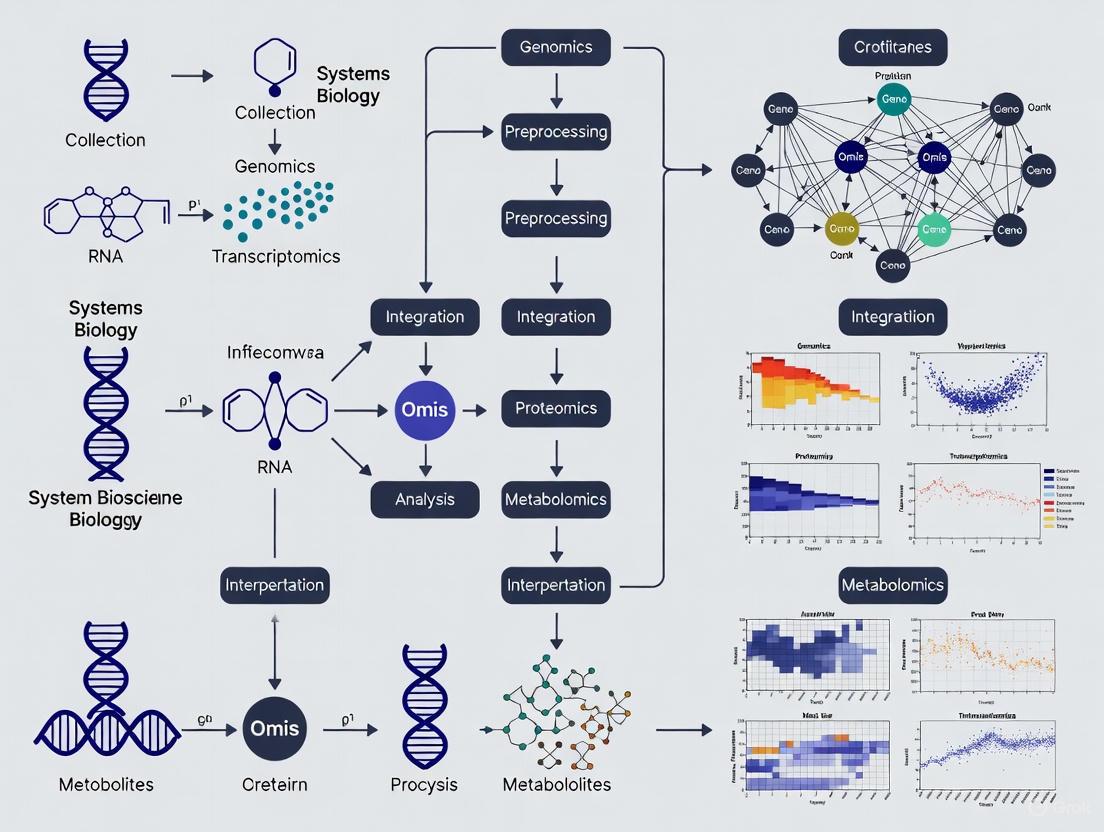
The integration of multi-omics data—encompassing genomics, transcriptomics, proteomics, and metabolomics—is revolutionizing biomedical research by providing a holistic view of biological systems.
Integrating Multi-Omics Data: Systems Biology Approaches for Unlocking Disease Mechanisms and Advancing Precision Medicine
Abstract
The integration of multi-omics data—encompassing genomics, transcriptomics, proteomics, and metabolomics—is revolutionizing biomedical research by providing a holistic view of biological systems. This article offers a comprehensive guide for researchers and drug development professionals on the foundational concepts, methodologies, and practical applications of systems biology for multi-omics data integration. We explore the significant challenges of data heterogeneity and high-dimensionality, review state-of-the-art computational methods from classical statistics to deep learning, and provide actionable strategies for troubleshooting and optimization. Through real-world case studies and comparative analysis of tools and validation techniques, this article demonstrates how effective multi-omics integration is pivotal for uncovering complex disease mechanisms, identifying robust biomarkers, and accelerating the development of targeted therapies and personalized treatment strategies.
The Multi-Omics Landscape: Core Concepts, Data Types, and Integration Challenges in Systems Biology
Multi-omics represents the integrative analysis of multiple omics technologies to gain a comprehensive understanding of biological systems and genotype-to-phenotype relationships [1]. This approach combines various molecular data layers—including genomics, transcriptomics, proteomics, epigenomics, and metabolomics—to construct holistic models of biological mechanisms that cannot be fully understood through single-omics studies alone [2] [3]. In the framework of systems biology, multi-omics integration provides unprecedented opportunities to elucidate complex molecular interactions associated with human diseases, particularly multifactorial conditions such as cancer, cardiovascular disorders, and neurodegenerative diseases [3]. The technological evolution and declining costs of high-throughput data generation have revolutionized biomedical research, enabling the collection of large-scale datasets across multiple biological layers and creating new requirements for specialized analytics that can capture the systemic properties of investigated conditions [2] [3].
Systems biology approaches multi-omics data integration through both knowledge-driven and data-driven strategies [4]. Knowledge-driven methods map molecular entities onto known biological pathways and networks, facilitating hypothesis generation within established knowledge domains. In contrast, data-driven strategies depend primarily on the datasets themselves, applying multivariate statistics and machine learning to identify patterns and relationships in a more unbiased manner [4]. The virtual space of translational research serves as the confluence point where biological findings are investigated for clinical applications, and medical needs directly guide specific biological experiments [2]. Within this space, systems bioinformatics has emerged as a crucial discipline that focuses on integrating information across different biological levels using both bottom-up approaches from systems biology and data-driven top-down approaches from bioinformatics [2].
Core Omics Technologies and Their Relationships
Defining the Omics Landscape
Omics technologies provide comprehensive, global assessments of biological molecules within an organism or environmental sample [1]. Each omics layer captures a distinct aspect of biological organization and function, together forming a multi-level information flow that systems biology seeks to integrate.
- Genomics: The study of an organism's complete set of DNA, including both coding and non-coding regions, and how different genes interact with each other and with the environment [1]. Genomics establishes the fundamental genetic template that influences all downstream molecular processes.
- Epigenomics: The study of chemical compounds and proteins that attach to DNA and modify gene expression without altering the DNA sequence itself [1]. Epigenomic modifications include DNA methylation and histone modifications, which serve as regulatory mechanisms that influence cellular phenotype.
- Transcriptomics: The study of the complete set of RNA transcripts (the transcriptome) produced by the genome at a specific time [1]. Transcriptomics reveals which genes are actively being expressed and provides insights into regulatory mechanisms operating at the RNA level.
- Proteomics: The study of the structure, function, composition, and interactions of the complete set of proteins (the proteome) present in a biological system at a certain time [1] [5]. Proteomics bridges the information flow from genes to functional effectors.
- Metabolomics: The study of all metabolites present in a biological system, particularly in relation to genetic and environmental influences [1]. Metabolomics provides the closest link to phenotypic expression, capturing the functional outputs of cellular processes.
Table 1: Core Omics Technologies in Multi-Omics Research
| Omics Type | Molecule Class Studied | Key Technologies | Biological Information Provided |
|---|---|---|---|
| Genomics | DNA | NGS, WGS, SNP arrays | Genetic blueprint, variants, polymorphisms |
| Epigenomics | DNA modifications | ChIP-seq, bisulfite sequencing | Gene regulation, chromatin organization |
| Transcriptomics | RNA | RNA-seq, microarrays | Gene expression, alternative splicing |
| Proteomics | Proteins | MS, protein arrays | Protein abundance, post-translational modifications |
| Metabolomics | Metabolites | GC/MS, LC/MS, NMR | Metabolic fluxes, pathway activities |
Biological Relationships Between Omics Layers
The relationship between different omics layers is complex and bidirectional, with each layer capable of influencing others through multiple regulatory mechanisms [1]. Genomics provides the foundational template, but transcriptomics, proteomics, and metabolomics capture dynamic molecular responses to genetic and environmental influences. Epigenomic modifications serve as intermediary regulatory mechanisms that modulate information flow from genome to transcriptome. The proteome represents the functional effector layer, while the metabolome provides the most immediate reflection of phenotypic status, positioned downstream in the biological information flow but capable of exerting feedback regulation on upstream processes.
Biological Information Flow in Multi-Omics - This diagram illustrates the complex bidirectional relationships between different omics layers, showing both forward information flow and feedback regulatory mechanisms.
Computational Methods for Multi-Omics Data Integration
Integration Strategies and Methodologies
The integration of multi-omics data presents significant computational challenges due to high dimensionality, heterogeneity, and technical variations across platforms [2] [3]. Computational methods for multi-omics integration can be broadly categorized based on their approach to handling multiple data layers and the scientific objectives they aim to address.
- Early Integration: Combines raw data matrices from different omics layers before analysis, requiring extensive normalization to address technical variations. This approach can capture complex interactions but may be confounded by platform-specific biases [6].
- Intermediate Integration: Employs methods that learn joint representations of separate datasets that can be used for subsequent analysis tasks. This includes dimensionality reduction techniques that extract latent factors representing shared variations across omics layers [2].
- Late Integration: Analyzes each omics dataset separately and combines the results at the decision level. While more robust to technical variations, this approach may miss subtle cross-omics interactions [6].
- Network-Based Integration: Constructs molecular networks where nodes represent biological entities and edges represent functional relationships. Network approaches provide a holistic view of relationships among biological components in health and disease [3].
Table 2: Computational Methods for Multi-Omics Integration
| Integration Type | Key Methods | Advantages | Limitations |
|---|---|---|---|
| Early Integration | Concatenation, Multi-block Analysis | Captures cross-omics interactions | Sensitive to technical noise and missing data |
| Intermediate Integration | MOFA, iCluster, SMFA | Learns robust joint representations | Complex parameter optimization |
| Late Integration | Ensemble Methods, Classifier Fusion | Robust to platform differences | May miss subtle cross-omics relationships |
| Network-Based Integration | Graph Convolutional Networks | Models biological context | Dependent on prior knowledge quality |
Advanced Integration Frameworks
Recent advances in multi-omics integration have introduced sophisticated frameworks designed to capture complex relationships within and between omics layers. SynOmics represents a cutting-edge graph convolutional network framework that improves multi-omics integration by constructing omics networks in the feature space and modeling both within- and cross-omics dependencies [6]. Unlike traditional approaches that rely on early or late integration strategies, SynOmics adopts a parallel learning strategy to process feature-level interactions at each layer of the model, enabling simultaneous learning of intra-omics and inter-omics relationships [6].
The OmicsAnalyst platform provides a user-friendly web-based implementation of various data-driven integration approaches, organized into three visual analytics tracks: correlation network analysis, cluster heatmap analysis, and dimension reduction analysis [4]. This platform lowers the access barriers to well-established methods for multi-omics integration through novel visual analytics, making sophisticated integration techniques accessible to researchers without extensive computational backgrounds [4].
Multi-Omics Data Integration Framework - This diagram illustrates the main computational strategies for integrating multi-omics data and their relationships to key research outputs.
Experimental Design and Workflow for Multi-Omics Studies
Multi-Omics Study Design Considerations
Designing robust multi-omics studies requires careful consideration of several factors to ensure biological relevance and technical feasibility. The selection of omics combinations should be guided by the scientific objectives and biological questions under investigation [2]. Studies aiming to understand regulatory processes may prioritize genomics, epigenomics, and transcriptomics, while investigations of functional phenotypes might emphasize transcriptomics, proteomics, and metabolomics. Sample collection strategies must account for the specific requirements of different omics technologies, including sample preservation methods, storage conditions, and input material requirements [2]. Experimental protocols should incorporate appropriate controls and replication strategies to address technical variability while maximizing biological insights within budget constraints.
Based on analysis of recent multi-omics studies, five key scientific objectives have been identified that particularly benefit from multi-omics approaches: (i) detection of disease-associated molecular patterns, (ii) subtype identification, (iii) diagnosis/prognosis, (iv) drug response prediction, and (v) understanding regulatory processes [2]. Each objective may require different combinations of omics types and computational approaches for optimal results. For instance, cancer subtyping frequently combines genomics, transcriptomics, and epigenomics to identify molecular subtypes with clinical relevance, while drug response prediction may integrate genomics with proteomics and metabolomics to capture both genetic determinants and functional states influencing treatment outcomes [2].
Data Processing and Quality Control Workflow
The analytical workflow for multi-omics data requires meticulous attention to data quality, normalization, and batch effect correction. The OmicsAnalyst platform implements a comprehensive data processing pipeline including data upload and annotation, missing value estimation, data filtering, identification of significant features, quality checking, and normalization/scaling [4]. Specific considerations for each step include:
- Missing Value Estimation: Features with excessive missing values may be excluded, or missing values may be estimated using established imputation methods appropriate for the specific omics data type [4].
- Data Filtering: Non-specific filtering based on variance measures (e.g., inter-quantile ranges) or abundance levels reduces dimensionality by excluding uninformative features while preserving biological signal [4].
- Normalization and Scaling: Different omics data types require specific normalization approaches to address technical variations and make datasets more "integrable" by sharing similar distributions [4].
- Quality Assessment: Visual assessment through density plots, PCA plots, and t-SNE plots helps identify batch effects, outliers, and other technical artifacts that might confound integration [4].
Multi-Omics Experimental Workflow - This diagram outlines the key stages in a comprehensive multi-omics study, from sample collection to biological interpretation and clinical translation.
Visualization and Interpretation of Multi-Omics Data
Visual Analytics Strategies
Effective visualization is crucial for interpreting complex multi-omics datasets and extracting meaningful biological insights. The PTools Cellular Overview implements a sophisticated multi-omics visualization approach that enables simultaneous visualization of up to four types of omics data on organism-scale metabolic network diagrams [7]. This tool uses different "visual channels" to represent distinct omics datasets—for example, displaying transcriptomics data as reaction arrow colors, proteomics data as reaction arrow thicknesses, and metabolomics data as metabolite node colors or thicknesses [7]. This coordinated multi-channel visualization facilitates direct comparison of different molecular measurements within their biological context.
OmicsAnalyst organizes visual analytics into three complementary tracks: correlation network analysis, cluster heatmap analysis, and dimension reduction analysis [4]. The correlation network analysis track identifies and visualizes relationships between key features from different omics datasets, offering both univariate methods (e.g., Pearson correlation) and multivariate methods (e.g., partial correlation) to compute pairwise similarities while controlling for potential confounding effects [4]. The cluster heatmap analysis track implements multi-view clustering algorithms including spectral clustering, perturbation-based clustering, and similarity network fusion to identify sample subgroups based on integrated molecular profiles [4]. The dimension reduction analysis track applies multivariate techniques to reveal global data structures, allowing exploration of scores, loadings, and biplots in interactive 3D scatter plots [4].
Advanced Visualization Techniques
Advanced visualization tools incorporate features such as semantic zooming, animation, and interactive data exploration to address the complexity of multi-omics data. Semantic zooming adjusts the level of detail displayed based on zoom level, showing pathway overviews at low magnification and detailed molecular information when zoomed in [7]. Animation capabilities enable visualization of time-course data, allowing researchers to observe dynamic changes in molecular profiles across experimental conditions or disease progression [7]. Interactive features include the ability to adjust color and thickness mappings to optimize information display and the generation of pop-up graphs showing detailed data values for specific molecular entities [7].
Network-based visualization approaches have proven particularly valuable for representing complex relationships in multi-omics data. These approaches employ edge bundling to aggregate similar connections, concentric circular layouts to evaluate focal nodes and hierarchical relationships, and 3D network visualization for deeper perspective on feature relationships [4]. When biological features are properly annotated during data processing, these visualization systems can perform enrichment analysis on selected node groups to identify overrepresented biological pathways, either through manual selection or automatic module detection algorithms [4].
Applications in Translational Medicine and Complex Diseases
Disease Subtyping and Biomarker Discovery
Multi-omics approaches have demonstrated particular value in identifying molecular subtypes of complex diseases that may appear homogeneous clinically but exhibit distinct molecular characteristics with implications for prognosis and treatment selection. Cancer research has extensively leveraged multi-omics stratification, combining genomic, transcriptomic, epigenomic, and proteomic data to define molecular subtypes with distinct clinical outcomes and therapeutic vulnerabilities [2]. Beyond oncology, multi-omics subtyping has been applied to neurological disorders, autoimmune conditions, and metabolic diseases, revealing pathogenic heterogeneity that informs targeted intervention strategies [3].
Biomarker discovery represents another major application area where multi-omics integration provides significant advantages over single-omics approaches. By combining information across molecular layers, multi-omics analyses can identify biomarker panels with improved sensitivity and specificity for early disease detection, prognosis prediction, and treatment response monitoring [3]. Integrated analysis of genomics and metabolomics has uncovered genetic regulators of metabolic pathways that serve as biomarkers for disease risk, while combined transcriptomics and proteomics has revealed post-transcriptional regulatory mechanisms that influence therapeutic efficacy [2] [3].
Drug Response Prediction and Therapeutic Development
Understanding the molecular determinants of drug response is a crucial application of multi-omics integration in pharmaceutical research and development. Multi-omics profiling of model systems and patient samples has identified molecular features at multiple biological levels that influence drug sensitivity and resistance mechanisms [2]. Genomics reveals inherited genetic variants affecting drug metabolism and target structure, transcriptomics captures expression states of drug targets and resistance mechanisms, proteomics characterizes functional protein abundances and modifications直接影响 drug interactions, and metabolomics profiles the metabolic context that influences drug efficacy and toxicity [2] [3].
The integration of multi-omics data has enabled the development of more predictive models of drug response through machine learning approaches that incorporate diverse molecular features. For example, the SynOmics framework has demonstrated superior performance in predicting cancer drug responses by capturing both within-omics and cross-omics dependencies through graph convolutional networks [6]. These integrated models facilitate the identification of patient subgroups most likely to benefit from specific treatments, supporting precision medicine approaches that match therapies to individual molecular profiles [6].
Multi-Omics Data Repositories
The expansion of multi-omics research has been accompanied by the development of specialized data repositories that provide curated access to integrated multi-omics datasets. These resources support method development, meta-analysis, and secondary research applications that leverage existing data to generate new biological insights.
Table 3: Multi-Omics Data Resources and Repositories
| Resource Name | Omics Content | Species | Primary Focus |
|---|---|---|---|
| The Cancer Genome Atlas (TCGA) | Genomics, epigenomics, transcriptomics, proteomics | Human | Pan-cancer atlas |
| Answer ALS | Whole-genome sequencing, RNA transcriptomics, ATAC-sequencing, proteomics | Human | Neurodegenerative disease |
| Fibromine | Transcriptomics, proteomics | Human/Mouse | Fibrosis research |
| DevOmics | Gene expression, DNA methylation, histone modifications, chromatin accessibility | Human/Mouse | Developmental biology |
| jMorp | Genomics, methylomics, transcriptomics, metabolomics | Human | Population diversity |
Essential Computational Tools and Reagents
Successful multi-omics studies require both computational tools for data analysis and experimental reagents for data generation. The selection of appropriate tools and reagents should be guided by the specific research objectives, omics technologies employed, and analytical approaches planned.
Table 4: Research Reagent Solutions for Multi-Omics Studies
| Category | Specific Tools/Reagents | Function | Application Notes |
|---|---|---|---|
| Sequencing Reagents | NGS library prep kits | Nucleic acid library construction | Platform-specific protocols required |
| Mass Spectrometry Reagents | Proteomics sample prep kits | Protein extraction, digestion, labeling | Compatibility with LC-MS systems |
| Metabolomics Standards | Reference metabolite libraries | Metabolite identification | Retention time indexing crucial |
| Epigenomics Reagents | Antibodies for ChIP-seq | Target-specific chromatin immunoprecipitation | Validation of antibody specificity essential |
| Multi-omics Integration Tools | OmicsAnalyst, SynOmics, PTools | Data integration and visualization | Method selection depends on study objectives |
Future Directions in Multi-Omics Research
Emerging Technologies and Approaches
The field of multi-omics research continues to evolve rapidly, with several emerging technologies poised to expand capabilities for biological discovery. Single-cell multi-omics technologies enable researchers to study molecular relationships at the finest resolution possible, identifying rare cell types and cell-to-cell variations that may be obscured in bulk tissue analyses [1]. Since single-cell DNA and RNA sequencing were named "2013 Method of the Year" by Nature, these approaches have made important contributions to understanding biology and disease mechanisms, and their integration with other single-cell omics measurements will provide unprecedented resolution of cellular heterogeneity [1].
Spatial multi-omics represents another frontier, preserving and analyzing the spatial context of molecular measurements within tissues and biological structures [1]. Just as single omics techniques cannot provide a complete picture of biological mechanisms, single-cell analyses are necessarily limited without spatial context. Spatial transcriptomics has already revealed tumor microenvironment-specific characteristics that affect treatment responses, and the combination of multiple spatial omics approaches has an important future in scientific research [1]. These technologies bridge the gap between molecular profiling and tissue morphology, enabling direct correlation of multi-omics signatures with histological features and tissue organization.
Computational Innovations and Challenges
As multi-omics technologies advance, computational methods must evolve to address new challenges in data integration, interpretation, and visualization. Future computational developments will need to handle increasingly large and complex datasets generated by single-cell and spatial technologies, requiring scalable algorithms and efficient computational frameworks [7]. Methods for temporal integration of multi-omics data will need to mature, capturing dynamic relationships across biological processes, disease progression, and therapeutic interventions [7].
Explainability and interpretability represent crucial considerations for the next generation of multi-omics computational tools. As integration methods incorporate more complex machine learning and artificial intelligence approaches, ensuring that results remain interpretable and biologically meaningful will be essential for translational applications [2]. The development of multi-omics data visualization tools that effectively represent high-dimensional data in intuitively understandable formats will continue to be a priority, lowering barriers for researchers to extract insights from complex integrated datasets [4] [7]. These advances will collectively support the ongoing transformation of multi-omics integration from a specialized methodology to a routine approach for comprehensive biological investigation and precision medicine applications.
Complex diseases such as cancer, neurodegenerative disorders, and COVID-19 are driven by multifaceted interactions across genomic, transcriptomic, proteomic, and metabolomic layers. Traditional single-omics approaches, which analyze one molecular layer in isolation, are fundamentally inadequate for deciphering this complexity. They provide a fragmented view, failing to capture the causal relationships and emergent properties that arise from cross-layer interactions. This whitepaper delineates the technical limitations of single-omics analyses and articulates the imperative for multi-omics integration through systems biology. By synthesizing current methodologies, showcasing a detailed COVID-19 case study, and providing a practical toolkit for researchers, we underscore that only an integrated approach can unravel disease mechanisms and accelerate therapeutic discovery.
Biological systems are inherently multi-layered, where complex phenotypes emerge from dynamic interactions between an organism's genome, transcriptome, proteome, and metabolome [8]. Single-omics technologies—genomics, transcriptomics, proteomics, or metabolomics conducted in isolation—offer a valuable but ultimately myopic view of this intricate network. While they can identify correlations between molecular changes and disease states, they cannot elucidate underlying causal mechanisms [8]. For instance, a mutation identified in the genome may not predict its functional impact on protein activity or metabolic flux, and a change in RNA expression often correlates poorly with the abundance of its corresponding protein due to post-transcriptional regulation [8] [3].
The study of complex, multifactorial diseases like cancer, Alzheimer's, and COVID-19 exposes these shortcomings most acutely. These conditions are not orchestrated by a single genetic defect but arise from dysregulated interactions across molecular networks, influenced by genetic background, environmental factors, and epigenetic regulation [8] [9]. Relying on a single-omics approach is akin to trying to understand a symphony by listening to only one instrument; critical context and harmony are lost. As a result, single-omics studies often generate long lists of candidate biomarkers with limited clinical utility, as they lack the systems-level context to distinguish true drivers from passive correlates [8] [9]. The path forward requires a paradigm shift from a reductionist, single-layer analysis to a holistic, systems biology framework that integrates multiple omics layers to construct a more complete and predictive model of health and disease.
Deconstructing the Omics Layers: Strengths and Limitations
To appreciate the necessity of integration, one must first understand the unique yet incomplete perspective offered by each individual omics layer. The following table summarizes the core components, technologies, and inherent limitations of four major omics fields.
Table 1: Key Omics Technologies and Their Individual Limitations in Disease Research
| Omics Layer | Core Components Analyzed | Common Technologies | Key Limitations in Isolation |
|---|---|---|---|
| Genomics | DNA sequences, structural variants, single nucleotide polymorphisms (SNPs) | Whole-genome sequencing, Exome sequencing, GWAS [8] | Cannot predict functional consequences on gene expression or protein function; most variants have no direct biological relevance [8]. |
| Transcriptomics | Protein-coding mRNAs, non-coding RNAs (lncRNAs, microRNAs, circular RNAs) | RNA-seq, single-cell RNA-seq (scRNA-seq) [8] [10] | mRNA levels often poorly correlate with protein abundance due to post-transcriptional controls; provides no data on protein activity or modification [8] [10]. |
| Proteomics | Proteins and their post-translational modifications (phosphorylation, glycosylation) | Mass spectrometry (label-free and labeled), affinity proteomics, protein chips [8] | Misses upstream regulatory events (e.g., genetic mutations, transcriptional bursts); technically challenging to detect low-abundance proteins [8]. |
| Metabolomics | Small molecule metabolites (carbohydrates, lipids, amino acids) | Mass spectrometry (MALDI, SIMS, LAESI) [8] [10] | Provides a snapshot of cellular phenotype but is several steps removed from initial genetic and transcriptional triggers [8]. |
The Multi-Omics Integration Paradigm: Methods and Workflows
Multi-omics integration synthesizes data from the layers described in Table 1 to create a unified model of biological systems. The integration workflow can be conceptualized as a multi-stage process, from experimental design to computational analysis, with the choice of method depending on the specific biological question.
Data Integration Approaches
Computational integration methods are broadly categorized based on how they handle the disparate data types.
- Correlation-based and Network-based Integration: This approach identifies statistical relationships between different molecular entities (e.g., an mRNA and its protein) and maps them into a comprehensive network. This network can then be analyzed to find hub nodes (highly connected molecules) and driver nodes (molecules that exert significant control over the network state), which are prime candidates for biomarkers or therapeutic targets [3] [9].
- Machine Learning and Deep Learning: These methods are powerful for handling the high-dimensionality and heterogeneity of multi-omics data. Deep generative models, like variational autoencoders (VAEs), are particularly adept at learning a unified representation of data from different omics layers, performing data imputation, and identifying complex, non-linear patterns that are invisible to classical statistics [11].
Workflow for a Single-Cell Multi-Omics Experiment
The advent of single-cell technologies has added a crucial dimension, allowing integration to be performed while accounting for cellular heterogeneity. A typical high-resolution workflow is outlined below.
Diagram 1: Single-Cell Multi-Omics Workflow.
- Single-Cell Isolation: Cells are separated from a tissue sample using methods like fluorescence-activated cell sorting (FACS) or microfluidic technologies (e.g., droplet-based 10X Genomics or image-based cellenONE platforms) [10] [12] [13].
- Cell Barcoding: Each individual cell is labeled with a unique molecular barcode during reverse transcription or amplification. This allows sequencing libraries from thousands of cells to be pooled and sequenced together, with the barcode used to deconvolute the data back to individual cells post-sequencing [10] [13].
- Multi-Omics Library Preparation: specialized protocols are used to capture multiple modalities from the same cell. For example:
- Sequencing & Data Integration: Pooled libraries are sequenced on high-throughput platforms. The resulting data is integrated using the computational methods described above, allowing researchers to link, for example, open chromatin regions with gene expression changes in individual cell types.
Case Study: A Systems Biology Approach to COVID-19 Therapy
The global challenge of COVID-19 exemplifies the power of a multi-omics, systems biology approach for identifying therapeutic targets for a complex disease. A 2024 study published in Scientific Reports provides a compelling model [9].
Experimental Protocol and Workflow
The study followed a rigorous multi-stage protocol to move from a broad genetic association to specific drug combinations.
Table 2: Key Research Reagent Solutions for Multi-Omics and Network Analysis
| Reagent / Tool Category | Example(s) | Primary Function in the Workflow |
|---|---|---|
| Gene/Database Resources | CORMINE, DisGeNET, STRING, KEGG [9] | Provides curated, context-specific biological data for network construction and pathway analysis. |
| Omic Data Analysis Tools | Expression Data (GSE163151) [9] | Provides empirical molecular profiling data (e.g., transcriptomes) for validation of computational predictions. |
| Network Controllability Algorithms | Target Controllability Algorithm [9] | Identifies a minimal set of "driver" nodes (genes/proteins) that can steer a biological network from a diseased to a healthy state. |
| Drug-Gene Interaction Databases | Drug-Gene Interaction Data [9] | Maps identified driver genes to existing pharmaceutical compounds, enabling drug repurposing strategies. |
- Data Collection and Network Construction: The researchers first aggregated 757 genes highly associated with COVID-19 from public databases (CORMINE and DisGeNET). A protein-protein interaction (PPI) network was built from these genes using the STRING database to identify highly connected hub genes (e.g., IL6, TNF) [9].
- Network Controllability Analysis: The directed network of COVID-19 signaling pathways was obtained from KEGG. Using a target controllability algorithm, the study identified a small set of driver genes capable of influencing the entire disease-associated network. IL6 was notably among the top drivers, validating its known role [9].
- Transcriptomic Validation: Analysis of gene expression data (GEO: GSE163151) confirmed that the identified hub and driver genes were differentially expressed between COVID-19 patients and controls. Furthermore, the co-expression patterns among these genes were significantly altered in the disease state, indicating a fundamental rewiring of regulatory networks [9].
- Drug-Gene Network Construction: Finally, the researchers constructed a bipartite network mapping existing drugs to the identified hub and driver genes. This systems-level analysis revealed combinations of drugs that could collectively target the core network regulators, presenting a powerful strategy for designing combination therapies and repurposing existing drugs [9].
Logical Workflow of the COVID-19 Case Study
The following diagram summarizes the logical flow of the case study, from data integration to clinical insight.
Diagram 2: Systems Biology Workflow for COVID-19.
The Scientist's Toolkit for Multi-Omics Research
Transitioning from single-omics to integrated research requires a new set of conceptual and practical tools. This toolkit encompasses experimental technologies, computational methods, and data resources.
Key Computational Methods for Data Integration
The table below categorizes and describes prominent computational approaches for multi-omics integration, which are critical for extracting biological meaning from complex datasets.
Table 3: Categories of Computational Methods for Multi-Omics Integration
| Method Category | Core Principle | Example Applications |
|---|---|---|
| Network-Based | Constructs graphs where nodes are biomolecules and edges are interactions. Importance is inferred from network topology (e.g., centrality, controllability) [3] [9]. | Identifying key regulator and driver genes in COVID-19 PPI and signaling networks [9]. |
| Deep Generative Models | Uses models like Variational Autoencoders (VAEs) to learn a compressed, joint representation of multiple omics datasets, enabling data imputation and pattern discovery [11]. | Integrating genomics, transcriptomics, and proteomics to identify novel molecular subtypes of cancer [11]. |
| Similarity-Based | Integrates datasets by finding a common latent space or by fusing similarity networks built from each omics type. | Clustering patients into integrative subtypes for precision oncology [3]. |
Navigating the Throughput vs. Accuracy Trade-Off in Single-Cell Analysis
A key practical consideration in experimental design is the choice of single-cell technology, which often involves a trade-off between the scale of data generation and the quality and specificity of the data.
- High-Throughput Technologies (e.g., 10X Genomics, BD Rhapsody): These droplet- or microwell-based systems can process tens of thousands of cells per run, making them ideal for large-scale atlas projects like the Human Cell Atlas [10] [12]. However, they have a higher risk of multiplets (droplets with more than one cell), lower sensitivity leading to gene dropout, and require large input cell numbers, which can be unsuitable for rare or delicate cell samples [12].
- High-Accuracy Technologies (e.g., cellenONE, C.SIGHT): These image-based, automated single-cell dispensers offer gentle cell handling, near-perfect single-cell accuracy, and the ability to select cells based on morphology or fluorescence. This makes them superior for studying rare cells (e.g., circulating tumor cells) or for complex, customized workflows like integrated single-cell proteomics and transcriptomics (e.g., nanoSPLITS) [12]. Their main limitation is lower throughput, processing hundreds to thousands of individually selected cells.
The evidence is clear: single-omics approaches are insufficient for unraveling the complex, interconnected mechanisms of human disease. They provide a static, fragmented view that cannot explain the dynamic, cross-layer interactions that define pathological states. The future of biomedical research lies in the systematic integration of multi-omics data within a systems biology framework. This paradigm shift, powered by advanced computational methods and high-resolution single-cell and spatial technologies, is transforming our ability to identify robust biomarkers, stratify patients based on molecular drivers, and discover effective combination therapies. For researchers and drug development professionals, embracing this integrative imperative is no longer an option but a necessity for achieving meaningful progress against complex diseases.
Multi-omics data integration represents a cornerstone of modern systems biology, providing an unprecedented opportunity to understand complex biological systems through the combined lens of genomics, transcriptomics, proteomics, and metabolomics. This approach enables researchers to move beyond single-layer analyses to capture a more holistic view of the intricate interactions and dynamics within an organism [14]. The fundamental premise of systems biology is that cross-talk between multiple molecular layers cannot be properly assessed by analyzing each omics layer in isolation [15]. Instead, integrating data from different omics levels offers the potential to significantly improve our understanding of their interrelation and combined influence on health and disease [15]. However, the path to meaningful integration is fraught with substantial challenges related to data heterogeneity, high-dimensionality, and technical noise that must be systematically addressed to realize the full potential of multi-omics research.
Data Heterogeneity: The Multi-Source Integration Problem
Data heterogeneity in multi-omics studies arises from the fundamentally different nature of various molecular measurements, creating significant barriers to seamless integration.
The heterogeneous nature of multi-omics data stems from multiple factors. Each omics technology generates data with distinct statistical distributions, noise profiles, and measurement characteristics [16]. For instance, transcriptomics and proteomics are increasingly quantitative, but the applicability and precision of quantification strategies vary considerably—from absolute to relative quantification [15]. This heterogeneity is further compounded by differences in sample requirements; the preferred collection methods, storage techniques, and required biomass for genomics studies are often incompatible with metabolomics, proteomics, or transcriptomics [15].
Sample matrix incompatibility represents another critical challenge. Biological samples optimal for one omics type may be unsuitable for others. For example, urine serves as an excellent bio-fluid for metabolomics studies but contains limited proteins, RNA, and DNA, making it suboptimal for proteomics, transcriptomics, and genomics [15]. Conversely, blood, plasma, or tissues provide more versatile matrices for generating multi-omics data but require rapid processing and cryopreservation to prevent degradation of unstable molecules like RNA and metabolites [15].
Table 1: Types of Multi-Omics Data Integration Approaches
| Integration Type | Data Characteristics | Key Challenges | Common Methods |
|---|---|---|---|
| Matched (Vertical Integration) | Multi-omics profiles from same samples | Sample compatibility, processing speed | MOFA, DIABLO |
| Unmatched (Diagonal Integration) | Data from different samples/studies | Cross-study variability, batch effects | SNF, MNN-correct |
| Temporal | Time-series multi-omics data | Temporal alignment, dynamics modeling | Dynamic Baysian networks |
| Spatial | Spatially-resolved omics data | Spatial registration, resolution matching | SpatialDE, novoSpaRc |
Experimental Design Solutions
Addressing data heterogeneity begins at the experimental design stage. A successful systems biology experiment requires careful consideration of samples, controls, external variables, biomass requirements, and replication strategies [15]. Ideally, multi-omics data should be generated from the same set of samples to enable direct comparison under identical conditions, though this is not always feasible due to limitations in sample biomass, access, or financial resources [15].
Technical considerations extend to sample processing compatibility. Formalin-fixed paraffin-embedded (FFPE) tissues, while excellent for genomic studies, are problematic for transcriptomics and proteomics because formalin does not halt RNA degradation and induces protein cross-linking [15]. Similarly, paraffin interferes with mass spectrometry performance, affecting both proteomics and metabolomics assays [15]. Recognizing and accounting for these limitations during experimental design is crucial for mitigating their impact on data integration.
High-Dimensionality: Navigating the Curse of Dimensionality
The high-dimensional nature of multi-omics data presents both computational and analytical challenges that require specialized approaches for effective navigation.
The Dimensionality Challenge
Single-cell technologies exemplify the dimensionality problem, routinely profiling tens of thousands of genes across thousands of individual cells [17]. This high dimensionality, coupled with characteristic technical noise and high dropout levels (under-sampling of mRNA molecules), complicates the identification of meaningful biological patterns [17]. The "curse of dimensionality" manifests as an accumulation of technical noise that obfuscates the true data structure, making conventional analytical approaches insufficient [18].
Dimensionality reduction has become a cornerstone of modern single-cell analysis pipelines, but conventional methods often fail to capture full cellular diversity [17]. Principal Component Analysis (PCA), for instance, projects data to a lower-dimensional linear subspace that maximizes total variance of the projected data, while Independent Component Analysis (ICA) identifies non-Gaussian combinations of features [17]. However, both approaches optimize objective functions over entire datasets, causing rare cell populations—defined by genes that may be noisy or unexpressed over much of the data—to be overlooked [17].
Advanced Computational Solutions
Novel computational strategies are emerging to address the limitations of conventional dimensionality reduction techniques. Surprisal Component Analysis (SCA) represents an information-theoretic approach that leverages the concept of surprisal (where less probable events are more informative when they occur) to assign surprisal scores to each transcript in each cell [17]. By identifying axes that capture the most surprising variation, SCA enables dimensionality reduction that better preserves information from rare and subtly defined cell types [17].
The SCA methodology involves converting transcript counts into surprisal scores by comparing a gene's expression distribution among a cell's k-nearest neighbors to its global expression pattern [17]. A transcript whose local expression deviates strongly from its global expression receives a high surprisal score, quantified through a Wilcoxon rank-sum test p-value and transformed via negative logarithm conversion [17]. The resulting surprisal matrix undergoes singular value decomposition to identify surprisal components that form the basis for projection into a lower-dimensional space [17].
Table 2: Dimensionality Reduction Methods for Multi-Omics Data
| Method | Type | Key Principle | Advantages | Limitations |
|---|---|---|---|---|
| PCA | Linear | Maximizes variance of projected data | Computational efficiency, interpretability | Sensitive to outliers, misses rare populations |
| SCA | Linear | Maximizes surprisal/information content | Captures rare cell types, preserves subtle signals | Computationally intensive for large k |
| scVI | Non-linear | Variational inference with ZINB model | Handles count nature, probabilistic framework | Complex implementation, black-box nature |
| Diffusion Maps | Non-linear | Diffusion process on k-NN graph | Captures continuous trajectories | Sensitivity to neighborhood parameters |
| PHATE | Non-linear | Potential of heat diffusion for affinity | Visualizes branching trajectories | Computational cost for large datasets |
For broader multi-omics integration, methods like Multi-Omics Factor Analysis (MOFA) provide unsupervised factorization that infers latent factors capturing principal sources of variation across data types [16]. MOFA decomposes each datatype-specific matrix into a shared factor matrix and weight matrices within a Bayesian probabilistic framework that emphasizes relevant features and factors [16]. Similarly, Multiple Co-Inertia Analysis (MCIA) extends covariance optimization to simultaneously align multiple omics features onto the same scale, generating a shared dimensional space for integration and biological interpretation [16].
Technical Noise: Overcoming Data Quality Challenges
Technical noise represents a fundamental barrier to robust multi-omics integration, requiring sophisticated statistical approaches for effective mitigation.
Technical noise in omics data arises from multiple sources throughout the experimental workflow. In single-cell sequencing, technical noise manifests as non-biological fluctuations caused by non-uniform detection rates of molecules, commonly observed as dropout events where genuine transcripts fail to be detected [18]. This noise masks true cellular expression variability and complicates the identification of subtle biological signals, potentially obscuring critical phenomena such as tumor-suppressor events in cancer or cell-type-specific transcription factor activities [18].
Batch effects further compound technical challenges by introducing non-biological variability across datasets from different experimental conditions or sequencing platforms [18]. These effects distort comparative analyses and impede the consistency of biological insights across studies, particularly problematic in multi-omics research where integration of diverse data types is essential [18]. The simultaneous reduction of both technical noise and batch effects remains challenging because conventional batch correction methods typically rely on dimensionality reduction techniques like PCA, which themselves are insufficient to overcome the curse of dimensionality [18].
Integrated Noise Reduction Frameworks
Advanced computational frameworks are emerging to address the dual challenges of technical noise and batch effects. RECODE (Resolution of the Curse of Dimensionality) represents a high-dimensional statistics-based approach that models technical noise as a general probability distribution and reduces it using eigenvalue modification theory [18]. The algorithm maps gene expression data to an essential space using noise variance-stabilizing normalization and singular value decomposition, then applies principal-component variance modification and elimination [18].
The recently enhanced iRECODE platform integrates batch correction within this essential space, minimizing decreases in accuracy and computational cost by bypassing high-dimensional calculations [18]. This integrated approach enables simultaneous reduction of technical and batch noise while preserving data dimensions, maintaining distinct cell-type identities while improving cross-batch comparability [18]. Quantitative evaluations demonstrate iRECODE's effectiveness, with relative errors in mean expression values decreasing significantly from 11.1-14.3% to just 2.4-2.5% [18].
The utility of noise reduction extends beyond transcriptomics to diverse single-cell modalities. RECODE has demonstrated effectiveness in processing single-cell epigenomics data, including scATAC-seq and single-cell Hi-C, as well as spatial transcriptomics datasets [18]. For scHi-C data, RECODE considerably mitigates data sparsity, aligning scHi-C-derived topologically associating domains with their bulk Hi-C counterparts and enabling detection of differential interactions that define cell-specific interactions [18].
Integrated Methodologies for Multi-Omics Analysis
Successfully navigating the challenges of multi-omics data requires integrated methodologies that address heterogeneity, dimensionality, and noise in a coordinated framework.
Experimental Design and Workflow Integration
A robust multi-omics workflow begins with comprehensive experimental design that anticipates integration challenges. The first step involves capturing prior knowledge and formulating hypothesis-testing questions, followed by careful consideration of sample size, power calculations, and platform selection [15]. Researchers must determine which omics platforms will provide the most value, noting that not all platforms need to be accessed to constitute a systems biology study [15].
Sample collection, processing, and storage requirements must be factored into experimental design, as these variables directly impact the types of omics analyses possible. Logistical limitations that delay freezing, sample size restrictions, and initial handling procedures can all influence biomolecule profiles, particularly for metabolomics and transcriptomics studies [15]. Establishing standardized protocols for sample processing across omics types, while challenging, is essential for generating comparable data.
Computational Integration Frameworks
Several computational frameworks have been developed specifically for multi-omics integration, each with distinct strengths and applications. Similarity Network Fusion (SNF) avoids merging raw measurements directly, instead constructing sample-similarity networks for each omics dataset where nodes represent samples and edges encode inter-sample similarities [16]. These datatype-specific matrices are fused via non-linear processes to generate a composite network capturing complementary information from all omics layers [16].
DIABLO (Data Integration Analysis for Biomarker discovery using Latent Components) takes a supervised approach, using known phenotype labels to guide integration and feature selection [16]. The algorithm identifies latent components as linear combinations of original features, searching for shared latent components across omics datasets that capture common sources of variation relevant to the phenotype of interest [16]. Feature selection is achieved using penalization techniques like Lasso to ensure only the most relevant features are retained [16].
Table 3: Multi-Omics Integration Methods and Applications
| Method | Integration Type | Statistical Approach | Best Suited Applications |
|---|---|---|---|
| MOFA | Unsupervised | Bayesian factorization | Exploratory analysis, latent pattern discovery |
| DIABLO | Supervised | Multiblock sPLS-DA | Biomarker discovery, classification tasks |
| SNF | Similarity-based | Network fusion | Subtype identification, cross-platform integration |
| MCIA | Correlation-based | Covariance optimization | Coordinated variation analysis, cross-dataset comparison |
| iRECODE | Noise reduction | High-dimensional statistics | Data quality enhancement, pre-processing |
For metabolic-focused studies, Genome-scale Metabolic Models (GEMs) serve as computational scaffolds for integrating multi-omics data to identify signatures of dysregulated metabolism [19]. These models enable the prediction of metabolic fluxes through linear programming approaches like flux balance analysis (FBA), and can be tailored to specific tissues or disease states [19]. Personalized GEMs have shown promise in guiding treatments for individual tumors, identifying dysregulated metabolites that can be targeted with anti-metabolites functioning as competitive inhibitors [19].
Successful navigation of multi-omics challenges requires both wet-lab and computational resources designed to address specific integration hurdles.
Table 4: Essential Research Reagents and Computational Resources
| Resource Category | Specific Tools/Reagents | Function/Purpose | Key Considerations |
|---|---|---|---|
| Sample Preparation | FAA-approved transport solutions | Cryopreserved sample transport | Maintains biomolecule integrity during transit |
| Sequencing Technologies | 10x Genomics, Smart-seq, Drop-seq | Single-cell transcriptomics | Protocol compatibility with downstream omics |
| Proteomics Platforms | SWATH-MS, UPLC-MS | Quantitative proteomics | Quantitative precision, coverage depth |
| Metabolomics Platforms | UPLC-MS, GC-MS | Metabolite profiling | Sample stability, extraction efficiency |
| Computational Tools | RECODE/iRECODE, SCA, MOFA, DIABLO | Noise reduction, dimensionality reduction, integration | Data type compatibility, computational requirements |
| Bioinformatics Platforms | Omics Playground, KEGG, Reactome | Integrated analysis, pathway mapping | User accessibility, visualization capabilities |
Navigating data heterogeneity, high-dimensionality, and technical noise represents a formidable challenge in multi-omics research, but continued methodological advancements provide powerful solutions. By addressing these challenges through integrated experimental design, sophisticated computational frameworks, and specialized analytical tools, researchers can unlock the full potential of multi-omics data integration. The convergence of information-theoretic dimensionality reduction approaches like SCA, comprehensive noise reduction platforms like iRECODE, and flexible integration methods like MOFA and DIABLO provides an increasingly robust toolkit for extracting meaningful biological insights from complex multi-omics datasets. As these methodologies continue to evolve and mature, they promise to advance our understanding of complex biological systems and accelerate the development of precision medicine approaches grounded in comprehensive molecular profiling.
The advent of high-throughput technologies has generated ever-growing volumes of biological data across multiple molecular layers, including genomics, transcriptomics, proteomics, and metabolomics [20]. While single-omics studies have provided valuable insights, they offer an overly simplistic view of complex biological systems where different layers interact dynamically [20]. Multi-omics integration emerges as a necessary approach to capture the entire complexity of biological systems and draw a more complete picture of phenotypic outcomes [20] [15]. The convergence of medical imaging and multi-omics data has further accelerated the development of multimodal artificial intelligence (AI) approaches that leverage complementary strengths of each modality for enhanced disease characterization [21].
Within systems biology, integration strategies for these heterogeneous datasets are broadly classified into early, intermediate, and late fusion paradigms, each with distinct methodological principles and applications [20] [22] [21]. These computational frameworks address the significant challenges posed by high-dimensionality, heterogeneity, and noise inherent in multi-omics datasets [20] [3]. This technical guide examines these core integration paradigms, their computational architectures, and their implementation within systems biology research for drug development and precision medicine.
Core Integration Paradigms
Conceptual Frameworks and Definitions
Multi-omics integration strategies can be categorized into distinct paradigms based on the stage at which data fusion occurs in the analytical pipeline. The nomenclature for these integration strategies varies across literature, with some sources using "fusion" terminology particularly in medical imaging contexts [21], while others refer more broadly to "integration" approaches [20]. This guide adopts a unified classification system encompassing three primary paradigms.
Early Integration (also called early fusion or concatenation-based integration) combines all omics datasets into a single matrix before analysis [20]. All features from different omics platforms are merged at the input level, creating a unified feature space that is then processed using machine learning models [20] [21].
Intermediate Integration (including mixed and intermediate fusion) employs joint dimensionality reduction or transformation techniques to find a common representation of the data [20] [22]. Unlike early integration, intermediate approaches maintain some separation between omics layers during the transformation process, either by independently transforming each omics block before combination or simultaneously transforming original datasets into common and omics-specific representations [20].
Late Integration (also called late fusion or model-based integration) analyzes each omics dataset separately and combines their final predictions or representations at the decision level [20] [21]. This modular approach allows specialized processing for each data type before aggregating outcomes.
Table 1: Comparative Analysis of Multi-Omics Integration Paradigms
| Integration Paradigm | Data Fusion Stage | Key Characteristics | Representative Algorithms |
|---|---|---|---|
| Early Integration | Input/feature level | Concatenates raw or preprocessed features; leverages cross-omics correlations; prone to curse of dimensionality | PCA on concatenated matrices; Random Forests; Support Vector Machines |
| Intermediate Integration | Transformation/learning level | Joint dimensionality reduction; preserves omics-specific patterns while learning shared representations; balances specificity and integration | MOFA+; iCluster; Pattern Fusion Analysis; Deep learning autoencoders |
| Late Integration | Output/decision level | Separate modeling for each omics; combines predictions; robust to missing data; preserves modality-specific processing | Weighted voting; Stacked generalization; Ensemble methods; Majority voting |
Expanded Classification Frameworks
Some systematic reviews further refine these categories to encompass five distinct integration strategies, expanding the three primary paradigms to address specific analytical needs [20]:
- Early Integration: Direct concatenation of omics datasets into a single matrix
- Mixed Integration: Independent transformation of each omics dataset before combination
- Intermediate Integration: Simultaneous transformation into common and omics-specific representations
- Late Integration: Separate analysis with combination of final predictions
- Hierarchical Integration: Integration based on known regulatory relationships between omics layers
Hierarchical integration represents a specialized approach that incorporates prior biological knowledge about regulatory relationships between molecular layers, such as those described by the central dogma of molecular biology [20]. This strategy explicitly models the directional flow of biological information, potentially offering more biologically interpretable models.
Technical Implementation and Methodologies
Early Integration: Concatenation-Based Approaches
Early integration fundamentally involves merging diverse omics measurements into a unified feature space at the outset of analysis. The technical workflow typically involves sample-wise concatenation of multiple omics datasets, each pre-processed according to its specific requirements, into a composite matrix that serves as input for machine learning models [20].
Diagram 1: Early integration workflow
Experimental Protocol for Early Integration:
- Data Preprocessing: Normalize and scale each omics dataset independently according to platform-specific requirements [20]
- Feature Concatenation: Merge preprocessed datasets sample-wise into a unified matrix where rows represent samples and columns represent all features across omics layers
- Dimensionality Reduction: Apply principal component analysis (PCA) or other reduction techniques to address high dimensionality [20]
- Model Training: Implement machine learning algorithms (e.g., Random Forests, SVM) on the integrated dataset
- Validation: Perform cross-validation and external validation to assess model performance and generalizability
The primary challenge in early integration is the curse of dimensionality, where the number of features (p) vastly exceeds the number of samples (n), creating computational challenges and increasing overfitting risk [20]. This approach also assumes that all omics data are available for the same set of samples and properly aligned [21].
Intermediate Integration: Joint Learning Approaches
Intermediate integration strategies transform omics datasets into a shared latent space where biological patterns can be identified across modalities. These methods aim to balance the preservation of omics-specific signals while capturing cross-omics relationships.
Diagram 2: Intermediate integration workflow
Methodological Variations in Intermediate Integration:
- Mixed Integration: First independently transforms or maps each omics block into a new representation before combining them for downstream analysis [20]
- Simultaneous Integration: Transforms original datasets jointly into common and omics-specific representations [20]
- Deep Learning Approaches: Use autoencoders or other neural network architectures to learn shared representations across modalities [20] [21]
Experimental Protocol for Intermediate Integration Using Matrix Factorization:
- Data Preparation: Standardize each omics dataset to have comparable ranges and distributions
- Model Selection: Choose appropriate integration algorithm (e.g., MOFA+, iCluster) based on data characteristics and research question
- Dimensionality Setting: Determine optimal number of latent factors through cross-validation or heuristic approaches
- Model Training: Apply joint matrix factorization to derive shared components across omics types
- Interpretation: Analyze factor loadings to identify driving features from each omics platform
- Validation: Assess biological relevance of identified patterns using pathway analysis or functional annotations
Intermediate integration effectively handles heterogeneity between different omics data types and can manage scale differences between platforms [20]. These methods are particularly valuable for identifying coherent biological patterns across molecular layers and for disease subtyping applications [20] [3].
Late Integration: Decision-Level Fusion
Late integration adopts a modular approach where each omics dataset is processed independently, with fusion occurring only at the decision or prediction level. This strategy aligns with ensemble methods in machine learning and is particularly valuable when omics data types have substantially different characteristics or when missing data is a concern [21].
Diagram 3: Late integration workflow
Fusion Methodologies in Late Integration:
- Weighted Voting: Combine predictions from omics-specific models with weights based on model performance or data quality [20]
- Stacked Generalization: Use predictions from base models as features for a meta-learner that makes final decisions [20]
- Majority Voting: Simple aggregation where the most frequent prediction across models is selected
- Confidence-based Fusion: Combine predictions weighted by confidence scores from each model
Late integration provides flexibility in handling different data types and is robust to missing modalities, as individual models can be trained and validated independently [21]. The modular nature of this approach also enhances interpretability, as the contribution of each omics type to the final decision can be traced and quantified [20] [21].
Experimental Design Considerations for Multi-Omics Studies
Foundational Design Principles
Proper experimental design is critical for successful multi-omics integration, particularly in systems biology approaches to complex diseases [15] [23]. The RECOVER initiative for studying Post-Acute Sequelae of SARS-CoV-2 infection (PASC) exemplifies comprehensive study design incorporating longitudinal multi-omics profiling [23].
Key Design Elements for Multi-Omics Studies:
- Sample Collection Strategy: Ensure sufficient biomass for all planned omics assays; implement standardized collection protocols across sites [15] [23]
- Temporal Design: Incorporate longitudinal sampling where appropriate to capture dynamic biological processes [23]
- Metadata Collection: Document comprehensive clinical, demographic, and technical metadata to enable proper confounding adjustment [15]
- Batch Effect Control: Randomize processing orders and implement technical controls to identify and correct for batch effects
Table 2: Essential Research Reagents and Platforms for Multi-Omics Studies
| Category | Specific Technologies/Reagents | Primary Function in Multi-Omics Research |
|---|---|---|
| Sample Collection & Stabilization | PAXgene RNA tubes; cell preparation tubes; Oragene DNA collection kits | Preserve molecular integrity during collection, storage, and transport [23] |
| Genomics Platforms | Next-generation sequencing; SNP-chip profiling | Interrogate genetic variation, mutations, and structural variants [15] |
| Transcriptomics Platforms | RNA-seq; single-cell RNA sequencing | Profile gene expression patterns and alternative splicing [15] |
| Proteomics Platforms | SWATH-MS; affinity-based arrays; UPLC-MS | Quantify protein abundance and post-translational modifications [15] |
| Metabolomics Platforms | UPLC-MS; GC-MS | Measure small molecule metabolites and metabolic pathway activity [15] |
| Epigenomics Platforms | Bisulfite sequencing; ChIP-seq | Characterize DNA methylation and histone modifications [21] |
Computational Infrastructure Requirements
The computational demands of multi-omics integration necessitate robust infrastructure and appropriate tool selection:
- High-Performance Computing: Multi-core processing capabilities for intensive matrix operations and algorithm training
- Memory Resources: Sufficient RAM to handle large matrices, particularly for early integration approaches
- Storage Solutions: Scalable storage for raw data, intermediate files, and processed results
- Software Ecosystem: Access to statistical computing environments (R/Python) and specialized multi-omics packages
Applications in Precision Medicine and Drug Development
Translational Applications in Oncology
Multi-omics integration has demonstrated particular value in oncology, where the complexity and heterogeneity of cancer benefit from layered molecular characterization [21] [3]. Integrated models combining imaging and omics data have shown improved performance in cancer identification, subtype classification, and prognosis prediction compared to unimodal approaches [21].
Key Applications in Cancer Research:
- Tumor Subtyping: Identification of molecular subtypes with distinct clinical outcomes and therapeutic vulnerabilities [20] [3]
- Biomarker Discovery: Discovery of multi-modal biomarker signatures with improved sensitivity and specificity [20] [3]
- Drug Response Prediction: Modeling therapeutic response based on integrated molecular profiles [21] [3]
- Resistance Mechanism Elucidation: Uncovering complementary pathways contributing to treatment resistance [3]
Emerging Frontiers: Multi-Omics in Chronic Disease
The systems biology approach to complex chronic conditions is exemplified by initiatives like the RECOVER study of PASC (Long COVID), which implements integrated, longitudinal multi-omics profiling to decipher molecular subtypes and mechanisms [23]. This paradigm demonstrates how deep clinical phenotyping combined with multi-omics data can accelerate understanding of poorly characterized conditions.
Implementation Framework for Chronic Disease Studies:
- Centralized Laboratory Processing: Minimize technical variability through standardized processing across omics platforms [23]
- Simultaneous Multi-Omics Profiling: Generate complementary omics data from the same samples to enable vertical integration [23]
- Clinical Correlation: Integrate deep clinical data with molecular measurements to establish clinical relevance [23]
- Data Accessibility: Ensure availability of integrated datasets for secondary analysis by the research community [23]
Comparative Analysis and Strategic Selection
Performance and Applicability Considerations
The selection of an appropriate integration strategy depends on multiple factors, including data characteristics, analytical goals, and computational resources.
Table 3: Strategic Selection Guide for Integration Paradigms
| Criterion | Early Integration | Intermediate Integration | Late Integration |
|---|---|---|---|
| Data Alignment | Requires complete, aligned data across omics | Handles some misalignment through transformation | Tolerant of misalignment and missing data |
| Dimensionality | Challenged by high dimensionality | Reduces dimensionality through latent factors | Manages dimensionality per modality |
| Model Interpretability | Lower due to feature entanglement | Moderate, depending on method | Higher, with clear modality contributions |
| Missing Data Handling | Poor, requires complete cases | Moderate, some methods handle missingness | Good, can work with available modalities |
| Biological Prior Knowledge | Difficult to incorporate | Can incorporate through model constraints | Easy to incorporate in individual models |
| Computational Complexity | Lower for simple models | Generally higher | Moderate, parallelizable |
Hybrid Integration Strategies
Recent advances have explored hybrid fusion strategies that combine elements from multiple paradigms to leverage their complementary strengths [21]. These approaches might, for example, integrate early fusion representations with decision-level fusion outputs to enhance predictive accuracy and biological relevance [21]. Hybrid architectures, including those incorporating attention mechanisms and graph neural networks, have shown promise in modeling complex inter-modal relationships in cancer prognosis and treatment response prediction [21].
The integration of multi-omics data represents a fundamental methodology in systems biology, enabling a more comprehensive understanding of biological systems and disease mechanisms than achievable through single-omics approaches. The three primary integration paradigms—early, intermediate, and late fusion—offer distinct advantages and limitations, making them suitable for different research contexts and data environments.
Early integration provides a straightforward approach for aligned datasets but struggles with high dimensionality. Intermediate integration offers a balanced solution through joint dimensionality reduction, while late integration delivers robustness and interpretability at the cost of potentially missing cross-omics interactions. The emerging trend toward hybrid approaches reflects the growing sophistication of multi-omics integration methodologies.
As multi-omics technologies continue to evolve and datasets expand, the development of more sophisticated, scalable, and interpretable integration strategies will be essential to fully realize the promise of precision medicine and advance drug development pipelines. Future directions will likely include enhanced incorporation of biological knowledge, improved handling of temporal dynamics, and more effective strategies for clinical translation.
A Practical Guide to Multi-Omics Integration Methods: From Classical Statistics to Deep Generative Models
In the field of systems biology, the integration of multi-omics data—genomics, transcriptomics, proteomics, metabolomics, and epigenomics—is crucial for constructing comprehensive models of complex biological systems [24]. The concurrent analysis of these data types presents significant statistical challenges, including high-dimensionality, heterogeneous data structures, and technical noise [25]. Dimensionality reduction methods are essential tools for addressing these challenges by extracting latent factors that represent underlying biological processes [26].
This technical guide provides an in-depth examination of four fundamental dimensionality reduction techniques for multi-omics integration: Canonical Correlation Analysis (CCA), Partial Least Squares (PLS), Joint and Individual Variation Explained (JIVE), and Non-negative Matrix Factorization (NMF). We compare their mathematical foundations, applications in multi-omics research, and provide detailed experimental protocols for implementation.
Methodological Foundations
Canonical Correlation Analysis (CCA)
Canonical Correlation Analysis is a correlation-based integrative method designed to extract latent features shared between multiple assays by identifying linear combinations of features—called canonical variables (CVs)—within each assay that achieve maximal across-assay correlation [24]. For two omics datasets X and Y, CCA finds weight vectors wX and wY such that the correlation between XwX and YwY is maximized [27].
Sparse multiple CCA (SMCCA) extends this approach to more than two assays by optimizing:
maximize∑i
where wi are sparse weight vectors promoting feature selection, particularly valuable for high-dimensional omics data [24]. A recent innovation incorporates the Gram-Schmidt (GS) algorithm with SMCCA to improve orthogonality among canonical variables, addressing the issue of highly correlated CVs that plagues traditional applications to high-dimensional omics data [24] [27].
Partial Least Squares (PLS)
Partial Least Squares regression is a valuable tool for elucidating intricate relationships between external environmental exposures and internal biological responses linked to health outcomes [28]. Unlike CCA, which maximizes correlation between latent components, PLS maximizes covariance between components and a response variable.
The PLS objective function finds weight vectors wX and wY that maximize:
cov(XwX,YwY)
This makes PLS particularly effective for predictive modeling in contexts with high multicollinearity, such as exposomics research analyzing complex mixtures of environmental pollutants [28]. Recent extensions like PLASMA (Partial LeAst Squares for Multiomics Analysis) employ a two-layer approach to predict time-to-event outcomes from multi-omics data, even when samples have missing omics data [29].
Joint and Individual Variation Explained (JIVE)
Joint and Individual Variation Explained provides a general decomposition of variation for integrated analysis of multiple datasets [30]. JIVE decomposes multi-omics data into three distinct components: joint variation across data types, structured variation individual to each data type, and residual noise.
Formally, for k data matrices X1, X2, ..., Xk, JIVE models:
Xi=Ji+Ai+εifor i=1,…,k
where J represents the joint structure matrix, Ai represents individual structure for dataset i, and εi represents residual noise [30]. The model imposes rank constraints rank(J) = r and rank(Ai) = ri, with orthogonality between joint and individual structures.
Supervised JIVE (sJIVE) extends this framework by simultaneously identifying joint and individual components while building a linear prediction model for an outcome, allowing components to be influenced by their association with the outcome variable [31].
Non-negative Matrix Factorization (NMF)
Non-negative Matrix Factorization is a parts-based decomposition that approximates a non-negative data matrix V as the product of two non-negative matrices: V ≈ WH [32]. The W matrix contains basis components (e.g., gene programs), while H contains coefficients (e.g., program usage per sample).
Integrative NMF (iNMF) extends this framework for multi-omics integration by leveraging multiple data sources to gain robustness to heterogeneous perturbations [25]. The method employs a partitioned factorization structure that captures both homogeneous and heterogeneous effects across datasets. A key advantage of NMF in biological contexts is that its non-negativity constraint yields additive, parts-based modules that align well with biological concepts like gene programs and pathway activities [32].
Table 1: Comparative Analysis of Multi-Omics Integration Methods
| Method | Mathematical Objective | Key Features | Optimal Use Cases | Limitations |
|---|---|---|---|---|
| CCA | max corr(XwX, YwY) | Identifies shared latent factors; Sparse versions enable feature selection | Exploring associations between omics layers; Cross-cohort validation [24] [27] | Assumes linear relationships; Canonical variables may be correlated in high dimensions |
| PLS | max cov(XwX, YwY) | Maximizes covariance with response; Handles multicollinearity | Predictive modeling; Exposomics studies with complex mixtures [28] | Requires careful tuning; Components may not be orthogonal |
| JIVE | Xi = Ji + Ai + εi | Separates joint and individual structure; Orthogonal components | Comprehensive data exploration; Studies where omics-specific signals are important [30] | Computationally intensive for very high dimensions; Rank selection challenging |
| NMF | V ≈ WH (W,H ≥ 0) | Parts-based decomposition; Intuitive interpretation with non-negativity constraint | Identifying gene programs; Tumor subtyping; Single-cell analysis [25] [32] | Sensitive to initializations; Non-unique solutions without constraints |
Experimental Protocols and Applications
SMCCA-GS for Proteomics and Methylomics Integration
Protocol Adapted from Jiang et al. (2023) [24] [27]
Objective: Identify shared latent variables between proteomics and DNA methylation data associated with blood cell counts.
Materials:
- Datasets: Proteomics and methylomics data from MESA (Multi-Ethnic Study of Atherosclerosis) and JHS (Jackson Heart Study)
- Preprocessing: Normalize protein abundances; Filter methylomics data to top 10,000 most variable CpG sites for computational efficiency
- Software: R with PMA package for sparse CCA
Procedure:
- Standardize each omics dataset to have mean zero and unit variance
- Apply SMCCA with Gram-Schmidt orthogonalization to generate canonical variables (CVs)
- Set sparsity parameters to retain approximately 10-15% of features in each component
- Iteratively apply Gram-Schmidt procedure after extracting each component to ensure orthogonality
- Extract top 50 proteomic and methylomic CVs
- Assess biological relevance by calculating proportion of variance explained in blood cell count phenotypes (WBC, RBC, PLT) using regression models
- Evaluate cross-cohort transferability by applying CV weights learned in one cohort to the other cohort
Key Findings: This protocol revealed strong associations between blood cell counts and protein abundance, suggesting that adjustment for blood cell composition is necessary in protein-based association studies. The CVs demonstrated high cross-cohort transferability, with proteomic CVs learned from JHS explaining 38.9-49.1% of blood cell count variance in MESA, comparable to the 39.0-50.0% variance explained in JHS [24].
PLASMA for Survival Analysis in Cancer
Protocol Adapted from PLASMA Method (2025) [29]
Objective: Predict time-to-event outcomes (overall survival) from multi-omics data with incomplete samples.
Materials:
- Datasets: TCGA stomach adenocarcinoma (STAD) data including mutations, methylation, miRNA, mRNA, and RPPA protein arrays
- Preprocessing: Filter features by variability (remove mRNAs with mean expression <5 or SD <1.25); Impute missing data using appropriate methods
- Software: R plasma package (v1.1.3)
Procedure:
- First Layer - Individual Omics Models:
- Apply PLS Cox regression to each complete omics dataset separately
- Extract components that covary with survival outcome for each omics type
Second Layer - Cross-Omics Integration:
- For each pair of omics datasets, use samples common to both to train PLS linear regression models
- Predict components from one omics dataset using features from another dataset
- Extend component definitions to union of all assayed samples
Integration and Prediction:
- Average all extended models (ignoring missing data) to create unified multi-omics model
- Build final Cox proportional hazards model using integrated components
- Validate on independent test sets and related cancer types
Key Findings: The PLASMA model successfully separated STAD test set patients into high-risk and low-risk groups (p = 2.73×10⁻⁸) and validated on esophageal adenocarcinoma data (p = 0.025), but not on biologically dissimilar squamous cell carcinomas (p = 0.57), indicating biological specificity [29].
JIVE for Gene Expression and miRNA Integration
Protocol Adapted from Lock et al. (2013) [30]
Objective: Decompose multi-omics data into joint and individual structures to characterize Glioblastoma Multiforme (GBM) subtypes.
Materials:
- Datasets: TCGA GBM data including gene expression (23,293 genes) and miRNA expression (534 miRNAs) for 234 tumor samples
- Preprocessing: Row-center data by subtracting mean within each row; Scale each data type by its total variation (sum-of-squares)
- Software: JIVE algorithm implementation in R
Procedure:
- Preprocess data to create scaled concatenated matrix: Xscaled = [X1scaled ... Xkscaled] where ||Xiscaled|| = 1
- Determine ranks for joint (rJ) and individual (ri) components using permutation or BIC approach
- Perform JIVE decomposition to obtain:
- Joint structure matrix J shared across all omics types
- Individual structure matrices Ai for each omics type
- Residual error matrices εi
- Verify orthogonality between joint and individual structures
- Relate joint components to known GBM subtypes (Neural, Mesenchymal, Proneural, Classical)
Key Findings: JIVE analysis revealed that joint structure between gene expression and miRNA data provided better characterization of GBM subtypes than individual analysis alone, identifying gene-miRNA associations relevant to cancer biology [30].
Integrative NMF for Ovarian Cancer Subtyping
Protocol Adapted from Yang et al. (2015) [25]
Objective: Identify multi-dimensional modules across DNA methylation, gene expression, and miRNA expression in ovarian cancer.
Materials:
- Datasets: TCGA ovarian cancer samples with methylation, gene expression, and miRNA expression data
- Preprocessing: Filter features by variability; Normalize datasets appropriately for each omics type
- Software: iNMF implementation available at https://github.com/yangzi4/iNMF
Procedure:
- Data Preparation:
- Format each omics dataset as non-negative matrices with matched samples
- Normalize matrices to account for different scales and distributions
Integrative NMF Optimization:
- Solve the iNMF objective function that separates homogeneous and heterogeneous effects
- Select tuning parameters to adapt to level of heterogeneity among datasets
- Perform multiple runs with different initializations to ensure stability
Module Extraction:
- Identify multi-dimensional modules representing coordinated activity across omics types
- Select top-weighted features for each module
- Perform pathway enrichment analysis on module components
Validation:
- Relate modules to known ovarian cancer subtypes
- Assess module stability through resampling techniques
Key Findings: iNMF identified common modules across patient samples linked to cancer-related pathways and established ovarian cancer subtypes, successfully handling the heterogeneous nature of multi-omics data [25].
Benchmarking and Performance Comparison
A comprehensive benchmark of joint dimensionality reduction (jDR) approaches evaluated nine methods across multiple contexts including simulated data, TCGA cancer data, and single-cell multi-omics data [26].
Table 2: Performance Benchmark of Integration Methods (Adapted from Cantini et al. 2021) [26]
| Method | Clustering Performance | Survival Prediction | Pathway Recovery | Single-Cell Classification | Computational Efficiency |
|---|---|---|---|---|---|
| intNMF | Best | Moderate | Good | Good | Moderate |
| MCIA | Good | Good | Best | Best | High |
| JIVE | Moderate | Good | Good | Moderate | Moderate |
| MOFA | Good | Good | Good | Good | Moderate |
| RGCCA | Moderate | Moderate | Moderate | Moderate | High |
Key findings from this benchmark indicate that intNMF performs best in clustering applications, while MCIA offers effective performance across many contexts. Methods that consider both shared and individual structures (like JIVE) generally outperform those that only identify shared structures [26].
Visualization of Method Concepts
Figure 1: Conceptual frameworks of CCA and JIVE methods
Figure 2: Conceptual frameworks of NMF and PLS methods
Research Reagent Solutions
Table 3: Essential Research Reagents and Computational Tools
| Category | Specific Tools/Datasets | Function | Application Examples |
|---|---|---|---|
| Public Data Repositories | TCGA (The Cancer Genome Atlas) | Provides multi-omics data across cancer types | Pan-cancer analysis; Method validation [30] [26] |
| Cohort Studies | MESA, JHS, COPDGene | Multi-ethnic populations with multi-omics profiling | Cross-cohort validation; Health disparity studies [24] [31] |
| Software Packages | PMA R package (CCA), plasma R package, JIVE implementation, iNMF Python | Algorithm implementations for multi-omics integration | Method application; Benchmarking studies [24] [29] [30] |
| Preprocessing Tools | Variance-stabilizing transforms, Batch correction methods | Data quality control and normalization | Preparing omics data for integration [32] |
| Validation Resources | Pathway databases (GO, KEGG, Reactome), Survival data | Biological interpretation and clinical validation | Functional enrichment; Clinical outcome correlation [26] [32] |
Correlation and matrix factorization methods provide powerful frameworks for addressing the computational challenges inherent in multi-omics data integration. CCA excels at identifying shared latent factors across omics modalities, with recent sparse implementations enabling feature selection in high-dimensional settings. PLS offers robust predictive modeling capabilities, particularly valuable for linking complex exposure mixtures to health outcomes. JIVE's distinctive ability to separate joint and individual sources of variation provides a more nuanced understanding of multi-omics data structures. NMF's non-negativity constraint yields intuitively interpretable parts-based representations that align well with biological concepts.
The selection of an appropriate integration method depends on specific research objectives, data characteristics, and analytical requirements. As multi-omics technologies continue to evolve, further development and refinement of these integration methods will be crucial for advancing systems biology and precision medicine initiatives.
In the field of systems biology, the holistic study of biological systems is pursued by examining the complex interactions between their molecular components [33]. The advent of high-throughput technologies has generated vast amounts of multi-omics data, measuring biological systems across various layers—including genome, epigenome, transcriptome, proteome, and metabolome [34] [3]. A core challenge in modern systems biology is the development of computational methods that can integrate these diverse, high-dimensional, and heterogeneous datasets to uncover coherent biological patterns and mechanisms [35] [11].
Integrative multi-omics clustering represents a powerful class of unsupervised methods specifically designed to find coherent groups of samples or features by leveraging information across multiple omics data types [35]. These methods have wide applications, particularly in cancer research, where they have been used to reveal novel disease subgroups with distinct clinical outcomes, thereby suggesting new biological mechanisms and potential targeted therapies [35] [3]. Among the numerous approaches developed, this guide focuses on three pivotal methods that exemplify probabilistic and network-based strategies: iCluster (a probabilistic latent variable model), MOFA (Multi-Omics Factor Analysis), and SNF (Similarity Network Fusion) [35] [26].
The following sections provide a technical examination of these three approaches, detailing their underlying algorithms, presenting benchmarking results, and offering practical protocols for their application.
Technical Examination of Core Methodologies
Integrative analysis methods can be broadly categorized based on when and how they process multiple omics data. iCluster and MOFA fall under the category of interactive clustering, where data integration and clustering occur simultaneously through shared parameters or component allocation variables [35]. SNF is typically classified under clustering of clusters, specifically within similarity-based approaches, where each omics dataset is first transformed into a sample similarity network, and these networks are then fused [35] [36].
Table 1: High-Level Categorization of Methods
| Method | Integration Category | Core Principle | Primary Output |
|---|---|---|---|
| iCluster | Interactive Clustering | Gaussian Latent Variable Model | Cluster assignments & latent factors |
| MOFA | Interactive Clustering | Statistical Factor Analysis | Factors capturing variation across omics |
| SNF | Clustering of Clusters | Similarity Network Fusion & Spectral Clustering | Fused sample network & cluster assignments |
Core Algorithmic Principles
iCluster: A Probabilistic Latent Variable Model
The iCluster method is based on a Gaussian latent variable model. It assumes that all omics data originate from a low-dimensional latent matrix, which is used for final clustering [35] [26]. The model posits that the observed multi-omics data X_k (for the k-th omics type) are generated from a set of shared latent variables Z, which follow a standard multivariate Gaussian distribution. The key mathematical formulation involves linking the latent variables to the observed data through coefficient matrices and assuming a noise model specific to each data type (e.g., Gaussian for continuous data, Bernoulli for binary data). A lasso-type (L1) penalty is incorporated into the model to induce sparsity in the coefficient matrices, facilitating feature selection [35]. Extensions like iClusterPlus and iClusterBayes were developed to handle specific data types and provide more flexible modeling frameworks [35].
MOFA: A Flexible Factor Analysis Framework
Multi-Omics Factor Analysis (MOFA) is a generalization of Factor Analysis to multiple omics layers. It decomposes the variation in the multi-omics data into a set of common factors that are shared across all omics datasets [26]. MOFA uses a Bayesian hierarchical framework to model the observed data Y of each view m as a linear combination of latent factors Z and view-specific weights W_m, plus view-specific noise ε_m [26]. A critical feature of MOFA is its ability to handle different data likelihoods (e.g., Gaussian for continuous, Bernoulli for binary) to model diverse data types. It also employs an Automatic Relevance Determination (ARD) prior to automatically infer the number of relevant factors. Unlike some methods that force a shared factorization, MOFA and related methods like MSFA can decompose the data into joint and individual variation components [26].
SNF: A Network-Based Fusion Approach
Similarity Network Fusion (SNF) takes a network-based approach. It first constructs a sample-similarity network for each omics data type separately [35] [37] [36]. For each omics type m, a distance matrix D_m is calculated between samples, which is then converted into a similarity (affinity) matrix W_m. This typically involves using a heat kernel to define local relationships. The core of SNF is an iterative process that fuses these multiple networks by diffusing information across them. In each iteration, each network is updated by fusing information from its own structure and the structures of all other networks. This process is repeated until the networks converge to a single, fused network W_fused that represents a consensus of all omics layers. Finally, spectral clustering is applied to this fused network to obtain the sample clusters [36].
Workflow Visualization
The following diagram illustrates the core workflows for iCluster, MOFA, and SNF, highlighting their distinct approaches to data integration.
Performance Benchmarking and Comparative Analysis
Key Strengths and Weaknesses
Table 2: Comparative Analysis of Method Strengths and Weaknesses
| Method | Key Strengths | Key Weaknesses |
|---|---|---|
| iCluster | • Built-in feature selection [35].• Probabilistic framework [35]. | • Computationally intensive [35].• May require gene pre-selection [36]. |
| MOFA | • Handles different data types & missing data [26].• Interpretable factors & variance decomposition. | • Factors can be challenging to interpret biologically without downstream analysis [26]. |
| SNF | • Computationally efficient [35].• Robust to noise [35] [36].• No need for data normalization [35]. | • No inherent feature selection [35].• Performance can be sensitive to network parameters [36]. |
Empirical Performance Insights
Benchmarking studies provide critical insights into the practical performance of these methods. A comprehensive benchmark of joint dimensionality reduction (jDR) approaches, which includes iCluster and MOFA, evaluated methods on their ability to retrieve ground-truth sample clustering from simulated data, predict survival and clinical annotations in TCGA cancer data, and classify multi-omics single-cell data [26].
Table 3: Selected Benchmarking Results from TCGA Data Analysis (Adapted from [26])
| Method | Clustering Performance (Simulated Data) | Survival Prediction (TCGA) | Pathway/Biological Process Recovery |
|---|---|---|---|
| intNMF | Best performing in clustering recovery [26]. | Information not specifically available. | Information not specifically available. |
| MCIA | Good performance, effective across many contexts [26]. | Information not specifically available. | Information not specifically available. |
| MOFA | Good performance, known for variance decomposition [26]. | Information not specifically available. | Information not specifically available. |
| iCluster | Performance evaluated, specifics not highlighted as top. | Information not specifically available. | Information not specifically available. |
This benchmark concluded that intNMF performed best in clustering tasks, while MCIA offered effective behavior across many contexts [26]. MOFA was recognized for its powerful variance decomposition capabilities. Another study focusing on network-based integration, which includes SNF, highlighted that methods like Integrative Network Fusion (INF), which leverages SNF, effectively integrated multiple omics layers in oncogenomics classification tasks, improving over the performance of single layers and naive data juxtaposition while providing compact signature sizes [37].
Experimental Protocols and Application Guidelines
Detailed Protocol for Applying SNF
The following protocol outlines the steps for applying the Similarity Network Fusion (SNF) method, as detailed in studies on Integrative Network Fusion [37] and multiview clustering [36].
- Data Preprocessing and Input: Begin with multiple omics data matrices (e.g., gene expression, methylation, miRNA expression) where rows represent features and columns represent matched patient samples. Normalize each dataset appropriately for its data type.
- Similarity Network Construction: For each omics data type
m:- Calculate a patient-to-patient distance matrix
D_musing a chosen metric (e.g., Euclidean distance). - Convert the distance matrix into a similarity matrix
W_m. This is often done using a heat kernel, which emphasizes local similarities. The kernel width parameter can be set based on the average nearest-neighbor distance.
- Calculate a patient-to-patient distance matrix
- Network Fusion:
- Initialize the fused network for each view as its own similarity matrix.
- Iteratively update each network's status by diffusing information from all other networks. The update equation is typically:
P_m = W_m * (∑_{n≠m} P_n / (M-1)) * W_m^T, whereP_mis the status matrix for viewmandMis the total number of omics types. - Repeat this iterative process until the networks converge or for a predefined number of iterations.
- Clustering on Fused Network: Apply spectral clustering to the final fused network
W_fusedto obtain cluster assignments for the patients. - Validation: Validate the resulting clusters by assessing their association with clinical outcomes, such as patient survival, or other relevant biological annotations.
Detailed Protocol for Applying iCluster
- Data Preparation and Preselection: Format your multi-omics data into a list of matrices, each corresponding to an omics type, with matched columns (samples). Due to computational constraints, it is often necessary to preselect informative features (e.g., highly variable genes) for each data type [36].
- Model Selection and Fitting:
- Choose the appropriate iCluster variant (e.g., iClusterPlus for discrete data) and specify the number of clusters
K. - The algorithm fits a latent variable model by maximizing the joint likelihood of all omics data, conditioned on the latent factors. The
L1penalty helps drive the coefficients of non-informative features to zero.
- Choose the appropriate iCluster variant (e.g., iClusterPlus for discrete data) and specify the number of clusters
- Result Extraction: The model outputs the cluster assignments for each sample and the estimated latent factors
Z, which can be visualized. The sparse coefficient matrices can be examined to identify features driving the clustering.
Detailed Protocol for Applying MOFA
- Data Input and Setup: Prepare the omics data as a list of matrices. MOFA can handle samples that are not present across all omics layers [26].
- Model Training:
- Specify the data likelihoods for each omics type (e.g., Gaussian, Bernoulli).
- The model is trained using stochastic variational inference to estimate the posterior distributions of the factors (
Z), weights (W), and other parameters.
- Downstream Analysis:
- Use the model's variance decomposition plot to quantify the variance explained by each factor in each omics view.
- Investigate the factor values across samples to identify patterns and associations with covariates.
- Examine the feature loadings to identify genes, proteins, or other molecules strongly associated with each factor for biological interpretation.
The Scientist's Toolkit: Essential Research Reagents
Table 4: Key Computational Tools and Data Resources for Multi-Omics Integration
| Tool / Resource | Function | Relevance to Methods |
|---|---|---|
| TCGA (The Cancer Genome Atlas) | Provides large-scale, patient-matched multi-omics data for validation and application [34] [38]. | Essential for benchmarking all three methods against real cancer data with clinical outcomes. |
| R/Bioconductor Packages | Provides implementations and supporting functions for statistical analysis [35] [33]. | iCluster, SNF, and MOFA have associated R packages (e.g., iClusterPlus, SNFtool, MOFA2). |
| Python (scikit-learn, etc.) | Provides environment for machine learning and data manipulation [33]. | Useful for implementing custom workflows and utilizing SNF implementations in Python. |
| MixOmics R Package | A comprehensive toolkit for multivariate analysis of omics data [33]. | Offers multiple integration methods and is cited in benchmarks for jDR methods. |
| Jupyter Notebooks | Interactive computational environment for reproducible analysis [26]. | The momix notebook was created to reproduce the jDR benchmark, aiding reproducibility. |
In summary, iCluster, MOFA, and SNF represent three powerful but philosophically distinct approaches to multi-omics integration within a systems biology framework. iCluster offers a sparse probabilistic model ideal for deriving discrete cluster assignments with built-in feature selection. MOFA provides a flexible Bayesian framework that decomposes variation into interpretable factors, excelling in exploratory analysis. SNF uses a network-based strategy to fuse similarity structures, proving robust and effective for clustering. The choice of method is not one-size-fits-all; it depends on the specific biological question, data characteristics, and desired output. As the field progresses, the integration of these methods with other data types, such as histopathological images and clinical information, will further enhance their power to unravel the complexity of biological systems [37].
Technological improvements have enabled the collection of data from different molecular compartments (e.g., gene expression, methylation status, protein abundance), resulting in multiple omics (multi-omics) data from the same set of biospecimens [39]. The large number of omic variables compared to the limited number of available biological samples presents a computational challenge when identifying the key drivers of disease. Effective integrative strategies are needed to extract common biological information spanning multiple molecular compartments that explains phenotypic variation [39].
Preliminary approaches to data integration, such as concatenating datasets or creating ensembles of single-omics models, can be biased towards certain omics data types and often fail to account for interactions between omic layers [39]. To address these limitations, DIABLO (Data Integration Analysis for Biomarker discovery using Latent cOmponents) was developed as a novel integrative method to identify multi-omics biomarker panels that can discriminate between multiple phenotypic groups [40] [39]. This supervised, N-integration method employs multiblock (s)PLS-DA to identify correlations between datasets while using a design matrix to control the relationships between them [40].
In the broader context of systems biology approaches for multi-omics data integration research, DIABLO represents a versatile framework that captures the complexity of biological networks while identifying key molecular drivers of disease mechanisms. By constructing latent components that maximize covariances between datasets, DIABLO balances model discrimination and integration, ultimately producing predictive models that can be applied to multi-omics data from new samples to determine their phenotype [40] [39].
Methodological Framework of DIABLO
Core Algorithm and Theoretical Foundations
DIABLO is a supervised multivariate method that maximizes the common or correlated information between multiple omics datasets while identifying key omics variables that characterize disease sub-groups or phenotypes of interest [39]. The method uses Projection to Latent Structure models (PLS) and extends both sparse PLS-Discriminant Analysis to multi-omics analyses and sparse Generalized Canonical Correlation Analysis to a supervised analysis framework [39].
As a component-based method (dimension reduction technique), DIABLO transforms each omic dataset into latent components and maximizes the sum of pairwise correlations between latent components and a phenotype of interest [39]. This approach enables DIABLO to function as an integrative classification method that builds predictive multi-omics models applicable to new samples for phenotype determination.
The framework is highly flexible in the types of experimental designs it can handle, ranging from classical single time point to cross-over and repeated measures studies [39]. Additionally, modular-based analysis can be incorporated using pathway-based module matrices instead of the original omics matrices, enhancing its utility for systems biology applications.
Workflow and Integration Process
The DIABLO framework follows a structured workflow for multi-omics data integration and biomarker discovery, as illustrated below:
Diagram 1: DIABLO Workflow for Biomarker Discovery. This flowchart illustrates the structured process from data input to biological validation in the DIABLO framework.
Design Matrix Configuration
A critical feature of DIABLO is the use of a design matrix that controls the relationships between different omics datasets [39]. Users can specify either:
- Full design: Maximizes correlation between all pairwise combinations of datasets, as well as between each dataset and the phenotypic outcome
- Null design: Maximizes only the correlation between each dataset and the phenotypic outcome, disregarding correlations between datasets
This design flexibility represents a key advantage of DIABLO, allowing researchers to balance the trade-off between discrimination and correlation based on their specific research objectives.
Performance and Comparative Analysis
Simulation Studies
To evaluate DIABLO's performance, a comprehensive simulation study was conducted using three omic datasets consisting of 200 samples (split equally over two groups) and 260 variables [39]. These datasets included four types of variables:
- 30 correlated-discriminatory (corDis) variables
- 30 uncorrelated-discriminatory (unCorDis) variables
- 100 correlated-nondiscriminatory (corNonDis) variables
- 100 uncorrelated-nondiscriminatory (unCorNonDis) variables
DIABLO was compared against two other integrative classification approaches: a concatenation-based sPLSDA classifier (combining all datasets into one) and an ensemble of sPLSDA classifiers (fitting separate sPLSDA classifiers for each omics dataset with consensus predictions combined via majority vote) [39].
Table 1: Comparative Performance of Integrative Classification Methods in Simulation Studies
| Method | Error Rate at Low Noise | Primary Variable Type Selected | Correlation Structure Utilization |
|---|---|---|---|
| DIABLO_full | Slightly higher | Mostly corDis variables | Maximizes correlation between datasets |
| DIABLO_null | Similar to other methods | Mixed discriminatory variables | Disregards inter-dataset correlation |
| Concatenation | Lower | Mixed variable types | Limited, due to dataset concatenation |
| Ensemble | Lower | Mixed variable types | Limited, treats datasets separately |
The results demonstrated that while concatenation, ensemble, and DIABLOnull classifiers performed similarly across various noise thresholds, DIABLOfull consistently selected mostly correlated and discriminatory (corDis) variables, unlike the other integrative classifiers [39]. This highlights how the design matrix affects DIABLO's flexibility, creating a trade-off between discrimination and correlation.
Biological Validation in Real-World Datasets
DIABLO was applied to multi-omics datasets from various cancers (colon, kidney, glioblastoma, and lung) to identify biomarker panels predictive of high and low survival times [39]. The method was compared against both supervised (concatenation, ensemble schemes) and unsupervised approaches (sparse generalized canonical correlation analysis, Multi-Omics Factor Analysis, Joint and Individual Variation Explained).
Table 2: Network Properties of Multi-Omics Biomarker Panels in Colon Cancer
| Method | Network Connectivity | Graph Density | Number of Communities | Biological Enrichment |
|---|---|---|---|---|
| DIABLO_full | High | High | Low | Superior |
| Unsupervised Approaches | High | High | Low | Moderate |
| DIABLO_null | Moderate | Moderate | Moderate | Limited |
| Other Supervised Methods | Low | Low | High | Limited |
Analysis revealed that DIABLOfull produced networks with greater connectivity and higher modularity (characterized by a limited number of large variable clusters), similar to unsupervised approaches [39]. However, unlike unsupervised methods, DIABLOfull maintained a strong focus on phenotype discrimination, resulting in biomarker panels with superior biological enrichment while preserving discriminative power.
The molecular networks identified by DIABLO_full showed tightly correlated features across biological compartments, indicating that the method successfully identified discriminative sets of features that represent coherent biological processes [39].
Experimental Protocols and Implementation
Key Methodological Steps
Implementing the DIABLO framework involves several critical steps:
Data Preparation and Preprocessing: Each omics dataset must be properly normalized and preprocessed according to platform-specific requirements. This includes quality control, normalization, and handling of missing values.
Model Parameterization: Users must specify the number of components and the number of variables to select from each dataset. The design matrix must be configured based on whether correlation between datasets should be maximized (full design) or ignored (null design).
Model Training: The DIABLO algorithm constructs latent components by maximizing the covariances between datasets while balancing model discrimination and integration.
Validation and Testing: The model should be validated using appropriate cross-validation techniques, and its predictive performance should be tested on independent datasets when available.
Table 3: Essential Computational Tools and Resources for DIABLO Implementation
| Resource | Type | Function | Availability |
|---|---|---|---|
| mixOmics R package | Software | Implements DIABLO framework and related multivariate methods | CRAN/Bioconductor |
| block.plsda() | Function | Performs multiblock PLS-Discriminant Analysis | Within mixOmics |
| block.splsda() | Function | Performs sparse multiblock PLS-Discriminant Analysis | Within mixOmics |
| plotLoadings() | Function | Visualizes variable loadings on components | Within mixOmics |
| plotIndiv() | Function | Plots sample projections | Within mixOmics |
| plotVar() | Function | Visualizes correlations between variables | Within mixOmics |
| TCGA Pan-Cancer Atlas | Data Resource | Provides multi-omics data for various cancer types | Public repository |
| CPTAC | Data Resource | Offers proteogenomic data for tumor analysis | Public repository |
Applications in Multi-Omics Biomarker Discovery
Molecular Network Identification
DIABLO has demonstrated particular utility in identifying molecular networks with superior biological enrichment compared to other integrative methods [39]. In analyses of cancer multi-omics datasets, DIABLO_full produced networks with higher graph density, lower number of communities, and larger number of triads, indicating tightly correlated features across biological compartments.
The diagram below illustrates the network characteristics of biomarker panels identified by different integrative approaches:
Diagram 2: Network Characteristics by Integration Method. This diagram compares the network properties of biomarker panels identified by different multi-omics integration approaches.
Case Study: Breast Cancer Biomarker Discovery
In a breast cancer case study using data from The Cancer Genome Atlas (TCGA), DIABLO successfully integrated multiple omics datasets to identify biomarker panels predictive of cancer subtypes [40]. The framework identified correlated features across mRNA, miRNA, and methylation datasets that discriminated between breast cancer molecular subtypes while maintaining strong biological interpretability.
The implementation demonstrated DIABLO's capability to handle real-world multi-omics data with varying technological platforms and biological effect sizes, ultimately producing biomarker panels with robust discriminative performance and biological relevance.
DIABLO represents a significant advancement in supervised multi-omics data integration for biomarker discovery. By maximizing correlations between datasets while maintaining discriminative power for phenotypic groups, DIABLO addresses critical limitations of previous integration approaches, including bias toward specific omics types and failure to account for inter-omics interactions.
The framework's flexibility in experimental design, coupled with its ability to produce biologically enriched biomarker panels, makes it particularly valuable for systems biology research aimed at understanding complex disease mechanisms. As multi-omics technologies continue to evolve, supervised integration methods like DIABLO will play an increasingly important role in bridging technological innovations with clinical translation in personalized medicine.
Future directions for DIABLO development include enhanced scalability for ultra-high-dimensional data, improved integration with single-cell and spatial multi-omics technologies, and expanded functionality for longitudinal data analysis. These advancements will further solidify DIABLO's position as a versatile tool for identifying robust biomarkers of dysregulated disease processes that span multiple functional layers.
The integration of multi-omics data is fundamental to advancing systems biology, offering unprecedented opportunities to understand complex biological systems. However, this integration is hampered by significant computational challenges, including pervasive missing data and the inherent difficulty of learning unified representations from heterogeneous, high-dimensional data sources. Deep learning, particularly Variational Autoencoders (VAEs), has emerged as a powerful framework to address these challenges. This technical guide details how VAEs, with their probabilistic foundation and flexible architecture, are being leveraged for two critical tasks in multi-omics research: data imputation and the learning of joint embeddings. We place a special emphasis on methodologies that incorporate biological prior knowledge, moving beyond black-box models to create interpretable, biologically-grounded computational tools for drug development and basic research.
Theoretical Foundations of Variational Autoencoders
A Variational Autoencoder (VAE) is a deep generative model that learns a probabilistic mapping between a high-dimensional data space and a low-dimensional latent space. Unlike deterministic autoencoders, VAEs learn the parameters of a probability distribution representing the data, enabling both robust data reconstruction and the generation of novel, realistic data samples [41].
The VAE architecture consists of two neural networks: an encoder (or inference network) and a decoder (or generative network). The encoder, ( q\phi(\mathbf{z} | \mathbf{x}) ), takes input data ( \mathbf{x} ) (e.g., a gene expression profile) and maps it to a latent variable ( \mathbf{z} ). It outputs the parameters of a typically Gaussian distribution—a mean vector ( \mu\phi(\mathbf{x}) ) and a variance vector ( \sigma\phi(\mathbf{x}) ). The decoder, ( p\theta(\mathbf{x} | \mathbf{z}) ), then reconstructs the data from a sample ( \mathbf{z} ) drawn from this learned distribution [42] [41].
The model is trained by maximizing the Evidence Lower Bound (ELBO), which consists of two key terms [41]: [ \mathcal{L}(\theta, \phi; \mathbf{x}) = \mathbb{E}{q\phi(\mathbf{z}|\mathbf{x})}[\log p\theta(\mathbf{x}|\mathbf{z})] - D{\text{KL}}(q_\phi(\mathbf{z}|\mathbf{x}) \| p(\mathbf{z})) ]
- Reconstruction Loss: The first term measures the fidelity of the reconstructed data ( \mathbf{x'} ) to the original input ( \mathbf{x} ), often using metrics like mean squared error or cross-entropy.
- KL Divergence: The second term acts as a regularizer, forcing the learned posterior distribution ( q_\phi(\mathbf{z}|\mathbf{x}) ) to be close to a prior distribution ( p(\mathbf{z}) ), usually a standard normal distribution. This encourages the latent space to be continuous, structured, and amenable to interpolation and generation.
A critical technical innovation that enables efficient training is the reparameterization trick. Instead of directly sampling ( \mathbf{z} \sim q\phi(\mathbf{z}|\mathbf{x}) ), which is a non-differentiable operation, the trick expresses the sample as ( \mathbf{z} = \mu\phi(\mathbf{x}) + \sigma_\phi(\mathbf{x}) \odot \epsilon ), where ( \epsilon \sim \mathcal{N}(0, I) ). This makes the sampling process differentiable and allows gradient-based optimization to flow through the entire network [41].
The following diagram illustrates the core architecture and data flow of a standard VAE:
VAEs for Multi-Omics Data Imputation
Missing data is a pervasive issue in omics datasets, arising from technical limitations, poor sample quality, or data pre-processing artifacts. VAEs offer a powerful solution for imputation by learning the underlying complex, non-linear relationships within and between omics modalities, allowing them to predict missing values based on the observed patterns in the data [43].
Core Imputation Methodology
The general workflow for VAE-based imputation involves:
- Data Preparation: The input data matrix is partitioned into observed and missing entries. Masking vectors are often used to indicate the presence of missing values.
- Model Training: A VAE is trained on the available complete or partially complete data points. The model learns a compressed, latent representation that captures the essential biological variation and technical covariation in the data.
- Imputation: For a cell with missing values, the observed features are encoded into the latent space. The decoder then reconstructs the full feature vector, including plausible estimates for the missing values, based on the learned data distribution [43].
Advanced Architectures for Imputation
Standard VAEs can be extended to enhance their imputation capabilities, particularly in multi-omics settings:
- Multi-Modal VAEs: These models process different omics types (e.g., transcriptomics, proteomics) through separate encoder branches. The latent representations from each modality are then fused—for instance, using a Mixture-of-Experts (MoE) or Product-of-Experts (PoE) approach—to form a joint latent space that informs the reconstruction of all modalities, thereby improving imputation accuracy [44].
- Conditional VAEs (cVAEs): These models condition the generation (and hence imputation) on specific variables, such as cell type or treatment status. This ensures that the imputed values are consistent with the known biological context of the sample [45].
Table 1: Deep Learning Models for Omics Data Imputation
| Model Type | Key Mechanism | Pros | Cons | Application in Omics |
|---|---|---|---|---|
| Autoencoder (AE) [43] | Compresses and reconstructs input data via encoder-decoder. | Learns complex non-linear relationships; relatively straightforward to train. | Prone to overfitting; less interpretable latent space. | Imputation in (single-cell) RNA-seq data [43]. |
| Variational Autoencoder (VAE) [43] [44] | Learns probabilistic latent space; maximizes ELBO. | Probabilistic, interpretable latent space; models uncertainty; enables generation. | Can produce smoother/blurrier reconstructions; more complex training. | Transcriptomics data imputation; multi-omics integration [43] [44]. |
| Generative Adversarial Networks (GANs) [43] | Generator and discriminator in adversarial training. | Can generate high-quality, realistic samples. | Unstable training; mode collapse; no inherent inference mechanism. | Applied to omics data that can be formatted as 2D images [43]. |
VAEs for Learning Joint Embeddings in Multi-Omics Integration
A primary goal in systems biology is to create a unified representation of a biological sample from its disparate omics measurements. VAEs are exceptionally well-suited for learning these joint embeddings, which are low-dimensional latent spaces that integrate information from multiple data modalities [46] [44].
Integration Strategies and Paradigms
VAE-based methods for multi-omics integration can be categorized by their architectural approach:
- Early Integration: Raw features from different omics modalities are simply concatenated into a single vector, which is fed into a standard VAE. This approach can capture some interactions but struggles with high dimensionality and modality-specific noise.
- Intermediate Integration: This is the most common and powerful strategy for VAEs. Separate encoders are used for each modality, and their outputs are combined in the latent space. The joint embedding is then used by a single decoder or multiple decoders for reconstruction. This allows the model to learn both modality-specific and cross-modality relationships [46].
- Late Integration: Separate VAEs are trained on each modality, and their individual latent representations are combined in a subsequent step (e.g., concatenation) for downstream tasks. This is less effective at capturing deep inter-modal interactions.
The following diagram visualizes the intermediate integration approach, which is highly effective for learning joint embeddings:
Biologically Informed Joint Embedding with expiMap
A significant advancement in interpretability is the expiMap architecture, which incorporates prior biological knowledge into the VAE to create a directly interpretable joint embedding [45].
Methodology:
- Architecture Programming: The decoder weights are "wired" using a binary matrix of known Gene Programs (GPs) (e.g., pathways from curated databases like KEGG or MSigDB). Each latent dimension is explicitly linked to the reconstruction of a specific GP.
- Soft Membership: To account for incomplete prior knowledge, L1 sparsity regularization is applied to genes not initially in a GP, allowing the model to selectively add new genes to these programs.
- GP Attention: A group lasso regularization layer acts as an attention mechanism, de-activating GPs that are redundant or not relevant to the data.
- De Novo Program Discovery: When mapping a new query dataset to a reference, expiMap can add new latent units to learn de novo GPs that capture biological variation unique to the query, using HSIC (Hilbert-Schmidt Independence Criterion) to ensure disentanglement from known GPs [45].
This approach transforms the latent space from a black box into a canvas where each dimension corresponds to a biologically meaningful program, allowing researchers to directly query which programs are active in different cell states or under perturbations.
Experimental Protocols and Performance Evaluation
Robust experimental design and evaluation are critical for developing and validating VAE models for multi-omics tasks.
Performance Benchmarks for Joint Embeddings
Evaluating the quality of a joint embedding involves assessing both its biological fidelity and its technical integration quality. A benchmark study investigating the performance of eight popular VAE-based tools on single-cell multi-omics data (CITE-seq and 10x Multiome) under varying sample sizes provides key insights [44].
Table 2: Example Evaluation Metrics for Joint Embeddings [44]
| Metric Category | Specific Metric | What It Measures |
|---|---|---|
| Biological Conservation | Cell-type Label Similarity (e.g., ARI, NMI) | How well the embedding preserves known cell-type groupings. |
| Trajectory Conservation | How well the embedding preserves continuous biological processes like differentiation. | |
| Batch/Modality Correction | Batch ASW (Average Silhouette Width) | How well cells from different technical batches are mixed. |
| Modality Secession Score | How well the embedding mixes cells from different omics modalities. | |
| Overall Data Quality | k-NN Classifier Accuracy | The utility of the embedding for downstream prediction tasks. |
Key Finding: The performance of all methods was highly dependent on sample size. While some complex models (e.g., those with attention modules and clustering regularization) excelled with large cell numbers (>10,000), simpler models like those based on a Mixture-of-Experts (MoE) integration paradigm demonstrated greater robustness and better performance in low-sample-size scenarios, which are common in costly multi-omics experiments [44].
A Protocol for Interpretable Reference Mapping with expiMap
The expiMap framework enables a powerful experimental workflow for analyzing new query data against a large, pre-trained reference atlas [45].
Detailed Protocol:
Reference Construction:
- Input: A large-scale, multi-dataset single-cell reference atlas (e.g., a healthy human cell atlas) and a binary GP matrix of prior knowledge.
- Model Training: Train an expiMap model on the reference data. The model learns an interpretable latent space where each dimension corresponds to a known (or refined) GP.
- Output: A pre-trained, biologically informed reference model.
Query Mapping and Interpretation:
- Input: A new query dataset (e.g., from a disease cohort or perturbation experiment) and the pre-trained reference model.
- Architectural Surgery: The reference model's parameters are frozen. New, trainable latent units are added to the model to capture potential de novo biological programs present in the query but not the reference.
- Fine-tuning: Only the weights connecting these new latent units to the output are trained on the query data, creating an information bottleneck that forces them to learn meaningful, novel variation.
- Hypothesis Testing: Using the Bayesian framework of the VAE, perform statistical testing (e.g., using Bayes factors) on the latent (GP) activities to identify which programs are significantly enriched or depleted in the query cells compared to the reference. This directly answers questions like "Which signaling pathways are perturbed in this disease?" [45].
The Scientist's Toolkit: Essential Research Reagents
Implementing VAE-based analysis requires a suite of computational "reagents." The following table details key resources for researchers embarking on this path.
Table 3: Essential Research Reagents for VAE-Based Multi-Omics Analysis
| Tool / Resource Name | Type | Primary Function | Relevance to VAEs |
|---|---|---|---|
| expiMap [45] | Software Package | Interpretable reference mapping and multi-omics integration. | Provides a ready-to-use implementation of the biologically informed VAE for querying GPs in new data. |
| Flexynesis [47] | Software Toolkit | Modular deep learning for bulk multi-omics. | Enables flexible construction of VAE and other architectures for classification, regression, and survival analysis from multi-omics inputs. |
| Curated Gene Sets (e.g., KEGG, MSigDB) [45] | Data Resource | Collections of biologically defined gene programs. | Provides the prior knowledge matrix (binary GP matrix) required for training models like expiMap. |
| Benchmarking Datasets (e.g., CITE-seq, 10x Multiome) [44] | Data Resource | Paired, multi-omics datasets with ground truth. | Essential for validating the performance of imputation and joint embedding methods on real, complex data. |
| scArches [45] | Algorithmic Strategy | Method for fine-tuning pre-trained models on new data without catastrophic forgetting. | The underlying strategy used by expiMap for reference mapping, applicable to other VAE architectures. |
Variational Autoencoders represent a transformative technology in the systems biology toolkit, directly addressing the dual challenges of data imputation and joint representation learning in multi-omics research. Their probabilistic nature allows them to handle uncertainty and generate plausible data, while their flexible architecture enables deep integration of diverse data types. The move towards biologically informed models, exemplified by expiMap, marks a critical evolution from black-box embeddings to interpretable latent spaces where dimensions correspond to tangible biological programs. As the field progresses, the integration of ever-larger and more diverse datasets, the development of more sample-efficient and stable models, and a continued emphasis on interpretability and prior knowledge integration will further solidify the role of VAEs in powering the next generation of integrative, mechanism-based discoveries in biology and medicine.
The complex and heterogeneous nature of human diseases, particularly in oncology and metabolic disorders, has revealed the limitations of traditional single-target therapeutic approaches. Systems biology emerges as a transformative paradigm that addresses this complexity by integrating multiple layers of molecular information to provide a more holistic understanding of disease mechanisms [15]. This interdisciplinary research field requires the combined contribution of biologists, computational scientists, and clinicians to untangle the biology of complex living systems by integrating multiple types of quantitative molecular measurements with well-designed mathematical models [15]. The premise and promise of systems biology has provided a powerful motivation for scientists to combine data generated from multiple omics approaches (e.g., genomics, transcriptomics, proteomics, and metabolomics) to create a more comprehensive understanding of cells, organisms, and communities, relating to their growth, adaptation, development, and progression to disease [15].
The rapid evolution of high-throughput technologies has enabled the collection of large-scale datasets across multiple omics layers at dramatically reduced costs, making comprehensive molecular profiling increasingly accessible [15] [3]. However, the true potential of these data-rich environments can only be realized through sophisticated computational integration methods that can extract biologically meaningful insights from heterogeneous, high-dimensional datasets [48] [3]. This technical guide explores how these integrated approaches are revolutionizing two critical aspects of therapeutic development: identifying novel drug targets and stratifying patient populations for precision medicine applications, ultimately accelerating the translation of molecular data into effective therapies.
Multi-Omics Data Types and Their Roles in Therapeutic Development
The Multi-Omics Landscape
Multi-omics investigations leverage complementary molecular datasets to provide unprecedented resolution of biological systems. Each omics layer contributes unique insights into the complex puzzle of disease pathogenesis and therapeutic response:
- Genomics reveals the genetic makeup and inherited variants that establish disease predisposition and potential drug targets [49]. Next-generation sequencing platforms enable comprehensive assessment of mutations, rearrangements, and structural variants that drive disease biology [50].
- Transcriptomics captures dynamic gene expression patterns that reflect active biological processes in response to disease states or therapeutic interventions [48].
- Proteomics identifies and quantifies the functional effectors within cells, including post-translational modifications that regulate protein activity [15] [51].
- Metabolomics provides a snapshot of the downstream products of cellular processes, offering the closest representation of cellular phenotype [15] [19].
- Epigenomics reveals regulatory modifications that influence gene expression without altering DNA sequence, providing mechanistic insights into how environmental factors influence disease risk [3].
As metabolites represent the downstream products of multiple interactions between genes, transcripts, and proteins, metabolomics—and the tools and approaches routinely used in this field—could assist with the integration of these complex multi-omics data sets [15]. This positioning makes metabolomic data particularly valuable for understanding the functional consequences of variations in other molecular layers.
Analytical Technologies Enabling Multi-Omics Research
Recent technological advancements have dramatically increased the resolution and scale of multi-omics profiling. These include:
- Single-cell multi-omics: Technologies providing unprecedented resolution of disease heterogeneity, offering insights into clonal evolution, therapeutic resistance, and microenvironmental interactions [50]. Platforms that merge single-cell genomics, transcriptomics, proteomics, spatial omics, and AI analytics are becoming central to translational research.
- Liquid biopsy platforms: Minimally invasive methods for detecting circulating tumor cells (CTCs), circulating tumor DNA (ctDNA), and exosomes in blood, enabling real-time monitoring of disease evolution and treatment response [50].
- Microfluidic systems: Including lab-on-a-chip devices that allow highly sensitive assays from small sample volumes, facilitating detection of rare biomarkers from limited clinical material [50].
- Artificial intelligence and machine learning: Advanced computational tools that enable large-scale analysis of multidimensional, multi-omics datasets, uncovering complex patterns across molecular layers that traditional statistical methods cannot capture [50] [52].
Table 1: Multi-Omics Data Types and Their Therapeutic Applications
| Omics Layer | Molecular Elements Analyzed | Primary Technologies | Drug Development Applications |
|---|---|---|---|
| Genomics | DNA sequences, mutations, structural variants | NGS, whole-exome sequencing, SNP arrays | Target identification, genetic biomarkers, pharmacogenomics |
| Transcriptomics | RNA expression levels, alternative splicing | RNA-seq, microarrays, single-cell RNA-seq | Pathway analysis, mechanism of action, resistance markers |
| Proteomics | Protein abundance, post-translational modifications | Mass spectrometry, affinity proteomics | Target engagement, signaling networks, biomarkers |
| Metabolomics | Small molecule metabolites, lipids | LC-MS, GC-MS, NMR | Pharmacodynamics, toxicity assessment, metabolic pathways |
| Epigenomics | DNA methylation, histone modifications | Bisulfite sequencing, ChIP-seq | Biomarker discovery, resistance mechanisms, novel targets |
Computational Frameworks for Multi-Omics Integration
Network-Based Integration Approaches
Biological systems are inherently networked, with biomolecules interacting to form complex regulatory and physical interaction networks. Network-based integration methods leverage this organizational principle to combine multi-omics data within a unified framework that reflects biological reality [48]. These approaches can be categorized into four primary types:
- Network propagation/diffusion: Methods that simulate the flow of information through biological networks to prioritize genes or proteins based on their proximity to known disease-associated molecules [48].
- Similarity-based approaches: Techniques that construct integrated networks by calculating molecular similarity across multiple data types, often used for patient stratification [53] [48].
- Graph neural networks: Deep learning methods that operate directly on graph-structured data, capable of capturing complex patterns in multi-omics networks [48].
- Network inference models: Algorithms that reconstruct regulatory networks from omics data to identify key driver molecules and pathways [48].
These network-based approaches are particularly valuable for drug discovery as they can capture the complex interactions between drugs and their multiple targets, enabling better prediction of drug responses, identification of novel drug targets, and facilitation of drug repurposing [48]. For example, patient similarity networks constructed from multi-omics data have successfully identified patient subgroups with distinct genetic features and clinical implications in multiple myeloma [53].
Genome-Scale Metabolic Modeling (GEM)
Genome-scale metabolic models represent another powerful framework for multi-omics integration, particularly for understanding metabolic aspects of disease and therapy [19]. GEMs are computational "maps" of metabolism that contain all known metabolic reactions in an organism or cell type, enabling researchers to simulate metabolic fluxes under different conditions.
These models serve as scaffolds for integrating multi-omics data, enabling the identification of signatures of dysregulated metabolism through systems approaches [19]. For instance, increased plasma mannose levels due to decreased uptake in the liver have been identified as a potential biomarker of early insulin resistance through multi-omics approaches integrated with GEMs [19]. Additionally, personalized GEMs can guide treatments for individual tumors by identifying dysregulated metabolites that can be targeted with anti-metabolites [19].
The following diagram illustrates the workflow for multi-omics data integration using network-based approaches and metabolic modeling:
Multi-Omics Data Integration Workflow
Artificial Intelligence and Machine Learning Approaches
AI and machine learning algorithms have become indispensable for extracting meaningful patterns from complex multi-omics datasets [50] [52]. These methods are particularly valuable when large amounts of data are generated since traditional statistical methods cannot fully capture the complexity of such datasets [50]. Key applications include:
- Deep learning models: Convolutional neural networks and transformers that can learn hierarchical representations directly from multi-omics data, enabling robust subtype identification and prediction of treatment response [52].
- Multi-modal AI: Approaches that integrate diverse data types including medical imaging, genomics, and clinical records to deliver comprehensive patient characterization [52].
- Feature selection algorithms: Techniques for identifying the most informative molecular features from high-dimensional omics datasets to improve model interpretability and generalizability [52].
In breast cancer, for example, hybrid models that combine engineered radiomics, deep embeddings, and clinical variables frequently improve robustness, interpretability, and generalization across vendors and centers [52]. These AI-driven approaches are transforming oncology by enabling non-invasive subtyping, prediction of pathological complete response, and estimation of recurrence risk.
Experimental Protocols for Multi-Omics Studies
Designing Multi-Omics Experiments
A high-quality, well-thought-out experimental design is the key to success for any multi-omics study [15]. This includes careful consideration of the samples or sample types, the selection or choice of controls, the level of control over external variables, the required quantities of the sample, the number of biological and technical replicates, and the preparation and storage of the samples.
A successful systems biology experiment requires that the multi-omics data should ideally be generated from the same set of samples to allow for direct comparison under the same conditions [15]. However, this is not always possible due to limitations in sample biomass, sample access, or financial resources. In some cases, generating multi-omics data from the same set of samples may not be the most appropriate design. For instance, the use of formalin-fixed paraffin-embedded tissues is compatible with genomic studies but is incompatible with transcriptomics and, until recently, proteomic studies [15].
The first step for any systems biology experiment is to capture prior knowledge and to formulate appropriate, hypothesis-testing questions [15]. This includes reviewing the available literature across all omics platforms and asking specific questions that need to be answered before considering sample size and power calculations for experiments and subsequent analysis.
Sample Collection and Processing Guidelines
Sample collection, processing, and storage requirements need to be factored into any good experimental design as these variables may affect the types of omics analyses that can be undertaken [15]. Key considerations include:
- Sample matrix selection: Blood, plasma, or tissues are excellent bio-matrices for generating multi-omics data because they can be quickly processed and frozen to prevent rapid degradation of RNA and metabolites [15]. Urine may be ideal for metabolomics studies but has limited utility for proteomics, transcriptomics, and genomics due to low concentrations of proteins, RNA, and DNA.
- Sample handling: Procedures that may influence biomolecule profiles must be standardized. Handling live animals, delays in processing, or improper storage conditions can significantly alter molecular profiles, particularly for metabolomics and transcriptomics [15].
- Storage considerations: Commercial solutions are now available for transporting cryo-preserved samples, which is essential for maintaining sample integrity during fieldwork or travel-related restrictions [15].
Table 2: Key Experimental Considerations for Multi-Omics Studies
| Experimental Factor | Considerations | Impact on Data Quality |
|---|---|---|
| Sample Collection | Processing time, stabilization methods | Rapid degradation of RNA and metabolites affects transcriptomics and metabolomics |
| Sample Storage | Temperature, duration, freeze-thaw cycles | Biomolecule degradation leading to false signals or missing data |
| Sample Quantity | Minimum required biomass for all assays | Limits number of omics platforms that can be applied to same sample |
| Replication | Biological vs. technical replicates | Affects statistical power and ability to distinguish biological from technical variation |
| Meta-data Collection | Clinical, demographic, and processing information | Essential for contextual interpretation and reproducibility |
| Platform Selection | Compatibility across omics platforms | Incompatible methods prevent direct comparison of data from the same samples |
Application 1: Drug Target Identification
Network-Based Target Discovery
Network medicine approaches have revolutionized drug target identification by contextualizing potential targets within their biological networks rather than considering them in isolation [48]. This paradigm recognizes that cellular function emerges from complex interactions between molecular components, and that disease often results from perturbations of network properties rather than single molecules [53] [48].
Network-based multi-omics integration offers unique advantages for drug discovery, as these approaches can capture the complex interactions between drugs and their multiple targets [48]. By integrating various molecular data types and performing network analyses, such methods can better predict drug responses, identify novel drug targets, and facilitate drug repurposing [48]. For example, studies have integrated multi-omics data spanning genomics, transcriptomics, DNA methylation, and copy number variations of SARS-CoV-2 virus target genes across 33 cancer types, elucidating genetic alteration patterns, expression differences, and clinical prognostic associations [48].
The following diagram illustrates how network approaches identify drug targets from multi-omics data:
Network-Based Drug Target Identification
Target Identification for Natural Products
Natural products represent a particularly challenging class of therapeutic compounds for target identification due to their complex chemical structures and typically polypharmacological profiles [51]. Recent advances in chemical biology have facilitated the development of novel strategies for identifying targets of natural products, including:
- Affinity purification: A target discovery technique that relies on the specific physical interactions between ligands and their targets, enabling the capture of functional proteins from cell or tissue lysates [51]. Compounds contain functional groups such as hydroxyl, carboxyl, or amino groups, which can be modified to introduce affinity tags without significantly affecting their biological activity.
- Click chemistry and photoaffinity labeling: Advanced chemical biology techniques that enable more efficient and specific labeling of target proteins, particularly for natural products with complex structures [51].
- Cellular thermal shift assay (CETSA) and drug affinity responsive target stability (DARTS): Label-free methods that monitor protein stability changes upon ligand binding, allowing target identification in complex biological systems [51].
These approaches have been successfully applied to identify targets of numerous natural products. For example, adenylate kinase 5 was identified as a protein target of ginsenosides in brain tissues using mass spectrometry-based DARTS and CETSA techniques [51]. Similarly, withangulatin A was found to directly target peroxiredoxin 6 in non-small cell lung cancer through quantitative chemical proteomics [51].
Application 2: Patient Stratification
Multi-Omics Approaches for Stratification
Patient stratification represents an open challenge aimed at identifying subtypes with different disease manifestations, severity, and expected survival time [53]. Several stratification approaches based on high-throughput gene expression measurements have been successfully applied. However, few attempts have been proposed to exploit the integration of various genotypic and phenotypic data to discover novel sub-types or improve the detection of known groupings [53].
Multi-omics integration has demonstrated remarkable potential for stratifying patients beyond what is possible with single-omics approaches. In one study, researchers performed a cross-sectional integrative study of three omic layers—genomics, urine metabolomics, and serum metabolomics/lipoproteomics—on a cohort of 162 individuals without pathological manifestations [49]. They concluded that multi-omic integration provides optimal stratification capacity, identifying four subgroups with distinct molecular profiles [49]. For a subset of 61 individuals, longitudinal data for two additional time-points allowed evaluation of the temporal stability of the molecular profiles of each identified subgroup, demonstrating consistent classification over time [49].
Network Medicine for Stratification
Network medicine provides a powerful framework for patient stratification by modeling biomedical data in terms of relationships among molecular players of different nature [53]. Patient similarity networks constructed from multi-omics data enable the identification of disease subtypes with distinct clinical outcomes and therapeutic responses [53].
In multiple myeloma, for example, a patient similarity network identified patient subgroups with distinct genetic features and clinical implications [53]. This approach integrated diverse molecular data types to create a comprehensive view of the disease heterogeneity, enabling more precise classification than traditional methods.
The application of AI to multi-omics data has further enhanced stratification capabilities. In breast cancer, AI integrating multi-omics data enables robust subtype identification, immune tumor microenvironment quantification, and prediction of immunotherapy response and drug resistance, thereby supporting individualized treatment design [52]. These approaches can identify subtle molecular patterns that correlate with differential treatment responses and survival outcomes.
Table 3: Multi-Omics Biomarkers for Patient Stratification Across Diseases
| Disease Area | Stratification Approach | Omic Data Types | Clinical Utility |
|---|---|---|---|
| Cardiovascular Disease | Metabolic risk stratification | Genomics, serum metabolomics, lipoproteomics | Identified subgroups with accumulation of risk factors associated with dyslipoproteinemias [49] |
| Multiple Myeloma | Patient similarity networks | Genomics, transcriptomics | Identified patient subgroups with distinct genetic features and clinical implications [53] |
| Breast Cancer | AI-based multi-omics integration | Transcriptomics, proteomics, imaging data | Enables robust subtype identification, prediction of immunotherapy response and drug resistance [52] |
| Healthy Individuals | Cross-sectional multi-omics | Genomics, urine metabolomics, serum metabolomics/lipoproteomics | Identified four subgroups with temporal stability of molecular profiles [49] |
The Scientist's Toolkit: Essential Research Reagents and Platforms
Successful multi-omics studies require specialized reagents, technologies, and computational resources. The following toolkit outlines essential components for implementing the methodologies described in this guide:
Table 4: Essential Research Reagents and Platforms for Multi-Omics Studies
| Category | Specific Tools/Platforms | Function | Application Examples |
|---|---|---|---|
| Omics Technologies | Next-generation sequencers (Illumina, PacBio) | Comprehensive genomic, transcriptomic, and epigenomic profiling | Mutation detection, structural variant analysis, gene expression [50] |
| Mass spectrometers (UPLC-MS, GC-MS) | Proteomic and metabolomic profiling | Protein quantification, post-translational modifications, metabolite identification [15] [50] | |
| Microfluidic systems (Fluidigm BioMark) | High-sensitivity assays from small sample volumes | Single-cell analysis, rare biomarker detection [50] | |
| Computational Tools | Network analysis platforms (Cytoscape) | Biological network visualization and analysis | Network-based integration, module detection [48] |
| GEM reconstruction tools (CASINO, RAVEN) | Metabolic network construction and simulation | Metabolic flux prediction, integration of metabolomics data [19] | |
| AI/ML libraries (PyRadiomics, Scikit-learn) | Feature extraction and predictive modeling | Radiomics analysis, patient stratification, drug response prediction [52] | |
| Chemical Biology Reagents | Photoaffinity probes, click chemistry reagents | Target identification for natural products and small molecules | Mapping protein targets of bioactive compounds [51] |
| Affinity purification matrices | Isolation of protein complexes and drug targets | Target "fishing" for uncharacterized compounds [51] |
The integration of multi-omics data through systems biology approaches is fundamentally transforming the landscape of drug discovery and development. By providing a holistic, network-based understanding of disease mechanisms, these methods enable more precise target identification and patient stratification than previously possible. The convergence of multi-omics technologies, advanced computational methods, and AI-driven analytics represents a paradigm shift from traditional reductionist approaches to a more comprehensive, systems-level understanding of biology and disease.
Despite significant progress, challenges remain in computational scalability, data integration, and biological interpretation [48]. Future developments will need to focus on incorporating temporal and spatial dynamics, improving model interpretability, and establishing standardized evaluation frameworks [48]. Additionally, the successful translation of these approaches into clinical practice will require robust validation in prospective studies and demonstration of improved patient outcomes.
As these technologies continue to evolve and become more accessible, multi-omics integration is poised to become a cornerstone of precision medicine, enabling the development of more effective, targeted therapies tailored to the molecular characteristics of individual patients and their diseases. The journey from data to therapies, while complex, is becoming increasingly navigable through the systematic application of the approaches outlined in this technical guide.
Overcoming Multi-Omics Hurdles: Strategies for Preprocessing, Feature Selection, and Robust Analysis
In systems biology, the integration of multi-omics data represents a powerful approach to understanding complex biological systems. However, one major bottleneck compromising the implementation of advanced analytical techniques, particularly for clinical use, is technical variation introduced during data generation [54]. Batch effects are notoriously common technical variations in multi-omics data that can lead to misleading outcomes if uncorrected or over-corrected [55]. These systematic variations, affecting larger numbers of samples processed under similar conditions, can originate from diverse sources including sample collection, preparation protocols, reagent lots, instrument performance, and data acquisition parameters [54] [56]. The profound negative impact of batch effects ranges from increased variability and decreased statistical power to incorrect conclusions and irreproducible findings [56]. In one documented clinical trial, batch effects from a changed RNA-extraction solution led to incorrect risk classification for 162 patients, 28 of whom received inappropriate chemotherapy [56]. This review provides a comprehensive technical guide to normalization and batch effect correction strategies, framing them as essential pre-processing standards for reliable multi-omics data integration within systems biology research.
Fundamental Causes and Classification
Batch effects stem from the fundamental assumption in quantitative omics profiling that instrument readouts linearly reflect analyte concentrations. In practice, the relationship between actual abundance and measured intensity fluctuates across experimental conditions due to numerous technical factors [56]. These fluctuations make measurements inherently inconsistent across different batches.
Batch effects can be categorized by their confounding level with biological factors of interest:
- Balanced Scenarios: Samples across biological groups are evenly distributed across batches, allowing many batch-effect correction algorithms to perform effectively [55].
- Confounded Scenarios: Biological factors and batch factors are completely or partially mixed, making distinguishing technical from biological variation challenging [55]. This scenario is common in longitudinal and multi-center studies.
Omics-Specific Technical Challenges
Different omics technologies present unique batch effect challenges:
- Transcriptomics: Platform differences (microarray vs. RNA-seq), library preparation protocols, and sequencing depth variations [56].
- Proteomics: Enzyme batch variations, liquid chromatography conditions, and mass spectrometer calibration [56].
- Metabolomics: Sample extraction efficiency, chromatographic separation, and ion suppression effects [56].
- Single-Cell Technologies: Higher technical variations due to lower RNA input, higher dropout rates, and cell-to-cell variations compared to bulk technologies [56].
Normalization Methods: Foundational Data Adjustment
Normalization addresses technical biases to make measurements comparable across samples. The table below summarizes common normalization techniques used across omics platforms:
Table 1: Common Normalization Methods in Omics Data Analysis
| Method | Principle | Strengths | Limitations | Common Applications |
|---|---|---|---|---|
| Log Normalization | Divides counts by total library size, multiplies by scale factor (e.g., 10,000), and log-transforms | Simple implementation; Default in Seurat/Scanpy [57] | Assumes similar RNA content; Doesn't address dropout events | scRNA-seq with uniform RNA content |
| CLR (Centered Log Ratio) | Log-transforms ratio of expression to geometric mean across genes | Handles compositional data effectively [57] | Requires pseudocount addition for zeros | CITE-seq ADT data normalization |
| SCTransform | Regularized negative binomial regression modeling sequencing depth | Excellent variance stabilization; Integrates with Seurat [57] | Computationally intensive; Relies on distribution assumptions | scRNA-seq with complex technical artifacts |
| Quantile Normalization | Aligns expression distributions across samples by sorting and averaging ranks | Creates uniform distributions | Can distort biological differences; Rarely used for scRNA-seq [57] | Microarray data analysis |
| Pooling-Based Normalization (Scran) | Uses deconvolution to estimate size factors by pooling cells | Effective for heterogeneous cell types; Stabilizes variance [57] | Requires diverse cell population | scRNA-seq with multiple cell types |
Batch Effect Correction Strategies and Algorithms
Algorithmic Approaches and Their Applications
Batch effect correction algorithms (BECAs) employ diverse computational strategies to remove technical variations while preserving biological signals:
Table 2: Batch Effect Correction Algorithms and Their Characteristics
| Algorithm | Underlying Methodology | Integration Capacity | Strengths | Limitations |
|---|---|---|---|---|
| Harmony | Mixture model; Iterative clustering and correction in low-dimensional space [58] | mRNA, spatial coordinates, protein, chromatin accessibility [59] | Fast, scalable; Preserves biological variation [58] [57] | Limited native visualization tools [57] |
| Seurat RPCA/CCA | Nearest neighbor-based; Reciprocal PCA or Canonical Correlation Analysis [58] | mRNA, chromatin accessibility, protein, spatial data [59] | High biological fidelity; Comprehensive workflow [57] | Computationally intensive for large datasets [57] |
| ComBat | Bayesian framework; Models batch effects as additive/multiplicative noise [58] | General-purpose for various omics data | Established, widely-used method | Can over-correct with severe batch-group confounding [55] |
| scVI | Variational autoencoder; Deep generative modeling [58] | mRNA, chromatin accessibility [59] | Handles complex non-linear batch effects | Requires GPU acceleration; Deep learning expertise [57] |
| Ratio-Based Method | Scales feature values relative to concurrently profiled reference materials [55] | Transcriptomics, proteomics, metabolomics | Effective in confounded scenarios; Simple implementation [55] | Requires reference materials in each batch |
| BERT | Tree-based decomposition using ComBat/limma [60] | Proteomics, transcriptomics, metabolomics, clinical data | Handles incomplete omic profiles; Efficient large-scale integration [60] | Newer method with less extensive validation |
Reference-Based Correction Methods
The ratio-based method, which scales absolute feature values of study samples relative to concurrently profiled reference materials, has demonstrated particular effectiveness in challenging confounded scenarios [55]. This approach transforms expression profiles using reference sample data as denominators, enabling effective batch effect correction even when biological and technical factors are completely confounded.
Recent innovations like Batch-Effect Reduction Trees (BERT) build upon established methods while addressing specific challenges in contemporary omics data. BERT decomposes integration tasks into binary trees of batch-effect correction steps, efficiently handling incomplete omic profiles where missing values are common [60].
Experimental Design and Quality Control Standards
Proactive Experimental Design
Proper experimental design can substantially reduce batch effects before computational correction:
- Randomization: Distributing biological groups across batches to avoid confounding [54]
- Blocking: Processing samples in balanced groups to minimize technical bias
- Reference Materials: Including quality control standards in each batch for normalization [54] [55]
- Replication: Incorporating technical replicates across batches to assess variability
Quality Control Standards for MSI
In Mass Spectrometry Imaging (MSI), novel quality control standards (QCS) have been developed using tissue-mimicking materials. For example, propranolol in a gelatin matrix effectively mimics ion suppression in tissues and enables monitoring of technical variations across the experimental workflow [54].
Table 3: Research Reagent Solutions for Quality Control
| Reagent/Material | Composition | Function | Application Context |
|---|---|---|---|
| Tissue-Mimicking QCS | Propranolol in gelatin matrix [54] | Mimics ion suppression in tissue; Monitors technical variation | MALDI-MSI quality control |
| Lipid Standards | Homogeneously deposited lipid mixtures [54] | Evaluates method reproducibility and mass accuracy | Single-cell MS imaging |
| Multiplexed Reference Materials | Matched DNA, RNA, protein, metabolite suites from cell lines [55] | Enables cross-platform normalization and batch effect assessment | Large-scale multi-omics studies |
| Cell Painting Assay | Six dyes labeling eight cellular components [58] | Provides morphological profiling for batch effect assessment | Image-based cell profiling |
The following workflow diagram illustrates the integration of quality control standards throughout an MSI experiment:
Quality Control Integration in MSI Workflow
Implementation Protocols and Workflows
Protocol: Quality Control Standard Preparation for MSI
Based on established methodologies for MALDI-MSI [54]:
Material Preparation:
- Prepare 15% gelatin solution from porcine skin gelatin
- Dissolve in water using thermomixer at 37°C with 300 rpm agitation until fully dissolved
- Prepare propranolol solutions in water at 10 mM concentration
QCS Solution Formulation:
- Mix propranolol solution with gelatin solution in 1:20 ratio
- Incubate at 37°C for 30 minutes before spotting
Slide Preparation:
- Spot QCS solution onto ITO-coated glass slides
- Maintain consistent spotting pattern across all slides in study
- Include on each slide alongside experimental samples
Matrix Application:
- Apply 2,5-dihydroxybenzoic acid matrix using appropriate deposition method
- Ensure uniform matrix crystallization across samples and QCS spots
Protocol: Ratio-Based Batch Correction Using Reference Materials
Based on the Quartet Project reference material framework [55]:
Reference Material Selection:
- Select appropriate reference materials (e.g., Quartet multiomics reference materials)
- Ensure reference reflects study sample characteristics
Experimental Design:
- Include reference materials in each processing batch
- Process references alongside study samples under identical conditions
Data Transformation:
- For each feature in each sample, calculate ratio relative to reference:
- Ratio = Featurevaluesample / Featurevaluereference
- Use median reference values when multiple reference replicates available
- For each feature in each sample, calculate ratio relative to reference:
Quality Assessment:
- Evaluate coefficient of variation across technical replicates
- Assess clustering of reference samples across batches post-correction
The following diagram illustrates the computational workflow for multi-omics data integration with batch effect correction:
Computational Workflow for Batch Effect Correction
Performance Assessment and Metrics
Quantitative Evaluation Metrics
Rigorous assessment of batch correction effectiveness is essential for establishing standards:
- Signal-to-Noise Ratio (SNR): Quantifies separation between distinct biological groups after integration [55]
- Average Silhouette Width (ASW): Measures both batch mixing (ASW Batch) and biological separation (ASW Label) [60]
- Relative Correlation (RC): Assesses agreement with reference datasets in terms of fold changes [55]
- Local Inverse Simpson's Index (LISI): Quantifies batch mixing and cell type separation in single-cell data [57]
- kBET (k-nearest neighbor Batch Effect Test): Statistical test for batch mixing in local neighborhoods [57]
Benchmarking Insights
Recent large-scale benchmarking studies provide guidance for method selection:
- In image-based cell profiling, Harmony and Seurat RPCA consistently ranked among top performers across multiple scenarios [58]
- For severely confounded batch-group scenarios, ratio-based methods outperformed other approaches [55]
- In single-cell RNA sequencing, method performance varies significantly based on data complexity and batch structure [57]
- For incomplete omic profiles, BERT demonstrated superior data retention compared to HarmonizR, retaining up to five orders of magnitude more numeric values [60]
The establishment of robust pre-processing standards for normalization and batch effect correction is fundamental to advancing systems biology approaches in multi-omics research. As the field moves toward increasingly complex integrative analyses, the implementation of standardized protocols using quality control materials, validated computational pipelines, and rigorous assessment metrics will enhance reproducibility and reliability across studies. The ongoing development of reference materials, benchmarking consortia, and adaptable algorithms like BERT for incomplete data represents promising directions for the field. By addressing the critical challenge of technical variability through standardized pre-processing, researchers can unlock the full potential of multi-omics integration to elucidate complex biological systems and advance translational applications in drug development and precision medicine.
Molecular profiling across multiple omics layers—including genomics, transcriptomics, proteomics, and metabolomics—forms the foundation for modern biological research and clinical decision-making [61]. However, the effective integration of these diverse data types presents significant challenges due to their inherent heterogeneity, high dimensionality, and universal issues of missing values and substantial noise [62] [16]. These data quality issues can profoundly impact downstream analyses, potentially obscuring true biological signals and leading to spurious conclusions if not properly addressed [63] [61]. The characteristics of high-dimensional omics data, such as missing values and significant noise, make multi-omics data integration particularly challenging [62]. It has been proven that missing values in high-dimensional omics data can adversely affect downstream analyses, making addressing missing values essential for maintaining data quality [62]. Furthermore, high-dimensional data often contain numerous redundant features that may be selected by chance and degrade analytical performance [62].
Within systems biology, where the goal is to construct comprehensive models of biological systems by integrating multiple data modalities, the critical importance of data preprocessing cannot be overstated. Effective handling of missing data and noise is not merely a preliminary step but a fundamental requirement for achieving accurate integration and meaningful biological interpretation [61]. The convergence of multi-omics technologies with artificial intelligence and machine learning offers powerful approaches to address these challenges, enabling researchers to extract robust biological insights from complex, noisy datasets [64] [65].
Understanding Missing Data Mechanisms in Omics
Classification of Missing Data Patterns
In omics studies, missing values arise from various sources, and understanding their underlying mechanisms is crucial for selecting appropriate handling strategies. Missing data mechanisms can be formally categorized into three primary types [61]:
- Missing Completely at Random (MCAR): The probability of data being missing is unrelated to both observed and unobserved data. This occurs due to technical artifacts such as random sample processing failures or instrumental errors.
- Missing at Random (MAR): The probability of a value being missing depends on observed data but not on unobserved data. For example, low-intensity peaks in mass spectrometry data might be more likely to be missing, and this intensity is an observed value.
- Missing Not at Random (MNAR): The probability of missingness depends on the unobserved value itself. This is common in proteomics where low-abundance proteins may be undetectable by current instrumentation, and the missingness relates to their true (but unmeasured) concentration.
Origins of Missing Data Across Omics Modalities
Different omics technologies exhibit characteristic patterns of missing data [61]:
- Proteomics and Metabolomics: Mass spectrometry-based techniques frequently generate MNAR data, where low-abundance molecules fall below detection limits. This affects approximately 15-30% of values in typical LC-MS datasets.
- Genomics and Transcriptomics: Sequencing-based approaches mainly produce MCAR or MAR data due to sequencing depth variations or technical failures, with missing rates typically under 10%.
- Multi-Omics Integration: Missingness becomes more complex when integrating multiple data types, as different modalities may have varying missingness patterns and rates across the same samples.
Computational Imputation Strategies for Multi-Omics Data
Taxonomy of Imputation Methods
Imputation algorithms for omics data can be categorized into five main methodological classes, each with distinct strengths and limitations [61]. The selection of an appropriate method depends on the missing data mechanism, data dimensionality, and computational resources.
Table 1: Categories of Missing Value Imputation Methods for Omics Data
| Method Category | Key Examples | Best-Suited Missing Mechanism | Advantages | Limitations |
|---|---|---|---|---|
| Simple Imputation | Mean/median/mode, Zero imputation | MCAR | Computational simplicity, fast execution | Distorts distribution, underestimates variance |
| Matrix Factorization | SVD, NNMF | MAR | Captures global data structure, effective for high-dimensional data | Computationally intensive for large datasets |
| K-Nearest Neighbors | KNN, SKNN | MAR, MCAR | Utilizes local similarity structure, intuitive | Sensitive to distance metrics, slow for large datasets |
| Deep Learning | GAIN, VAEs | MAR, MNAR | Handles complex patterns, multiple data types | High computational demand, risk of overfitting |
| Multivariate Methods | MICE, Random Forest | MAR | Flexible, models uncertainty | Complex implementation, computationally intensive |
Advanced Deep Learning Approaches
Recent advances in deep learning have produced powerful imputation frameworks specifically designed for omics data. Among these, Generative Adversarial Imputation Networks (GAIN) have demonstrated particular promise [62]. The GAIN framework adapts generative adversarial networks (GANs) for the imputation task, where a generator network produces plausible values for missing data points while a discriminator network attempts to distinguish between observed and imputed values [62]. This adversarial training process results in high-quality imputations that preserve the underlying data distribution.
Another significant approach involves Variational Autoencoders (VAEs), which have been widely used for data imputation and augmentation in multi-omics studies [66]. VAEs learn a low-dimensional, latent representation of the complete data and can generate plausible values for missing entries by sampling from this learned distribution. The technical aspects of these models often incorporate adversarial training, disentanglement, and contrastive learning to enhance performance [66].
Experimental Protocol: GAIN Implementation for mRNA Expression Data
The following protocol outlines the steps for implementing GAIN imputation for mRNA expression data, as applied in the DMOIT framework [62]:
Data Preparation:
- Remove features with 100% missing value rate
- Apply min-max scaling to normalize expression values between 0 and 1
- For CNV data, mark variations as: no change (0), decreased copy number (-1), and increased copy number (1)
GAIN Architecture Configuration:
- Generator Network: 3 fully connected layers with ReLU activation (dimensions: 128, 64, 128)
- Discriminator Network: 3 fully connected layers with leaky ReLU activation (dimensions: 128, 64, 1)
- Hint Mechanism: Randomly reveal portions of the original data to the discriminator
Training Procedure:
- Loss Functions: Custom adversarial loss with generator-discriminator equilibrium
- Optimizer: Adam with learning rate of 0.001
- Batch Size: 64 samples
- Early Stopping: Based on reconstruction error on validation set
Imputation Validation:
- Artificially introduce missing values into complete samples
- Compare imputed vs. actual values using root mean square error (RMSE)
- Assess preservation of covariance structure and biological variance
GAIN Imputation Workflow: The generator creates plausible imputations while the discriminator distinguishes between observed and imputed values.
Denoising Strategies for High-Dimensional Omics Data
Robust Feature Selection Framework
High-dimensional omics data typically contain numerous redundant or noisy features that can obscure biological signals. A sampling-based robust feature selection module has been developed to address this challenge, leveraging bootstrap sampling to identify denoised and stable feature sets [62]. This approach enhances the reliability of selected features by aggregating results across multiple data subsamples.
Table 2: Denoising Strategies for Multi-Omics Data
| Strategy Type | Technical Approach | Primary Application | Key Parameters | Impact on Data Quality | ||
|---|---|---|---|---|---|---|
| Variance-Based Filtering | Coefficient of variation threshold | All omics types | Threshold percentile (e.g., top 20%) | Removes low-information features | ||
| Bootstrap Feature Selection | Repeated sampling with stability analysis | mRNA expression, Methylation | Number of bootstrap iterations (e.g., 1000) | Identifies robust feature set | ||
| Network-Based Denoising | Protein-protein interaction networks | Proteomics, Transcriptomics | Network topology metrics | Prioritizes biologically connected features | ||
| Correlation Analysis | Inter-feature correlation clustering | Metabolomics, Lipidomics | Correlation threshold (e.g., | r | >0.8) | Reduces multicollinearity |
Experimental Protocol: Bootstrap Robust Feature Selection
The following protocol details the robust feature selection process as implemented in the DMOIT framework [62]:
Bootstrap Sampling:
- Generate 1,000 bootstrap samples by random sampling with replacement from the original dataset
- Each bootstrap sample should contain the same number of instances as the original dataset
Feature Importance Evaluation:
- For each bootstrap sample, calculate feature importance scores using variance-based filtering
- Alternatively, apply model-based importance metrics (e.g., random forest feature importance)
- Rank features by their importance scores within each bootstrap iteration
Stability Analysis:
- Compute the frequency at which each feature appears in the top-k important features across all bootstrap samples
- Select features that demonstrate high selection stability (e.g., frequency > 80%)
- Apply false discovery rate (FDR) correction to stability p-values
Validation:
- Assess reproducibility of selected features across technical replicates
- Evaluate biological coherence of selected feature sets through pathway enrichment analysis
- Compare classification performance using robust feature set vs. full feature set
Robust Feature Selection Process: Multiple bootstrap samples are used to identify stable, informative features.
Integrated Workflows for Multi-Omics Data Preprocessing
The DMOIT Framework: A Case Study in Systematic Data Cleaning
The Denoised Multi-Omics Integration approach based on Transformer multi-head self-attention mechanism (DMOIT) exemplifies a comprehensive strategy for handling missing data and noise in multi-omics studies [62]. This framework consists of three integrated modules that work sequentially to ensure data quality before integration and analysis:
Generative Adversarial Imputation Network Module: Handles missing values using the GAIN approach described in Section 3.3, learning feature distributions to generate plausible imputations that preserve data structure [62].
Robust Feature Selection Module: Applies the bootstrap-based feature selection method detailed in Section 4.2 to reduce noise and redundant features, effectively decreasing dimensionality while retaining biologically relevant signals [62].
Multi-Head Self-Attention Feature Extraction: Captures both intra-omics and inter-omics interactions through a novel architecture that enhances interaction capture beyond simplistic concatenation techniques [62].
This framework has been validated using cancer datasets from The Cancer Genome Atlas (TCGA), demonstrating superior performance in survival time classification across different cancer types and estrogen receptor status classification for breast cancer compared to traditional machine learning methods and other integration approaches [62].
Implementation Considerations for Systems Biology
When implementing data cleaning workflows for multi-omics integration in systems biology, several practical considerations emerge:
Batch Effect Correction: Technical variations between experimental batches must be addressed before imputation and denoising to prevent perpetuating technical artifacts [61]. Methods such as Combat, Harman, or surrogate variable analysis should be applied as initial steps.
Order of Operations: The sequence of preprocessing steps significantly impacts results. Recommended order: (1) batch correction, (2) missing value imputation, (3) denoising and feature selection.
Preservation of Biological Variance: A critical challenge lies in distinguishing technical noise from true biological variability, particularly in studies of heterogeneous systems such as tumor microenvironments or developmental processes [63].
Table 3: Key Research Reagent Solutions for Multi-Omics Data Preprocessing
| Resource Category | Specific Tools/Platforms | Primary Function | Application Context |
|---|---|---|---|
| Data Imputation Software | GAIN, VAE, MissForest, GSimp | Missing value estimation | Proteomics, Metabolomics datasets with MNAR patterns |
| Feature Selection Packages | Boruta, Caret, FSelector, Specs | Dimensionality reduction | High-dimensional transcriptomics, methylomics |
| Integration Frameworks | MOFA+, DIABLO, SNF, OmicsPlayground | Multi-omics data harmonization | Systems biology, biomarker discovery |
| Visualization Platforms | MixOmics, OmicsPlayground, Cytoscape | Result interpretation and exploration | Pathway analysis, network biology |
The integration of multi-omics data within systems biology requires meticulous attention to data quality, particularly in addressing ubiquitous challenges of missing values and technical noise. As reviewed in this technical guide, advanced computational strategies including generative adversarial networks for imputation and bootstrap-based robust feature selection provide powerful solutions to these challenges. The continuing convergence of artificial intelligence with multi-omics technologies promises further advances in data cleaning methodologies, enabling more accurate modeling of complex biological systems and enhancing the translational potential of multi-omics research in precision medicine and drug development [64] [67]. Future directions will likely focus on the development of integrated frameworks that simultaneously handle missing data, batch effects, and biological heterogeneity while preserving subtle but biologically important signals in increasingly complex multi-omics datasets.
In the field of systems biology, the integration of multi-omics data—encompassing genomics, transcriptomics, epigenomics, and proteomics—has become essential for unraveling the complex mechanisms underlying diseases like cancer and neurodegenerative disorders [68] [69]. However, this integration presents a significant computational challenge due to the high dimensionality, heterogeneity, and noise inherent in these datasets. The process of feature selection, which identifies the most informative variables from a vast initial pool, is therefore a critical preprocessing step that enhances model performance, prevents overfitting, and, most importantly, improves the interpretability of results for biological discovery [70].
While traditional feature selection methods have been widely used, they often struggle with the scale and complexity of modern multi-omics data. This has spurred the development and application of more sophisticated algorithms, including genetic programming (GP) and other advanced machine learning techniques. These methods excel at navigating vast feature spaces to uncover robust biomarkers and molecular signatures that might otherwise remain hidden [68]. This whitepaper provides an in-depth technical guide to these advanced feature selection strategies, detailing their methodologies, comparing their performance, and illustrating their application through contemporary research in multi-omics integration.
Advanced Feature Selection Algorithms: Mechanisms and Applications
The evolution of feature selection has moved from simple filter methods to complex algorithms capable of adaptive integration and multi-omics analysis. Below, we explore several key advanced approaches.
Genetic Programming (GP) for Adaptive Integration
Genetic Programming (GP) is an evolutionary algorithm that automates the optimization of multi-omics integration and feature selection by mimicking natural selection [68]. Unlike fixed-method approaches, GP evolves a population of potential solutions (feature subsets and integration rules) over generations. It uses genetic operations like crossover and mutation to explore the solution space, selecting individuals based on a fitness function, such as the model's predictive accuracy for a clinical outcome like patient survival [68].
A key application is the adaptive multi-omics integration framework for breast cancer survival analysis. This framework uses GP to dynamically select the most informative features from genomics, transcriptomics, and epigenomics data, identifying complex, non-linear molecular signatures that impact patient prognosis [68]. The experimental results demonstrated the framework's robustness, achieving a concordance index (C-index) of 78.31% during cross-validation and 67.94% on a held-out test set [68].
Differentiable Information Imbalance (DII)
The Differentiable Information Imbalance (DII) is a novel, unsupervised filter method that addresses two common challenges in feature selection: determining the optimal number of features and aligning heterogeneous data types [70]. DII operates by quantifying how well distances in a reduced feature space predict distances in a ground truth space (e.g., the full feature set). It optimizes a set of feature weights through gradient descent to minimize the Information Imbalance score, a measure of prediction quality [70].
This method is particularly valuable in molecular systems biology for identifying a minimal set of collective variables (CVs) that accurately describe biomolecular conformations. By applying sparsity constraints like L1 regularization, DII can produce interpretable, low-dimensional representations crucial for understanding complex biological systems [70].
Ensemble Machine Learning and Statistical-Based Integration
Ensemble feature selection combines multiple machine learning models to achieve a more stable and generalizable feature set. One study implemented an ensemble of SVR, Linear Regression, and Ridge Regression to predict cancer drug responses (IC50 values) from 38,977 initial genetic and transcriptomic features [71]. Through an iterative reduction process, the model identified a core set of 421 critical features, revealing that copy number variations (CNVs) were more predictive of drug response than mutations—a finding that challenges the traditional focus on driver genes [71].
For unsupervised multi-omics integration, statistical models like MOFA+ (Multi-Omics Factor Analysis) have shown remarkable performance. MOFA+ is a Bayesian group factor analysis model that learns a shared low-dimensional representation across different omics datasets. It uses sparsity-promoting priors to infer latent factors that capture key sources of variability, effectively distinguishing shared signals from modality-specific noise [72]. In a benchmark study for breast cancer subtype classification, MOFA+ outperformed a deep learning-based method (MoGCN), achieving a higher F1-score (0.75) and identifying 121 biologically relevant pathways compared to MoGCN's 100 [72].
Table 1: Summary of Advanced Feature Selection Algorithms in Systems Biology
| Algorithm | Type | Key Mechanism | Best Suited For | Key Advantage |
|---|---|---|---|---|
| Genetic Programming (GP) [68] | Evolutionary / Wrapper | Evolves feature subsets and integration rules via selection, crossover, and mutation. | Adaptive multi-omics integration; Survival analysis. | Discovers complex, non-linear feature interactions without predefined models. |
| Differentiable Information Imbalance (DII) [70] | Unsupervised Filter | Optimizes feature weights via gradient descent to minimize information loss against a ground truth. | Identifying collective variables; Molecular system modeling. | Automatically handles heterogeneous data units and determines optimal feature set size. |
| MOFA+ [72] | Statistical / Unsupervised | Bayesian factor analysis to learn shared latent factors across omics layers. | Unsupervised multi-omics integration; Subtype discovery. | Highly interpretable, low-dimensional representation; less data hungry than deep learning. |
| Ensemble ML (SVR, Ridge Regression) [71] | Supervised / Embedded | Combines multiple linear models to iteratively reduce features based on predictive power. | Predicting continuous outcomes (e.g., drug response IC50). | Provides stable feature rankings and robust performance. |
| Deep Learning (MoGCN) [72] | Supervised / Embedded | Uses graph convolutional networks and autoencoders to extract and integrate features. | Complex pattern recognition in multi-omics data. | Can capture highly non-linear and hierarchical relationships. |
Experimental Protocols and Workflows
To ensure reproducibility and provide a practical guide, this section details the standard protocols for implementing the discussed feature selection methods in a multi-omics study.
A Generalized Workflow for Multi-Omics Feature Selection
The following diagram outlines a common high-level workflow for applying advanced feature selection in multi-omics research, from data collection to biological validation.
Protocol 1: Adaptive Integration with Genetic Programming
This protocol is based on the framework described for breast cancer survival analysis [68].
Step 1: Data Acquisition and Preprocessing
- Data Source: Obtain multi-omics data (e.g., genomics, transcriptomics, epigenomics) from public repositories like The Cancer Genome Atlas (TCGA).
- Data Cleansing: Remove features with excessive missing values. Perform imputation for remaining missing data using appropriate methods (e.g., k-nearest neighbors).
- Normalization: Normalize each omics dataset separately to make features comparable. For RNA-seq data, this may involve transcripts per million (TPM) normalization followed by log2 transformation.
Step 2: Initialize Genetic Programming
- Population: Generate an initial population of individuals, where each individual represents a potential solution (a specific set of features and integration rules).
- Representation: Typically uses a tree-based representation, where leaf nodes are features from the various omics layers, and internal nodes are mathematical or logical operators.
- Fitness Function: Define a fitness function to evaluate individuals. A common choice is the C-index (Concordance Index) on a training set, which measures the model's ability to correctly rank patient survival times.
Step 3: Evolve the Population
- Selection: Select the top-performing individuals based on their fitness score to become parents for the next generation. Use tournament or roulette wheel selection.
- Genetic Operations:
- Crossover (Recombination): Swap random subtrees between two parent individuals to create two new offspring.
- Mutation: Randomly alter a subtree in an individual (e.g., replace a node with a new feature or operator).
- Termination: Repeat selection, crossover, and mutation for a fixed number of generations or until convergence (e.g., no significant improvement in fitness).
Step 4: Model Development and Validation
- Final Model: Select the individual with the highest fitness from the final generation.
- Validation: Evaluate the final model on a completely held-out test set using the C-index to ensure generalizability.
Protocol 2: Unsupervised Feature Selection with MOFA+
This protocol is adapted from the comparative analysis for breast cancer subtype classification [72].
Step 1: Data Collection and Processing
- Data: Download normalized multi-omics data (e.g., host transcriptomics, epigenomics, microbiomics) for patient samples.
- Batch Effect Correction: Apply batch correction algorithms like ComBat (from the SVA package in R) for transcriptomics and Harman for methylation data to remove technical artifacts.
- Filtering: Discard features with zero expression in more than 50% of the samples.
Step 2: MOFA+ Model Training
- Setup: Use the MOFA+ package in R. Input the three processed omics matrices.
- Configuration: Train the model with a high number of iterations (e.g., 400,000) and set a convergence threshold. The model will automatically infer the number of latent factors (LFs).
- Factor Selection: Post-training, select Latent Factors that explain a minimum of 5% variance in at least one data type for further analysis.
Step 3: Feature Selection
- Identify Key Features: For the chosen Latent Factors, extract the absolute loading scores of all features.
- Select Top Features: Rank features based on their absolute loadings from the factor explaining the highest shared variance. Select the top 100 features from each omics layer to form a consolidated, highly informative feature set of 300 features.
Step 4: Downstream Analysis
- Clustering Evaluation: Use the selected features to generate a t-SNE plot and calculate clustering metrics like the Calinski-Harabasz index.
- Biological Validation: Perform pathway enrichment analysis (e.g., using the IntAct database via OmicsNet 2.0) on the selected transcriptomic features to interpret their biological relevance.
Successful implementation of the aforementioned protocols relies on a suite of computational tools and data resources. The table below catalogs key solutions used in the cited research.
Table 2: Key Research Reagent Solutions for Multi-Omics Feature Selection
| Resource Name | Type | Primary Function in Research | Application Context |
|---|---|---|---|
| The Cancer Genome Atlas (TCGA) [68] [72] | Data Repository | Provides curated, clinically annotated multi-omics data for thousands of cancer patients. | Primary data source for training and validating models in oncology. |
| cBioPortal [72] | Data Portal | Web platform for visualizing, analyzing, and downloading cancer genomics data from TCGA and other sources. | Facilitates easy data access and preliminary exploration. |
| MOFA+ [72] | R Package | Statistical tool for unsupervised integration of multi-omics data using factor analysis. | Identifying latent factors and selecting features for subtype classification. |
| DADApy [70] | Python Library | Contains the implementation of the Differentiable Information Imbalance (DII) algorithm. | Automated feature weighting and selection for molecular systems. |
| Scikit-learn [72] | Python Library | Provides a wide array of machine learning algorithms for model training and evaluation (e.g., SVC, Logistic Regression). | Building and validating classifiers using selected feature sets. |
| Bioconductor [73] | R Package Ecosystem | Offers thousands of packages for the analysis and comprehension of high-throughput genomic data. | Statistical analysis, annotation, and visualization of omics data. |
| COSIME [74] | Machine Learning Algorithm | A multi-view learning tool that analyzes two datasets simultaneously to predict outcomes and interpret feature interactions. | Uncovering pairwise feature interactions across different data types (e.g., cell types). |
The integration of multi-omics data is a cornerstone of modern systems biology, and effective feature selection is the key to unlocking its potential. As this whitepaper has detailed, advanced algorithms like Genetic Programming, MOFA+, and Differentiable Information Imbalance are pushing the boundaries of what is possible. These methods move beyond simple filtering to enable adaptive integration, handle data heterogeneity, and provide biologically interpretable results. The choice of algorithm depends heavily on the research goal—whether it is supervised prediction of patient survival, unsupervised discovery of disease subtypes, or identifying the fundamental variables that drive a molecular system. By leveraging the structured protocols and tools outlined herein, researchers and drug developers can optimize their feature selection strategies, thereby accelerating the discovery of robust biomarkers and the development of personalized therapeutic interventions.
Systems biology represents an interdisciplinary paradigm that seeks to untangle the biology of complex living systems by integrating multiple types of quantitative molecular measurements with sophisticated mathematical models [15]. This approach requires the combined expertise of biologists, chemists, mathematicians, and computational scientists to create a holistic understanding of cellular growth, adaptation, development, and disease progression [15] [19]. The fundamental premise of systems biology rests upon the recognition that complex phenotypes, including multifactorial diseases, emerge from dynamic interactions across multiple molecular layers—genomics, transcriptomics, proteomics, metabolomics, and epigenomics—that cannot be fully understood when studied in isolation [3] [16].
Technological advancements over the past decade have dramatically reduced costs and increased accessibility of high-throughput omics technologies, enabling researchers to collect rich, multi-dimensional datasets at an unprecedented scale [15] [3]. Next-generation DNA sequencing, RNA-seq, SWATH-based proteomics, and UPLC-MS/GC-MS metabolomics now provide comprehensive molecular profiling capabilities that were previously unimaginable [15]. This data explosion has created both unprecedented opportunities and significant challenges for the research community. While large-scale omics data are becoming more accessible, genuine multi-omics integration remains computationally and methodologically challenging due to the inherent heterogeneity, high dimensionality, and different statistical distributions characteristic of each omics platform [15] [16].
The selection of an appropriate integration strategy is not merely a technical decision but a fundamental aspect of experimental design that directly determines the biological insights that can be extracted from multi-omics datasets. This technical guide provides a structured framework for researchers to match their specific biological questions with the most suitable integration methods, supported by practical experimental protocols and implementation guidelines tailored for systems biology applications in basic research and drug development.
A Decision Framework for Multi-Omics Integration Methods
Selecting the optimal integration method requires careful consideration of multiple experimental and analytical factors. The following decision framework systematically addresses these considerations to guide researchers toward appropriate methodological choices.
Table 1: Multi-Omics Integration Method Selection Framework
| Biological Question | Data Structure | Sample Size | Recommended Methods | Key Considerations |
|---|---|---|---|---|
| Unsupervised pattern discovery | Matched or unmatched samples | Moderate to large (n > 50) | MOFA, MCIA | MOFA identifies latent factors across data types; MCIA captures shared covariance structures |
| Supervised biomarker discovery | Matched samples with phenotype | Small to moderate (n > 30) | DIABLO, sPLS-DA | DIABLO identifies multi-omics features predictive of clinical outcomes; requires careful cross-validation |
| Network-based subtype identification | Matched samples | Moderate (n > 100) | SNF, WGCNA | SNF fuses similarity networks; effective for cancer subtyping and patient stratification |
| Metabolic mechanism elucidation | Matched transcriptomics & metabolomics | Small to large | GEM with FBA | Genome-scale metabolic models require manual curation but provide functional metabolic insights |
| Cross-omics regulatory inference | Matched multi-omics time series | Moderate to large | Dynamic Bayesian networks, MOFA+ | Captures temporal relationships but requires multiple time points and computational resources |
Defining the Biological Question and Experimental Scope
The foundation of successful multi-omics integration begins with precisely formulating the biological question and experimental scope. Researchers must clearly articulate whether their study aims to discover novel disease subtypes, identify predictive biomarkers, elucidate metabolic pathways, or infer regulatory networks [3] [16] [19]. This initial clarification directly informs the choice of integration methodology, as different algorithms are optimized for distinct biological objectives.
Critical considerations at this stage include determining the necessary omics layers, with the understanding that not all platforms need to be accessed to constitute a valid systems biology study [15]. For instance, investigating post-transcriptional regulation would necessarily require both transcriptomic and proteomic data, while metabolic studies would prioritize metabolomic integration with transcriptomic or proteomic layers [19]. The scope should also define the specific perturbations to be included, appropriate dose/time points, and whether the study design adequately addresses these parameters through proper replication strategies (biological, technical, analytical, and environmental) [15].
Assessing Data Compatibility and Experimental Design
Data compatibility represents a fundamental consideration in method selection. Matched multi-omics data, where all omics profiles are generated from the same biological samples, enables "vertical integration" approaches that directly model relationships across molecular layers within the same biological context [16]. This design is particularly powerful for identifying regulatory mechanisms and cross-omics interactions. In contrast, unmatched data from different sample sets may require "diagonal integration" methods that combine information across technologies, cells, and studies through more complex computational strategies [16].
Sample-related practical constraints significantly impact integration possibilities. Insufficient biomass may prevent comprehensive multi-omics profiling from a single sample, while matrix incompatibilities (e.g., urine being excellent for metabolomics but poor for transcriptomics) may limit the omics layers that can be effectively studied [15]. Additionally, sample processing and storage methods must preserve biomolecule integrity across all targeted omics layers, with immediate freezing generally required for transcriptomic and metabolomic analyses [15].
Matching Methods to Data Characteristics and Sample Sizes
The statistical properties of the data and sample size critically influence method selection. High-dimensional data with thousands of features per omics layer requires methods with built-in dimensionality reduction or regularization to avoid overfitting [16]. For studies with limited samples (n < 30), methods like DIABLO that incorporate feature selection through penalization techniques become essential [16]. Larger cohorts (n > 100) enable more complex modeling approaches, including network-based methods like SNF that identify patient subtypes based on shared molecular patterns across omics layers [16].
The following workflow diagram illustrates the decision process for selecting the appropriate integration method based on biological question and data characteristics:
Detailed Methodologies for Core Integration Approaches
MOFA (Multi-Omics Factor Analysis)
MOFA is an unsupervised Bayesian framework that decomposes multi-omics data into a set of latent factors that capture the principal sources of biological and technical variation across data types [16]. The model assumes that each omics data matrix can be reconstructed as the product of a shared factor matrix (representing latent factors across samples) and weight matrices (specific to each omics modality), plus a residual noise term. Mathematically, for each omics modality m, the model represents: Xm = Z Wm^T + εm, where Z contains the latent factors, Wm the weights for modality m, and ε_m the residual noise.
Experimental Protocol for MOFA Implementation:
- Data Preprocessing: Normalize each omics dataset separately using platform-specific methods (e.g., TPM for RNA-seq, quantile normalization for proteomics). Handle missing values using probabilistic imputation or complete-case analysis depending on the missingness mechanism [16].
- Model Training: Initialize the model with overspecified factors (10-15) and train using stochastic variational inference until evidence lower bound (ELBO) convergence. Apply automatic relevance determination (ARD) to prune irrelevant factors.
- Factor Interpretation: Correlate factors with sample metadata (e.g., clinical variables, batch effects) to identify biologically meaningful patterns. Perform feature set enrichment analysis on factor weights to annotical factors with biological processes.
- Validation: Assess robustness through cross-validation and bootstrap resampling. Compare factors to known biological structures when available.
MOFA is particularly effective for integrative exploratory analysis of large-scale multi-omics cohorts, capable of handling heterogeneous data types and missing data patterns [16]. Its probabilistic framework provides natural uncertainty quantification, and the inferred factors often correspond to key biological axes of variation, such as cell-type composition, pathway activities, or technical artifacts.
DIABLO (Data Integration Analysis for Biomarker Discovery using Latent Components)
DIABLO is a supervised integration method that identifies latent components as linear combinations of original features that maximally covary with a categorical outcome variable across multiple omics datasets [16]. The method extends sparse PLS-DA to multiple blocks, enabling the identification of multi-omics biomarker panels predictive of clinical outcomes.
Experimental Protocol for DIABLO Implementation:
- Experimental Design: Ensure adequate sample size (minimum 30 samples, preferably more) with matched multi-omics profiles and well-defined phenotypic groups. Include appropriate control samples and randomize processing batches to minimize technical confounding.
- Data Preparation: Pre-process each omics dataset with variance-stabilizing transformations. Standardize features to zero mean and unit variance. Perform initial quality control to remove low-quality samples or extreme outliers.
- Model Training: Determine the number of components through cross-validation. Tune the sparsity parameters for each omics block using leave-one-out or k-fold cross-validation to balance model interpretability and prediction accuracy.
- Biomarker Validation: Validate selected biomarker panels in an independent cohort when possible. Perform permutation testing to assess significance of identified components. Use bootstrap resampling to estimate stability of selected features.
DIABLO has demonstrated particular utility in clinical translation studies for identifying molecular signatures that stratify patients based on disease subtypes, treatment response, or prognostic categories [3] [16]. The method's supervised nature and built-in feature selection make it well-suited for biomarker discovery with moderate sample sizes.
SNF (Similarity Network Fusion)
SNF employs a network-based approach that constructs and fuses sample-similarity networks from each omics dataset [16]. Rather than directly integrating raw measurements, SNF first computes similarity networks for each omics modality, where nodes represent samples and edges encode similarity between samples based on Euclidean distance or other appropriate kernels.
Experimental Protocol for SNF Implementation:
- Network Construction: For each omics dataset, compute patient similarity networks using heat kernel weighting. Adjust the hyperparameter α (typically 0.5) and number of neighbors K (typically 10-20) based on data characteristics.
- Network Fusion: Iteratively update each network using non-linear fusion operations that promote strong local affinities until convergence. The fusion process preserves shared patterns across omics types while filtering out modality-specific noise.
- Cluster Identification: Apply spectral clustering to the fused network to identify patient subgroups. Determine the optimal number of clusters using eigenvalue gap analysis or stability measures.
- Cluster Characterization: Annotate identified clusters using clinical metadata and pathway enrichment analysis. Validate clusters in independent datasets when available.
SNF has proven particularly powerful in cancer genomics for identifying molecular subtypes that transcend individual omics layers, revealing integrative patterns that provide improved prognostic stratification compared to single-omics approaches [3] [16].
Genome-Scale Metabolic Modeling (GEM) with Flux Balance Analysis
GEMs provide a mechanistic framework for integrating transcriptomic and metabolomic data by reconstructing the complete metabolic network of an organism or tissue [19]. Flux Balance Analysis (FBA) uses linear programming to predict metabolic flux distributions that optimize a biological objective function, typically biomass production or ATP synthesis.
Experimental Protocol for GEM Integration:
- Model Reconstruction: Obtain a tissue-specific GEM from databases such as Human Metabolic Atlas or reconstruct using transcriptomic data as a scaffold [19]. Define system boundaries and exchange reactions appropriate for the biological context.
- Contextualization: Integrate transcriptomic data to create condition-specific models using methods like iMAT, INIT, or FASTCORE that prune reactions based on expression thresholds [19].
- Flux Prediction: Perform FBA to predict metabolic flux distributions. For multi-omic integration, additionally constrain the model using extracellular metabolomic data when available.
- Gap Analysis: Identify metabolic gaps between predicted and measured extracellular metabolomic profiles. Calculate secretion/consumption patterns and compare with experimental data.
GEMs represent a powerful approach for functional interpretation of multi-omics data, particularly for metabolic diseases such as diabetes, NAFLD, and cancer [19]. Their mechanistic nature enables prediction of metabolic vulnerabilities and potential therapeutic targets.
Table 2: Computational Requirements and Implementation Considerations
| Method | Software Package | Programming Language | Minimum RAM | Processing Time | Data Scaling |
|---|---|---|---|---|---|
| MOFA | MOFA2 (R/Python) | R, Python | 8-16 GB | 1-6 hours | 100-1000 samples |
| DIABLO | mixOmics (R) | R | 4-8 GB | Minutes-hours | 30-500 samples |
| SNF | SNFtool (R) | R | 4-16 GB | Minutes | 50-500 samples |
| GEM/FBA | COBRA Toolbox | MATLAB, Python | 4-8 GB | Seconds-minutes | No strict limit |
Experimental Design and Practical Implementation
Sample Preparation and Quality Control
Successful multi-omics integration begins with meticulous experimental design and sample preparation. The ideal scenario involves generating all omics data from the same set of biological samples to enable direct comparison under identical conditions [15]. Blood, plasma, and tissues generally serve as excellent matrices for comprehensive multi-omics studies, as they can be rapidly processed and frozen to prevent degradation of labile RNA and metabolites [15].
Critical considerations for sample preparation include:
- Biomass Requirements: Ensure sufficient material for all planned omics assays, recognizing that requirements vary significantly across platforms (e.g., RNA-seq typically requires 100ng-1μg total RNA, while proteomics may need 10-100μg protein) [15].
- Storage Conditions: Implement immediate freezing at -80°C or liquid nitrogen storage for transcriptomic and metabolomic studies to preserve biomolecule integrity [15].
- Matrix Compatibility: Select appropriate biological matrices; while urine excels for metabolomics, it contains limited proteins and nucleic acids, making it suboptimal for proteomic or genomic studies [15].
The following workflow illustrates a robust experimental design for generating multi-omics data suitable for integration:
Research Reagent Solutions and Essential Materials
Table 3: Essential Research Reagents and Platforms for Multi-Omics Studies
| Reagent/Platform | Function | Application Notes |
|---|---|---|
| PAXgene Blood RNA System | Stabilizes RNA in blood samples | Critical for transcriptomic studies from blood; prevents RNA degradation during storage and transport [15] |
| FFPE Tissue Sections | Preserves tissue architecture | Compatible with genomics but suboptimal for transcriptomics/proteomics without specialized protocols [15] |
| Cryopreservation Media | Maintains cell viability during freezing | Essential for preserving metabolic states; FAA-approved solutions enable transport of cryopreserved samples [15] |
| Magnetic Bead-based Kits | Nucleic acid/protein purification | Enable high-throughput processing; platform-specific protocols optimize yield for different omics applications |
| Internal Standard Mixtures | Metabolomic/proteomic quantification | Stable isotope-labeled standards enable absolute quantification across samples and batches |
| Multiplex Assay Kits | Parallel measurement of analytes | Reduce sample requirement; enable correlated measurements from same aliquot |
Data Preprocessing and Normalization Strategies
Appropriate preprocessing is critical for successful multi-omics integration, as technical artifacts can obscure biological signals and lead to spurious correlations. Each omics data type requires platform-specific normalization to address unique noise characteristics and batch effects [16].
Omics-Specific Preprocessing Protocols:
- Genomics/Transcriptomics: Apply quality control (FastQC), adapter trimming, alignment (STAR/Hisat2), gene quantification (featureCounts), and normalization (TPM/DESeq2 variance stabilization) [15] [16].
- Proteomics: Perform peak picking, peptide identification, protein inference, and normalize using robust regression or quantile normalization. Address missing values using imputation methods appropriate for the missingness mechanism [16].
- Metabolomics: Apply peak alignment, compound identification, batch correction using QC samples, and normalization using probabilistic quotient normalization or internal standards [15].
Following platform-specific processing, cross-omics normalization strategies such as ComBat or cross-platform normalization should be applied to remove batch effects while preserving biological signals [16].
Applications in Complex Human Diseases
Multi-omics integration has demonstrated particular utility in elucidating the mechanisms of complex human diseases that involve dysregulation across multiple molecular layers. In cancer research, integrated analysis of genomic, transcriptomic, and proteomic data has revealed novel subtypes with distinct clinical outcomes and therapeutic vulnerabilities [3]. For metabolic disorders such as type 2 diabetes and NAFLD, combining metabolomic profiles with transcriptomic and genomic data has identified early biomarkers and metabolic vulnerabilities [19].
One compelling application involves using personalized genome-scale metabolic models to guide therapeutic interventions. In hepatocellular carcinoma, analysis of personalized GEMs predicted 101 potential anti-metabolites, with experimental validation confirming the efficacy of L-carnitine analog perhexiline in suppressing tumor growth in HepG2 cell lines [19]. Similarly, in NAFLD, GEM-guided supplementation of metabolic co-factors (serine, N-acetyl-cysteine, nicotinamide riboside, and L-carnitine) demonstrated efficacy in reducing liver fat content based on plasma metabolomics and inflammatory markers [19].
Network-based integration approaches have proven particularly powerful for patient stratification in complex diseases. Similarity Network Fusion applied to breast cancer data identified integrative subtypes with significant prognostic differences that were not apparent from any single omics layer [3] [16]. These integrated subtypes demonstrated improved prediction of clinical outcomes and treatment responses compared to conventional single-omics classifications.
The continuing evolution of multi-omics integration methodologies promises to further advance systems biology approaches, potentially enabling the realization of P4 medicine—personalized, predictive, preventive, and participatory healthcare based on comprehensive molecular profiling [19]. As these methods mature and become more accessible through platforms like Omics Playground, their application to drug development and clinical translation is expected to expand significantly [16].
The pursuit of precision medicine through systems biology requires a holistic understanding of biological systems, achieved primarily through the integration of multi-omics data. This approach involves combining datasets across multiple biological layers—including genomics, transcriptomics, proteomics, metabolomics, and epigenomics—to construct comprehensive models of health and disease mechanisms [3]. The rapid advancement of high-throughput sequencing and other assay technologies has generated vast, complex datasets, creating unprecedented opportunities for advancing personalized therapeutic interventions [11].
However, significant challenges impede progress in this field. Multi-omics data integration remains technically demanding due to the high-dimensionality, heterogeneity, and frequent missing values across data types [11]. These technical hurdles are compounded by a growing expertise gap, where biologists with domain knowledge may lack advanced computational skills, and data scientists may lack deep biological context. This gap creates a critical bottleneck in translational research, delaying the extraction of clinically actionable insights from complex biological data.
This technical guide addresses this challenge by presenting a framework for leveraging user-friendly platforms and automated workflows to empower researchers, scientists, and drug development professionals. By bridging this expertise gap, we can accelerate the transformation of multi-omics data into biological understanding and therapeutic advances.
The Computational Landscape of Multi-Omics Data Integration
Classical and Modern Integration Approaches
Computational methods leveraging statistical and machine learning approaches have been developed to address the inherent challenges of multi-omics data. These methods can be broadly categorized into two paradigms:
Classical Statistical Approaches include network-based methods that provide a holistic view of relationships among biological components in health and disease [3]. These approaches often employ correlation-based networks, Bayesian integration methods, and matrix factorization techniques to identify key molecular interactions and biomarkers across omics layers.
Modern Machine Learning Methods, particularly deep generative models, have emerged as powerful tools for addressing data complexity. Variational autoencoders (VAEs) have been widely used for data imputation, augmentation, and batch effect correction [11]. Recent advancements incorporate adversarial training, disentanglement, and contrastive learning to improve model performance and biological interpretability. Foundation models and multimodal data integration represent the cutting edge, offering promising future directions for precision medicine research [11].
Key Computational Challenges in Multi-Omics Integration
Table 1: Key Computational Challenges in Multi-Omics Data Integration
| Challenge | Description | Potential Impact |
|---|---|---|
| High Dimensionality | Features (e.g., genes, proteins) vastly exceed sample numbers | Increased risk of overfitting; reduced statistical power |
| Data Heterogeneity | Different scales, distributions, and data types across omics layers | Difficulty in identifying true biological signals |
| Missing Values | Incomplete data across multiple omics assays | Reduced sample size; potential for biased conclusions |
| Batch Effects | Technical variations between experimental batches | False associations; obscured biological signals |
| Biological Interpretation | Translating computational findings to biological mechanisms | Limited clinical applicability and validation |
Bridging the Expertise Gap Through Accessible Platforms
The Workflow Automation Platform Solution
AI workflow platforms have emerged as critical tools for bridging the computational expertise gap in multi-omics research. These platforms provide unified environments that combine data integration, intelligent routing, and automation logic, going beyond simple business process automation to leverage advanced intelligence [75]. For the multi-omics researcher, these tools enable the construction of analytical flows that trigger actions based on predictions, surface alerts in dashboards, and adapt as analytical requirements evolve.
The core benefits of these platforms for biomedical research include:
End-to-end analytical automation that chains logic, context, and prediction across systems, enabling entire analytical processes to run autonomously from raw data preprocessing to preliminary insights generation [75].
Smarter decisions, delivered in real time through built-in access to AI models and real-time data feeds, allowing workflows to make decisions dynamically based on analytical outcomes [75].
Reduced lag between insight and action by taking action the moment a statistical threshold is crossed, a biomarker is identified, or a quality control condition is met—shrinking the gap between analytical discovery and validation [75].
Essential Platform Capabilities for Multi-Omics Research
Table 2: Essential Capabilities for AI Workflow Platforms in Multi-Omics Research
| Capability | Research Application | Importance |
|---|---|---|
| Native AI Capabilities | Embedded ML models for feature selection, classification, and pattern recognition | Enables sophisticated analysis without custom coding |
| Real-time Data Connectivity | Integration with live experimental data streams and public repositories | Facilitates dynamic analysis as new data emerges |
| Low-code/No-code Builder | Visual workflow construction for experimental and analytical processes | Empowers domain experts without programming backgrounds |
| Flexible Integrations | Connections to specialized bioinformatics tools and databases (e.g., TCGA, GEO) | Leverages existing investments in specialized tools |
| Automation Orchestration | Coordination of multi-step analytical pipelines with conditional logic | Manages complex, branching analytical strategies |
| Model Lifecycle Management | Retraining of models based on new experimental data | Maintains model performance as knowledge evolves |
Implementation Framework: Automated Multi-Omics Analysis Workflow
End-to-End Multi-Omics Integration Protocol
The following methodology provides a detailed protocol for implementing an automated multi-omics integration workflow using accessible platforms:
Phase 1: Experimental Design and Data Collection
- Sample Preparation: Collect and process biological samples (tissue, blood, cell lines) under standardized conditions.
- Multi-Assay Profiling: Conduct genomic (whole-genome or exome sequencing), transcriptomic (RNA-seq), proteomic (mass spectrometry), and epigenomic (methylation array) profiling on matched samples.
- Data Quality Control: Implement automated quality metrics assessment using platform-embedded quality control checks, with threshold-based alerts for quality failures.
Phase 2: Data Preprocessing and Normalization
- Platform-Assisted Processing: Utilize built-in data transformation tools for sequence alignment, peak detection, and spectral analysis.
- Batch Effect Correction: Apply ComBat or other normalization methods through pre-configured analytical nodes to address technical variations.
- Data Imputation: Address missing values using variational autoencoders (VAEs) or other generative models accessible through the platform's model library [11].
Phase 3: Integrated Analysis and Pattern Recognition
- Concatenation-Based Integration: Merge feature spaces from different omics layers after appropriate scaling and normalization.
- Network-Based Analysis: Employ network propagation algorithms to identify interconnected molecular features across omics layers [3].
- Dimensionality Reduction: Utilize UMAP or t-SNE implementations available in the platform to visualize integrated patterns.
Phase 4: Validation and Biological Interpretation
- Predictive Modeling: Build classifiers for patient stratification using platform-embedded machine learning algorithms (random forests, SVMs, neural networks).
- Pathway Enrichment Analysis: Connect to external knowledge bases (KEGG, Reactome) through API integrations to identify dysregulated biological processes.
- Experimental Validation: Design targeted validation experiments based on computational findings, tracking validation outcomes back into the analytical workflow.
Visualizing the Automated Multi-Omics Workflow
The following diagram illustrates the core logical workflow for automated multi-omics data integration, representing the pathway from raw data to biological insight:
Automated Multi-Omics Analysis Workflow
Essential Research Reagent Solutions for Multi-Omics Studies
Successful implementation of automated multi-omics workflows requires both computational and wet-lab reagents. The following table details essential research reagent solutions for generating robust multi-omics datasets:
Table 3: Essential Research Reagent Solutions for Multi-Omics Studies
| Reagent Category | Specific Examples | Function in Multi-Omics Pipeline |
|---|---|---|
| Nucleic Acid Extraction Kits | Qiagen AllPrep, TRIzol, magnetic bead-based systems | Simultaneous isolation of DNA, RNA, and protein from single samples to maintain molecular correspondence |
| Library Preparation Kits | Illumina Nextera, Swift Biosciences Accel-NGS | Preparation of sequencing libraries for genomic, transcriptomic, and epigenomic profiling |
| Mass Spectrometry Standards | TMT/Isobaric labeling reagents, stable isotope-labeled peptides | Quantitative proteomic analysis and cross-sample normalization |
| Single-Cell Profiling Reagents | 10x Genomics Chromium, BD Rhapsody | Partitioning and barcoding for single-cell multi-omics applications |
| Automation-Compatible Plates | 96-well, 384-well plates with barcoding | High-throughput sample processing compatible with liquid handling systems |
| Quality Control Assays | Bioanalyzer/TapeStation reagents, Qubit assays | Assessment of nucleic acid and protein quality before advanced analysis |
Platform Selection Criteria for Biomedical Research Teams
When selecting an AI workflow platform for multi-omics research, teams should evaluate options against the following critical criteria:
Technical Capabilities
- Native AI Capabilities: Platforms should offer AI as a first-class citizen, not a bolt-on, with native support for embedding machine learning models, applying natural language processing, and making predictions as part of analytical workflows [75].
- Real-time Data Connectivity: The platform must ingest, process, and act on real-time signals from experimental instruments and data repositories, as static, batch-only data pipelines limit analytical agility [75].
- Flexible Integrations: Essential connections to specialized bioinformatics tools, public databases (e.g., GEO, TCGA), and laboratory information management systems (LIMS) through APIs and prebuilt connectors.
Usability and Governance
- Low-code or No-code Builder: Drag-and-drop builders, prebuilt logic blocks, and simple UI elements empower non-developers to build and modify workflows without sacrificing analytical depth [75].
- Governance and Security: Permission controls, audit logs, role-based access, and usage analytics become critical as automation expands across the research organization [75].
- Model Lifecycle Management: Support for retraining models based on new experimental data and monitoring performance to maintain predictive accuracy as knowledge evolves.
The integration of multi-omics data represents both a formidable challenge and tremendous opportunity in systems biology and precision medicine. By leveraging user-friendly platforms and automated workflows, research organizations can effectively bridge the computational expertise gap that often impedes translational progress. The framework presented in this technical guide provides a practical pathway for implementing these solutions, enabling research teams to focus more on biological interpretation and therapeutic innovation, and less on computational technicalities. As these platforms continue to evolve, they will play an increasingly vital role in accelerating the transformation of multi-omics data into clinically actionable insights, ultimately advancing the goals of precision medicine and personalized therapeutic development.
Validating Multi-Omics Insights: Case Studies, Software Platforms, and Performance Benchmarking
Insulin resistance (IR) is the fundamental pathophysiological mechanism underlying metabolic syndrome and Type 2 Diabetes Mellitus (T2DM), characterized by a reduced response of peripheral tissues to insulin signaling [76] [77]. With global diabetes prevalence projected to affect 853 million people by 2050, understanding the complex etiology of IR has become increasingly urgent [77] [78]. Traditional research approaches have provided limited insights into the multifactorial nature of IR, creating a pressing need for innovative investigative frameworks.
Systems biology approaches utilizing multi-omics data integration have emerged as powerful methodologies for unraveling complex host-microbe interactions in metabolic diseases [11]. The gut microbiome, often termed the "second genome," encodes over 22 million genes—nearly 1,000 times more than the human genome—endowing it with remarkable metabolic versatility that significantly influences host physiology [77] [78]. Recent advances demonstrate that integrating metagenomics, metabolomics, and host transcriptomics can reveal previously unrecognized relationships between microbial metabolic functions and host IR phenotypes [79] [80].
This case study examines how integrative multi-omics approaches have identified specific gut microbial taxa, their carbohydrate metabolic pathways, and resulting metabolite profiles as key drivers of insulin resistance. We present a technical framework for designing and executing such studies, including detailed methodologies, data integration strategies, and visualization techniques that enable researchers to translate complex biological relationships into actionable insights for therapeutic development.
Background and Significance
Gut Microbiome as a Metabolic Organ
The human gut microbiota constitutes a complex ecosystem of trillions of microorganisms that collectively function as a metabolic organ, contributing approximately 10% of the host's overall energy extraction through fermentation of otherwise indigestible dietary components [77] [78]. These microorganisms dedicate a significant portion of their genomic capacity to carbohydrate metabolism, encoding over 100 different carbohydrate-active enzymes (CAZymes) that break down complex polysaccharides like cellulose and hemicellulose [77]. The phylum Bacteroidetes, for instance, dedicates substantial genomic resources to glycoside hydrolases and polysaccharide-cleaving enzymes, utilizing thousands of enzyme combinatorial forms to dominate carbohydrate metabolism within the gut ecosystem [78].
Microbial Metabolites in Insulin Sensitivity
Short-chain fatty acids (SCFAs)—particularly acetate, propionate, and butyrate—are pivotal microbial metabolites that orchestrate systemic energy balance and glucose homeostasis through multiple mechanisms [76] [77]. These include enhancing insulin sensitivity, modulating intestinal barrier function, exerting anti-inflammatory effects, and regulating energy metabolism. Butyrate supports intestinal barrier integrity by stimulating epithelial cell proliferation and upregulating tight junction proteins (occludin, zona occludens-1, and Claudin-1), while SCFAs collectively modulate energy metabolism through activation of AMP-activated protein kinase (AMPK), promoting fat oxidation and glucose utilization [77]. Paradoxically, while numerous studies suggest SCFAs confer anti-obesity and antidiabetic benefits, dysregulated SCFA accumulation might exacerbate metabolic dysfunction under certain conditions, highlighting the context-dependent nature of these metabolites [77] [78].
Table 1: Key Gut Microbial Metabolites and Their Documented Effects on Insulin Resistance
| Metabolite | Primary Microbial Producers | Effects on Insulin Signaling | Target Tissues |
|---|---|---|---|
| Butyrate | Faecalibacterium, Roseburia | Activates AMPK, enhances GLP-1 secretion, strengthens gut barrier, anti-inflammatory | Liver, adipose tissue, intestine |
| Propionate | Bacteroides, Akkermansia | Suppresses gluconeogenesis, modulates immune responses, promotes intestinal gluconeogenesis | Liver, adipose tissue, intestine |
| Acetate | Bifidobacterium, Prevotella | Stimulates adipogenesis, inhibits lipolysis, increases browning of white adipose tissue | Adipose tissue, liver, skeletal muscle |
| Succinate | Various commensals | Promotes intestinal gluconeogenesis, may induce inflammation | Intestine, liver |
Methodology for Multi-Omics Investigation
Study Design and Cohort Recruitment
The foundational study design for investigating microbiome-IR relationships employs a comprehensive cross-sectional approach with subsequent validation experiments [80]. A representative study by Takeuchi et al. analyzed 306 individuals (71% male, median age 61 years) recruited during annual health check-ups, excluding those with diagnosed diabetes to avoid confounding effects of long-lasting hyperglycemia [80]. This cohort design specifically targeted the pre-diabetic phase where interventions could have maximal impact. Key clinical parameters included HOMA-IR (Homeostatic Model Assessment of Insulin Resistance) scores with a cutoff of ≥2.5 defining IR, BMI measurements (median 24.9 kg/m²), and HbA1c levels (median 5.8%) to capture metabolic health status without the complications of overt diabetes [80].
Multi-Omics Data Generation
Metagenomic Sequencing: Microbial DNA extraction from fecal samples followed by shotgun metagenomic sequencing on platforms such as Illumina provides comprehensive taxonomic and functional profiling [80]. Bioinformatic processing includes quality control (adapter removal, quality filtering), assembly (Megahit, MetaSPAdes), gene prediction (Prodigal, FragGeneScan), and taxonomic assignment using reference databases (Greengenes, SILVA) [80].
Untargeted Metabolomics: Fecal and plasma metabolomic profiling employs two mass spectrometry-based analytical platforms for hydrophilic and lipid metabolites [80] [81]. Liquid chromatography-mass spectrometry (LC-MS) with chemical isotope labeling (CIL) significantly enhances detection sensitivity and quantitative accuracy [81]. For example, dansylation labeling of metabolites followed by LC-UV normalization enables precise relative quantification using peak area ratios of 12C-labeled individual samples to 13C-labeled pool samples [81].
Host Transcriptomics: Cap analysis of gene expression (CAGE) on peripheral blood mononuclear cells (PBMCs) measures gene expression at transcription-start-site resolution, providing insights into host inflammatory status and signaling pathways [80].
Clinical Phenotyping: Comprehensive metabolic parameters including HOMA-IR, BMI, triglycerides, HDL-cholesterol, and adiponectin levels are essential for correlating multi-omics data with clinical manifestations of IR [80].
Data Integration and Analytical Approaches
Multi-Omics Data Integration: Advanced computational methods leverage statistical and machine learning approaches to overcome challenges of high-dimensionality, heterogeneity, and missing values across data types [11]. Regularized regression methods including Least Absolute Shrinkage and Selection Operator (LASSO) and Elastic Net regression build estimation models for insulin resistance measures from metabolomics data combined with clinical variables [82]. These approaches can account for up to 77% of the variation in insulin sensitivity index (SI) in testing datasets [82].
Network Analysis: Construction of microorganism-metabolite networks based on significant positive or negative correlations reveals ecological and functional relationships [80]. Co-abundance grouping (CAG) of metabolites and KEGG pathway enrichment analysis of predicted metagenomic functions identify biologically meaningful patterns [80].
Validation Frameworks: K-fold cross-validation and bootstrap methods provide accuracy estimation in differential analysis, while mixed effects models with kinship covariance structures account for family relationships in cohort studies [82] [83].
The following workflow diagram illustrates the comprehensive multi-omics approach for linking gut microbiome and metabolomic data to identify drivers of insulin resistance:
Key Findings and Mechanisms
Altered Carbohydrate Metabolism in Insulin Resistance
Multi-omics profiling reveals that fecal carbohydrates, particularly host-accessible monosaccharides (fructose, galactose, mannose, and xylose), are significantly increased in individuals with insulin resistance compared to those with normal insulin sensitivity [79] [80]. These elevated monosaccharides correlate strongly with microbial carbohydrate metabolism pathways and host inflammatory cytokines, suggesting a direct link between incomplete microbial carbohydrate processing and systemic IR [80]. Analysis of previously published cohorts confirms these findings, with fecal glucose and arabinose positively associated with both obesity and HOMA-IR across diverse populations [80].
The aberrant carbohydrate profile extends to microbial fermentation products, with fecal propionate particularly elevated in IR individuals [80]. This finding aligns with propionate's known role in gluconeogenesis and presents a paradoxical contrast to its potential beneficial effects at different concentrations or in different metabolic contexts [76] [77]. Additionally, bacterial digalactosyl/glucosyldiacylglycerols (DGDGs) containing glucose and/or galactose structures show positive correlations with precursor diacylglycerols and monosaccharides, suggesting potential interactions between microbial lipid metabolism and host IR pathways [80].
Taxonomic Signatures of Insulin Resistance
Distinct microbial taxa demonstrate strong associations with insulin resistance and sensitivity phenotypes [79] [80]. Lachnospiraceae family members (particularly Dorea and Blautia genera) are significantly enriched in individuals with IR and show positive correlations with fecal monosaccharide levels [79] [80]. These taxa are associated with phosphotransferase system (PTS) pathways for carbohydrate uptake but reduced carbohydrate catabolism pathways such as glycolysis and pyruvate metabolism, suggesting incomplete processing of dietary carbohydrates [80].
Conversely, Bacteroidales-type bacteria (including Bacteroides, Parabacteroides, and Alistipes) and Faecalibacterium characterize individuals with normal insulin sensitivity [80]. Specifically, Alistipes and several Bacteroides species demonstrate negative correlations with HOMA-IR and fecal carbohydrate levels [80]. In vitro validation confirms that Alistipes indistinctus efficiently metabolizes the monosaccharides that accumulate in feces of IR individuals, supporting its role as an insulin sensitivity-associated bacterium [79] [80].
Table 2: Bacterial Taxa Associated with Insulin Resistance and Sensitivity
| Taxonomic Group | Association with IR | Correlation with Fecal Monosaccharides | Postulated Metabolic Role |
|---|---|---|---|
| Dorea (Lachnospiraceae) | Positive | Positive | Incomplete carbohydrate processing, PTS system enrichment |
| Blautia (Lachnospiraceae) | Positive | Positive | Enhanced polysaccharide fermentation, reduced carbohydrate catabolism |
| Alistipes (Rikenellaceae) | Negative | Negative | Efficient monosaccharide metabolism, carbohydrate catabolism |
| Bacteroides spp. | Negative | Negative | Glycoside hydrolase production, complex polysaccharide breakdown |
| Faecalibacterium prausnitzii | Negative | Negative | Butyrate production, anti-inflammatory effects |
Host-Microbe Interaction Mechanisms
The mechanistic link between microbial carbohydrate metabolism and host insulin resistance involves both metabolic and inflammatory pathways [79]. Excess monosaccharides in the gut lumen may promote lipid accumulation and activate immune cells, leading to increased pro-inflammatory cytokine production that disrupts insulin signaling [79]. This inflammation-driven IR connects microbial metabolic outputs with established pathways of insulin resistance involving serine/threonine phosphorylation of insulin receptor substrate (IRS) proteins and reduced PI3K activation [83] [81].
The following diagram illustrates the mechanistic relationship between gut microbial composition, metabolite profiles, and host insulin resistance:
Experimental Validation
In Vitro Bacterial Culturing
Functional validation of multi-omics findings requires in vitro culturing of identified bacterial taxa under controlled conditions [79] [80]. Insulin-sensitivity-associated bacteria such as Alistipes indistinctus are cultured in anaerobic chambers (37°C, 2-3 days) in specialized media containing the monosaccharides found elevated in IR individuals [79]. Measurement of bacterial growth kinetics and monosaccharide utilization rates using LC-MS confirmation validates the differential carbohydrate metabolism capacity between IR-associated and IS-associated bacteria [80].
Gnotobiotic Mouse Models
Germ-free mouse models provide a controlled system for validating causal relationships between specific microbial taxa and host metabolic phenotypes [80]. Mice fed a high-fat diet receive oral gavage with identified IR-associated (Lachnospiraceae) or IS-associated (Alistipes indistinctus) bacteria [79] [80]. Metabolic phenotyping includes glucose tolerance tests, insulin tolerance tests, tissue insulin signaling assessment (Western blotting for p-AKT/AKT ratio in liver, muscle, and adipose tissue), and quantification of inflammatory markers (plasma cytokines, tissue macrophage infiltration) [79]. These experiments demonstrate that transfer of IS-associated bacteria reduces blood glucose, decreases fecal monosaccharide levels, improves lipid accumulation, and ameliorates IR [79] [80].
Intervention Studies
Dietary interventions that modulate substrate availability for gut microbiota provide further validation of the carbohydrate metabolism hypothesis [79]. Controlled feeding studies in human cohorts or animal models examine how reduced dietary monosaccharide intake affects fecal carbohydrate levels, microbial community composition, and insulin sensitivity indices, regardless of the baseline gut microbiome composition [79].
The Scientist's Toolkit
Table 3: Essential Research Reagents and Platforms for Microbiome-Metabolomics Studies
| Category | Specific Tools/Reagents | Function | Technical Notes |
|---|---|---|---|
| Sequencing Platforms | Illumina NovaSeq, HiSeq | Metagenomic sequencing | Shotgun sequencing preferred over 16S for functional insights |
| Mass Spectrometry | LC-MS systems with CIL capability | Untargeted metabolomics | Dansylation labeling enhances sensitivity for amine/phenol-containing metabolites |
| Bioinformatic Tools | MetaPhlAn, HUMAnN, DIABLO | Taxonomic & functional profiling | Integration of multiple omics data types |
| Bacterial Culturing | Anaerobic chambers, YCFA media | Functional validation of taxa | Maintain strict anaerobic conditions for obligate anaerobes |
| Gnotobiotic Models | Germ-free C57BL/6 mice | Causal validation | Require specialized facilities and procedures |
| Statistical Analysis | LASSO, Elastic Net regression | Multi-omics integration | Handle high-dimensional data with regularization |
This case study demonstrates how integrative multi-omics approaches can unravel the complex relationships between gut microbial metabolism and host insulin resistance. The combination of metagenomics, metabolomics, and host transcriptomics has identified specific microbial taxa (Lachnospiraceae vs. Bacteroidales), functional pathways (carbohydrate metabolism), and metabolite profiles (elevated monosaccharides and propionate) that distinguish insulin-resistant from insulin-sensitive individuals.
These findings suggest several promising therapeutic avenues: (1) targeted probiotics containing insulin-sensitivity-associated bacteria like Alistipes indistinctus; (2) dietary interventions specifically designed to reduce fecal monosaccharide accumulation; and (3) microbiome-based biomarkers for early detection of insulin resistance risk [79]. However, important questions remain regarding the specific bacterial metabolic pathways involved, the detailed mechanisms linking gut metabolites to tissue-specific insulin signaling, and the influence of host genetics and environmental factors on these relationships [79].
Future studies should incorporate longitudinal designs to establish temporal relationships between microbial changes and metabolic deterioration, expand to diverse ethnic populations to account for geographic variations in gut microbiome composition, and employ more sophisticated systems biology models to predict emergent properties of host-microbe interactions [79] [11]. As multi-omics technologies continue to advance and integration methods become more sophisticated, systems biology approaches will play an increasingly central role in unraveling the complex etiology of metabolic diseases and developing novel therapeutic strategies.
Breast cancer remains a major global health issue, profoundly influencing the quality of life of millions of women and accounting for approximately one in six cancer deaths globally [68]. The disease's complexity is compounded by its heterogeneity, encompassing a diverse array of molecular subtypes with distinct clinical characteristics [68]. Traditional single-omics approaches have proven insufficient for capturing the complex interactions between different molecular layers that drive cancer progression [68]. In response, multi-omics integration has emerged as a transformative approach, providing a more comprehensive perspective of biological systems by combining genomics, transcriptomics, proteomics, and metabolomics [15].
This case study examines an adaptive multi-omics integration framework that leverages genetic programming to optimize feature selection and model development for breast cancer survival prediction [68]. The proposed framework addresses critical limitations of conventional methods by adaptively selecting the most informative features from each omics dataset, potentially revolutionizing prognostic evaluation and therapeutic decision-making in oncology [68]. Situated within the broader context of systems biology, this approach aligns with the paradigm of P4 medicine—personalized, predictive, preventive, and participatory—which aims to transform healthcare through multidisciplinary integration of quantitative molecular measurements with sophisticated mathematical models [19].
Background and Significance
The Challenge of Breast Cancer Heterogeneity
The clinical heterogeneity of breast cancer manifests in varying treatment responses and patient outcomes, driven by underlying molecular diversity [68]. This heterogeneity extends across multiple biological layers, including genomic mutations, transcriptomic alterations, epigenomic modifications, and proteomic variations [68]. Single-omics studies, while valuable, provide only partial insights into this complexity. For instance, genomic studies identify mutations but fail to capture their functional consequences, while transcriptomic profiles reveal expression patterns but not necessarily protein abundance or activity [68].
Multi-Omics Integration Strategies
The integration of multi-omics data presents substantial computational and analytical challenges due to inherent differences in data structures, scales, and biological interpretations across omics layers [15]. Three primary strategies have emerged for addressing these challenges:
- Early Integration: Combining raw data from different omics levels at the beginning of the analysis pipeline. While this approach can identify correlations between omics layers, it may introduce noise and bias [68].
- Intermediate Integration: Processing each omics dataset separately before combining them during feature selection, extraction, or model development. This approach offers greater flexibility and control over the integration process [68].
- Late Integration: Analyzing each omics dataset independently and combining results at the final stage. This method preserves unique characteristics of each datatype but may obscure cross-omics relationships [68].
Recent evidence suggests that late fusion models consistently outperform early integration approaches in survival prediction, particularly when combining omics and clinical data [84].
Systems Biology Framework
Systems biology provides the conceptual foundation for multi-omics integration, emphasizing the interconnected nature of biological systems [19]. This interdisciplinary field requires collaboration between biologists, mathematicians, computer scientists, and clinicians to develop models that can simulate complex biological processes [15]. The metabolomic layer occupies a particularly important position in these frameworks, as metabolites represent downstream products of multiple interactions between genes, transcripts, and proteins, thereby providing functional readouts of cellular activity [15].
Methodology: The Adaptive Multi-Omics Integration Framework
Framework Architecture
The adaptive multi-omics integration framework consists of three core components that work in sequence to transform raw multi-omics data into prognostic predictions [68].
Data Preprocessing Module
The initial module addresses critical data quality and compatibility issues inherent to multi-omics studies. Proper experimental design is paramount at this stage, requiring careful consideration of sample collection, processing, and storage protocols to ensure compatibility across different analytical platforms [15]. Key considerations include:
- Sample Compatibility: Ensuring biological samples yield high-quality data for all omics platforms. Blood, plasma, or tissues are preferred as they can be quickly processed to prevent degradation of RNA and metabolites [15].
- Data Normalization: Applying platform-specific normalization techniques to address technical variations while preserving biological signals.
- Missing Value Imputation: Employing sophisticated algorithms to handle missing data points without introducing bias.
The framework utilizes multi-omics data from The Cancer Genome Atlas (TCGA), a comprehensive public resource that includes genomics, transcriptomics, and epigenomics data from breast cancer patients [68].
Adaptive Integration and Feature Selection via Genetic Programming
This component represents the framework's innovation core, employing genetic programming to evolve optimal combinations of molecular features associated with breast cancer outcomes [68]. Unlike traditional approaches with fixed integration methods, this adaptive system:
- Evolves Feature Subsets: Utilizes evolutionary principles to identify the most predictive features from each omics dataset.
- Optimizes Integration Strategy: Dynamically determines how different omics layers should be combined for maximum predictive power.
- Identifies Complex Patterns: Discovers non-linear relationships and interactions between features across omics layers that might be missed by conventional methods.
Genetic programming operates through iterative cycles of selection, crossover, and mutation, progressively refining feature combinations toward improved survival prediction accuracy [68].
Model Development and Validation
The final component focuses on constructing and validating survival prediction models using the selected features. The framework employs the concordance index (C-index) as the primary evaluation metric, which measures how well the model orders patients by their survival risk [68]. The validation process includes:
- Cross-Validation: Assessing model performance through 5-fold cross-validation on the training set to ensure robustness.
- Test Set Evaluation: Measuring performance on an independent test set to evaluate generalizability.
- Comparison with Benchmarks: Comparing results against established methods to demonstrate improvement.
Table 1: Performance Metrics of the Adaptive Multi-Omics Framework
| Validation Method | C-Index | Assessment Purpose |
|---|---|---|
| 5-Fold Cross-Validation | 78.31% | Model robustness on training data |
| Independent Test Set | 67.94% | Generalizability to unseen data |
Experimental Protocols
Data Acquisition and Curation
The framework employs data from the TCGA breast cancer cohort, incorporating:
- Genomics Data: Somatic mutations and copy number variations (CNV) that reveal DNA-level alterations.
- Transcriptomics Data: RNA sequencing data quantifying gene expression levels.
- Epigenomics Data: DNA methylation patterns that regulate gene expression without altering DNA sequence.
Data quality control procedures include checks for sample purity, platform-specific quality metrics, and consistency across measurement batches.
Genetic Programming Implementation
The genetic programming workflow implements the following steps:
- Initialization: Creating an initial population of potential solutions (feature combinations) randomly.
- Evaluation: Assessing each solution's fitness using the C-index from a survival model.
- Selection: Choosing the best-performing solutions for reproduction based on tournament selection.
- Crossover: Combining elements of selected solutions to create offspring.
- Mutation: Introducing random changes to maintain diversity in the population.
- Termination: Repeating the cycle until convergence or a maximum number of generations.
The algorithm parameters, including population size, mutation rate, and crossover probability, are optimized through systematic experimentation.
Survival Analysis Methodology
The framework employs Cox proportional hazards models trained on the features selected through genetic programming. Model performance is quantified using the C-index, which represents the probability that for a randomly selected pair of patients, the one with higher predicted risk experiences the event sooner [68].
Key Experimental Results
Performance Benchmarking
The adaptive framework demonstrated competitive performance compared to existing multi-omics integration methods. The achieved C-index of 78.31% during cross-validation and 67.94% on the test set represents significant improvement over traditional single-omics approaches [68]. Comparative analysis reveals that the framework performs favorably against other state-of-the-art methods:
Table 2: Comparison with Other Multi-Omics Integration Approaches
| Method / Study | Cancer Type | Key Features | Reported Performance |
|---|---|---|---|
| Adaptive Multi-Omics Framework (This Study) | Breast Cancer | Genetic programming for feature selection | C-index: 78.31% (train), 67.94% (test) |
| DeepProg [68] | Liver & Breast Cancer | Deep-learning & machine-learning fusion | C-index: 68% to 80% |
| MOGLAM [68] | Multiple Cancers | Dynamic graph convolutional network with feature selection | Enhanced performance vs. existing methods |
| Multiomics Deep Learning [84] | Breast Cancer | Late fusion of clinical & omics data | High test-set concordance indices |
Biological Insights and Explainability
Beyond predictive performance, the framework provides valuable biological insights through explainability analyses that reveal features significantly associated with patient survival [84]. The genetic programming approach identified robust biomarkers across multiple omics layers, including:
- Genomic biomarkers: Mutations in key cancer driver genes and copy number alterations in chromosomal regions associated with breast cancer pathogenesis.
- Transcriptomic signatures: Gene expression patterns indicative of dysregulated pathways in cancer progression.
- Epigenomic regulators: DNA methylation marks that influence gene expression without altering DNA sequence.
These findings align with known cancer biology while potentially revealing novel associations that merit further investigation.
Visualization of Workflows and Relationships
Multi-Omics Integration Framework Workflow
The following diagram illustrates the complete workflow of the adaptive multi-omics integration framework, from data input through to survival prediction:
Genetic Programming Optimization Process
The genetic programming component implements an evolutionary algorithm to optimize feature selection, as visualized below:
Multi-Omics Data Flow in Systems Biology
The systems biology context of multi-omics data generation and integration is illustrated below:
The Scientist's Toolkit: Research Reagent Solutions
Successful implementation of multi-omics studies requires specialized computational tools and resources. The following table catalogs essential solutions used in the featured research and related studies:
Table 3: Essential Research Tools for Multi-Omics Survival Analysis
| Tool/Resource | Type | Primary Function | Application in Research |
|---|---|---|---|
| The Cancer Genome Atlas (TCGA) | Data Repository | Provides comprehensive multi-omics data from cancer patients | Primary data source for framework development and validation [68] |
| Genetic Programming Algorithms | Computational Method | Evolutionary optimization of feature selection and integration | Core adaptive integration engine in the proposed framework [68] |
| Cox Proportional Hazards Model | Statistical Method | Survival analysis with multiple predictor variables | Primary modeling approach for survival prediction [68] |
| R/Python with Bioinformatics Libraries | Programming Environment | Data preprocessing, analysis, and visualization | Implementation of analysis pipelines and custom algorithms [85] |
| Deep Learning Frameworks (TensorFlow, PyTorch) | Machine Learning Tools | Neural network implementation for complex pattern recognition | Comparative benchmark methods for multi-omics integration [84] |
| Pathway Databases (KEGG, Reactome) | Knowledge Bases | Curated biological pathway information | Interpretation of identified biomarkers and biological validation [19] |
| Genome-Scale Metabolic Models (GEMs) | Modeling Framework | Computational maps of metabolic networks | Scaffolding for multi-omics data integration in systems biology [19] |
Discussion and Future Perspectives
Interpretation of Key Findings
The development of this adaptive multi-omics framework represents a significant advancement in computational oncology for several reasons. First, the application of genetic programming addresses a fundamental challenge in multi-omics research: the identification of biologically relevant features from high-dimensional datasets without relying on predetermined integration rules [68]. Second, the framework's performance demonstrates that adaptive integration strategies can outperform fixed approaches, particularly through their ability to capture complex, non-linear relationships across omics layers [68].
The observed performance differential between cross-validation (C-index: 78.31%) and test set (C-index: 67.94%) results highlights the generalization challenge inherent in multi-omics predictive modeling. This pattern is consistent with other studies in the field and underscores the importance of rigorous validation on independent datasets [84]. The framework's test set performance remains clinically relevant, potentially providing valuable prognostic information to complement established clinical parameters.
Integration with Systems Biology Principles
This framework exemplifies core systems biology principles by treating cancer not as a collection of isolated molecular events, but as an emergent property of dysregulated networks spanning multiple biological layers [19]. The adaptive integration approach acknowledges that driver events can originate at different omics levels—genomic, transcriptomic, or epigenomic—and that their combinatorial effects ultimately determine clinical outcomes [19].
The metabolomic dimension deserves particular attention in future extensions of this work. As noted in systems biology literature, metabolites represent functional readouts of cellular activity and can serve as a "common denominator" for integrating multi-omics data [15]. The current framework's focus on genomics, transcriptomics, and epigenomics could be enhanced by incorporating metabolomic profiles to capture more proximal representations of phenotypic states.
Clinical Translation and Applications
The translational potential of this research extends beyond prognostic stratification to include therapeutic decision support. By identifying which molecular features most strongly influence survival predictions, the framework can potentially guide targeted therapeutic strategies aligned with the principles of precision oncology [68]. Additionally, the adaptive nature of the framework makes it suitable for incorporating novel omics modalities as they become clinically available.
Challenges to clinical implementation include technical validation, regulatory approval, and integration with existing clinical workflows. Future work should focus on prospective validation in diverse patient cohorts and the development of user-friendly interfaces that enable clinical utilization without requiring specialized computational expertise.
Future Research Directions
Several promising research directions emerge from this work:
- Temporal Dynamics Integration: Incorporating longitudinal omics measurements to capture disease evolution and treatment response dynamics [19].
- Multi-Cancer Applicability: Extending the framework to other cancer types with appropriate validation [68].
- Incorporating Microbiome Data: Integrating host-microbiome interactions, which increasingly appear relevant to cancer progression and treatment response [19].
- Explainable AI Enhancements: Developing more sophisticated interpretation tools to extract biological insights from the complex feature combinations identified through genetic programming [84].
This case study demonstrates that adaptive multi-omics integration using genetic programming provides a powerful framework for breast cancer survival prediction. By moving beyond fixed integration rules and leveraging evolutionary algorithms to discover optimal feature combinations, this approach achieves competitive performance while providing biologically interpretable insights.
Situated within the broader paradigm of systems biology, this work exemplifies how computational integration of diverse molecular data layers can yield clinically relevant predictions that transcend the limitations of single-omics approaches. The framework's flexibility suggests potential applicability across cancer types and molecular modalities, positioning it as a valuable contributor to the evolving toolkit of precision oncology.
As multi-ics technologies continue to advance and computational methods become increasingly sophisticated, adaptive integration strategies will play an essential role in unraveling the complexity of cancer biology and translating these insights into improved patient outcomes.
The integration of multi-omics data represents a core challenge in modern systems biology, essential for elucidating the complex molecular mechanisms underlying health and disease [3]. This integration enables a comprehensive view of biological systems, moving beyond the limitations of single-layer analyses to reveal interactions across genomics, transcriptomics, proteomics, and metabolomics [86]. However, the high dimensionality and heterogeneity of these datasets present significant computational challenges that require sophisticated software tools capable of handling data complexity while providing actionable biological insights. Within this landscape, four software ecosystems have emerged as critical platforms: COPASI for dynamic biochemical modeling, Cytoscape for network visualization and analysis, MOFA+ for multi-omics factor analysis, and Omics Playground for interactive bioinformatics exploration. This review provides a systematic technical comparison of these platforms, focusing on their capabilities, applications, and interoperability within multi-omics research workflows, particularly in pharmaceutical and clinical contexts where understanding complex biological networks is paramount for drug discovery and development.
Methodology
Search Strategy and Selection Criteria
The analysis presented in this review was conducted through a comprehensive evaluation of current literature, software documentation, and peer-reviewed publications. Primary sources included the official websites and documentation for each software platform, supplemented by relevant scientific publications from PubMed and other biomedical databases. For COPASI, the latest stable release (4.45) features and capabilities were analyzed [87] [88]. Cytoscape's functionality was assessed through its core documentation and recent publications about Cytoscape Web [89] [90]. Omics Playground was evaluated based on its version 4 beta specifications and published capabilities [91] [92]. MOFA+ documentation was reviewed from its official repository and associated publications. The selection criteria prioritized recent developments (2023-2025) to ensure the assessment reflects current capabilities, with emphasis on features directly supporting multi-omics integration and analysis.
Comparative Analysis Framework
The comparative assessment was structured around six key dimensions: (1) Core computational methodologies employed by each platform; (2) Multi-omics data support and integration capabilities; (3) Visualization and analytic functionalities; (4) Interoperability and data exchange standards; (5) Usability and accessibility for different researcher profiles; and (6) Specialized applications in pharmaceutical and clinical research. Each dimension was evaluated through systematic testing where possible and thorough documentation review where software access was limited. Quantitative metrics were extracted directly from developer documentation, while qualitative assessments were derived from published case studies and user reports.
Comparative Software Analysis
Core Technical Specifications
Table 1: Fundamental characteristics and capabilities of the four software ecosystems
| Feature | COPASI | Cytoscape | MOFA+ | Omics Playground |
|---|---|---|---|---|
| Primary Focus | Biochemical kinetics & systems modeling | Network visualization & analysis | Multi-omics data integration | Interactive exploratory analysis |
| Core Methodology | ODEs, SDEs, stochastic simulation | Graph theory, network statistics | Factor analysis, dimensionality reduction | Multiple statistical methods & ML |
| Multi-omics Support | Limited (kinetic modeling focus) | Extensive via apps | Native multi-omics integration | Native multi-omics (v4 beta) |
| Visualization Strength | Simulation plots & charts | Network graphs & layouts | Factor plots, variance decompositions | Interactive dashboards & plots |
| SBML Support | Full import/export | Limited via apps | Not applicable | Not applicable |
| Key Advantage | Precise dynamic simulations | Flexible network representation | Cross-omics pattern discovery | User-friendly exploration |
Multi-Omics Integration Capabilities
Table 2: Multi-omics data handling and integration approaches
| Software | Integration Method | Supported Data Types | Analysis Type |
|---|---|---|---|
| COPASI | Kinetic model incorporation | Metabolomics, enzymatic data | Mechanistic, dynamic |
| Cytoscape | Network-based overlay | Genomics, transcriptomics, proteomics, metabolomics | Topological, spatial |
| MOFA+ | Statistical factor analysis | All omics layers simultaneously | Statistical, dimensional reduction |
| Omics Playground | Unified interactive analysis | Transcriptomics, proteomics, metabolomics (v4) | Exploratory, comparative |
Technical Requirements and Accessibility
Table 3: Implementation specifications and usage characteristics
| Parameter | COPASI | Cytoscape | MOFA+ | Omics Playground |
|---|---|---|---|---|
| Installation | Standalone application | Desktop application | R/Python package | Web-based platform |
| License | Artistic License 2.0 | Open source | Open source | Freemium subscription |
| Programming Requirement | None (GUI available) | None, but automation via R/Python | R/Python required | None (GUI only) |
| Learning Curve | Moderate | Moderate to steep | Steep | Gentle |
| Best Suited For | Biochemists, modelers | Network biologists, bioinformaticians | Computational biologists | Experimental biologists, beginners |
Detailed Platform Analysis
COPASI
COPASI (Complex Pathway Simulator) specializes in simulating and analyzing biochemical networks using ordinary differential equations (ODEs), stochastic differential equations (SDEs), and Gillespie's stochastic simulation algorithm [87]. Its core strength lies in modeling metabolic pathways and signaling networks with precise kinetic parameters, enabling researchers to study system dynamics rather than just steady-state behavior. The software provides various analysis methods including parameter estimation, metabolic control analysis, and sensitivity analysis [87]. A significant development is the recent introduction of CytoCopasi, which integrates COPASI's simulation engine with Cytoscape's visualization capabilities, creating a powerful synergy for chemical systems biology [93]. This integration allows researchers to construct models using pathway databases like KEGG and kinetic parameters from BRENDA, then visualize simulation results directly on network diagrams [93]. The latest COPASI 4.45 release includes enhanced features such as ODE-to-reaction conversion tools and improved SBML import capabilities [88]. COPASI finds particular application in drug target discovery, as demonstrated in studies of the cancerous RAF/MEK/ERK pathway, where it can simulate the effects of enzyme inhibition on pathway dynamics [93].
Cytoscape
Cytoscape is an open-source software platform for visualizing complex molecular interaction networks and integrating these with any type of attribute data [89]. Its core architecture revolves around network graphs where nodes represent biological molecules (proteins, genes, metabolites) and edges represent interactions between them. The platform's true power emerges through its extensive app ecosystem, with hundreds of available apps extending its functionality for specific analysis types and data integration tasks [89]. Recently, Cytoscape Web has been developed as an online implementation that maintains the desktop version's key visualization functionality while enabling better collaboration through web-based data sharing [90]. Cytoscape excels in projects that require mapping multi-omics data onto biological pathways and networks, such as identifying key subnetworks in gene expression data or visualizing protein-protein interaction networks with proteomic data overlays [89]. While originally focused on genomics and proteomics, applications like CytoCopasi are expanding its reach into biochemical kinetics and metabolic modeling [93]. The platform is particularly valuable for generating publication-quality network visualizations and for exploring complex datasets through interactive network layouts and filtering options.
MOFA+
MOFA+ (Multi-Omics Factor Analysis+) is a statistical framework for discovering the principal sources of variation across multiple omics datasets. Its core methodology employs factor analysis to identify latent factors that capture shared and unique patterns of variation across different omics layers [3]. This approach is particularly powerful for integrating heterogeneous data types and identifying coordinated biological signals that might be missed when analyzing each omics layer separately. MOFA+ operates as a package within R and Python environments, making it accessible to researchers with computational backgrounds but presenting a steeper learning curve for experimental biologists. The software outputs a set of factors that represent the major axes of variation in the data, along with the weight of each feature (gene, protein, metabolite) on these factors, enabling biological interpretation of the uncovered patterns [3]. MOFA+ has proven particularly valuable in clinical applications such as patient stratification, where it can identify molecular subtypes that cut across traditional diagnostic categories, potentially revealing new biomarkers and therapeutic targets [3]. Its strength lies in providing a holistic, unbiased view of multi-omics datasets without requiring prior knowledge of specific pathways or interactions.
Omics Playground
Omics Playground takes a distinctly user-centered approach to multi-omics analysis by providing an interactive, web-based platform that requires no programming skills [91]. The platform offers more than 18 interactive analysis modules for RNA-Seq and proteomics data, with the new version 4 beta adding comprehensive metabolomics support and multi-omics integration capabilities [92]. Its key innovation lies in enabling researchers to explore their data through intuitive visualizations and interactive controls, significantly reducing the barrier to complex bioinformatics analyses. The multi-omics implementation in version 4 supports three integration methods: MOFA, MixOmics, and Deep Learning, allowing users to analyze transcriptomics, proteomics, and metabolomics datasets both separately and in an integrated fashion [92]. Data can be uploaded as separate CSV files for each omics type or as a single combined file with prefixes indicating data types ("gx:" for genes, "px:" for proteins, "mx:" for metabolites) [92]. This platform is particularly valuable for collaborative environments where bioinformaticians and biologists need to work together, as it allows bioinformaticians to offload repetitive exploratory tasks while maintaining analytical rigor through best-in-class methods and algorithms [91].
Integrated Workflow for Multi-Omics Analysis
Conceptual Framework for Tool Integration
The complementary strengths of COPASI, Cytoscape, MOFA+, and Omics Playground suggest a powerful integrated workflow for comprehensive multi-omics analysis. This workflow begins with data exploration and pattern discovery, progresses through statistical integration and network analysis, and culminates in mechanistic modeling and visualization. The sequential application of these tools allows researchers to address different biological questions at appropriate levels of resolution, from system-wide patterns to detailed molecular mechanisms.
Multi-Omics Analysis Workflow
Experimental Protocol for Integrated Multi-Omics Analysis
Phase 1: Data Preparation and Exploratory Analysis
- Data Collection: Assemble transcriptomics, proteomics, and metabolomics datasets from experimental studies. Ensure proper normalization and quality control for each data type.
- Initial Exploration in Omics Playground: Upload datasets to Omics Playground using the multi-omics beta feature. For combined files, prefix feature names with "gx:", "px:", and "mx:" to indicate gene expression, protein, and metabolite data, respectively [92]. Perform initial quality assessments, differential expression analysis, and clustering to identify prominent patterns.
- Feature Selection: Based on exploratory analysis, select the most informative features (genes, proteins, metabolites) for deeper integration analysis.
Phase 2: Multi-Omics Integration and Pattern Discovery
- MOFA+ Analysis: Export selected features from Omics Playground and import into MOFA+ (R/Python environment). Perform factor analysis to identify latent factors representing shared variation across omics layers.
- Factor Interpretation: Examine factor weights to interpret biological meaning of identified patterns. Associate factors with sample metadata (e.g., clinical outcomes, experimental conditions).
- Feature Prioritization: Select features with high weights on biologically relevant factors for network analysis.
Phase 3: Network Construction and Analysis
- Network Generation in Cytoscape: Import prioritized multi-omics features into Cytoscape. Construct molecular interaction networks using database plugins (e.g., from KEGG, Reactome, or STRING).
- Data Mapping: Overlay expression or abundance data from different omics layers onto network nodes using visual styles (color, size) to represent quantitative changes.
- Network Analysis: Identify significantly enriched pathways, key hub proteins, and functional modules using Cytoscape apps like ClusterMaker, cytoHubba, or ReactomeFI.
Phase 4: Mechanistic Modeling and Validation
- Pathway Selection: Based on network analysis, select core pathways for detailed dynamic modeling.
- Model Construction in COPASI/CytoCopasi: Use CytoCopasi within Cytoscape to convert selected subnetworks into kinetic models [93]. Retrieve kinetic parameters from databases like BRENDA through automated queries.
- Simulation and Validation: Perform time-course simulations and parameter scans to model system behavior under different conditions (e.g., gene knockouts, drug treatments). Validate model predictions against experimental data.
- Intervention Analysis: Use the validated model to simulate therapeutic interventions (e.g., enzyme inhibition) and identify potential control points in the system.
Key Research Reagent Solutions
Table 4: Essential computational resources for multi-omics analysis
| Resource | Type | Primary Function | Access |
|---|---|---|---|
| KEGG Database | Pathway database | Pathway maps for network construction | https://www.kegg.jp/ |
| BRENDA | Enzyme kinetics database | Kinetic parameters for modeling | https://www.brenda-enzymes.org/ |
| SBML | Model exchange format | Sharing models between tools | http://sbml.org/ |
| CX2 Format | Network exchange format | Transferring networks between Cytoscape desktop and web | [90] |
| GMT Files | Gene set format | Gene set enrichment analysis in Omics Playground | [92] |
Applications in Pharmaceutical Research and Drug Development
The integrated use of these software tools offers significant advantages in pharmaceutical research, particularly in target discovery and drug efficacy evaluation. CytoCopasi has been specifically applied to drug competence studies on the cancerous RAF/MEK/ERK pathway, demonstrating how kinetic modeling coupled with network visualization can identify optimal intervention points and predict system responses to perturbations [93]. This approach moves beyond static network analysis to capture the dynamic behavior of signaling pathways under different inhibitory conditions.
MOFA+ contributes to pharmaceutical applications through its ability to stratify patient populations based on multi-omics profiles, enabling identification of molecular subtypes that may respond differently to therapies [3]. This is particularly valuable for clinical trial design and personalized medicine approaches, where understanding the coordinated variation across omics layers can reveal biomarkers for treatment selection.
Omics Playground accelerates drug discovery by enabling rapid exploration of compound effects across multiple molecular layers. Researchers can quickly identify patterns in transcriptomic, proteomic, and metabolomic responses to drug treatments, generating hypotheses about mechanisms of action and potential resistance pathways. The platform's interactive nature facilitates collaboration between computational and medicinal chemists in interpreting these complex datasets.
COPASI's strength in pharmacokinetic and pharmacodynamic modeling complements these approaches by providing quantitative predictions of drug metabolism and target engagement. Integration of COPASI models with multi-omics data from other platforms creates a powerful framework for predicting how pharmacological perturbations will propagate through biological systems, bridging the gap between molecular measurements and physiological outcomes.
COPASI, Cytoscape, MOFA+, and Omics Playground represent complementary pillars in the computational infrastructure for multi-omics research. Each platform brings distinctive strengths: COPASI excels in dynamic mechanistic modeling; Cytoscape in network visualization and analysis; MOFA+ in statistical integration of diverse omics datasets; and Omics Playground in accessible, interactive exploration. Rather than competing solutions, these tools form a synergistic ecosystem when used together in integrated workflows. The emerging trend of explicit integration between these platforms, exemplified by CytoCopasi, points toward a future where researchers can more seamlessly move between exploratory analysis, statistical integration, network biology, and mechanistic modeling. For researchers in pharmaceutical and clinical settings, mastering these tools and their intersections provides a powerful approach to unraveling complex biological systems and accelerating the translation of multi-omics data into therapeutic insights.
Multi-omics integration represents a cornerstone of modern systems biology, providing a holistic framework to understand complex biological systems by combining data from multiple molecular layers. The fundamental premise of systems biology is that cellular functions emerge from complex, dynamic interactions between DNA, RNA, proteins, and metabolites rather than from any single molecular component in isolation [8]. Multi-omics approaches operationalize this perspective by enabling researchers to capture these interactions simultaneously, thus offering unprecedented opportunities to unravel the molecular mechanisms driving health and disease [8] [11].
However, the immense potential of multi-omics data brings substantial computational challenges. The high-dimensionality, heterogeneity, and technical noise inherent in omics datasets necessitate sophisticated integration methods [38] [11]. Dozens of computational approaches have been developed, employing diverse strategies from classical statistics to deep learning [11]. This proliferation of methods creates a critical need for rigorous, standardized benchmarking to guide researchers in selecting appropriate tools for their specific biological questions and data types [94] [95].
Effective benchmarking requires a dual focus on quantitative performance metrics and biological interpretability. The Concordance Index (C-index) has emerged as a crucial statistical metric for evaluating prognostic model performance, particularly in survival analysis contexts [96] [97]. However, superior statistical performance alone is insufficient; methods must also demonstrate biological relevance by recovering known biological pathways, identifying meaningful biomarkers, and providing mechanistic insights [8] [98]. This technical review provides a comprehensive framework for benchmarking multi-omics integration methods, emphasizing the synergistic application of statistical metrics like the C-index with robust biological validation within a systems biology paradigm.
Categories of Multi-omics Integration Methods
Method Classifications by Data Structure and Integration Strategy
Multi-omics integration methods can be categorized based on their underlying data structures and computational approaches. Understanding these categories is essential for selecting appropriate benchmarking strategies.
Table 1: Classification of Multi-omics Integration Methods
| Category | Definition | Data Types | Representative Methods |
|---|---|---|---|
| Vertical Integration | Simultaneous measurement of multiple omics layers in the same single cells | RNA+ADT, RNA+ATAC, RNA+ADT+ATAC | Seurat WNN, Multigrate, sciPENN [94] |
| Diagonal Integration | Integration of data from different single-cell modalities measured in different cell sets | Heterogeneous single-cell modalities | Not specified in results |
| Mosaic Integration | Integration of single-cell data with bulk omics or other reference data | Single-cell + bulk omics | Not specified in results |
| Cross Integration | Alignment of datasets across different conditions, technologies, or species | Multi-batch, multi-condition | STAligner, DeepST, PRECAST [95] |
| Deep Generative Models | Using neural networks to learn joint representations across modalities | Any multi-omics combination | VAEs with adversarial training, disentanglement [11] |
Computational Foundations of Integration Methods
The computational strategies underlying these integration categories range from classical statistical approaches to cutting-edge machine learning. Deep generative models, particularly variational autoencoders (VAEs), have gained significant traction for their ability to handle high-dimensionality, heterogeneity, and missing values across omics data types [11]. These models employ various regularization techniques, including adversarial training, disentanglement, and contrastive learning, to create robust latent representations that capture shared biological signals across modalities while minimizing technical artifacts [11].
Recent advancements include foundation models and multimodal learning approaches that can generalize across diverse biological contexts [11]. For spatial transcriptomics data, graph-based deep learning methods have demonstrated particular effectiveness by explicitly modeling spatial relationships between cells or spots [95]. Methods like STAGATE, GraphST, and SpaGCN employ graph neural networks with attention mechanisms or contrastive learning to integrate gene expression with spatial location information [95].
Benchmarking Frameworks and Performance Metrics
Statistical Metrics for Integration Performance
A comprehensive benchmarking framework requires multiple evaluation metrics tailored to specific analytical tasks. These metrics collectively assess different dimensions of method performance.
Table 2: Performance Metrics for Benchmarking Multi-omics Integration Methods
| Metric Category | Specific Metrics | Interpretation | Application Context |
|---|---|---|---|
| Clustering Quality | Adjusted Rand Index (ARI), Normalized Mutual Information (NMI), Average Silhouette Width (ASW) | Higher values indicate better cluster separation and consistency with reference labels | Cell type identification, tissue domain discovery [94] [95] |
| Classification Accuracy | F1-score, Accuracy, Precision, Recall | Higher values indicate better prediction performance | Cell type classification, phenotype prediction [94] |
| Prognostic Performance | Concordance Index (C-index), Time-dependent AUC | C-index > 0.7 indicates good predictive ability; higher values better | Survival analysis, clinical outcome prediction [96] [97] |
| Batch Correction | iLISI, graph connectivity | Higher values indicate better mixing of batches without biological signal loss | Multi-sample, multi-condition integration [94] [95] |
| Feature Selection | Reproducibility, Marker Correlation | Higher values indicate more stable, biologically relevant feature selection | Biomarker discovery, signature identification [94] |
| Spatial Coherence | Spatial continuity score, spot-to-spot alignment accuracy | Higher values indicate better preservation of spatial patterns | Spatial transcriptomics, tissue architecture [95] |
The Concordance Index in Multi-omics Context
The Concordance Index (C-index) serves as a particularly important metric in clinically-oriented multi-omics studies. It quantifies how well a prognostic model ranks patients by their survival times, with a value of 1.0 indicating perfect prediction and 0.5 representing random chance [96] [97]. In multi-omics studies, the C-index provides a crucial measure of clinical relevance beyond technical performance.
For example, in a comprehensive study of women's cancers, PRISM (PRognostic marker Identification and Survival Modelling through multi-omics integration) achieved C-indices of 0.698 for BRCA, 0.754 for CESC, 0.754 for UCEC, and 0.618 for OV by integrating gene expression, miRNA, DNA methylation, and copy number variation [97]. These values demonstrate the strong predictive power of properly integrated multi-omics data, with most models exceeding the 0.7 threshold considered clinically useful.
Experimental Design for Method Benchmarking
Best Practices in Experimental Design
Robust benchmarking requires careful experimental design to ensure fair method comparisons. Several critical factors must be considered:
- Sample Size: A minimum of 26 samples per class is recommended to ensure robust clustering performance, with larger sample sizes needed for more complex biological questions [38].
- Feature Selection: Selecting less than 10% of omics features significantly improves clustering performance by reducing dimensionality [38]. Strategic feature selection can improve performance by up to 34% according to some benchmarks [38].
- Class Balance: Maintaining a sample balance under a 3:1 ratio between classes prevents bias in model training and evaluation [38].
- Noise Characterization: Controlling noise levels below 30% ensures that biological signals remain detectable above technical variation [38].
- Multi-omics Combinations: Optimal omics combinations are context-dependent; for survival analysis, miRNA expression often provides complementary prognostic information across cancer types [97].
Case Study: Thyroid Toxicity Assessment
A comprehensive benchmark study on thyroid toxicity assessment illustrates these principles in practice. Researchers collected six omics layers (long and short transcriptome, proteome, phosphoproteome, and metabolome from plasma, thyroid, and liver) alongside clinical and histopathological data [98]. This design enabled direct comparison of multi-omics versus single-omics approaches for detecting pathway-level responses to chemical exposure.
The study demonstrated multi-omics integration's superiority in detecting responses at the regulatory pathway level, highlighting the involvement of non-coding RNAs in post-transcriptional regulation [98]. Furthermore, integrating omics data with clinical parameters significantly enhanced data interpretation and biological relevance [98].
Figure 1: Experimental workflow for benchmarking multi-omics integration methods, illustrating the sequence from study design through biological validation.
Benchmarking Results and Method Performance
Performance Across Method Categories
Systematic benchmarking reveals that method performance is highly dependent on data modalities and specific analytical tasks. For vertical integration of RNA+ADT data, Seurat WNN, sciPENN, and Multigrate generally demonstrate superior performance in preserving biological variation of cell types [94]. For RNA+ATAC integration, Seurat WNN, Multigrate, Matilda, and UnitedNet show robust performance across diverse datasets [94].
Notably, no single method consistently outperforms all others across all data types and tasks. For example, in spatial transcriptomics benchmarking, BayesSpace excels in clustering accuracy for sequencing-based data, while GraphST shows superior performance for imaging-based data [95]. Similarly, for multi-slice alignment, PASTE and PASTE2 demonstrate advantages in 3D reconstruction of tissue architecture [95].
Impact of Feature Selection Strategies
Feature selection significantly influences benchmarking outcomes. Methods that incorporate feature selection, such as Matilda and scMoMaT, can identify cell-type-specific markers that improve clustering and classification performance [94]. In contrast, methods like MOFA+ generate more reproducible feature selection results across modalities but select cell-type-invariant marker sets [94].
In prognostic modeling, rigorous feature selection enables the identification of minimal biomarker panels without sacrificing predictive power. The PRISM framework demonstrates that models with carefully selected features can achieve C-indices comparable to models using full feature sets, enhancing clinical feasibility [97].
Table 3: Performance of Multi-omics Survival Models Across Cancer Types
| Cancer Type | Omic Modalities | C-index | Key Prognostic Features |
|---|---|---|---|
| BRCA | GE + ME + CNV + miRNA | 0.698 | miRNA expression provides complementary prognostic information |
| CESC | GE + ME + CNV + miRNA | 0.754 | Integration of methylation and miRNA most predictive |
| UCEC | GE + ME + CNV + miRNA | 0.754 | Combined omics signature outperforms single omics |
| OV | GE + ME + CNV + miRNA | 0.618 | Lower performance highlights unique molecular features |
Biological Relevance Assessment
Pathway and Functional Analysis
Beyond statistical metrics, biological relevance represents a critical dimension in benchmarking multi-omics methods. Effective integration should recover known biological pathways and provide novel mechanistic insights. In a thyroid toxicity study, multi-omics integration successfully identified pathway-level responses to chemical exposure that were missed by single-omics approaches [98]. The integrated analysis revealed the involvement of non-coding RNAs in post-transcriptional regulation, demonstrating how multi-omics data can uncover previously unknown regulatory mechanisms [98].
In cancer research, integrated analyses have constructed comprehensive models of the tumor microenvironment (TME). For colorectal cancer, integrating gene expression, somatic mutation, and DNA methylation data enabled the construction of immune-related molecular prognostic models that accurately stratified patient risk (average C-index = 0.77) and guided chemotherapy decisions [96].
Clinical and Therapeutic Relevance
The ultimate test of biological relevance lies in clinical applicability. Multi-omics prognostic models have demonstrated utility in personalized cancer therapy. For example, the PRISM framework identified concise biomarker signatures with performance comparable to full-feature models, facilitating potential clinical implementation [97]. Similarly, multi-omics integration has proven valuable in drug target discovery, particularly for identifying targets of natural compounds [8].
Spatial multi-omics approaches have revealed spatially organized immune-malignant cell networks in human colorectal cancer, providing insights into tumor-immune interactions that could inform immunotherapy development [8] [38]. These findings highlight how multi-omics integration can bridge molecular measurements with tissue-level organization and function.
Essential Research Reagents and Computational Tools
The Scientist's Toolkit
Successful multi-omics benchmarking requires both wet-lab reagents and computational resources. The following table outlines essential components for multi-omics studies.
Table 4: Essential Research Reagent Solutions for Multi-omics Studies
| Category | Specific Tools/Reagents | Function | Application Context |
|---|---|---|---|
| Sequencing Technologies | 10x Visium, Slide-seq, MERFISH | Spatial transcriptomics profiling | Tissue architecture analysis [95] |
| Single-cell Technologies | CITE-seq, SHARE-seq, TEA-seq | Simultaneous measurement of multiple modalities | Cellular heterogeneity studies [94] |
| Proteomic Platforms | Mass spectrometry, affinity proteomics | Protein identification and quantification | Proteogenomic studies [8] |
| Computational Tools | Seurat, MOFA+, Multigrate, STAGATE | Data integration and analysis | Various multi-omics integration tasks [94] [95] |
| Benchmarking Frameworks | PRISM, multi-omics factor analysis | Performance evaluation and method comparison | Validation studies [94] [97] |
Figure 2: Multi-omics integration and evaluation workflow, showing the relationship between different data types, integration approaches, and evaluation criteria.
Benchmarking multi-omics integration methods requires a balanced approach that considers both statistical performance metrics like the Concordance Index and biological relevance. The C-index provides a crucial measure of prognostic performance in clinical applications, with values above 0.7 generally indicating clinically useful models [96] [97]. However, biological validation through pathway analysis, recovery of known biology, and clinical correlation remains equally important for assessing method utility [8] [98].
Future methodology development should focus on several key areas: (1) improved scalability to handle increasingly large multi-omics datasets; (2) enhanced ability to integrate emerging data types, particularly spatial omics and single-cell multi-omics; (3) more sophisticated approaches for biological interpretation of integrated results; and (4) standardization of benchmarking pipelines to enable fair method comparisons [94] [11] [95]. As multi-omics technologies continue to evolve, rigorous benchmarking will remain essential for translating complex molecular measurements into meaningful biological insights and clinical applications.
The field is moving toward foundation models and multimodal approaches that can generalize across diverse biological contexts [11]. Simultaneously, there is growing recognition of the need for compact, clinically feasible biomarker panels that retain predictive power [97]. These complementary directions will continue to shape the development and benchmarking of multi-omics integration methods in the coming years, further advancing systems biology approaches for understanding complex biological systems.
Computational models in systems biology are powerful tools for synthesizing current knowledge about biological processes into a coherent framework and for exploring system behaviors that are impossible to predict from examining individual components in isolation [99]. The predictive power of these models relies fundamentally on their accurate representation of biological reality, creating an essential bridge between in silico predictions and in vivo biological systems [99]. Within the context of multi-omics data integration research, the challenge of validation becomes increasingly complex as researchers must reconcile data across genomic, transcriptomic, proteomic, metabolomic, and epigenomic layers, each with its own technological artifacts, noise profiles, and biological contexts [3]. The integration of these datasets provides global insights into biological processes and holds great promise in elucidating the myriad molecular interactions associated with human diseases, particularly multifactorial ones such as cancer, cardiovascular, and neurodegenerative disorders [3].
The central challenge in translating computational outputs into actionable hypotheses lies in addressing two fundamental aspects of model validity: external validity (how well the model fits with experimentally knowable data) and internal validity (whether the model is soundly and consistently constructed) [99]. This whitepaper provides a comprehensive technical framework for addressing these validation challenges, with specific methodologies and tools tailored for multi-omics research in neuroscience and complex disease modeling. As computational researchers take increasingly independent leadership roles within biomedical projects, leveraging the growing availability of public data, robust validation frameworks become critical for ensuring that computational predictions drive meaningful biological discovery rather than leading research down unproductive paths [100].
Theoretical Foundations: Internal and External Validation Frameworks
Defining Model Validity in Biological Contexts
The validity of computational models in systems biology must be evaluated through complementary lenses of internal and external validation. Internal validity ensures that models are soundly constructed, internally consistent, and independently reproducible. This involves rigorous software engineering practices, documentation standards, and computational reproducibility frameworks [99]. External validity addresses how well computational models represent in vivo states and make accurate predictions testable through experimental investigation [99]. This distinction is particularly crucial in multi-omics research, where models must not only be computationally correct but also biologically relevant.
The internal validity of a model depends on several factors: (1) mathematical soundness of the underlying equations; (2) appropriate parameterization based on available data; (3) numerical stability of simulation algorithms; (4) software implementation correctness; and (5) completeness of model documentation [99]. External validation requires: (1) consistency with existing experimental data; (2) predictive power for novel experimental outcomes; (3) biological plausibility across multiple organizational scales; and (4) robustness to parameter uncertainty [99]. In multi-omics research, external validation often requires demonstrating that integrated models provide insights beyond what any single omics layer could reveal independently [3].
Multi-Omics Integration Challenges for Biological Validation
Integrating multi-omics data presents significant challenges for biological validation due to the high dimensionality, heterogeneity, and different noise characteristics of each data layer [3]. Technical artifacts, batch effects, and platform-specific biases can create spurious correlations that appear biologically meaningful but fail validation. Furthermore, the dynamic range and measurement precision vary dramatically across omics technologies, making integrated validation approaches essential.
Network-based approaches offer particularly powerful frameworks for multi-omics validation by providing a holistic view of relationships among biological components in health and disease [3]. These approaches enable researchers to contextualize computational predictions within known biological pathways and interaction networks, creating opportunities for hypothesis generation that spans multiple biological scales. Successful applications of multi-omics data integration have demonstrated transformative potential in biomarker discovery, patient stratification, and guiding therapeutic interventions in specific human diseases [3].
Practical Methodologies: From Computational Outputs to Testable Hypotheses
Parameter Sensitivity Analysis and Identifiability Assessment
Parameter sensitivity analysis is a critical methodology for determining which parameters most significantly impact model behavior, thereby guiding experimental design for validation. The table below summarizes key sensitivity analysis approaches and their applications in biological validation:
Table 1: Parameter Sensitivity Analysis Methods for Biological Validation
| Method | Computational Approach | Application in Validation | Considerations for Multi-Omics |
|---|---|---|---|
| Local Sensitivity Analysis | Partial derivatives around parameter values | Identifies parameters requiring precise measurement | Limited exploration of parameter space; efficient for large models |
| Global Sensitivity Analysis | Variance decomposition across parameter space | Determines interaction effects between parameters | Computationally intensive; reveals system-level robustness |
| Sloppy Parameter Analysis | Eigenvalue decomposition of parameter Hessian matrix | Identifies parameters that can be loosely constrained | Reveals underlying biological symmetries and degeneracies |
| Sobol' Indices | Variance-based method using Monte Carlo sampling | Quantifies contribution of individual parameters and interactions | Handles nonlinear responses; applicable to complex models |
Sensitivity analysis addresses the critical challenge of parameter scarcity in biological modeling. In one CaMKII activation model, only 27% of parameters came directly from experimental papers, 13% were derived from literature measurements, 27% came from previous modeling papers, and 33% had to be estimated during model construction [99]. Sensitivity analysis helps prioritize which of these uncertain parameters warrant experimental investigation for validation purposes.
Experimental Design for Model Validation and Discrimination
Designing experiments specifically for computational model validation requires different considerations than traditional experimental design. The table below outlines specialized experimental protocols for model validation:
Table 2: Experimental Protocols for Computational Model Validation
| Protocol Type | Experimental Design | Data Outputs | Validation Application |
|---|---|---|---|
| Model Discrimination | Perturbations targeting key divergent predictions | Quantitative measurements of system response | Testing competing models of the same biological process |
| Parameter Estimation | Interventions that maximize information gain for sensitive parameters | Time-course data with precise error estimates | Refining parameter values to improve model accuracy |
| Predictive Validation | Novel conditions not used in model construction | Comparative outcomes between predictions and results | Assessing genuine predictive power beyond curve-fitting |
| Multi-scale Validation | Measurements across biological scales (molecular to cellular) | Correlated data from different omics layers | Testing consistency of model predictions across biological organization |
A particularly powerful approach involves designing experiments that test specific model predictions which differentiate between competing hypotheses. For example, a model might predict that inhibiting a specific kinase will have disproportionate effects on downstream signaling due to network topology rather than direct interaction strength. Experimental validation would then require precise measurements of both the targeted kinase activity and downstream pathway effects under inhibition conditions [99].
Visualization and Workflow Frameworks
Computational-Experimental Validation Workflow
The integrated workflow for translating computational outputs into validated biological hypotheses involves iterative cycles of prediction, experimental design, and model refinement. The diagram below illustrates this process:
Multi-Omics Data Integration for Hypothesis Generation
Network-based approaches to multi-omics integration provide powerful frameworks for generating biologically meaningful hypotheses. The diagram below illustrates how heterogeneous data sources are integrated to form testable predictions:
Successful translation of computational outputs into biologically validated hypotheses requires specialized research reagents and computational resources. The table below details essential solutions for experimental validation:
Table 3: Research Reagent Solutions for Experimental Validation
| Reagent/Resource | Type | Function in Validation | Application Notes |
|---|---|---|---|
| FAIR Data Repositories | Data Resource | Enable data discovery, standardization, and re-use | Critical for parameter estimation and model constraints [99] |
| Parameter Sensitivity Tools | Computational Tool | Identify parameters that most significantly impact model behavior | Prioritizes experimental effort on most influential parameters [99] |
| FindSim Framework | Computational Framework | Integration of multiscale models with experimental datasets | Enables systematic model calibration and validation [99] |
| Network Analysis Tools | Computational Tool | Reveal key molecular interactions and biomarkers from multi-omics data | Provides holistic view of biological system organization [3] |
| Experimental Microgrant System | Collaborative Framework | Incentivizes generation of specific data needed for models | Connects computational and experimental researchers [99] |
Case Studies: Successful Applications in Neuroscience and Disease Research
CaMKII Signaling Pathway Modeling and Validation
The CaMKII activation model represents a successful case study in computational neuroscience validation. This model demonstrated how only 27% of parameters could be taken directly from experimental papers, while the remainder required derivation from literature (13%), previous models (27%), or estimation during construction (33%) [99]. The validation process involved specific experimental designs to test predictions about the system's response to perturbations, with iterative refinement based on discrepancies between predictions and experimental outcomes.
The validation workflow for this model exemplifies the principles outlined in Section 4.1, beginning with specific biological questions about CaMKII function in synaptic plasticity, proceeding through model construction and parameterization, generating testable hypotheses about kinase activation dynamics, designing experiments specifically to test these predictions, and ultimately refining the model based on experimental outcomes. This iterative process resulted in a validated model that provided insights beyond the original experimental data used in its construction.
Multi-Omics Integration in Complex Disease Research
Network-based multi-omics approaches have demonstrated significant success in elucidating the molecular underpinnings of complex diseases. These approaches have revealed key molecular interactions and biomarkers that were not apparent when analyzing individual omics layers in isolation [3]. The validation of these integrated models requires specialized experimental designs that test predictions spanning multiple biological scales, from genetic variation to metabolic consequences.
Successful applications of multi-omics integration have moved beyond theoretical methods to demonstrate transformative potential in clinical contexts, including biomarker discovery, patient stratification, and guiding therapeutic interventions in specific human diseases [3]. The validation of these approaches often involves prospective studies where model predictions are tested in new patient cohorts or experimental model systems, with the resulting data used to refine the integration algorithms and improve predictive performance.
Future Perspectives: Collaborative Technologies and Incentivized Validation
The future of biological validation for computational models lies in developing more sophisticated collaborative technologies that bridge the gap between computational and experimental neuroscience. One promising approach involves the creation of an incentivized experimental database where computational researchers can submit "wish lists" of experiments needed to complete or validate their models, with explicit instructions on biological context, required data, and suggested experimental designs [99]. These experiments would be categorized by difficulty and methodology, with linked monetary compensation that covers experimental costs while providing additional research funds for participating labs.
This incentivized framework would operate through "microgrants" split into two components: initial funding for experiment execution and a bonus upon submission of raw data and documentation following FAIR principles (Findable, Accessible, Interoperable, and Reusable) [99]. This approach not only addresses the critical data scarcity problem in biochemical modeling but also creates formal collaboration structures that give proper credit to experimental contributors through authorship and provenance tracking. Such frameworks are particularly valuable in neuroscience, where molecular understanding evolves rapidly and the ability to test hypotheses quickly against prior evidence accelerates discovery while reducing unnecessary duplication of effort [99].
Parallel developments in reproducibility audits for internal validity and enhanced FAIR data principles will further strengthen the validation ecosystem. As computational researchers take increasingly independent leadership roles in biomedical projects [100], these collaborative validation frameworks will become essential infrastructure for ensuring that computational predictions drive meaningful biological discovery rather than leading research down unproductive paths. The integration of these approaches with multi-omics methodologies promises to accelerate the translation of computational outputs into clinically actionable insights for complex human diseases.
Conclusion
Systems biology approaches for multi-omics integration represent a paradigm shift from a reductionist to a holistic understanding of disease, proving essential for tackling complex conditions like cancer and metabolic disorders. The synthesis of insights from foundational concepts, diverse methodologies, troubleshooting strategies, and real-world validation confirms that no single integration method is universally superior; the choice depends heavily on the specific biological question and data characteristics. The future of the field lies in the development of more adaptable, interpretable, and scalable frameworks, including foundation models and advanced multimodal AI. As these technologies mature, they will profoundly enhance our ability to deconvolute disease heterogeneity, discover novel biomarkers and drug targets, and ultimately fulfill the promise of precision medicine by matching the right therapeutic mechanism to the right patient at the right dose.
References
- 1. Chapter 1 — Introduction to Multiomics [https://www.metabolon.com/multiomics-guide/introduction-to-multiomics/]
- 2. A guide to multi-omics data collection and integration for ... [https://pmc.ncbi.nlm.nih.gov/articles/PMC9747357/]
- 3. Integrating Multi-Omics Data: Methods and Applications in ... [https://www.sciencedirect.com/science/article/pii/S2215017X25000657]
- 4. OmicsAnalyst: a comprehensive web-based platform for visual ... [https://pmc.ncbi.nlm.nih.gov/articles/PMC8262745/]
- 5. Contrast requirements for WCAG 2.2 Level AA [https://www.makethingsaccessible.com/guides/contrast-requirements-for-wcag-2-2-level-aa/]
- 6. SynOmics: integrating multi-omics data through feature ... [https://pubmed.ncbi.nlm.nih.gov/41231214/]
- 7. Visual analysis of multi-omics data [https://www.frontiersin.org/journals/bioinformatics/articles/10.3389/fbinf.2024.1395981/full]
- 8. Applications of multi‐omics analysis in human diseases - PMC [https://pmc.ncbi.nlm.nih.gov/articles/PMC10390758/]
- 9. Systems biology approaches to identify driver genes and ... [https://www.nature.com/articles/s41598-024-52484-8]
- 10. Single-cell and spatially resolved omics: Advances and ... [https://pmc.ncbi.nlm.nih.gov/articles/PMC10499650/]
- 11. A technical review of multi-omics data integration methods [https://pubmed.ncbi.nlm.nih.gov/40748323/]
- 12. High-Throughput vs. High-Accuracy in Single-Cell Omics [https://www.cellenion.com/high-throughput-vs-high-accuracy-in-single-cell-omics/]
- 13. Advances in single-cell omics and multiomics for high- ... [https://www.nature.com/articles/s12276-024-01186-2]
- 14. Challenges with multi-omics data integration [https://www.sciencedirect.com/science/article/abs/pii/B9780443135958000106]
- 15. Systems Biology and Multi-Omics Integration - PubMed Central [https://pmc.ncbi.nlm.nih.gov/articles/PMC6523452/]
- 16. Multi-Omics: Challenges and Solutions [https://bigomics.ch/blog/key-challenges-in-multi-omics-data-integration/]
- 17. SCA: recovering single-cell heterogeneity through information ... [https://genomebiology.biomedcentral.com/articles/10.1186/s13059-023-02998-7]
- 18. Comprehensive noise reduction in single-cell data with the ... [https://pmc.ncbi.nlm.nih.gov/articles/PMC12570323/]
- 19. Systems Biology: A Multi-Omics Integration Approach to ... [https://e-enm.org/journal/view.php?number=2069]
- 20. Integration strategies of multi-omics data for machine learning ... [https://pmc.ncbi.nlm.nih.gov/articles/PMC8258788/]
- 21. Integrating Multi-Omics and Medical Imaging in Artificial ... [https://pmc.ncbi.nlm.nih.gov/articles/PMC12650882/]
- 22. Computational strategies for single-cell multi-omics ... [https://www.sciencedirect.com/science/article/pii/S2001037021001720]
- 23. A multi-omics strategy to understand PASC through the ... [https://www.frontiersin.org/journals/systems-biology/articles/10.3389/fsysb.2024.1422384/full]
- 24. Canonical correlation analysis for multi-omics - PubMed Central [https://pmc.ncbi.nlm.nih.gov/articles/PMC10237647/]
- 25. A non-negative matrix factorization method for detecting ... [https://pmc.ncbi.nlm.nih.gov/articles/PMC5006236/]
- 26. Benchmarking joint multi-omics dimensionality reduction ... [https://www.nature.com/articles/s41467-020-20430-7]
- 27. Canonical correlation analysis for multi-omics [https://journals.plos.org/plosgenetics/article?id=10.1371/journal.pgen.1010517]
- 28. A Review of the Applications and Challenges of applying ... [https://www.sciencedirect.com/science/article/abs/pii/S0003267025012206]
- 29. PLASMA: Partial LeAst Squares for Multiomics Analysis - PMC [https://pmc.ncbi.nlm.nih.gov/articles/PMC11763701/]
- 30. JOINT AND INDIVIDUAL VARIATION EXPLAINED (JIVE ... [https://pmc.ncbi.nlm.nih.gov/articles/PMC3671601/]
- 31. sJIVE: Supervised Joint and Individual Variation Explained [https://pmc.ncbi.nlm.nih.gov/articles/PMC9481062/]
- 32. Non-negative Matrix Factorization (NMF) for Omics [https://www.metwarebio.com/nmf-for-omics-practical-guide/]
- 33. Algorithms and tools for data-driven omics integration to ... [https://pmc.ncbi.nlm.nih.gov/articles/PMC11987215/]
- 34. Multi-omics Data Integration, Interpretation, and Its Application [https://pmc.ncbi.nlm.nih.gov/articles/PMC7003173/]
- 35. Integrative clustering methods for multi-omics data - PMC [https://pmc.ncbi.nlm.nih.gov/articles/PMC9097984/]
- 36. Multiview clustering of multi-omics data integration by using a ... [https://bmcbioinformatics.biomedcentral.com/articles/10.1186/s12859-022-04826-4]
- 37. Integrative Network Fusion: A Multi-Omics Approach in ... [https://pmc.ncbi.nlm.nih.gov/articles/PMC7340129/]
- 38. A review on multi-omics integration for aiding study design of ... [https://bmcgenomics.biomedcentral.com/articles/10.1186/s12864-025-11925-y]
- 39. singha53-zz/diablo: DIABLO - an integrative multi-group, ... [https://github.com/singha53-zz/diablo]
- 40. DIABLO [https://mixomics.org/mixdiablo/]
- 41. Uncover This Tech Term: Variational Autoencoders - PMC [https://pmc.ncbi.nlm.nih.gov/articles/PMC12123074/]
- 42. Trends and Applications of Variational Autoencoders in ... [https://www.sciencedirect.com/science/article/abs/pii/S0895611125001569]
- 43. Deep Learning Methods for Omics Data Imputation - PMC [https://pmc.ncbi.nlm.nih.gov/articles/PMC10604785/]
- 44. The performance of deep generative models for learning joint ... [https://pmc.ncbi.nlm.nih.gov/articles/PMC9643784/]
- 45. Biologically informed deep learning to query gene ... [https://www.nature.com/articles/s41556-022-01072-x]
- 46. Deep learning-based approaches for multi-omics data ... [https://biodatamining.biomedcentral.com/articles/10.1186/s13040-024-00391-z]
- 47. Flexynesis: A deep learning toolkit for bulk multi-omics data ... [https://www.nature.com/articles/s41467-025-63688-5]
- 48. Network-based multi - omics analysis methods in integrative ... drug [https://biodatamining.biomedcentral.com/articles/10.1186/s13040-025-00442-z]
- 49. Multi-omic integration sets the path for early prevention ... [https://www.nature.com/articles/s41525-025-00491-7]
- 50. From data to therapy: emerging tech driving cancer drug ... [https://www.drugtargetreview.com/article/187075/from-data-to-therapy-emerging-tech-driving-cancer-drug-discovery/]
- 51. Recent advances in target identification technology of ... [https://www.sciencedirect.com/science/article/abs/pii/S0163725825000452]
- 52. Frontiers | Artificial intelligence integrates - multi for... omics data [https://www.frontiersin.org/journals/oncology/articles/10.3389/fonc.2025.1612474/full]
- 53. Network medicine for patients' stratification: From single ... [https://pubmed.ncbi.nlm.nih.gov/37323106/]
- 54. Quality Control Standards for Batch Effect Evaluation and ... [https://pmc.ncbi.nlm.nih.gov/articles/PMC12120824/]
- 55. Correcting batch effects in large-scale multiomics studies ... [https://genomebiology.biomedcentral.com/articles/10.1186/s13059-023-03047-z]
- 56. Assessing and mitigating batch effects in large-scale omics ... [https://pmc.ncbi.nlm.nih.gov/articles/PMC11447944/]
- 57. Batch effect correction and normalization of scRNA-Seq data [https://www.nygen.io/resources/blog/batch-effect-normalization-techniques-scrna-seq]
- 58. Evaluating batch correction methods for image-based cell ... [https://www.nature.com/articles/s41467-024-50613-5]
- 59. A Guide to Multi-omics Integration Strategies [https://frontlinegenomics.com/a-guide-to-multi-omics-integration-strategies/]
- 60. High performance data integration for large-scale analyses ... [https://www.nature.com/articles/s41467-025-62237-4]
- 61. Computational Methods for Data Integration and Imputation ... [https://pubmed.ncbi.nlm.nih.gov/39740174/]
- 62. DMOIT: denoised multi-omics integration approach based ... [https://www.frontiersin.org/journals/genetics/articles/10.3389/fgene.2024.1488683/full]
- 63. Navigating Through the Noise: A Roadmap for Combining ... [https://link.springer.com/article/10.1007/s11692-025-09655-w]
- 64. AI-driven multi-omics integration for multi-scale predictive ... [https://www.sciencedirect.com/science/article/pii/S2001037024004513]
- 65. Integrative Omics and AI-Driven Systems Biology: Multilayer ... [https://pmc.ncbi.nlm.nih.gov/articles/PMC12604040/]
- 66. A technical review of multi-omics data integration methods [https://arxiv.org/abs/2501.17729]
- 67. 2025 Trends: Multiomics [https://www.genengnews.com/topics/omics/2025-trends-multiomics/]
- 68. Adaptive multi-omics integration framework for breast ... [https://www.nature.com/articles/s41598-025-22202-z]
- 69. 2025 and Beyond: The Future of Genomic Data Analysis ... [https://blog.crownbio.com/2025-and-beyond-the-future-of-genomic-data-analysis-and-innovations-in-genomics-services]
- 70. Automatic feature selection and weighting in molecular ... [https://www.nature.com/articles/s41467-024-55449-7]
- 71. Genetic features for drug responses in cancer [https://www.sciencedirect.com/science/article/pii/S0010482525009230]
- 72. Comparative analysis of statistical and deep learning-based ... [https://translational-medicine.biomedcentral.com/articles/10.1186/s12967-025-06662-5]
- 73. Top 10 AI Genetic Analysis Tools in 2025: Features, Pros ... [https://www.devopsschool.com/blog/top-10-ai-genetic-analysis-tools-in-2025-features-pros-cons-comparison/]
- 74. New algorithm helps decipher complex biological data to ... [https://www.waisman.wisc.edu/2025/10/21/new-algorithm-helps-decipher-complex-biological-data-to-advance-neurodevelopmental-research/]
- 75. 10 AI Workflow Platforms to Consider in 2025 [https://www.domo.com/learn/article/ai-workflow-platforms]
- 76. Mechanisms linking gut microbial metabolites to insulin ... [https://pmc.ncbi.nlm.nih.gov/articles/PMC8192250/]
- 77. The role of gut microbiota in insulin resistance: recent progress [https://pmc.ncbi.nlm.nih.gov/articles/PMC12332526/]
- 78. The role of gut microbiota in insulin resistance [https://www.frontiersin.org/journals/microbiology/articles/10.3389/fmicb.2025.1633029/full]
- 79. Gut microbiome regulates inflammation and insulin ... [https://www.nature.com/articles/s41392-024-01746-y]
- 80. Gut microbial carbohydrate metabolism contributes to ... [https://www.nature.com/articles/s41586-023-06466-x]
- 81. Distinctive Metabolomics Patterns Associated With Insulin ... [https://www.frontiersin.org/journals/molecular-biosciences/articles/10.3389/fmolb.2020.609806/full]
- 82. Methods for estimating insulin resistance from untargeted ... [https://pmc.ncbi.nlm.nih.gov/articles/PMC10412652/]
- 83. Cellular Signaling Pathways in Insulin Resistance-Systems ... [https://pmc.ncbi.nlm.nih.gov/articles/PMC5264126/]
- 84. Multimodal Fusion Strategies for Survival Prediction in ... [https://www.sciencedirect.com/science/article/pii/S2001037025004404]
- 85. Data Analysis and Visualization - Research ... [https://guides.library.txstate.edu/research-data/analysis-visualization]
- 86. From Omics to Multi-Omics: A Review of Advantages and ... [https://www.mdpi.com/2073-4425/15/12/1551]
- 87. COPASI [https://copasi.org/]
- 88. COPASI: News/2025/04/22/Release [https://copasi.org/News/2025/04/22/Release/]
- 89. Cytoscape: An Open Source Platform for Complex Network ... [https://cytoscape.org/]
- 90. Cytoscape Web: bringing network biology to the browser [https://pubmed.ncbi.nlm.nih.gov/40308211/]
- 91. Interactive Bioinformatics Software | Omics Playground [https://bigomics.ch/omics-playground/]
- 92. Omics Playground 4 - Discover the Latest Features [https://bigomics.ch/blog/omics-playground-4-discover-the-latest-features/]
- 93. CytoCopasi: a chemical systems biology target and drug ... [https://pmc.ncbi.nlm.nih.gov/articles/PMC10963058/]
- 94. Multitask benchmarking of single-cell multimodal omics ... [https://www.nature.com/articles/s41592-025-02856-3]
- 95. Benchmarking clustering, alignment, and integration methods ... [https://genomebiology.biomedcentral.com/articles/10.1186/s13059-024-03361-0]
- 96. Integrative analyses of multi-omics data constructing tumor ... [https://www.sciencedirect.com/science/article/pii/S2405844024087759]
- 97. Multi-omics prognostic marker discovery and survival ... [https://www.nature.com/articles/s41598-025-20572-y]
- 98. Evaluating the performance of multi-omics integration [https://pubmed.ncbi.nlm.nih.gov/39441382/]
- 99. Validation Through Collaboration [https://pmc.ncbi.nlm.nih.gov/articles/PMC9537119/]
- 100. The evolution of computational research in a data-centric ... [https://www.sciencedirect.com/science/article/pii/S0092867424008390]