Global Optimization in Systems Biology: Methods, Applications, and Tools for Biomedical Research
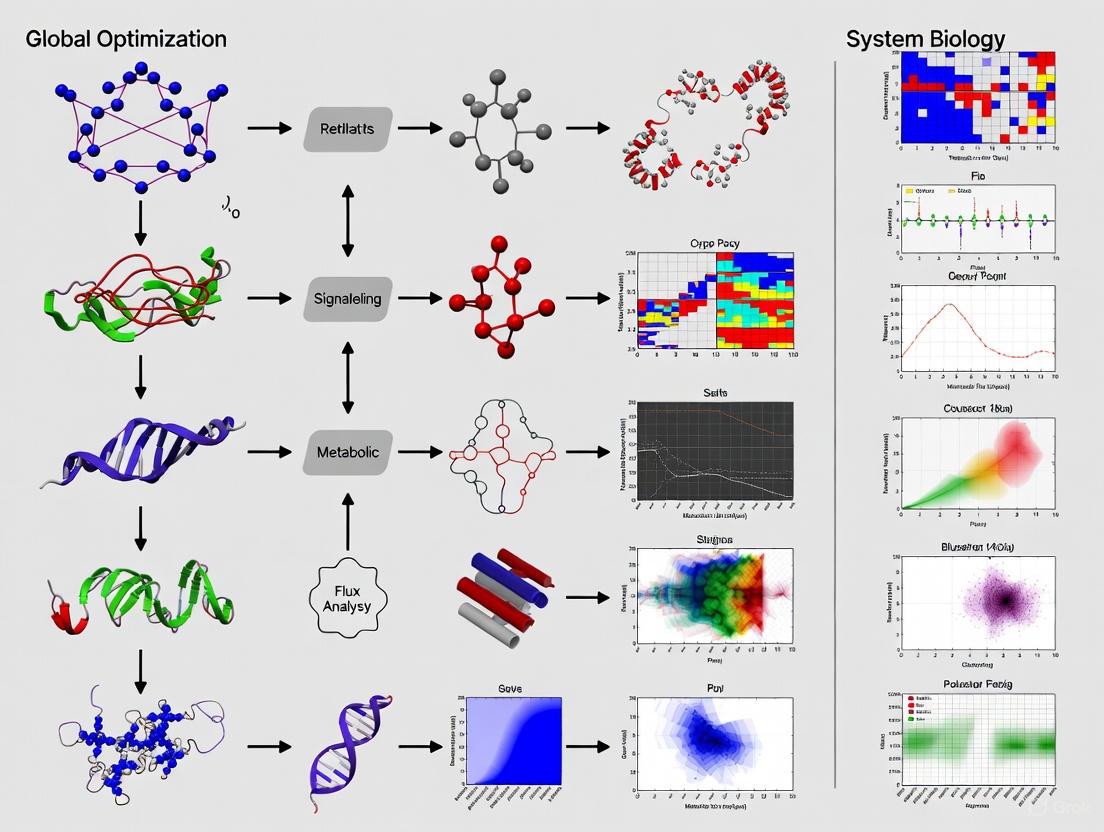
This article provides a comprehensive overview of global optimization, a crucial mathematical framework for solving complex, nonlinear problems in systems biology.
Global Optimization in Systems Biology: Methods, Applications, and Tools for Biomedical Research
Abstract
This article provides a comprehensive overview of global optimization, a crucial mathematical framework for solving complex, nonlinear problems in systems biology. Aimed at researchers and drug development professionals, it explores the foundational principles distinguishing global from local optimization and the challenges posed by multimodal biological models. The review details deterministic, stochastic, and metaheuristic methods, alongside specialized software tools like MEIGO and AMIGO. It highlights concrete applications in metabolic engineering, drug target identification, and model calibration. Finally, the article offers guidance on method selection, validation, and discusses future perspectives for optimizing biological systems in biomedical and clinical research.
What is Global Optimization and Why is it Critical in Systems Biology?
Mathematical global optimization aims to find the absolute best solution for a given problem within a complex, potentially multi-dimensional search space, a capability that is at the core of many challenges in systems biology [1] [2]. In contrast to local optimization, which may converge to a suboptimal solution close to its starting point, global optimization methods are designed to escape these local minima or maxima and locate the globally optimal solution [2]. This technical guide explores the fundamental principles of global optimization, its critical role in systems biology research—from model identification to metabolic engineering—and provides detailed methodologies for its application, with a specific focus on addressing problems in drug development.
In systems biology, optimization is the underlying hypothesis for model development, a tool for model identification, and a means to compute optimal stimulation procedures to synthetically achieve a desired biological behavior [1]. These problems are typically formulated as Nonlinear Programming Problems (NLPs) with dynamic and algebraic constraints [1]. The presence of nonlinearities in the objective function and constraints often leads to nonconvexity, which results in the potential existence of multiple local solutions, a phenomenon known as multimodality [2].
For visualization, one can imagine the objective function of a multimodal problem with two decision variables as a terrain with multiple peaks and valleys. A local optimization algorithm might find the top of a small hill, while a global optimizer is designed to find the highest mountain in the entire range. The solution of these multimodal problems is the focus of the subfield of global optimization, a class that includes many continuous problems and the vast majority of combinatorial optimization problems [2].
Core Mathematical Principles
The fundamental components of any mathematical optimization problem are:
- Decision Variables: Quantities that can be varied during the search for the best solution (e.g., the amounts of enzymes in a metabolic pathway) [2].
- Objective Function: A performance index that quantifies the quality of a solution defined by a set of decision variables, which can be either maximized or minimized (e.g., the fit between model output and experimental data) [2].
- Constraints: Requirements that must be met, usually expressed as equalities or inequalities (e.g., mass-balance constraints in a metabolic network) [2].
Global optimization problems can be classified based on the nature of their decision variables. Continuous optimization involves variables represented by real numbers, while discrete or combinatorial optimization involves integer numbers [2]. Many challenging problems in systems biology involve a mix of both.
The Challenge of Nonconvexity
A particularly important property is convexity. Convex optimization problems have a unique solution (they are unimodal) and can be solved very efficiently and reliably, even with a very large number of decision variables [2]. However, the nonlinear and highly constrained nature of systems biology models often makes them nonconvex and multimodal [1] [2]. Consequently, locating the global optimum is a daunting task, and specialized efficient and robust optimization techniques are required [1]. Most global optimization problems belong to the class of NP-hard problems, where obtaining global optima with guarantees is often impossible within a reasonable computation time [2].
Methodologies and Algorithmic Approaches
A range of algorithms has been developed to tackle global optimization problems. In many instances, stochastic global optimization methods can locate a near-globally optimal solution in a reasonable time, though they do not offer full guarantees of global optimality [2].
Stochastic and Hybrid Methods
Stochastic methods incorporate an element of randomness to explore the search space broadly and avoid becoming trapped in local optima. Evolutionary computation methods are one class of stochastic methods that have shown good performance in systems biology applications [2].
To enhance efficiency, hybrid methods that combine global and local techniques have shown great potential for difficult problems like parameter estimation [2]. For example, one developed hybrid global optimization method combines evolutionary global search with local descent [3]. A parallel version of such a method can be implemented to enable the solution of large-scale problems in an acceptable time frame [3]. The cooperative enhanced scatter search (eSS) algorithm is another example of a novel global optimization method used in systems biology [1].
The following diagram illustrates the workflow of a typical hybrid global optimization algorithm:
A Protocol for Multi-Variable Model Optimization
The following detailed protocol is adapted from a study that performed global optimization of a ventricular myocyte model to multi-variable data [4]. This provides a concrete example of applying global optimization in a pharmacological context.
Objective: To optimize a mathematical model of human ventricular myocyte electrophysiology to better predict the risk of drug-induced arrhythmias, thereby improving drug safety testing.
Background: The baseline model (O'Hara-Rudy - ORd) performs poorly in simulating congenital Long QT (LQT) syndromes, raising concerns about its predictive power for drug-induced LQT and Torsades de Pointes (TdP) risk. Optimization constrains model parameters using clinical data to generate models with higher predictive accuracy [4].
Methodology:
- Define Objective Function: The objective function is formulated to minimize the sum-of-squares error between the model simulation and clinical data. In the simplest case ("APDLQT" optimization), this is based on Action Potential Duration at 90% repolarization (APD90) for control and LQT conditions [4].
- Incorporate Multi-Variable Data: To improve the identifiability of parameters and the physiological relevance of the optimized model, a "multi-variable" optimization is performed. This involves adding terms to the objective function that heavily penalize solutions where intracellular calcium ([Ca2+]i) and sodium ([Na+]i) concentrations fall outside physiologically plausible bounds [4].
- Set Optimization Bounds: Physiologically-based bounds are placed on the model parameters being optimized to ensure the solution remains biologically realistic.
- Select and Execute Algorithm: A global optimization algorithm, such as a hybrid cooperative enhanced scatter search method, is used to search the high-dimensional parameter space for the set of parameters that minimizes the defined objective function [1] [4].
- Validate Optimized Model: The predictive power of the optimized model is tested against a separate database of known arrhythmogenic and non-arrhythmogenic ion channel blockers. The model's output (e.g., APD50 and diastolic [Ca2+]i) is used to classify drugs' TdP risk, and the classification performance is compared against the baseline model [4].
Table 1: Key Research Reagent Solutions for Cardiac Myocyte Model Optimization
| Item Name | Function/Description | Application in Protocol |
|---|---|---|
| O'Hara-Rudy (ORd) Model | A mathematical model of human ventricular myocyte electrophysiology. | Serves as the baseline model to be optimized and validated. [4] |
| Clinical LQT Data | QT interval prolongation data from patients with congenital LQT syndromes (LQT1, LQT2, LQT3). | Provides the primary objective data for the optimization process. [4] |
| Ion Channel Block Data | A curated database of drugs with known effects on cardiac ion channels (IKr, ICaL, INa) and associated TdP risk. | Used for independent validation of the optimized model's predictive power. [4] |
| Global Optimizer (e.g., eSS) | A stochastic global optimization algorithm capable of handling nonlinear, multimodal problems. | Executes the search for parameter values that minimize the objective function. [1] [4] |
Applications in Systems Biology and Drug Development
Global optimization methods are pivotal across numerous domains within systems biology and pharmaceutical research.
Model Identification and Reverse Engineering
The problem of parameter estimation in biochemical pathways is frequently formulated as a nonlinear programming problem subject to the pathway model acting as constraints [2]. Since these problems are often multimodal, global optimization methods are essential to avoid local solutions that can be physiologically misleading [2]. Furthermore, global optimization is used for reverse engineering to infer biomolecular networks, such as transcriptional regulatory networks and signaling pathways, from experimental data [2].
Metabolic Engineering and Synthetic Biology
Metabolic engineering exploits a systems-level approach for optimizing a desired cellular phenotype [2]. Optimization-based methods using genome-scale metabolic models enable the identification of gene knockout strategies for obtaining improved phenotypes. These problems are combinatorial in nature, and their computational time increases exponentially with problem size, creating a clear need for efficient global optimization algorithms [2]. Similarly, in synthetic biology, optimization algorithms are used to search for components and configurations that optimize dynamic behavior according to predefined design objectives [2]. Frameworks like OptCircuit use optimization-based design to aid in the construction and fine-tuning of integrated biological circuits [2].
Drug Safety Pharmacology (The CiPA Initiative)
As highlighted in the protocol, global optimization is central to improving the predictive accuracy of cardiac cell models used in safety pharmacology, such as within the Comprehensive in Vitro Proarrhythmia Assay (CiPA) initiative [4]. By optimizing models to clinical data, researchers can better predict a drug's potential to cause Torsades de Pointes, thereby reducing false-positive outcomes and improving risk assessment during drug development [4].
Table 2: Summary of Global Optimization Applications in Systems Biology
| Application Area | Typical Objective | Nature of Problem | References |
|---|---|---|---|
| Parameter Estimation | Calibrate model parameters to fit experimental data. | Frequently multimodal, continuous NLP. | [2] |
| Reverse Engineering | Reconstruct network structures (e.g., gene regulatory networks) from data. | Often combinatorial and multimodal. | [2] |
| Metabolic Engineering | Identify gene knockout strategies to maximize product yield. | Combinatorial (mixed-integer). | [2] |
| Synthetic Biology | Design biological circuits with optimal dynamic behavior. | Mixed continuous-combinatorial. | [2] |
| Drug Safety Testing | Optimize models to improve prediction of cardiotoxicity (TdP risk). | Multimodal, multi-variable constrained NLP. | [4] |
The following diagram illustrates how global optimization integrates into the broader workflow of model-based drug safety assessment:
Global optimization provides an essential mathematical framework for tackling some of the most complex problems in systems biology and drug development. The nonlinear, constrained, and often multimodal nature of these problems—from model calibration to the design of synthetic circuits—demands robust algorithms that can navigate complex landscapes in search of the best solution. While the field has advanced significantly with the development of stochastic and hybrid methods, challenges remain in enhancing the efficiency and robustness of these approaches for large-scale models. The continued refinement of global optimization methodologies promises to further empower researchers and drug development professionals in their quest to build predictive biological models and engineer safer, more effective therapeutic interventions.
Mathematical optimization serves as a cornerstone of computational systems biology, enabling researchers to make sense of complex biological systems by finding the best solutions to well-defined problems subject to predefined constraints [2]. These optimization problems involve decision variables (parameters that can be varied), an objective function (a performance index quantifying solution quality), and constraints (requirements that must be met) [2]. In biological contexts, optimization aims to make systems or designs as effective or functional as possible, mirroring the optimizing processes of evolution that have shaped biological structures and behaviors [2].
The fundamental challenge in systems biology optimization stems from the non-linear and highly constrained nature of biological models, which often results in non-convex optimization landscapes with multiple local solutions (multimodality) [2]. These characteristics make finding globally optimal solutions particularly difficult, especially when dealing with large numbers of decision variables and the stiff dynamics commonly observed in biological systems [5] [2]. The presence of nonlinearities in objective functions and constraints frequently leads to nonconvexity, resulting in the potential existence of multiple local solutions, thus necessitating global optimization approaches that can navigate these complex landscapes effectively [2].
Fundamental Concepts and Mathematical Definitions
Non-linearity in Biological Systems
Non-linearity represents a fundamental characteristic of biological systems where the relationship between system components does not follow a simple proportional pattern. In mathematical terms, a system is non-linear when the output is not directly proportional to the input, and the principle of superposition does not apply. Biological non-linearities manifest in various forms, including:
- Allosteric enzyme regulation: Where enzyme activity displays sigmoidal response curves to substrate concentration
- Cellular signaling cascades: Exhibiting amplification and threshold effects
- Gene regulatory networks: Demonstrating switch-like behaviors and feedback loops
These non-linear relationships result in differential equation models where the rate equations contain higher-order terms or complex functional forms that cannot be expressed as linear combinations of the state variables.
Non-convexity in Optimization Landscapes
Non-convexity refers to the property of an optimization landscape where the feasible space defined by constraints is not convex, meaning that a line segment connecting any two points in the space may pass outside the space [2]. In practical terms, non-convex optimization problems contain multiple "valleys" and "hills" in their objective function surfaces, making it difficult to navigate toward the global optimum. For biological systems, non-convexity arises from:
- Complex reaction kinetics: With Michaelis-Menten, Hill, and other non-linear rate equations
- Multi-stability: Where systems can exist in multiple stable states under identical conditions
- Bifurcations: Where small parameter changes lead to qualitative changes in system behavior
The key implication of non-convexity is that local search methods may become trapped in suboptimal regions of the parameter space, failing to identify the true global solution.
Multimodality in Objective Functions
Multimodality describes the existence of multiple local optima (minima or maxima) in an objective function landscape [2]. In biological optimization, this manifests as multiple distinct parameter sets that locally satisfy optimality conditions but yield different objective function values. The biological significance of multimodality includes:
- Alternative biological mechanisms: Different parameter combinations may represent biologically plausible alternative mechanisms
- Robustness in biological systems: Multiple configurations achieving similar functional outcomes
- Experimental uncertainty: Reflecting the inherent noise and variability in biological measurements
For simple cases with only two decision variables, the objective function of a multimodal problem can be visualized as a terrain with multiple peaks, where local search algorithms may converge to different solutions depending on their starting points [2].
Table 1: Characteristics of Optimization Problem Types in Systems Biology
| Problem Type | Mathematical Properties | Solution Characteristics | Biological Examples |
|---|---|---|---|
| Linear Programming (LP) | Linear objective function and constraints | Unique global solution, convex feasible space | Metabolic flux balance analysis [2] |
| Non-linear Programming (NLP) | Non-linear objective function and/or constraints | Potential multiple local solutions, non-convex feasible space | Enzyme kinetics parameter estimation [2] |
| Global Optimization | Highly non-linear, non-convex, multimodal | Multiple local optima, difficult to find global solution | Gene network inference, full pathway model calibration [2] |
Origins of Non-linearity and Multimodality
The challenges of non-linearity, non-convexity, and multimodality in biological models stem from several intrinsic properties of biological systems and their mathematical representations. The inherent non-determinism of AI models used in systems biology introduces significant variability, particularly in ensemble learning methods and deep learning architectures where random weight initialization, mini-batch gradient descent, and dropout regularization techniques can lead to different training runs converging to various local minima on the error surface [6]. This non-deterministic behavior arises from various sources inherent in model architecture, training processes, hardware acceleration, or mathematical definitions, creating fundamental challenges for reproducibility and optimization [6].
Data complexity further compounds these challenges through high dimensionality, heterogeneity, and multimodality of biological datasets [6]. Biomedical data often contains diverse types including genomic sequences, imaging, and clinical records, each characterized by high dimensionality and heterogeneity that complicate preprocessing and introduce variability [6]. The multimodal nature of biological data, such as combining MRI scans with gene expression profiles, requires sophisticated preprocessing strategies to ensure compatibility and retain meaningful relationships across data types [6]. Missing data, a frequent issue in clinical studies, exacerbates these difficulties as imputation methods often introduce variability or bias that can skew normalization and downstream analyses [6].
Model complexity represents another significant source of these challenges, referring to the architectural sophistication and computational demands of AI models in systems biology [6]. Complex model architectures with numerous parameters and non-linear activation functions create highly rugged optimization landscapes with multiple local minima, making global optimization particularly challenging, especially with the substantial computational costs required for models tackling NP-hard problems where computational complexity rises exponentially with input size [6].
Implications for Model Calibration and Prediction
The presence of non-linearity, non-convexity, and multimodality has profound implications for biological model calibration and predictive capability. In parameter estimation for biochemical pathways, formulated as nonlinear programming problems subject to pathway model constraints, multimodality means that local solutions can be very misleading when calibrating models [2]. A local solution may indicate a bad fit even for a model that could potentially match experimental data perfectly if the global optimum were found, highlighting the critical need for global optimization methods to avoid these deceptive local solutions [2].
For Universal Differential Equations (UDEs) that combine mechanistic differential equations with artificial neural networks, these challenges manifest in deteriorating performance and convergence with increasing noise levels or decreasing data availability [5]. The flexibility of artificial neural networks increases susceptibility to overfitting, and UDEs need to strike a careful balance between the contributions of the mechanistic and ANN components to maintain interpretability while achieving accurate predictions [5]. The complex interaction between ANN components and mechanistic parameters creates additional optimization challenges, as it remains unclear how the complex ANN influences the inference of mechanistic parameters and the overall interpretability of the UDE model [5].
Table 2: Impact of Data and Model Challenges on Biological Optimization
| Challenge Category | Specific Manifestations | Impact on Optimization | Potential Consequences |
|---|---|---|---|
| Data Complexity | High dimensionality, heterogeneity, multimodality, missing data, noise [6] | Increases parameter space dimensionality, introduces false minima, complicates gradient calculation | Model unidentifiability, poor generalizability, incorrect biological inferences |
| Model Complexity | Non-linear activation functions, multi-layer architectures, numerous parameters [6] | Creates highly rugged optimization landscapes, increases computational demands | Convergence to suboptimal solutions, excessive computational requirements, overfitting |
| Numerical Challenges | Stiff dynamics, floating-point precision, hardware variations [6] [5] | Introduces numerical instability, affects reproducibility, causes convergence failures | Inconsistent results across computational platforms, failed optimizations, unreliable models |
Methodological Approaches and Experimental Protocols
Global Optimization Frameworks
Addressing the challenges of non-linearity, non-convexity, and multimodality requires sophisticated global optimization approaches. Stochastic global optimization methods have shown significant promise for these problems, including enhanced scatter search and other population-based algorithms [1]. These methods are particularly valuable for model identification in systems biology, where they can handle the nonlinear and highly constrained nature of biological models with large numbers of decision variables [1]. For nonconvex problems, global optimization seeks the globally optimal solution among the set of possible local solutions, navigating complex terrain with multiple peaks that characterize multimodal problems [2].
Hybrid methods that combine global and local techniques have demonstrated substantial potential for difficult problems like parameter estimation in biological systems [2]. These approaches typically employ global exploration in the early stages to identify promising regions of the parameter space, followed by local refinement to converge to precise solutions. The cooperative enhanced scatter search (eSS) framework, along with software tools like AMIGO and DOTcvpSB, have shown excellent performance for global optimization in systems biology applications, particularly for model identification and stimulation design [1].
Universal Differential Equations (UDEs) represent a powerful emerging framework that combines mechanistic differential equations with data-driven artificial neural networks, forming a flexible approach for modeling complex biological systems with partial mechanistic understanding [5]. This hybrid methodology leverages prior knowledge while learning unknown processes from data, but introduces significant optimization challenges due to the need to balance mechanistic and neural network components while avoiding overfitting and maintaining interpretability [5].
Multi-start Optimization Pipeline
A systematic multi-start pipeline represents a robust approach for effective training of complex biological models, addressing the challenges of multimodality through extensive exploration of the parameter space [5]. This pipeline carefully distinguishes between mechanistic parameters (critical for biological interpretability) and ANN parameters (modeling components not well-understood), implementing specific strategies for each [5]. The key components include:
Parameter transformation and regularization: Implementing log-transformation for parameters spanning orders of magnitude while enforcing positive values, with tanh-based transformation for bounded parameter estimation [5]. Weight decay regularization applies L2 penalty to ANN parameters to prevent overcomplexity and maintain balance between mechanistic and data-driven components [5].
Multi-start strategy with hyperparameter sampling: Jointly sampling initial values for both model parameters and hyperparameters including ANN size, activation function, and optimizer learning rate to improve exploration of the hyperparameter space [5]. This approach accounts for the large parameter space and non-convex objective functions that complicate parameter identification.
Advanced numerical schemes and likelihood methods: Leveraging specialized solvers like Tsit5 and KenCarp4 within the SciML framework to handle stiff dynamical systems prevalent in systems biology [5]. Maximum likelihood estimation identifies the maximum likelihood estimate for mechanistic parameters while simultaneously estimating noise parameters of the error model [5].
Figure 1: UDE Multi-start Optimization Workflow
Experimental Protocol for Biological Model Optimization
A robust experimental protocol for addressing non-linearity, non-convexity, and multimodality in biological models involves the following detailed methodological steps:
Problem Formulation and Preprocessing
- Define mechanistic model structure based on biological prior knowledge
- Identify known parameters and components requiring data-driven approximation
- Implement data normalization and preprocessing to handle heterogeneous biological data types
- Address missing data through appropriate imputation strategies
Parameter Transformation and Scaling
- Apply log-transformation for parameters spanning multiple orders of magnitude
- Implement tanh-based transformation for bounded parameter estimation when needed
- Scale input data to improve numerical conditioning of the optimization problem
- Establish parameter bounds based on biological constraints and domain knowledge
Multi-start Optimization Execution
- Sample initial parameter values from defined distributions covering the parameter space
- Jointly sample hyperparameters including ANN architecture and optimizer settings
- Execute global optimization phase to identify promising regions of parameter space
- Apply local refinement to converge to precise solutions from promising starting points
Validation and Regularization
- Implement early stopping based on out-of-sample performance to prevent overfitting
- Apply weight decay regularization to ANN parameters to control complexity
- Validate model performance on independent test datasets
- Assess mechanistic parameter interpretability and biological plausibility
Table 3: Research Reagent Solutions for Computational Systems Biology
| Tool/Category | Specific Examples | Function/Purpose | Application Context |
|---|---|---|---|
| Global Optimization Software | DOTcvpSB, AMIGO, cooperative enhanced scatter search (eSS) [1] | Solves nonlinear programming problems with dynamic constraints | Model identification, stimulation design in systems biology [1] |
| UDE Frameworks | Julia SciML, Universal Differential Equations [5] | Combines mechanistic ODEs with neural networks | Modeling biological systems with partially unknown dynamics [5] |
| Numerical Solvers | Tsit5, KenCarp4 [5] | Handles stiff differential equations | Solving ODE models with vastly different timescales [5] |
| Parameter Estimation | Maximum likelihood estimation, multi-start algorithms [5] | Identifies model parameters from experimental data | Model calibration with noisy, sparse biological data [5] |
Case Studies and Applications
Glycolysis Pathway Modeling
The application of UDEs to glycolysis modeling demonstrates the practical challenges and solutions for handling non-linearity, non-convexity, and multimodality in biological systems [5]. Glycolysis represents a central metabolic pathway describing ATP and NADH-dependent conversion of glucose to pyruvate, modeled using seven ordinary differential equations exhibiting stable oscillations across twelve free parameters [5]. In this case study, researchers replaced the ATP usage and degradation terms with an artificial neural network that takes all seven state variables as inputs, creating a scenario where the ANN must learn dependency on only one input (ATP species) to recover the true data-generating process [5].
This application highlighted several critical challenges: the stiff dynamics of biological systems requiring specialized numerical solvers, measurement noise following complex distributions necessitating appropriate error models, and limited data availability restricting parameter identifiability [5]. The results demonstrated that model performance and convergence deteriorate significantly with increasing noise levels or decreasing data availability, regardless of ANN size or hyperparameter configurations [5]. However, regularization emerged as a key factor in restoring inference accuracy and model interpretability, with weight decay regularization particularly effective in maintaining balance between mechanistic and data-driven model components [5].
Metabolic Network Optimization
Metabolic engineering represents another significant application area where optimization challenges manifest clearly, exploiting an integrated, systems-level approach for optimizing desired cellular properties or phenotypes [2]. Constraint-based analysis coupled with optimization has created a consistent framework for generating and testing hypotheses about functions of microbial cells using genome-scale models [2]. Optimization-based methods using these genome-scale metabolic models enable identification of gene knockout strategies for obtaining improved phenotypes, though these problems have a combinatorial nature where computational time increases exponentially with problem size [2].
Flux balance methodology provides a guide to metabolic engineering and bioprocess optimization by calculating optimal flux distributions using linear optimization to represent metabolic phenotypes under specific conditions [2]. This approach has generated notable success stories including in silico predictions of Escherichia coli metabolic capabilities and genome-scale reconstruction of Saccharomyces cerevisiae metabolic networks [2]. However, these applications also reveal fundamental questions about optimality principles in biological systems, particularly which criteria (objective functions) are optimized in metabolic networks—a question addressed through concepts of constrained evolutionary optimization and cybernetic models [2].
Figure 2: Unimodal vs Multimodal Optimization Landscapes
The challenges of non-linearity, non-convexity, and multimodality in biological models continue to drive methodological innovations in computational systems biology. Future research directions should focus on enhancing the efficiency and robustness of global optimization approaches to make them applicable to large-scale models, with particular emphasis on hybrid methods combining global and local techniques [2]. The development of computer-aided design tools for biological engineering represents another promising direction, where optimization algorithms could guide the improvement of biological system behavior by searching for optimal components and configurations according to predefined design objectives [2].
The stochastic nature inherent in biomolecular systems necessitates advances in optimization methods capable of handling this uncertainty, with early approaches already emerging for parameter estimation in stochastic biochemical reactions and optimization of stochastic gene network models [2]. As systems biology continues to evolve, optimization methods will likely play an increasingly important role in synthetic biology applications, particularly in the rational redesign and directed evolution of novel in vitro metabolic pathways where optimization serves as the key component [2].
In conclusion, addressing the challenges of non-linearity, non-convexity, and multimodality requires a multifaceted approach combining sophisticated global optimization algorithms, appropriate regularization strategies, and careful balancing of mechanistic and data-driven model components. The continuing development of frameworks like Universal Differential Equations, coupled with advances in numerical methods and computational resources, promises to enhance our ability to extract meaningful biological insights from complex, noisy data despite these fundamental challenges. As optimization methodologies mature, they will increasingly enable the predictive understanding and engineering of biological systems that represents the ultimate goal of systems biology research.
Global optimization provides a essential mathematical foundation for systems biology, enabling researchers to move from qualitative descriptions of biological systems to quantitative and predictive models. In the context of systems biology research, global optimization encompasses computational methods designed to find the best possible solution for complex biological problems where the objective function is often non-convex, multi-modal, or presented as a black-box with computationally expensive evaluations [7]. These methods systematically explore entire parameter spaces to identify global minima, overcoming the limitations of local optimization that often converge to suboptimal solutions trapped in local minima [8] [7]. The core challenge in systems biology—translating nonlinear, high-dimensional biological systems into predictive mathematical models—makes global optimization not merely useful but indispensable for extracting meaningful insights from complex data.
The applications of global optimization span multiple domains within systems biology, creating a cohesive framework for biological discovery and engineering. This technical guide explores three foundational applications: parameter identification for mathematical models of biological networks, metabolic engineering for the design of cell factories, and optimal experimental design for maximizing information gain from costly biological experiments. Together, these applications form an iterative cycle where models inform experiments, experimental data refine models, and optimization algorithms drive both processes toward desired biological objectives.
Model Identification and Parameter Estimation
Model identification involves determining the unknown parameters of mathematical models that best explain experimental data, a process fundamental to creating predictive biological models.
Formulating the Parameter Estimation Problem
Parameter estimation begins with a mathematical model representing biological system dynamics, typically expressed as ordinary differential equations (ODEs): ẋ(t) = f(x, p, u), where x represents biological quantities such as molecular concentrations, p denotes the unknown model parameters to be estimated, and u represents experimental perturbations [9]. The estimation process minimizes an objective function that quantifies the discrepancy between model predictions and experimental data [8] [10]. For quantitative data, this typically takes the form of a weighted residual sum of squares: fquant(x) = Σj (yj,model(x) - yj,data)^2 [11]. Parameter identification thus becomes an optimization problem: finding the parameter vector x that minimizes f_quant(x) [8].
Methodologies and Algorithms
Multiple algorithmic approaches exist for solving parameter estimation problems, each with distinct strengths and computational trade-offs:
Table 1: Optimization Methods for Parameter Estimation
| Method Class | Examples | Mechanism | Advantages | Limitations |
|---|---|---|---|---|
| Gradient-based | Levenberg-Marquardt, L-BFGS-B [8] | Uses first/second derivatives to navigate parameter space | Fast convergence; efficient for smooth objectives | May converge to local minima; requires gradient computation |
| Metaheuristic | Differential Evolution, Scatter Search [11] [8] | Population-based search without gradient information | Better global search properties; handles non-smooth functions | Computationally expensive; no convergence guarantees |
| Hybrid | Globally-biased BIRECT, DIRECT variants [7] | Combines global search with local refinement | Balances exploration/exploitation; handles expensive evaluations | Implementation complexity; parameter tuning |
For biological models with potential multi-modal objective functions, metaheuristic approaches are often preferred for their ability to escape local minima [8]. The DIRECT algorithm and its variants are particularly valuable as they deterministically partition the search space and balance global exploration with local intensification without requiring extensive parameter tuning [7].
Incorporating Qualitative Data
A significant advancement in parameter identification is the integration of qualitative data through constrained optimization frameworks [11]. Qualitative observations (e.g., "protein A activates protein B" or "mutant strain is inviable") can be formalized as inequality constraints on model outputs: gi(x) < 0. These are incorporated into a composite objective function: ftot(x) = fquant(x) + fqual(x), where fqual(x) = Σi Ci · max(0, gi(x)) imposes penalties for constraint violations [11]. This approach dramatically expands the types of biological data usable for model parameterization, particularly when quantitative time-course data are limited.
Figure 1: Parameter Identification Workflow: This diagram illustrates the iterative process of model parameter estimation, combining experimental data with mathematical models through optimization algorithms.
Metabolic Engineering Applications
Metabolic engineering applies optimization principles to redesign metabolic networks for improved production of valuable chemicals, pharmaceuticals, and biofuels.
Genome-Scale Metabolic Modeling
Genome-scale metabolic models (GEMs) represent the comprehensive biochemical network of an organism, encompassing thousands of metabolic reactions catalyzed by enzymes encoded in its genome [12]. The development of GEMs was pioneered for bacteria by Palsson's group and for eukaryotic cells (S. cerevisiae) by Nielsen's group [12]. These models enable in silico prediction of metabolic fluxes under different genetic and environmental conditions through constraint-based optimization approaches. GEMs have become indispensable tools for predicting how genetic modifications alter metabolic fluxes and identifying engineering targets for improved product synthesis [12].
Flux Balance Analysis and Optimization
Flux Balance Analysis (FBA) is a constrained optimization approach that predicts metabolic flux distributions by assuming the network is at steady state [12]. The core mathematical formulation solves: maximize c^T v subject to S·v = 0 and vmin ≤ v ≤ vmax, where S is the stoichiometric matrix, v is the flux vector, and c is a vector defining the biological objective (typically biomass formation or product synthesis) [12]. FBA and related constraint-based methods enable prediction of optimal metabolic flux distributions for maximizing target metabolite production, guiding genetic engineering strategies.
Case Study: Optimal Metabolic Network Identification (OMNI)
The OMNI (Optimal Metabolic Network Identification) method demonstrates the application of optimization to metabolic network refinement [13]. OMNI identifies the set of active reactions in a genome-scale metabolic network that results in the best agreement between in silico predicted and experimentally measured flux distributions [13]. When applied to Escherichia coli mutant strains with lower-than-predicted growth rates, OMNI identified reactions acting as flux bottlenecks, whose corresponding genes were often downregulated in evolved strains [13]. For industrial strains, OMNI can suggest metabolic engineering strategies to improve byproduct secretion by identifying suboptimal flux distributions [13].
Table 2: Key Research Reagents and Computational Tools for Metabolic Engineering
| Resource Type | Specific Examples | Function/Application |
|---|---|---|
| Metabolic Databases | Kyoto Encyclopedia of Genes and Genomes (KEGG) [12] | Repository of metabolic pathways and enzyme information |
| Modeling Software | COBRA Toolbox [12] | MATLAB-based suite for constraint-based reconstruction and analysis |
| Host Organisms | Escherichia coli, Saccharomyces cerevisiae [12] | Common chassis for metabolic engineering and heterologous expression |
| Experimental Data | Fluxomics, Metabolomics [10] | Quantitative measurements for model validation and refinement |
Optimal Experimental Design
Optimal experimental design (OED) applies optimization principles to design maximally informative experiments within practical constraints, crucial for reducing the time and resources needed for biological discovery.
Fundamental Principles and Mathematical Formulation
OED addresses the challenge that not all experimental data equally support dynamic modeling, especially with nonlinear models common in systems biology [14]. The goal is to identify experimental conditions (e.g., measurement timepoints, observed species, perturbation types) that maximize information gain about model parameters or discriminate between competing models [14] [9]. In mathematical terms, OED seeks experimental designs ξ that optimize a criterion Ψ(ξ) based on the Fisher Information Matrix or profile likelihoods [9]. For biological systems where prior parameter knowledge is sparse, frequentist approaches based on profile likelihood have advantages over Bayesian methods that require specified prior distributions [9].
Methodological Approaches
Profile Likelihood-Based Experimental Design
The two-dimensional profile likelihood approach provides a powerful framework for OED in nonlinear systems [9]. This method quantifies the expected uncertainty of a targeted parameter after a potential measurement by constructing a two-dimensional likelihood profile that accounts for different possible measurement outcomes [9]. The range of reasonable measurement outcomes before the experiment is quantified using validation profiles, enabling prediction of how different experimental results would affect parameter uncertainty [9]. This approach yields a design criterion representing the expected average width of the confidence interval after measuring data for a specific experimental condition.
The AMIGO2 Toolbox
The AMIGO2 (Advanced Model Identification using Global Optimization) toolbox implements a practical procedure for computing optimal experiments in systems and synthetic biology [14]. This software tool supports model-based OED to either identify the best model among candidates or improve the identifiability of unknown parameters [14]. AMIGO2 is particularly valuable for designing experiments that enhance practical identifiability—the ability to uniquely determine parameters from available data—addressing a common challenge in biological modeling where parameters may be structurally identifiable in principle but not in practice given experimental limitations [14].
Figure 2: Optimal Experimental Design Workflow: This diagram illustrates the sequential process of designing experiments to maximize information gain for model parameterization, highlighting the iterative nature of the approach.
Applications in Biological Systems
OED has been successfully applied across biological domains, from immunoreceptor signaling to metabolic network characterization. In signaling networks, OED helps determine which signaling nodes and timepoints to measure for robust parameter estimation of often large, non-identifiable systems [8]. In metabolism, OED guides flux measurement strategies to resolve network ambiguities with minimal experimental effort [10]. The sequential nature of OED—where data from initial experiments inform the design of subsequent ones—makes it particularly valuable for resource-constrained biological research [9].
Integrated Workflow and Future Directions
The three application domains—model identification, metabolic engineering, and optimal experimental design—form an integrated workflow in modern systems biology. Metabolic models identify engineering targets, engineered strains generate experimental data, optimal design maximizes information from experiments, and parameter estimation refines models to complete the cycle. Future developments will likely enhance this integration through artificial intelligence (AI)-based models [12] and improved uncertainty quantification methods [8] that better characterize parameter identifiability and model prediction reliability.
The continued advancement of global optimization methodologies remains essential for addressing the increasing complexity of biological models and the growing volume of experimental data. As systems biology progresses toward whole-cell models and digital twins [15], optimization algorithms that efficiently handle high-dimensional parameter spaces, multi-modal objective functions, and hybrid discrete-continuous decision variables will become increasingly critical for translating biological knowledge into predictive models and engineered biological systems.
In systems biology, many critical problems are fundamentally multimodal; they possess not one, but multiple distinct solutions in the decision space. These solutions represent different parameter sets or model structures that can explain the same biological observation. When facing such complexity, traditional local optimization methods, which converge to the nearest optimum from a single starting point, are destined to fail. They become trapped in suboptimal regions, providing an incomplete and often misleading picture of the biological system under study. This limitation is particularly consequential in fields like drug discovery and intracellular signaling analysis, where overlooking alternative solutions can mean the difference between a successful therapeutic and a failed experiment.
The challenge extends beyond merely finding multiple solutions. It requires simultaneously considering the accuracy and diversity of these solutions. If an algorithm focuses solely on accuracy, it will likely fall into a single solution, failing to capture the full scope of biological possibilities. Conversely, if it overemphasizes diversity, it may fail to obtain satisfying accuracy for any solution. This delicate trade-off underscores why specialized global optimization strategies are not merely beneficial but essential for robust systems biology research.
The Fundamental Challenge of Multimodality
Defining Multimodal Optimization Problems
A Multimodal Optimization Problem (MMOP) refers to the problem of having more than one optima or satisfactory solution in the decision space [16]. Unlike single-objective optimization, multimodal optimization aims to locate all or most of these multiple solutions—which have the same or similar fitness value but different solution structures—in a single search and maintain these solutions throughout the entire search process [16].
In biological terms, this multimodality manifests when different molecular structures, network architectures, or parameter sets produce functionally equivalent phenotypes. For instance, multiple protein configurations might achieve similar binding affinity, or different metabolic pathway fluxes might yield equivalent biomass production. The core challenge lies in the fitness landscape—the mathematical representation of how solutions map to performance metrics. Multimodal landscapes contain multiple peaks (local and global optima) separated by valleys of poorer performance, creating a complex terrain that confounds simple gradient-based search methods.
Pitfalls of Local Optimization Methods
Local optimization techniques, such as gradient descent and quasi-Newton methods, operate on a fundamental principle: they iteratively move toward better solutions in the immediate neighborhood of the current point. This approach suffers from critical limitations in biological contexts:
- Premature Convergence: Local methods become trapped in the first local optimum they encounter, regardless of its quality relative to other solutions. In practice, this means a model might be calibrated to one possible parameter set while potentially superior alternatives remain undiscovered [1].
- Incomplete Solution Space Exploration: By converging to a single solution, local methods provide a fragmented understanding of the biological system. They cannot reveal the full repertoire of parameter combinations or network designs that achieve similar functional outcomes [16].
- Sensitivity to Initial Conditions: The solution obtained depends entirely on the starting point chosen for the optimization, making results irreproducible and highly variable.
- Inability to Capture Biological Redundancy: Biological systems often evolve redundant mechanisms to ensure robustness. Local optimization cannot uncover this inherent redundancy, leading to biologically implausible or incomplete models.
Table 1: Comparison of Local vs. Global Optimization Characteristics in Biological Contexts
| Characteristic | Local Optimization | Global Optimization |
|---|---|---|
| Solution Diversity | Single solution | Multiple solutions |
| Fitness Landscape Navigation | Follows local gradients | Explores diverse regions |
| Biological Redundancy Capture | Limited | Comprehensive |
| Computational Cost | Lower per run | Higher overall |
| Risk of Premature Convergence | High | Low |
| Applicability to Multimodal Problems | Poor | Excellent |
Global Optimization Methodologies for Biological Systems
Swarm Intelligence and Evolutionary Algorithms
Swarm intelligence algorithms have demonstrated particular effectiveness for solving MMOPs due to their inherent population-based approach, which maintains diversity across multiple potential solutions simultaneously [16]. These methods are particularly well-suited for the nonlinear, high-dimensional parameter spaces common in biological models.
The Brain Storm Optimization (BSO) algorithm incorporates a clustering strategy to group solutions during the search process, effectively mapping the landscape of possible solutions [16]. Its variant, knowledge-driven BSO in objective space (KBSOOS), enhances performance by leveraging information from previous solutions to guide future search, demonstrating significantly improved capability in maintaining solution diversity while ensuring accuracy [16].
Genetic Algorithms (GAs) have proven superior for problems with numerous free parameters. In one geophysical inverse problem with 30 free parameters, genetic algorithms still yielded accurate solutions where simulated annealing became only marginally useful [17]. This performance advantage may reflect "the nonproximate search methods used by them or, possibly, the more complex and capacious memory available to a genetic algorithm for storing its accumulated experience" [17].
Bayesian Multimodel Inference (MMI)
Bayesian MMI has emerged as a powerful approach for addressing model uncertainty in systems biology. Rather than selecting a single "best" model, MMI combines predictions from multiple models to increase certainty in systems biology predictions [18]. This approach becomes particularly relevant when leveraging a set of potentially incomplete models of the same biological pathway.
The Bayesian MMI workflow involves:
- Calibrating available models to training data using Bayesian parameter estimation
- Combining the resulting predictive probability densities using MMI
- Generating improved multimodel predictions of important biological quantities
Mathematically, Bayesian MMI constructs predictors through a linear combination of predictive densities from each model:
$${{{\rm{p}}}}(q| {{{d}}}{{{{\rm{train}}}}},{{\mathfrak{M}}}{K}): !!={\sum }{k=1}^{K}{w}{k}{{{\rm{p}}}}({q}{k}| {{{{\mathcal{M}}}}}{k},{{d}}_{{{{\rm{train}}}}})$$
where weights wk ≥ 0 and ${\sum }{k}^{K}{w}{k}=1$ [18]. This approach has been successfully applied to ERK signaling pathways, demonstrating increased predictive certainty and robustness to model set changes and data uncertainties [18].
Hybrid and Enhanced Strategies
Given the computational demands of biological models, hybrid optimization strategies that combine global and local methods have shown particular promise. These methods use global exploration to identify promising regions of the solution space, then employ local refinement to fine-tune solutions, offering a balance between thorough exploration and computational efficiency [19] [1].
The control vector parameterization (CVP) framework transforms dynamic optimization problems into nonlinear programming problems by parameterizing control variables [20]. This approach, implemented in toolboxes like DOTcvpSB, enables the solution of complex dynamic optimization problems relevant to biological systems, including optimal control for modifying self-organized dynamics and computational design of biological circuits [20].
Table 2: Global Optimization Methods and Their Applications in Systems Biology
| Method Class | Specific Algorithms | Strengths | Biological Applications |
|---|---|---|---|
| Swarm Intelligence | Brain Storm Optimization (BSO), Particle Swarm Optimization | Maintains solution diversity, handles high dimensions | Nonlinear equation systems, network inference |
| Evolutionary Algorithms | Genetic Algorithms, Differential Evolution | Robust to local optima, handles integer variables | Geophysical inversion, parameter estimation |
| Bayesian Methods | Bayesian Multimodel Inference, Bayesian Model Averaging | Quantifies uncertainty, combines model structures | ERK signaling pathway analysis, prediction |
| Hybrid Methods | Enhanced Scatter Search, CVP with global-local | Balances exploration and exploitation | Dynamic optimization of distributed biological systems |
Experimental Protocols and Implementation
Diversity Measurement and Performance Metrics
Evaluating multimodal optimization requires specialized metrics that account for both solution quality and diversity. Traditional performance metrics like optima ratio (OR) and success rate (SR) have limitations because they do not adequately consider the diversity of solutions [16].
A recently proposed diversity indicator addresses this gap by providing a quantitative measurement of solution distribution for solving MMOPs [16]. This indicator extends the understanding of an algorithm's search capability on MMOPs by measuring how well solutions cover the different possible optima, not just whether optima were found. The diversity measure is particularly valuable when an algorithm obtains most but not all possible solutions, providing a more nuanced assessment of performance than binary success/failure metrics [16].
Knowledge-Driven Algorithm Design
Incorporating domain knowledge significantly enhances optimization performance for biological problems. The "No free lunch" theory implies that better algorithms can be designed by embedding problem-specific information into the search process [16]. This approach transforms black-box optimization into gray-box optimization, where partial information from problems guides the search strategy.
Knowledge-driven BSOOS algorithms combine knowledge obtained from both the type of solved problem and the properties of the algorithm itself [16]. In practice, this means leveraging understanding of biological network structures, known parameter constraints, and prior distribution information to focus computational resources on biologically plausible solutions.
Workflow for Multimodal Biological Optimization
The following diagram illustrates a comprehensive workflow for applying global optimization methods to multimodal biological problems:
Multimodal Optimization Workflow in Systems Biology - This diagram outlines the comprehensive process from problem formulation to biological interpretation, highlighting the iterative nature of global optimization in biological contexts.
Table 3: Key Computational Tools for Multimodal Optimization in Systems Biology
| Tool/Resource | Type | Function | Application Context |
|---|---|---|---|
| DOTcvpSB | Software Toolbox | Solves continuous and mixed-integer dynamic optimization problems | Bioreactor optimization, optimal drug infusion, oscillation minimization [20] |
| KBSOOS | Algorithm | Knowledge-driven multimodal optimization | Solving nonlinear equation systems, maintaining solution diversity [16] |
| Bayesian MMI | Statistical Framework | Combines predictions from multiple models | ERK signaling pathway analysis, uncertainty quantification [18] |
| Proper Orthogonal Decomposition | Model Reduction | Reduces computational complexity of distributed models | Dynamic optimization of spatially distributed biological systems [19] |
| SUNDIALS | Numerical Solver Suite | Solves differential equations and sensitivity analysis | Inner iteration in control vector parameterization [20] |
Case Studies in Biological Systems
Intracellular Signaling Pathways: ERK Signaling
The extracellular-regulated kinase (ERK) signaling cascade presents a classic example where multimodal optimization is essential. Searching the BioModels database yields over 125 ordinary differential equation models for ERK signaling [18]. Each model was developed with different simplifying assumptions and formulations, yet multiple models can represent the same pathway.
Bayesian multimodel inference has been successfully applied to ERK pathway models, combining predictions from ten different model structures to increase predictive certainty [18]. This approach enabled researchers to identify possible mechanisms of experimentally measured subcellular location-specific ERK activity, suggesting that "location-specific differences in both Rap1 activation and negative feedback strength are necessary to capture the observed dynamics" [18].
The following diagram illustrates the multimodel inference process for ERK signaling analysis:
Multimodel Inference for ERK Signaling - This diagram shows how multiple ERK pathway models are combined through Bayesian multimodel inference to generate robust predictions of subcellular ERK activity.
Spatial Biological Systems: Bacterial Chemotaxis and Pattern Formation
Spatially distributed biological systems present particularly challenging optimization problems due to their inherent complexity. The dynamic optimization of such systems has been addressed using hybrid global optimization methods combined with reduced order models [19].
In bacterial chemotaxis, researchers computed "the time-varying optimal concentration of chemotractant in one of the spatial boundaries in order to achieve predefined cell distribution profiles" [19]. Similarly, the FitzHugh-Nagumo model, which describes physiological processes like heart behavior, was optimized to force "a system to evolve from an undesired to a desired pattern with a reduced number of actuators" [19].
These applications demonstrate how global optimization methods enable not just analysis but active design of biological behaviors in spatially complex systems—a capability far beyond the reach of local optimization techniques.
Drug Discovery: Multimodal AI Approaches
In drug discovery, the multimodal challenge extends beyond parameter optimization to integrating diverse data types. The KEDD framework exemplifies this approach, simultaneously incorporating "molecular structures, structured knowledge from knowledge graphs, and unstructured knowledge from biomedical literature" [21]. This multimodal understanding of biomolecules has led to performance improvements of 5.2% on drug-target interaction prediction and 2.6% on drug property prediction compared to state-of-the-art models [21].
Multimodal AI approaches address the critical "missing modality problem" where complete multimodal information is unavailable for novel drugs and proteins [21]. By leveraging sparse attention and modality masking techniques, these frameworks can reconstruct missing features based on relevant molecules, maintaining predictive capability even with incomplete data.
The multimodal nature of biological systems demands a correspondingly sophisticated approach to optimization. Local methods, while computationally efficient, fundamentally cannot capture the complex solution landscapes of biological models. Global optimization methods—from swarm intelligence and evolutionary algorithms to Bayesian multimodel inference—provide the necessary framework to address this complexity, offering more complete, robust, and biologically plausible solutions.
As systems biology continues to tackle increasingly complex questions, the importance of global multimodal optimization will only grow. Future directions point toward more tightly integrated multimodal AI frameworks, enhanced scalability for high-dimensional problems, and more sophisticated uncertainty quantification methods. For researchers in systems biology and drug development, embracing these global optimization approaches is not merely an technical choice but a fundamental requirement for generating meaningful biological insights.
The transition from local to global optimization methods represents more than just a shift in algorithms—it embodies a fundamental evolution in how we conceptualize and address biological complexity. By acknowledging and embracing multimodality, systems biologists can move beyond simplified single-solution models toward a more comprehensive understanding that captures the true richness and redundancy of biological systems.
A Toolkit of Global Optimization Methods and Their Biological Applications
Within the domain of global optimization in systems biology research, the imperative to find globally optimal parameter sets for nonlinear dynamic models demands rigorous, deterministic algorithms. This technical guide elucidates two cornerstone methodologies: the Branch-and-Bound (B&B) framework and Cutting-Plane methods. These strategies provide deterministic guarantees of convergence to a global optimum within a specified tolerance, a critical requirement for robust parameter estimation and model calibration in biological systems [22]. We detail their algorithmic foundations, integration into spatial Branch-and-Bound (sBB) and outer approximation schemes for mixed-integer nonlinear programming (MINLP) problems, and provide explicit experimental protocols for their application in dynamic biological models. The discussion is framed within the practical challenges of systems biology, where nonconvexities and multimodality are prevalent.
Mathematical modeling of biological systems, often described by sets of nonlinear ordinary differential equations (ODEs), is fundamental to understanding cellular processes. A central task is parameter estimation—finding the model coefficients that minimize the discrepancy between simulated and experimental data. This is formulated as a nonlinear optimization problem, typically nonconvex due to the model structure, leading to multiple local minima [22]. Standard gradient-based local optimization methods can converge to suboptimal local solutions, yielding inaccurate models. Stochastic global optimization methods, while computationally faster, offer no guarantee of convergence to the global optimum in finite time [22].
Deterministic global optimization methods overcome this by employing mathematical strategies that rigorously confine the search for the optimum. They provide both a candidate solution and a provable bound on its optimality gap (the difference between the best-found solution and a lower bound on the global optimum) [22]. This guarantee is indispensable for producing reliable, reproducible models in computational biology. Two pivotal and often interconnected paradigms enabling this are Branch-and-Bound and Cutting-Plane methods.
Foundational Algorithm: The Branch-and-Bound Framework
Branch-and-bound is a general algorithm design paradigm for solving optimization problems by systematically enumerating candidate solutions via state-space search, organized as a tree, and using bounding functions to prune suboptimal branches [23].
Core Principles
The algorithm operates on two principles:
- Branching: Recursively splitting the search space (feasible region) into smaller subspaces.
- Bounding: Calculating lower (for minimization) and upper bounds on the objective function value within each subspace. A branch (node) is discarded ("pruned") if its lower bound exceeds the current best upper bound (incumbent solution), as it cannot contain the global optimum [23].
A generic B&B algorithm for minimization requires three problem-specific operations [23]:
branch(I): Partitions an instance I representing a solution subset into two or more child instances.bound(I): Computes a valid lower bound for any solution in the subspace of I.solution(I): Determines if I represents a single candidate solution and optionally returns a feasible solution to provide an upper bound.
Table 1: Key Characteristics of Global Optimization Methods in Systems Biology
| Feature | Deterministic Methods (B&B, Cutting-Plane) | Stochastic Methods (e.g., Genetic Algorithms) |
|---|---|---|
| Optimality Guarantee | Yes. Convergence to global optimum within ε-tolerance is provable [22]. | No. Provide near-optimal solutions with unknown quality guarantees [22]. |
| Computational Burden | High. Tend to lead to large computational demands [22]. | Lower. Typically faster, especially for large-scale problems [22]. |
| Output | Solution and rigorous optimality gap [22]. | Solution only, with no proven bound. |
| Typical Application | Parameter estimation for critical, high-fidelity models where accuracy is paramount [22]. | Initial screening, exploration of vast search spaces, or when computational time is limited. |
Spatial Branch-and-Bound for Nonconvex MINLPs
In systems biology, problems often involve continuous variables (e.g., rate constants) and discrete decisions (e.g., model structure selection), leading to MINLP formulations. Standard B&B for integer programming branches on discrete variables. Spatial Branch-and-Bound (sBB) extends this to handle nonconvex continuous functions by branching on continuous variable domains [24].
The sBB algorithm iteratively refines convex relaxations of the original nonconvex problem. The relaxation provides a lower bound (for minimization), while the original problem solved locally provides an upper bound. The region (node) with the lowest lower bound is processed next. The process repeats until the gap between the global upper bound and the best lower bound is within a tolerance ε [24].
Table 2: Steps of a Spatial Branch-and-Bound Algorithm [24]
| Step | Action | Purpose in Systems Biology Context |
|---|---|---|
| 1. Initialization | Define the initial search region S (variable bounds). Set convergence tolerance ε, upper bound U=∞. | Establish biological parameter bounds (e.g., kinetic constants must be positive). |
| 2. Node Selection | Choose a region (node) from the tree to process. | Heuristic (e.g., best lower bound) to guide search toward promising parameter subspaces. |
| 3. Lower Bound | Solve a convex relaxation of the problem in the selected region. | Provides a guaranteed under-estimate of the best possible fit in that parameter region. |
| 4. Upper Bound | Solve the original nonconvex problem locally within the region. | Finds a candidate parameter set and calculates the actual sum-of-squared residuals. |
| 5. Pruning | If a node's lower bound > global upper bound U, discard it. Update U if a better solution is found. | Eliminates regions of parameter space that provably cannot contain the global best-fit. |
| 6. Check Convergence | If U - lower bound ≤ ε, terminate. The solution is ε-global optimal. | Determines when the parameter estimation result is sufficiently certain. |
| 7. Branching | Split the current region (e.g., bisect a continuous variable's range). Create new child nodes. | Refines the search, improving the tightness of convex relaxations in subsequent iterations. |
Diagram 1: Spatial Branch-and-Bound Algorithm Flow
Cutting-Plane Methods and Outer Approximation
Cutting-plane methods iteratively refine a feasible set by adding linear constraints ("cuts") that exclude parts of the relaxation where no optimal solution can lie, without cutting off any feasible integer or optimal solutions [25]. In global optimization, they are often used within an Outer Approximation framework.
Outer Approximation for Deterministic Global Optimization
This approach decomposes a nonconvex problem into two levels:
- Master Problem (MILP): A mixed-integer linear relaxation of the original problem, built using linear supports (cuts) of the nonlinear functions. Solving this provides a rigorous lower bound on the global optimum.
- Slave Problem (NLP): The original nonconvex problem is solved with fixed discrete variables from the master solution. This yields a feasible solution and an upper bound [22].
The algorithm iterates: the slave NLP solution generates new linearizations (cuts) that are added to the master MILP to tighten its relaxation. The bounds converge until the optimality gap is closed [22]. This method is particularly effective when integrated with convex relaxations of dynamic models.
Experimental Protocol: Parameter Estimation via Outer Approximation with Orthogonal Collocation
Aim: To deterministically estimate parameters (θ) for a biological ODE model from time-course experimental data.
Methodology:
- Model Discretization (Simultaneous Approach): Transform the continuous-time ODE model into an algebraic system using Orthogonal Collocation on Finite Elements [22]. This involves:
- Dividing the time horizon into NE finite elements.
- Within each element, approximating state variable profiles using Lagrange polynomials at NK orthogonal collocation points (e.g., Legendre roots).
- Enforcing the ODEs to hold exactly at these collocation points. This reformulation converts the dynamic parameter estimation problem into a large-scale, finite-dimensional Nonconvex NLP.
- Algorithm Execution (Outer Approximation): a. Initialization: Generate an initial set of linearizations (cuts) or a convex relaxation for the nonconvex terms in the discretized NLP. b. Master (MILP) Solution: Solve the current linear outer approximation. The solution provides a lower bound (LB) and proposed values for discrete variables (if any) and continuous variable bounds. c. Slave (NLP) Solution: Fix any discrete variables from (b) and solve the original nonconvex NLP locally (e.g., using a gradient-based solver). The solution provides an upper bound (UB) and a new feasible parameter set θ. d. Cut Generation: Linearize the nonlinear constraints (from the discretized ODEs and objective) around the solution θ. Add these linear constraints as cuts to the master MILP. These cuts will remove the current master solution in the next iteration if it is not optimal. e. Termination Check: If UB - LB ≤ ε, stop. The current UB solution is ε-global optimal. Otherwise, return to step (b).
Diagram 2: Outer Approximation Iterative Algorithm
Table 3: Research Reagent Solutions for Deterministic Global Optimization in Systems Biology
| Item / Resource | Function / Purpose | Example/Notes |
|---|---|---|
| Deterministic Global Solver | Core software implementing sBB or outer approximation algorithms. | Commercial: BARON, ANTIGONE. Open-source: Couenne, SCIP (for MINLP) [22]. |
| Modeling & Discretization Environment | Platform to encode biological ODE models and perform orthogonal collocation. | Pyomo (Python), GAMS, MATLAB with CasADi. Enables algebraic reformulation of dynamic problems [22]. |
| Local NLP Solver | Solves the nonconvex slave problems and provides upper bounds. | IPOPT, CONOPT, SNOPT. Often interfaced within the global solver framework. |
| MILP Solver | Solves the linear/convex master problems to provide lower bounds. | CPLEX, Gurobi, CBC. Critical for the efficiency of outer approximation methods. |
| Convex Relaxation Library | Provides routines to generate convex envelopes for common nonconvex terms (e.g., bilinear, fractional). | Part of advanced solvers like BARON. Custom implementations can use McCormick relaxations [22]. |
| High-Performance Computing (HPC) Cluster | Computational resource to handle the significant CPU burden of rigorous global optimization for large models. | Parallelization of branch-and-bound tree search can dramatically reduce wall-clock time. |
| Experimental Dataset | Time-series quantitative measurements of species concentrations. | The objective function (e.g., sum of squared residuals) is minimized against this data [22]. |
| Parameter Bounds (Biological Priors) | Physically/physiologically plausible lower and upper bounds for all model parameters. | Essential for initializing the search space and accelerating convergence by pruning [24]. |
In the pursuit of predictive and reliable models in systems biology, deterministic global optimization strategies are non-negotiable for critical parameter estimation tasks. The Branch-and-Bound framework, particularly in its spatial variant, and Cutting-Plane methods, frequently deployed via Outer Approximation algorithms, provide the mathematical machinery to deliver solutions with guaranteed proximity to the global optimum. While computationally intensive, the integration of these methods with robust model discretization techniques like orthogonal collocation represents the state-of-the-art for reconciling complex, nonlinear biological dynamics with experimental data. Their application ensures that conclusions drawn from computational models rest upon a foundation of mathematical certainty, a cornerstone of rigorous systems biology research.
Global optimization (GO) is a cornerstone of modern computational systems biology, essential for solving complex nonlinear problems where traditional local optimization methods fail. These challenges include model identification, where parameters of dynamic biological models are estimated from experimental data, and stimulation design, which aims to synthetically achieve a desired cellular behavior [1]. The mathematical models describing biological networks are typically nonlinear, highly constrained, and involve a large number of decision variables, making their solution a daunting task. Efficient and robust GO techniques are therefore critical for extracting meaningful biological insights from computational models.
The core challenge in systems biology is that the energy landscapes—or more broadly, solution spaces—of these problems are often characterized by a high-dimensional, nonlinear, and multi-modal topology. The number of local minima in such spaces can grow exponentially with system complexity, making it easy for algorithms to become trapped in suboptimal solutions [26]. Stochastic and metaheuristic algorithms provide a powerful approach to navigate these complex landscapes by strategically balancing two opposing search strategies: exploration (searching new regions of the space) and exploitation (refining good solutions already found) [27] [26]. This guide focuses on three pivotal methodologies within this domain: Genetic Algorithms, Scatter Search, and Simulated Annealing, detailing their mechanisms, applications, and implementation in systems biology research.
Table 1: Core Stochastic Metaheuristics in Systems Biology
| Algorithm | Primary Inspiration | Key Strengths | Typical Systems Biology Applications |
|---|---|---|---|
| Genetic Algorithms (GA) | Biological evolution | Effective for complex, high-dimensional spaces; naturally parallelizable [28] | Parameter estimation, network model inference, multi-objective optimization |
| Scatter Search (SS) | Structured solution combination | High solution quality through intensification and diversification; versatile and adaptable [29] | Model identification, optimization of stimulation protocols [1] |
| Simulated Annealing (SA) | Thermodynamic annealing process | Strong theoretical convergence guarantees; simple to implement [30] | Molecular structure prediction, parameter fitting, network randomization [26] [31] |
Methodological Foundations and Protocols
Genetic Algorithms (GA)
Genetic Algorithms are population-based metaheuristics inspired by the process of natural selection. They operate on a set of candidate solutions, applying principles of selection, crossover, and mutation to evolve populations toward optimality over successive generations [26].
Detailed Experimental Protocol:
- Initialization: Generate an initial population of candidate solutions (chromosomes) randomly or via heuristic methods. In systems biology, a chromosome might encode a set of model parameters or a network structure.
- Evaluation: Calculate the fitness of each solution in the population. The fitness function is problem-specific, such as the error between model predictions and experimental data in parameter estimation.
- Selection: Select parent solutions for reproduction, typically with a probability proportional to their fitness. Techniques include tournament selection or roulette wheel selection.
- Crossover: Recombine pairs of parents to produce offspring. This exchanges genetic material, exploring new regions of the search space. A common method is single-point or multi-point crossover.
- Mutation: Apply random changes to offspring with a low probability. This operator introduces new genetic diversity, helping the population escape local optima.
- Replacement: Form the next generation by selecting individuals from the parent and offspring populations, often preserving the fittest individuals (elitism).
- Termination: Repeat steps 2-6 until a stopping criterion is met (e.g., a maximum number of generations, fitness threshold, or convergence stability).
Diagram 1: Genetic Algorithm Workflow
Scatter Search (SS)
Scatter Search is an evolutionary algorithm that emphasizes systematic combination of solutions rather than randomized operations. It leverages strategic memory and context knowledge to create new solutions, making it particularly effective for intensifying search in promising regions while maintaining diversity [1] [29].
Detailed Experimental Protocol:
- Diversification Generation: Create a large and diverse set of candidate solutions, Pop, to ensure broad coverage of the search space.
- Improvement: Apply a local search or heuristic improvement method to each solution in Pop to enhance their quality.
- Reference Set Update: Construct a small Reference Set (RefSet) from Pop by selecting b high-quality and diverse solutions.
- Subset Generation: Generate subsets of solutions from the RefSet, typically all pairs of solutions, for combination.
- Solution Combination: Use linear or nonlinear combinations (e.g, path relinking) of each subset to create new trial solutions.
- Reference Set Update (Iterative): Rebuild the RefSet by selecting the best solutions from the union of the existing RefSet and the new trial solutions.
- Termination: Repeat steps 4-6 until the RefSet converges or a maximum number of iterations is reached.
Table 2: Scatter Search Variants and Applications
| SS Variant / Tool | Key Feature | Reported Application / Performance |
|---|---|---|
| Cooperative enhanced Scatter Search (eSS) | Enhanced for complex NLPs [1] | Effective for model identification and stimulation design in systems biology [1] |
| Parallel SS (Speed-oriented) | Focuses on reducing computational time [29] | Faster convergence in combinatorial problems like MaxCut and Profile Minimization [29] |
| Parallel SS (Quality-oriented) | Focuses on increasing search exploration [29] | Improved solution quality in Capacitated Dispersion Problem [29] |
Simulated Annealing (SA)
Simulated Annealing is a probabilistic single-solution metaheuristic inspired by the annealing process in metallurgy. It carefully controls the acceptance of worse solutions to escape local minima, converging to a global optimum under a properly defined cooling schedule [30] [31].
Detailed Experimental Protocol:
- Initialization: Start with an initial solution ( si ) and set a high initial temperature ( T ), and define a cooling schedule ( \alpha ) (e.g., ( T{k+1} = \alpha T_k )).
- Perturbation: Generate a new candidate solution ( sj ) by applying a small, random perturbation to ( si ).
- Evaluation: Compute the change in objective function cost: ( \Delta E = E(sj) - E(si) ).
- Acceptance Criterion: Accept the new solution ( s_j ) if:
- ( \Delta E < 0 ) (improving move), or
- With probability ( \exp(-\Delta E / T) ) if ( \Delta E \geq 0 ) (non-improving move).
- Cooling: Reduce the temperature ( T ) according to the predefined cooling schedule.
- Termination: Repeat steps 2-5 until a frozen state is reached (e.g., temperature is sufficiently low or no improvement is found after several iterations).
Diagram 2: Simulated Annealing Workflow
The Scientist's Toolkit: Research Reagent Solutions
Table 3: Essential Software and Computational Tools
| Tool / Resource | Type | Function in Research | Example Use Case |
|---|---|---|---|
| AMIGO | Software Toolbox | Model identification and optimal experimental design in dynamic systems [1] | Parameter estimation in complex biological pathway models [1] |
| DOTcvpSB | Software Tool | Solving dynamic optimization problems [1] | Computing optimal stimulation procedures in synthetic biology [1] |
| AutoDock | Computational Platform | Molecular docking and virtual screening [32] | Predicting protein-ligand binding affinity in early drug discovery [32] |
| EvoJAX | Software Library (GPU-accelerated) | Implementing and running evolutionary algorithms efficiently [33] | Accelerating GA-based optimization of biological network models [33] |
| SwissADME | Web Tool | Predicting absorption, distribution, metabolism, and excretion properties [32] | Evaluating drug-likeness of candidate molecules in lead optimization [32] |
Advanced Applications in Systems Biology and Drug Discovery
The application of these metaheuristics extends to cutting-edge research in drug discovery and systems biology. For instance, Structure-Based Molecule Optimization (SBMO) aims to refine molecules to better fit protein targets, a process critical for drug efficacy. A 2025 study introduced MolJO, a gradient-guided framework that leverages a Bayesian update strategy. This method operates in a continuous, differentiable space, allowing for joint optimization of both continuous (coordinates) and discrete (atom types) variables while preserving rotational and translational equivariance. The method uses a backward correction strategy that optimizes within a sliding window of past decisions, enabling a seamless trade-off between exploration and exploitation. On the CrossDocked2020 benchmark, this approach achieved a success rate of 51.3%, with a docking score (Vina Dock) of -9.05 and a synthetic accessibility (SA) score of 0.78, representing more than a four-fold improvement in success rate over gradient-based counterparts [34].
In network neuroscience, a novel Simulated Annealing algorithm was developed for randomizing weighted brain networks (connectomes). The algorithm's objective is to preserve the network's weighted degree (strength) sequence while randomizing its topology. The energy function minimized during annealing is the mean squared error between the strength sequences of the empirical and randomized networks. This method was benchmarked against established algorithms like Maslov-Sneppen and Rubinov-Sporns, generating 10,000 null networks for comparison. The SA algorithm achieved near-perfect strength preservation (Spearman correlation ≈ 1.0 in HCP datasets), significantly outperforming other methods (P ≈ 0) and providing a more accurate null model for identifying significant features in next-generation connectomics data [31].
Furthermore, hybrid approaches are gaining prominence. A Guided Hybrid Modified Simulated Annealing (GHMSA) algorithm combines SA with a gradient method for solving constrained global optimization problems. It uses a novel penalty function approach to handle constraints and has demonstrated superior performance in engineering design and benchmark problems, outperforming state-of-the-art metaheuristics in terms of solution quality, efficiency, and robustness [30]. This mirrors the broader trend of hybridizing metaheuristics with machine learning to create more powerful and efficient optimization pipelines for biological problems [27].
Global optimization provides a critical foundation for addressing complex problems in systems biology and bioinformatics. Many challenges in this field, from dynamic model calibration to network reconstruction, involve navigating high-dimensional, non-convex parameter spaces riddled with multiple local optima. Traditional local optimization methods often fail to locate the globally best solution, converging instead on suboptimal local minima. Global optimization methods, particularly metaheuristics, offer a robust methodology for these applications by efficiently exploring complex search spaces [35]. These software toolboxes implement advanced numerical strategies to infer model parameters from experimental data, design optimal experiments, and unravel biological mechanisms that would otherwise remain hidden. This technical guide provides a comprehensive overview of the MEIGO and AMIGO toolboxes, detailing their methodologies, applications, and implementation to empower researchers in selecting and utilizing these powerful tools.
The MEIGO Toolbox
Core Architecture and Capabilities
MEIGO (MEtaheuristics for bIoinformatics Global Optimization) is an open-source software suite specifically designed to solve demanding optimization problems in computational biology. Its development addresses a significant gap in the availability of robust metaheuristic tools for this domain. The toolbox implements state-of-the-art metaheuristics capable of solving diverse problem classes, including continuous nonlinear programming (cNLP), mixed-integer nonlinear programming (MINLP), and integer programming (IP) problems [35]. MEIGO follows a modular architecture and is available in both R and Matlab implementations, with a Python wrapper also available for the R version, ensuring broad accessibility across computational environments [35] [36].
The core of MEIGO consists of two primary optimization engines:
- Enhanced Scatter Search (eSS): A population-based evolutionary method for solving cNLP and MINLP problems
- Variable Neighborhood Search (VNS): A trajectory-based metaheuristic for IP problems
Additionally, the R version includes BayesFit, a Bayesian inference method for parameter estimation that uses Markov Chain Monte Carlo (MCMC) to sample complete probability distributions of parameters, accounting for both experimental error and model non-identifiability [35].
Algorithmic Methodologies
Enhanced Scatter Search (eSS)
The enhanced scatter search algorithm in MEIGO represents a significant improvement over original scatter search methodologies. Unlike other population-based methods like genetic algorithms, eSS utilizes a small population size (called the "Reference Set" or RefSet) and performs combinations among members systematically rather than randomly [35]. Key enhancements include:
- Replacement Strategy: Utilizes a 1+1 replacement strategy similar to Differential Evolution, where a RefSet member can only be replaced by a solution generated through its combination with another member, enhancing diversity and preventing premature stagnation [35].
- Go-Beyond Strategy: Exploits promising search directions by analyzing vectors between RefSet members and their offspring, generating new solutions beyond the original segment to favor intensification [35].
- Memory Utilization: Employs memory to select efficient initial points for local searches, avoid premature convergence, and perturb solution vectors stuck in stationary points [35].
The method handles arbitrary objective functions as black-boxes, making it applicable to optimizing complex systems that may involve solving inner problems such as simulations or nested optimization [35].
Variable Neighborhood Search (VNS)
The VNS implementation in MEIGO performs local search around an incumbent solution while systematically visiting different neighborhoods to locate multiple local optima, from which the global optimum is expected to emerge. The algorithm incorporates advanced strategies to enhance performance:
- Neighborhood Transition: Methodically shifts between neighborhoods, typically starting with close neighborhoods (perturbing few decision variables) and progressing to more distant ones when no improvements are found [35].
- Cycle Prevention: Implements strategies to avoid cycles in search by preventing repetition of perturbed decision variables in consecutive neighborhood searches [35].
- Adaptive Aggressiveness: Allows adjustment of search intensity to locate high-quality solutions within computational constraints, particularly beneficial for large-scale problems [35].
Implementation and Usage
Implementing optimization problems in MEIGO requires defining a structured problem list and options list. The following code illustrates a typical problem definition for a constrained optimization task:
For problems with integer or binary variables, additional fields int_var and bin_var must be specified, with variables ordered as continuous, integer, then binary [36].
Table: MEIGO Optimization Algorithms and Their Applications
| Algorithm | Problem Type | Key Features | Typical Applications |
|---|---|---|---|
| Enhanced Scatter Search (eSS) | Continuous (cNLP) & Mixed-Integer (MINLP) | Population-based, 1+1 replacement, go-beyond strategy | Parameter estimation, Optimal experimental design |
| Variable Neighborhood Search (VNS) | Integer Programming (IP) | Trajectory-based, systematic neighborhood change | Network reconstruction, Feature selection |
| BayesFit (R version only) | Bayesian parameter estimation | MCMC sampling, Metropolis-Hastings criterion | Uncertainty quantification, Model selection |
Parallelization and Cooperation Strategies
MEIGO implements sophisticated parallel cooperation strategies where multiple algorithm threads with different settings or random initializations exchange information to enhance search efficiency. The cooperation mechanism includes:
- Information Sharing: Threads exchange best solutions found and, for eSS, the RefSet containing diversity information [35]
- Synchronization: Communication occurs at fixed time intervals (τ) [35]
- Hybrid Strategies: Combines conservative threads (emphasizing diversification) with aggressive threads (emphasizing intensification) [35]
This cooperative approach enables each thread to benefit from knowledge gathered by others, significantly improving performance on challenging optimization landscapes.
The AMIGO Toolbox
The AMIGO (Advanced Model Identification in Global Optimization) toolbox is a MATLAB-based software suite specifically designed for parameter estimation and optimal experimental design in systems biology. While the search results provide less technical detail for AMIGO compared to MEIGO, they indicate that AMIGO represents a comprehensive framework for dynamic model calibration and analysis [35] [37]. The toolbox is structured around three main modules:
- Pre-processor (AMIGO_Prep): Handles user input data, generates necessary directories and code (MATLAB or C mexfiles) [37]
- Numerical Kernel: Performs core optimization tasks using various solvers [37]
- Post-processor: Generates reports, structures, and visualizations of results [37]
AMIGO has been successfully applied to diverse problems in systems biology, leveraging metaheuristics like eSS for dynamic model calibration where traditional methods often fail [35].
Implementation and Software Architecture
The AMIGO toolbox follows a modular architecture organized into specific directories:
- Help: Contains all toolbox documentation [37]
- Examples: Houses implemented examples serving as templates for new problems [37]
- Kernel: Maintains numerical functions, NLP solvers, IVP solvers, and auxiliary code [37]
- Preprocessor and Postprocessor: Manage code generation and result visualization respectively [37]
Installation requires downloading the toolbox files, unzipping them, and running the AMIGO_Startup script within MATLAB to initialize paths and settings [37]. The toolbox is freely available to academic users through a password-protected distribution system [37].
Table: Comparison of MEIGO and AMIGO Toolboxes
| Feature | MEIGO | AMIGO |
|---|---|---|
| Primary Focus | General global optimization | Parameter estimation & optimal experimental design |
| Core Algorithms | eSS, VNS, BayesFit | eSS, various local solvers |
| Implementation | R, Matlab, Python | MATLAB |
| License | GPLv3 | Free for academic use |
| Parallelization | Cooperative strategies | Not specified in results |
| Key Applications | Diverse bioinformatics problems | Systems biology model calibration |
DOTcvpSB Toolbox
Based on the search results conducted, no specific information is available for the DOTcvpSB toolbox. This appears to be a specialized tool not covered in the current search literature. Researchers seeking information on this toolbox may need to consult specialized repositories or publications in computational biology software.
Experimental Protocols and Applications
Standard Parameter Estimation Workflow
Parameter estimation in dynamic models represents a fundamental application of both MEIGO and AMIGO toolboxes. The following protocol outlines a typical workflow:
Problem Formulation:
- Define the mathematical model structure (typically ODEs or DAEs)
- Identify parameters to be estimated and their plausible bounds
- Compile experimental data for model calibration
Objective Function Definition:
- Implement a cost function quantifying the discrepancy between model simulations and experimental data
- Common formulations include weighted least squares or maximum likelihood criteria
Optimization Setup:
- Select appropriate solver (e.g., eSS for continuous parameters)
- Configure algorithm options (evaluation limits, local solver selection)
- For MEIGO, define problem structure with variable bounds and constraints
Solution Validation:
- Perform multi-start optimization to assess solution robustness
- Conduct identifiability analysis to evaluate parameter determinability
- Validate against unused experimental data
This methodology has been successfully applied to calibrate models of various biological systems, including signaling pathways, metabolic networks, and gene regulatory circuits [35].
Case Study: Optimization of a Biochemical Reaction Network
The MEIGO documentation provides a specific example of optimizing a biochemical reaction network with kinetic parameters [36]. The problem formulation includes:
This example demonstrates a characteristic optimization problem in biochemical engineering with both equality constraints (mass balances) and inequality constraints (experimental limitations).
Visualization of Optimization Workflows
MEIGO Enhanced Scatter Search Algorithm
The following Graphviz diagram illustrates the workflow of the enhanced Scatter Search method in MEIGO:
Generalized Inverse Optimal Control in Biology
Recent advances in optimization for systems biology include generalized inverse optimal control, which infers optimality principles directly from experimental data [38]. This approach incorporates:
- Multi-criteria optimality with nested objective functions across biological scales
- Active constraint identification during biological processes
- Temporal switching of optimality principles during observed time horizons
- Uncertainty quantification in mathematical modeling of biological systems
This methodology enables researchers to discover underlying optimality principles in biological systems rather than imposing assumed objectives, with applications in biomedicine, biotechnology, and agriculture [38].
Essential Research Reagent Solutions
Table: Computational Research Reagents for Global Optimization
| Reagent/Tool | Function | Implementation Examples |
|---|---|---|
| Enhanced Scatter Search (eSS) | Global optimization for continuous & mixed-integer problems | MEIGO::MEIGO(problem, opts, algorithm="ESS") |
| Variable Neighborhood Search (VNS) | Integer programming & combinatorial optimization | MEIGO::MEIGO(problem, opts, algorithm="VNS") |
| Bayesian Inference (BayesFit) | Parameter uncertainty quantification & probability distribution sampling | BayesFit in R version of MEIGO |
| Cooperative Parallelization | Accelerate convergence via multiple algorithm threads | opts$parallel <- 1 in MEIGO |
| Optimal Experimental Design | Maximize information content of experiments | AMIGO2 optimal experimental design module |
MEIGO and AMIGO represent sophisticated software platforms that implement state-of-the-art metaheuristics to address challenging optimization problems in systems biology and bioinformatics. While MEIGO provides a general-purpose optimization suite with robust global search capabilities, AMIGO offers a more specialized environment for dynamic model identification and experimental design. Both toolboxes leverage metaheuristics like enhanced scatter search to navigate multimodal, high-dimensional parameter spaces characteristic of biological systems models. Their continuing development and application promise to enhance our ability to reverse-engineer biological networks, optimize biological systems, and ultimately advance personalized medicine and biotechnology applications. As the field progresses, integration of these tools with emerging methodologies like generalized inverse optimal control will further expand their utility in deciphering biological complexity.
Global optimization provides a powerful mathematical foundation for understanding and engineering complex biological systems. In systems biology, global optimization refers to computational methods that systematically explore the entire solution space of a biological network to find the best possible solution—the global optimum—rather than settling for local improvements. This approach is particularly crucial for analyzing metabolic networks, where the objective is to identify a set of conditions or genetic modifications that maximize the production of a desired biochemical. The fundamental challenge lies in the inherent complexity of metabolic systems: they are high-dimensional, non-linear, and contain numerous local optima that can trap conventional optimization methods. Framing metabolic engineering problems within the context of global optimization allows researchers to transcend these limitations and identify truly optimal strategies for strain improvement [39] [7].
This case study explores how global optimization principles are applied to redesign metabolic networks for the overproduction of valuable biochemicals. We will examine the core mathematical frameworks, detailed experimental methodologies, and emerging computational technologies that are shaping the future of metabolic engineering.
Core Principles of Metabolic Network Optimization
Mathematical Frameworks and Formulations
The optimization of metabolic networks is formally structured as a mathematical problem with an objective function and a set of constraints.
- Objective Function: This is a mathematical description of the system property to be maximized or minimized, such as the flux toward a desired product or the final concentration of a target metabolite [39].
- Constraints: These are a set of equations and inequalities that describe the feasible operating space of the metabolic network. They typically include:
- Stoichiometric Constraints: Based on mass balance, ensuring that for each metabolite, the rate of production equals the rate of consumption.
- Thermodynamic Constraints: Defining the directionality of reactions.
- Capacity Constraints: Limiting the maximum flux through enzymatic reactions.
- Regulatory Constraints: Incorporating known genetic or metabolic regulation [39].
A primary goal is often to find a control function, defined over a finite time interval, that maximizes the final yield of a desired product. A significant theoretical result, derived from Pontryagin's Maximum Principle, demonstrates that for a class of networks where the desired product competes with cell growth, the optimal control profile is a "bang-bang" control—it only assumes values at the extremes of its possible range (e.g., 0 or 1). This reduces the infinite-dimensional problem of finding a continuous control function to the simpler task of finding the optimal timing to switch between extreme states [40].
Key Optimization-Based Approaches for Metabolic Engineering
Computational methods for metabolic network redesign can be categorized based on the type of genetic interventions they propose.
Table 1: Key Optimization-Based Metabolic Redesign Approaches
| Approach Category | Description | Primary Application |
|---|---|---|
| Gene Knockouts [39] | Identifies reactions to be removed from the network to redirect flux toward a desired product. | Eliminating competing pathways. |
| Non-native Additions [39] | Suggests the introduction of heterologous reactions or pathways to create new metabolic capabilities or improve yields. | Expanding native metabolism. |
| Combined Modifications [39] | Integrates knockouts, down-regulations, and over-expressions for complex strain engineering. | Fine-tuning metabolic fluxes. |
| Bi-Level Optimization [40] | Framed as an optimization problem where an outer loop maximizes a production objective, while an inner loop simulates cellular growth via methods like Flux Balance Analysis. | Mimicking the trade-off between product synthesis and biomass growth. |
Methodologies and Experimental Protocols
A Workflow for Model-Guided Optimization
The following diagram outlines a generalized protocol for optimizing a metabolic network using model-guided strategies, incorporating steps from gene knockout identification to experimental validation.
Protocol 1: Bi-Level Optimization for Metabolite Overproduction
This protocol is adapted from studies that use dynamic models of metabolic networks to determine optimal control strategies [40].
- Objective: To find the time-profile of a metabolic switch (u(t)) that maximizes the final concentration of a target metabolite.
- Primary Equipment: Systems Biology Model (e.g., in MATLAB, Python with SciPy), Ordinary Differential Equation (ODE) solver.
- Procedure:
- Formulate the Dynamic Model: Define the metabolic network as a system of ODEs, where metabolite concentrations (xi) change over time based on reaction fluxes (vi). For example:
dx₂/dt = v₁ - v₂(1-u) - v₃uHere, the control variableuredirects flux between branches [40]. - Define the Optimization Criterion: Set the objective function (J) to maximize, typically the concentration of the target product at a final time (e.g.,
J = x₅(t_final)) [40]. - Apply Pontryagin's Maximum Principle: For networks where the control variable appears linearly, justify a "bang-bang" control strategy. This means the optimal
u(t)will only be 0 or 1, switching between these states at specific times [40]. - Implement Direct Optimization: Perform a numerical parameter sweep over possible switching times (
t_reg). Simulate the system for eacht_regand compute the resultingJto find the value that maximizes the objective function [40].
- Formulate the Dynamic Model: Define the metabolic network as a system of ODEs, where metabolite concentrations (xi) change over time based on reaction fluxes (vi). For example:
- Validation: The optimal strategy should be validated by comparing simulated metabolite time-courses against experimental data, if available.
Protocol 2: Model-Guided Coupling of Production to Fitness
This protocol uses genome-scale metabolic models (GEMs) to design strategies that link the production of a heterologous compound to cellular growth, enabling adaptive laboratory evolution (ALE). It is based on methods like EvolveXGA [41].
- Objective: To identify genetic and environmental modifications that force the flux through a production pathway to become coupled with biomass formation.
- Primary Equipment: Constraint-based reconstruction and analysis (COBRA) toolbox, Flux Balance Analysis (FBA) solver, Genetic Algorithm platform.
- Procedure:
- Define the Production Objective: Load the GEM and define the heterologous production reaction for the target compound.
- Run a Genetic Algorithm Search: Use an algorithm (e.g., EvolveXGA) to search for combinations of:
- Reaction Knockouts: A limited set of gene deletions (e.g., up to 4).
- Chemical Environment: Specific nutrient availabilities defined by exchange reaction bounds. The algorithm evaluates combinations based on whether they create flux coupling between biomass synthesis and product formation [41].
- Validate the Strategy In Silico: Use FBA on the engineered model to confirm that growth (fitness) is impossible without a high flux through the production pathway.
- Implement in vivo: Engineer the selected knockouts into the host organism (e.g., S. cerevisiae) and cultivate it in the designed chemical environment.
- Perform Adaptive Laboratory Evolution (ALE): Propagate the engineered strain serially for many generations, allowing natural selection to enrich for mutants with higher growth rates, which consequently exhibit higher production yields [41].
- Validation: Analyze evolved populations and isolated clones using whole-genome sequencing and quantitative metabolite analysis to confirm improved yield [41].
Essential Research Reagents and Computational Tools
A successful optimization pipeline relies on both biological reagents and sophisticated software.
Table 2: The Scientist's Toolkit for Metabolic Network Optimization
| Tool/Reagent | Function | Example Use Case |
|---|---|---|
| Genome-Scale Model (GEM) [39] | A stoichiometric matrix representing all known metabolic reactions in an organism. | Serves as the in silico platform for Flux Balance Analysis and prediction. |
| Flux Balance Analysis (FBA) [40] [39] | A computational method to predict metabolic flux distributions that maximize a biological objective (e.g., growth). | Used as the inner objective in bi-level optimization frameworks. |
| DIRECT Algorithm [7] | A deterministic global optimization algorithm that partitions the search space without needing derivatives. | Solving non-convex optimization problems where the objective function is expensive to evaluate. |
| CRISPR-Cas Technology [42] | Enables precise genome engineering for generating gene knockouts, insertions, and other modifications. | Implementing computational predictions by deleting target genes in the host organism. |
| EvolveXGA [41] | A genetic algorithm-based method for designing fitness-coupling strategies. | Identifying combinations of gene knockouts and media conditions for ALE. |
Advanced Applications and Emerging Frontiers
Construction of Minimal Metabolic Networks
A radical application of optimization is the systematic definition of Minimal Metabolic Networks (MMNs). This involves using algorithms to remove the maximum number of genes encoding enzymes and transporters from a genome-scale model while maintaining a growth rate above a strict threshold (e.g., 99% of wild-type). This process has defined a new functional class of genes called Network Efficiency Determinants (NEDs). NED genes, while not strictly essential, are very rarely eliminated during minimization, indicating that the metabolic network cannot be easily rerouted to compensate for their loss. Their removal significantly reduces the network's global efficiency. In yeast, genes like TPS1, TPS2, and PFK2 are examples of such highly conserved, high-impact genes [42].
Quantum Computing for Metabolic Optimization
A frontier in the field is the application of quantum computing to overcome computational bottlenecks in analyzing massive metabolic networks. Researchers have demonstrated that quantum interior-point methods can solve Flux Balance Analysis problems. The quantum approach uses quantum singular value transformation (SVT) to perform matrix inversion—a computationally expensive step in classical methods—more efficiently for very large, sparse matrices. While currently demonstrated only on simulators with small networks, this approach outlines a potential path to accelerate the analysis of genome-scale models, dynamic simulations, and multi-species microbial communities in the future fault-tolerant quantum computing era [43].
Data Presentation and Analysis
The results of optimization protocols are typically quantified by metrics such as final product titer, growth rate, and yield. The following table summarizes hypothetical quantitative outcomes from different optimization strategies applied to a model network, illustrating the trade-offs and improvements achievable.
Table 3: Comparative Performance of Optimization Strategies on a Prototype Network
| Optimization Strategy | Final Product Titer (x₅) [mM] | Optimal Switching Time (t_reg) [s] | Relative Performance vs. Baseline |
|---|---|---|---|
| Baseline (Constant Control) | |||
| ─── u = 0 throughout [40] | 0.15 | N/A | 0% |
| ─── u = 1 throughout [40] | 0.25 | N/A | 0% |
| Direct Dynamic Optimization [40] | 0.82 | 9 | +228% |
| Bi-Level Optimization (GP) [40] | 0.79 | 10 | +216% |
| Bi-Level Optimization (LP) [40] | 0.75 | 11 | +200% |
The integration of global optimization with systems biology has transformed metabolic engineering from a trial-and-error discipline into a predictive science. Framing the challenge of biochemical production within the context of global optimization allows researchers to navigate the complexity of metabolic networks and derive strategies that are provably optimal or near-optimal. As computational power grows and new paradigms like quantum computing mature, the scope and scale of tractable optimization problems will continue to expand. This progression promises to accelerate the development of efficient microbial cell factories, paving the way for more sustainable biomanufacturing processes and novel therapeutic solutions.
Parameter estimation for dynamic models of cell signaling networks is a cornerstone of quantitative systems biology, enabling the transition from qualitative diagrams to predictive mathematical frameworks. This process involves inferring kinetic parameters, such as rate constants and binding affinities, from experimental data, a task complicated by noisy measurements, sparse data sampling, and the inherent sloppiness of biological models where many parameters have minimal influence on model outputs [44] [45]. The challenge is framed within the broader context of global optimization in systems biology research, which aims to find the best set of parameters that explain the experimental data across the entire, often complex, search space of possible solutions [7]. This case study explores the application of optimal experimental design (OED) and Bayesian estimation methods to efficiently and accurately estimate parameters for a phosphatidylinositol 3,4,5-trisphosphate (PIP3) signaling model, demonstrating a principled approach to overcoming the inherent limitations of intuitive experimentation [44] [45].
In systems biology, models of signaling networks are frequently formulated as systems of ordinary differential equations (ODEs). The kinetic parameters within these models are rarely known a priori and must be inferred from experimental data. Global optimization refers to a class of computational methods designed to find the set of parameters that minimizes the discrepancy between model predictions and experimental data across the entire parameter space, avoiding suboptimal local minima [7]. This is crucial because the objective functions in biological models are often non-convex and multi-modal, meaning they possess multiple potential solutions [7].
A significant challenge in this field is that intuitively planned experiments often fail to provide data sufficient to constrain parameter values, leading to high uncertainty in estimates [44]. Furthermore, parameters can be non-identifiable, meaning that different parameter combinations can yield identical model outputs, making unique estimation impossible [45]. Global optimization methods, particularly when combined with optimal experimental design, provide a systematic framework to address these issues, enabling more reliable and predictive model calibration.
Key Concepts and Definitions
The table below defines key technical terms essential for understanding parameter estimation in dynamic models.
Table 1: Key Terminology in Dynamic Model Parameter Estimation
| Term | Definition |
|---|---|
| Global Optimization | A computational method to find the best solution (e.g., parameter set) by systematically exploring the entire search space, avoiding entrapment in local minima [7]. |
| Black-box Function | A function whose internal structure is unknown and is evaluated through computational experiments rather than explicit mathematical formulation [7]. |
| DIRECT Algorithm | A deterministic global optimization algorithm that partitions the search space and balances global exploration with local intensification without requiring derivative information [7]. |
| Bayesian Parameter Estimation | A statistical approach that treats parameters as random variables, using data to update prior beliefs and compute a posterior distribution that quantifies estimation uncertainty [45]. |
| Structural Identifiability | An analysis to determine if a model's parameters can be uniquely estimated from the specified model outputs, given perfect, noise-free data [45]. |
| Sensitivity Analysis | A method to quantify how sensitive a model's outputs are to variations in its parameters, helping to rank parameters by their influence [45]. |
| Optimal Experimental Design (OED) | A numerical strategy to design experimental protocols (e.g., timing, drug concentrations) that minimize the predicted uncertainty of parameter estimates [44]. |
Case Study: Parameter Estimation for a PIP3 Signaling Model
Biological Background and Experimental System
This case study focuses on a model of PIP3 second messenger signaling, a pathway frequently deregulated in cancer [44]. The experimental system utilized a chemically induced dimerization technique to achieve precise spatial and temporal control over pathway activation.
- Activation: A cytosolic construct (CF-p85) was recruited to the plasma membrane using the rapamycin derivative iRap, leading to activation of the PI3K catalytic subunit p110 and production of PIP3 [44].
- Inhibition: The PI3K inhibitor LY29 was used to reversibly inhibit the pathway [44].
- Measurement: PIP3 production was monitored in live cells via fluorescence microscopy by tracking the membrane translocation of a yellow fluorescent protein fused to the PH domain of Akt (Y-PH) [44].
The initial, intuitively planned experimental protocol failed to yield data from which the model's relevant parameters could be accurately inferred [44].
The Dynamic Model
The biological system was formalized as a system of ODEs, representing the key reactions and states of the signaling process. The model included parameters to be estimated (e.g., binding rate constants, catalytic rates) and control variables (e.g., concentrations of iRap and LY29) [44].
Diagram 1: PIP3 signaling pathway and measurement system.
Application of Optimal Experimental Design
The researchers employed an OED cycle to design more informative experiments [44].
- Initial Estimation: An initial parameter set was estimated from the data generated by the intuitive protocol. This set was poorly defined, with high uncertainty [44].
- Optimization: A numerical optimal control method was used to compute the concentration-time profiles for iRap and LY29 that would minimize the predicted uncertainty of the parameter estimates, based on the current model and parameter beliefs [44].
- Experimentation: The optimized experimental protocol was executed in the lab.
- Re-estimation: Model parameters were re-estimated from the new, more informative data. This cycle of optimization and experimentation was repeated. Remarkably, just two cycles were sufficient to reduce the mean variance of the parameter estimates by more than sixty-fold, demonstrating a dramatic increase in estimation precision afforded by OED [44].
Comprehensive Methodological Workflow
A robust framework for parameter estimation and uncertainty quantification (UQ) integrates multiple computational steps. The following workflow, synthesizing concepts from the case study and broader literature, ensures thorough model calibration [45].
Diagram 2: Integrated workflow for parameter estimation and UQ.
Pre-Estimation Analysis
Before parameter estimation, two critical analyses reduce problem complexity and ensure reliability.
- Structural Identifiability Analysis: Determines if parameters can be uniquely estimated from the proposed model outputs, even with perfect data. Non-identifiable parameters must be fixed or the model redesigned [45].
- Global Sensitivity Analysis (GSA): Ranks parameters based on their influence on model outputs. Parameters with negligible sensitivity can be fixed to nominal values, thereby reducing the dimensionality of the estimation problem [45].
Core Estimation & Uncertainty Quantification
- Optimal Experimental Design (OED): As demonstrated in the case study, OED uses the current model to compute experimental inputs (e.g., drug addition schedules) that will generate data most informative for parameter estimation, minimizing forecasted uncertainty [44].
- Bayesian Parameter Estimation: This approach frames parameter estimation as a problem of computing the posterior probability distribution of the parameters given the data. Methods like Markov Chain Monte Carlo (MCMC) are used to sample from this posterior, providing not just a single parameter value but a full distribution that characterizes uncertainty [45]. Advanced filters like the Constrained Interval Unscented Kalman Filter (CIUKF) can be integrated with MCMC to account for uncertainty in both the data and the model structure itself [45].
The Scientist's Toolkit: Research Reagent Solutions
The following table details key reagents and computational tools used in the featured PIP3 signaling study and the broader field, with their specific functions.
Table 2: Essential Research Reagents and Tools for Signaling Studies
| Item | Type | Function in Parameter Estimation |
|---|---|---|
| iRap | Chemical Inducer | Rapamycin derivative; provides precise temporal control to initiate PI3K signaling by inducing protein dimerization [44]. |
| LY29 | Pharmacological Inhibitor | Reversibly inhibits PI3K activity; used as a manipulable control variable to perturb system dynamics for better parameter identifiability [44]. |
| CF-p85 & Lyn-FRB | Genetically Encoded Components | Engineered proteins that form the chemically inducible dimerization system for pathway activation [44]. |
| Y-PH (Akt PH Domain) | Fluorescent Biosensor | Fused to YFP; serves as the primary live-cell readout for PIP3 production by translocating to the membrane upon lipid generation [44]. |
| CST Pathways & Diagrams | Knowledge Resource | Provides curated signaling pathways to inform model structure and identify key proteins and mechanisms for investigation [46]. |
| Connectome | Computational Tool | An R package for quantifying and visualizing cell-cell signaling topologies from single-cell RNA-sequencing data, useful for inferring interaction networks [47]. |
| Pathview | Computational Tool | An R package for pathway-based data integration and visualization, enabling the overlay of omics data onto pathway maps [48]. |
Discussion and Future Directions
The integration of optimal experimental design with Bayesian parameter estimation represents a paradigm shift in calibrating dynamic models of cell signaling. The presented case study conclusively shows that OED can achieve a dramatic reduction in parameter uncertainty with minimal experimental cycles, offering immense potential savings in time and resources [44]. The adoption of a comprehensive UQ workflow, including identifiability and sensitivity analyses, ensures that the resulting models are not only fit to data but also have quantified reliability, making them more trustworthy for critical applications like drug target identification and therapeutic optimization [45].
Future developments in this field will likely focus on increasing the scalability of these methods to larger, more complex network models and improving their accessibility to experimental biologists. Furthermore, the integration of single-cell data and spatial information through tools like Connectome [47] will enable the construction of models that account for cellular heterogeneity and tissue-level organization, pushing the frontiers of predictive systems biology.
Overcoming Computational Challenges in Biological Optimization
In systems biology research, global optimization refers to the process of finding the set of model parameters that best fit experimental data across the entire biologically plausible parameter space, rather than merely finding a locally optimal solution. This process is fundamental to creating predictive models of cellular networks, metabolic pathways, and drug pharmacokinetics. However, parameter estimation is profoundly challenging when dealing with the noisy and scarce experimental data typical of biological experiments. Traditional local optimization methods often fail to converge to physiologically realistic parameters under these conditions, necessitating robust global optimization approaches.
The emergence of mechanistic learning, which integrates mechanistic mathematical modeling with data-driven machine learning, represents a paradigm shift in addressing this challenge. This hybrid approach leverages the interpretability of mechanistic models with the predictive power of machine learning, creating a powerful framework for parameter estimation even with limited data [49]. This technical guide explores cutting-edge methodologies that enable researchers to overcome the pervasive challenges of data scarcity and noise in biological parameter estimation.
Core Methodological Frameworks
Physics-Informed Neural Networks with Constrained Optimization
Physics-Informed Neural Networks (PINNs) have emerged as a powerful tool for solving inverse problems in biological systems. The standard PINN approach incorporates the residual of governing differential equations directly into the loss function, enabling parameter estimation from observational data. However, this method often suffers from convergence issues and sensitivity to noise, which can lead to physiologically implausible parameter estimates.
The novel PINNverse framework addresses these limitations by reformulating parameter estimation as a constrained optimization problem. Instead of balancing multiple competing objectives through weighted sums, PINNverse minimizes data-fitting error subject to the explicit constraint that the governing differential equations and boundary conditions must be satisfied. This approach employs the Modified Differential Method of Multipliers (MDMM) to simultaneously update network weights and Lagrange multipliers in a single optimization loop, enabling convergence to any point on the Pareto front with negligible computational overhead [50] [51].
The table below summarizes the key advantages of the constrained optimization approach in PINNverse compared to traditional PINNs:
Table 1: Comparison of Traditional PINNs and PINNverse for Parameter Estimation
| Feature | Traditional PINNs | PINNverse |
|---|---|---|
| Optimization Approach | Weighted-sum loss function | Constrained optimization |
| Pareto Front Convergence | Limited to convex regions | Any point, including concave regions |
| Noise Robustness | Prone to overfitting | Prevents overfitting via physical constraints |
| Computational Overhead | Standard | Negligible increase |
| Parameter Estimation with Sparse Data | Unreliable with high noise | Robust even with significant noise |
Recurrent Neural Networks with Implicit Numerical Methods
For time-dependent biological processes, such as signaling pathway dynamics or drug metabolism, Gated Recurrent Units (GRUs) combined with implicit numerical methods offer a robust solution for parameter estimation from sparse temporal measurements. This approach addresses the critical challenge of vanishing gradients that plagues traditional RNNs when modeling long sequential dependencies in biological data [52].
The methodology involves:
- Using a GRU network to produce an initial solution approximation across the entire temporal domain
- Employing an implicit numerical method (e.g., Adams-Moulton) to simulate the time iteration scheme
- Integrating physical constraints directly into the time iteration scheme
- Formulating mean square errors between the iteration scheme and the neural network's predictions
- Incorporating sparse experimental data points as additional constraints in the loss function
This architecture has demonstrated particular effectiveness for modeling complex biological dynamics described by partial differential equations, such as pattern formation in morphogenesis and oscillatory dynamics in genetic regulatory networks [52].
Deep Learning-Enhanced Pharmacokinetic Parameter Estimation
In pharmaceutical development, traditional non-linear least squares (NLLS) fitting for quantifying pharmacokinetic parameters from Dynamic Contrast-Enhanced MRI (DCE-MRI) data is particularly sensitive to noise, non-convex, and computationally slow, leading to unreliable parameter estimation—especially for low-dose protocols.
A deep learning-based approach overcomes these limitations by:
- Training deep neural networks on extensive simulations across various dose scenarios (20% to full-dose)
- Learning robust feature representations that are invariant to noise characteristics
- Providing rapid parameter inference once trained
This method has demonstrated significant improvements in parameter estimation for tumor characterization, showing better alignment with literature values, improved tumor versus healthy tissue differentiation, greater parameter homogeneity in healthy tissues, and substantially reduced processing time [53].
Experimental Protocols and Workflows
PINNverse Implementation Protocol
Objective: To estimate unknown parameters in differential equations governing biological systems from noisy, sparse measurement data.
Materials and Computational Environment:
- Python 3.7+ with TensorFlow 2.4+ or PyTorch 1.8+
- Standard scientific computing libraries (NumPy, SciPy)
- GPU acceleration (recommended for large networks)
Procedure:
- Problem Formulation:
- Define the system of differential equations: ( \frac{du}{dt} = f(t, u, \tau) ), where ( \tau ) represents unknown parameters
- Specify initial conditions and boundary conditions based on experimental setup
- Identify measurement data points and their temporal/spatial locations
Network Architecture:
- Design a fully connected neural network with 3-8 hidden layers and 50-200 neurons per layer
- Select appropriate activation functions (tanh or swish typically work well for biological systems)
- Implement the network using standard deep learning frameworks
Constrained Optimization Setup:
- Define data loss: ( \mathcal{L}{data} = \frac{1}{N} \sum{i=1}^N |u(ti, xi) - u_i|^2 )
- Define physics loss: ( \mathcal{L}{physics} = \frac{1}{M} \sum{j=1}^M |\frac{du}{dt} - f(t, u, \tau)|^2 )
- Formulate as constrained optimization: minimize ( \mathcal{L}{data} ) subject to ( \mathcal{L}{physics} = 0 )
Training Protocol:
- Initialize network weights and Lagrange multipliers
- Use Adam optimizer with learning rate 0.001-0.0001
- Simultaneously update network parameters (gradient descent) and Lagrange multipliers (gradient ascent)
- Train for 10,000-50,000 iterations, monitoring both losses
- Implement early stopping if validation loss plateaus
Parameter Extraction:
- Extract estimated parameters ( \tau ) from the trained network
- Perform uncertainty quantification through bootstrap sampling or Bayesian extensions
Validation:
- Compare estimated parameters with known values in synthetic test cases
- Assess physiological plausibility of parameters in real biological applications
- Evaluate predictive performance on held-out experimental data
Figure 1: PINNverse Parameter Estimation Workflow - This diagram illustrates the systematic process for estimating parameters using the PINNverse framework, from problem formulation through validation.
GRU-RNN Protocol for Sparse Temporal Data
Objective: To estimate parameters in time-dependent biological systems from sparse, noisy temporal measurements.
Procedure:
- Data Preprocessing:
- Discretize temporal domain using appropriate time steps for the biological process
- Normalize experimental measurements to zero mean and unit variance
- Identify locations and times of sparse measurements
Network Architecture:
- Implement GRU layer with 50-100 units to capture temporal dependencies
- Add fully connected layers after GRU for spatial reconstruction
- Use hyperbolic tangent activation functions for hidden layers
Implicit Numerical Integration:
- Implement Adams-Moulton method or similar implicit scheme
- Compute derivatives using central difference approximations for spatial terms
- Enforce physical constraints through the numerical scheme
Multi-component Loss Function:
- Numerical scheme consistency: ( \mathcal{L}{numerical} = \frac{1}{K} \sum{k=1}^K |u{numerical} - u{network}|^2 )
- Data fidelity: ( \mathcal{L}{data} = \frac{1}{N} \sum{i=1}^N |u(ti, xi) - u_i|^2 )
- Physics consistency: ( \mathcal{L}{physics} = \frac{1}{M} \sum{j=1}^M |PDE residual|^2 )
- Total loss: ( \mathcal{L} = \lambda1 \mathcal{L}{numerical} + \lambda2 \mathcal{L}{data} + \lambda3 \mathcal{L}{physics} )
Training and Validation:
- Train using Adam optimizer with learning rate decay
- Monitor all loss components separately
- Use k-fold cross-validation for hyperparameter tuning
The Scientist's Toolkit: Research Reagent Solutions
Table 2: Essential Computational Tools for Parameter Estimation in Systems Biology
| Tool/Category | Function | Example Applications |
|---|---|---|
| Constrained Optimization Frameworks | Enforces physical constraints during parameter estimation | PINNverse [50], MDMM [51] |
| Recurrent Neural Networks (GRU/LSTM) | Models temporal dependencies in time-series data | Signaling pathway dynamics [52] |
| Sparse Regression Techniques | Identifies parsimonious models from data | SINDy [49], Sparse Optimization [54] |
| Uncertainty Quantification Methods | Estimates confidence in parameter estimates | Bayesian PINNs, Bootstrap sampling [55] |
| Metaheuristic Algorithms | Global optimization in non-convex parameter spaces | Snake Optimization [56], Particle Swarm |
| Mechanistic Learning Hybrids | Combines mechanistic models with ML | UDE, UPINNs [49] |
| Sensitivity Analysis Tools | Identifies most influential parameters | Sobol indices, Morris method |
Quantitative Performance Comparison
The table below summarizes the quantitative performance of various parameter estimation methods across different challenge scenarios, as reported in recent literature:
Table 3: Performance Comparison of Parameter Estimation Methods with Noisy and Scarce Data
| Method | Data Scenario | Performance Metrics | Biological Application Domain |
|---|---|---|---|
| PINNverse [50] [51] | 10-20 data points with 5-15% noise | Robust parameter recovery (≤5% error), prevents overfitting, maintains physical plausibility | ODE models in systems biology, PDE models in spatial patterning |
| GRU-RNN with Implicit Numerical [52] | 5-10% temporal measurements with 10% noise | Accurate long-term predictions (RMSE improvement of 30-50% over traditional PINNs) | Reaction-diffusion systems, oscillatory biological networks |
| Deep Learning Pharmacokinetics [53] | Low-dose DCE-MRI (20% dose) | 40-60% faster processing, improved tumor vs. healthy tissue differentiation (p<0.05) | Pharmacokinetic modeling, tumor characterization |
| Improved Snake Optimization [56] | Noisy engineering benchmarks | 26-63% improvement in population distribution uniformity, 5-35% performance in engineering applications | UAV path planning, sensor network deployment |
| Sparse Optimization Hybrid [54] | Continuous-time system identification | Accurate derivative estimation, parsimonious model structure | Wastewater treatment, chemical reactors |
Figure 2: Method Selection Guide for Different Data Scenarios - This diagram illustrates how different parameter estimation methods can be selected based on specific data characteristics and application requirements.
Parameter estimation from noisy and scarce experimental data remains a central challenge in systems biology research, but recent methodological advances have significantly improved our capabilities. The integration of mechanistic modeling with machine learning approaches has created a powerful paradigm for addressing this fundamental problem. Frameworks like PINNverse that reformulate parameter estimation as constrained optimization problems demonstrate particularly robust performance in the presence of noise, while recurrent architectures with implicit numerical methods effectively handle sparse temporal data.
As these methodologies continue to mature, they promise to enhance the predictive power of biological models, ultimately accelerating drug development and improving our understanding of complex biological systems. The key to success lies in selecting the appropriate methodological framework based on the specific data characteristics and biological questions at hand, leveraging the complementary strengths of both mechanistic and data-driven approaches.
In systems biology research, global optimization aims to find the best possible solution to complex biological problems by navigating vast, multidimensional parameter spaces. High-dimensional datasets, often comprising hundreds or thousands of features, introduce the "curse of dimensionality", where data sparsity increases, computational demands grow exponentially, and model generalizability decreases [57] [58]. These challenges are particularly pronounced in systems biology applications such as model parameter estimation, biomarker identification, and genetic network inference [2] [59]. The core task of global optimization in this context is to identify optimal solutions within complex biological models while avoiding suboptimal local solutions, a process fundamental to making reliable biological predictions [1] [2] [59].
This technical guide examines two complementary strategies for addressing these challenges: variable selection, which identifies and retains the most relevant features, and dimensionality reduction, which transforms data into lower-dimensional spaces while preserving essential information [57] [60] [58]. Within the framework of global optimization, these strategies enhance computational efficiency and improve the robustness and interpretability of biological models, enabling more accurate predictions in drug development and basic biological research [57] [2].
Core Concepts and Terminology
- Global Optimization: The process of finding the absolute best solution to a problem with potentially multiple local optima, often requiring specialized algorithms for non-convex problems [2] [59].
- Variable Selection: The process of identifying and retaining the most relevant features (variables) while eliminating irrelevant, redundant, or noisy features from a dataset [57] [60].
- Dimensionality Reduction: Techniques that transform high-dimensional data into a lower-dimensional representation while preserving meaningful properties of the original data [58].
- Curse of Dimensionality: Phenomenon where the volume of space increases so rapidly that data becomes sparse, making statistical analysis unreliable and computational costs prohibitive as dimensions increase [57] [58].
Table 1: Classification of Dimensionality Reduction and Variable Selection Techniques
| Category | Description | Key Methods |
|---|---|---|
| Feature Selection | Identifies and retains most relevant variables | Wrappers, Filters, Embedded Methods [60] |
| Feature Projection | Transforms data into lower-dimensional space | PCA, LDA, t-SNE, UMAP [60] |
| Linear Methods | Assumes linear relationships in data | PCA, LDA, ICA [60] [58] |
| Non-linear Methods | Captures non-linear data structures | t-SNE, UMAP, Isomap, LLE [60] |
Variable Selection Methods and Algorithms
Variable selection techniques enhance model performance by reducing complexity, decreasing training time, improving generalization, and avoiding the curse of dimensionality [57]. These methods are particularly valuable in systems biology for identifying biomarker signatures from high-throughput genomic and proteomic data [57] [59].
Hybrid Feature Selection Algorithms
Recent advances combine multiple optimization approaches to overcome limitations of individual algorithms. These hybrid methods demonstrate particular promise for high-dimensional biological data:
Table 2: Performance Comparison of Hybrid Feature Selection Algorithms
| Algorithm | Key Innovation | Dataset | Accuracy | Features Selected |
|---|---|---|---|---|
| TMGWO (Two-phase Mutation Grey Wolf Optimization) | Two-phase mutation strategy for exploration/exploitation balance | Wisconsin Breast Cancer | 98.85% | 4 [57] |
| BBPSOACJ (Binary Black Particle Swarm Optimization) | Adaptive chaotic jump strategy to prevent stuck particles | Multiple medical datasets | Superior to comparison methods | Not specified [57] |
| CHPSODE (Chaotic PSO with Differential Evolution) | Balances exploration and exploitation via chaotic PSO | 8 benchmark functions | Reliable and effective | Not specified [57] |
| ISSA (Improved Salp Swarm Algorithm) | Adaptive inertia weights, elite salps, and local search techniques | Multiple datasets | High convergence accuracy | Not specified [57] |
Experimental Protocol for Hybrid Feature Selection
For researchers implementing these methods, the following protocol provides a standardized approach:
- Data Preprocessing: Normalize features to zero mean and unit variance. Handle missing values through imputation or removal.
- Algorithm Initialization: Configure hybrid algorithm parameters (e.g., population size, mutation rates, stopping criteria) based on problem characteristics.
- Fitness Evaluation: Define objective function combining classification accuracy and feature set size:
Fitness = α * Accuracy + (1-α) * (1 - |Features|/Total_Features)where α balances importance [57]. - Feature Subset Generation: Apply optimization algorithm to search feature space, generating candidate subsets.
- Validation: Evaluate selected features using cross-validation on held-out test data.
- Final Model Training: Train classifier using only selected features on complete dataset.
Dimensionality Reduction Techniques
Dimensionality reduction transforms high-dimensional data into lower-dimensional representations through feature projection, enabling visualization, noise reduction, and more efficient computation [60] [58].
Linear Dimensionality Reduction Methods
- Principal Component Analysis (PCA): Identifies orthogonal axes of maximum variance in data through eigenvector decomposition of the covariance matrix. The resulting principal components are linear combinations of original features, ordered by decreasing variance [60] [58].
- Linear Discriminant Analysis (LDA): Finds feature combinations that maximize separation between predefined classes, making it particularly useful for classification problems with labeled data [58].
Nonlinear Dimensionality Reduction Methods
- t-Distributed Stochastic Neighbor Embedding (t-SNE): Converts similarities between data points to joint probabilities and minimizes divergence between probability distributions in high and low dimensions, excelling at revealing cluster structure [60] [58].
- Uniform Manifold Approximation and Projection (UMAP): Balances preservation of local and global data structures using topological concepts, offering superior speed and scalability compared to t-SNE [60].
Table 3: Comparative Analysis of Dimensionality Reduction Techniques
| Method | Type | Preservation Focus | Output Dimensions | Key Advantage |
|---|---|---|---|---|
| PCA | Linear | Global variance | 1 to original dimensions | Computational efficiency, interpretability [60] [58] |
| LDA | Linear | Class separation | up to classes-1 | Optimal class discrimination [58] |
| t-SNE | Non-linear | Local structure | Typically 2-3 | Effective cluster visualization [60] [58] |
| UMAP | Non-linear | Local & global structure | Typically 2-3 | Speed, scalability, preserves global structure [60] |
Advanced Global Optimization Frameworks
Bayesian Multimodel Inference for Uncertainty Quantification
Bayesian Multimodel Inference (MMI) addresses model uncertainty by combining predictions from multiple candidate models rather than selecting a single "best" model [18]. This approach is particularly valuable in systems biology where multiple models with different simplifying assumptions can describe the same biological pathway [18].
The MMI workflow constructs a consensus estimator as a weighted combination of individual model predictions:
p(q|d_train, 𝔐_K) = Σ_{k=1}^K w_k p(q_k|M_k, d_train)
where w_k are model weights determined by methods such as:
- Bayesian Model Averaging (BMA): Weights models by their posterior probability given training data [18]
- Pseudo-BMA: Uses expected log pointwise predictive density to estimate performance on new data [18]
- Stacking: Optimizes weights to maximize predictive performance [18]
Optimization Algorithms in Computational Systems Biology
Global optimization methods are essential for parameter estimation in biological models, which are often nonlinear and multimodal [2] [59]:
- Multi-start Nonlinear Least Squares (ms-nlLSQ): Applies local optimization from multiple starting points to find global minimum, effective for continuous parameter estimation in differential equation models [59]
- Markov Chain Monte Carlo (MCMC): Stochastic sampling method that characterizes posterior distributions of parameters, particularly useful for models with stochastic elements [59]
- Genetic Algorithms (GA): Population-based heuristic search inspired by natural evolution, effective for mixed continuous-discrete optimization problems [59]
Applications in Systems Biology and Drug Development
Biomarker Discovery and Validation
High-dimensional classification with feature selection enables identification of diagnostic and prognostic biomarkers from genomic, proteomic, and metabolomic data [57]. For example, TMGWO with SVM achieved 96% accuracy in breast cancer classification using only 4 features, outperforming Transformer-based methods like TabNet (94.7%) and FS-BERT (95.3%) [57].
Intracellular Signaling Pathway Analysis
Bayesian MMI has been successfully applied to extracellular-regulated kinase (ERK) signaling pathways, combining multiple model structures to increase prediction certainty and identify mechanisms driving subcellular location-specific ERK activity [18].
Metabolic Network Optimization
Constraint-based analysis of genome-scale metabolic models uses linear programming to predict optimal flux distributions, enabling in silico predictions of microbial metabolic capabilities for metabolic engineering [2].
Nucleic Acid Sequence Design
Intelligent optimization methods combine traditional rule-based approaches with AI-driven design for nucleic acid sequences, supporting applications in gene synthesis, therapeutic development, and DNA data storage [61].
The Scientist's Toolkit: Research Reagent Solutions
Table 4: Essential Research Reagents and Computational Tools
| Reagent/Tool | Function | Application Context |
|---|---|---|
| Genetic Constructor | Online DNA design platform | Synthetic biology, nucleic acid sequence design [61] |
| GeneOptimizer | Multiparameter DNA sequence optimization | Sliding window approach to manage vast sequence space [61] |
| AMIGO/DOTcvpSB | Parameter estimation toolboxes | Model identification and stimulation design in systems biology [1] |
| DeepSEED | Deep flanking sequence engineering | Promoter design using deep learning [61] |
| Evo Model | Sequence modeling and design | Genome-scale sequence design and optimization [61] |
| Encord Active | Data visualization platform | Implements UMAP for 2D embedding visualization [60] |
| Scikit-learn | Machine learning library | Provides implementations of PCA, LDA, and other dimensionality reduction methods [58] |
| MATLAB Optimization Toolbox | Numerical optimization environment | Parameter estimation, flux balance analysis, model calibration [62] |
Variable selection and dimensionality reduction strategies form an essential component of global optimization in systems biology, enabling researchers to extract meaningful insights from high-dimensional biological data. The integration of hybrid optimization algorithms with Bayesian multimodel inference represents a powerful framework for addressing biological complexity while quantifying uncertainty. As systems biology continues to generate increasingly large and complex datasets, these computational strategies will play an increasingly critical role in drug development, diagnostic biomarker discovery, and fundamental biological research.
1. Introduction: The Imperative for Global Optimization in Systems Biology In systems biology and metabolic engineering, the ultimate goal is the rational design of organisms for biotechnological purposes, such as maximizing the yield of a target compound. This requires the identification of optimal modifications through computational optimization of detailed mathematical models of cellular processes [63]. However, these kinetic models are inherently non-linear and non-convex, leading to optimization landscapes riddled with multiple local minima where standard algorithms fail. Deterministic global optimization (GO) methods are essential to guarantee convergence to the true, global optimum, providing reliable predictions for strain design [64]. A significant barrier is that many realistic non-linear models lack a mathematical structure amenable to efficient global optimization. This whitepaper addresses this challenge by detailing model recasting—a transformative technique that converts complex, arbitrary non-linear models into structured canonical forms, enabling the application of powerful, guaranteed global optimization algorithms [63] [65].
2. Canonical Forms: The Bedrock of Tractable Optimization Canonical modeling frameworks provide a uniform mathematical structure that facilitates analysis and optimization. The key forms relevant to recasting are:
Table 1: Comparison of Canonical Modeling Frameworks in Systems Biology
| Canonical Form | Mathematical Structure | Key Properties | Optimization Suitability |
|---|---|---|---|
| Generalized Mass Action (GMA) | dX_i/dt = ∑ (±) γ_ik ∏ X_j^(f_ijk) |
Sum of power-law terms. Derivative is a posynomial. | Amenable to deterministic GO via convex relaxations and outer-approximation algorithms [63] [64]. |
| S-system | dX_i/dt = α_i ∏ X_j^(g_ij) - β_i ∏ X_j^(h_ij) |
A special, aggregated case of GMA. Each derivative is a difference of two power-law terms. | Logarithmic transformation converts steady-state equations into a linear system, enabling extremely efficient analysis [63]. |
| Saturable and Cooperative (SC) | Contains fractional forms like (X^h)/(K + X^h) |
Extends power-law to explicitly model enzyme saturation and cooperativity. More accurate but non-convex. | Direct global optimization is challenging. Primary candidate for recasting into GMA form [63]. |
The power-law formalism underlying GMA and S-system models is particularly powerful because it yields a mathematical structure (e.g., posynomials) for which specialized, efficient deterministic global optimization strategies have been developed [63] [66].
3. The Recasting Methodology: A Step-by-Step Protocol Recasting is an exact algebraic transformation that reformulates a non-linear model into an equivalent GMA or S-system model by introducing auxiliary variables. The following protocol is adapted from the transformation of SC models into GMA form [63].
Experimental Protocol 1: Recasting an SC Model into a GMA Canonical Form
- Identify Non-Power-Law Terms: Scan the model equations for non-power-law terms, most commonly rational functions or saturable Michaelis-Menten type expressions (e.g.,
V_max * S / (K_M + S)) or cooperative Hill functions (S^h / (K + S^h)). - Define Auxiliary Variables: For each distinct non-power-law term, define a new auxiliary variable. For example, for a term
T = S / (K_M + S), define a new variableZ1 = 1 / (K_M + S). - Construct Defining Equations: Create new differential or algebraic equations that define these auxiliary variables in power-law (GMA) form. This often requires successive transformations.
- For
Z1 = 1 / (K_M + S), introduce another variableZ2 = K_M + S. The defining equations become:Z2 = K_M + S(This is already a sum, which can be recast).Z1 = Z2^(-1)(This is a power-law term).
- For
- Substitute and Rewrite: Substitute the original non-linear term in the velocity equation with its equivalent expression using the auxiliary variables. Ensure all kinetic orders are numerically defined.
- Expand the System: The final recast model will have an increased number of state variables (original metabolites + auxiliary variables) but every term in every equation will be a power-law monomial, conforming to the GMA canonical structure.
This process, analogous to symbolic reformulation algorithms [63], converts an intractable non-convex problem into a form where deterministic GO algorithms like outer-approximation can be rigorously applied.
Diagram 1: The model recasting workflow from original form to canonical GMA.
4. The Global Optimization Framework for Recast Models Once recast into GMA form, deterministic global optimization can be performed. A highly effective strategy is an outer-approximation (OA) algorithm combined with a simultaneous collocation approach for dynamic models [64].
Experimental Protocol 2: Deterministic Global Optimization via Outer-Approximation
- Discretization (for dynamic problems): Transform the system of Ordinary Differential Equations (ODEs) into a set of algebraic equations using orthogonal collocation on finite elements. State variables are approximated using Lagrange polynomials over discrete time intervals [64].
- NLP Formulation: This yields a large-scale, non-convex Nonlinear Programming (NLP) problem, typically minimizing the sum of squared errors between model predictions and experimental data.
- Algorithm Iteration:
- Master Problem (MILP): A convex relaxation of the non-convex NLP is constructed, often using piecewise McCormick envelopes for bilinear terms. This is formulated as a Mixed-Integer Linear Programming (MILP) problem, which provides a rigorous lower bound (LB) on the global optimum.
- Slave Problem (NLP): The original NLP is solved with fixed binary variables from the MILP solution, providing a feasible upper bound (UB).
- Convergence Check: The algorithm iterates between the master and slave problems. The LB is monotonically non-decreasing, and the UB is monotonically non-increasing. The procedure terminates when
(UB - LB) / UB ≤ ε, where ε is a pre-specified optimality tolerance, guaranteeing a global ε-optimum [64].
This method has been shown to solve challenging parameter estimation problems to global optimality in a fraction of the time required by general-purpose solvers like BARON [64].
5. Case Study: Recasting and Optimizing a Hypothetical Metabolic Pathway
Consider a pathway from a source X5 to products, with feedback inhibition and activation [63]. A saturable and cooperative (SC) model is used:
dX1/dt = 20 * k1 * (X5/(1+X5)) - 40 * k2 * (X1/(1+X1)) * (1/(1+X3^2))
Recasting Application: The term (X5/(1+X5)) is recast by defining Z1 = 1/(1+X5). The defining equation is recast to GMA form, and the original term is replaced by X5 * Z1. Similar steps are applied to other fractional terms. The full recast model becomes a GMA system suitable for global optimization to find enzyme activity profiles that maximize a target flux.
Diagram 2: A metabolic pathway with activation and feedback inhibition [63].
6. The Scientist's Toolkit: Essential Research Reagents & Solutions Table 2: Key Computational Tools for Model Recasting and Global Optimization
| Tool/Solution | Function | Relevance to Recasting & GO |
|---|---|---|
| Power-law (GMA/S-system) Formalisms | Provides the canonical target mathematical structure. | The destination format for recasting; enables the use of specialized algorithms [63]. |
| Symbolic Algebra Software (e.g., Mathematica, SymPy) | Automates the algebraic manipulation of equations. | Crucial for implementing the recasting protocol on complex models without manual error. |
| Orthogonal Collocation Discretization | Converts continuous-time ODEs into discrete algebraic constraints. | Foundational step for optimizing dynamic models within the OA framework [64]. |
| Deterministic GO Algorithms (OA, sBB) | Solves non-convex problems to guaranteed global optimality. | The core solver engine for the recast convex/relaxed problem. |
| MILP/NLP Solvers (e.g., CPLEX, Gurobi, IPOPT) | Computationally solves the master and slave optimization problems. | Workhorse software for executing the iterative OA algorithm [64]. |
7. Conclusion and Future Directions Model recasting is a powerful enabler for global optimization in systems biology, transforming analytically intractable models into canonical forms that unlock rigorous, deterministic solution methods. This approach bridges the gap between detailed, mechanistic modeling and the need for reliable computational design in metabolic engineering and drug development [63] [67]. The integration of recasting with advanced GO algorithms like outer-approximation represents a mature framework for parameter estimation and steady-state optimization. Future advancements lie in automating the recasting process for genome-scale models, integrating these methods with machine learning for hybrid model structures [67] [68], and developing even tighter convex relaxations to solve larger-scale problems efficiently, further solidifying the role of global optimization in rational biological design.
In the complex landscape of systems biology, constructing predictive kinetic models of cellular processes is a cornerstone for understanding disease mechanisms and identifying therapeutic targets. This task is formalized as a global optimization problem, where the goal is to find the set of unknown model parameters that best explain experimental data [69]. The mathematical models, typically systems of nonlinear ordinary differential equations, must be calibrated by minimizing a cost function (e.g., sum of squared errors) between model predictions and observed data. This parameter estimation problem is notoriously challenging due to its nonconvexity (leading to multiple local minima) and ill-conditioning (often caused by over-parameterization and data scarcity) [69].
Solving this inverse problem efficiently and robustly is critical. Metaheuristic algorithms have emerged as powerful tools for global optimization in this domain. Their performance hinges on a fundamental trade-off: exploration, the ability to widely search the solution space to locate promising regions, and exploitation, the ability to intensively search those regions to find the optimal solution [70] [71]. Excessive exploration wastes computational resources and slows convergence, while excessive exploitation risks premature convergence to suboptimal local solutions. Therefore, tuning the balance between exploration and exploitation is not merely an algorithmic concern but a prerequisite for generating reliable, generalizable biological models that can accelerate drug discovery [69] [72].
This whitepaper serves as a technical guide for tuning metaheuristics within this context. We synthesize recent research to provide quantitative benchmarks, detailed methodologies for balance assessment, and protocols for hybrid algorithm design, all framed around the pressing need for robust global optimization in systems biology.
Core Concepts and Quantitative Benchmarks
Exploration is defined as the diversification of the search process across different regions of the feasible space. It is crucial for avoiding local optima and is often associated with high population diversity [70] [73]. Exploitation is the intensification of the search around promising solutions, leading to refinement and convergence, typically indicated by a decrease in population diversity [70] [71].
A seminal study quantitatively evaluated this balance across 12 major metaheuristics (e.g., Differential Evolution, Particle Swarm Optimization, Grey Wolf Optimizer) on 42 benchmark functions [70]. The balance was measured using a dimension-wise diversity metric, calculating the exploration percentage (XPL%) and exploitation percentage (XPT%) during the search process.
Table 1: Performance of Metaheuristics Linked to Exploration-Exploitation Balance [70]
| Algorithm | Best-Performing Balance (XPL% : XPT%) | Key Observation |
|---|---|---|
| Whale Optimization Algorithm (WOA) | 10 : 90 | Maintained the best overall performance indexes. |
| CMA-ES | 10 : 90 | Excellent results on unimodal and complex functions. |
| Grey Wolf Optimizer (GWO) | 10 : 90 | Effective balance leading to high precision. |
| Teaching-Learning Based Optimization (TLBO) | 10 : 90 | Robust performance across function types. |
| Artificial Bee Colony (ABC) | ~50 : ~50 | Maintained a nearly equal balance. |
| General Trend | High Exploitation (≥90%) | The balance producing the best results in the majority of functions was above 90% exploitation. |
The data suggests that for a wide range of benchmark problems, a strong bias towards exploitation (≥90%) yielded superior results. This implies that algorithms should quickly identify and intensively refine promising regions, but must retain a minimal, strategic exploration component to avoid stagnation [70].
In systems biology, regularization techniques are essential to combat ill-conditioning and overfitting, which alters the optimization landscape. They effectively introduce a penalty for complexity, biasing the search towards simpler, more generalizable models [69].
Table 2: Regularization Methods for Robust Parameter Estimation [69]
| Method | Function | Role in Tuning Exploration/Exploitation |
|---|---|---|
| L2 (Tikhonov) Regularization | Adds penalty proportional to the sum of squared parameters. | Smoothens the cost function landscape, reducing the number of sharp local minima, making it more amenable to exploitation. |
| L1 (Lasso) Regularization | Adds penalty proportional to the sum of absolute parameter values. | Promotes sparsity (zeroing out parameters), effectively reducing the search space dimensionality and simplifying exploration. |
| Bayesian Priors | Incorporates prior knowledge as a probability distribution. | Constraints the feasible parameter space, guiding both exploration and exploitation towards biologically plausible regions. |
Experimental Protocols for Assessing Balance
Protocol: Dimension-Wise Diversity Measurement
This protocol provides a reproducible method to quantify the exploration-exploitation balance during a metaheuristic's run, as used in [70].
Objective: To calculate the exploration (XPL) and exploitation (XPT) percentages at each iteration t.
Materials:
- A population of N candidate solutions (agents): ( \mathbf{X} = {X1, X2, ..., X_N} ).
- The dimensionality of the problem: D.
Procedure:
- Calculate Median Solution: For each dimension j (where j = 1, ..., D), compute the median value ( m_j ) across all N agents.
- Compute Diversity per Dimension: For each agent i and dimension j, calculate the absolute deviation from the median: ( d{ij} = |x{ij} - m_j| ).
- Calculate Total Diversity at Iteration t: Sum the deviations across all agents and dimensions, and normalize by N and D: [ div^t = \frac{1}{N \cdot D} \sum{i=1}^{N} \sum{j=1}^{D} d_{ij} ]
- Track Maximum Diversity: Record the maximum div^t value observed across all iterations of the optimization run: ( div^{max} ).
- Compute Exploration Percentage: For each iteration t, the exploration percentage is: [ XPL\%^t = \frac{div^t}{div^{max}} \times 100\% ]
- Compute Exploitation Percentage: The exploitation percentage is the complement: [ XPT\%^t = 100\% - XPL\%^t ]
Interpretation: A high XPL% indicates a dispersed population (exploration phase). A high XPT% indicates a clustered population (exploitation phase). Plotting XPL% over iterations visualizes the algorithm's balance dynamics.
Protocol: Hybrid GA-ILS for Complex Scheduling
This protocol details the hybrid metaheuristic from [73], which explicitly combines exploration (GA) and exploitation (ILS) to solve NP-hard University Course Timetabling Problems, analogous to complex search spaces in biology.
Objective: To find a high-quality feasible timetable by leveraging global exploration and local intensification.
Algorithm Components:
- Genetic Algorithm (GA): A population-based method for broad exploration.
- Iterated Local Search (ILS): A single-solution method for deep exploitation.
- Local Search (LS): A subroutine for hill-climbing within a neighborhood.
Workflow:
- GA Phase (Exploration): a. Initialization: Generate an initial population of random timetables. b. Evaluation: Calculate fitness (penalty for soft constraint violations). c. Selection: Select parent solutions using tournament selection. d. Crossover: Apply a problem-specific crossover operator to parents to produce offspring. e. Mutation: Apply a low-probability mutation operator to offspring to maintain diversity. f. Local Search (Embedded): Apply a fast LS to each offspring to improve it locally. This step begins the shift towards exploitation. g. Replacement: Form the new population from the best existing and offspring solutions. h. Repeat steps b-g for a predefined number of generations. The output is the best solution found, which is likely in a promising region (global optimum basin) but may be trapped in a local optimum.
- ILS Phase (Exploitation & Escape): a. Initialization: Use the best solution from the GA phase as the current solution. b. Local Search: Apply an intensive LS to the current solution until a local optimum is reached. c. Perturbation: If no improvement is found, apply a stronger, randomized "perturbation" move to the current solution. This kicks the solution out of the local optimum, reintroducing exploration at a local scale. d. Acceptance Criterion: Decide whether to accept the perturbed solution as the new current solution (e.g., always accept, or accept based on a simulated annealing criterion). e. Repeat steps b-d until a termination condition (e.g., time limit, iteration count) is met.
Key Tuning Parameters: GA population size, crossover/mutation rates, LS neighborhood size, ILS perturbation strength. The balance is governed by the computational budget allocated to each phase and the intensity of the perturbation.
Visualization of Concepts and Workflows
Diagram 1: Metaheuristic Tuning Workflow for Balance
Diagram 2: Global Optimization Pipeline in Systems Biology
The Scientist's Toolkit: Research Reagent Solutions
Table 3: Essential Computational Tools for Metaheuristic Tuning in Systems Biology
| Item / Solution | Function in Optimization | Relevance to Exploration/Exploitation |
|---|---|---|
| Dimension-Wise Diversity Metric [70] | A diagnostic tool to quantify the percentage of exploration and exploitation during an algorithm's run. | Essential for empirically tuning algorithm parameters to achieve the desired balance. |
| Benchmark Function Suites (e.g., CEC, BBOB) | Standardized sets of unimodal, multimodal, and composite test functions. | Used to rigorously test and compare an algorithm's balance and performance before application to biological models. |
| Regularization Libraries (e.g., in SciPy, TensorFlow) [69] | Implementations of L1, L2, and elastic net regularization for objective functions. | Critical for handling ill-posed biological inverse problems; they shape the optimization landscape, affecting balance needs. |
| Hybrid Algorithm Frameworks (e.g., GA-ILS) [73] | Pre-designed templates combining population-based and single-solution methods. | Provide a structured approach to explicitly balance exploration (global search) and exploitation (local refinement). |
| AI-Driven Discovery Platforms (e.g., Exscientia, Insilico) [72] | Integrated software using AI for target identification and lead optimization. | Employ sophisticated metaheuristics and ML models where the exploration-exploitation balance is key to navigating vast chemical and biological spaces. |
| Global Optimization Software (e.g., MEIGO, NLopt) | Toolboxes containing implementations of various metaheuristics (DE, PSO, etc.) and direct search methods. | Allow researchers to select and configure appropriate algorithms for their specific parameter estimation problem. |
Global optimization is fundamental to systems biology research, enabling the extraction of meaningful insights from complex, high-dimensional biological data. It refers to the task of finding the globally best solution, rather than a local optimum, for a model or simulation, which is critical for ensuring the biological relevance and predictive power of computational findings. In practice, researchers face significant challenges related to computational cost, ensuring algorithm convergence, and effectively leveraging parallel computing resources. These challenges are compounded by the inherent uncertainty in biological data and models, which arises from incomplete data, measurement errors, and limited biological knowledge [74]. This guide examines these practical considerations, providing methodologies and frameworks to enhance the robustness and efficiency of computational biology research, particularly within drug discovery and development pipelines where these tools are increasingly central [75] [76].
Computational Cost in Biological Simulations
The computational expense of systems biology simulations stems from the complexity of biological systems and the scale of modern omics data. Effective management of these costs is a primary concern for research feasibility.
- Model Complexity: Mechanistic models, such as dynamic kinetic models and genome-scale metabolic models, involve simulating numerous interdependent biochemical reactions. The computational cost scales with the number of metabolites, reactions, and regulatory interactions modeled [74].
- Data-Driven Models: Machine learning and deep learning models, including neural networks trained on time-series omics data, require substantial resources for both training and inference. The cost scales with data volume, model architecture complexity, and the number of hyperparameters [77] [78].
- Parameter Space Exploration: Global optimization and uncertainty quantification techniques, such as profile likelihoods and Bayesian inference, require evaluating objective functions across vast, multi-dimensional parameter spaces, leading to a massive number of simulations [74].
Benchmarking and Cost Management
Table 1: Estimated Computational Costs for Common Systems Biology Tasks
| Task | Hardware Requirements | Typical Time to Solution | Key Scaling Factors |
|---|---|---|---|
| Genome-Scale Metabolic Modeling | High-Performance Computing (HPC) Cluster | Hours to Days | Number of genes/reactions, complexity of constraints, simulation type (e.g., FBA, dFBA) [75] |
| Molecular Dynamics Simulation | HPC with GPUs | Days to Weeks | System size (number of atoms), simulation time-scale, force field complexity [76] |
| Deep Learning on Omics Data | Server with Multiple High-End GPUs | Hours to Days | Number of layers/parameters, dataset size (samples x features), number of training epochs [77] [78] |
| Ultra-Large Virtual Drug Screening | Large-scale CPU/GPU cluster or Cloud Computing | Days [76] | Library size (from millions to billions of compounds), sophistication of scoring function [76] |
Strategies to manage costs include optimal experimental design (OED), which uses computational models to identify the most informative experiments, thereby reducing the experimental burden required for model calibration [74]. Furthermore, active learning strategies can accelerate tasks like virtual screening by iteratively combining fast machine learning-based predictions with more accurate but costly physical simulations, focusing resources on the most promising regions of the chemical space [76].
Ensuring Convergence in Optimization Algorithms
Convergence to a global optimum is not guaranteed in complex biological models. Non-identifiability, noisy data, and multi-modal objective functions are significant obstacles.
Convergence Diagnostics and Challenges
- Profile Likelihoods: This method assesses parameter identifiability by analyzing how the objective function changes when a parameter is varied away from its optimal value. Wide, flat profiles indicate parameters that are poorly identifiable, which can prevent convergence or make the model highly sensitive to initial guesses [74].
- Bayesian Inference: Markov Chain Monte Carlo (MCMC) sampling allows for a full exploration of the posterior distribution of parameters. Diagnostics such as trace plots, Gelman-Rubin statistics, and effective sample size are used to determine if MCMC chains have converged to the same stationary distribution [74].
- Ensemble Modeling: When models are non-identifiable, a single optimal parameter set may not exist. Ensemble approaches, which work with a collection of parameter sets that are all consistent with the data, provide a more robust framework for making predictions in the face of uncertainty and convergence issues [74].
Experimental Protocol: A Multi-Start Optimization with Profile Likelihood
The following protocol provides a robust methodology for parameter estimation and convergence diagnostics.
Objective: To estimate parameters of a dynamic systems biology model and verify convergence to a globally optimal solution. Materials: Dataset (e.g., time-course proteomics data), computational model (e.g., a set of ODEs), high-performance computing resource.
Problem Formulation:
- Define the objective function, e.g., a weighted sum of squares between model simulations and experimental data.
- Define plausible parameter bounds based on biological knowledge.
Multi-Start Optimization:
- Randomly sample a large number (e.g., 1000) of initial parameter guesses from within the defined bounds.
- In parallel, run a local optimization algorithm (e.g., trust-region reflective, Nelder-Mead) from each initial guess to find local minima.
- Convergence Criterion: The algorithm is considered to have converged when the relative change in the objective function value between iterations is below a threshold (e.g., 1e-6).
Solution Cluster Analysis:
- Cluster the final parameter sets from all runs based on their objective function value and parameter values.
- Identify the best-fitting parameter set from the cluster with the lowest objective function value.
Identifiability Analysis via Profile Likelihood:
- For each parameter in the best-fitting set, fix its value at a series of points around the optimum.
- At each point, re-optimize all other parameters and compute the new objective function value.
- Plot the profile likelihood (objective value vs. fixed parameter value). A uniquely identifiable parameter will show a sharp, V-shaped profile.
Validation:
- Use the fitted model to make predictions on a validation dataset not used for parameter estimation.
- If prediction accuracy is poor, consider model structural errors or the need for additional data as guided by optimal experimental design.
Title: Parameter Estimation and Convergence Workflow
Parallel Computing Architectures and Implementation
Parallel computing is a non-negotiable enabler for handling the computational burden of global optimization in systems biology.
Parallelization Strategies and Hardware
- Embarrassingly Parallel Tasks: These are the most straightforward to distribute. Examples include running multiple independent model simulations with different parameter sets (as in multi-start optimization) or docking different molecules in a virtual screen against the same target [76]. These tasks can be distributed across hundreds of CPUs with minimal communication overhead.
- GPU Acceleration: Graphics Processing Units (GPUs), with their thousands of cores, are exceptionally well-suited for the matrix and vector operations that underpin deep learning models [78]. They are also critical for molecular dynamics simulations and the scoring phase in structure-based virtual screening, where the same calculation is performed on many entities simultaneously [76].
- Hybrid and High-Performance Computing (HPC): For the most demanding tasks, hybrid models that use both multi-core CPUs and GPUs are essential. HPC clusters provide the infrastructure for such workloads, allowing for both task-level parallelism (e.g., different optimization runs) and data-level parallelism (e.g., training a single large model across multiple nodes) [75] [77].
Table 2: Key Research Reagent Solutions: Computational Tools and Platforms
| Item / Platform | Function / Application | Relevant Parallel Computing Architecture |
|---|---|---|
| Schrödinger Suite [76] | A comprehensive platform for computational chemistry, including molecular dynamics and virtual screening. | Leverages GPU acceleration for molecular dynamics (Desmond) and docking (Glide). |
| AlphaFold 3 [78] | Predicts the 3D structure of proteins and protein-ligand complexes with high accuracy. | Heavily reliant on TPU/GPU clusters for deep learning inference and training. |
| GENTRL / Chemistry42 [78] | Generative AI models for designing novel drug-like molecules and optimizing lead compounds. | Training and inference of deep generative models require multiple high-end GPUs. |
| ZINC20 Database [76] | A free ultralarge-scale chemical database for virtual screening. | Screening requires HPC or cloud computing to manage billions of compound calculations. |
| Open-Source Docking Platforms [76] | Software like AutoDock Vina or FRED for performing structure-based virtual screening. | Can be parallelized at the task level across a CPU cluster; some versions support GPU. |
Implementation and Workflow
Title: Parallel Computing Architecture for Global Optimization
The diagram above illustrates a standard master-worker architecture for parallelizing global optimization tasks. The master node partitions the problem—such as a large chemical library for virtual screening or a set of parameter vectors for model calibration—into smaller, independent subproblems. These subproblems are then distributed to a pool of worker nodes (CPUs or GPUs) across a cluster. Each worker performs the computationally intensive task, such as running a simulation or calculating a docking score, and returns the result to the master. The master node finally aggregates all results to identify the best-fitting parameters or the top-ranking compounds, enabling informed scientific decisions.
Navigating the practical challenges of computational cost, convergence, and parallel computing is essential for robust and impactful systems biology research. By adopting a structured approach that combines rigorous diagnostics like profile likelihood and ensemble modeling with the strategic use of modern HPC and GPU resources, researchers can enhance the reliability of their findings. The ongoing convergence of computational biology with advanced AI and increasingly powerful hardware promises to further streamline these processes, accelerating the pace from biological insight to therapeutic discovery [79]. As the field evolves, a deep understanding of these practical considerations will be a key differentiator for successful research and development programs.
Evaluating and Selecting Global Optimization Strategies
In the field of systems biology research, global optimization provides the computational foundation for elucidating complex biological phenomena, from cellular signaling pathways to metabolic network regulation [80]. The effectiveness of these computational models hinges on their ability to navigate high-dimensional, multi-modal search spaces characteristic of biological systems—a significant challenge given the presence of numerous local optima and the intricate balance between exploration and exploitation required [80]. Under the "No Free Lunch" theorem, which establishes that no single optimization algorithm can outperform all others across every problem, selecting appropriate algorithms becomes paramount [81]. This selection depends critically on rigorous benchmarking using standardized metrics that quantitatively assess both the quality of solutions obtained and the computational resources required to find them. This guide provides systems biology researchers and drug development professionals with a comprehensive framework for evaluating optimization algorithms through validated metrics and experimental protocols, enabling more reliable and reproducible computational research in biological applications.
Core Metrics for Benchmarking
Solution Quality Metrics
Solution quality metrics evaluate how effectively an optimization algorithm identifies biologically plausible and optimal solutions within the complex landscape of systems biology models.
Table 1: Metrics for Evaluating Solution Quality
| Metric Category | Specific Metric | Definition and Calculation | Interpretation in Systems Biology Context |
|---|---|---|---|
| Solution Accuracy | Best Fitness Value | The optimal value of the objective function found by the algorithm. | Indicates how well the solution matches experimental biological data (e.g., protein expression levels). |
| Average Fitness | Mean fitness value across multiple independent runs. | Measures consistency in finding good solutions to biological optimization problems. | |
| Statistical Significance | p-values from Wilcoxon signed-rank or Mann-Whitney U tests comparing algorithm performance. | Determines whether performance differences between algorithms are statistically significant for biological reproducibility. | |
| Convergence Behavior | Convergence Curve | Plot of best fitness value versus iteration number or function evaluations. | Reveals how quickly a model of a biological process (e.g., metabolic flux) approaches its optimal state. |
| Convergence Rate | Number of iterations or function evaluations required to reach a specified solution quality threshold. | Indicates computational feasibility for time-sensitive biological applications like molecular dynamics. | |
| Robustness and Reliability | Standard Deviation | Variability of solution quality across multiple independent runs. | Quantifies algorithm sensitivity to initial conditions in stochastic biological systems. |
| Success Rate | Percentage of runs that successfully reach a pre-defined target fitness value. | Measures reliability in finding physiologically plausible parameter sets for biological models. |
For multi-modal problems common in biological systems, fitness landscape analysis provides crucial insights into problem difficulty and suitable algorithm selection [81]. Key fitness landscape metrics with low computational overhead include:
- Metric M1: Measures global structure and curvature of the fitness landscape, helping identify smooth versus rugged landscapes in biological parameter spaces [81]
- Metric M2: Quantifies degree of multi-modality, indicating prevalence of local optima that may trap algorithms in suboptimal biological solutions [81]
- Metric M3: Detects presence of flat regions or plateaus where search guidance diminishes, common in under-constrained biological models [81]
These landscape metrics enable researchers to characterize their specific biological optimization problem before extensive computational investment, guiding algorithm selection based on problem features rather than trial-and-error approaches [81].
Computational Efficiency Metrics
Computational efficiency metrics quantify the resource consumption of optimization algorithms, particularly important for large-scale biological systems with high-dimensional parameter spaces.
Table 2: Metrics for Evaluating Computational Efficiency
| Resource Category | Specific Metric | Definition and Calculation | Relevance to Systems Biology |
|---|---|---|---|
| Time Efficiency | Running Time | Wall-clock time measured from algorithm initiation to completion. | Determines practical feasibility for large-scale biological models requiring frequent re-optimization. |
| Function Evaluations | Total number of objective function calculations performed. | Standardized measure of computational cost, especially relevant for computationally expensive biological simulations. | |
| Space Efficiency | Memory Usage | Peak RAM consumption during algorithm execution. | Critical for large-scale biological networks with thousands of parameters and constraints. |
| Population Storage | Memory required to maintain candidate solutions in population-based algorithms. | Impacts scalability for evolutionary algorithms applied to genome-scale metabolic models. | |
| Scalability | Time Complexity | Theoretical growth rate of running time with increasing problem size (Big O notation). | Predicts performance on high-dimensional biological problems (e.g., whole-cell models). |
| Dimensionality Scaling | Relationship between performance metrics and number of decision variables. | Informs algorithm selection for parameter estimation in large biological networks. |
In virtual screening for drug discovery—a key application of optimization in systems biology—additional efficiency metrics include enrichment factor (EF) and early enrichment metrics [82] [83]. The enrichment factor at 1% (EF1%) measures the ability of a virtual screening method to identify true binders early in the ranking process, with state-of-the-art methods achieving EF1% values of 16.72 or higher [83]. For large-scale biological problems, computational tractability requires selecting metrics with low dependence on problem dimensionality and sample size [81].
Experimental Protocols for Benchmarking
Benchmarking Workflow for Systems Biology
Figure 1: Benchmarking workflow for optimization algorithms in systems biology
Detailed Methodologies
Fitness Landscape Analysis Protocol
Objective: Quantify problem difficulty and identify algorithm-matched features before full-scale optimization [81].
Procedure:
- Sample Generation: Generate 1000-5000 points uniformly across the search space defined by biological constraints
- Metric Calculation: Compute 28 identified fitness landscape metrics with low computational overhead [81]
- Feature Mapping: Map metrics to landscape characteristics:
- Multi-modality (prevalence of local optima)
- Neutrality (presence of flat regions)
- Global structure (basin sizes and distribution)
- Algorithm Selection: Match landscape features to algorithm strengths:
- Rugged landscapes: Algorithms with strong exploration capabilities
- Smooth landscapes: Algorithms with efficient local search
- Neutral landscapes: Algorithms that maintain population diversity
Validation: Verify computational tractability by ensuring metric calculation time is less than 10% of typical optimization run time [81].
Cross-Validation Protocol for Biological Models
Objective: Ensure robust performance across diverse biological conditions and prevent overfitting.
Procedure:
- Data Partitioning: Split biological dataset into k folds (typically k=5 or k=10)
- Iterative Optimization: For each fold:
- Train model on k-1 folds using optimization algorithm
- Validate solution on held-out fold
- Record solution quality and convergence metrics
- Performance Aggregation: Compute mean and standard deviation of metrics across all folds
- Statistical Testing: Apply Friedman test with post-hoc Holm procedure to identify statistically significant performance differences [80]
Quality Control: Solutions showing high variance across folds may indicate overfitting to specific biological conditions rather than finding generally applicable parameters.
Virtual Screening Validation Protocol
Objective: Validate optimization performance for drug discovery applications [82] [83].
Procedure:
- Dataset Preparation: Use benchmark sets like DEKOIS 2.0 containing known active compounds and decoys [82]
- Docking Optimization: Apply optimization algorithms for pose prediction and scoring
- Performance Quantification:
- Calculate enrichment factors (EF1%, EF5%)
- Generate ROC curves and calculate AUC values
- Assess chemotype enrichment through pROC-Chemotype plots [82]
- Experimental Validation: Select top-ranked compounds for experimental binding affinity assays
Validation Criterion: Successful virtual screening campaigns typically achieve hit rates of 14-44% with single-digit micromolar binding affinities [83].
Implementation Framework
The Scientist's Toolkit
Table 3: Essential Research Reagent Solutions for Optimization Benchmarking
| Tool Category | Specific Tool/Resource | Function in Benchmarking | Application Context |
|---|---|---|---|
| Benchmark Datasets | CEC2011, CEC2017 Benchmark Sets | Standardized test functions for global optimization performance evaluation | Algorithm development and validation [80] |
| DEKOIS 2.0 | Benchmark sets with known active compounds and decoys for virtual screening validation | Drug discovery and molecular docking optimization [82] | |
| CASF-2016 | 285 diverse protein-ligand complexes for scoring function evaluation | Validation of binding affinity predictions [83] | |
| Software Libraries | RosettaVS | Physics-based virtual screening method supporting receptor flexibility | High-accuracy pose prediction and binding affinity ranking [83] |
| AutoDock Vina | Widely-used molecular docking tool | Baseline comparison for docking performance [82] [83] | |
| RIME Algorithm | Physics-inspired optimization for continuous and feature selection problems | Global optimization in biological parameter spaces [80] | |
| Analysis Frameworks | Fitness Landscape Analysis (FLA) | Metrics for quantifying problem difficulty and algorithm selection | Pre-optimization problem characterization [81] |
| Statistical Test Suite | Friedman test, Holm post-hoc analysis for algorithm comparison | Robust statistical comparison of multiple algorithms [80] |
Algorithm Selection Framework
Figure 2: Algorithm selection framework for biological optimization
Advanced Considerations for Biological Applications
Multi-objective Optimization in Biological Systems
Biological optimization problems frequently involve multiple competing objectives, such as balancing model accuracy with simplicity, or optimizing for both binding affinity and specificity in drug design. For such problems, extend the benchmarking framework to include:
- Pareto Front Analysis: Measure the quality and diversity of non-dominated solutions
- Hypervolume Metrics: Quantify the volume of objective space dominated by solutions
- Solution Spacing: Evaluate distribution uniformity across the Pareto front
Noise and Uncertainty Handling
Biological data often contains substantial experimental noise and measurement uncertainty. Effective optimization algorithms must demonstrate:
- Noise Resilience: Consistent performance despite stochastic objective function evaluations
- Robustness Testing: Solution stability when model parameters or initial conditions vary
- Uncertainty Quantification: Ability to provide confidence intervals or posterior distributions for solutions
Robust benchmarking of optimization algorithms using comprehensive metrics for solution quality and computational efficiency is fundamental to advancing systems biology research. The framework presented enables researchers to make informed algorithm selections based on quantitative performance assessments rather than anecdotal evidence, ultimately leading to more reliable biological insights and more efficient drug discovery pipelines. As optimization problems in systems biology continue to increase in scale and complexity, adopting standardized benchmarking practices will be essential for ensuring scientific reproducibility and accelerating progress in understanding biological systems. Future directions should focus on developing domain-specific benchmark sets for common biological problem classes and establishing community-wide standards for reporting optimization performance in biological applications.
Global optimization is a cornerstone of computational systems biology, essential for tackling the nonlinear, high-dimensional, and often non-convex problems inherent in modeling complex biological systems [1] [84]. The core challenges—such as parameter estimation in dynamical models (model tuning) and feature selection for biomarker identification—demand robust, efficient, and scalable numerical strategies [59]. This whitepaper provides an in-depth technical comparison of the three predominant algorithmic paradigms employed in this domain: deterministic, stochastic, and hybrid methods. We dissect their underlying principles, relative advantages, limitations, and optimal use cases, all contextualized within the rigorous demands of systems biology research and drug development. Supported by experimental protocols and quantitative comparisons, this guide aims to equip researchers with the knowledge to select and implement the most effective optimization strategy for their specific biological problem.
The Imperative for Global Optimization in Systems Biology
Systems biology seeks a quantitative, mechanistic understanding of biological processes, often through mathematical models comprising ordinary differential equations (ODEs) or stochastic simulation algorithms [84] [59]. A quintessential problem is model identification or parameter estimation, where unknown model parameters (e.g., reaction rate constants) must be inferred from experimental data. This is formulated as a nonlinear programming (NLP) problem, minimizing a cost function (e.g., sum of squared residuals) subject to potential constraints [1] [84]. The objective landscapes are frequently riddled with multiple local minima, noise, and poor parameter identifiability, making the search for the globally optimal parameter set a daunting task [59]. Similarly, biomarker identification involves selecting an optimal subset of features from high-throughput omics data to classify samples accurately, which is a combinatorial optimization problem [59]. The success of these endeavors—whether for understanding disease mechanisms or designing synthetic biological circuits—hinges on the efficacy of the global optimization techniques employed [85] [86].
Algorithmic Paradigms: A Detailed Comparison
The following table synthesizes the core characteristics, advantages, and disadvantages of the three algorithm classes, drawing from their applications in systems biology and chemical engineering [87] [88] [59].
Table 1: Comparison of Deterministic, Stochastic, and Hybrid Optimization Methods
| Aspect | Deterministic Methods | Stochastic Methods | Hybrid Methods |
|---|---|---|---|
| Core Principle | Use gradient/Hessian information or direct search patterns with deterministic rules. | Use randomized search operators inspired by natural processes (evolution, swarm behavior). | Strategic combination of stochastic and deterministic components. |
| Examples | Nelder-Mead (NM), Gauss-Newton, Sequential Quadratic Programming (SQP) | Genetic Algorithms (GA), Particle Swarm Optimization (PSO), Simulated Annealing (SA), Differential Evolution (DE) | GA-NM, PSO-NM, SA-NM (sequential); Parallel Hybrid (e.g., SM/DSDA-VB) [87] [88] |
| Exploration vs. Exploitation | Strong local exploitation; poor global exploration. | Strong global exploration; local exploitation can be inefficient. | Designed to balance exploration (stochastic phase) and exploitation (deterministic phase). |
| Convergence Guarantees | Guaranteed convergence to a local optimum (under specific conditions). | No guarantees, but asymptotic convergence to global optimum possible for some. | Aims to improve convergence reliability and speed versus pure methods. |
| Sensitivity to Initial Guess | Highly sensitive; can get trapped in local minima. | Generally insensitive; designed to escape local minima. | Reduced sensitivity; stochastic phase provides robust initialization [87]. |
| Handling of Variable Types | Typically continuous. | Continuous, discrete, or mixed. | Can handle mixed variables effectively [88]. |
| Computational Cost | Low to moderate per iteration, but may require multiple starts. | High, requires many function evaluations (population-based). | Can be high but often more efficient than pure stochastic search [88]. |
| Best Use Case in Systems Biology | Refining a good initial guess; problems with convex-like neighborhoods. | Problems with unknown parameter scales, multi-modal landscapes, or black-box models. | Complex, high-dimensional parameter estimation where a good initial guess is unavailable [87] [59]. |
Experimental Protocols and Methodologies
Protocol: Multi-Start Nonlinear Least Squares (Deterministic)
This protocol is used for fitting ODE models to time-series data [59].
- Problem Formulation: Define the objective function
c(θ) = Σ (y_model(t_i, θ) - y_data(t_i))^2, whereθis the vector of parameters to estimate. - Initialization: Generate
N(e.g., 100) random initial guesses forθwithin physiologically plausible bounds (lb,ub). - Local Optimization: For each initial guess, run a local deterministic optimizer (e.g., a Gauss-Newton or Levenberg-Marquardt algorithm) to find a local minimum
θ*_i. - Solution Selection: From the set
{θ*_1, ..., θ*_N}, select the parameter set yielding the lowest value ofc(θ)as the global solution candidate. - Validation: Assess the quality of fit and parameter identifiability using statistical methods (e.g., profile likelihood).
Protocol: Genetic Algorithm (Stochastic)
A heuristic method inspired by natural selection for global search [59] [89].
- Initialization: Create an initial population of
Pcandidate solutions (chromosomes), each representing a parameter vectorθ. - Evaluation: Compute the fitness (inverse of the objective function
c(θ)) for each candidate. - Selection: Select parent chromosomes for reproduction, with probability proportional to their fitness (tournament or roulette wheel selection).
- Crossover: With a defined probability, recombine pairs of parents to produce offspring (e.g., using arithmetic or uniform crossover).
- Mutation: With a low probability, randomly alter elements in the offspring chromosomes to maintain diversity.
- Replacement: Form a new generation from the best parents and offspring (elitist strategy).
- Termination: Repeat steps 2-6 until a maximum number of generations is reached or convergence criteria are met.
Protocol: Hybrid Particle Swarm-Nelder-Mead (PS-NM) Algorithm
This sequential hybrid approach is effective for parameter estimation with unknown initial magnitudes [87].
- Stochastic Phase (PSO):
- Initialize a swarm of particles with random positions (parameter vectors) and velocities.
- Iteratively update each particle's velocity and position based on its personal best and the swarm's global best.
- Run the PSO for a predefined number of iterations or until the swarm diversity drops below a threshold.
- Solution Transfer: The best solution found by PSO (
θ_PSO) is used as the initial guess for the deterministic phase. - Deterministic Phase (Nelder-Mead):
- Initialize an
n+1vertex simplex aroundθ_PSO. - Perform NM operations (reflection, expansion, contraction, shrink) to converge to a local minimum
θ*.
- Initialize an
- Output: The refined solution
θ*is reported as the final optimized parameter set.
Visualization of Optimization Workflows and Architectures
Title: Optimization Workflow in Systems Biology
Title: Hybrid Algorithm Architectures
The Scientist's Toolkit: Essential Research Reagents & Solutions
The following table lists key computational "reagents" and tools essential for implementing the optimization experiments described, particularly in model tuning [84] [59].
Table 2: Key Research Reagents and Software Tools for Optimization
| Item Name / Tool | Type/Category | Primary Function in Optimization |
|---|---|---|
| Differential Equation Solver | Software Library (e.g., SUNDIALS CVODE, MATLAB ode45) | Numerically integrates ODE systems to simulate model trajectories for a given parameter set θ. |
| Objective Function Evaluator | Custom Code | Wrapper that calls the model simulator, calculates the difference between simulated and experimental data, and returns the cost c(θ). |
Parameter Bounds (lb, ub) |
Constraints | Physically or biologically plausible ranges for parameters, crucial for guiding the search and ensuring meaningful solutions. |
| Global Optimization Solver | Software (e.g., MEIGO, GAlib, Pyswarm) | Implements stochastic (GA, PSO, SA) or hybrid algorithms, managing population evolution and convergence checks. |
| Local Optimization Solver | Software (e.g., NLopt, SciPy optimize, fminsearch) | Implements deterministic algorithms (NM, SQP) for local refinement of solution candidates. |
| Sensitivity & Identifiability Analysis Tool | Software (e.g., COSI, D2D) | Post-optimization analysis to determine which parameters are uniquely identifiable from the data, assessing solution reliability. |
| High-Performance Computing (HPC) Cluster | Infrastructure | Enables parallel function evaluations and running multiple optimization starts or large populations, drastically reducing wall-clock time. |
The choice between deterministic, stochastic, and hybrid optimization methods is not merely technical but strategic, impacting the reliability and interpretability of systems biology models [87] [88]. For problems with a reasonably good initial guess and a less rugged landscape, deterministic methods offer speed and precision. When facing a true black-box problem with unknown parameter scales and multi-modal cost surfaces, stochastic methods are the indispensable tool for global exploration [59] [89].
However, the hybrid approach represents a sophisticated synthesis, strategically mitigating the weaknesses of each pure class. The evidence suggests that for the complex, high-dimensional parameter estimation problems commonplace in systems biology—such as calibrating large-scale signaling networks or metabolic models—hybrid algorithms like PS-NM or GA-NM are often the most robust and efficient choice [87]. They systematically combine the broad search capability of stochastic methods with the pinpoint convergence of deterministic methods, yielding physically meaningful parameters with lower least-square residuals and reduced sensitivity to initial conditions [87]. As the field progresses towards larger and more integrated models, the continued development and application of advanced hybrid, and particularly parallel hybrid [88], architectures will be critical for unlocking new discoveries in biological research and accelerating the drug development pipeline.
The Role of Optimal Experimental Design in Improving Model Identifiability
Mathematical modeling has become indispensable for interpreting complex biological systems and guiding decision-making in areas like pharmacology and public health [90]. The predictive utility of these models, however, is entirely contingent on the accurate estimation of their parameters from experimental data. This process is fundamentally an optimization problem: finding the parameter values that best align model outputs with observed data [2]. Global optimization in systems biology refers to the suite of mathematical and computational strategies employed to solve these often non-convex, multimodal problems, ensuring that the identified parameters are the best possible fit globally, not just locally [1] [2]. A critical challenge within this framework is parameter identifiability—the ability to uniquely determine parameter values from available data [90] [91].
This guide posits that optimal experimental design (OED) is the essential bridge between global optimization and robust model identifiability. While advanced algorithms can search parameter space, their success is limited by the information content of the data. A poorly designed experiment yields data that may fit many parameter sets equally well, leading to non-identifiable models and unreliable predictions [92]. Therefore, the most sophisticated global optimization is futile without thoughtfully planned data collection. OED applies optimization principles a priori to determine how, when, and what to measure to maximize the information gained for parameter estimation or model discrimination, thereby directly enhancing practical identifiability [90] [91]. This creates a virtuous cycle: optimal experiments produce maximally informative data, which enables more confident global parameter optimization, resulting in identifiable, predictive models.
Core Concepts: Identifiability and Optimal Design
Structural vs. Practical Identifiability: Identifiability analysis assesses whether model parameters can be uniquely determined from data. Structural identifiability is a theoretical property determined by the model structure alone, assuming perfect, noise-free data [90]. Practical identifiability is the more relevant measure for experimentalists, dealing with the reality of finite, noisy data. A parameter is practically identifiable if its confidence intervals, derived from real data, are finite and sufficiently narrow to permit confident biological inference [90] [92] [91].
The Optimal Experimental Design Paradigm: OED formulates the planning of experiments as an optimization problem. The "decision variables" are experimental controls (e.g., measurement time points, dosages, stimuli). The "objective function" is a metric of information gain or uncertainty reduction, such as the determinant of the Fisher Information Matrix (FIM) or the volume of parameter confidence intervals [92] [91]. The goal is to find the experimental protocol that optimizes this objective, subject to constraints like cost, time, or ethical limits [2].
Information Metrics for Design: Two primary classes of sensitivity metrics are used to construct OED objectives:
- Local Sensitivity (Fisher Information Matrix): The FIM, derived from local partial derivatives of model outputs to parameters, approximates the curvature of the likelihood function. Its inverse provides a lower bound for parameter estimation error (Cramér-Rao bound). Maximizing the FIM's determinant (D-optimal design) minimizes the overall volume of parameter confidence ellipsoids [92].
- Global Sensitivity (e.g., Sobol' Indices): Global methods evaluate sensitivity over the entire prior parameter space, capturing non-linear and interactive effects. Designing experiments to reduce the uncertainty of the most globally sensitive parameters can lead to more robust designs, especially when prior knowledge of parameters is weak [92].
Table 1: Comparison of Sensitivity Analysis Methods for OED [92]
| Method | Basis | Advantages | Limitations | Common OED Criterion |
|---|---|---|---|---|
| Local (FIM) | Partial derivatives at a nominal parameter set. | Computationally efficient; well-established theory. | Assumes local linearity; design may be suboptimal if nominal parameters are incorrect. | D-optimality (max det(FIM)); A-optimality (min trace(inv(FIM))). |
| Global (Sobol') | Variance decomposition over parameter distributions. | Captures non-linearity and interactions; robust to parameter uncertainty. | Computationally intensive; requires defined parameter distributions. | Focus on reducing uncertainty for parameters with highest total-effect indices. |
Methodological Workflow: From Model to Minimally Sufficient Design
The following protocol, synthesizing approaches from recent literature, outlines a step-by-step methodology for employing OED to achieve practical identifiability [90] [91].
Step 1: Model Development and Preliminary Calibration Develop a mechanistic mathematical model (e.g., a system of ODEs) of the biological process. Calibrate it using any existing preliminary data to obtain a nominal parameter set. This model must be structurally identifiable. Validate the model on a separate dataset if possible [90].
Step 2: Define Objectives and Constraints Clearly state the OED goal: is it to estimate all parameters, a specific subset, or to discriminate between competing models? Define practical constraints: maximum number of samples, feasible time points, allowable doses, and measurement noise characteristics [92] [91].
Step 3: Perform Sensitivity & Identifiability Analysis Conduct a global sensitivity analysis (e.g., using Sobol' indices) on the model to rank parameters by their influence on the outputs of interest. Subsequently, perform a practical identifiability analysis (e.g., via profile likelihood) on the nominally calibrated model to identify which parameters are poorly identifiable with the existing or hypothetical data [90] [92].
Step 4: Formulate and Solve the OED Optimization Problem
Select an appropriate information metric (e.g., FIM-based) as the objective function. Formally define the optimization problem: decision variables (e.g., t₁, t₂, ..., tₙ measurement times), objective (e.g., max det(FIM(θ, t₁...tₙ))), and constraints. Solve this using a global optimization algorithm (e.g., enhanced scatter search, evolutionary algorithms) suitable for the potentially non-convex design space [1] [2] [91].
Step 5: Implement Design and Iterate Execute the experiment according to the optimal design. Collect the new data and re-calibrate the model. Re-assess practical identifiability with the augmented dataset. If identifiability is insufficient, the process can be iterated, using the updated model as the new baseline for further OED [90].
Graphviz Diagram 1: Iterative OED Workflow for Identifiability (Max 760px)
Case Study & Data: PK/PD Model for a Therapeutic Antibody
Consider a pharmacokinetic/pharmacodynamic (PK/PD) model for an immune checkpoint inhibitor (e.g., pembrolizumab) incorporating a tumor microenvironment (TME) compartment [90]. The model links plasma PK to target occupancy (TO) and tumor growth inhibition (TGI) in the TME. Key identifiability challenges arise for parameters governing drug-target interaction (k_onT) and target synthesis (k_synt) within the TME, as they are difficult to measure directly.
Objective: Identify the minimal set of time points for measuring percent TO in the TME to ensure practical identifiability of k_onT and k_synt.
Protocol Application:
- The model was calibrated to published PK and TGI data [90].
- Profile likelihood analysis revealed
k_onTandk_syntwere not practically identifiable with only PK/TGI data. - An OED problem was formulated: find the 3 optimal time points
(t1, t2, t3)to sample TME TO that maximize the determinant of the FIM forθ = [k_onT, k_synt]. - A global optimizer (e.g., enhanced scatter search [1]) solved for
(t1, t2, t3). - Synthetic data at these optimal times rendered the parameters identifiable.
Table 2: PK/TGI Model Parameters & Identifiability Status [90]
| Parameter | Description | Nominal Value | Easily Measured? | Identifiable without TME TO? |
|---|---|---|---|---|
CL |
Systemic clearance | 0.5 L/day | Yes (from PK) | Yes |
Vc |
Central volume | 3.0 L | Yes (from PK) | Yes |
r |
Tumor growth rate | 0.1 day⁻¹ | Yes (control experiment) | Yes |
d |
Max kill rate | 0.5 day⁻¹ | Possibly (in vitro) | Yes |
TO₅₀ |
50% effective TO | 60% | Possibly (in vitro) | Yes |
k_synt |
Target synthesis in TME | 0.02 nM/day | No | No |
k_onT |
Drug-target assoc. in TME | 0.1 nM⁻¹day⁻¹ | No | No |
Graphviz Diagram 2: Site-of-Action PK/PD Model with TME (Max 760px)
Table 3: Research Reagent Solutions for OED and Identifiability Studies
| Item / Solution | Function in OED for Identifiability | Example / Notes |
|---|---|---|
| Mechanistic ODE/ADE Modeling Software | Provides the platform to implement the biological model, perform simulations, and calculate sensitivities. | COPASI, AMIGO [1], SimBiology, custom code in R/Python/Julia. |
| Global Optimization Solver | Solves the non-convex OED problem to find optimal measurement schedules or inputs. | Enhanced Scatter Search (eSS) [1], genetic algorithms, particle swarm optimization. |
| Sensitivity & Identifiability Analysis Toolbox | Quantifies parameter influence and assesses practical identifiability from data. | Profile Likelihood estimation tools, algorithms for calculating Sobol' indices, FIM computation libraries. |
| Calibrated Biological Assay for Key Output | Generates the high-quality, quantifiable data points at the optimized time points. | ELISA for target occupancy [90], qPCR for gene expression, flow cytometry for cell counts. |
| Controllable Experimental Perturbation System | Enables the implementation of optimal control inputs (e.g., time-varying doses) for model discrimination designs. | Programmable infusion pumps, inducible gene expression systems, controllable bioreactors. |
| Statistical Power Analysis Software | Guides the determination of necessary biological replicates to ensure effect detection, complementing OED. | Used to determine sample size for adequate replication [93], e.g., G*Power, R pwr package. |
Systems biology has emerged as a pivotal discipline for understanding complex biological systems through integrating computational modeling and experimental data. Global optimization in this context refers to the comprehensive approach of identifying optimal parameter sets, model structures, and experimental designs that maximize predictive accuracy while quantifying uncertainty. This whitepaper examines transformative applications of systems biology, with a focused case study on Bayesian multimodel inference for extracellular-regulated kinase (ERK) signaling pathways. We present quantitative comparisons of methodological performance, detailed experimental protocols for key techniques, and standardized visualizations of signaling pathways and workflows. These success stories demonstrate how global optimization frameworks enhance prediction certainty, enable robust biological discovery, and accelerate therapeutic development.
Global optimization in systems biology represents a paradigm shift from traditional single-model approaches to integrated frameworks that account for multiple sources of uncertainty. Where conventional methods often select a single "best" model based on limited data, global optimization employs sophisticated computational techniques to simultaneously evaluate ensembles of models, parameters, and experimental conditions. This approach is particularly valuable for intracellular signaling pathways where sparse, noisy data and incomplete biological knowledge make unique model identification challenging.
The fundamental challenge addressed by global optimization is model uncertainty – the reality that multiple mechanistic models with different simplifying assumptions can often describe the same biological pathway with comparable accuracy. Research shows that over 125 distinct ordinary differential equation (ODE) models of the ERK signaling cascade exist in the BioModels database alone [18]. Traditional model selection methods using information criteria like Akaike information criterion (AIC) or Bayes Factors can introduce selection bias and misrepresent uncertainty when available experimental data are sparse and noisy [18]. Global optimization approaches, particularly Bayesian multimodel inference (MMI), systematically address this uncertainty by leveraging all available models and data to produce more robust, certain predictions.
Success Story: Bayesian Multimodel Inference for ERK Signaling
Challenge: Predicting Intracellular Signaling with Incomplete Models
The ERK pathway plays a critical role in cell proliferation, differentiation, and survival, making it a prime target for therapeutic interventions in cancer and other diseases. However, predicting ERK signaling activity presents substantial challenges due to unobservable intermediate steps, spatial regulation, and contextual variability across cell types and conditions. Individual models capture specific aspects of ERK dynamics but fail to comprehensively represent the full biological complexity, leading to uncertain predictions with limited translational utility [18].
Solution: Bayesian Multimodel Inference Framework
Bayesian MMI addresses model uncertainty by constructing consensus estimators that systematically combine predictions from multiple candidate models. This approach quantifies and incorporates model uncertainty alongside parametric and data uncertainties that are more commonly addressed in systems biology workflows [18]. The MMI framework employs three primary methods for weighting model contributions:
- Bayesian Model Averaging (BMA): Uses the probability of each model conditioned on training data
- Pseudo-Bayesian Model Averaging: Weights models based on expected log pointwise predictive density (ELPD)
- Stacking of Predictive Densities: Optimizes weights to maximize predictive performance on validation data
The mathematical foundation of MMI constructs a multimodel estimate of a quantity of interest (QoI) as a linear combination of predictive densities from each model:
where weights wk ≥ 0 and Σwk = 1 [18]. For ERK signaling, QoIs include both time-varying trajectories of kinase activities and steady-state dose-response curves that characterize input-output relationships across stimulus concentrations.
Implementation Workflow
The complete Bayesian MMI workflow implements a structured pipeline from model calibration to multimodel prediction:
MMI Workflow: From model calibration to biological insights.
Key Findings and Impact
Application of Bayesian MMI to ERK signaling demonstrated substantial improvements in predictive certainty and robustness:
- Increased Predictive Certainty: MMI consistently produced predictions with higher certainty compared to individual models across multiple experimental and synthetic datasets
- Robustness to Data Uncertainty: MMI-based predictions maintained performance despite increases in data noise and variability
- Biological Discovery: The approach identified that location-specific differences in both Rap1 activation and negative feedback strength are necessary to capture observed subcellular ERK dynamics [18]
These findings highlight how global optimization through MMI enables researchers to draw more reliable conclusions from limited data while explicitly accounting for uncertainty in model structures.
Quantitative Performance Analysis
Comparative Method Performance
Table 1: Performance comparison of multimodel inference methods for ERK signaling pathway
| Method | Uncertainty Quantification | Data Requirements | Computational Complexity | Robustness to Model Set Changes |
|---|---|---|---|---|
| Bayesian Model Averaging (BMA) | Comprehensive (model, parameter, data) | Moderate to High | High | Moderate |
| Pseudo-BMA | Focus on predictive performance | Moderate | Moderate | High |
| Stacking of Predictive Densities | Optimized for prediction | Moderate to High | High | Very High |
| Traditional Model Selection | Limited (single model only) | Low | Low | Low |
Table 2: Performance metrics for ERK signaling predictions using MMI versus single-model approaches
| Approach | Prediction Accuracy (R²) | Uncertainty Coverage | Robustness Score | Implementation Complexity |
|---|---|---|---|---|
| Single Best Model (AIC) | 0.72 ± 0.08 | 64% | 0.55 | Low |
| Bayesian Model Averaging | 0.85 ± 0.05 | 89% | 0.82 | High |
| Pseudo-BMA Weights | 0.88 ± 0.04 | 92% | 0.88 | Moderate |
| Stacking of Predictive Densities | 0.91 ± 0.03 | 95% | 0.94 | High |
The quantitative results demonstrate that all MMI approaches outperformed traditional single-model selection, with stacking of predictive densities achieving the highest overall performance across metrics [18]. This performance advantage was particularly pronounced when dealing with subcellular location-specific ERK activity data, where spatial compartmentalization introduces additional complexity.
Experimental Protocols for Systems Biology
TMT-Based Quantitative Secretory Proteomics
For studying spatial regulation of signaling pathways, quantitative proteomics provides essential data on protein localization and abundance. This protocol enables resolution of dynamic changes in leaf apoplast proteome profiles but can be adapted for secretory pathway analysis in mammalian systems [94].
Key Steps:
- Apoplast Flush Collection: Infiltrate tissue with extraction buffer and centrifuge to collect apoplast fluid
- Protein Cleaning: Use filter-aided sample preparation (FASP) to remove contaminants
- Protein Digestion: Digest proteins with sequencing-grade trypsin
- TMT-Labeling: Label peptides with tandem mass tag reagents for multiplexed quantification
- Mass Spectrometry Analysis: Analyze labeled peptides using LC-MS/MS
- Data Analysis: Process using Proteome Discoverer 3.0 with in silico-generated spectral libraries
Critical Considerations:
- Maintain consistent extraction buffer composition and incubation times
- Include appropriate controls for non-specific protein binding
- Normalize data across multiple TMT batches using reference samples
Computational Workflow for DNA Methylation Analysis
Epigenetic regulation represents another application area where global optimization approaches are valuable. This protocol provides a standardized pipeline for whole-genome bisulfite sequencing (WGBS) and enzymatic methyl sequencing (EM-seq) data [94].
Bioinformatics Steps:
- Quality Control: Assess raw read quality using FastQC for BS-seq and EM-seq data
- Read Alignment: Map reads to reference genome using Bowtie2 or BS-Seeker2
- Methylation Calling: Generate CGmap files with context-specific methylation ratios
- DMR Identification: Identify differentially methylated regions using MethylC-analyzer and HOME
- Data Visualization: Create methylation profiles and comparative plots
- Functional Analysis: Annotate DMRs with genomic features and pathway associations
The protocol has been validated for both plant and animal systems and is available through a GitHub repository for enhanced reproducibility [94].
Visualization of Signaling Pathways and Workflows
ERK Signaling Pathway Architecture
ERK Pathway: Core signaling cascade with feedback.
Bayesian Multimodel Inference Methodology
Bayesian MMI: Methodology for combining model predictions.
Research Reagent Solutions
Table 3: Essential research reagents for systems biology studies
| Reagent/Category | Specific Examples | Research Function | Application Context |
|---|---|---|---|
| Mass Spectrometry Reagents | Tandem Mass Tags (TMT), Filter-aided sample preparation (FASP) kits | Multiplexed protein quantification | Quantitative secretory proteomics [94] |
| Epigenetics Tools | Bisulfite conversion kits, Methylation-sensitive enzymes | DNA methylation profiling | Whole genome bisulfite sequencing [94] |
| Computational Tools | Bayesian inference software (Stan, PyMC3), Model selection criteria | Parameter estimation, uncertainty quantification | Multimodel inference [18] |
| Single-Cell Technologies | Heavy metal-conjugated antibodies, Cell barcoding reagents | High-dimensional protein analysis | Mass cytometry by time-of-flight (CyTOF) [94] |
| Molecular Biology Reagents | RNase A, DNA shearing kits, Adapter ligation systems | Library preparation for sequencing | WGBS library construction [94] |
The successful application of Bayesian multimodel inference to ERK signaling exemplifies how global optimization approaches are transforming systems biology research. By moving beyond single-model paradigms to integrated frameworks that explicitly account for model uncertainty, researchers can achieve more certain predictions, robust biological insights, and accelerated translational applications. The quantitative demonstrations, standardized protocols, and visualization frameworks presented in this whitepaper provide actionable guidance for implementing these approaches across diverse biological systems. As systems biology continues to evolve, global optimization methodologies will play an increasingly critical role in extracting meaningful insights from complex, high-dimensional biological data, ultimately advancing drug discovery and therapeutic development.
Guidelines for Choosing the Right Method Based on Problem Characteristics
Global optimization is a cornerstone of computational systems biology, providing the essential tools to tackle complex problems where traditional local optimization methods fail. In the context of systems biology research, global optimization focuses on finding the best possible solution according to specific criteria when multiple local solutions exist [59]. This capability is crucial because most mathematical models in systems biology present three characteristics that make parameter estimation exceptionally difficult: high non-linearity creating multimodality, a large number of parameters to be estimated, and frequently scarce experimental data that may cause identifiability problems [95].
The fundamental challenge stems from what is known as the "curse of dimensionality," where the number of experiments required grows exponentially with the number of parameters, making traditional grid search approaches intractable for biological systems [96]. Model calibration consists of finding parameters that give the best fit to experimental data, which entails minimizing a cost function measuring the goodness of this fit [95]. This process is formally formulated as a nonlinear programming problem with differential-algebraic constraints, where the goal is to find parameter vector p that minimizes the difference between model predictions and experimental data across all experiments, observables, and samples [95].
Fundamental Challenges in Biological Optimization
Biological optimization problems present unique difficulties that distinguish them from optimization challenges in other domains. These systems are fundamentally "black-box" functions where the relationship between inputs and outputs is unknown and expensive to evaluate through experimentation [96]. The objective functions are often non-convex, multimodal, and may exhibit rugged, discontinuous, or stochastic behavior due to complex molecular interactions [96].
Key challenges include:
- Experimental noise: Biological data often contains heteroscedastic noise (non-constant measurement uncertainty) that must be accounted for in optimization strategies [96]
- High-dimensional design spaces: Dozens of strain modifications and culture conditions create parameter spaces with up to 20 or more dimensions [96]
- Resource constraints: Cloning complexity, protracted growth cycles, and limited lab infrastructure severely restrict the number of experiments that can be conducted [96]
- Multiple local optima: Non-convex objective functions mean gradient-based methods easily become trapped in suboptimal solutions [59]
These challenges necessitate specialized global optimization approaches that can efficiently navigate complex parameter spaces with minimal experimental iterations.
Comparative Analysis of Optimization Methods
Table 1: Comparison of Global Optimization Methods in Systems Biology
| Method | Strategy Class | Parameter Support | Objective Function Type | Convergence Properties | Ideal Use Cases |
|---|---|---|---|---|---|
| Multi-start Non-linear Least Squares (ms-nlLSQ) | Deterministic | Continuous only | Continuous | Proved convergence to local minimum under specific hypotheses [59] | Fitting experimental data to continuous models with smooth objective functions [59] |
| Random Walk Markov Chain Monte Carlo (rw-MCMC) | Stochastic | Continuous | Continuous and non-continuous | Proved convergence to global minimum under specific hypotheses [59] | Models involving stochastic equations or simulations; problems with noisy experimental data [59] |
| Simple Genetic Algorithm (sGA) | Heuristic | Continuous and discrete | Continuous and non-continuous | Certain implementations converge to global solution for discrete parameters [59] | Broad range including model tuning and biomarker identification; mixed parameter types [59] |
| Cooperative Enhanced Scatter Search (CeSS) | Parallel metaheuristic | Continuous | Continuous | Speeds up performance through cooperative parallelism [95] | Large-scale parameter estimation of highly non-linear models with many parameters [95] |
| Bayesian Optimization (BO) | Sequential strategy | Continuous | Black-box functions | Sample-efficient global optimization assuming continuity [96] | Experimental optimization with expensive evaluations; up to 20 dimensions; rugged landscapes [96] |
Table 2: Computational Requirements and Performance Characteristics
| Method | Function Evaluations per Iteration | Parallelization Capability | Handling of Noise | Implementation Complexity |
|---|---|---|---|---|
| ms-nlLSQ | Several evaluations [59] | Moderate | Poor with noisy data | Low to moderate [59] |
| rw-MCMC | One evaluation [59] | High through multiple chains | Excellent native handling | Moderate [59] |
| sGA | Several evaluations (population-based) [59] | High inherent parallelism | Requires explicit handling | Low to moderate [59] |
| CeSS | Multiple evaluations across threads [95] | High (cooperative parallelism) | Requires explicit handling | High [95] |
| Bayesian Optimization | One evaluation per sequential step [96] | Moderate (batch evaluations) | Explicit noise modeling | High (requires surrogate model) [96] |
Method Selection Guidelines
Problem Characterization Framework
Selecting the appropriate optimization method begins with careful characterization of the biological problem along several key dimensions:
- Parameter space dimensionality: Low-dimensional problems (1-10 parameters) can be addressed with most methods, while high-dimensional problems (10+ parameters) require specialized approaches like Bayesian Optimization or Cooperative Scatter Search [96]
- Experimental cost and constraints: When experimental evaluations are extremely expensive or time-consuming, sample-efficient methods like Bayesian Optimization are strongly preferred over population-based methods [96]
- Parameter types: Problems with exclusively continuous parameters can utilize any method, while mixed continuous-discrete parameter spaces require heuristic approaches like Genetic Algorithms [59]
- Noise characteristics: Systems with significant heteroscedastic noise benefit from methods with explicit noise modeling capabilities like Bayesian Optimization with appropriate kernel selection [96]
- Computational resources: Methods like Cooperative Scatter Search offer performance improvements more than proportional to increased computing power through cooperative parallelism [95]
Decision Workflow for Method Selection
The following diagram illustrates the systematic decision process for selecting the appropriate optimization method based on problem characteristics:
Application-Specific Recommendations
Model Parameter Estimation
For estimating parameters in dynamic models described by ordinary differential equations:
- Large-scale kinetic models (e.g., central carbon metabolism of E. coli): Cooperative Enhanced Scatter Search (CeSS) has demonstrated superior performance by leveraging cooperative parallelism between different processor threads [95]
- Medium-scale ODE models with known noise characteristics: Multi-start non-linear least squares (ms-nlLSQ) provides efficient local optimization with multiple restarts to escape local minima [59]
- Stochastic models or models with significant uncertainty: Random Walk Markov Chain Monte Carlo (rw-MCMC) offers robust parameter estimation with proven convergence properties [59]
Biomarker Identification and Experimental Design
For classification problems and optimal experimental design:
- Biomarker identification from omics data: Genetic Algorithms efficiently handle the mixed discrete-continuous nature of feature selection problems [59]
- Culture condition optimization and media composition: Bayesian Optimization provides sample-efficient guidance for experimental campaigns with limited resources [96]
- High-dimensional transcriptional control optimization: Bayesian Optimization with modular kernel architecture handles up to 12-dimensional optimization landscapes effectively [96]
Implementation Protocols
Bayesian Optimization Framework for Biological Experiments
Bayesian Optimization has emerged as a particularly powerful method for guiding biological experimental campaigns toward optimal outcomes with minimal resource expenditure [96]. The implementation protocol consists of three core components:
Gaussian Process (GP) as surrogate model: A probabilistic model that defines a distribution over functions, returning a Gaussian distribution of expected output for any set of input parameters, characterized by mean and variance [96]
Acquisition function selection: Determines the next parameters to test by balancing exploration (high uncertainty regions) and exploitation (known high-performance regions). Common functions include:
- Expected Improvement (EI)
- Upper Confidence Bound (UCB)
- Probability of Improvement (PI) [96]
Iterative experimental cycle:
- Initialize with limited initial data (3-5 experimental points)
- Update GP model with all available data
- Maximize acquisition function to determine next experiment
- Conduct experiment and add result to dataset
- Repeat until convergence or resource exhaustion [96]
Critical implementation considerations include kernel selection appropriate for biological systems, explicit heteroscedastic noise modeling, and support for variable batch sizes reflecting practical laboratory workflows [96].
Cooperative Parallel Strategy for Large-Scale Models
The Cooperative Enhanced Scatter Search (CeSS) strategy implements a cooperative parallelism approach for large-scale parameter estimation problems [95]:
Algorithm architecture: Multiple independent optimization programs (threads) run in parallel on different processors, each implementing an enhanced Scatter Search algorithm (eSS) [95]
Cooperation mechanism: Threads exchange information through a shared solution repository, modifying systemic properties of the algorithm to speed up performance more than proportionally to increased computing power [95]
Implementation protocol:
- Initialize multiple eSS threads with diverse initial points
- Implement asynchronous communication for solution sharing
- Apply combination methods to generate new trial points from shared solutions
- Implement restart strategies to maintain diversity
- Continue until convergence criteria met across threads [95]
This approach has demonstrated significant performance improvements for parameter estimation problems involving models of central carbon metabolism of E. coli that include different regulatory levels [95].
Essential Research Reagent Solutions
Table 3: Key Research Reagents and Computational Tools for Optimization Experiments
| Reagent/Tool | Function/Purpose | Example Application | Implementation Considerations |
|---|---|---|---|
| Marionette-wild E. coli Strain | Genomically integrated array of orthogonal, sensitive inducible transcription factors enabling multi-dimensional transcriptional control [96] | Optimization of multi-step enzymatic pathways (e.g., astaxanthin production) [96] | 12-dimensional optimization landscape; requires specific inducers (e.g., naringenin) [96] |
| Modular Kernel Architecture | Enables selection/combination of covariance functions appropriate for specific biological systems [96] | Flexible surrogate modeling in Bayesian Optimization to match system characteristics | Critical for balancing overfitting and underfitting with noisy biological data [96] |
| Heteroscedastic Noise Model | Accurately captures non-constant measurement uncertainty inherent in biological systems [96] | Experimental optimization with varying measurement precision across parameter space | Essential for realistic uncertainty quantification in biological experiments [96] |
| Pantone Color Standards | Provides consistent color identification for visualizations and experimental labeling [97] | Standardized color coding in experimental workflows and result reporting | Ensures reproducibility and clear communication of experimental conditions [97] |
| Acquisition Function Library | Enables selection of appropriate exploration-exploitation balance based on experimental goals [96] | Risk-averse vs. risk-seeking optimization policies for different experimental scenarios | Choice affects convergence speed and robustness to local optima [96] |
Selecting the appropriate global optimization method in systems biology requires careful consideration of problem characteristics including parameter types, dimensionality, experimental constraints, and noise properties. No single method dominates across all problem types, reflecting the "No Free Lunch" theorem which states that elevated performance over one class of problems is offset by performance over another class [59]. Bayesian Optimization excels in sample-efficient experimental guidance, Cooperative Scatter Search provides powerful parallel performance for large-scale models, Genetic Algorithms handle mixed parameter types effectively, and MCMC methods offer robust uncertainty quantification for stochastic systems. The continuing development of cooperative strategies and specialized biological optimization frameworks promises enhanced capabilities for extracting maximum information from increasingly complex biological systems with minimal experimental resources.
Conclusion
Global optimization has emerged as an indispensable computational pillar in systems biology, enabling researchers to unravel the complexity of biological networks and engineer novel functions. This synthesis of key takeaways from foundational concepts to methodological applications and validation underscores its transformative role in tackling non-convex, multimodal problems inherent to biological systems. The continued development of robust, efficient, and user-friendly optimization algorithms and software suites is crucial for future advancements. Looking forward, the integration of global optimization with multi-scale modeling, machine learning, and high-throughput data generation holds immense promise for accelerating biomarker discovery, rational drug development, and the design of synthetic biological systems, ultimately paving the way for more predictive and personalized biomedical interventions.
References
- 1. Global optimization in systems biology: stochastic methods ... [https://pubmed.ncbi.nlm.nih.gov/22161343/]
- 2. Optimization in computational systems biology [https://bmcsystbiol.biomedcentral.com/articles/10.1186/1752-0509-2-47]
- 3. Parallel hybrid algorithm for global optimization of ... [https://www.sciencedirect.com/science/article/pii/S0898122106001933]
- 4. Global Optimization of Ventricular Myocyte Model to Multi ... [https://pmc.ncbi.nlm.nih.gov/articles/PMC5742183/]
- 5. Current state and open problems in universal differential ... [https://www.nature.com/articles/s41540-025-00550-w]
- 6. Challenges of reproducible AI in biomedical data science [https://pmc.ncbi.nlm.nih.gov/articles/PMC11724458/]
- 7. Global Optimization Methods and Algorithms [https://www.nature.com/research-intelligence/nri-topic-summaries/global-optimization-methods-and-algorithms-micro-40997]
- 8. Parameter Estimation and Uncertainty Quantification for ... [https://pmc.ncbi.nlm.nih.gov/articles/PMC7384601/]
- 9. Optimal Experimental Design Based on Two-Dimensional ... [https://www.frontiersin.org/journals/molecular-biosciences/articles/10.3389/fmolb.2022.800856/full]
- 10. Questions, data and models underpinning metabolic ... [https://www.frontiersin.org/journals/systems-biology/articles/10.3389/fsysb.2022.998048/full]
- 11. Using both qualitative and quantitative data in parameter ... [https://www.nature.com/articles/s41467-018-06439-z]
- 12. Modeling for understanding and engineering metabolism - PMC [https://pmc.ncbi.nlm.nih.gov/articles/PMC11894412/]
- 13. Identification of genome-scale metabolic network models ... [https://systemsbiology.ucsd.edu/publications/2006/identification-genome-scale-metabolic-network-models-using-experimentally]
- 14. Optimal Experimental Design for Systems and Synthetic ... [https://pubmed.ncbi.nlm.nih.gov/33405225/]
- 15. ICSB - Oct 2025 - Systems Biology Ireland [https://www.ucd.ie/sbi/research/researchspotlightarticles/icsb-oct2025/]
- 16. Solving multimodal optimization problems by a knowledge ... [https://www.sciencedirect.com/science/article/abs/pii/S1568494623011237]
- 17. Global optimization methods for multimodal inverse problems [https://www.sciencedirect.com/science/article/pii/002199919290400S]
- 18. Increasing certainty in systems biology models using ... [https://www.nature.com/articles/s41467-025-62415-4]
- 19. Dynamic optimization of distributed biological systems using ... [https://pmc.ncbi.nlm.nih.gov/articles/PMC3532319/]
- 20. DOTcvpSB, a software toolbox for dynamic optimization in ... [https://bmcbioinformatics.biomedcentral.com/articles/10.1186/1471-2105-10-199]
- 21. Toward Unified AI Drug Discovery with Multimodal ... [https://pmc.ncbi.nlm.nih.gov/articles/PMC10886071/]
- 22. Deterministic global optimization algorithm based on outer ... [https://pmc.ncbi.nlm.nih.gov/articles/PMC3536584/]
- 23. Branch and bound [https://en.wikipedia.org/wiki/Branch_and_bound]
- 24. Spatial branch and bound method [https://optimization.cbe.cornell.edu/index.php?title=Spatial_branch_and_bound_method]
- 25. Cutting Plane Methods for Global Optimization [https://link.springer.com/rwe/10.1007/978-0-387-74759-0_104]
- 26. A Review of Global Optimization Methods for Molecular ... [https://pmc.ncbi.nlm.nih.gov/articles/PMC12537999/]
- 27. Fifty years of metaheuristics [https://www.sciencedirect.com/science/article/pii/S0377221724002637]
- 28. Using Genetic Algorithms for Research Software Structure ... [https://www.mdpi.com/2674-113X/4/4/26]
- 29. A novel parallel framework for scatter search [https://www.sciencedirect.com/science/article/pii/S0950705125002953]
- 30. Guided Hybrid Modified Simulated Annealing Algorithm for ... [https://www.mdpi.com/2227-7390/10/8/1312]
- 31. A simulated annealing algorithm for randomizing weighted ... [https://www.nature.com/articles/s43588-024-00735-z]
- 32. Top 5 Drug Trends Discovery Driving Breakthroughs 2025 [https://www.pelagobio.com/cetsa-drug-discovery-resources/blog/drug-discovery-trends-2025/]
- 33. The Quest for the Ultimate Algorithm III — The Niche of ... [https://medium.com/@adnanmasood/the-quest-for-the-ultimate-algorithm-iii-the-niche-of-global-search-and-optimization-with-cb5ef8d742ac]
- 34. Improving Drug with Structure-Based Molecule Discovery Optimization [https://scisimple.com/en/articles/2025-05-12-improving-drug-discovery-with-structure-based-molecule-optimization--ak56wyz]
- 35. MEIGO: an open-source software suite based on ... [https://bmcbioinformatics.biomedcentral.com/articles/10.1186/1471-2105-15-136]
- 36. MEIGOR: a software suite based on metaheuristics for global ... [http://bioconductor.posit.co/packages/3.23/bioc/vignettes/MEIGOR/inst/doc/MEIGOR-vignette.html]
- 37. AMIGO2 toolbox - Download [https://sites.google.com/site/amigo2toolbox/download]
- 38. Generalized inverse optimal control and its application in ... [https://www.sciencedirect.com/science/article/pii/S1367578825000434]
- 39. Mathematical optimization applications in metabolic networks [https://www.sciencedirect.com/science/article/abs/pii/S1096717612001000]
- 40. Optimization strategies for metabolic networks - PMC [https://pmc.ncbi.nlm.nih.gov/articles/PMC2936905/]
- 41. Model-guided chemical environment and metabolic ... [https://www.sciencedirect.com/science/article/pii/S2214030125000112]
- 42. Minimisation of metabolic networks defines a new ... [https://www.nature.com/articles/s41467-024-52816-2]
- 43. Quantum Algorithm Targets Metabolic Networks in Step ... [https://thequantuminsider.com/2025/11/25/quantum-algorithm-targets-metabolic-networks-in-step-toward-biological-modeling/]
- 44. Optimal Experimental Design for Parameter Estimation of a ... [https://journals.plos.org/ploscompbiol/article?id=10.1371/journal.pcbi.1000558]
- 45. Bayesian parameter estimation for dynamical models in ... [https://pmc.ncbi.nlm.nih.gov/articles/PMC9629650/]
- 46. Pathways and Diagrams [https://www.cellsignal.com/pathways?srsltid=AfmBOop3RWSnCcUCn53lde4qaLMykRXODq0Ju0TOA320yDdK5TLTIOI1]
- 47. Computation and visualization of cell–cell signaling ... [https://www.nature.com/articles/s41598-022-07959-x]
- 48. Tools for visualization and analysis of molecular networks ... [https://pmc.ncbi.nlm.nih.gov/articles/PMC4461095/]
- 49. Mechanistic learning in biomedical sciences [https://www.sciencedirect.com/journal/mathematical-biosciences/special-issue/102J6KNZRMM]
- 50. PINNverse: Accurate parameter estimation in differential ... [https://arxiv.org/abs/2504.05248]
- 51. PINNverse: Accurate parameter estimation in differential ... [https://openreview.net/forum?id=BBlE9cuKFa]
- 52. Parameter identification for PDEs using sparse interior data ... [https://www.nature.com/articles/s41598-025-02410-3]
- 53. Deep Learning-Enhanced Pharmacokinetic Parameter ... [https://archive.ismrm.org/2025/3989.html]
- 54. Sparse optimization assisted hybrid data driven modeling ... [https://www.sciencedirect.com/science/article/pii/S2405896325005245]
- 55. A User-Centric Approach to Reliable Automated Flow ... [https://pubmed.ncbi.nlm.nih.gov/40001293/]
- 56. Improved Snake Optimization Algorithm for Global ... [https://www.nature.com/articles/s41598-025-01299-2]
- 57. Optimizing high dimensional data classification with a ... [https://www.nature.com/articles/s41598-025-08699-4]
- 58. What is Dimensionality Reduction? [https://www.ibm.com/think/topics/dimensionality-reduction]
- 59. Optimization Algorithms for Computational Systems Biology [https://www.frontiersin.org/journals/applied-mathematics-and-statistics/articles/10.3389/fams.2017.00006/full]
- 60. Top 12 Dimensionality Reduction Techniques for Machine ... [https://encord.com/blog/dimentionality-reduction-techniques-machine-learning/]
- 61. Advances in Intelligent Design and Optimization Methods ... [https://www.icck.org/article/abs/jaib.2025.194547]
- 62. Dynamic Modeling in Systems Biology (Fundamental) 2025 [https://www.dtls.nl/courses/dynamic-modeling-in-systems-biology-2025/]
- 63. Steady-state global optimization of metabolic non-linear ... [https://pmc.ncbi.nlm.nih.gov/articles/PMC3201032/]
- 64. Deterministic global optimization algorithm based on outer ... [https://bmcbioinformatics.biomedcentral.com/articles/10.1186/1471-2105-13-90]
- 65. Recasting nonlinear differential equations as S-systems [http://www.sciencedirect.com/science/article/pii/0025556487900356]
- 66. Modeling of Metabolic Systems Using Global Optimization ... [https://www.sciencedirect.com/science/article/abs/pii/S1474667017388535]
- 67. Advancing drug development with “Fit-for-Purpose” modeling ... [https://pmc.ncbi.nlm.nih.gov/articles/PMC12436579/]
- 68. A foundation model for clinician-centered drug repurposing [https://www.nature.com/articles/s41591-024-03233-x]
- 69. Robust and efficient parameter estimation in dynamic models ... [https://pmc.ncbi.nlm.nih.gov/articles/PMC4625902/]
- 70. A better balance in metaheuristic algorithms: Does it exist? [https://www.sciencedirect.com/science/article/abs/pii/S2210650219304080]
- 71. Evolution and Trends of the Exploration–Exploitation Balance ... [https://pmc.ncbi.nlm.nih.gov/articles/PMC12383399/]
- 72. Leading AI-Driven Drug Discovery Platforms [https://www.sciencedirect.com/science/article/abs/pii/S0031699725075118]
- 73. An Exploration and Exploitation-Based Metaheuristic ... [https://www.mdpi.com/2075-1680/12/8/720]
- 74. Quantifying and managing uncertainty in systems biology [https://www.sciencedirect.com/science/article/pii/S2452310025000174]
- 75. Computational Biology Market Size, Trends & Forecast 2034 [https://www.gminsights.com/industry-analysis/computational-biology-market]
- 76. Computational approaches streamlining drug discovery [https://www.nature.com/articles/s41586-023-05905-z]
- 77. Computational Biology Market Size to Hit USD 21.95 ... [https://www.precedenceresearch.com/computational-biology-market]
- 78. The future of pharmaceuticals: Artificial intelligence in drug ... [https://pmc.ncbi.nlm.nih.gov/articles/PMC12391800/]
- 79. Technology Convergence Report 2025 [https://www.weforum.org/publications/technology-convergence-report-2025/digest/]
- 80. Advanced RIME architecture for global optimization and ... [https://journalofbigdata.springeropen.com/articles/10.1186/s40537-024-00931-8]
- 81. Identification of metrics suitable for determining the ... [https://www.sciencedirect.com/science/article/abs/pii/S1364815221003236]
- 82. Benchmarking the Structure-Based Virtual Screening ... [https://pmc.ncbi.nlm.nih.gov/articles/PMC12363558/]
- 83. An artificial intelligence accelerated virtual screening ... [https://www.nature.com/articles/s41467-024-52061-7]
- 84. Global Optimization in Systems Biology: Stochastic ... [https://link.springer.com/chapter/10.1007/978-1-4419-7210-1_24]
- 85. Foundations of Algorithms and Computational Techniques ... [https://ocw.mit.edu/courses/20-482j-foundations-of-algorithms-and-computational-techniques-in-systems-biology-spring-2006/]
- 86. Computational & Systems Biology [https://dbbs.wustl.edu/programs/computational-system-biology/]
- 87. Hybrid stochastic-deterministic algorithms for the ... [https://www.sciencedirect.com/science/article/pii/S0013468625000362]
- 88. A hybrid deterministic-stochastic algorithm for the optimal ... [https://www.sciencedirect.com/science/article/abs/pii/S009813542300371X]
- 89. Hybrid leader based optimization: a new stochastic ... [https://www.nature.com/articles/s41598-022-09514-0]
- 90. Minimally sufficient experimental design using identifiability ... [https://www.nature.com/articles/s41540-023-00325-1]
- 91. Optimal experiment design for practical parameter ... [https://arxiv.org/abs/2506.11311]
- 92. Optimal experimental design for parameter estimation in ... [https://www.sciencedirect.com/science/article/abs/pii/S002555642500197X]
- 93. How thoughtful experimental design can empower ... [https://www.nature.com/articles/s41467-025-62616-x]
- 94. Systems Biology [https://bio-protocol.org/category.aspx?fl1=13&c=1]
- 95. A cooperative strategy for parameter estimation in large ... [https://pmc.ncbi.nlm.nih.gov/articles/PMC3512509/]
- 96. Model: Bayesian Optimisation for Biology | Imperial - iGEM 2025 [https://2025.igem.wiki/imperial/Model]
- 97. Colors 2025 [https://www.w3schools.com/colors/colors_2025.asp]