From Single Targets to Complex Networks: How Systems Biology is Revolutionizing Drug Discovery
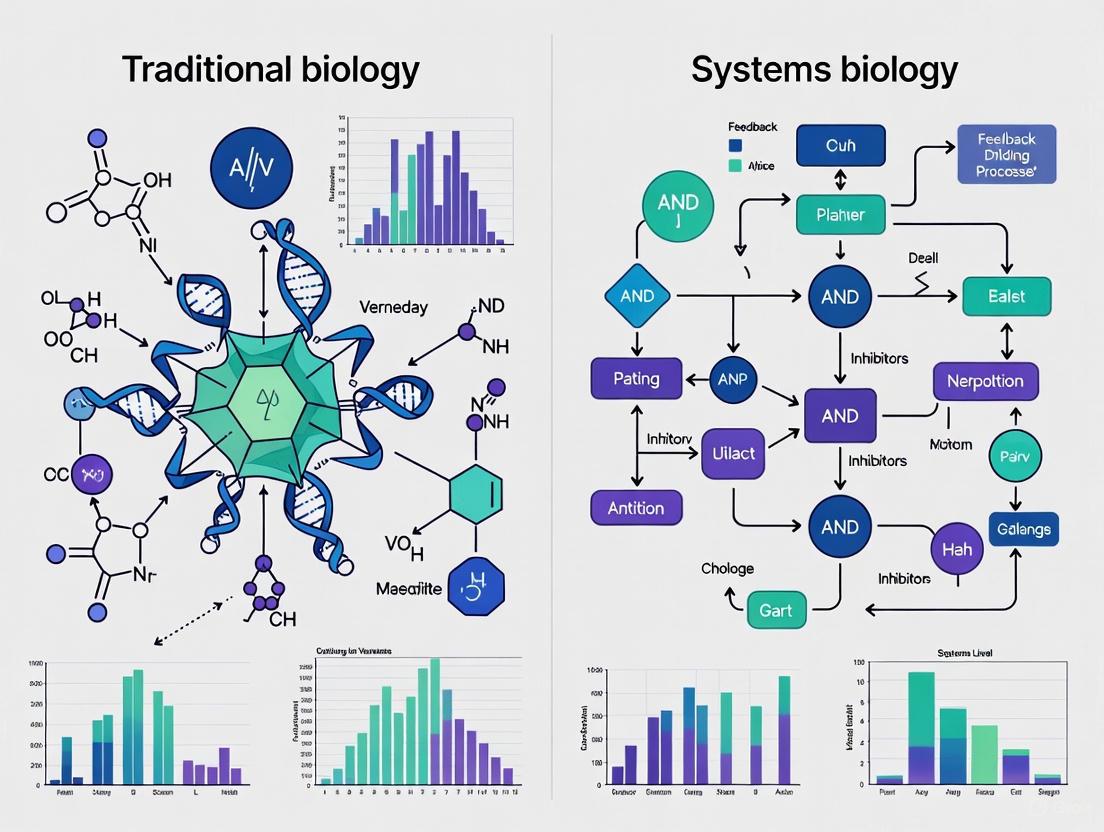
This article provides a comprehensive comparison between traditional reductionist and modern systems biology approaches in biomedical research and drug development.
From Single Targets to Complex Networks: How Systems Biology is Revolutionizing Drug Discovery
Abstract
This article provides a comprehensive comparison between traditional reductionist and modern systems biology approaches in biomedical research and drug development. It explores the foundational principles of each paradigm, detailing the methodological shift from single-target investigation to network-based analysis. The content covers practical applications of systems biology in identifying drug targets, optimizing combinations, and stratifying patients, while also addressing the computational and experimental challenges inherent in modeling complex biological systems. Through comparative analysis of clinical translation success and efficacy in tackling complex diseases, the article demonstrates how systems biology provides a more holistic framework for understanding disease mechanisms and developing effective therapeutics. Aimed at researchers, scientists, and drug development professionals, this review synthesizes current evidence to highlight both the transformative potential and ongoing limitations of systems biology in advancing precision medicine.
Reductionism vs Holism: Paradigm Shifts in Biological Research
The traditional reductionist approach has been the predominant paradigm in biological science and medicine for centuries. Rooted in the Cartesian method of breaking complex problems into smaller, simpler, and more tractable units, reductionism operates on the fundamental assumption that understanding individual components in isolation is sufficient to explain the behavior of the whole system [1] [2]. In practice, this means that biological organisms are treated as collections of distinct parts, with the expectation that by deconstructing a system to its molecular foundations—genes, proteins, and pathways—we can ultimately reconstruct and comprehend its complete functioning. This "divide and conquer" strategy has driven tremendous successes in modern medicine, enabling the identification of specific pathogens responsible for infections, the development of targeted therapies, and the meticulous mapping of linear metabolic pathways [2].
However, the reductionist worldview carries inherent limitations in its conceptualization of biological organization. By focusing on a singular, dominant factor for each disease state, emphasizing static homeostasis over dynamic regulation, and employing additive treatments for multiple system dysfunctions, reductionism often neglects the complex interplay between components that yields emergent behaviors unpredicted by investigating parts in isolation [2]. As molecular biology has evolved into the post-genomic era, the shortcomings of this exclusively reductionist perspective have become increasingly apparent when confronting multifactorial diseases and complex phenotypic traits that cannot be explained by single genetic mutations or linear causal pathways [1] [3]. The very success of reductionism in cataloging biological components has revealed the necessity of complementary approaches that can address system-wide behaviors arising from dynamic interactions.
Core Principles and Methodologies
Fundamental Tenets of Reductionism
Reductionist biology is characterized by several interconnected principles that guide its application in research and medicine. First, it maintains that complex biological phenomena can be fully explained through the properties of their constituent molecular components, implying a direct determinism between molecular states and system outcomes [1]. This principle manifests experimentally through the isolation of single variables under controlled conditions to establish causal relationships, with the expectation that biological behavior is linear, predictable, and deterministic rather than stochastic or emergent [1]. The approach further assumes that multiple system problems can be addressed through additive treatments—solving each issue individually without accounting for complex interplay between interventions [2]. Finally, reductionism conceptualizes biological regulation through the lens of static homeostasis, emphasizing the maintenance of physiological parameters within normal ranges rather than dynamic stability achieved through continuous adaptation [2].
Characteristic Methodological Framework
The experimental implementation of reductionism follows a consistent pattern across biological disciplines. The central method involves controlled manipulation of individual components—whether genes, proteins, or pathways—to reveal their specific functions within cells or organisms [4]. These manipulations typically employ strong experimental perturbations, such as gene knockouts or pharmacological inhibition, that "vex nature" by isolating component function from its systemic context [4]. The analysis then focuses on predefined, limited readouts rather than comprehensive system monitoring, building knowledge incrementally by studying one component or pathway at a time [4]. This methodological framework has proven exceptionally powerful for establishing causal relationships in signaling pathways and genetic networks, though it necessarily simplifies the complexity of intact biological systems operating under physiological conditions.
Table 1: Key Characteristics of the Traditional Reductionist Approach
| Aspect | Reductionist Perspective |
|---|---|
| System Behavior | Explained by properties of individual components [1] |
| Experimental Approach | Focus on one factor or limited number of factors [1] |
| Causal Relationships | Directly determining factors; linear causality [1] |
| Model Characteristics | Linearity, predictability, determinism [1] |
| Metaphor | Machine/magic bullet [1] |
| Homeostasis | Static maintenance of normal ranges [2] |
| Treatment Strategy | Additive interventions for multiple problems [2] |
Experimental Protocols in Reductionist Research
High-Throughput Behavioral Fingerprinting in Drosophila melanogaster
A contemporary example of reductionist methodology can be found in behavioral neuroscience using model organisms. The "coccinella" framework for Drosophila melanogaster represents a sophisticated reductionist approach to ethomics (high-throughput behavioral analysis) [5]. This protocol employs a distributed mesh of ethoscopes—open-source devices combining Raspberry Pi microcomputers with Raspberry Pi NoIR cameras—to track individual flies in custom-designed arenas. The system operates in real-time tracking mode, analyzing images at the moment of acquisition with a temporal resolution of one frame every 444±127 milliseconds (equivalent to 2.2 fps) at a resolution of 1280×960 pixels [5].
The experimental workflow begins with housing individual flies in circular arenas (11.5mm diameter) containing solidified agar with nutrients alone (control) or nutrients combined with compounds of interest. Animals move freely in a two-dimensional space designed to maintain walking position. The system extracts a minimalist behavioral parameter—maximal velocity over 10-second intervals—creating a monodimensional time series as a behavioral correlate [5]. This data is then processed using Highly Comparative Time-Series Analysis (HCTSA), a computational framework that applies over 7,700 statistical tests to identify discriminative features [5]. Finally, these features enable behavioral classification through machine learning algorithms like linear support vector machines (SVMlinear), creating behavioral fingerprints for different pharmacological treatments [5].
The strength of this reductionist approach was demonstrated through pharmacobehavioral profiling of 17 treatments (16 neurotropic compounds plus solvent control). The system achieved 71.4% accuracy in distinguishing compounds based solely on velocity time-series data, significantly outperforming random classification (5.8%) [5]. Notably, some compounds like dieldrin were identified with 94% accuracy, validating that meaningful biological discrimination can be achieved even with minimalist behavioral representation.
Target-Centric Drug Discovery
In pharmaceutical research, reductionist protocols typically focus on identifying and validating single protein targets followed by developing compounds that modulate their activity. The standard workflow begins with target identification through genetic association studies (e.g., genome-wide association studies), gene expression profiling of diseased versus healthy tissue, or analysis of protein-protein interactions [6]. Candidate targets are then validated using gain-of-function and loss-of-function experiments in cellular models, employing techniques like RNA interference, CRISPR-Cas9 gene editing, or overexpression systems [3].
Successful target validation leads to high-throughput screening of compound libraries against the purified target protein or cellular pathway, typically measuring a single readout such as binding affinity, enzymatic activity, or reporter gene expression [6]. Hit compounds are optimized through structure-activity relationship studies that systematically modify chemical structure to enhance potency, selectivity, and drug-like properties [6]. Finally, lead compounds undergo efficacy testing in animal models that measure predefined endpoints related to the specific target pathway, followed by safety assessment in toxicology studies focusing on standard parameters [6].
This reductionist drug discovery paradigm has produced numerous successful therapeutics, particularly for diseases with well-defined molecular pathologies. However, its limitations become apparent when addressing complex, multifactorial diseases where single-target modulation proves insufficient to reverse pathological states [7].
The Scientist's Toolkit: Essential Research Reagents
Table 2: Key Research Reagents in Reductionist Biological Research
| Reagent/Category | Function in Reductionist Research |
|---|---|
| CRISPR-Cas9 Systems | Targeted gene editing for loss-of-function and gain-of-function studies [3] |
| RNAi Libraries | Gene silencing for systematic functional screening [3] |
| Monoclonal Antibodies | Specific protein detection, quantification, and inhibition [6] |
| Chemical Inhibitors/Agonists | Pharmacological manipulation of specific protein targets [5] |
| Reporter Constructs | Measurement of pathway activity through fluorescent or luminescent signals [6] |
| knockout Model Organisms | Investigation of gene function in intact biological systems [3] |
| siRNA/shRNA | Transient or stable gene silencing in cellular models [6] |
| Recombinant Proteins | In vitro studies of protein function and compound screening [6] |
Reductionism in the Context of Systems Biology
Philosophical and Methodological Contrast
The emergence of systems biology represents both a complement and challenge to traditional reductionism. Where reductionism seeks to explain biological phenomena by breaking systems into constituent parts, systems biology aims to understand how these parts interact to produce emergent behaviors [1]. This fundamental difference in perspective leads to distinct methodological approaches: reductionism focuses on one or few factors in isolation, while systems biology considers multiple factors simultaneously in dynamic interaction [1]. The metaphors differ significantly—reductionism views biological systems as machines with replaceable parts, while systems biology employs network metaphors emphasizing connectivity and interdependence [1].
The conceptualization of causality further distinguishes these approaches. Reductionism posits direct, linear causal relationships where manipulating a component produces predictable, proportional effects [1]. In contrast, systems biology recognizes nonlinear relationships where effects may be disproportionate to interventions and highly dependent on system context and state [1]. Similarly, where reductionism emphasizes static homeostasis maintained through negative feedback, systems biology incorporates dynamic stability concepts including oscillatory behavior and chaotic dynamics that remain stable despite apparent variability [2] [4].
Convergence and Complementarity
Despite their philosophical differences, reductionist and systems approaches are increasingly recognized as complementary rather than mutually exclusive [3]. Reductionist methods provide the essential component-level understanding that forms the foundation for systems modeling, while systems perspectives help contextualize reductionist findings within integrated networks [3]. Modern biological research often employs iterative cycles between these approaches—using reductionist methods to characterize individual elements, systems approaches to identify emergent properties, and further reductionist experiments to mechanistically test hypotheses generated from systems-level observations [3] [4].
This convergence is particularly evident in the analysis of complex traits, where forward genetics (reductionist) and network approaches (systems) together provide more complete understanding than either could alone [3]. Similarly, in drug discovery, target-based approaches (reductionist) and network pharmacology (systems) are increasingly integrated to address the limitations of single-target therapies for complex diseases [7] [6]. The combination of detailed molecular knowledge from reductionism with holistic perspectives from systems biology offers a more comprehensive path toward understanding biological complexity.
Comparative Analysis: Key Differences and Applications
Table 3: Reductionist versus Systems Approaches in Biological Research
| Research Aspect | Reductionist Approach | Systems Approach |
|---|---|---|
| Primary Focus | Individual components in isolation [1] | System as a whole and interactions between components [1] |
| Experimental Design | Controlled manipulation of single variables [1] | Multiple simultaneous measurements under physiological conditions [8] |
| Data Type | Limited, predefined readouts [4] | High-dimensional omics data (genomics, transcriptomics, proteomics, metabolomics) [8] [7] |
| Model Characteristics | Linear, deterministic, predictable [1] | Nonlinear, stochastic, sensitive to initial conditions [1] |
| Causal Interpretation | Direct, linear causality [1] | Emergent properties from network interactions [1] |
| Treatment Paradigm | Single-target therapies [7] | Multi-target, combination therapies [7] |
| Health Conceptualization | Static homeostasis, normal ranges [2] | Robustness, adaptability, homeodynamics [1] |
| Strengths | Establishing causal mechanisms, target identification [3] [6] | Understanding complex diseases, predicting emergent effects [8] [7] |
| Limitations | Poor prediction of system behavior, overlooking compensatory mechanisms [2] [4] | Complexity of models, requirement for large datasets, challenging validation [8] [4] |
The traditional reductionist approach has provided the foundational methodology for modern biological research, enabling tremendous advances in understanding molecular mechanisms underlying health and disease. Its power to establish clear causal relationships through controlled manipulation of isolated components remains indispensable for mechanistic inquiry. However, the limitations of reductionism become apparent when confronting biological complexity—where emergent properties arise from dynamic interactions that cannot be predicted from studying individual components alone [1] [4].
The ongoing convergence of reductionist and systems approaches represents the most promising path forward for biological research [3]. Reductionism continues to provide essential component-level understanding and methodological rigor, while systems biology offers frameworks for integrating this knowledge into network models that better reflect biological reality [3] [4]. This synergy is particularly valuable in drug discovery, where the combination of target-based approaches and network pharmacology may overcome limitations of single-target therapies for complex diseases [7] [6]. Rather than representing competing paradigms, reductionism and systems biology increasingly function as complementary perspectives, each necessary for a complete understanding of biological organization across scales.
Reductionist Research Workflow
Systems Biology Research Workflow
The study of biology has undergone a fundamental transformation with the emergence of systems biology, representing a significant departure from traditional reductionist approaches. Where traditional biology has excelled at isolating and examining individual components—single genes, proteins, or pathways—systems biology investigates how these components interact to produce emergent behaviors that cannot be predicted from studying parts in isolation [9]. This paradigm shift recognizes that biological networks, from intracellular signaling pathways to entire ecosystems, exhibit properties that arise from the complex, non-linear interactions between their constituent parts [10] [9].
The foundation of systems biology rests upon the core principle that "the whole is more than the sum of its parts," a concept known as emergence [10]. This approach has become increasingly vital as technologies generate vast amounts of high-resolution data characterizing biological systems across multiple scales, from molecules to entire organisms [11]. By integrating quantitative measurements, computational modeling, and engineering principles, systems biology provides a framework for understanding how evolved systems are organized and how intentional synthesis of biological systems can be achieved [12] [9].
Core Principles of Systems Biology
Emergence as a Foundational Concept
Emergence describes the phenomenon where complex patterns, properties, or behaviors arise from interactions among simpler components [10]. In biological systems, emergent properties manifest across all scales of organization:
- Cellular Level: Individual neurons transmit electrical impulses, but consciousness, cognition, and memory emerge only when billions connect to form neural networks [10].
- Organismal Level: Heart tissues individually cannot pump blood, but their coordinated organization produces the emergent property of rhythmic contraction [10].
- Social Level: Individual ants follow simple behavioral rules, but colonies collectively exhibit intelligent problem-solving and complex construction abilities [10].
Professor Michael Levin's research on xenobots—programmable living organisms constructed from frog cells—demonstrates emergence in action. These cell assemblies exhibit movement, self-repair, and environmental responsiveness without any neural circuitry, their behaviors emerging purely from cellular interactions and organization [10].
Key Drivers of Emergent Properties
Several interconnected principles govern how emergent properties arise in biological networks:
- Interactions: Emergence depends on communication between components, whether through electrical and chemical signals in neural networks or bioelectric gradients guiding cellular decision-making [10].
- Self-Organization: Biological systems often structure themselves without external instructions, as seen in bird flocking or cellular self-organization guided by bioelectric cues [10].
- Hierarchies of Organization: Life operates through nested hierarchies from molecules to organisms, with higher-level properties emerging from lower-level interactions [10].
Comparative Analysis: Traditional vs. Systems Biology Approaches
Table 1: Fundamental Differences Between Traditional and Systems Biology Approaches
| Aspect | Traditional Biology | Systems Biology |
|---|---|---|
| Primary Focus | Individual components (genes, proteins) | Networks and interactions between components [9] |
| Methodology | Qualitative description, hypothesis-driven | Quantitative measurement, modeling, hypothesis-generating [13] [9] |
| Scope | Isolated pathways or processes | Multi-scale integration from molecules to organisms [11] [13] |
| Data Type | Low-throughput, targeted measurements | High-throughput 'omics' data (transcriptomics, proteomics, metabolomics) [13] [9] |
| Understanding | Mechanism of specific elements | Emergent system properties and dynamics [10] [9] |
| Modeling Approach | Minimal use of mathematical models | Essential dependency on computational models [13] [9] |
Table 2: Analytical Outputs and Capabilities Comparison
| Output Capability | Traditional Biology | Systems Biology |
|---|---|---|
| Predictive Power | Limited to direct linear relationships | Predictive for complex, non-linear behaviors [13] |
| Treatment Development | Target-specific drugs, often with limited efficacy | Network pharmacology, multi-target therapies [13] |
| Disease Understanding | Single-factor causation | Multi-factorial, network-based dysfunction [13] |
| Experimental Design | One-variable-at-a-time | Multi-perturbation analyses [9] |
| Time Resolution | Static snapshots | Dynamic, temporal modeling [13] [9] |
Experimental Frameworks in Systems Biology
Methodological Pillars
Systems immunology exemplifies the systems biology approach through several methodological pillars [13]:
- Network Pharmacology: Examining drug effects within the context of interconnected biological pathways rather than isolated targets [13].
- Quantitative Systems Pharmacology: Integrating pharmacokinetic and pharmacodynamic modeling with systems biology to optimize therapeutic strategies [13].
- Artificial Intelligence and Machine Learning: Extracting patterns from high-dimensional data to predict immune responses, identify biomarkers, and discover novel pathways [13].
Representative Experimental Protocol
A typical systems biology investigation involves an integrated workflow that combines high-throughput data collection with computational modeling:
The Scientist's Toolkit: Essential Research Reagents and Technologies
Table 3: Key Research Reagents and Technologies in Systems Biology
| Reagent/Technology | Function | Application Example |
|---|---|---|
| Single-cell RNA sequencing | Resolution of cellular heterogeneity and rare cell states [13] | Identification of novel immune cell subtypes in disease [13] |
| Mass cytometry (CyTOF) | High-dimensional protein measurement at single-cell level [13] | Immune cell profiling in autoimmune conditions [13] |
| Bioelectric signaling tools | Measurement and manipulation of cellular electrical gradients [10] | Studying pattern formation in development and regeneration [10] |
| CRISPR-based perturbations | High-throughput functional screening of genetic elements [14] | Mapping genetic interaction networks [14] |
| Mathematical modeling frameworks | Quantitative representation of system dynamics [13] [9] | Predicting immune response outcomes to pathogens [13] |
| AI/ML algorithms | Pattern recognition in high-dimensional data [13] | Biomarker discovery and treatment response prediction [13] |
Case Study: Systems Immunology in Therapeutic Development
The immune system exemplifies biological complexity, comprising approximately 1.8 trillion cells utilizing around 4,000 distinct signaling molecules [13]. This complexity makes it particularly suited for systems biological approaches. Systems immunology has emerged as a distinct field that integrates omics technologies with computational modeling to predict immune system behavior and develop more effective treatments [13].
Application to Disease Research
Systems immunology approaches have transformed our understanding of immune-related diseases:
- Autoimmune Diseases: Multi-omics data integrated with ML models have improved diagnostics and identified novel pathways in autoimmune and inflammatory diseases [13].
- Cancer Immunotherapy: AI models analyze complex tumor-immune interactions to predict treatment responses and identify resistance mechanisms [13].
- Vaccine Development: Systems approaches have been used to predict vaccine responsiveness since pioneering studies on the Yellow Fever vaccine [13].
Systems biology represents not a replacement for traditional biological approaches but rather an essential complement. While reductionist methods continue to provide crucial insights into molecular mechanisms, systems biology offers the framework to understand how these mechanisms integrate to produce emergent behaviors [10] [9]. The future of biological research lies in leveraging both approaches: using traditional methods to characterize individual components and systems approaches to understand their integrated functions.
As technological advances continue to generate increasingly detailed quantitative measurements, the role of systems biology will expand further, potentially enabling predictive biology and personalized therapeutic interventions [11] [13] [9]. This integration of approaches promises to unlock deeper insights into the emergent properties that characterize living systems across all scales of biological organization.
The field of biology has undergone a profound conceptual transformation, evolving from a reductionist perspective that viewed biological systems as precise, predictable machinery to a holistic paradigm that embraces complexity, dynamics, and interconnectedness. This shift from mechanical clockwork metaphors to holistic systems thinking represents a fundamental change in how researchers approach biological investigation, particularly in drug discovery and development. The traditional reductionist approach, which dominated 20th-century biology, focused on deconstructing living systems into their component parts—genes, proteins, cells—with the belief that complete understanding would emerge from characterizing these individual elements [15]. This perspective was exemplified by the clockwork metaphor, which depicted biological systems as mechanical assemblies governed by specific rules and mechanisms, predictable in their operations once understood [16].
In contrast, modern systems biology recognizes that "nothing in the living world happens in a vacuum" and that "no life processes proceed in isolation" [15]. This holistic approach acknowledges that biological functions emerge from complex, dynamic networks of interacting components that are highly regulated and adaptive. The transition between these paradigms was driven by multiple factors: the completion of the human genome project, the development of high-throughput technologies generating massive molecular datasets, exponential growth in computational power, and advocacy by influential researchers [15]. This evolution has fundamentally transformed research methodologies, analytical frameworks, and conceptual models across biological sciences, particularly impacting how researchers approach disease mechanisms and therapeutic development.
Metaphorical Evolution: From Clockwork to Complex Systems
The changing landscape of biological thought is reflected in the metaphors used to describe and explain biological systems. These metaphors provide conceptual frameworks that shape research questions, methodologies, and interpretations.
Traditional Mechanical Metaphors
The clockwork metaphor dominated traditional biological thinking, comparing biological systems to precise, predictable mechanical devices like clocks [16]. This perspective emphasized linear causality, determinism, and decomposability—the assumption that system behavior could be fully understood by analyzing individual components in isolation. Related mechanical metaphors included the domino effect, illustrating simple linear causality where one event triggers another in a predictable sequence [16]. These metaphors supported a reductionist approach that has been enormously successful in cataloging biological components but ultimately insufficient for explaining emergent biological functions.
Modern Systems Metaphors
Contemporary biology employs more sophisticated metaphors that better capture the complexity of living systems:
- The Iceberg Metaphor: Represents biological systems as having only a small portion of observable elements above the surface, while most underlying dynamics, feedback loops, and structures remain hidden beneath [16].
- The Ecosystem Metaphor: Emphasizes interdependency, feedback loops, and resilience through comparing biological systems to ecological networks where multiple elements interact in complex ways [16].
- The Network Metaphor: Highlights the interconnected nature of biological components, emphasizing concepts like nodes, links, and network effects [16].
- The Organism Metaphor: Compares systems to living organisms where parts are analogous to organs and their interactions create emergent functions [16].
- The Butterfly Effect: Illustrates how small changes in one part of a system can create significant, unpredictable effects elsewhere, capturing the nonlinearity of biological systems [16].
These evolving metaphors reflect a fundamental reconceptualization of biological systems from deterministic machinery to complex, adaptive networks with emergent properties that cannot be fully understood through reductionist approaches alone.
Methodological Comparison: Traditional versus Systems Approaches
The paradigm shift from reductionist to holistic thinking has manifested in distinct methodological approaches to biological research and drug discovery. The table below summarizes key differences between these frameworks:
Table 1: Methodological Comparison of Traditional and Systems Biology Approaches
| Aspect | Traditional Biology Approaches | Systems Biology Approaches |
|---|---|---|
| Fundamental Perspective | Reductionist; focuses on individual components | Holistic; focuses on system interactions and networks |
| Primary Methodology | Isolated study of linear pathways | Network analysis; integration of multi-omics data |
| Modeling Approach | Qualitative descriptions; limited mathematical formalization | Quantitative mathematical models (ODEs, PDEs, Boolean networks) |
| Typical Data Collection | Targeted measurements of single molecular types | High-throughput multi-omics datasets (genomic, transcriptomic, proteomic, metabolomic) |
| Time Considerations | Often static snapshots | Dynamic measurements over time |
| Regulatory Focus | Limited feedback considerations | Comprehensive analysis of feedback and feedforward loops |
| Representative Metaphor | Clockwork, domino effect | Iceberg, ecosystem, network, butterfly effect |
| Drug Discovery Application | Single-target therapies | Network pharmacology; polypharmacology |
Traditional approaches typically investigated single genes or proteins through tightly controlled experiments that isolated specific pathways from their broader context [17]. In contrast, systems biology employs high-throughput technologies such as microarrays, mass spectrometry, and next-generation sequencing to generate global, multi-omics datasets that capture information across multiple biological levels simultaneously [17] [6]. The systems approach recognizes that "most biological features are determined by complex interactions among a cell's distinct components" rather than by single molecules in isolation [17].
Modeling Frameworks: From Qualitative to Quantitative Representations
The transition from traditional to systems approaches has introduced sophisticated mathematical and computational modeling frameworks to biological research. These frameworks enable researchers to simulate and predict system behavior under different conditions and perturbations.
Qualitative Modeling Approaches
Boolean network models represent a fundamental qualitative approach where biological entities are characterized by binary variables (ON/OFF) and their interactions are expressed using logic operators (AND, OR, NOT) [18]. These models require few or no kinetic parameters and provide coarse-grained descriptions of biological systems, making them particularly valuable when mechanistic details or kinetic parameters remain unknown [18]. The piecewise affine differential equation models (also called hybrid models) occupy a middle ground, combining logical descriptions of regulatory relationships with continuous concentration decay [18]. These models are suitable for systems with partial knowledge of parameter values and have been widely used in literature [18].
Quantitative Modeling Approaches
Quantitative models, usually implemented as sets of differential equations, are considered the most appropriate dynamic approaches for modeling real biological systems [18]. Among these, Hill-type models have been successfully employed in modeling specific signaling networks [18]. In these models, the production rate of a species is modeled by a Hill function and the degradation rate is considered linear, capturing the sigmoid response curves common in biological systems [18]. Quantitative models provide detailed information about real-valued attractors and system dynamics not available in qualitative approaches [18].
Table 2: Comparison of Dynamic Modeling Approaches in Biological Research
| Model Type | Key Characteristics | Data Requirements | Representative Applications |
|---|---|---|---|
| Boolean Models | Binary variables (ON/OFF); logical interactions | Minimal parameters; network topology | Large-scale networks; initial exploratory modeling |
| Piecewise Affine (Hybrid) Models | Combines logical regulation with continuous decay | Partial parameter knowledge; threshold values | Systems with some quantitative data available |
| Hill-Type Continuous Models | Ordinary differential equations with sigmoid functions | Kinetic parameters; detailed mechanistic knowledge | T-cell receptor signaling; cardiac β-adrenergic signaling |
| Network Models | Nodes and edges representing biological entities | Interaction data; omics datasets | Disease pathway mapping; drug target identification |
The integration of these modeling approaches enables researchers to translate between different levels of biological abstraction, from qualitative understanding to quantitative prediction [18]. Comparative studies have shown that while fixed points of asynchronous Boolean models are observed in continuous Hill-type and piecewise affine models, these models may exhibit different attractors under certain conditions [18].
Experimental Design and Protocols in Systems Biology
Systems biology employs distinctive experimental designs that differ significantly from traditional biological approaches. These protocols emphasize comprehensive data collection, integration across biological levels, and computational validation.
Core Workflow for Systems Biology Investigation
The following diagram illustrates a generalized experimental workflow in systems biology research:
Diagram 1: Systems Biology Research Workflow
Detailed Methodological Protocols
Network Reconstruction and Analysis Protocol
Purpose: To reconstruct biological networks from high-throughput data and identify key regulatory components. Methodology:
- Data Collection: Generate genome-wide datasets using appropriate technologies (RNA-Seq, mass spectrometry, etc.) [6].
- Network Construction: Build interaction networks using:
- Topological Analysis: Identify network properties using tools like Cytoscape with plugins for advanced analysis [17].
- Functional Annotation: Annotate networks with functional information using enrichment analysis and Gene Ontology [17].
- Hub Identification: Identify "party hubs" (simultaneous interactions) and "date hubs" (dynamic temporal interactions) [17].
Applications: This approach has been used to identify genetic similarities among diseases and design novel therapeutic interventions [17].
Dynamic Modeling Protocol for Regulatory Networks
Purpose: To create dynamic models that simulate the temporal behavior of biological regulatory networks. Methodology:
- Model Design: Identify key molecular interactions and regulatory logic [18] [8].
- Model Construction: Translate pathway interactions into mathematical formalisms:
- Parameter Estimation: Calibrate model parameters using experimental data [8].
- Model Validation: Test model predictions against independent experimental results [8].
- Therapeutic Simulation: Simulate pharmacological interventions to identify potential targets [6].
Applications: Successfully applied to model T-cell receptor signaling, cardiac β-adrenergic signaling, and various regulatory network motifs [18].
The Scientist's Toolkit: Essential Research Reagents and Technologies
Contemporary systems biology research requires specialized reagents and technologies that enable comprehensive data generation and analysis. The following table details key solutions essential for implementing systems approaches:
Table 3: Essential Research Reagent Solutions for Systems Biology
| Reagent/Technology | Function | Application in Systems Biology |
|---|---|---|
| High-Throughput Sequencing Platforms | Genome-wide characterization of DNA and RNA | Transcriptomics; epigenomics; variant identification [6] |
| Mass Spectrometry Systems | Large-scale protein and metabolite identification and quantification | Proteomics; phosphoproteomics; metabolomics [6] |
| CRISPR Screening Tools | Genome-wide functional perturbation | Gene function identification; network validation; drug target discovery [19] |
| Single-Cell Sequencing Kits | Characterization of cellular diversity at individual cell level | Cellular heterogeneity mapping; tumor microenvironment analysis [19] |
| Bioinformatics Software Suites | Data integration, network analysis, and visualization | Pathway mapping; network modeling; multi-omics integration [17] |
| AI/ML Analysis Platforms | Pattern recognition in complex datasets | Drug discovery; biomarker identification; protein folding prediction [19] [20] |
| Cell Signaling Assays | Measurement of pathway activation states | Network perturbation analysis; drug mechanism studies [6] |
These tools enable the generation of multidimensional datasets that capture information across multiple biological levels, facilitating the reconstruction of comprehensive network models [6]. The integration of AI-powered platforms like DeepVariant for genomic analysis and AlphaFold for protein structure prediction represents particularly advanced tools that are accelerating systems biology research [19].
Applications in Drug Discovery and Development
The transition from traditional to systems approaches has particularly transformed pharmaceutical research, enabling more comprehensive understanding of disease mechanisms and therapeutic strategies.
Target Identification and Validation
Traditional target identification focused on differentially regulated genes, often with poor correlation to protein expression and limited efficacy [6]. Systems approaches employ network-based target identification that considers:
- Causal network models representing directed relations between biological objects [6]
- Network medicine approaches that analyze disease modules within interactomes [6]
- Multi-omics integration to identify master regulators within disease networks [6]
This approach has been successfully applied to various cancers, identifying novel therapeutic targets through analysis of dysregulated networks rather than individual genes [6].
Drug Mechanism and Polypharmacology
Systems biology enables comprehensive analysis of drug mechanisms through:
- BioMAP platforms using primary human cell-based assays and predictive analysis tools [6]
- Network pharmacology analyzing drug effects on multiple targets simultaneously [6]
- Mechanism of action studies using proteomic and transcriptomic signatures [6]
These approaches recognize that most effective drugs act on multiple targets rather than single proteins, providing a framework for understanding polypharmacology [6].
Biomarker Discovery and Personalized Medicine
Systems approaches have accelerated biomarker discovery through:
- Integrative analysis of tissue transcriptomics and urine metabolomics [6]
- Classification algorithms that group patients based on molecular signatures [6]
- Network-based stratification of complex diseases into distinct subtypes [6]
These applications facilitate the development of personalized treatment strategies tailored to individual molecular profiles [6].
Conceptual Foundations: Visualizing Pathway Relationships
The conceptual difference between traditional and systems approaches can be visualized through their representation of biological pathways:
Diagram 2: Linear vs Feedback Pathway Structures
The traditional perspective (top) views pathways as linear sequences without regulatory feedback, while systems approaches (bottom) incorporate complex feedback interactions that create emergent behaviors and nonlinear dynamics [15]. Studies comparing these structures have demonstrated that while linear pathways respond predictably to perturbations, feedback pathways exhibit complex, often counterintuitive behaviors that cannot be understood through reductionist analysis alone [15].
Future Perspectives and Emerging Trends
The evolution from mechanical to holistic thinking in biology continues to accelerate, with several emerging trends shaping future research directions:
AI and Machine Learning Integration: Advanced AI tools are being incorporated into systems biology workflows for pattern recognition, prediction, and data integration [19] [20]. These technologies enable analysis of complex datasets beyond human comprehension capacity.
Multi-Scale Modeling Approaches: Future modeling frameworks aim to connect molecular, cellular, tissue, and organism levels into unified computational representations [15].
Single-Cell Resolution: Technologies enabling analysis at individual cell resolution are revealing previously unappreciated heterogeneity in biological systems [19].
Digital Twins in Medicine: The creation of virtual patient models that simulate individual disease processes and treatment responses represents an emerging application of systems approaches [20].
Unified Quantitative Frameworks: Efforts are underway to develop shared languages and frameworks connecting statistical and mathematical modeling traditions in biology [21].
These developments promise to further transform biological research and therapeutic development, continuing the conceptual evolution from mechanical simplicity to embracing biological complexity.
The pursuit of biological knowledge has historically been guided by two contrasting epistemological approaches: traditional reductionist biology and systems biology. These frameworks differ fundamentally in how they conceptualize living organisms, formulate research questions, and validate biological knowledge. Reductionist biology, dominant throughout the 20th century, operates on the premise that complex systems are best understood by investigating their individual components in isolation [15] [17]. This approach has yielded enormous successes, including the characterization of molecular inventories and metabolic pathways. In contrast, systems biology represents a philosophical shift toward understanding biological phenomena as emergent properties of complex, dynamic networks [17] [22]. It contends that system components seldom reveal functionality when studied in isolation, and that means of reconstructing integrated systems from their parts are required to understand biological phenomena [15]. This epistemological comparison examines how these competing frameworks construct biological knowledge through different conceptual lenses, methodological tools, and validation criteria, with significant implications for research and drug development.
Philosophical Underpinnings and Conceptual Frameworks
Reductionist Biology: The Analytical Tradition
Reductionist biology stems from Cartesian analytical traditions, positing that complex biological phenomena can be completely understood by decomposing systems into their constituent parts and studying each element individually [15] [22]. This epistemology assumes that interactions between parts are weak enough to be neglected in initial analyses, and that relationships describing part behavior are sufficiently linear [22]. Knowledge construction follows a linear-causal model where understanding component A and component B independently should enable prediction of their joint behavior. The reductionist approach creates knowledge through carefully controlled experiments that isolate variables, with the epistemological ideal being that complete knowledge of molecular inventories would eventually explain the functionality of life [15]. This framework has dominated molecular and cellular biology education, emphasizing qualitative understanding of discrete biological entities and processes [23] [24].
Systems Biology: The Holistic Synthesis
Systems biology represents a philosophical return to holistic perspectives on living organisms, echoing historical views of the human body as an integrated system as seen in Greek, Roman, and East Asian medicine [15]. Its epistemology contends that "nothing in the living world happens in a vacuum" and "no life processes proceed in isolation" [15]. Knowledge construction follows a network model where understanding emerges from analyzing interactions and relationships between components. This framework explicitly recognizes that biological functionality arises from complex, dynamic systems consisting of uncounted parts and processes that are highly regulated [15]. The systems approach acknowledges that many genetic changes alter gene expression, but emphasizes that decades of research demonstrate how genetic variations bring about the molecular events that induce diseases and phenotypes through complex network interactions [17]. Rather than focusing on single molecules or signaling pathways, systems biology strategies focus on global analysis of multiple interactions at different levels, reflecting the true nature of biological processes determined by complex interactions among a cell's distinct components [17].
Table 1: Philosophical Foundations of Biological Epistemologies
| Epistemological Aspect | Reductionist Biology | Systems Biology |
|---|---|---|
| Fundamental Unit of Analysis | Isolated components (genes, proteins, pathways) | Networks, interactions, and emergent properties |
| Conceptualization of Causality | Linear causality | Multidirectional, complex causality |
| Knowledge Validation Criteria | Reproducibility under controlled isolation | Predictive power for system behavior |
| View of Biological Regulation | One-to-one mapping | Distributed control through interactive networks |
| Educational Approach | Qualitative description of discrete entities [24] | Integration of quantitative skills with biological concepts [23] |
Methodological Approaches and Experimental Design
Reductionist Methodologies: Isolation and Control
Reductionist biology employs methodological strategies designed to isolate variables and establish causal relationships through controlled experimentation. The epistemological strength of this approach lies in its ability to eliminate confounding factors and establish clear cause-effect relationships. Key methodological principles include:
- Single-Variable Focus: Experimental designs that manipulate one variable while holding others constant to establish causal links [24].
- Component Isolation: Studying biological entities (genes, proteins, metabolic reactions) outside their native contexts through techniques like protein purification, single-gene knockouts, and in vitro assays.
- Linear Pathway Modeling: Conceptualizing metabolic and signaling processes as sequential, linear pathways [15].
The reductionist approach has been enormously successful in characterizing biological components, with methodological frameworks deeply embedded in traditional biology education that emphasizes qualitative understanding of discrete entities [23] [24].
Systems Methodologies: Integration and Perturbation
Systems biology employs a recursive, iterative methodology that combines computational model building with experimental validation [22]. The epistemological foundation rests on understanding systems through their responses to perturbations. Key methodological principles include:
- High-Throughput Omics Technologies: Simultaneous measurement of system components (genomics, transcriptomics, proteomics, metabolomics) to capture global states [25] [17].
- Iterative Computational Modeling: The "model as hypothesis" approach where computational models are continuously refined through experimental testing [22].
- Network Analysis: Using graph theory to represent biological relationships, where nodes symbolize system constituents and links represent interactions [17].
- Multi-Scale Integration: Combining data across biological hierarchies from molecules to organisms [24].
Systems biology methodologies can be categorized into bottom-up approaches (building models from known network components and interactions) and top-down approaches (inferring networks from large datasets) [22]. Both approaches aim to understand how biological functions emerge from network properties rather than individual components.
Table 2: Methodological Comparison in Biological Research
| Methodological Aspect | Reductionist Biology | Systems Biology |
|---|---|---|
| Experimental Design | Isolated variable testing | System perturbation and response analysis |
| Data Collection | Targeted, hypothesis-driven measurements | Untargeted, high-throughput profiling [25] [17] |
| Model Building | Descriptive, graphical representations | Mathematical, computational models [15] [22] |
| Analysis Approach | Statistical comparisons between groups | Multivariate, network, and pattern analysis [17] [22] |
| Key Technologies | PCR, Western blot, enzyme assays | Microarrays, sequencing, mass spectrometry [17] |
Knowledge Representation and Modeling Frameworks
Reductionist Representations: Discrete and Qualitative
Reductionist biology represents knowledge through discrete, qualitative models that emphasize sequence, structure, and linear relationships. Knowledge is typically organized in mental categories that reflect mechanistic entities, with common student conflation between these categories representing a significant learning challenge [24]. Traditional biological models include:
- Descriptive Pathway Diagrams: Linear representations of metabolic and signaling pathways.
- Structural Models: Three-dimensional representations of biological molecules.
- Sequence Representations: Linear depictions of genetic information flow (DNA → RNA → protein).
These representations excel at communicating discrete biological mechanisms but struggle to capture dynamic, emergent system behaviors. Educational research reveals that students learning through reductionist approaches often develop fragmented knowledge structures with limited integration between related concepts [24].
Systems Representations: Networked and Quantitative
Systems biology represents knowledge through quantitative, computational models that emphasize interactions, dynamics, and emergent properties. Knowledge integration involves creating connections between ideas and building complex knowledge structures through iterative processes [24]. Representative modeling approaches include:
- Network Models: Using graph theory to represent interactions between biological components [17].
- Dynamic Simulations: Mathematical models (e.g., differential equations) that capture system behavior over time [15].
- Constraint-Based Models: Genome-scale metabolic reconstructions that simulate organismal metabolism [22].
- Multi-Scale Models: Integrative frameworks connecting molecular, cellular, and physiological levels.
These representations explicitly capture the dynamic, interconnected nature of biological systems, with educational interventions demonstrating that integrating quantitative reasoning into biological education enhances students' ability to understand complex biological systems [23].
Knowledge Construction Pathways: This diagram illustrates how reductionist and systems biology approaches follow different pathways to construct biological knowledge, with reductionism building from discrete components through linear causality to qualitative models, while systems biology builds from integrated networks through emergent properties to dynamic simulations.
Experimental Applications and Case Studies
Reductionist Experimentation: Enzyme Kinetics
The reductionist approach is exemplified by traditional enzyme kinetics studies, particularly the Michaelis-Menten theory developed in 1913 [26]. This epistemological framework constructs knowledge through controlled in vitro conditions that eliminate cellular complexity:
Experimental Protocol: Michaelis-Menten Enzyme Kinetics
- Reagent System: Purified enzyme, substrate, and buffer solution isolated from cellular context.
- Initial Rate Measurements: Reaction velocities measured under conditions where substrate concentration exceeds enzyme concentration.
- Parameter Estimation: Determination of KM and Vmax through linear transformations (Lineweaver-Burk plot) or nonlinear regression.
- Mechanistic Interpretation: Inference of catalytic mechanism from kinetic parameters.
This approach successfully characterizes molecular-level enzyme behavior but cannot predict enzyme function in native cellular environments where multiple enzymes compete for substrates and products inhibit reactions through feedback mechanisms [15].
Systems Experimentation: Network Analysis in Complex Diseases
Systems biology approaches complex diseases as emergent properties of disrupted biological networks rather than consequences of single gene defects [17]. This epistemological framework constructs knowledge through multi-omics data integration and network medicine:
Experimental Protocol: Network-Based Disease Gene Discovery
- Data Acquisition: Collection of genomic, transcriptomic, and proteomic profiles from disease and control tissues.
- Network Construction: Building protein-protein interaction networks using databases like STRING or experimental data [17].
- Topological Analysis: Identification of network hubs, bottlenecks, and modules using tools like Cytoscape [17].
- Functional Validation: Experimental perturbation of candidate genes in model systems to test predictions.
This approach has successfully identified disease modules for conditions like type 2 diabetes, demonstrating that complex diseases are jointly contributed by alterations of numerous genes that coordinate as functional biological pathways or networks [25].
Table 3: Experimental Applications in Disease Research
| Research Aspect | Reductionist Approach | Systems Approach |
|---|---|---|
| Disease Conceptualization | Single gene or protein defects | Network perturbations and module dysregulation [17] |
| Therapeutic Target Identification | Single target molecules | Network neighborhoods and regulatory nodes [17] |
| Experiment Scale | Individual molecule focus | Genome-scale analyses [22] |
| Validation Strategy | Single variable manipulation | Multiple perturbation testing |
| Success Examples | Enzyme replacement therapies | Network-based drug repositioning |
The Scientist's Toolkit: Essential Research Reagents and Solutions
Biological knowledge construction relies on specialized research tools and reagents that reflect the epistemological priorities of each approach. These essential materials enable the experimental methodologies characteristic of reductionist and systems frameworks.
Table 4: Essential Research Reagents and Solutions
| Reagent/Solution | Primary Research Approach | Function in Knowledge Construction |
|---|---|---|
| Purified Enzymes/Proteins | Reductionist | Enables characterization of molecular function in isolation from cellular context [26] |
| Specific Inhibitors/Agonists | Reductionist | Facilitates controlled perturbation of individual system components to establish causal relationships |
| Cloning Vectors & Expression Systems | Reductionist | Allows study of gene function through controlled overexpression or knockout in model systems |
| Omics Profiling Kits | Systems | Enables comprehensive measurement of biological molecules (genes, transcripts, proteins, metabolites) [25] [17] |
| Network Analysis Software | Systems | Facilitates visualization and analysis of complex biological relationships (e.g., Cytoscape) [17] |
| Constraint-Based Modeling Tools | Systems | Supports simulation of system-level behaviors from network reconstructions [22] |
Experimental Workflows Comparison: This diagram contrasts the linear workflow characteristic of reductionist biology with the iterative, recursive workflow of systems biology, highlighting how each approach structures the process of knowledge construction from biological questions.
Educational Implications and Knowledge Transmission
The epistemological differences between reductionist and systems biology profoundly influence how biological knowledge is transmitted to future generations of scientists. Traditional biology education has predominantly emphasized reductionist approaches, focusing on qualitative understanding of discrete biological components [23] [24]. This educational model often fails to equip students with the quantitative skills necessary for modern biological research, perpetuating the perception that biology is relatively math-free [23].
Systems biology education represents a paradigm shift, integrating quantitative skills with biological concepts throughout the curriculum [23] [27]. This approach recognizes that understanding complex biological systems requires students to develop integrated knowledge networks that are both productively organized and flexibly dynamic [24]. Educational research demonstrates that students must sort mechanistic entities into appropriate mental categories and that conflation between these categories is common without explicit instructional support [24].
The challenges of systems biology education include balancing depth and breadth across disciplines, integrating experimental and computational approaches, and developing adaptive curricula that keep pace with rapidly evolving methodologies [27]. Successful educational models incorporate active learning approaches, project-based coursework, and iterative model-building exercises that reflect the recursive nature of systems science [27].
Reductionist and systems biology represent complementary rather than contradictory approaches to constructing biological knowledge. Each epistemology offers distinct strengths: reductionism provides detailed mechanistic understanding of individual components, while systems biology reveals emergent properties and network behaviors. The future of biological research lies in leveraging both approaches through iterative cycles of deconstruction and reconstruction [15] [22].
This epistemological synthesis is particularly crucial for addressing complex challenges in drug development and therapeutic innovation, where both detailed molecular mechanisms and system-level responses determine clinical outcomes. As systems biology continues to evolve and integrate with artificial intelligence approaches [28], its epistemological framework will further transform how we conceptualize, investigate, and understand the profound complexity of living systems.
For decades, drug discovery has predominantly followed a "single target, single disease" model, aiming to develop highly selective drugs that interact with one specific protein or pathway [29]. This approach has demonstrated success in treating monogenic diseases and conditions with well-defined molecular mechanisms. However, clinical data increasingly reveal that single-target drugs often prove insufficient for interfering with complete disease networks in complex disorders, frequently leading to limited therapeutic efficacy, development of drug resistance, and adverse side effects [29]. The recognition of these limitations has catalyzed a fundamental shift in pharmaceutical research toward multi-target strategies and systems biology approaches that acknowledge and address the complex, interconnected nature of pathological processes [30].
Complex diseases such as cancer, neurodegenerative disorders, epilepsy, and diabetes involve highly intricate etiologies with multifaceted pathophysiological mechanisms [29]. These diseases typically arise from dysregulations across multiple molecular networks rather than isolated defects at single points [30]. The inherent biological complexity of these conditions presents fundamental challenges to single-target interventions, necessitating innovative approaches that consider the system-wide behavior of disease networks. This case study examines the scientific evidence demonstrating the limitations of single-target drugs in complex disease treatment and explores the emerging paradigm of network-based therapeutic strategies.
The Inadequacy of Single-Target Approaches in Complex Diseases
Scientific Evidence from Clinical and Preclinical Studies
Substantial evidence from both clinical practice and preclinical research demonstrates the limitations of single-target therapies in complex disease management. In oncology, for instance, targeted therapies designed to inhibit specific cancer-driving proteins initially show promising results, but their efficacy is often limited by the development of resistance mechanisms. Cancer cells frequently activate alternative pathways or undergo mutations that bypass the inhibited target, leading to treatment failure [31]. This phenomenon of resistance development is particularly problematic in single-target approaches, as the biological system finds new ways to maintain the disease state despite precise intervention at one node [29].
In neurological disorders, similar limitations are evident. Epilepsy represents a compelling case where single-target antiseizure medications (ASMs) frequently prove inadequate for treatment-resistant forms of the condition [32]. Preclinical data from animal models demonstrates that single-target ASMs show significantly reduced efficacy in challenging seizure models such as the 6-Hz corneal kindling test at higher current strengths, whereas multi-target ASMs consistently exhibit broader therapeutic profiles across multiple models [32]. The table below summarizes comparative efficacy data of single-target versus multi-target ASMs across standardized preclinical seizure models:
Table 1: Comparative Efficacy of Single-Target vs. Multi-Target Antiseizure Medications in Preclinical Models [32]
| Compound | Primary Targets | ED50 (mg/kg) in MES test | ED50 (mg/kg) in s.c. PTZ test | ED50 (mg/kg) in 6-Hz (44 mA) test |
|---|---|---|---|---|
| Single-Target ASMs | ||||
| Phenytoin | Voltage-activated Na+ channels | 9.5 | NE | NE |
| Carbamazepine | Voltage-activated Na+ channels | 8.8 | NE | NE |
| Lacosamide | Voltage-activated Na+ channels | 4.5 | NE | 13.5 |
| Ethosuximide | T-type Ca2+ channels | NE | 130 | NE |
| Multi-Target ASMs | ||||
| Valproate | GABA synthesis, NMDA receptors, Na+ & Ca2+ channels | 271 | 149 | 310 |
| Topiramate | GABAA & NMDA receptors, Na+ channels | 33 | NE | 126 |
| Cenobamate | GABAA receptors, persistent Na+ currents | 9.8 | 28.5 | 16.4 |
| Padsevonil | SV2A,B,C and GABAA receptors | 92.8 | 4.8 | 2.43 |
ED50 = Median Effective Dose; MES = Maximal Electroshock Seizure; PTZ = Pentylenetetrazole; NE = Not Effective
The data clearly demonstrates that single-target ASMs exhibit narrow spectrums of activity, typically showing efficacy in only one or two seizure models, whereas multi-target ASMs display broader efficacy across multiple models. This pattern correlates with clinical observations where approximately one-third of epilepsy patients prove resistant to treatment, primarily those with complex forms of the disorder [32].
Network-Level Limitations of Single-Target Interventions
The fundamental limitation of single-target drugs lies in their inability to effectively modulate disease networks that operate through distributed, interconnected pathways. Complex diseases typically involve:
- Compensatory mechanisms: Biological systems often activate alternative pathways when primary pathways are inhibited, maintaining the disease state through redundant signaling networks [29].
- Multifactorial pathogenesis: Diseases like Alzheimer's and atherosclerosis involve multiple pathological processes simultaneously, including protein misfolding, inflammation, oxidative stress, and cellular dysfunction [30].
- Dynamic progression: Disease mechanisms evolve over time, with different pathways gaining prominence at various disease stages, making static single-target interventions increasingly inadequate as the condition progresses [29].
The COVID-19 pandemic provided a striking example of network-level disease complexity, with the SARS-CoV-2 virus affecting not only the respiratory system but also the gastrointestinal tract, nervous system, and cardiovascular system [29]. This multisystem involvement creates therapeutic challenges that single-target approaches cannot adequately address, as they lack the comprehensive modulatory capacity needed to simultaneously impact multiple symptomatic manifestations.
Experimental Evidence: Methodologies and Findings
In Vitro and In Vivo Models for Evaluating Drug Efficacy
Research comparing single-target and multi-target approaches employs standardized experimental methodologies across both in vitro and in vivo systems. High-throughput screening (HTS) and high-content screening (HCS) technologies enable systematic evaluation of compound effects on molecular targets and cellular phenotypes [29]. These approaches facilitate the identification of multi-target compounds through activity profiling across multiple target classes.
In cancer research, sophisticated in vitro models demonstrate the superior efficacy of multi-target approaches in complex diseases. A 2020 study developed a innovative Ru–Pt conjugate that combined cisplatin-based chemotherapy with photodynamic therapy in a single molecular entity [33]. This multi-action drug was tested across various cancer cell lines, including drug-resistant strains, using the following experimental protocol:
Table 2: Key Research Reagent Solutions for Multi-Target Drug Evaluation
| Research Tool | Function/Application | Experimental Context |
|---|---|---|
| Ru-Pt Conjugate | Combined chemo- and photodynamic therapy | Multi-action cancer therapeutic [33] |
| HTS Biochemical Screening Systems | Detect drug-target binding using fluorescence/absorbance | Natural product screening [29] |
| HTS Cell Screening Systems | Detect drug-induced cell phenotypes without known targets | Multi-target drug screening [29] |
| 6-Hz Seizure Model (44 mA) | Corneal kindling model of treatment-resistant seizures | Preclinical ASM efficacy testing [32] |
| Intrahippocampal Kainate Model | Chronic model of mesial temporal lobe epilepsy | Preclinical ASM evaluation in chronic epilepsy [32] |
| Amygdala Kindling Model | Electrical kindling model for focal seizures | Preclinical evaluation of ASMs [32] |
The experimental results demonstrated that the Ru-Pt conjugate exhibited significantly higher cytotoxicity against cancer cells compared to individual components alone, with irradiated samples showing dramatically enhanced tumor-killing rates [33]. Most notably, the multi-action conjugate demonstrated tenfold higher efficacy against drug-resistant cell lines compared to single-agent treatments, highlighting the potential of multi-target approaches to overcome resistance mechanisms that limit conventional therapies [33].
Network Pharmacology and Systems Biology Methodologies
Systems biology approaches employ distinct methodological frameworks that differ fundamentally from traditional reductionist methods. Network pharmacology represents a key methodology that maps drug-disease interactions onto biological networks to identify optimal intervention points [13]. The typical workflow involves:
- Multi-omics data integration: Combining genomic, transcriptomic, proteomic, and metabolomic data to construct comprehensive network models of disease mechanisms [13].
- Network analysis: Using computational tools to identify key network nodes and connections that drive disease phenotypes.
- Target identification: Selecting optimal target combinations that maximize therapeutic efficacy while minimizing network destabilization.
- Validation: Experimental verification of network predictions using in vitro and in vivo models.
Artificial intelligence and machine learning approaches further enhance these methodologies by enabling pattern recognition in high-dimensional data sets, predicting biomarkers and treatment responses, and identifying novel biological pathways [13]. These computational methods facilitate the transition from single-target to multi-target therapeutic strategies by providing insights into complex network behaviors that cannot be discerned through conventional linear approaches.
Diagram 1: Single-Target vs. Systems Biology Drug Discovery Approaches
Multi-Target Therapeutic Strategies: Evidence and Applications
Designed Multiple Ligands (DMLs) and Combination Therapies
The limitations of single-target drugs have spurred the development of several multi-target therapeutic strategies, including rationally designed multi-target drugs (also termed Designed Multiple Ligands or DMLs) and fixed-dose combination therapies [32]. DMLs represent single chemical entities specifically designed to modulate multiple targets simultaneously, offering potential advantages in pharmacokinetic predictability and patient compliance compared to drug combinations [32].
Between 2015-2017, approximately 21% of FDA-approved new chemical entities were DMLs, compared to 34% single-target drugs, indicating growing pharmaceutical interest in this approach [32]. In epilepsy treatment, padsevonil represents one of the first intentionally designed DMLs, developed to simultaneously target SV2A/B/C synaptic vesicle proteins and GABAA receptors [32]. Although this particular compound did not separate from placebo in phase IIb trials for treatment-resistant focal epilepsy, its development established important principles for multi-target drug design in complex neurological disorders.
Fixed-dose combinations represent another prominent multi-target strategy, particularly valuable for diseases with multiple interrelated pathological processes. In cardiovascular disease and diabetes, fixed-dose combinations simultaneously target multiple risk factors—such as hypertension, dyslipidemia, and hyperglycemia—in a single formulation [34]. This approach demonstrates the practical application of network medicine principles by addressing the interconnected nature of cardiovascular metabolic risk factors without requiring patients to manage multiple separate medications.
Natural Products as Multi-Target Therapeutics
Natural products represent an important source of multi-target therapeutics, with more than half of approved small molecule drugs being derived from or related to natural products [29]. Compounds such as morphine, paclitaxel, and resveratrol inherently modulate multiple biological targets, embodying the multi-target principle that underlies their therapeutic effects [29].
The multi-target properties of natural products present both opportunities and challenges for drug development. While their inherent polypharmacology offers advantages for complex disease treatment, the development process faces obstacles including difficulty in active compound screening, target identification, and preclinical dosage optimization [29]. Advanced technologies such as network pharmacology, integrative omics, CRISPR gene editing, and computational target prediction are helping to address these challenges by clarifying the mechanisms of action and optimal application of natural product-based therapies [29].
Systems Biology: A New Framework for Drug Discovery
Conceptual Foundations and Methodologies
Systems biology represents a fundamental paradigm shift from reductionist to holistic approaches in biomedical research. Where traditional drug discovery focuses on isolating and targeting individual components, systems biology investigates biological systems as integrated networks, examining emergent properties that arise from system interactions rather than individual elements [13]. This perspective is particularly valuable for understanding and treating complex diseases that involve disturbances across multiple interconnected pathways.
Quantitative Systems Pharmacology (QSP) has emerged as a key discipline within systems biology, constructing comprehensive mathematical models that simulate drug effects across multiple biological scales—from molecular interactions to organism-level responses [35]. These models integrate diverse data types including pharmacokinetic parameters, target binding affinities, signaling pathway dynamics, and physiological responses to predict how drugs will behave in complex biological systems [35]. The predictive capability of QSP models is increasingly recognized in drug development, with some models achieving regulatory acceptance for specific applications such as predicting therapy-induced cardiotoxicities [13].
Applications in Complex Disease Research
Systems approaches are demonstrating particular utility in neurodegenerative disease research, where traditional single-target strategies have consistently failed to yield effective treatments. Diseases like Alzheimer's and Parkinson's involve multiple interconnected pathological processes including protein misfolding, neuroinflammation, oxidative stress, and metabolic dysfunction [30]. Network medicine approaches are helping to redefine these conditions based on molecular endotypes—underlying causative mechanisms—rather than descriptive symptomatic phenotypes [30].
This reconceptualization enables identification of shared therapeutic targets across etiologically distinct disorders. For example, since protein aggregation represents a common hallmark of multiple neurodegenerative diseases, therapeutics designed to eliminate protein aggregates could potentially benefit multiple conditions [30]. Similarly, network-based analyses have identified olanzapine—a multitargeted drug with nanomolar affinities for over a dozen different receptors—as an effective treatment for resistant schizophrenia where highly selective antipsychotic drugs failed [30].
Diagram 2: Network-Based Multi-Target Intervention in Complex Disease
The accumulating evidence from both clinical experience and preclinical research demonstrates that single-target drug paradigms face fundamental limitations in complex disease treatment. These limitations arise from the network properties of biological systems, where diseases emerge from disturbances across multiple interconnected pathways rather than isolated defects at single points. The development of resistance, inadequate efficacy, and inability to address disease complexity represent significant challenges that single-target approaches cannot adequately overcome.
Systems biology and network pharmacology provide innovative frameworks for addressing these challenges through multi-target therapeutic strategies. Designed multiple ligands, fixed-dose combinations, and natural product-based therapies offer promising approaches for modulating disease networks more comprehensively. The integration of computational modeling, multi-omics data, and AI-driven analysis enables more rational design of therapeutic interventions that acknowledge and leverage the inherent complexity of biological systems.
As drug discovery continues to evolve beyond the "one disease, one target, one drug" paradigm, the successful development of future therapies for complex diseases will increasingly depend on adopting network-based perspectives that align with the fundamental principles of biological organization. This paradigm shift holds particular promise for addressing conditions like neurodegenerative diseases, treatment-resistant epilepsy, and complex cancers, where single-target approaches have historically demonstrated limited success.
Omics Integration and Computational Modeling: Practical Implementation in Drug Development
The study of biological systems has undergone a paradigm shift from traditional reductionist approaches to comprehensive systems-level analyses. Traditional biology typically investigates individual molecular components in isolation—single genes, proteins, or pathways—through hypothesis-driven experimentation. In contrast, systems biology integrates high-throughput multi-omics data to construct holistic models of biological systems, capturing emergent properties that arise from complex interactions across multiple molecular layers [13]. This transformation has been driven by technological revolutions in sequencing, mass spectrometry, and computational analytics that enable simultaneous measurement of thousands of biological molecules.
High-throughput omics technologies now provide unprecedented insights into the complexity of living systems by enabling comprehensive, large-scale analysis of diverse biomolecular data [36]. The integration of genomics, transcriptomics, proteomics, and metabolomics allows researchers to gain a holistic understanding of biological systems, leading to the identification of novel biomarkers and therapeutic targets, particularly in complex diseases such as cancer [36]. This review provides a comprehensive comparison of these technologies, their experimental protocols, performance benchmarks, and their collective power in advancing systems biology research.
Technology Platforms and Performance Comparisons
Genomics Technologies
Genomics technologies focus on characterizing the complete set of genes or DNA sequences in an organism, including genetic variations and structural alterations. The evolution of genomic technologies has progressed from first-generation Sanger sequencing to advanced next-generation sequencing (NGS) and third-generation long-read sequencing [37].
Table 1: Comparison of High-Throughput Genomics Platforms
| Technology Type | Examples | Read Length | Throughput | Accuracy | Key Applications | Limitations |
|---|---|---|---|---|---|---|
| Microarrays | Affymetrix GeneChip, Illumina BeadArray | N/A (hybridization-based) | High (simultaneous profiling) | Moderate | SNP detection, copy number variation | Limited to known sequences, cross-hybridization issues |
| Next-Generation Sequencing (NGS) | Illumina (HiSeq, NovaSeq), Ion Torrent | Short-read (32-330 bp) | Very High (106 reads/array) | High (~99.9%) | Whole genome sequencing, variant discovery | Short reads struggle with structural variants and repetitive regions |
| Third-Generation Sequencing | PacBio SMRT, Oxford Nanopore | Long-read (>10,000 bp) | High | Lower than NGS | De novo assembly, structural variant detection | Higher error rates, requires specialized analysis |
Key genomic approaches include:
- Whole Genome Sequencing (WGS): Comprehensive analysis of the entire genome, capturing both coding and non-coding variants [38]
- Whole Exome Sequencing (WES): Targeted sequencing of protein-coding regions (1-2% of genome) for efficient identification of protein-affecting mutations [38]
- Genome-Wide Association Studies (GWAS): Identification of genetic variants associated with specific traits or diseases across populations [38]
Transcriptomics Technologies
Transcriptomics technologies analyze the complete set of RNA transcripts in a cell, including mRNA, non-coding RNA, and other RNA varieties, to understand gene expression patterns and regulatory mechanisms.
Table 2: Comparison of High-Throughput Transcriptomics Platforms
| Technology | Methodology | Sensitivity | Throughput | Key Applications | Considerations |
|---|---|---|---|---|---|
| Microarrays | Hybridization with fluorescently labeled probes | Moderate | High | Gene expression profiling, splicing variants | Limited dynamic range, background noise |
| RNA-Seq | cDNA sequencing with NGS | High | Very High | Discovery of novel transcripts, alternative splicing | Requires high-quality RNA, computational complexity |
| Single-Cell RNA-Seq | Barcoding and sequencing of individual cells | High for abundant transcripts | Moderate to High | Cellular heterogeneity, rare cell populations | Technical noise, sparsity of data |
| Spatial Transcriptomics | Positional barcoding on tissue surfaces | Variable by platform | Moderate | Tissue architecture analysis, spatial gene expression | Resolution limitations, specialized equipment |
Advanced spatial transcriptomics platforms have achieved subcellular resolution, with systematic benchmarking revealing distinct performance characteristics across platforms [39]. Recent evaluations of Stereo-seq v1.3, Visium HD FFPE, CosMx 6K, and Xenium 5K demonstrated that Xenium 5K generally showed superior sensitivity for multiple marker genes, while Stereo-seq v1.3, Visium HD FFPE, and Xenium 5K showed high correlations with matched single-cell RNA sequencing data [39].
Proteomics Technologies
Proteomics involves the large-scale study of proteins, including their expression levels, post-translational modifications, and interactions. Unlike genomic and transcriptomic analyses, proteomic technologies must contend with greater molecular complexity and dynamic range.
Table 3: Comparison of High-Throughput Proteomics Platforms
| Technology | Principle | Sensitivity | Throughput | Key Applications | Limitations |
|---|---|---|---|---|---|
| Mass Spectrometry | LC-MS/MS with peptide separation and identification | High (attomole range) | Moderate to High | Protein identification, PTM analysis, quantification | Difficulty detecting low-abundance proteins |
| Protein Pathway Arrays | Antibody-based detection on arrays | Moderate | High | Signaling network analysis, phosphoproteomics | Limited to known antigens, antibody quality dependence |
| Next-Generation Tissue Microarrays | Multiplexed tissue staining with digital pathology | High (visual) | High | Protein localization, validation studies | Semi-quantitative, tissue heterogeneity issues |
| Multiplex Bead-Based Assays (Luminex) | Fluorescent-coded beads with antibody detection | Moderate to High | High | Cytokine profiling, biomarker validation | Limited multiplexing capacity compared to MS |
Mass spectrometry-based proteomics can be divided into several approaches [40]:
- Bottom-up proteomics: Proteins are enzymatically digested into peptides prior to MS analysis
- Top-down proteomics: Intact proteins are analyzed directly by MS
- Shotgun proteomics: Complex protein mixtures are digested and analyzed via multidimensional HPLC-MS
High-throughput proteomics has evolved through three phases: discovery proteomics (identifying novel proteins and structures), network-analysis proteomics (building global signaling networks), and clinical proteomics (developing clinical assays) [40].
Metabolomics Technologies
Metabolomics focuses on the systematic study of small molecule metabolites, providing a direct readout of cellular activity and physiological status.
Table 4: Comparison of High-Throughput Metabolomics Platforms
| Technology | Principle | Coverage | Sensitivity | Key Applications | Challenges |
|---|---|---|---|---|---|
| Nuclear Magnetic Resonance (NMR) Spectroscopy | Magnetic properties of atomic nuclei | Limited (high-abundance metabolites) | Moderate | Metabolic flux analysis, structural elucidation | Lower sensitivity compared to MS |
| Mass Spectrometry with LC Separation | Chromatographic separation with mass detection | Extensive | High (pico-molar) | Global metabolite profiling, biomarker discovery | Compound identification difficulties |
| GC-MS | Gas chromatography with mass detection | Moderate (volatile compounds) | High | Metabolic profiling, toxicology studies | Requires derivatization for many metabolites |
Integrated Multi-Omics Approaches in Systems Biology
Data Integration Strategies
The true power of modern omics technologies emerges through their integration, which provides a more comprehensive understanding of biological systems than any single approach alone. Multi-omics integration strategies can be broadly categorized into [36]:
- Similarity-based methods: Identify common patterns and correlations across omics datasets using approaches like correlation analysis, clustering algorithms, and similarity network fusion (SNF)
- Difference-based methods: Focus on detecting unique features and variations between different omics levels using differential expression analysis, variance decomposition, and feature selection methods
Popular integration algorithms include Multi-Omics Factor Analysis (MOFA), which uses Bayesian factor analysis to identify latent factors responsible for variation across multiple omics datasets, and Canonical Correlation Analysis (CCA), which identifies linear relationships between two or more omics datasets [36].
The integration of transcriptomics and proteomics is particularly valuable, as mRNA levels often correlate poorly with protein abundance due to post-transcriptional regulation, translation efficiency, and protein degradation [41]. This disconnect highlights why multi-omics approaches are essential for accurate biological interpretation.
Computational and Analytical Frameworks
Advanced computational tools are essential for managing the complexity and volume of multi-omics data. Platforms such as OmicsNet and NetworkAnalyst provide critical infrastructure for managing and analyzing multi-omics data, with features for data filtering, normalization, statistical analysis, and network visualization [36]. These tools enable researchers to uncover new pathways and molecular mechanisms, driving advancements in precision medicine.
Machine learning and artificial intelligence have become indispensable for omics data analysis. Applications include supporting the discovery of novel biological pathways, predicting biomarkers and immune responses, and generating new data through generative AI techniques [13]. The development and performance of AI models in biological contexts critically depend on the size, diversity, and quality of the datasets used, requiring high-quality annotations, representative biological variation, and carefully curated metadata [13].
Cellular Stress Response Pathway
Case Study: Temporal Systems Biology of Nanoparticle Toxicity
A comprehensive systems biology study on silver nanoparticle (AgNP) toxicity demonstrates the power of temporal multi-omics integration [42]. Researchers investigated the temporal dynamics of gene expression in human lung epithelial cells exposed to AgNPs, integrating transcriptomic analysis, gene ontology enrichment, protein-protein interaction networks, and dynamic simulations.
The experimental protocol included:
- Transcriptomic profiling at multiple time points (1, 6, and 24 hours) post-exposure
- Differential gene expression analysis identifying 854 upregulated and 1037 downregulated genes at 6 hours
- Protein-protein interaction networks constructed using STRING database
- Dynamic simulations using CellDesigner and COPASI to model gene interactions over 48 hours
This approach revealed a temporal adaptation in cellular response, with early activation of ribosomal biogenesis and stress pathways transitioning to DNA repair and cell cycle regulation at later stages [42]. Key hub genes shifted from ribosomal proteins (RPS27A, RPS11, RPL23A) at 6 hours to cell cycle regulators (CDC20, CDK1, PLK1) at 24 hours, illustrating how cells dynamically reprogram their molecular interactions in response to prolonged stress.
Essential Research Reagents and Tools
Table 5: Essential Research Reagent Solutions for High-Throughput Omics
| Reagent/Tool | Function | Example Applications | Key Considerations |
|---|---|---|---|
| Poly(dT) Oligos | Capture poly(A)-tailed RNA | Spatial transcriptomics, RNA-seq | Critical for transcriptome coverage, sequence specificity |
| Stable Metal-Tagged Antibodies | Protein detection via mass cytometry | CyTOF, Imaging Mass Cytometry | Enables multiplexed protein detection without spectral overlap |
| Enzymatic Digestion Mixes | Protein cleavage for bottom-up proteomics | LC-MS/MS proteomics | Specificity (trypsin vs. Lys-C) affects peptide yield |
| Single-Cell Barcoding Reagents | Cell-specific labeling for single-cell omics | scRNA-seq, single-cell proteomics | Barcode diversity, labeling efficiency |
| Multifidelity HTS Compound Libraries | Drug screening with multiple data modalities | MF-PCBA screening [43] | Coverage of chemical space, data quality tiers |
High-throughput omics technologies have fundamentally transformed biological research from traditional reductionist approaches to comprehensive systems-level analyses. The integration of genomics, transcriptomics, proteomics, and metabolomics provides unprecedented insights into the complexity of living systems, enabling the identification of novel biomarkers and therapeutic targets that were previously inaccessible through single-platform approaches.
Despite significant advances, challenges remain in data complexity, technical limitations, and ethical considerations. Future directions include the development of more sophisticated computational tools and the application of advanced machine learning techniques, which are critical for addressing the complexity and heterogeneity of multi-omics datasets [36]. As these technologies continue to evolve, they will further enhance our ability to understand biological systems at unprecedented resolution, ultimately advancing personalized medicine and improving clinical outcomes.
The integration of high-throughput omics data represents not merely a technological advancement but a fundamental shift in how we investigate biological systems—from studying isolated components to understanding complex, interconnected networks that give rise to life's processes.
In the quest to understand complex biological systems and accelerate drug discovery, two distinct yet complementary philosophies have emerged: the top-down approach and the bottom-up approach. The top-down method begins with system-wide analyses to identify patterns and relationships, working from the whole organism down to molecular mechanisms. In contrast, the bottom-up approach starts with detailed mechanistic understanding of individual components, building upward to predict system behavior. These methodologies represent fundamentally different pathways to scientific discovery, each with unique strengths, limitations, and applications in modern biological research and pharmaceutical development.
The distinction between these approaches spans multiple scientific disciplines, from systems biology to drug discovery. In systems biology, top-down approaches reconstruct metabolic networks from experimental 'omics' data (proteomics, transcriptomics), while bottom-up approaches meticulously assemble detailed models from individual components to simulate whole systems under different physiological conditions [44] [45] [46]. Similarly, in drug development, top-down strategies rely on observed clinical data and phenotypic screening, whereas bottom-up methods leverage mechanistic understanding of molecular interactions to design therapeutics [47] [48]. This article provides a comprehensive comparison of these foundational approaches, examining their methodological frameworks, experimental applications, and relative advantages within contemporary scientific research.
Defining the Approaches: Conceptual Frameworks and Historical Context
Top-Down Approach: From System to Components
The top-down approach is characterized by its initial focus on the complete system or overall goal, which is subsequently broken down into smaller constituent parts for analysis. This methodology examines biological systems holistically, using high-throughput technologies to generate system-wide data before investigating specific mechanisms [45]. In management contexts, this approach describes a strategy where decision-making originates from leadership and filters down through hierarchical structures [49], but in scientific applications, it refers to analytical processes that begin with observational data at the system level.
The conceptual framework of top-down analysis follows a specific workflow: (1) defining the overall system or problem space, (2) generating comprehensive observational data, (3) identifying patterns and relationships within the system, and (4) investigating specific components based on emergent findings. This approach is particularly valuable when dealing with complex systems where the relationships between components are not fully understood, as it allows researchers to identify significant elements and interactions without predetermined assumptions about their relative importance.
Bottom-Up Approach: From Components to System
The bottom-up approach operates in the opposite direction, beginning with detailed analysis of individual components and gradually assembling them into increasingly complex systems to understand emergent properties [46]. This method builds comprehensive models from fundamental units, constructing biological understanding from molecular mechanisms upward to integrated physiological systems. The approach assumes that thorough understanding of individual elements will enable accurate prediction of system behavior when these components interact.
The bottom-up methodology follows a structured process: (1) identifying and characterizing basic components, (2) understanding individual functions and properties, (3) assembling components into functional modules, and (4) integrating modules to model system behavior. This approach is deeply rooted in reductionist scientific traditions and has gained significant traction with advances in molecular biology and computational modeling capabilities. It particularly excels in situations where component behaviors are well-characterized and their interactions follow predictable patterns.
Historical Development and Evolution
Both approaches have deep historical roots that reflect broader philosophical traditions in science. The bottom-up approach aligns with reductionism, which has dominated scientific inquiry for centuries, while top-down strategies correlate with holistic perspectives that consider emergent properties in complex systems [48] [50].
In drug discovery, bottom-up thinking gained prominence with Paul Ehrlich's systematic screening of chemical compounds in the early 20th century, representing a transition from random trial-and-error to methodical investigation of molecular interactions [48]. The "era of structure-based drug design" beginning in the 1980s attempted to create drugs atom-by-atom based on protein structures, representing the ultimate expression of the bottom-up philosophy in pharmaceutical research [48].
Meanwhile, top-down approaches have seen resurgence with advances in high-throughput technologies and computational analysis. The emergence of systems biology in the late 20th century, pioneered by researchers like Palsson who developed genome-scale mathematical models, formalized top-down methodologies for biological research [44]. Recent developments in artificial intelligence and machine learning have further enhanced top-down capabilities, allowing researchers to identify patterns in complex datasets that would be inaccessible through reductionist methods alone [48].
Applications in Systems Biology: Methodological Comparisons
Top-Down Approaches in Systems Biology
In systems biology, top-down approaches reconstruct metabolic networks from experimental 'omics' data, allowing researchers to understand underlying interactions through information flow from proteome or transcriptome to simulated metabolic pathways [45]. This methodology utilizes high-throughput technologies including DNA microarrays, RNA-Seq, and mass spectrometry to generate comprehensive datasets representing system-wide biological states [44] [45]. The approach is particularly valuable for identifying unexpected relationships and patterns within complex biological systems without preconceived hypotheses about specific mechanisms.
The top-down workflow in systems biology typically involves: (1) generating comprehensive 'omics' data (transcriptomics, proteomics, metabolomics) under different physiological conditions; (2) applying statistical and bioinformatics methodologies to identify significant patterns and correlations; (3) reconstructing metabolic networks based on identified relationships; and (4) validating predictions through targeted experimental interventions. This approach has been successfully applied to create tissue-specific metabolic models, such as liver and adipose tissue reconstructions in cattle, enabling researchers to understand system-wide responses to nutritional interventions [44].
Bottom-Up Approaches in Systems Biology
Bottom-up approaches in systems biology involve constructing detailed models from basic data units to simulate whole system behavior under varying physiological conditions [46]. This method integrates organism-specific information into genome-scale models through a multi-step process: (1) draft reconstruction using data from genomic and metabolic databases; (2) manual curation to validate and refine the reconstruction; (3) transformation into mathematical models using constraint-based modeling approaches; and (4) testing and refinement through simulation of known physiological states [44] [46].
The bottom-up methodology has produced significant advances in tissue-specific modeling, such as HepatoNet1—a comprehensive reconstruction of human liver metabolism that enables researchers to test components of liver function under various conditions without time-consuming experimentation [46]. These models allow detailed investigation of metabolic pathways, including cholesterol biosynthesis and bile formation, providing insights into optimal conditions for tissue function and responses to perturbations [46].
Comparative Analysis: Workflow and Output Differences
The fundamental distinction between top-down and bottom-up approaches in systems biology lies in their starting points and analytical directions. The following diagram illustrates the contrasting workflows:
Table 1: Comparative Workflows in Systems Biology
| Aspect | Top-Down Approach | Bottom-Up Approach |
|---|---|---|
| Starting Point | System-wide observational data [45] | Individual components and mechanisms [46] |
| Data Requirements | High-throughput 'omics' data [44] | Detailed characterization of molecular interactions [46] |
| Analytical Direction | From system to components [45] | From components to system [46] |
| Primary Strength | Identifies emergent patterns and relationships [45] | Provides mechanistic understanding [46] |
| Computational Tools | Statistical analysis, pattern recognition [44] | Constraint-based modeling, simulation [44] [46] |
| Validation Method | Targeted experimental verification of predictions [45] | Comparison of simulated and observed system behavior [46] |
Applications in Drug Discovery and Development
Top-Down Strategies in Pharmaceutical Research
In drug discovery, top-down approaches utilize observed clinical data and phenotypic screening to identify therapeutic candidates without requiring detailed understanding of their molecular mechanisms [47] [48]. This methodology focuses on measurable endpoints—such as changes in blood pressure, glucose levels, or metabolic activity—regardless of the specific biological pathways involved [48]. Modern top-down strategies increasingly incorporate artificial intelligence and machine learning to analyze complex datasets and identify subtle patterns that might escape conventional analysis.
The top-down paradigm is particularly valuable in early drug discovery when molecular targets are poorly characterized. Historical examples include the discovery of anxiolytics by observing effects on animal behavior and the identification of malaria treatments through traditional medicine practices [48]. Contemporary applications include phenotypic screening that assesses drug effects on cell morphology, size, and elasticity using high-resolution imaging and advanced image analysis techniques [48]. In clinical development, top-down modeling approaches analyze concentration-response relationships to assess cardiac risk factors like QT interval prolongation, informing regulatory decisions without complete mechanistic understanding [47].
Bottom-Up Strategies in Pharmaceutical Research
Bottom-up approaches in drug discovery begin with detailed analysis of molecular interactions, attempting to design therapeutics based on comprehensive understanding of target structures and binding mechanisms [48]. This strategy assumes that sufficient knowledge of molecular physics and biological pathways will enable rational design of effective compounds. The approach gained significant momentum with advances in structural biology, computational chemistry, and molecular biology that allowed researchers to visualize and manipulate specific drug-target interactions.
The most successful applications of bottom-up strategies include the development of HIV protease inhibitors and drugs for hypertension and heartburn [48]. These achievements demonstrated the potential of structure-based drug design to create effective therapeutics through targeted molecular interventions. The bottom-up paradigm typically involves: (1) target identification and structural characterization; (2) computational modeling of binding interactions; (3) compound design and optimization; and (4) iterative testing and refinement. However, the approach faces significant challenges due to the complexity of biological systems, where targeted interventions often produce unexpected downstream effects that limit efficacy or cause adverse reactions [48].
Comparative Analysis: Drug Discovery Applications
The following table summarizes key differences between top-down and bottom-up approaches in drug discovery and development:
Table 2: Drug Discovery Approach Comparison
| Characteristic | Top-Down Approach | Bottom-Up Approach |
|---|---|---|
| Philosophical Basis | Pattern recognition from system observations [48] | Mechanistic understanding from first principles [48] |
| Primary Data Source | Clinical observations, phenotypic screening [47] [48] | Target structure, binding assays, molecular interactions [48] |
| Target Identification | Emerges from system-level data [48] | Predetermined based on biological hypothesis [48] |
| Success Examples | Traditional medicines, phenotypic discoveries [48] | HIV protease inhibitors, targeted therapies [48] |
| Key Limitations | Mechanism often unknown initially [48] | Poor prediction of system-level effects [48] |
| Modern Technologies | AI/ML pattern recognition, image analysis [48] | Structure-based design, molecular dynamics [48] |
The Emerging Middle-Out Paradigm
Recognizing the complementary strengths and limitations of both approaches, researchers are increasingly adopting a "middle-out" strategy that integrates top-down observational data with bottom-up mechanistic models [47] [46]. This hybrid approach uses system-level observations to constrain and refine mechanistic models, while leveraging molecular understanding to interpret emergent patterns in high-dimensional data. In drug safety assessment, middle-out modeling combines bottom-up physiological models with top-down clinical data to determine uncertain parameters and improve predictive accuracy [47] [46].
The middle-out approach is particularly valuable in cardiac safety assessment, where researchers integrate known physiological mechanisms (bottom-up) with clinical QT interval data (top-down) to better predict drug effects on cardiac repolarization [47]. Similarly, in systems pharmacology, this strategy enables more accurate prediction of drug exposure and response variability at individual and population levels by combining mechanistic knowledge with clinical observations [46].
Experimental Data and Methodologies
Key Experimental Protocols
Top-Down Protocol: Metabolic Network Reconstruction from Omics Data
Sample Preparation and Data Generation: Collect tissue samples under defined physiological conditions. Extract RNA/protein for transcriptomic/proteomic analysis using DNA microarrays, RNA-Seq, or mass spectrometry [44] [45].
Data Preprocessing and Normalization: Process raw data to remove technical artifacts, normalize across samples, and perform quality control assessment using appropriate statistical methods [44].
Pattern Identification: Apply multivariate statistical analysis, clustering algorithms, and correlation metrics to identify significant patterns, co-expression networks, and potential regulatory relationships [44].
Network Reconstruction: Reconstruct metabolic networks using constraint-based modeling approaches, integrating identified patterns with existing pathway databases [44].
Model Validation and Refinement: Test predictions through targeted experimental interventions, such as gene knockdown or metabolic perturbation, and iteratively refine the model [44].
Bottom-Up Protocol: Genome-Scale Metabolic Model Construction
Draft Reconstruction: Compile organism-specific genomic, biochemical, and physiological data from databases to generate initial model framework [44] [46].
Manual Curation: Systematically validate and refine model components through literature review, adding missing elements and removing incorrect annotations [44].
Mathematical Formalization: Convert biochemical reactions into stoichiometric matrix representation, define system constraints, and implement using computational platforms like the COBRA Toolbox [44].
Model Simulation and Gap Analysis: Test model performance by simulating known physiological functions, identifying gaps through failure analysis, and iteratively improving model completeness [44].
Experimental Validation: Design and execute experiments specifically to test model predictions, using results to further refine model structure and parameters [44] [46].
Comparative Performance Data
Table 3: Experimental Approach Comparison
| Performance Metric | Top-Down Approach | Bottom-Up Approach |
|---|---|---|
| Network Coverage | Comprehensive for expressed pathways [45] | Limited to annotated components [46] |
| Mechanistic Detail | Limited without additional investigation [45] | High resolution for included elements [46] |
| Predictive Accuracy | Context-dependent, high for patterns [45] | Variable, often limited by system complexity [46] |
| Experimental Throughput | High with modern omics platforms [44] | Lower due to detailed characterization requirements [46] |
| Unknown Discovery Potential | High for emergent properties [45] | Limited to predefined component interactions [46] |
| Resource Requirements | Significant for data generation and analysis [44] | Intensive for detailed mechanistic studies [46] |
Essential Research Reagents and Solutions
Table 4: Key Research Reagents and Solutions
| Reagent/Solution | Primary Function | Approach Application |
|---|---|---|
| DNA Microarrays | Genome-wide expression profiling | Top-down transcriptomic analysis [44] |
| RNA-Seq Reagents | High-resolution transcriptome sequencing | Top-down pattern identification [44] |
| Mass Spectrometry | Protein and metabolite identification | Top-down proteomics and metabolomics [45] |
| CRISPR/Cas9 Systems | Targeted gene editing | Bottom-up model validation [46] |
| Recombinant Proteins | Structural and functional studies | Bottom-up mechanistic characterization [48] |
| Stable Isotope Tracers | Metabolic flux analysis | Both approaches for pathway validation [44] |
| COBRA Toolbox | Constraint-based metabolic modeling | Bottom-up model simulation [44] |
| BioCyc/MetaCyc Databases | Metabolic pathway information | Both approaches for network construction [44] |
Integrated Workflow Visualization
The following diagram illustrates how top-down and bottom-up approaches can be integrated in a comprehensive research strategy:
The comparative analysis of top-down and bottom-up approaches reveals their complementary nature in biological research and drug development. Rather than representing opposing philosophies, these methodologies address different aspects of scientific inquiry and problem-solving. The top-down approach excels at identifying system-level patterns and emergent properties without predefined hypotheses, making it particularly valuable for exploratory research and complex systems where mechanisms are poorly understood. Conversely, the bottom-up approach provides mechanistic understanding and detailed predictive capabilities for well-characterized system components, enabling targeted interventions and rational design.
The most significant advances likely lie in strategic integration of both approaches through middle-out strategies that leverage their respective strengths while mitigating limitations. Future research should focus on developing improved computational frameworks and experimental designs that facilitate seamless integration of system-level observations with mechanistic models. Such integrated approaches will be essential for addressing the increasing complexity of biological systems and meeting the challenges of modern drug development, ultimately leading to more effective therapeutics and deeper understanding of biological function across multiple scales of organization.
The paradigm of drug discovery is undergoing a fundamental shift, moving from the traditional "one-drug-one-target" model toward a network-based approach that acknowledges the complexity of biological systems and disease processes [51] [52]. This new paradigm, known as network pharmacology, represents the convergence of systems biology, computational analytics, and pharmacology [17] [53]. It investigates drug actions within the framework of biological networks, offering a powerful methodology for understanding how multi-component therapeutics, such as traditional herbal medicines, exert their effects through synergistic interactions on multiple targets simultaneously [54] [55]. For complex, multifactorial diseases—including cancer, neurodegenerative disorders, and metabolic syndromes—this network-aware strategy demonstrates superior potential compared to single-target approaches by addressing disease pathophysiology more comprehensively and with a reduced risk of side effects [52] [53]. This guide objectively compares the foundational principles, methodologies, and applications of traditional pharmacology versus network pharmacology, framing them within a broader thesis on shifting research approaches from reductionist to systems-level science.
Comparative Analysis: Traditional Pharmacology vs. Network Pharmacology
The following table summarizes the core distinctions between the traditional and network pharmacology paradigms, highlighting differences in their philosophical underpinnings, methodological approaches, and therapeutic outcomes.
Table 1: Key Features of Traditional and Network Pharmacology
| Feature | Traditional Pharmacology | Network Pharmacology |
|---|---|---|
| Targeting Approach | Single-target | Multi-target / network-level [51] [53] |
| Disease Suitability | Monogenic or infectious diseases | Complex, multifactorial disorders [53] |
| Model of Action | Linear (receptor–ligand) | Systems/network-based [53] |
| Risk of Side Effects | Higher (off-target effects) | Lower (network-aware prediction) [53] |
| Failure in Clinical Trials | Higher (~60-70%) | Lower due to pre-network analysis [53] |
| Technological Tools | Molecular biology, pharmacokinetics | Omics data, bioinformatics, graph theory [53] |
| Personalized Therapy | Limited | High potential (precision medicine) [53] |
Experimental Evidence: A Network Pharmacology Case Study
Investigation of Taohong Siwu Decoction (THSWD) for Osteoarthritis
To illustrate the practical application and validation of network pharmacology, we examine a study investigating Taohong Siwu Decoction (THSWD), a traditional Chinese medicine formulation used to treat osteoarthritis (OA) [54]. OA is a multifactorial disease involving progressive erosion of articular cartilage, proteoglycan degradation, and disruption of the collagen network, making it a suitable candidate for a multi-target therapeutic approach [54].
Experimental Protocol and Workflow
The study employed an integrated in silico methodology combining chemical space analysis, virtual screening, and network construction [54]. The specific workflow is outlined below.
Diagram 1: Experimental workflow for network pharmacology analysis of THSWD
1. Ligand Database Construction:
- Objective: To assemble a comprehensive library of chemical constituents present in the six herbal components of THSWD.
- Procedure: Compounds from each herb were identified from the Chinese Herbal Drug Database and the Handbook of the Chemical Constituents in Chinese Herb Original Plants [54]. After removing duplicates, 206 unique compounds were selected. Their chemical structures were drawn using ISIS Draw and optimized with Discovery Studio 2.0 using a Merck molecular force field (MMFF) [54].
2. Chemical Space Analysis:
- Objective: To evaluate the drug-like properties of the THSWD compound library and compare them to known drug-like molecules.
- Procedure: Molecular descriptors (1D, 2D, and 3D) for all 206 compounds were calculated. Principal Component Analysis (PCA) was performed to map the chemical distribution of the ligands in chemical space. Key molecular properties (e.g., molecular weight, AlogP, hydrogen bond donors/acceptors) were statistically analyzed and compared against Lipinski's "Rule of Five" to assess drug-likeness [54].
3. Virtual Docking Screening:
- Objective: To identify potential interactions between THSWD compounds and protein targets known to be associated with osteoarthritis.
- Procedure: The 3D crystal structures of 15 OA-related target proteins (e.g., COX-1/2, MMP-1/3/9/13, TNF-α, iNOS) were obtained from the Protein Data Bank [54]. All 206 THSWD compounds were docked into the active sites of these protein models using Discovery Studio 2.0 LigandFit. The docked structures were ranked based on their DockScores, and the top five compounds for each target were selected as potential inhibitors [54].
4. Network Construction and Analysis:
- Objective: To visualize and interpret the complex relationships between potential active compounds, their protein targets, and associated diseases.
- Procedure: Three distinct networks were built using Cytoscape software:
- Candidate Compound-Candidate Target (cC-cT) Network: Created using known drug-target interactions from the Therapeutic Targets Database (TTD) to establish a reference.
- Potential Compound-Potential Target (pC-pT) Network: Established by connecting the top-docking THSWD compounds to their corresponding OA targets.
- Target-Disease (T-D) Network: Constructed by linking the 15 OA target proteins to other diseases they are associated with, as per the TTD [54].
Key Quantitative Findings
The application of this protocol yielded quantitative data that underscores the multi-target nature of THSWD.
Table 2: Key Experimental Findings from THSWD Network Analysis
| Analysis Parameter | Result | Interpretation |
|---|---|---|
| Total Compounds Screened | 206 | THSWD acts as a natural combinatorial chemical library [54]. |
| Drug-like Properties | Broad diversity in chemical space; overlapped with known drug-like compounds | Confirms THSWD contains abundant drug-like and lead-like compounds [54]. |
| Key OA Targets Screened | 15 (e.g., COX-2, MMPs, TNF-α) | Covers a broad spectrum of inflammatory and tissue degradation pathways [54]. |
| Multi-Target Compounds | 19 compounds correlated with >1 target | Demonstrates inherent polypharmacology within the formulation [54]. |
| Maximum Target Degree | 7 (for a single compound) | Indicates the presence of compounds with exceptionally broad target interactions [54]. |
| Potential Disease Associations | 69 diseases linked to the 15 targets via T-D network | Suggests potential for therapeutic repurposing beyond OA [54]. |
Successful execution of a network pharmacology study requires a suite of specialized databases and software tools for data curation, target prediction, network analysis, and visualization. The following table details key resources.
Table 3: Essential Research Toolkit for Network Pharmacology
| Category | Tool/Database | Primary Function |
|---|---|---|
| Drug & Compound Information | DrugBank, PubChem, ChEMBL, TCMSP | Provides chemical structures, target profiles, and pharmacokinetic data for drugs and natural compounds [56] [53]. |
| Gene-Disease Associations | DisGeNET, OMIM, GeneCards | Catalogs disease-linked genes, mutations, and gene functions for target identification [53]. |
| Target Prediction | SwissTargetPrediction, PharmMapper, SEA | Predicts potential protein targets for small molecules based on structure or similarity [53]. |
| Protein-Protein Interactions (PPI) | STRING, BioGRID, IntAct | Supplies high-confidence data on physical and functional interactions between proteins [57] [53]. |
| Pathway & Enrichment Analysis | KEGG, Reactome, DAVID, Gene Ontology (GO) | Identifies biologically overrepresented pathways and functional annotations within target networks [57] [53]. |
| Network Visualization & Analysis | Cytoscape (with plugins), Gephi | Visualizes interaction networks, performs topological analysis, and identifies functional modules and hub nodes [54] [53]. |
Conceptual Framework: The "Network Target" Paradigm
The core innovation of network pharmacology is its "network target" concept, which fundamentally shifts the paradigm from single-target targeting to the modulation of specific disease modules within the larger biological network [55]. This conceptual framework underpins the entire methodology and explains its suitability for complex diseases and multi-component therapies.
Diagram 2: The "Network Target" concept, where a multi-component therapeutic acts synergistically on a disease-related network of interacting targets.
In this model, a complex disease is not driven by a single gene or protein failure but by perturbations within a disease module—a sub-network of interconnected proteins and pathways [17] [52]. A multi-component therapeutic, such as an herbal formulation like THSWD, is composed of numerous active compounds. These compounds can selectively and cooperatively modulate multiple key nodes (targets) within the disease module. This synergistic intervention can potentially restore the network to a healthy state more effectively and with greater resilience than the single-point intervention characteristic of traditional pharmacology [54] [55]. This framework provides a scientific rationale for the holistic nature of traditional medicine systems and guides the discovery of novel multi-target drug combinations.
Biological research has undergone a fundamental paradigm shift from traditional reductionist approaches to holistic systems-level analysis. The reductionist paradigm, which dominated 20th-century biology, focused on isolating and studying individual biological components—single genes, proteins, or pathways—with the implicit assumption that understanding these parts would eventually explain the whole system [58]. While this approach successfully identified most cellular components and generated extensive biological knowledge, it offered limited capacity to understand how system properties emerge from dynamic interactions across multiple levels of biological organization [17] [58]. In contrast, systems biology represents a philosophical and methodological evolution that emphasizes "putting together rather than taking apart, integration rather than reduction" [58]. This framework recognizes that biological functions rarely arise from single molecules but rather emerge from complex networks of interactions controlled by intricate regulatory mechanisms [17].
The transition from descriptive to predictive frameworks represents the cornerstone of modern computational biology. Descriptive models characterize what has been observed experimentally, while predictive models utilize mathematical formulations to forecast system behaviors under novel conditions not explicitly tested during model development [59]. This predictive capacity is particularly valuable in drug development, where accurate models can anticipate efficacy and toxicity before costly clinical trials, potentially saving billions of dollars in development costs [60] [61]. The power of mathematical modeling lies in its ability to perform hundreds of virtual experiments rapidly, generating testable hypotheses that would be difficult to formulate from empirical data alone [13].
Table 1: Fundamental Differences Between Traditional and Systems Biology Approaches
| Aspect | Traditional Biology | Systems Biology |
|---|---|---|
| Philosophical Basis | Reductionism | Holism |
| Primary Focus | Isolated components | Interactions between components |
| Experimental Design | Single-variable experiments | Multi-parameter, high-throughput measurements |
| Model Type | Descriptive | Predictive |
| Technology Requirements | Standard molecular biology tools | High-throughput 'omics', computational infrastructure |
| Typical Output | Qualitative descriptions | Quantitative, dynamic models |
Methodological Foundations: Contrasting Experimental and Computational Approaches
Traditional Reductionist Methodologies
Traditional biological research employs carefully controlled experiments that isolate specific components of biological systems. The experimental protocols typically begin with hypothesis generation based on prior observations, followed by perturbation of a single variable (e.g., gene knockout, chemical inhibition) while holding other factors constant. Measurements focus on a limited set of predefined outputs using techniques such as Western blotting for protein detection, PCR for gene expression analysis, and immunohistochemistry for spatial localization [62]. These approaches generate primarily qualitative or semi-quantitative data that describe biological phenomena but offer limited predictive power beyond similar experimental conditions.
The fundamental scientific method underlying traditional approaches follows a linear pathway: observation → hypothesis → experimental perturbation → data collection → interpretation. While this reductionist methodology has been remarkably successful in characterizing individual molecular components, it struggles to address complex, multifactorial diseases where system-level dysregulation involves numerous interconnected pathways [7]. This limitation becomes particularly evident in drug development, where single-target therapies often prove inadequate for complex diseases because they cannot address the robust, redundant networks that maintain pathological states [7].
Systems Biology Methodologies
Systems biology employs iterative cycles of computational modeling and experimental validation to develop predictive understanding of biological systems. The core workflow begins with system characterization using high-throughput technologies (transcriptomics, proteomics, metabolomics) to generate comprehensive parts lists [63] [58]. These data inform the construction of mathematical models that simulate system behavior, followed by computational perturbations to generate predictions, which are then tested experimentally [63]. The resulting experimental data refine the model in an iterative process that progressively enhances predictive accuracy [63] [59].
Two complementary approaches dominate systems biology: top-down and bottom-up modeling [58]. The top-down approach begins with large-scale 'omics' data to identify correlated molecular behaviors and infer interaction networks, while the bottom-up approach starts with detailed mechanistic knowledge of individual components and integrates them into increasingly comprehensive models [58]. The bottom-up approach is particularly valuable in drug development, where it facilitates translating drug-specific in vitro findings to in vivo human contexts by reconstructing processes that determine drug exposure and effect [58].
Diagram 1: The Systems Biology Iterative Modeling Workflow. This diagram illustrates the continuous cycle of model development, prediction, experimental validation, and refinement that enables the transition from descriptive to predictive frameworks.
Comparative Analysis: Experimental Design and Data Requirements
The fundamental differences between traditional and systems biology approaches manifest most clearly in their experimental design and data requirements. Traditional approaches typically examine one or a few variables across limited conditions, while systems biology employs high-throughput technologies to measure thousands of components simultaneously under multiple perturbation conditions [17] [63]. This comprehensive data collection enables the construction of networks that reveal emergent properties not apparent from studying individual components.
Table 2: Data Requirements and Analytical Approaches
| Characteristic | Traditional Biology | Systems Biology |
|---|---|---|
| Data Density | Low-dimensional | High-dimensional |
| Measurement Technologies | PCR, Western blot, microscopy | Microarrays, mass spectrometry, NGS |
| Typical Sample Size | Dozens to hundreds | Thousands to millions (single-cell) |
| Time Resolution | Often endpoint measurements | High-temporal resolution |
| Analytical Tools | Basic statistics | Network analysis, machine learning |
| Data Integration | Limited | Multi-omics integration |
The quality and quantity of input data significantly impact model accuracy in both approaches, but systems biology places greater demands on data comprehensiveness [64]. For predictive models, the structural diversity of molecules in training datasets critically influences the applicability domain—the chemical space where models can make reliable predictions [64]. Global models built from structurally diverse datasets capture broader structure-property relationships and generalize better than local models built from congeneric compounds [64]. A key challenge in predictive modeling is addressing activity cliffs—pairs of structurally similar compounds with large property differences—which can destabilize quantitative structure-activity relationship (QSAR) models [64].
Mathematical Frameworks: From Descriptive to Predictive Modeling
Traditional Descriptive Models
Descriptive models in traditional biology typically employ statistical analyses to characterize observed relationships without strong predictive claims. These include dose-response curves that describe pharmacological effects using Hill equations, linear regression models relating molecular features to biological activities, and phenomenological models that mathematically describe observed behaviors without claiming mechanistic accuracy. While these models excel at summarizing experimental data, they often fail when extrapolating beyond the specific conditions used for their development, limiting their utility for predicting novel therapeutic behaviors [64].
The similarity principle—that structurally similar compounds have similar properties—represents one of the most fundamental descriptive models in chemistry and biology [64]. While intuitively appealing and often valid, this principle faces significant challenges in accounting for activity cliffs where minimal structural changes produce dramatic functional differences [64]. Identifying these discontinuities requires specialized approaches such as the Structure-Activity Landscape Index (SALI) and network-like similarity graphs [64].
Predictive Modeling in Systems Biology
Predictive modeling in systems biology employs sophisticated mathematical frameworks to anticipate system behaviors under novel conditions. Mechanistic models based on ordinary differential equations (ODEs) quantitatively represent how system components interact, with parameters estimated from experimental data [59] [62]. These models enable in silico experiments that would be difficult, expensive, or unethical to perform physically, such as testing drug toxicity in human populations [64] [13].
To address uncertainty in model parameters, systems biology often employs ensemble modeling approaches that build multiple models with different parameterizations rather than seeking a single "correct" model [59]. The consensus among ensemble predictions provides a measure of confidence, with higher agreement indicating more reliable predictions [59]. This approach is particularly valuable for large-scale dynamic models where parameter uncertainty is inevitable due to limited experimental data [59].
Diagram 2: Ensemble Modeling Approach for Predictive Confidence. This diagram illustrates how multiple model parameterizations generate an ensemble of models whose consensus predictions provide confidence estimates, addressing uncertainty in biological modeling.
Applications in Drug Development: A Comparative Case Study
Target Identification and Validation
Traditional drug discovery typically begins with identifying a single molecular target believed to play a critical role in disease pathology. The reductionist approach employs techniques such as gene expression profiling, genetic association studies, and molecular biology methods to implicate specific proteins in disease processes [61]. While successful for some therapies, this approach has high failure rates for complex diseases because it cannot account for network robustness and compensatory mechanisms that bypass single interventions [7].
Systems biology approaches network analysis to identify multiple nodes whose coordinated modulation may more effectively reverse disease states [17] [7]. By mapping the mechanism of disease (MOD) as an interconnected network, systems biology can identify critical control points and predict which combinations of interventions might synergistically restore homeostasis [7]. This network perspective is particularly valuable for understanding why many single-target therapies fail in complex diseases and for designing more effective multi-target strategies [7].
Toxicity Assessment
Cardiotoxicity represents a major cause of drug candidate attrition, with traditional approaches relying on animal models and in vitro assays that often poorly predict human responses [60] [13]. These descriptive models provide limited insight into underlying mechanisms and struggle to anticipate rare adverse events [60].
Systems biology employs quantitative systems pharmacology models that simulate drug effects from molecular interactions to organ-level responses [58] [13]. For cardiotoxicity assessment, these models integrate data on drug-ion channel interactions, tissue-level electrophysiology, and hemodynamic effects to predict clinical outcomes [58]. The predictive power of such mechanistic models has proven sufficient for regulatory acceptance, with some cardiac models now surpassing animal models in predictive accuracy for human toxicology [13].
Table 3: Performance Comparison in Drug Development Applications
| Application Area | Traditional Approach Limitations | Systems Biology Advantages |
|---|---|---|
| Target Identification | High failure rate in complex diseases | Identifies synergistic target combinations |
| Toxicity Prediction | Limited human translatability | Human-specific mechanistic models |
| Clinical Trial Design | Population averages miss responders | Enables patient stratification via biomarkers |
| Dose Optimization | Empirical titration | Model-informed precision dosing |
| Compound Prioritization | High attrition rates | Improved candidate selection |
The Scientist's Toolkit: Essential Research Reagents and Platforms
The methodological differences between traditional and systems biology approaches are reflected in their distinctive toolkits. While traditional biology relies on standard molecular biology reagents, systems biology requires specialized platforms for high-throughput data generation and computational analysis.
Table 4: Essential Research Tools and Platforms
| Tool Category | Specific Examples | Function | Approach |
|---|---|---|---|
| Network Analysis Software | Cytoscape [17], Ingenuity Pathway Analysis [17], MetaCore [17] | Biological network visualization and analysis | Systems Biology |
| Protein Interaction Databases | String [17] | Catalogues known and predicted protein-protein interactions | Systems Biology |
| Gene Expression Profiling | Microarrays [17], RNA-seq | Genome-wide transcription measurement | Both |
| Single-Cell Analysis | scRNA-seq, CyTOF [13] | Resolves cellular heterogeneity | Systems Biology |
| Molecular Biology Reagents | PCR primers, antibodies [62] | Targeted molecule measurement | Traditional |
| CRISPR/Cas9 Systems | Gene editing tools [62] | Precise genetic manipulation | Both |
| Quantitative Imaging | Fluorescent protein tags [62] | Spatial and temporal protein dynamics | Both |
The transition from descriptive to predictive frameworks in biology represents not merely a technical improvement but a fundamental philosophical shift in how we study living systems. Traditional reductionist approaches continue to provide essential mechanistic insights into individual components, while systems biology offers powerful frameworks for understanding how these components interact to produce emergent behaviors [58]. Rather than representing competing paradigms, these approaches are complementary—reductionism reveals the parts, while systems biology explains their organization [58].
The future of biological research and drug development lies in the judicious integration of both approaches, leveraging the mechanistic depth of reductionist methods with the predictive power of systems-level analysis [62] [7]. This integration is particularly crucial for addressing complex diseases, where successful therapeutic strategies will likely require combining multi-target interventions with patient-specific customization based on individual network dynamics [7]. As systems biology platforms mature and incorporate more sophisticated artificial intelligence approaches, they hold the promise of dramatically increasing success rates in drug development by providing data-driven matching of the right therapeutic mechanisms to the right patients at the right doses [13] [7].
AI and Machine Learning in Target Identification and Compound Validation
The field of drug discovery is in the midst of a profound transformation, moving from traditional, labor-intensive methods toward integrated, systems-based approaches powered by artificial intelligence (AI). This paradigm shift is most evident in the critical early stages of target identification and compound validation, where AI and machine learning (ML) are demonstrating remarkable capabilities to accelerate timelines, reduce costs, and improve success rates [65]. Traditional drug discovery has long been characterized by lengthy development cycles averaging over 12 years, prohibitive costs exceeding $2.5 billion per approved drug, and high attrition rates with approximately 90% of candidates failing during clinical development [66]. This inefficiency has created an urgent need for more predictive and computationally driven approaches.
The emergence of systems biology provides the foundational framework for this transition, conceptualizing biological systems as dynamic, multiscale networks rather than collections of isolated components [13]. When applied to immunology and pharmacology, this systems-level perspective enables researchers to model complex interactions between drugs, targets, and disease pathways with unprecedented sophistication. AI technologies have become the engine that powers this systems-based approach, with machine learning, deep learning, and generative models now capable of integrating massive, multimodal datasets—from genomic profiles to clinical outcomes—to generate predictive models that accelerate the identification of druggable targets and optimize lead compounds [66]. This review provides a comprehensive comparison of AI-driven versus traditional methods for target identification and compound validation, presenting experimental data, methodological protocols, and analytical frameworks to guide researchers in navigating this evolving landscape.
Performance Comparison: AI vs Traditional Methods
Quantitative Metrics and Clinical Pipeline Impact
Table 1: Performance comparison between AI-driven and traditional drug discovery methods
| Performance Metric | AI-Driven Approaches | Traditional Approaches | Key Evidence |
|---|---|---|---|
| Early Discovery Timeline | 18-24 months for clinical candidate [65] | Typically 3-6 years [66] | Insilico Medicine's IPF drug: target to Phase I in 18 months [65] |
| Compound Synthesis Efficiency | 70% faster design cycles; 10x fewer compounds synthesized [65] | Thousands of compounds synthesized [65] | Exscientia's CDK7 inhibitor: clinical candidate after 136 compounds [65] |
| Clinical Pipeline Growth | >75 AI-derived molecules in clinical stages by end of 2024 [65] | Declining productivity with higher costs [66] | Molecules from Exscientia, Insilico, Recursion in Phase I/II trials [65] [67] |
| Target Prediction Accuracy | MolTarPred: highest effectiveness in benchmark [68] | Limited by single-target focus and experimental constraints [68] | Systematic comparison of 7 prediction methods using FDA-approved drugs [68] |
| Hit Enrichment Rates | >50-fold improvement in virtual screening [69] | Conventional high-throughput screening | Ahmadi et al. (2025): pharmacophoric features with protein-ligand data [69] |
Limitations and Validation Challenges
Despite these promising metrics, AI-driven drug discovery faces significant validation challenges. As of 2025, no AI-discovered drug has received regulatory approval, with most programs remaining in early-stage trials [65]. This raises the critical question of whether AI is truly delivering better success or merely accelerating failures [65]. The "black box" nature of many deep learning models also limits mechanistic insight into their predictions, creating interpretability challenges for both researchers and regulators [66]. Furthermore, AI models are profoundly dependent on the quality and diversity of their training data, with incomplete, biased, or noisy datasets potentially leading to flawed predictions and limited generalizability [66].
Traditional methods, while slower and more resource-intensive, benefit from established regulatory pathways and greater mechanistic transparency. The most successful organizations are those that combine AI's predictive power with empirical validation through integrated, cross-disciplinary pipelines [69]. This convergence enables earlier, more confident go/no-go decisions while reducing late-stage surprises through functionally validated target engagement [69].
Experimental Protocols and Methodologies
AI-Driven Target Identification Workflow
Table 2: Key methodologies for AI-driven target identification
| Method Category | Specific Techniques | Underlying Algorithm | Application Context |
|---|---|---|---|
| Ligand-Centric | MolTarPred, PPB2, SuperPred [68] | 2D similarity, nearest neighbor, Naïve Bayes, deep neural networks [68] | Known ligands with annotated targets; drug repurposing [68] |
| Target-Centric | RF-QSAR, TargetNet, CMTNN [68] | Random forest, Naïve Bayes, ONNX runtime [68] | Novel protein targets; extensive chemogenomic data [68] |
| Structure-Based | Molecular docking, AlphaFold models [68] | Physics-based scoring functions, machine learning scoring [68] | Availability of 3D protein structures; novel binding sites [68] |
| Systems Biology | Network pharmacology, QSP modeling [13] | Multi-omics integration, mechanistic models [13] | Complex diseases; polypharmacology; biomarker discovery [13] |
Protocol 1: Benchmarking Target Prediction Methods
- Database Preparation: Source experimentally validated bioactivity data from ChEMBL (version 34 or newer), containing over 2.4 million compounds and 15,598 targets [68]. Filter interactions with standard values (IC50, Ki, or EC50) below 10,000 nM and exclude non-specific or multi-protein targets.
- Confidence Scoring: Apply a confidence score threshold of ≥7 to ensure only direct protein target interactions are included, enhancing prediction reliability [68].
- Benchmark Dataset: Curate a benchmark set of FDA-approved drugs, ensuring no overlap with the training database to prevent overestimation of performance [68].
- Method Evaluation: Test multiple prediction methods (MolTarPred, PPB2, RF-QSAR, TargetNet, ChEMBL, CMTNN, SuperPred) using the same benchmark dataset for fair comparison [68].
- Fingerprint Optimization: For similarity-based methods, evaluate different fingerprint strategies. Morgan fingerprints with Tanimoto similarity generally outperform MACCS fingerprints with Dice scores [68].
Protocol 2: Experimental Validation of AI Predictions
- Cellular Target Engagement: Apply Cellular Thermal Shift Assay (CETSA) to validate direct drug-target binding in intact cells and tissues [69]. This method quantitatively measures target engagement under physiologically relevant conditions.
- Binding Affinity Assays: Conduct surface plasmon resonance (SPR) or isothermal titration calorimetry (ITC) to determine binding kinetics and affinity constants for predicted interactions.
- Functional Validation: Implement cell-based phenotypic assays relevant to the disease context to confirm functional modulation of the predicted target.
- Selectivity Profiling: Use broad panels such as Eurofins' SafetyScreen44 to assess off-target interactions and potential toxicity concerns.
Compound Validation and Optimization
Protocol 3: AI-Accelerated Hit-to-Lead Optimization
- Generative Molecular Design: Employ deep generative models (variational autoencoders, generative adversarial networks) to create novel chemical structures with desired pharmacological properties [66].
- Multi-parameter Optimization: Use reinforcement learning to balance potency, selectivity, solubility, and predicted toxicity profiles [66].
- Synthetic Feasibility Screening: Apply AI-based retrosynthesis tools (e.g., AiZynthFinder) to prioritize readily synthesizable compounds [65].
- In Silico ADMET Prediction: Utilize platforms like SwissADME and admetSAR to predict absorption, distribution, metabolism, excretion, and toxicity properties before synthesis [69].
- High-Throughput Validation: Integrate with automated synthesis and screening platforms to execute rapid design-make-test-analyze (DMTA) cycles, reducing optimization timelines from months to weeks [69].
Visualization of Workflows and Signaling Pathways
Comparative Workflows: Traditional vs AI-Driven Approaches
Systems Biology Framework for Target Identification
Experimental Validation Workflow
Essential Research Reagents and Computational Tools
Table 3: Research reagent solutions for target identification and validation
| Category | Specific Tool/Reagent | Key Function | Application Context |
|---|---|---|---|
| Bioactivity Databases | ChEMBL, BindingDB, DrugBank [68] | Source of experimentally validated drug-target interactions | Training AI models; benchmarking predictions [68] |
| Target Prediction Servers | MolTarPred, PPB2, RF-QSAR, TargetNet [68] | In silico target fishing for small molecules | Initial hypothesis generation; drug repurposing [68] |
| Structural Biology Tools | AlphaFold models, molecular docking suites [68] | Protein structure prediction and binding site analysis | Structure-based target identification [68] |
| Validation Assays | CETSA, SPR, high-content screening [69] | Experimental confirmation of target engagement | Mechanistic validation in physiologically relevant systems [69] |
| AI Development Platforms | TensorFlow, PyTorch, scikit-learn [67] | Building custom machine learning models | Developing specialized prediction algorithms [67] |
The comparative analysis presented in this guide demonstrates that AI-driven approaches are achieving substantial advantages over traditional methods in key performance metrics, particularly in accelerating early discovery timelines and improving compound synthesis efficiency [65] [66]. However, the most successful drug discovery pipelines in 2025 are not those that exclusively adopt AI, but rather those that strategically integrate computational predictions with rigorous experimental validation [69]. This integrated approach leverages the scalability and predictive power of AI while maintaining the mechanistic fidelity and regulatory acceptance of traditional methods.
The emerging field of systems immunology provides a compelling framework for this integration, combining multi-omics data, mechanistic models, and AI to reveal the emergent behavior of complex biological networks [13]. As single-cell technologies and spatial omics continue to advance, they will provide increasingly rich datasets for training more sophisticated AI models capable of predicting therapeutic outcomes with greater accuracy [13]. For researchers and drug development professionals, the strategic imperative is clear: develop expertise in both AI methodologies and experimental validation techniques, building cross-disciplinary teams that can navigate the entire spectrum from computational prediction to clinical translation. Organizations that master this integration will be best positioned to reduce attrition rates, compress development timelines, and deliver innovative therapies to patients.
The fields of combination therapies and drug repurposing represent two strategic approaches to addressing complex medical challenges, from multidrug-resistant infections to refractory cancers. Traditionally, therapeutic development has followed a linear, target-driven paradigm focused on single agents against specific molecular targets. However, the emergence of systems biology approaches has revolutionized this process by enabling researchers to understand disease as a network dysfunction and therapeutic intervention as a modulation of entire biological systems rather than isolated targets. This paradigm shift has proven particularly valuable in drug repurposing, where identifying new uses for existing drugs benefits immensely from understanding their effects across multiple biological pathways and systems [13].
The fundamental distinction between these approaches lies in their conceptual framework: traditional methods typically operate under a "one drug, one target" hypothesis with limited consideration of system-wide effects, while systems biology approaches utilize computational modeling, multi-omics data integration, and network analysis to predict and validate therapeutic strategies that account for biological complexity. This comparative guide examines representative applications from both paradigms, focusing on their methodological foundations, experimental validation, and relative performance in advancing combination therapies and drug repurposing strategies.
Comparative Analysis: Methodologies and Performance Metrics
Table 1: Comparison of Traditional vs. Systems Biology Approaches in Therapeutic Development
| Feature | Traditional Approaches | Systems Biology Approaches |
|---|---|---|
| Conceptual Basis | "One drug, one target" hypothesis | Network pharmacology and polypharmacology |
| Screening Methods | Phenotypic or target-based screening of single agents | High-throughput multi-omics profiling and AI-driven prediction |
| Data Utilization | Limited datasets (e.g., IC50 values, binding affinity) | Multi-omics integration (genomics, transcriptomics, proteomics) |
| Experimental Validation | Standalone animal models or clinical observations | Organ-on-a-chip platforms and in silico modeling |
| Key Strengths | Well-established protocols, regulatory familiarity | Ability to identify synergistic combinations, address resistance mechanisms |
| Major Limitations | High failure rates for complex diseases, limited efficacy in monotherapy | Computational complexity, data quality dependencies |
| Representative Applications | Repurposing itraconazole as anti-angiogenic agent [70] | PDGrapher for combinatorial perturbagen prediction [71] |
Table 2: Performance Comparison of Computational Prediction Platforms
| Platform/Method | Prediction Focus | Key Metrics | Performance Highlights |
|---|---|---|---|
| PDGrapher [71] | Combinatorial therapeutic targets | Ground-truth target detection, training efficiency | Detected up to 13.37% more therapeutic targets in chemical intervention datasets; trained 25× faster than indirect methods |
| DeepSynergy [72] | Drug synergy prediction | Pearson correlation: 0.73, AUC: 0.90 | 7.2% improvement in mean squared error over previous methods |
| BIND Framework [73] | Multiple biological interactions | F1-scores across interaction types | F1-scores of 0.85-0.99 across different biological domains; 26.9% improvement for PPI predictions |
| DrugComboRanker [72] | Synergistic drug combinations | Bliss Independence score, Combination Index | Effective prioritization of combinations from large-scale screens |
Traditional Approaches: Established Methods and Applications
Foundational Methodologies
Traditional drug repurposing has primarily relied on observational clinical discovery, phenotypic screening, and target-based approaches. The clinical discovery approach depends on identifying serendipitous observations during clinical trials, as exemplified by sildenafil, which was initially developed for angina but repurposed for erectile dysfunction based on unexpected side effects [70]. This method, while historically productive, lacks systematic applicability and depends heavily on chance observations.
Phenotypic screening approaches utilize cell-based or whole-organism assays to identify compounds that modify disease-relevant phenotypes without requiring detailed knowledge of specific molecular targets. These screens typically employ libraries of FDA-approved compounds, such as the Johns Hopkins Drug Library (JHDL) or NCATS Pharmaceutical Collection, which contain 1,600 and approximately 2,750 compounds respectively [70]. Standardized experimental protocols for phenotypic screening involve:
- Cell line selection: Primary cells, engineered cell lines, or iPSC-derived cells relevant to the disease pathology
- Compound exposure: Treatment with library compounds across a range of concentrations (typically 1 nM-10 μM)
- Phenotype assessment: Measurement of disease-relevant endpoints (cell viability, morphological changes, functional outputs)
- Hit validation: Confirmation of activity in secondary assays and disease models
A significant limitation of traditional repurposing screens has been the frequent identification of compounds with high IC50 values that exceed safely achievable plasma concentrations in humans. For example, in a malaria repurposing screen, 27 of 32 identified hits had IC50 values >10 nM, limiting their clinical utility as monotherapies [70].
Representative Experimental Protocol: Anti-infective Combination Screening
Traditional approaches to combination therapy development against multidrug-resistant bacteria follow a systematic screening process:
- Compound Selection: Approved antibiotics are combined with non-antibiotic drugs from repurposing libraries
- Checkerboard Assay:
- Serial dilutions of both compounds in 96-well plates
- Bacterial inoculation (~5×10^5 CFU/mL)
- Incubation for 16-20 hours at 37°C
- Synergy Assessment:
- Calculation of Fractional Inhibitory Concentration (FIC) index
- FIC index = (MIC of drug A in combination/MIC of drug A alone) + (MIC of drug B in combination/MIC of drug B alone)
- Interpretation: FIC ≤0.5 = synergy; >0.5-4 = additive/indifferent; >4 = antagonism
- Time-Kill Assays: Validation of promising combinations at multiple timepoints over 24 hours
This approach has successfully identified clinically valuable combinations, such as polymyxin B with chlorpromazine against multidrug-resistant Acinetobacter baumannii, despite its relatively low-throughput nature and limited mechanistic insight [74] [75].
Systems Biology Approaches: Next-Generation Therapeutic Discovery
Computational Frameworks and Network Pharmacology
Systems biology approaches have introduced computational frameworks that leverage multi-omics data and artificial intelligence to predict effective combination therapies and repurposing opportunities. Unlike traditional methods, these approaches model disease as a network dysfunction and identify interventions that restore homeostatic network states.
The PDGrapher platform exemplifies this paradigm, utilizing a causally inspired graph neural network model to predict combinatorial perturbagens (sets of therapeutic targets) capable of reversing disease phenotypes [71]. Its methodology involves:
- Network Embedding: Disease cell states are embedded into biological networks (protein-protein interaction or gene regulatory networks)
- Latent Representation: A graph neural network learns latent representations of these states
- Inverse Problem Solving: The model directly predicts perturbagens needed to achieve a desired therapeutic response rather than simulating responses to predefined perturbations
This approach has demonstrated superior performance in identifying ground-truth therapeutic targets across 19 datasets spanning 11 cancer types, detecting up to 13.37% more true positives in chemical intervention datasets compared to existing methods [71].
The BIND (Biological Interaction Network Discovery) framework provides another advanced implementation of systems principles, utilizing 11 knowledge graph embedding methods evaluated on 8 million interactions across 30 biological relationships [73]. Its two-stage training strategy involves initial training on all interaction types to capture inter-relationships, followed by relation-specific fine-tuning that achieved improvements up to 26.9% for protein-protein interaction predictions.
Experimental Validation in Advanced Model Systems
Systems biology approaches increasingly rely on human-relevant experimental platforms for validation, notably organ-on-a-chip (OOC) technology that provides more physiologically relevant data compared to traditional cell culture or animal models. The 2025 MPS World Summit showcased numerous applications of these platforms [76]:
- Liver-Chip systems at Boehringer Ingelheim and Daiichi Sankyo for cross-species drug-induced liver injury (DILI) prediction
- Kidney-Chip models at UCB for antisense oligonucleotide de-risking
- Blood-Brain Barrier-Chip at Bayer for translational CNS drug development studies
- Lymph Node-Chip at Pfizer for predicting antigen-specific immune responses
These microphysiological systems enable researchers to validate computational predictions in human-derived tissues with organ-level functionality, creating a powerful feedback loop that refines computational models. The recent introduction of the AVA Emulation System further advances this field by enabling 96 independent Organ-Chip experiments in a single run, generating >30,000 time-stamped data points in a typical 7-day experiment [76].
Quantitative Assessment of Synergistic Interactions
Systems approaches employ sophisticated metrics to quantify therapeutic interactions:
Bliss Independence Score:
- S = EA+B − (EA + EB)
- Where EA+B represents combined effect, EA and EB represent individual effects
- Positive S indicates synergy; negative S suggests antagonism [72]
Combination Index (CI):
- CI = (CA,x/ICx,A) + (CB,x/ICx,B)
- Where CA,x and CB,x are concentrations in combination achieving x% effect
- ICx,A and ICx,B are concentrations alone achieving x% effect
- CI <1 indicates synergy; CI=1 additive; CI>1 antagonism [72]
These quantitative frameworks enable precise characterization of combination effects and facilitate comparison across different therapeutic platforms.
Essential Research Reagents and Platforms
Table 3: Research Reagent Solutions for Combination Therapy and Repurposing Studies
| Reagent/Platform | Function | Application Context |
|---|---|---|
| Johns Hopkins Drug Library (JHDL) [70] | Collection of 1,600 FDA-approved compounds | Phenotypic screening for repurposing candidates |
| PrimeKG Knowledge Graph [73] | Biomedical knowledge base with 129,375 nodes across 10 types | Network-based drug repurposing and mechanism analysis |
| AVA Emulation System [76] | High-throughput Organ-on-a-Chip platform | Human-relevant validation of predicted combinations |
| Chip-R1 Rigid Chip [76] | Non-PDMS, low-drug-absorbing consumable | ADME and toxicology applications in OOC models |
| LINCS/CMap Databases [71] | Gene expression profiles from chemical/genetic perturbations | Signature-based repurposing and combination prediction |
| BIND Framework [73] | Unified biological interaction prediction | Multi-scale analysis of drug-disease relationships |
The comparative analysis reveals distinct advantages and limitations for both traditional and systems biology approaches in advancing combination therapies and drug repurposing strategies. Traditional methods offer well-established protocols and regulatory familiarity but face challenges in addressing complex, multifactorial diseases and drug resistance mechanisms. Systems biology approaches provide unprecedented predictive power through multi-omics integration and AI-driven modeling but require specialized expertise and face computational complexity challenges.
The most promising path forward involves integrating both paradigms, leveraging the systematic discovery capabilities of systems approaches with the practical validation methodologies of traditional platforms. As organ-on-a-chip technologies advance in throughput and physiological relevance, they are positioned to bridge these paradigms by providing human-relevant experimental systems that generate data-rich feedback for refining computational models. This synergistic integration promises to accelerate the development of effective combination therapies and successful drug repurposing strategies for addressing pressing unmet medical needs.
Overcoming Complexity: Addressing Technical and Analytical Challenges
Managing mathematical complexity is a central challenge in biological modeling. The choice between traditional reductionist approaches and modern systems biology methods fundamentally shapes how researchers manage these computational limitations. This guide provides a comparative analysis of their performance, supported by experimental data and detailed methodologies.
Core Approach to Complexity: A Comparative Framework
The foundational difference between traditional and systems biology approaches lies in their treatment of system complexity.
Table 1: Fundamental Approach to Model Complexity
| Feature | Traditional Biology Models | Systems Biology Models |
|---|---|---|
| Philosophical Basis | Reductionism: Investigates one component at a time [62] | Holism: Studies emergent properties of entire networks [62] [77] |
| Network Scope | Limited, focused on linear pathways [62] | Comprehensive, encompassing multi-scale, dynamic networks [62] [77] |
| Treatment of Noise | Often treated as a nuisance to be minimized | Recognized as a potential source of system robustness and flexibility [62] |
| Primary Goal | Precise, intuitive understanding of individual components [62] | Understanding system-level behaviors and interactions that are non-intuitive [62] |
Quantitative Performance Comparison
The different approaches result in tangible variations in model performance, scalability, and resource requirements.
Table 2: Quantitative Model Performance and Requirements
| Performance Metric | Traditional Biology Models | Systems Biology Models | Experimental Support / Context |
|---|---|---|---|
| Scalability | Limited; performance degrades with network size [78] | Higher; designed for large, complex networks [79] | LLM performance declines as the number of clauses in a problem increases [78] |
| Data Handling | Smaller, curated datasets | Massive, high-throughput omics datasets (genomics, proteomics) [80] [77] | Models require integration of data from thousands of genes/proteins [80] |
| Computational Load | Lower per simulation | High; requires HPC (High-Performance Computing) and cloud resources [79] | HPC integration is a key characteristic of biological simulation software [79] |
| Temporal Dynamics | Often static or steady-state assumptions | Explicitly dynamic, modeling time-series and oscillations [62] | Example: Modeling p53 and NF-ĸB oscillation dynamics [62] |
Experimental Protocols for Model Validation
Protocol: Testing Robustness to Parameter Variation (MAmTOW Method)
This protocol tests a model's resilience, a key indicator of its ability to handle complexity.
- Objective: To determine the "Maximum Allowable mammalian Trade–Off–Weight" (MAmTOW)—the upper limit of gene copy number or protein concentration variations a network can tolerate before losing functional robustness [62].
- Methodology:
- Define Network: Select a core network (e.g., the mammalian cell cycle network).
- Systematic Perturbation: In silico, systematically vary the abundance (dosage) of individual proteins and protein complexes within the model.
- Measure Output: Monitor key performance indicators, such as the timing of cell cycle phase transitions (e.g., G1/S transition) and the preservation of the network's temporal structure.
- Identify Threshold: Identify the dosage thresholds where transitions become erratic or fail, indicating a loss of robustness [62].
- Expected Outcome: Systems biology models, which incorporate quantitative protein dosage and complex stoichiometry, will demonstrate a wider "allowable operating range" compared to traditional threshold-based models [62].
Protocol: Validating Spatiotemporal Predictions
This protocol assesses how well a model incorporates critical spatial information, a major source of complexity.
- Objective: To validate model predictions about protein localization and its impact on cellular timing and function [62].
- Methodology:
- Modeling: Use a systems model that incorporates protein compartmentalization (e.g., nuclear vs. cytoplasmic localization of p27Kip1).
- Experimental Tagging: Use CRISPR/Cas9 gene-editing to endogenously tag proteins of interest with fluorescent reporters (e.g., GFP variants) in live mammalian cells, preserving native chromosomal context and expression levels [62].
- Data Acquisition: Perform quantitative fluorescence time-lapse microscopy to track protein localization and abundance in single cells over time.
- Data Integration: Integrate the measured spatiotemporal dynamics into the computational model.
- Expected Outcome: Models that emulate protein degradation simply by reducing concentration to zero will fail to accurately predict phenotypes compared to models that correctly simulate protein translocation between compartments [62].
Visualizing Complexity Management Pathways
The following diagrams illustrate the fundamental workflows associated with each approach, highlighting how they manage information and complexity.
Traditional Biology Model Workflow
Systems Biology Model Workflow
The Scientist's Toolkit: Research Reagent Solutions
Successfully managing complexity requires a suite of specialized computational and experimental tools.
Table 3: Essential Toolkit for Managing Model Complexity
| Tool Category / Reagent | Function in Managing Complexity | Example Products & Platforms |
|---|---|---|
| Bioinformatics Platforms | Analyze large-scale genomic, transcriptomic, and proteomic data sets. | Partek Flow (genomic analysis), OmicsBox (functional genomics) [81] |
| Simulation & Modeling Software | Create in silico models of biological networks for dynamic simulation and prediction. | Dassault Systèmes BIOVIA (advanced modeling), SimBiology [79] [81] |
| AI/ML-Powered Analysis Tools | Enhance predictive capabilities, automate data analysis, and identify patterns in complex data. | AlphaFold (protein structure), BioNeMo (generative AI for drug discovery), DeepVariant (genetic variant calling) [82] |
| Laboratory Automation Platforms | Generate high-quality, reproducible quantitative data at scale for model parameterization and validation. | Synthace (no-code experiment design and automation), Benchling (ELN & LIMS integration) [82] [81] |
| Specialized Databases | Provide structured, curated biological information for network construction and validation. | TCMID (herbal medicine networks), TCMSP (systems pharmacology) [77] |
The pursuit of a comprehensive understanding of biological systems has long been divided between two philosophical approaches: traditional reductionist biology and systems biology. Traditional biology focuses on isolated components—single genes, proteins, or pathways—to understand their specific functions. In contrast, systems biology is defined as a new field that aims to understand biology at the system level, entailing the functional analysis of the structure and dynamics of cells and organisms [17]. Rather than focusing on the characteristics of isolated components, systems biology places the focus on the interactions between them [17]. This fundamental difference in approach dictates how each paradigm tackles one of contemporary biology's most pressing challenges: the integration of multi-omic data from diverse sources.
The advent of high-throughput technologies has resulted in the generation of large and complex multi-omics datasets, offering unprecedented opportunities for advancing precision medicine [83]. However, these datasets present significant hurdles due to their high-dimensionality, heterogeneity, and frequency of missing values across data types [83]. For researchers, this means that effectively integrating genomic, transcriptomic, proteomic, and metabolomic data requires not just advanced computational tools, but a fundamental shift in how we conceptualize biological systems and their interactions.
Comparative Analysis: Traditional vs. Systems Biology Approaches to Data Integration
The table below summarizes the fundamental differences between how traditional biology and systems biology approaches conceptualize and implement multi-omic data integration.
Table 1: Fundamental Differences in Data Integration Approaches
| Aspect | Traditional Biology Approach | Systems Biology Approach |
|---|---|---|
| Philosophical Basis | Reductionist: studies isolated components | Holistic: analyzes systems as integrated wholes |
| Primary Focus | Single molecules or signaling pathways | Global analysis of multiple interactions at different levels |
| Network Perspective | Limited or pathway-specific | Comprehensive use of mathematical Graph Theory tools |
| Data Handling | Independent analysis of omics layers with subsequent correlation | Simultaneous integration of multi-omics data prior to analysis |
| Typical Methods | Early or late integration strategies | Intermediate, mixed, or hierarchical integration |
| Key Limitation | Unable to capture complex inter-omics interactions | High computational demands and complexity of implementation |
The Multi-Omic Data Landscape and Integration Challenges
Multi-omics studies have become commonplace in precision medicine research, providing a holistic perspective of biological systems and uncovering disease mechanisms [83]. However, several consortia including TCGA/ICGC and ProCan have generated invaluable multi-omics datasets that present specific technical challenges [83].
A primary challenge is the sheer heterogeneity of omics data comprising datasets originating from a range of data modalities with completely different data distributions and types [84]. This heterogeneity creates a cascade of challenges involving unique data scaling, normalisation, and transformation requirements for each individual dataset [84]. Furthermore, the high-dimension low sample size (HDLSS) problem, where variables significantly outnumber samples, leads machine learning algorithms to overfit these datasets, decreasing their generalisability [84].
Missing values represent another critical hurdle, as they can hamper downstream integrative bioinformatics analyses, requiring additional imputation processes before statistical analyses can be applied [84]. Effective integration must also account for the regulatory relationships between datasets from different omics layers to accurately reflect the nature of this multidimensional data [84].
Methodological Frameworks: Experimental Protocols for Multi-Omic Data Integration
Classical Statistical and Machine-Learning Approaches
Several well-established computational methods form the foundation of multi-omics data integration. The table below summarizes the key methodological approaches, their strengths, and limitations.
Table 2: Multi-Omics Data Integration Methods and Applications
| Model Approach | Strengths | Limitations | Representative Tools |
|---|---|---|---|
| Correlation/Covariance-based | Captures linear relationships, interpretable, flexible sparse extensions | Limited to linear associations, typically requires matched samples | sGCCA, rGCCA, DIABLO |
| Matrix Factorisation | Efficient dimensionality reduction, identifies shared and omic-specific factors | Assumes linearity, doesn't explicitly model uncertainty or noise | JIVE, intNMF, iNMF, LIGER |
| Probabilistic-based | Captures uncertainty in latent factors, probabilistic inference | Computationally intensive, may require strong model assumptions | iCluster, iClusterPlus, MOFA, BCC |
| Network-based | Represents relationships as networks, robust to missing data | Sensitive to similarity metrics choice, may require extensive tuning | SNF, NetICS, PARADIGM |
| Deep Generative Learning | Learns complex nonlinear patterns, supports missing data and denoising | High computational demands, limited interpretability | VAEs, VIPCCA, VIMCCA |
Canonical Correlation Analysis (CCA) and its extensions represent a classical statistical approach designed to explore relationships between two sets of variables. CCA aims to find column vectors that maximize the correlation between linear combinations of different omics datasets [83]. The method has proven particularly useful as a joint dimensionality reduction and information extraction method in genomic studies where multiple data types are collected from the same set of samples [83]. DIABLO extends this approach to a supervised framework that simultaneously maximizes common information between multiple omics datasets and minimizes prediction error of a response variable [83].
Matrix decomposition methods like JIVE (Joint and Individual Variation Explained) are considered extensions of Principal Component Analysis that decompose each omics matrix into joint and individual low-rank approximations and a residual noise by minimising the overall sum of squared residuals [83]. Similarly, Integrative Non-Negative Matrix Factorisation (iNMF) decomposes multiple omics datasets into a shared basis matrix and specific omics coefficient matrices [83].
Probabilistic methods like iCluster use a joint latent variable model designed to identify latent cancer subtypes based on multi-omics data [83]. This method decomposes each omics dataset into a shared latent factor matrix and omics-specific weight matrices, assuming both the errors and the latent factor matrix follow a normal distribution [83].
Integration Strategies for Vertical Data
Multi-omics datasets are broadly organized as horizontal or vertical, corresponding to the complexity and heterogeneity of the data [84]. Vertical data refers to data generated using multiple technologies, probing different aspects of the research question, and traversing the possible range of omics variables including the genome, metabolome, transcriptome, epigenome, proteome, and microbiome [84]. For such complex data, five distinct integration strategies have been defined:
Early Integration: Concatenates all omics datasets into a single large matrix, increasing the number of variables without altering the number of observations [84].
Mixed Integration: Separately transforms each omics dataset into a new representation then combines them for analysis, reducing noise, dimensionality, and dataset heterogeneities [84].
Intermediate Integration: Simultaneously integrates multi-omics datasets to output multiple representations—one common and some omics-specific—though this requires robust pre-processing [84].
Late Integration: Analyzes each omics separately and combines the final predictions, circumventing challenges of assembling different datasets but failing to capture inter-omics interactions [84].
Hierarchical Integration: Focuses on inclusion of prior regulatory relationships between different omics layers, though this is still a nascent field with methods often focusing on specific omics types [84].
Multi-Omic Data Integration Workflow Comparison
Successful multi-omic data integration requires both computational tools and structured frameworks for data management and analysis. The table below outlines key resources essential for navigating the complexities of multi-omic data integration.
Table 3: Essential Research Reagent Solutions for Multi-Omic Data Integration
| Tool/Category | Specific Examples | Function/Purpose |
|---|---|---|
| Data Standards | MIAME, MIAPE | Minimum information guidelines for reporting microarray and proteomics experiments [85] |
| Analysis Platforms | Cytoscape, mixOmics, cBioPortal | Visualization, integration, and exploration of multi-omics data [17] [86] |
| Network Analysis | Ingenuity Pathway Analysis, MetaCore, String | Construction and analysis of biological networks from omics data [17] |
| Data Repositories | ArrayExpress, GEO, TCGA/ICGC | Public repositories for storing and accessing multi-omics datasets [85] [83] |
| Ontology Resources | OBO Foundry, NCBO BioPortal, OLS | Controlled vocabularies and ontologies for standardizing biological data annotation [87] |
| Programming Frameworks | R, Python with specialized packages | Statistical analysis and implementation of integration algorithms [83] |
Visualization and Interpretation Tools
After multi-omics data has been integrated, several platforms help visualize and interpret the results. cBioPortal, Firebrowse, and OASIS help explore the interactions between multi-omics layers in physiology and disease [86]. These tools enable researchers to move from integrated datasets to biological insights through user-friendly interfaces and visualization capabilities.
Cytoscape deserves special mention as a versatile, open-source software platform for complex network visualization and integration with any type of attribute data [17]. It incorporates several plugins that perform advanced topological analyses, modeling, and data integration from different sources [17]. Approaches like iCTNet can analyze genome-scale biological networks for human complex traits with up to five layers of omics information—phenotype-SNP association, protein-protein interaction, disease-tissue, tissue-gene and drug-gene relationships [17].
Future Directions and Emerging Solutions
The field of multi-omics integration is rapidly evolving, with several promising trends emerging. Artificial intelligence and machine learning are playing an increasingly central role, with deep generative models such as variational autoencoders (VAEs) gaining prominence for tasks like imputation, denoising, and creating joint embeddings of multi-omics data [83]. These approaches can learn complex nonlinear patterns and support missing data, though they come with high computational demands and limited interpretability [83].
Network integration represents another significant advancement, where multiple omics datasets are mapped onto shared biochemical networks to improve mechanistic understanding [88]. As part of this network integration, analytes are connected based on known interactions—for example, a transcription factor mapped to the transcript it regulates or metabolic enzymes mapped to their associated metabolite substrates and products [88].
The growing application of single-cell multi-omics enables researchers to correlate and study specific genomic, transcriptomic, and epigenomic changes within individual cells [88]. Similar to how bulk sequencing technologies evolved, we are now seeing studies examining more of each cell's molecular content as sample preparation technologies continue to improve and sequencing costs decline [88].
Network-Based Multi-Omic Data Integration
The integration of multi-omic data from diverse sources remains a significant challenge in biological research, with the choice between traditional and systems biology approaches fundamentally influencing research outcomes. Traditional methods offer simplicity and interpretability but fail to capture the complex interactions between biological molecules. Systems biology approaches, while computationally demanding and complex to implement, provide a more holistic perspective that can reveal emergent properties and network-level insights.
The future of multi-omics research will likely involve a combination of improved computational tools, standardized protocols, and collaborative efforts across academia, industry, and regulatory bodies [88]. As the field addresses challenges related to standardization, data volume, and diverse population representation, multi-omics integration will continue to advance personalized medicine, offering deeper insights into human health and disease [88]. For researchers embarking on multi-omics studies, the key lies in selecting integration strategies that align with their specific biological questions while remaining mindful of the computational requirements and interpretability of the chosen methods.
Network alignment serves as a fundamental computational technique for identifying corresponding nodes across two or more networks, enabling researchers to map conserved biological pathways, identify functional orthologs, and transfer knowledge between well-characterized and novel biological systems. In the broader thesis context of comparing traditional versus systems biology approaches, network alignment represents a quintessential systems method that moves beyond the traditional focus on individual components to analyze biological systems as interconnected networks. Where traditional biology might compare pathways by examining individual genes or proteins sequentially, systems biology through network alignment enables a holistic comparison of entire functional modules and interaction patterns simultaneously. This paradigm shift introduces unique technical considerations and computational barriers that researchers must navigate to extract biologically meaningful insights from comparative network analyses, particularly in pharmaceutical development where pathway conservation across species can critically inform drug target validation and toxicity prediction.
Technical Approaches to Network Alignment
Network alignment methodologies have evolved substantially, with contemporary approaches generally categorized into probabilistic, spectral, and network embedding techniques. Each carries distinct mathematical frameworks, algorithmic considerations, and suitability for different biological contexts.
Probabilistic Alignment Frameworks
A 2025 probabilistic approach introduces a groundbreaking blueprint model for multiple network alignment. This method hypothesizes an underlying latent network blueprint (L) from which all observed networks are generated through noisy copying processes. Formally, given K observed networks with adjacency matrices {A^k, k = 1, ..., K}, the approach seeks to find the blueprint L and permutations {πk} that map nodes in each observed network to blueprint nodes. The model specifies probabilistic copying rules where edges in the blueprint (Lij = 1) are copied with error probability q, while non-edges (L_ij = 0) are copied with error probability p [89].
The likelihood of observing adjacency matrix A given latent blueprint L, error parameters, and mapping π factorizes as: p(A | L, q, p, π) = q^(o10) p^(o01) (1-q)^(o11) (1-p)^(o00) where the edge overlaps oXY = Σδ(Lπ(i)π(j), X) δ(A_ij, Y) count alignment matches and mismatches between blueprint and observations [89].
A critical advantage of this approach is its capacity to provide the entire posterior distribution over alignments rather than a single point estimate, enabling uncertainty quantification crucial for biological interpretation. The transparency of its model assumptions facilitates extension with contextual biological information, such as known node classifications or functional annotations [89].
Spectral Methods and Network Embedding Techniques
Spectral methods perform alignment through direct manipulation of network adjacency matrices, treating alignment as a matrix matching problem. These approaches include techniques such as REGAL, FINAL, IsoRank, and BigAlign, which leverage spectral graph theory to extract structural features for comparison [90].
In contrast, network representation learning methods employ an intermediate step where nodes are embedded into low-dimensional vector spaces that preserve structural properties. Techniques including PALE, IONE, and DeepLink generate these embeddings, then perform mapping between embedding spaces to identify node correspondences. These approaches can incorporate node attributes and features alongside structural information, potentially enhancing alignment accuracy for biological networks where node metadata (e.g., gene expression, protein domains) provides valuable biological context [90].
Comparative Performance Analysis
Experimental Framework and Evaluation Metrics
A comprehensive comparative study established a benchmarking framework to evaluate network alignment techniques systematically. The evaluation incorporated multiple networks with varying structural properties and employed key performance metrics including:
- Accuracy: The proportion of correctly aligned node pairs relative to ground truth correspondence
- Precision: The fraction of correctly aligned pairs among all predicted alignments
- Recall: The fraction of correctly aligned pairs among all true correspondences
- Scalability: Computational efficiency measured through execution time and memory usage across different network sizes [90]
The benchmark implemented both spectral methods (REGAL, FINAL, IsoRank, BigAlign) and network representation techniques (PALE, IONE, DeepLink), enabling fair comparison under identical system settings and datasets [90].
Quantitative Performance Results
Table 1: Alignment Accuracy Across Network Types
| Method Category | Specific Method | Social Networks | Protein Interaction | Citation Networks | Robustness to Noise |
|---|---|---|---|---|---|
| Spectral Methods | REGAL | 0.89 | 0.78 | 0.82 | Medium |
| FINAL | 0.85 | 0.82 | 0.79 | High | |
| IsoRank | 0.76 | 0.85 | 0.71 | Low | |
| BigAlign | 0.81 | 0.79 | 0.84 | Medium | |
| Network Embedding | PALE | 0.88 | 0.81 | 0.85 | High |
| IONE | 0.83 | 0.76 | 0.80 | Medium | |
| DeepLink | 0.91 | 0.84 | 0.87 | High |
Table 2: Computational Efficiency Comparison
| Method | Time Complexity | Memory Usage | Scalability | Node Attribute Support |
|---|---|---|---|---|
| REGAL | O(n²) | Medium | Thousands | Limited |
| FINAL | O(n³) | High | Hundreds | Yes |
| IsoRank | O(n³) | High | Hundreds | Limited |
| BigAlign | O(n²) | Medium | Thousands | No |
| PALE | O(n) | Low | Millions | Yes |
| IONE | O(n) | Low | Millions | Yes |
| DeepLink | O(n) | Low | Millions | Yes |
The comparative analysis revealed that network embedding methods generally offer superior scalability to large biological networks while maintaining competitive accuracy. DeepLink consistently demonstrated high performance across diverse network types, achieving 0.91 accuracy on social networks and 0.84 on protein interaction networks. For protein-protein interaction matching specifically, IsoRank achieved strong performance (0.85 accuracy), reflecting its design for biological applications [90].
Spectral methods like FINAL showed particular robustness to network noise, valuable for biological data with inherent experimental variability, while embedding methods excelled at aligning large-scale networks with millions of nodes [90].
Technical Barriers in Biological Pathway Comparison
Methodological and Computational Challenges
Translating network alignment techniques to biological pathway comparison introduces several technical barriers:
Network Heterogeneity and Scale: Biological networks exhibit diverse topological properties, with protein-protein interactions, metabolic pathways, and gene regulatory networks displaying distinct scale-free, small-world, or hierarchical structures. This heterogeneity challenges alignment algorithms designed for specific network types [90].
Incomplete Ground Truth: Unlike social networks where ground truth alignments can be validated through user identities, biological pathway alignments often lack comprehensive validation data, making performance assessment difficult [89].
Definition of Biological Meaningfulness: A technically correct alignment according to structural metrics may not correspond to biological significance, as functional conservation does not always mirror topological conservation. This creates challenges in evaluating whether alignments reflect true functional homology versus structural coincidence [89].
Noise and Incompleteness: Experimental biological networks contain substantial missing interactions and false positives, particularly in protein-protein interaction data derived from high-throughput screens. Alignment methods must be robust to these imperfections [90].
Visualization of Network Alignment Approaches
Experimental Protocol for Pathway Alignment
A standardized protocol for evaluating pathway alignment methods enables reproducible comparison:
Data Preparation:
- Select source and target biological networks (e.g., KEGG pathways, Reactome pathways, or protein-protein interaction networks)
- Preprocess networks to remove self-loops and ensure connectivity
- Annotate nodes with biological metadata (gene identifiers, functional annotations, expression profiles)
- Establish ground truth node correspondences where available (e.g., orthology mappings from OrthoDB or EnsemblCompara)
Alignment Execution:
- Implement alignment algorithm with standardized parameter settings
- For probabilistic methods: specify prior distributions for error parameters p and q
- For spectral methods: set dimensionality for spectral embeddings
- For embedding methods: define embedding dimensions and training epochs
Validation and Evaluation:
- Compute alignment accuracy against known node correspondences
- Assess biological coherence of aligned modules through functional enrichment analysis (GO, KEGG enrichment)
- Evaluate topological preservation through metrics such as edge correctness and symmetric substructure score
- Perform sensitivity analysis to network perturbations by systematically introducing noise
This protocol facilitates fair comparison across methods and ensures biological relevance beyond purely structural metrics [90].
Table 3: Research Reagent Solutions for Network Alignment
| Resource Category | Specific Tool/Resource | Function | Application Context |
|---|---|---|---|
| Software Libraries | NetworkX (Python) | Network creation, manipulation and analysis | General-purpose network analysis and algorithm prototyping |
| igraph (R/Python/C) | Large network analysis with efficient algorithms | Handling biological networks with thousands of nodes | |
| Graph-tool (Python) | Efficient network analysis and visualization | Probabilistic modeling and statistical analysis of networks | |
| Alignment Algorithms | REGAL | Scalable network alignment using embeddings | Large-scale biological network comparison |
| FINAL | Noise-resistant alignment with node attributes | Protein interaction networks with experimental variability | |
| IsoRank | Global alignment using spectral methods | Pathway conservation across species | |
| Probabilistic Multiple Alignment (2025) | Bayesian alignment with uncertainty quantification | Multiple pathway comparison with missing data | |
| Biological Databases | KEGG | Pathway database with cross-species mappings | Ground truth for metabolic pathway alignment |
| STRING | Protein-protein interaction networks | Source networks with confidence scores | |
| Reactome | Curated pathway database | Human pathway analysis and cross-species comparison | |
| BioGRID | Physical and genetic interactions | Protein interaction networks for alignment | |
| Benchmarking Resources | Network Alignment Benchmark (NAB) | Standardized evaluation framework | Method comparison and performance assessment |
Network alignment represents a powerful approach for comparative pathway analysis within systems biology, yet significant technical barriers remain in its application to biological questions. The methodological divide between traditional and systems biology approaches is particularly evident in network alignment, where the holistic, multi-scale perspective of systems biology necessitates sophisticated computational frameworks that move beyond component-by-component comparison.
The emerging probabilistic paradigm for multiple network alignment addresses several limitations of heuristic approaches by providing explicit model assumptions, full posterior distributions over alignments, and natural incorporation of biological context. Meanwhile, network embedding methods offer unprecedented scalability to the massive biological networks now being generated through high-throughput technologies.
For researchers and drug development professionals, selection of alignment methodologies must balance multiple considerations: structural accuracy versus biological meaningfulness, computational efficiency versus robustness to noise, and scalability versus interpretability. No single approach dominates across all biological scenarios, underscoring the importance of method selection guided by specific research questions and biological contexts. As network alignment continues to evolve, integration with multi-omics data, single-cell resolution networks, and temporal dynamics will present both new challenges and opportunities for understanding biological systems across scales and species.
The drive to understand the immense complexity of biological systems, particularly the immune system with its estimated 1.8 trillion cells and 4,000 distinct signaling molecules, has propelled the adoption of sophisticated artificial intelligence (AI) models [13]. These models, including transformer-based architectures and deep neural networks, show exceptional performance in tasks ranging from predicting immune responses to simulating cellular behaviors post-perturbation. However, this performance comes at a steep computational cost, raising significant concerns about environmental sustainability and practical deployment [91]. The pursuit of biological accuracy thus collides with the pressing need for computational tractability, creating a critical trade-off space that researchers must navigate.
This challenge is acutely felt when applying these models within systems biology, a field that integrates quantitative molecular measurements with computational modeling to understand broader biological contexts [13]. Systems biology approaches, which aim to model the immune system as a dynamic, multiscale network, inherently require processing high-dimensional 'omics' data (e.g., transcriptomics, proteomics) [13]. In contrast, more traditional biology approaches might focus on understanding individual components with less computational overhead. The emergence of foundation models and large perturbation models (LPMs) capable of integrating diverse experimental data has intensified the need for model compression [92]. These models, while powerful, have reached an "unprecedented scale with hundreds of millions of parameters," making their training and deployment a task that only a few teams worldwide can accomplish due to extreme hardware demands [93]. For instance, the Llama2 model with 130 billion parameters requires 260 GB of memory even when using half-precision floating-point format [93]. This review objectively compares the primary model compression techniques available to researchers, evaluating their performance trade-offs and providing a structured guide for selecting appropriate strategies within biological research contexts.
Core Compression Techniques: Mechanisms and Biological Applications
Model compression encompasses several principal methodologies, each with distinct mechanisms and implications for biological research. The table below summarizes the fundamental principles and considerations for the primary techniques.
Table 1: Fundamental Model Compression Techniques
| Technique | Core Principle | Key Advantage | Primary Biological Application Concern |
|---|---|---|---|
| Pruning | Removes redundant parameters (weights/neurons) from a trained model [91] [93] | Reduces model size and computational load directly [93] | Potential loss of rare but biologically critical signaling pathways |
| Knowledge Distillation | Transfers knowledge from a large, complex model (teacher) to a smaller, faster one (student) [91] [93] | Presains higher performance in a smaller footprint than training a small model from scratch [91] | Risk of oversimplifying complex, non-linear biological interactions |
| Quantization | Reduces numerical precision of model parameters (e.g., 32-bit to 8-bit) [91] [93] | Significantly decreases memory requirements and speeds up inference [93] | Precision loss may affect subtle predictive nuances in dose-response relationships |
| Low-Rank Decomposition | Approximates weight matrices with lower-rank factorizations [93] | Reduces computational complexity of linear operations | May struggle to capture the full hierarchical organization of biological systems |
These techniques are not mutually exclusive and are often combined in strategies like "deep compression," which integrates pruning, quantization, and encoding to achieve maximal size reduction [93]. The biological fidelity of the compressed model depends heavily on selecting the right technique or combination thereof for the specific research context.
Quantitative Performance Comparison of Compression Techniques
Recent empirical studies provide concrete data on the performance trade-offs associated with different compression methods. The following table synthesizes findings from applying these techniques to transformer-based models on a sentiment analysis task (Amazon Polarity dataset), which shares computational characteristics with many biological sequence and text-mining applications [91].
Table 2: Experimental Performance of Compression Techniques on Transformer Models
| Model & Compression Technique | Performance Metrics (Accuracy, F1-Score) | Energy Consumption Reduction | Carbon Emission Reduction |
|---|---|---|---|
| BERT (Baseline) | Baseline for comparison | Baseline | Baseline |
| BERT with Pruning & Distillation | 95.90% accuracy, 95.90% F1-score [91] | 32.097% [91] | Proportional reduction |
| DistilBERT with Pruning | 95.87% accuracy, 95.87% F1-score [91] | -6.709% (increase) [91] | Proportional increase |
| ALBERT with Quantization | 65.44% accuracy, 63.46% F1-score [91] | 7.12% [91] | Proportional reduction |
| ELECTRA with Pruning & Distillation | 95.92% accuracy, 95.92% F1-score [91] | 23.934% [91] | Proportional reduction |
The data reveals crucial patterns. First, combining techniques like pruning and distillation can maintain near-baseline performance (95.90% vs. original) while achieving substantial energy savings (32.097% reduction) [91]. This approach is particularly valuable for complex biological tasks where predictive accuracy cannot be compromised. Second, the performance impact varies significantly by technique, with quantization showing particular sensitivity—the already-compact ALBERT architecture suffered severe performance degradation (65.44% accuracy) when quantized [91]. This suggests that certain biological models with tightly optimized parameters may be less tolerant of precision reduction. Finally, not all compression guarantees immediate energy benefits, as evidenced by DistilBERT with pruning showing a 6.709% increase in energy consumption despite maintained accuracy [91]. This highlights the importance of directly measuring energy impacts rather than assuming efficiency gains.
Experimental Protocol for Compression Evaluation
To ensure reproducible evaluation of compression techniques, researchers should follow this structured protocol, adapted from benchmark studies [91]:
- Model Selection and Baseline Establishment: Select target models representing different architectural families (e.g., BERT, ELECTRA). Train uncompressed models to establish baseline performance, energy consumption, and carbon emissions using tools like CodeCarbon [91].
- Compression Application: Systematically apply target compression techniques:
- Pruning: Implement iterative magnitude-based pruning, removing the least important weights based on absolute value, followed by fine-tuning [93].
- Knowledge Distillation: Train student models using soft labels and output distributions from pre-trained teacher models, typically with a temperature parameter in the softmax function to soften the probability distribution [91] [93].
- Quantization: Apply post-training quantization to reduce parameter precision from 32-bit floating point to 16-bit or 8-bit integer representations using standard scaling and mapping techniques [91].
- Metric Assessment: Evaluate compressed models on task-specific biological benchmarks (e.g., perturbation effect prediction, immune response classification) while simultaneously tracking computational metrics (memory footprint, inference latency) and environmental impacts (energy consumption via CodeCarbon, estimated carbon emissions) [91].
- Comparative Analysis: Perform statistical comparisons to identify significant performance-energy trade-offs and determine the optimal compression strategy for the specific biological application.
Visualization of Compression Trade-offs and Workflows
The fundamental relationship between model capability and computational demand creates the central trade-off in model compression for biological applications. The following diagram illustrates this core concept and the positioning of different compression techniques within this spectrum.
Diagram 1: Fundamental Compression Trade-off
The experimental workflow for applying and evaluating compression techniques involves a systematic process from model preparation through final assessment, as visualized below.
Diagram 2: Experimental Evaluation Workflow
Successfully implementing model compression for biological applications requires both computational tools and domain-specific resources. The following table catalogs essential "research reagents" for this interdisciplinary work.
Table 3: Essential Research Reagents for Model Compression in Biology
| Tool/Resource | Type | Primary Function | Application Context |
|---|---|---|---|
| CodeCarbon [91] | Software Library | Tracks energy consumption and carbon emissions during model training/inference | Environmental impact assessment for sustainable AI |
| scRNA-seq Data [13] | Biological Data | Provides high-resolution single-cell transcriptomics for parameterizing models | Training and validating models on heterogeneous cell states |
| Large Perturbation Model (LPM) [92] | Computational Framework | Integrates diverse perturbation experiments using disentangled representations | Predicting post-perturbation outcomes for genetic/chemical interventions |
| Pruning Algorithms [93] | Computational Method | Identifies and removes redundant model parameters while preserving function | Reducing model size for deployment in resource-constrained environments |
| Knowledge Distillation Framework [91] [93] | Computational Method | Transfers knowledge from large teacher models to compact student models | Creating deployable models that retain complex biological predictions |
| LINCS Datasets [92] | Biological Data | Provides large-scale perturbation data across genetic and pharmacological domains | Training and benchmarking models for drug discovery applications |
The empirical data reveals that no single compression technique universally dominates; rather, the optimal strategy depends on the specific biological question and computational constraints. For applications where predictive accuracy is paramount, such as therapeutic discovery, combined pruning and knowledge distillation typically offers the best balance, maintaining ~95-96% of original performance while reducing energy consumption by 24-32% [91]. In contrast, for large-scale screening applications where throughput is critical, quantization may provide sufficient efficiency gains despite some accuracy trade-offs.
The emerging approach of purpose-specific compression represents the most promising direction. Rather than seeking universally compressed models, researchers can optimize for specific biological discovery tasks—such as predicting transcriptomes post-perturbation [92] or identifying immune response biomarkers [13]. This targeted strategy aligns with the principles of systems biology, where understanding the interactions and emergent behaviors of biological systems requires both computational tractability and preservation of biologically relevant predictive capabilities. As the field advances, the integration of biologically inspired compression techniques, such as perforated backpropagation inspired by dendritic computation [94], may further enhance our ability to balance these competing demands effectively.
The integration of in silico predictions with robust experimental validation represents the critical path forward for modern drug discovery and systems biology. As artificial intelligence and computational models become increasingly sophisticated, generating hypotheses with unprecedented speed and scale, the rigor of subsequent wet-lab validation has become the decisive factor in translating digital breakthroughs into tangible therapies. This paradigm bridges two historically separate approaches: the traditional reductionist methodology, which focuses on isolating and studying individual biological components, and the systems biology approach, which employs computational power to understand complex biological systems as integrated, dynamic networks [95]. Where traditional methods might validate a single drug-target interaction, systems biology validation requires confirming multi-scale, network-level predictions that account for the profound complexity of living systems.
The fundamental challenge lies in designing validation frameworks that are as sophisticated as the AI models they seek to test. This article examines the current state of experimental validation, comparing how traditional and systems-oriented approaches verify computational predictions, with specific focus on the methodologies, reagents, and interpretive frameworks necessary to build confidence in in silico discoveries. As one analysis notes, technologies that provide direct, in situ evidence of drug-target interaction are no longer optional—they are strategic assets in the R&D workflow [69].
Comparative Frameworks: Traditional vs. Systems Biology Validation
The philosophical and methodological divide between traditional and systems biology approaches extends fundamentally into their validation strategies. The table below summarizes key distinctions in how these paradigms approach the critical task of verifying computational predictions.
Table 1: Comparison of Traditional Reductionist and Systems Biology Validation Approaches
| Aspect | Traditional Reductionist Approach | Systems Biology Approach |
|---|---|---|
| Core Philosophy | Studies isolated components; assumes linear causality [95]. | Models systems as interconnected networks; analyzes emergent properties [95]. |
| Primary Validation Goal | Confirm binding or modulation of a specific, pre-defined protein target. | Confirm perturbation of a biological network and resulting phenotypic outcome. |
| Typical Assay Systems | Purified protein assays, immortalized cell lines. | Primary cells, co-cultures, patient-derived organoids/PDXs, intact cellular systems [69] [96]. |
| Data Integration | Modular, low-dimensional data (e.g., IC50, Ki). | Multimodal, high-dimensional data (e.g., transcriptomics, proteomics, phenomics) [96] [95]. |
| Key Validation Technologies | Radioligand binding, ELISA, enzymatic activity assays. | CETSA, high-content imaging, multi-omics profiling, CRISPR screens [69]. |
| Time & Resource Scale | Relatively shorter timelines and lower resource demands per target. | Longer timelines and higher resource investment for comprehensive network analysis. |
A pivotal differentiator is the systems biology focus on holism versus reductionism. Traditional computational tools excelled within a reductionist paradigm, for instance, using docking to fit a ligand into a single protein pocket. In contrast, modern AI-driven discovery platforms aim to create a comprehensive representation of biology by integrating multimodal data (chemical, omics, images, text) to construct complex models like knowledge graphs [95]. Validating the outputs of these holistic models consequently requires moving beyond single-point assays to methods that can capture system-wide responses.
Methodologies for Multi-Scale Experimental Validation
Cellular-Level Validation: Confirming Target Engagement in Physiologically Relevant Context
Confirming that a predicted compound interacts with its intended target in a living cellular environment is a foundational validation step. While traditional methods often rely on overexpression systems or reporter assays, systems biology emphasizes physiologically relevant contexts and direct measurement in native environments.
Cellular Thermal Shift Assay (CETSA): This method has emerged as a powerful technique for validating direct target engagement in intact cells and native tissues, bridging the gap between biochemical potency and cellular efficacy [69]. The underlying principle is that a small molecule binding to its protein target typically stabilizes the protein against heat-induced denaturation.
- Experimental Protocol: Cells or tissue samples are treated with the compound of interest or a vehicle control. Aliquots are heated to different temperatures to denature unbound proteins. The soluble (folded) protein fraction is separated from the insoluble (aggregated) fraction by centrifugation or filtration. The remaining soluble target protein is quantified via Western blot or high-resolution mass spectrometry [69]. A positive result shows a rightward shift in the protein's melting curve (increased thermal stability) in the compound-treated samples.
- Key Reagents: Native cell lines or primary cells; compound of interest; lysis buffer; protein quantification kit (e.g., BCA); specific antibody for the target protein or equipment for LC-MS/MS.
- Application Example: A 2024 study applied CETSA in combination with mass spectrometry to quantitatively measure drug-target engagement of DPP9 in rat tissue, successfully confirming dose- and temperature-dependent stabilization ex vivo and in vivo [69].
High-Content Imaging and Phenotypic Screening: For platforms like Recursion OS that use AI to analyze cellular morphology, validation involves linking phenotypic changes to specific targets or pathways.
- Experimental Protocol: Cells are treated with predicted compounds and stained with fluorescent dyes for cellular components (e.g., nuclei, cytoskeleton, organelles). Automated high-throughput microscopes capture images, which are then analyzed by AI models (e.g., Phenom-2, a 1.9 billion-parameter model) to quantify subtle phenotypic features [95]. "Target deconvolution" follows to identify the molecular target responsible for the observed phenotype, often using the platform's knowledge graph tools [95].
- Key Reagents: Cell lines (often with fluorescent tags); compound libraries; fluorescent dyes or antibodies for staining; high-throughput imaging systems.
Tissue and Organism-Level Validation: Assessing Efficacy in Complex Systems
After establishing cellular-level engagement, predictions must be tested in increasingly complex models that better recapitulate the tissue and tumor microenvironment.
Patient-Derived Xenografts (PDXs) and Organoids: These models preserve patient-specific genetics and histopathological features, providing a critical bridge between cell lines and clinical trials for validation.
- Experimental Protocol: PDX models are established by implanting human tumor tissue into immunodeficient mice. Animals are treated with the predicted therapeutic, and tumor growth is monitored longitudinally. AI predictions of efficacy are cross-validated against the observed response in the PDX model carrying the matching genetic mutation [96]. Tumoroids (3D in vitro microtumors) offer a medium-throughput alternative for screening combination therapies or dosing regimens.
- Key Reagents: Immunodeficient mice (e.g., NSG); patient-derived tumor tissue; test compounds; in vivo imaging system (e.g., IVIS).
Longitudinal Data Integration for Model Refinement: A key systems biology practice is using time-series data from these in vivo studies to iteratively refine the AI models. For instance, observed tumor growth trajectories in PDX models are fed back into the predictive algorithms to enhance their accuracy for subsequent simulations [96].
Multi-Omics Integration as a Validation Tool
Systems-level validation often requires evidence that a compound induces the predicted network-level changes in gene expression, protein abundance, and signaling pathways.
- Experimental Protocol: After compound treatment, samples (cells, tissues) are collected for parallel multi-omics analysis—commonly transcriptomics (RNA-seq) and proteomics (mass spectrometry). The resulting data is integrated to see if the observed changes align with the in silico model's predictions of pathway modulation and mechanism of action [96] [95].
- Application Example: Crown Bioscience's platforms integrate genomic, proteomic, and transcriptomic data to enhance predictive power and validate that predictions reflect real-world tumor biology. In one instance, this integrated approach identified a novel lung cancer biomarker that was later validated in clinical studies [96].
The Validation Workflow: From In Silico Prediction to Wet-Lab Confirmation
The following diagram illustrates the iterative, multi-stage workflow that characterizes modern systems biology validation, forming a closed feedback loop that refines both biological hypotheses and the AI models themselves.
The Scientist's Toolkit: Essential Reagents and Solutions
Successful experimental validation relies on a suite of specialized research reagents and platforms. The following table details key solutions essential for bridging in silico predictions with wet-lab results.
Table 2: Key Research Reagent Solutions for Experimental Validation
| Reagent / Solution | Function in Validation | Application Context |
|---|---|---|
| CETSA Kits/Reagents | Measures target engagement of small molecules in intact cells and native tissue lysates by quantifying thermal stabilization of the bound protein target [69]. | Pathway: Target Engagement; Systems Biology. |
| Patient-Derived Xenograft (PDX) Models | Provides a physiologically relevant, in vivo model that retains the genetic and histological heterogeneity of the original human tumor for evaluating therapeutic efficacy [96]. | Pathway: Efficacy Validation; Both. |
| Patient-Derived Organoids/Tumoroids | Enables medium-throughput, in vitro screening of compound efficacy and synergy in a 3D architecture that mimics the tumor microenvironment. | Pathway: Efficacy Validation; Systems Biology. |
| Multi-Omics Profiling Kits | (e.g., RNA-seq, Proteomics kits). Generate high-dimensional data to confirm that a compound induces the predicted system-wide changes in gene expression and protein networks [96] [95]. | Pathway: Mechanism of Action; Systems Biology. |
| High-Content Imaging Reagents | (e.g., multiplexed fluorescent dyes, antibodies). Allow for automated, AI-powered analysis of phenotypic changes in cells upon compound treatment, linking morphology to target/pathway modulation [95]. | Pathway: Phenotypic Screening; Systems Biology. |
| CRISPR-Cas9 Editing Tools | Used for functional validation of novel AI-predicted targets via gene knockout/knockdown, confirming the target's role in the disease phenotype. | Pathway: Target Validation; Both. |
The rigorous experimental validation of in silico predictions is the crucible in which modern computational drug discovery is proven. While traditional reductionist methods provide clear, focused answers on specific interactions, the systems biology approach—with its reliance on physiologically relevant models, multi-omics integration, and iterative feedback loops—offers a powerful framework for validating the complex, network-level hypotheses generated by contemporary AI platforms. The choice of validation strategy is not trivial; it must be as sophisticated and deliberate as the computational approach it serves. As the field evolves, the organizations that lead will be those that master the seamless integration of in silico foresight with robust, multi-scale wet-lab validation, turning algorithmic predictions into life-saving therapies.
The pursuit of scientific discovery in biology and drug development is increasingly constrained by resource limitations, necessitating strategic approaches to experimental design. Research methodologies largely align with two contrasting paradigms: traditional reductionist biology and systems biology. Traditional biology employs a focused, linear approach, investigating individual components like single genes or proteins in isolation to establish causal relationships. In contrast, systems biology embraces a holistic perspective, analyzing complex interactions within biological systems simultaneously through high-throughput technologies and computational modeling [17] [15].
This guide provides an objective comparison of these approaches, evaluating their performance, cost-effectiveness, and optimal applications within resource-conscious research frameworks. The integration of these strategies into hybrid study designs represents an emerging frontier for maximizing research output while strategically allocating finite resources.
Comparative Analysis: Traditional vs. Systems Biology Approaches
The selection between traditional and systems biology approaches involves strategic trade-offs between resource investment, scope of insight, and methodological requirements. The table below summarizes key comparative aspects.
Table 1: Strategic Comparison between Traditional and Systems Biology Approaches
| Aspect | Traditional Biology | Systems Biology |
|---|---|---|
| Core Philosophy | Reductionism; studies components in isolation | Holism; studies systems as interactive networks |
| Typical Scope | Single or few components (e.g., one gene, one protein) | System-wide (e.g., all transcripts, proteins, metabolites) |
| Data Type | Low-throughput, targeted data | High-throughput, multi-omics data (genomics, proteomics, etc.) |
| Primary Costs | Reagents, personnel time for focused experiments | High-cost technology platforms, bioinformatics, computational resources |
| Skill Set Required | Specialized experimental techniques (e.g., PCR, Western blot) | Computational biology, mathematical modeling, data science |
| Time Investment | Shorter experimental cycles; longer timeline for systemic understanding | Longer initial setup and data analysis; provides integrated insights faster |
| Resource Optimization Strength | High cost-effectiveness for focused questions; lower absolute cost | Identifies non-obvious interactions; prevents wasted resources on dead-end leads |
| Inherent Limitation | Incomplete picture; potential for misleading conclusions from isolated data | High initial resource requirement; complex data interpretation |
Experimental Protocols and Methodologies
A clear understanding of the methodologies underpinning each approach is crucial for evaluating their associated costs and data outputs.
Traditional Biology: Hypothesis-Driven Investigation
The following workflow outlines a typical reductionist protocol for studying a specific gene's function, such as its role in a disease pathway.
Detailed Experimental Protocol: Gene Function Analysis via siRNA Knockdown
- Hypothesis Formation: Formulate a specific hypothesis (e.g., "Knockdown of Gene X will reduce cell proliferation in Cancer Cell Line Y").
- Cell Culture: Maintain relevant cell lines under optimal conditions, requiring growth media, sera, and flasks/plates.
- Gene Silencing:
- Transfection: Introduce siRNA molecules specifically targeting the gene of interest into the cells using a transfection reagent.
- Control: Perform a parallel experiment with a non-targeting (scrambled) siRNA.
- Validation of Knockdown:
- RNA Isolation & Quantitative PCR (qPCR): 48-72 hours post-transfection, extract total RNA and perform qPCR to quantify the reduction in the target gene's mRNA levels compared to the control.
- Reagents: RNA extraction kits, qPCR master mix, primers, cDNA synthesis kit.
- Phenotypic Assay:
- Cell Viability/Proliferation Assay: Perform an assay (e.g., MTT, CellTiter-Glo) to measure cell proliferation or viability in the knockdown versus control groups.
- Reagents: Assay-specific kits.
- Data Analysis: Use statistical tests (e.g., t-test) to determine if the observed difference in proliferation is significant.
Systems Biology: Discovery-Driven Investigation
This protocol describes a network analysis approach to understand the broader cellular implications of a drug treatment, leveraging the "global constraint principle" which explains how interacting limitations within a cell shape its overall response [97].
Detailed Experimental Protocol: Network Analysis of Drug Response
- Experimental Design & Sample Preparation:
- Treat a relevant cell model with the drug compound and a vehicle control (e.g., DMSO).
- Perform sample preparation in biological replicates to ensure statistical power.
- Multi-Omics Data Generation:
- Transcriptomics: Extract RNA and perform RNA-sequencing (RNA-seq) to profile global gene expression changes.
- Proteomics: Extract proteins and analyze them using mass spectrometry to identify and quantify protein abundance changes.
- Reagents: Next-generation sequencing kits, mass spectrometry columns, and buffers.
- Data Integration and Network Construction:
- Bioinformatics Processing: Map sequencing reads to a reference genome, and identify differentially expressed genes and proteins using specialized software.
- Network Building: Use tools like Cytoscape [17] to construct an interaction network. Input the list of significantly altered genes/proteins into a known protein-protein interaction database (e.g., STRING) to visualize the affected biological pathways.
- Modeling and Simulation:
- Apply constraint-based modeling [97] to simulate the flow of resources (e.g., energy, metabolites) through the reconstructed network under treatment vs. control conditions.
- This helps identify key bottlenecks or "limiting factors" in the cellular system that govern the drug's effect.
- Validation: Select key nodes (proteins/genes) from the network model predicted to be critical and validate their role using traditional methods (e.g., siRNA knockdown) in a targeted follow-up experiment.
Conceptual Workflows and Signaling Pathways
The diagrams below, defined using the DOT language, illustrate the fundamental logical structures of each approach and a specific signaling pathway concept relevant to their integration.
High-Level Research Workflow Comparison
This diagram contrasts the core decision-making流程 of the two biological paradigms.
A Systems Biology Signaling Pathway with Feedback
This diagram visualizes a key systems biology concept using a simple signaling pathway with feedback, demonstrating emergent properties like oscillation or stability that are central to its analyses [15].
The Scientist's Toolkit: Essential Research Reagents and Solutions
The execution of both traditional and systems biology experiments relies on a foundational set of research reagents and tools. The table below details key materials and their functions.
Table 2: Key Research Reagent Solutions for Biological Investigation
| Research Reagent / Solution | Primary Function | Common Application Context |
|---|---|---|
| Small Interfering RNA (siRNA) | Silences specific gene expression by degrading target mRNA molecules. | Functional validation of individual genes in traditional protocols; secondary validation in systems biology. |
| Next-Generation Sequencing (NGS) Kits | Enable high-throughput, parallel sequencing of millions of DNA/RNA fragments. | Core technology for generating transcriptomic (RNA-seq) and genomic data in systems biology. |
| Mass Spectrometry Reagents | Include enzymes (trypsin), buffers, and columns for preparing and separating protein/peptide samples. | Core technology for proteomic profiling in systems biology. |
| Cell Viability/Proliferation Assay Kits | Provide colorimetric, fluorescent, or luminescent readouts of cell health and number. | Measuring phenotypic outcomes in traditional experiments and validating systems-level predictions. |
| qPCR Master Mix & Primers | Enables precise quantification of specific RNA/DNA targets through amplification and fluorescence detection. | Gold-standard for targeted gene expression validation in both paradigms. |
| Constraint-Based Modeling Software | Computational tools for simulating metabolic networks and predicting system responses under constraints [97]. | Identifying key bottlenecks and predicting cellular behavior in systems biology analysis. |
| Network Analysis Software (e.g., Cytoscape) | Platforms for visualizing and analyzing complex molecular interaction networks [17]. | Interpreting multi-omics data and identifying functional modules in systems biology. |
Integrated Study Design: A Hybrid Framework for Resource Optimization
The most cost-effective strategy for modern research often lies in a hybrid design that leverages the strengths of both traditional and systems approaches. Hybrid Implementation Study Designs, as categorized in implementation science, provide a valuable framework [98] [99].
- Type 1 Hybrid: Primarily tests the effectiveness of a clinical or biological intervention while gathering preliminary data on its implementation. Resource Benefit: Uses systems methods exploratively without requiring full commitment, optimizing initial resource allocation.
- Type 2 Hybrid: Simultaneously and equally tests both the intervention and the implementation strategy. Resource Benefit: Parallel tracking accelerates the translation from discovery to application, providing a more rapid return on investment.
- Type 3 Hybrid: Primarily tests an implementation strategy while collecting data on the intervention's effectiveness. Resource Benefit: Focuses resources on optimizing the process of research, improving the efficiency of all subsequent projects.
A practical integrated workflow involves using systems biology to generate a comprehensive, data-rich map of a biological system, which then informs the design of highly focused, resource-efficient traditional experiments to validate key nodes within the network. This strategy mitigates the risk of investing in dead-end leads and ensures that limited resources are channeled toward the most biologically relevant targets.
Evidence and Efficacy: Measuring Impact on Clinical Success and Therapeutic Outcomes
The transition from promising preclinical results to approved clinical therapies represents one of the most significant challenges in modern biomedical research. The high attrition rate in drug development, historically hovering around 90%, underscores the critical need for more predictive models and robust evaluation metrics [100]. This comprehensive analysis compares traditional and systems biology approaches through the lens of clinical translation metrics, examining how these paradigms differ in their ability to predict ultimate therapeutic success. The translational gap is particularly evident in nanomedicine, where despite thousands of published studies, only an estimated 50-80 nanomedicines had achieved global approval by 2025, representing a conversion rate of less than 0.1% from laboratory to clinic [101]. Understanding the metrics that define successful translation is essential for researchers, scientists, and drug development professionals seeking to optimize their strategies for bringing effective treatments to patients.
This guide objectively compares the performance of traditional reductionist approaches with emerging systems biology frameworks, providing supporting experimental data and methodological details to enable informed decision-making. By examining quantitative success rates, methodological foundations, and practical applications, we aim to provide a comprehensive resource for navigating the complex landscape of modern drug development.
Quantitative Analysis of Clinical Translation Success Rates
Industry-Wide Clinical Trial Attrition
Drug development remains characterized by substantial attrition rates at each phase of clinical testing. Contemporary analyses reveal that the likelihood of a drug progressing from Phase I to Phase II is approximately 60-70%, while transition from Phase II to Phase III drops significantly to 30-33% [100]. The probability of gaining regulatory approval after Phase III completion shows recovery at approximately 50-57.8% [100]. These metrics highlight the particularly challenging Phase II to Phase III transition, where many candidates fail to demonstrate sufficient efficacy or encounter safety concerns.
The dynamic nature of these success rates is captured in recent longitudinal analyses. A 2025 study examining clinical trial success rates (ClinSR) revealed that after a period of decline since the early 21st century, success rates have recently hit a plateau and begun to show improvement [102]. This analysis of 20,398 clinical development programs involving 9,682 molecular entities provides the most comprehensive contemporary picture of drug development success patterns, with the findings made accessible through an online platform (ClinSR.org) for ongoing tracking [102].
Table 1: Clinical Trial Success Rates Across Development Phases
| Development Phase | Traditional Approaches Success Rate | Systems Biology-Informed Success Rate | Key Influencing Factors |
|---|---|---|---|
| Phase I to Phase II | 60-70% | Data Incomplete | Safety profile, pharmacokinetics |
| Phase II to Phase III | 30-33% | Data Incomplete | Efficacy signals, biomarker validation |
| Phase III to Approval | 50-57.8% | Data Incomplete | Large-scale efficacy, risk-benefit ratio |
| Overall Program (Preclinical to Approval) | ~10% | Emerging evidence of improvement | Target selection, clinical trial design |
Therapeutic Area Variability
Substantial variation exists in clinical success rates across therapeutic areas and drug modalities. The 2025 dynamic analysis of clinical trial success rates identified great variations among the ClinSRs of various diseases, developmental strategies, and drug modalities [102]. This heterogeneity underscores the importance of contextualizing success metrics within specific therapeutic domains rather than relying on industry-wide averages.
Anti-cancer drug development has demonstrated notable improvement over time, with clinical success rates increasing from 9.9% in the mid-1990s to 19.8% in the early 2000s [100]. This enhancement coincides with the adoption of more targeted approaches and biomarker-driven strategies, though success rates remain low in absolute terms. The first half of 2025 saw continued progress in oncology drug approvals, with eight novel cancer therapies approved, including drugs for challenging targets such as KRAS-mutated ovarian cancer and new antibody-drug conjugates for solid tumors [103].
Comparative Framework: Traditional vs. Systems Biology Approaches
Foundational Methodological Differences
Traditional drug development typically follows a linear, reductionist pathway focusing on single targets or pathways. In contrast, systems biology embraces a holistic, network-oriented view of biological systems, recognizing the inherent complexity and emergent properties of physiological and pathological processes [13].
The core distinction lies in their conceptualization of biological systems. Traditional immunology, for instance, "describes the immune system in structural and functional terms, emphasizing the components that exist and their respective functions," while systems biology "conceptualizes the immune system as an interconnected and evolving network, emphasizing how interactions and systemic properties emerge from component interactions" [13]. This fundamental philosophical difference shapes every aspect of the drug development process, from target identification to clinical trial design.
Table 2: Methodological Comparison Between Traditional and Systems Biology Approaches
| Aspect | Traditional Approaches | Systems Biology Approaches |
|---|---|---|
| Conceptual Foundation | Reductionist, linear causality | Holistic, network interactions |
| Primary Methods | Single-target assays, in vitro models | Multi-omics integration, computational modeling |
| Data Structure | Low-dimensional, hypothesis-driven | High-dimensional, discovery-driven |
| Success Metrics | Individual endpoint achievement | System-level response profiling |
| Model Systems | Immortalized cell lines, simple animal models | Patient-derived models, human-relevant systems |
| Clinical Translation | Often poor predictive value | Emerging improved prediction |
The Systems Biology Toolkit
Systems biology employs a diverse methodological arsenal to capture biological complexity. Key approaches include:
- Multi-omics Integration: Combined analysis of genomic, transcriptomic, proteomic, and metabolomic data to capture multi-scale biological information [13]
- Mechanistic Computational Modeling: Quantitative representations of biological systems describing how components interact [13]
- Network Pharmacology: Examination of drug effects within the context of biological networks rather than isolated targets [13]
- Quantitative Systems Pharmacology (QSP): Leveraging biological models to simulate drug behaviors and predict patient responses [35]
- Bayesian Multimodel Inference (MMI): Approaches that increase predictive certainty by combining multiple models of the same biological pathway [104]
These methods enable researchers to move beyond simplistic one-drug-one-target paradigms toward comprehensive understanding of therapeutic interventions in complex biological systems.
Experimental Platforms and Model Systems
Preclinical Model Evolution
The choice of preclinical models significantly influences translational success. Traditional approaches often rely on conventional cell lines and animal models with limited human relevance, while systems biology emphasizes human-relevant systems that better recapitulate human disease biology.
Advanced preclinical models have demonstrated substantial improvements in predictive validity:
Patient-Derived Xenografts (PDX): Created by implanting patient tumor tissue into immunodeficient mice, PDX models preserve key genetic and phenotypic characteristics of patient tumors and are considered "the most clinically relevant preclinical models" [103]. These models have played crucial roles in validating biomarkers, including HER2 and BRAF, and have helped identify mechanisms of resistance, such as KRAS mutation as a marker of resistance to cetuximab [105].
Organoids: Three-dimensional structures grown from patient tumor samples that faithfully recapitulate phenotypic and genetic features of original tumors. The FDA has recently announced reduced animal testing requirements for monoclonal antibodies, with potential replacement by advanced approaches including organoids [103]. These models support high-throughput therapeutic screening and more accurately predict tumor responses than traditional cell lines.
3D Co-culture Systems: These incorporate multiple cell types (including immune, stromal, and endothelial cells) to provide comprehensive models of the human tissue microenvironment, enabling more physiologically accurate study of cellular interactions and microenvironments [105].
The Scientist's Toolkit: Essential Research Reagents and Platforms
Table 3: Key Research Reagent Solutions for Translational Research
| Reagent/Platform | Function | Traditional vs. Systems Biology Application |
|---|---|---|
| Immortalized Cell Lines | High-throughput drug screening | Used in both approaches, but systems biology places less emphasis due to limited physiological relevance |
| Patient-Derived Organoids | 3D culture maintaining tumor heterogeneity | Primarily in systems biology for more human-relevant drug response assessment |
| PDX Models | In vivo maintenance of human tumor characteristics | Gold standard in systems biology for preclinical validation |
| Multi-omics Profiling Platforms | Comprehensive molecular characterization | Foundation of systems biology approaches; limited use in traditional methods |
| Computational Modeling Software | In silico simulation of biological systems | Exclusive to systems biology for hypothesis generation and testing |
Measuring Translation Success: Metrics and Methodologies
Biomarker Validation Strategies
Biomarkers serve as crucial indicators throughout the drug development process, yet their successful translation from preclinical discovery to clinical utility remains challenging. Less than 1% of published cancer biomarkers actually enter clinical practice, highlighting the significant validation gap [105].
Systems biology approaches strengthen biomarker development through:
- Longitudinal Validation: Repeated biomarker measurement over time provides a dynamic view of disease progression and treatment response, offering a more robust picture than single, static measurements [105]
- Functional Validation: Moving beyond correlative associations to demonstrate biological relevance through functional assays that confirm a biomarker's role in disease processes or treatment responses [105]
- Cross-species Transcriptomic Analysis: Integrating data from multiple species and models to provide a more comprehensive picture of biomarker behavior, helping to overcome limitations of animal models [105]
Advanced computational methods further enhance biomarker development. Artificial intelligence and machine learning are revolutionizing biomarker discovery by identifying patterns in large datasets that cannot be detected through traditional means [105]. In one study, "AI-driven genomic profiling led to improved responses to targeted therapies and immune checkpoint inhibitors, which resulted in better response rates and survival outcomes for patients with various types of cancer" [105].
Clinical Trial Velocity as a Predictive Metric
Beyond traditional success rates, clinical trial velocity has emerged as a powerful composite metric reflecting program health and strategic execution. Rather than simply measuring speed, velocity serves as "a powerful proxy for the underlying health, strategic foresight, and operational excellence of a drug development program" [100].
Key components of clinical trial velocity include:
- Cycle Time from IRB Submission to Approval: Measures regulatory efficiency and preparedness [100]
- Cycle Time from Contract to Enrollment: Reflects operational execution and site readiness [100]
- Patient Recruitment Rate: The most significant bottleneck, with approximately 80% of clinical trials delayed due to recruitment problems [100]
High-velocity programs typically demonstrate front-loaded investment in quality, exemplifying the "quality is speed" paradox where meticulous protocol design and strategic planning ultimately accelerate development [100]. This approach contrasts with traditional strategies that may prioritize short-term speed over sustainable execution.
Visualization of Key Workflows
Systems Biology Multimodel Inference Workflow
Systems Biology MMI Workflow: Bayesian multimodel inference systematically combines predictions from multiple models to increase certainty in systems biology predictions, addressing model uncertainty through structured computational approaches [104].
Integrated Preclinical Screening Platform
Integrated Preclinical Screening: A holistic, multi-stage approach leveraging complementary model systems to de-risk biomarker strategies and improve clinical translation success [103].
The comparison between traditional and systems biology approaches reveals complementary strengths in the pursuit of improved clinical translation. While traditional methods offer established frameworks and historical precedent, systems biology provides powerful new tools for navigating biological complexity. The integration of these paradigms—leveraging the precision of reductionist approaches within the contextual framework of systems biology—represents the most promising path forward.
Success in modern drug development requires both methodological sophistication and strategic execution. Clinical trial velocity, robust biomarker validation, and human-relevant model systems collectively contribute to improved translation rates. As systems biology continues to mature, its emphasis on network pharmacology, quantitative systems pharmacology, and multimodel inference offers substantial potential for enhancing the predictability of drug development and ultimately bridging the persistent translational gap.
Tumor heterogeneity, the presence of diverse cell populations within and between tumors, represents one of the most significant obstacles in modern oncology. This complexity exists at multiple levels—genetic, epigenetic, and phenotypic—creating a dynamic ecosystem where distinct subclones compete and adapt under selective pressures like therapy [106] [107]. Traditional oncology approaches have typically targeted single dominant clones or pathways, often yielding initial responses followed by therapeutic resistance due to outgrowth of pre-existing minor subclones or the emergence of new resistant populations [106] [108]. This fundamental limitation has stimulated the development of systems biology approaches, which conceptualize tumors as complex, adaptive systems and utilize computational modeling, multi-omics data integration, and evolutionary principles to develop more sustainable treatment strategies [109] [110] [111].
The clinical implications of tumor heterogeneity are profound, affecting diagnosis, treatment selection, and long-term patient outcomes. A single biopsy often fails to capture the complete genomic landscape of a tumor, potentially missing resistant subclones that later drive recurrence [106] [107]. For targeted therapies and immunotherapies alike, cellular diversity provides multiple routes for evasion—whether through variable antigen expression, differential sensitivity to treatment, or the creation of immunosuppressive microenvironments [106]. Understanding these challenges forms the critical foundation for comparing how traditional and systems approaches conceptualize and address tumor heterogeneity in cancer research and therapy development.
Fundamental Differences Between Traditional and Systems Approaches
The distinction between traditional and systems biology approaches extends beyond technological differences to encompass fundamentally divergent philosophies about cancer biology and therapeutic intervention. Traditional oncology typically employs a reductionist framework, focusing on linear causality and targeting individual molecular components with high specificity [111]. This approach has yielded significant successes, particularly in cancers driven by single oncogenic addictions, but struggles with the adaptive, multi-causal nature of heterogeneous tumors.
In contrast, systems biology approaches embrace a holistic perspective, viewing tumors as complex adaptive systems with emergent properties that cannot be fully understood by studying individual components in isolation [110] [13] [111]. These approaches leverage computational modeling, network analysis, and multi-omics integration to map the interconnected web of molecular interactions that sustain tumor ecosystems. Rather than seeking to eliminate all cancer cells through maximum cell kill, systems approaches often aim for evolutionary control, maintaining tolerable tumor burdens by suppressing the most aggressive subclones [109].
Table 1: Core Philosophical and Methodological Differences Between Approaches
| Aspect | Traditional Approaches | Systems Biology Approaches |
|---|---|---|
| Theoretical Foundation | Reductionism; linear causality | Holism; emergent properties; network theory |
| View of Heterogeneity | Problem to be eliminated through targeting | Adaptive system to be managed or controlled |
| Primary Strategies | Maximum tolerated dose; combination targeted therapy | Adaptive therapy; double-bind therapy; network pharmacology |
| Treatment Metrics | Tumor shrinkage; progression-free survival | Time to progression; cumulative drug exposure; quality of life |
| Model Systems | 2D cell lines; xenograft models | Organoids; humanized mice; computational simulations |
| Data Utilization | Focused on driver mutations; single biomarkers | Multi-omics integration; network analysis; mathematical modeling |
Experimental Models and Methodologies
Traditional Preclinical Models
Traditional oncology research has relied heavily on a suite of preclinical models with well-characterized limitations in capturing tumor heterogeneity. Two-dimensional (2D) cell cultures represent the simplest model system, offering reproducibility and scalability but critically lacking the three-dimensional architecture, cell-matrix interactions, and heterogeneous cellular composition of human tumors [106] [108]. Murine xenograft models, created by implanting human cancer cells into immunocompromised mice, allow for in vivo drug testing but suffer from the absence of a functional human immune system and species-specific microenvironmental differences that alter tumor behavior [106]. Even more advanced models like patient-derived xenografts (PDXs) better maintain original tumor histology and genomics but gradually lose human stromal components that are replaced by murine counterparts, distorting critical microenvironmental interactions [106].
These model limitations directly contribute to the high failure rate of oncology drugs in clinical development, with approximately 95% of new cancer drugs failing to reach approval despite promising preclinical results [106]. The disconnect between homogeneous, controlled laboratory models and heterogeneous human tumors represents a fundamental challenge that traditional approaches struggle to overcome.
Systems Biology Methodologies and Experimental Frameworks
Systems biology employs integrated computational and experimental frameworks specifically designed to quantify, analyze, and intervene in heterogeneous tumor ecosystems. Single-cell technologies—including RNA sequencing (scRNA-seq), mass cytometry (CyTOF), and ATAC-seq—enable unprecedented resolution of cellular diversity within tumors, revealing rare cell states and transitional populations that bulk analyses miss [110] [13]. These high-dimensional datasets serve as inputs for computational models ranging from ordinary differential equations that describe population dynamics to agent-based models that simulate individual cell behaviors and spatial interactions [109] [110].
Network pharmacology represents another key systems methodology, mapping complex interactions between multiple drugs, their targets, and disease networks to identify combination therapies that address heterogeneity more comprehensively than single-agent approaches [13] [112]. These approaches explicitly acknowledge biological complexity, seeking to identify critical control points within tumor networks rather than isolating individual causal drivers.
Figure 1: Systems Biology Workflow for Addressing Tumor Heterogeneity. This pipeline integrates multi-omics measurements with computational modeling to develop personalized therapeutic strategies.
Therapeutic Strategies and Clinical Applications
Traditional Targeted Therapies and Limitations
Traditional targeted therapies operate on a straightforward principle: identify a dominant oncogenic driver mutation and administer a selective inhibitor against that specific pathway. This approach has produced remarkable successes in specific cancer subtypes defined by single genetic alterations, such as EGFR-mutant lung cancers and BRAF-mutant melanomas [106] [111]. However, in heterogeneous tumors, this strategy inherently selects for pre-existing resistant subclones that lack the targeted mutation or have alternative signaling pathway activation [106] [107]. The problem is compounded by phenotypic plasticity, where non-genetic mechanisms such as chromatin remodeling enable rapid adaptation to targeted therapies on timescales too brief for Darwinian selection to explain [110].
The diagnostic limitations of traditional approaches further complicate therapeutic efficacy. Single tumor biopsies capture only a spatial snapshot of heterogeneity and may miss geographically separated resistant subclones, leading to treatment selection based on incomplete information [107]. Additionally, the static nature of traditional histopathological and molecular diagnosis fails to capture the dynamic evolution of tumor ecosystems under therapeutic pressure, creating a moving target that single-pathway inhibitors cannot effectively address.
Systems-Driven Therapeutic Innovations
Systems approaches have generated several innovative therapeutic strategies specifically designed to manage tumor heterogeneity and evolution. Evolutionary Cancer Therapy (ECT), also known as adaptive therapy, applies principles from evolutionary game theory to cancer treatment [109]. Rather than maximizing tumor cell kill, ECT aims to maintain stable tumor burdens by exploiting competitive interactions between drug-sensitive and drug-resistant subclones. Clinical trials in metastatic castrate-resistant prostate cancer have demonstrated remarkable success, with adaptive therapy protocols extending median time to progression from 14.3 to 33.5 months while reducing cumulative drug doses to just 47% of standard dosing [109].
Double-bind therapy represents another systems-inspired approach, using drug sequences or combinations where resistance to one treatment increases susceptibility to another [109]. This strategic exploitation of evolutionary constraints represents a fundamental departure from traditional combination therapies, which typically aim for simultaneous pathway inhibition rather than sequential evolutionary trapping.
Table 2: Comparative Clinical Outcomes Between Traditional and Systems-Informed Therapies
| Therapy Approach | Cancer Type | Primary Outcome Measure | Traditional Therapy | Systems-Informed Therapy |
|---|---|---|---|---|
| Adaptive Therapy | Metastatic Castrate-Resistant Prostate Cancer | Median Time to Progression | 14.3 months [109] | 33.5 months [109] |
| Adaptive Therapy | Metastatic Castrate-Resistant Prostate Cancer | Cumulative Drug Dose | 100% (reference) [109] | 47% of standard dosing [109] |
| Targeted Therapy + Immunotherapy | HER2-positive Breast Cancer | 10-Year Mortality Reduction | 21.1% (chemotherapy alone) [111] | 14.7% (with anti-HER2 therapy) [111] |
| Immune Checkpoint Inhibition | Advanced Mesothelioma | Median Overall Survival | 16.1 months (chemotherapy) [111] | 17.2 months (with PD-1 inhibitor) [111] |
Research Reagent Solutions and Experimental Toolkits
Implementing robust research programs to address tumor heterogeneity requires specialized reagents and methodologies. The following toolkit table outlines essential resources for both traditional and systems-based approaches.
Table 3: Essential Research Reagent Solutions for Studying Tumor Heterogeneity
| Research Tool | Category | Primary Function in Heterogeneity Research |
|---|---|---|
| Patient-Derived Organoids | Advanced Model System | Maintains patient-specific genetic heterogeneity and tumor architecture in 3D culture [106] |
| Humanized Mouse Models | Advanced Model System | Enables study of human tumor-immune interactions in vivo through engraftment of human immune systems [106] |
| Single-Cell RNA-seq Kits | Sequencing Technology | Resolves transcriptional heterogeneity at individual cell level; identifies rare subpopulations [110] |
| Mass Cytometry (CyTOF) Antibodies | Proteomic Analysis | Enables high-dimensional protein measurement at single-cell level (>40 parameters simultaneously) [110] [13] |
| CRISPR Screening Libraries | Functional Genomics | Identifies genetic dependencies and resistance mechanisms across heterogeneous cell populations [113] |
| Synthetic Genetic Circuits | Synthetic Biology | Engineers controllable cellular behaviors to test hypothesis about heterogeneity dynamics [113] |
The challenge of tumor heterogeneity requires moving beyond the traditional dichotomy of traditional versus systems approaches toward an integrated framework that leverages the strengths of both paradigms. Traditional reductionist methods provide essential molecular insights and targeted interventions for specific subsets of patients, while systems approaches offer the conceptual and methodological tools to manage complexity, evolution, and adaptation at the ecosystem level [111] [112]. The clinical success of evolutionary therapy trials demonstrates that systems principles can be translated into practical treatment strategies with significant patient benefit [109].
Future progress will depend on developing more sophisticated multi-scale models that bridge genetic, epigenetic, and microenvironmental heterogeneity; advancing single-cell technologies to enable real-time monitoring of tumor evolution; and creating new computational frameworks that can translate systems-level insights into clinically actionable strategies [110] [13] [112]. As these fields continue to converge, oncology moves closer to a truly precision paradigm that acknowledges and exploits the complex, adaptive nature of cancer to achieve more durable responses and improved quality of life for patients.
Patient stratification, the process of categorizing patients into subgroups based on disease risk or therapeutic response, represents a foundational pillar of precision medicine. Traditional stratification approaches have primarily relied on single-parameter biomarkers, such as the presence of a specific protein receptor or a single genetic mutation, to guide treatment decisions [114]. While this method has enabled foundational advances, particularly in oncology, it often fails to capture the complex, multi-dimensional nature of disease biology, leading to variable treatment outcomes and significant non-responder populations [115].
In contrast, systems biology approaches leverage high-dimensional data from multiple molecular layers (genomics, transcriptomics, proteomics, etc.) to create integrated models of disease pathophysiology [13]. These models enable stratification based on a more holistic understanding of the biological networks driving disease, moving beyond static, descriptive classifications to dynamic, predictive ones [13] [116]. This guide objectively compares the performance and capabilities of traditional versus systems biology-driven patient stratification within precision medicine applications.
Comparative Performance Analysis
The quantitative performance differences between traditional and systems biology approaches are evident across key metrics such as predictive accuracy, diagnostic specificity, and trial efficiency. The table below summarizes a comparative analysis based on recent studies and implementations.
Table 1: Performance Comparison of Stratification Approaches
| Performance Metric | Traditional Approach | Systems Biology Approach | Supporting Evidence |
|---|---|---|---|
| Predictive Accuracy | Limited; often fails to predict progression in complex diseases | High; 91.1% accuracy in predicting Alzheimer's progression [117] | AI model (PPM) predicted AD progression with 0.94 AUC [117] |
| Diagnostic Specificity | Moderate; can miss actionable subgroups | High; multi-omics reveals clinically actionable subgroups missed by RNA analysis alone [116] | Protein profiling identified poor-prognosis biomarkers invisible to standard RNA analysis [116] |
| Therapeutic Response | Variable; high non-responder rates in many therapies | Improved; 46% slowing of cognitive decline in pre-stratified Alzheimer's patients [117] | Re-analysis of a failed trial (AMARANTH) showed significant effect after AI-guided stratification [117] |
| Trial Efficiency | Lower; requires larger sample sizes and longer timelines | Higher; AI-guided stratification can reduce required sample size by up to 50% [117] | Use of "digital twin" control arms can cut enrollment needs and shorten timelines [118] |
| Actionable Findings | ~25-30% of rare cancer patients [119] | ~75% of rare cancer patients [119] | Australia's MoST program found actionable biomarkers in 75% of participants using comprehensive profiling [119] |
Experimental Protocols and Methodologies
Traditional Single-Gene Biomarker Protocol
The methodology for traditional, single-gene biomarker stratification is well-established in clinical guidelines, such as for detecting BRAF V600E mutations in metastatic colorectal cancer.
- Objective: To identify patients with BRAF V600E mutations eligible for targeted therapy (e.g., encorafenib combined with cetuximab and FOLFOX) [114].
- Sample Processing:
- A formalin-fixed paraffin-embedded (FFPE) tumor tissue sample is sectioned.
- DNA is extracted and purified from the tumor cells.
- The DNA is amplified using Polymerase Chain Reaction (PCR) and analyzed via a targeted method like Sanger sequencing or a targeted next-generation sequencing (NGS) panel.
- Data Analysis: The sequence data is aligned and analyzed for the presence of the specific single-nucleotide variant (c.1799T>A) that defines the BRAF V600E mutation. The output is a binary result (positive or negative) [114].
- Stratification Decision: Patients testing positive for the mutation are stratified into the treatment group receiving the targeted regimen, while negative patients are not.
AI-Guided Multi-Omics Stratification Protocol
The following protocol is derived from the successful re-stratification of the AMARANTH Alzheimer's Disease clinical trial, which used a Predictive Prognostic Model (PPM) [117].
- Objective: To stratify patients with Mild Cognitive Impairment (MCI) into "slow" or "rapid" progression subgroups to assess differential response to an investigational therapy.
- Sample Processing & Data Collection:
- Biomarker Analysis: Obtain baseline measurements of β-amyloid burden via florbetapir PET imaging.
- Genotyping: Determine APOE4 carrier status from blood or saliva DNA.
- Neuroimaging: Acquire structural MRI scans and calculate medial temporal lobe (MTL) grey matter (GM) density via volumetric analysis.
- Computational Analysis with PPM:
- Model Training: The PPM, based on a Generalized Metric Learning Vector Quantization (GMLVQ) algorithm, is trained on a independent research cohort (e.g., ADNI). It uses β-amyloid, APOE4, and MTL GM density to discriminate between "Clinically Stable" and "Clinically Declining" individuals [117].
- Feature Weighting: The model's metric tensor is interrogated to determine the relative importance of each feature (β-amyloid was most discriminative in the AMARANTH case) and their interactions [117].
- Prognostic Index Calculation: For each patient in the trial, the PPM calculates a single, continuous prognostic index. This represents the patient's distance from the "stable" prototype in the model's learned metric space.
- Stratification: Patients are classified into "slow progressive" (PPM index below a set threshold, e.g., 0) or "rapid progressive" (PPM index above a set threshold, e.g., 1) based on validation against longitudinal outcomes like tau accumulation [117].
- Outcome Assessment: Treatment efficacy is evaluated separately within each stratified subgroup, allowing for the detection of effects that are masked in an unstratified population.
Workflow Visualization
The following diagram illustrates the logical and procedural relationship between the two stratification methodologies, highlighting the key differentiators.
Figure 1: A comparative workflow of traditional versus systems biology patient stratification pathways.
The Scientist's Toolkit: Essential Research Reagents & Solutions
Implementing robust patient stratification requires a suite of specialized reagents, technologies, and computational tools. The following table details key solutions for systems biology-based stratification.
Table 2: Essential Research Reagents and Solutions for Advanced Patient Stratification
| Tool Category | Specific Examples / Technologies | Primary Function in Stratification |
|---|---|---|
| Multi-Omics Profiling | Whole Genome/Exome Sequencing, Single-Cell RNA-seq, Mass Spectrometry Proteomics, Spatial Transcriptomics [115] | Provides comprehensive molecular data layers (DNA, RNA, protein) from a single sample for integrated analysis. |
| Spatial Biology Platforms | Multiplex IHC/IF, 10x Genomics Visium, Imaging Mass Cytometry [115] | Maps the spatial organization of cells and biomarkers within the tissue architecture, crucial for understanding the tumor microenvironment. |
| AI/ML Analytical Tools | Predictive Prognostic Models (PPM), Graph Neural Networks (e.g., IntegrAO), NMFProfiler [117] [115] | Integrates complex, multi-modal datasets to identify predictive signatures and classify patients into molecular subgroups. |
| Preclinical Models | Patient-Derived Xenografts (PDX), Patient-Derived Organoids (PDOs) [115] | Validates biomarker-therapy hypotheses and studies resistance mechanisms in a clinically relevant model system before human trials. |
| Digital Pathology & QC | AISight Image Management, AI-powered Quality Control Algorithms [120] | Manages digital pathology images and applies algorithm-based quality control to biospecimen analysis, improving data consistency. |
| Data Integration Software | Federated Data Platforms, SOPHiA GENETICS DDM Platform [118] [119] | Enables secure, centralized analysis of decentralized data, essential for training robust AI models on large, diverse datasets. |
The evolution from traditional, reductionist stratification to systems biology-driven, integrative approaches marks a critical advancement in precision medicine. Quantitative data from recent studies and trials consistently demonstrates the superiority of multi-omics and AI-guided methods in enhancing predictive accuracy, uncovering latent patient subgroups, and significantly improving clinical trial efficacy and efficiency [117] [116] [119].
While traditional biomarker approaches remain valuable for well-characterized, monogenic drivers, the future of patient stratification lies in harnessing the complexity of biological systems. The ongoing development of sophisticated computational models, spatial biology tools, and federated data networks will continue to refine these capabilities, ultimately enabling truly personalized and predictive healthcare for a broader range of diseases.
The pursuit of scientific discovery in biology and drug development is governed by finite resources, making strategic resource allocation a critical determinant of success. Research methodologies fundamentally influence how capital, time, and expertise are invested. Traditional biology, often characterized by a reductionist approach, investigates biological systems by isolating and studying individual components, such as a single gene or protein [58] [15]. In contrast, systems biology employs a holistic paradigm, using computational and mathematical modeling to understand complex interactions within biological systems as a whole [58] [17]. This guide provides an objective comparison of the economic impact and Return on Investment (ROI) of these two approaches, focusing on their application in modern research and drug development.
Methodology: Framework for Comparison
Defining Return on Investment (ROI) in a Research Context
In a research and development (R&D) context, ROI is calculated to evaluate the efficiency and profitability of an investment. The core financial formula is [121]: ROI = [(Benefit - Investment Cost) / Investment Cost] * 100 For this analysis, "Benefit" encompasses both tangible financial returns (e.g., revenue from a developed drug) and intangible strategic gains (e.g., foundational knowledge, validated targets, robust datasets). "Investment Cost" includes direct costs (reagents, equipment, salaries) and indirect costs (time, opportunity cost) [121].
Comparative Analysis of Experimental Protocols
To objectively compare the approaches, we analyze their typical experimental workflows. The table below summarizes the core methodologies.
Table 1: Comparison of Core Experimental Protocols
| Aspect | Traditional Biology Approach | Systems Biology Approach |
|---|---|---|
| Core Philosophy | Reductionist, hypothesis-driven; studies components in isolation [15]. | Holistic, integrative; studies system-wide interactions [58] [17]. |
| Key Techniques | Gene cloning, Western blot, PCR, knockout/knock-in studies [15]. | High-throughput omics (genomics, proteomics), network analysis, computational modeling [58] [17] [77]. |
| Data Output | High-resolution, low-throughput data on specific targets. | High-dimensional, system-wide datasets requiring computational analysis [17] [122]. |
| Typical Workflow | 1. Formulate hypothesis on a single target.2. Design controlled experiment.3. Collect low-throughput data.4. Validate and interpret results. | 1. Define system-level question.2. Generate multi-omics data.3. Integrate data into networks/models.4. Use model to simulate and predict system behavior [58] [122]. |
The following diagram illustrates the fundamental difference in logic and resource flow between the two paradigms.
Resource Allocation & Economic Impact Analysis
The choice between traditional and systems biology has profound implications for how a research organization allocates its financial, human, and temporal resources.
Financial and Temporal Investment
Table 2: Analysis of Financial and Temporal Investments
| Investment Category | Traditional Biology | Systems Biology |
|---|---|---|
| Upfront Capital Cost | Lower. Requires standard lab equipment [123]. | Higher. Requires investment in high-throughput platforms (e.g., sequencers, mass spectrometers) and high-performance computing [17] [77]. |
| Operational Cost per Experiment | Variable, but typically lower per individual experiment. | High per project due to reagent costs for omics-scale data generation [17]. |
| Personnel & Expertise | Biology-trained specialists. | Interdisciplinary teams (biologists, computer scientists, mathematicians, engineers) with higher associated costs [58] [123]. |
| Project Timeline | Shter cycles for hypothesis testing. Can be slow for mapping complex systems. | Longer initial phase for data generation and model building. Accelerated hypothesis generation and testing in later stages [123] [122]. |
Comparative ROI and Strategic Value
The ROI of each approach manifests differently across the R&D timeline. Systems biology, despite higher initial investment, can mitigate the high cost of late-stage failure in drug development by providing a more comprehensive understanding of mechanisms and potential toxicities early on [17] [77]. Its network-based analyses allow for the identification of multi-target drugs and the repurposing of existing compounds, potentially reducing development costs and time [77]. Furthermore, the iterative cycle of modeling and prediction can streamline experimental design, reducing wasted resources on dead-end hypotheses [123] [122].
Conversely, traditional biology offers a compelling ROI for well-defined problems where the causative agent is known to be a single, specific target. Its lower barrier to entry and straightforward interpretability make it highly efficient for validating specific mechanisms and performing detailed functional studies that may be too complex for current systems-level modeling [15].
Case Study: Drug Target Identification
Experimental Scenario and Workflow
Consider a project to identify therapeutic targets for a complex disease like cancer. The experimental workflows and resource allocation differ significantly.
Table 3: Protocol for Drug Target Identification
| Step | Traditional Biology Protocol | Systems Biology Protocol |
|---|---|---|
| 1. Hypothesis | A specific protein (e.g., from literature) is central to the disease. | The disease arises from perturbations in a complex molecular network. |
| 2. Experiment | Knock down the protein in a cell model and assay for phenotypic changes (e.g., proliferation). | Perform multi-omics (e.g., transcriptomics, proteomics) on diseased vs. healthy tissues. |
| 3. Analysis | Statistical comparison (e.g., t-test) between treated and control groups. | Integrate omics data to construct a molecular interaction network. Use algorithms to identify key "hub" nodes [17] [77]. |
| 4. Output | Confirmation or rejection of the single protein's role. | A prioritized list of potential targets within the dysregulated network. |
The systems biology approach to network analysis can be visualized as follows:
The Scientist's Toolkit: Essential Research Reagents and Platforms
The differing methodologies necessitate distinct toolkits. The table below lists key solutions for a systems biology approach to target identification.
Table 4: Key Research Reagent Solutions for Systems Biology
| Reagent / Platform | Function in Research |
|---|---|
| High-Throughput Sequencer | Generates genome-wide transcriptomics (RNA-seq) data to measure gene expression levels across different conditions [17] [77]. |
| Mass Spectrometer | Identifies and quantifies the entire complement of proteins (proteomics) and metabolites (metabolomics) in a biological sample [17] [77]. |
| String Database | A database of known and predicted protein-protein interactions, used as a scaffold to build molecular networks from omics data [17]. |
| Cytoscape Software | An open-source platform for visualizing and analyzing complex molecular interaction networks and integrating them with other data types [17]. |
| Mathematical Modeling Tools | Software (e.g., MATLAB, Python with SciPy) used to build and simulate computational models that predict system dynamics [123] [122]. |
Synthesis of Economic and Scientific Value
The economic analysis reveals that traditional and systems biology are not mutually exclusive but are complementary investments with different risk-reward profiles. Traditional biology offers a lower-risk, incremental ROI model, highly effective for linear progress in well-understood areas. Its primary economic limitation is the potential for high opportunity cost if a pursued target is ultimately ineffective, a common occurrence in complex diseases [17] [77].
Systems biology presents a higher-risk, higher-potential-return model. The initial capital and expertise requirements are significant, and the path from a network model to a validated drug target is non-trivial [122]. However, its ability to illuminate the complexity of disease mechanisms provides a powerful strategy for de-risking the later, most expensive stages of clinical development [77]. By providing a holistic view, it can reduce the probability of late-stage attrition, which is the single largest cost driver in pharmaceutical R&D.
Strategic Recommendations for Resource Allocation
For research organizations and drug development professionals, the optimal strategy involves a synergistic allocation of resources.
- Portfolio Approach: Allocate a majority of resources to traditional biology for validating and deepening understanding of specific targets, while dedicating a strategic portion of the R&D budget to systems biology for novel target discovery and understanding complex drug responses.
- Staged Investment in Systems Biology: Organizations new to systems biology can start with focused, collaborative projects, leveraging core facilities or CROs for omics data generation to manage upfront capital investment.
- Integrated Workflow: The most efficient modern research pipelines use systems biology to generate robust, data-driven hypotheses and identify candidate targets, which are then validated and mechanistically dissected using the precise, controlled tools of traditional biology. This combined approach maximizes ROI by leveraging the strengths of both paradigms.
The approach to understanding complex diseases and developing new therapies is undergoing a fundamental transformation. Traditional biology, with its reductionist foundation, examines biological systems by breaking them down into their constituent parts and studying them in isolation. In contrast, systems biology embraces a holistic perspective, investigating how these components interact within complex networks to produce emergent behaviors and functions [95]. This philosophical divergence has profound implications for how clinical trials are designed, conducted, and interpreted in the context of complex diseases.
Reductionist approaches have historically dominated biomedical research, operating on the premise that complex biological phenomena can be understood by studying individual molecular components—typically one gene or protein at a time. This methodology has yielded significant discoveries but struggles to account for the complex, nonlinear interactions that characterize most biological systems, particularly in multifactorial diseases [95]. Systems-oriented strategies address this limitation by integrating data across multiple biological scales—from molecular and cellular levels to tissue, organ, and organism levels—to construct comprehensive models of disease pathophysiology and therapeutic response [35] [124].
This case comparison examines how these contrasting paradigms manifest in modern clinical trial design, with particular focus on their application in complex disease contexts. Through detailed analysis of methodological approaches, practical applications, and experimental outcomes, we provide researchers and drug development professionals with a framework for selecting appropriate strategies based on their specific research questions and therapeutic goals.
Methodological Comparison: Core Principles and Techniques
Foundational Philosophies and Their Technical Implementations
The operational differences between traditional and systems biology approaches stem from their contrasting views on biological complexity. Traditional methods typically employ hypothesis-driven experimentation, where researchers test predetermined hypotheses using controlled variables and standardized assays. This approach excels at establishing causal relationships but may overlook unexpected interactions or system-level behaviors [95].
Systems biology employs hypothesis-agnostic discovery, using computational models to identify patterns and relationships across large, multimodal datasets without strong prior assumptions about mechanism. This data-driven strategy is particularly valuable for identifying novel therapeutic targets and understanding complex disease mechanisms that span multiple biological pathways [124] [95].
The tools and techniques characteristic of each approach reflect their underlying philosophies. Traditional biology relies heavily on targeted assays such as ELISA, Western blot, and PCR, which measure specific analytes with high precision but limited scope. Systems biology utilizes untargeted omics technologies—including genomics, transcriptomics, proteomics, and metabolomics—to generate comprehensive molecular profiles from biological samples [125]. These are complemented by advanced computational methods such as network analysis, machine learning, and mathematical modeling to integrate and interpret the resulting data.
Table 1: Core Methodological Differences Between Traditional and Systems Biology Approaches
| Feature | Traditional Biology | Systems Biology |
|---|---|---|
| Philosophical Basis | Reductionism | Holism |
| Experimental Approach | Hypothesis-driven | Hypothesis-generating |
| Data Type | Targeted, low-dimensional | Untargeted, high-dimensional |
| Primary Methods | Single-analyte assays | Multi-omics technologies |
| Model System | Isolated components | Integrated networks |
| Key Output | Causal mechanisms | System dynamics |
Analytical Frameworks and Integration Capabilities
The analytical frameworks employed by these approaches differ substantially in how they handle biological complexity. Traditional methods typically use univariate statistical analyses that examine variables in isolation, identifying individual factors associated with disease or treatment response. While statistically powerful for specific questions, this approach cannot capture interacting effects or pathway-level perturbations [125].
Systems biology employs multivariate and network-based analyses that explicitly model interactions between system components. Techniques such as GO term functional enrichment analysis, kinase enrichment analysis, and metabolic pathway analysis identify coordinated changes across biological pathways, providing insights into system-level regulation [125]. For example, a systems biology study of cyanotic congenital heart disease (CCHD) identified 4,170 differentially expressed genes and coordinated dysfunction in mitochondrial respiratory chain components including NDUFV1, NDUFV2, COX5A, and COQ7—findings that would likely be missed in traditional gene-by-gene analyses [125].
The integration of disparate data types represents another key distinction. Traditional biology typically maintains separate experimental streams for different data types (e.g., genetics, biochemistry, physiology), with integration occurring conceptually rather than computationally. Systems biology employs formal data integration frameworks that combine molecular, clinical, and real-world data into unified models. For instance, the Pharma.AI platform integrates 1.9 trillion data points from over 10 million biological samples and 40 million documents to identify novel therapeutic targets [95].
Application in Clinical Trials: Practical Implementation Across Stages
Target Identification and Validation
The process of identifying and validating therapeutic targets highlights the complementary strengths of traditional and systems approaches. Traditional methods typically begin with established biological knowledge, focusing on targets with well-characterized roles in disease pathways. Validation employs reductionist experimental models such as cell lines with gene knockdown/overexpression and animal models with targeted genetic modifications [95].
Systems biology approaches leverage large-scale multi-omic datasets to identify targets within the context of biological networks. The CONVERGE platform exemplifies this approach, integrating over 60 terabytes of human gene expression data, protein-protein interactions, and clinical samples to identify targets for neurodegenerative diseases without relying on animal models [95]. This human-data-centric approach may improve translational relevance, particularly for diseases with poor animal model fidelity.
Table 2: Clinical Trial Applications Across Development Stages
| Trial Stage | Traditional Approach | Systems Biology Approach |
|---|---|---|
| Target Identification | Literature review, candidate genes | Network analysis, multi-omic data mining |
| Preclinical Development | In vitro assays, animal models | QSP modeling, digital twins |
| Trial Design | Fixed protocols, large sample sizes | Adaptive designs, synthetic control arms |
| Endpoint Assessment | Single primary endpoints | Multi-dimensional biomarker panels |
| Safety Evaluation | Adverse event monitoring | Predictive toxicity modeling |
Trial Design and Patient Stratification
Clinical trial design represents an area where systems approaches offer particularly innovative solutions to long-standing challenges. Traditional trials typically employ fixed protocols with rigid eligibility criteria and large sample sizes to ensure statistical power. While methodologically sound, this approach often struggles with recruitment, generalizability, and ethical concerns related to placebo groups [126].
Systems biology enables adaptive trial designs that can evolve based on accumulating data. Digital twin technology allows researchers to create virtual replicas of patients that simulate disease progression and treatment response under different conditions [126]. These in silico representations can serve as synthetic control arms, reducing the number of patients receiving placebo while maintaining statistical rigor. For example, in a clinical trial for ventricular tachycardia, an AI-guided approach using cardiac digital twins demonstrated 60% shorter procedure times and a 15% increase in acute success rates compared to standard techniques [126].
Patient stratification strategies also differ substantially between approaches. Traditional methods typically use clinical phenotypes and simple biomarkers to define patient subgroups. Systems biology employs multi-dimensional profiling that integrates molecular, clinical, and real-world data to identify patient endotypes with distinct treatment responses. In a QSP model for elranatamab in multiple myeloma, baseline soluble BCMA levels were used to stratify patients and optimize dosing regimens [127].
Endpoint Assessment and Mechanism of Action
The evaluation of treatment effects reflects the different information needs of each approach. Traditional trials focus primarily on clinical endpoints such as survival, disease progression, or standardized symptom scales. These outcomes have clear clinical relevance but may lack sensitivity to detect subtle treatment effects or provide insights into therapeutic mechanisms [128].
Systems biology incorporates multi-scale biomarker panels that capture treatment effects across biological levels. For example, a systems biology study of CCHD integrated genomic, epigenomic, transcriptomic, proteomic, and metabolomic data to characterize mitochondrial dysfunction, identifying not just whether treatments worked but how they affected underlying disease mechanisms [125]. This approach facilitates the development of pharmacodynamic biomarkers that can guide dose optimization and schedule selection.
Understanding mechanism of action represents another area of differentiation. Traditional methods typically investigate mechanism through targeted pathway analysis, examining predefined signaling cascades thought to be relevant to the therapeutic intervention. Systems biology employs network perturbation analysis that models how interventions alter global system behavior. In CAR-T cell therapy development, multiscale QSP models have been used to understand the complex cellular kinetics and tumor killing dynamics in solid tumors, integrating data from cell-level CAR-antigen interactions to clinical-level patient response variability [128].
Case Studies: Real-World Applications in Complex Diseases
Cyanotic Congenital Heart Disease (CCHD): Multi-Omic Investigation
A systematic review of systems biology applications in CCHD provides a compelling case study in complex disease characterization. Researchers integrated findings from 31 studies employing genomic, epigenomic, transcriptomic, proteomic, and metabolomic approaches to elucidate the role of mitochondrial dysfunction in CCHD pathophysiology [125].
The traditional understanding of CCHD focused primarily on anatomical abnormalities and their hemodynamic consequences. While valuable, this perspective offered limited insights into the molecular mechanisms underlying disease progression or the metabolic adaptations to chronic cyanosis.
The systems biology approach revealed coordinated alterations across multiple biological scales, including:
- 8 pathogenic/likely pathogenic single nucleotide polymorphisms
- 73 differentially methylated genes
- 4,170 differentially expressed genes
- 173 differentially expressed proteins
- Dysregulation of mitochondrial respiratory chain components (NDUFV1, NUFV2, NDUFA5, COX5A, COQ7)
This multi-omic integration demonstrated that CCHD pathogenesis and progression are associated with mitochondrial dysfunction through changes in metabolism, fission, and fusion, highlighting potential therapeutic targets that would not be apparent from traditional approaches [125].
CAR-T Cell Therapy for Solid Tumors: QSP Modeling
The application of chimeric antigen receptor (CAR)-T cell therapy to solid tumors illustrates how systems biology approaches can address challenges that have proven intractable to traditional methods. While CAR-T therapies have revolutionized hematologic malignancy treatment, their effectiveness in solid tumors remains limited due to complex biological barriers [128].
Traditional development approaches have struggled to optimize CAR-T therapies for solid tumors due to the "live cell" nature of these therapeutics and substantial patient-to-patient variability in solid tumor pathophysiology.
A mechanistic multiscale QSP model was developed to integrate essential biological features impacting CAR-T cell fate and antitumor cytotoxicity [128]. This comprehensive framework incorporated:
- Cell-level CAR-antigen interaction and activation
- In vivo CAR-T biodistribution, proliferation, and phenotype transition
- Clinical-level patient tumor heterogeneity and response variability
- Multimodal experimental data from preclinical and clinical studies
The model was calibrated using original preclinical data for a novel claudin18.2-targeted CAR-T product (LB1908) and demonstrated general utility across multiple solid tumor targets (HER2, EGFR, GPC3, MSLN). Through virtual patient simulations, researchers prospectively evaluated different dosing strategies, including step-fractionated dosing and flat dose-based regimens, to inform future clinical trial implementation [128].
Multiple Myeloma Treatment: Dose Optimization via QSP
The development of elranatamab, a bispecific antibody for relapsed/refractory multiple myeloma (RRMM), exemplifies how QSP modeling can support dose optimization and regimen selection. BsAbs present particular challenges for traditional dose-finding approaches due to their complex exposure-response relationships, which depend on multiple drug-specific and system-specific factors [127].
Traditional oncology development has historically used maximum tolerated dose-based strategies, which may not identify optimal therapeutic windows for complex biologics.
A QSP model was developed that captured elranatamab's mechanism of action and disease dynamics, incorporating:
- CD3 T-cell and plasma-cell interactions with elranatamab
- Soluble BCMA (sBCMA) binding and its impact on drug availability
- Tumor dynamics and biomarker production (M-protein, free light chains)
- Data from phase 1 and phase 2 clinical trials
Model simulations supported 76 mg weekly as the optimal regimen, including in patients with high sBCMA levels. Additionally, the model predicted that responders could maintain efficacy with less frequent dosing (every 2 weeks, then monthly) after initial treatment, demonstrating how systems approaches can personalize treatment schedules based on individual patient responses [127].
Experimental Protocols and Methodologies
Systems Biology Workflow for Complex Disease Characterization
The following diagram illustrates a generalized systems biology workflow for complex disease investigation, integrating elements from multiple case studies:
Systems Biology Workflow for Complex Disease Trials
Multi-Scale QSP Modeling Protocol for CAR-T Cell Therapy
The development of a multiscale QSP model for CAR-T therapies in solid tumors follows a structured protocol that integrates data across biological scales [128]:
Step 1: Model Scope Definition
- Define clinical question and relevant biological scales
- Identify key mechanisms: CAR-antigen binding, T-cell activation, tumor killing
- Determine system boundaries and required data types
Step 2: Mathematical Representation
- Formulate ordinary differential equations for cellular interactions
- Parameterize binding kinetics (CAR affinity, antigen density)
- Model cellular processes: proliferation, differentiation, exhaustion
Step 3: Multi-Scale Data Integration
- Incorporate in vitro data: CAR-T potency, cytokine secretion
- Integrate preclinical in vivo data: tumor growth inhibition, CAR-T expansion
- Calibrate using clinical data: pharmacokinetics, biomarker dynamics
Step 4: Virtual Population Generation
- Identify key sources of variability through sensitivity analysis
- Sample parameter distributions to reflect population heterogeneity
- Select virtual patients that match clinical cohort characteristics
Step 5: Model Validation and Application
- Validate predictions against independent clinical datasets
- Simulate alternative dosing regimens and patient stratifications
- Identify biomarkers predictive of treatment response
The Scientist's Toolkit: Essential Research Reagent Solutions
Table 3: Key Research Reagents and Platforms for Systems Biology Clinical Research
| Tool Category | Specific Examples | Primary Function |
|---|---|---|
| Multi-Omic Platforms | RNA sequencing, Mass spectrometry proteomics, NMR metabolomics | Comprehensive molecular profiling from limited samples |
| Computational Modeling | QSP platforms, PANTHER pathway analysis, Digital twin software | Integrate diverse data types and simulate interventions |
| Data Integration | Knowledge graphs (e.g., Recursion OS), Multi-modal transformers | Identify relationships across biological scales |
| Validation Tools | Flow cytometry, Immunohistochemistry, ELISA | Confirm computational predictions experimentally |
| Specialized Reagents | CLDN18.2-targeted CAR-T (LB1908), Soluble BCMA assays | Disease-specific mechanism investigation |
Comparative Performance Analysis
Quantitative Outcomes Across Development Stages
The performance differential between traditional and systems biology approaches can be quantified across multiple drug development metrics:
Table 4: Performance Metrics Comparison in Drug Development
| Development Metric | Traditional Approach | Systems Biology Approach | Data Source |
|---|---|---|---|
| Target Identification | 3-5 years | 1-2 years | [95] |
| Preclinical Translation | ~90% failure rate | Improved prediction accuracy | [129] [128] |
| Clinical Trial Duration | 5-7 years | 30-50% reduction via digital twins | [126] |
| Patient Recruitment | Often challenging | Improved via digital twin synthetic arms | [126] |
| Dose Optimization | MTD-based | Mechanism-informed optimal dosing | [127] |
Strengths and Limitations in Complex Disease Contexts
Each approach demonstrates distinctive strengths and limitations when applied to complex diseases:
Traditional approaches maintain advantages in:
- Established methodologies with standardized protocols and regulatory familiarity
- Clear causal inference for well-defined biological pathways
- Lower computational resource requirements
- Direct experimental control over specific variables
Systems approaches excel in:
- Handling biological complexity and emergent properties
- Identifying novel mechanisms beyond established pathways
- Personalizing interventions based on multi-dimensional profiling
- Reducing late-stage failures through improved translational prediction
The integration of both approaches represents the most promising path forward, leveraging the precision of targeted methods with the comprehensive perspective of systems-level analyses. This hybrid strategy is increasingly embodied in model-informed drug development, where QSP models are used to guide traditional experimental programs [128] [127].
The comparison between traditional and systems biology approaches in complex disease clinical trials reveals complementary rather than competing paradigms. Traditional reductionist methods provide essential mechanistic insights and causal validation, while systems approaches offer unprecedented capacity to understand complexity, predict emergent behaviors, and optimize interventions across diverse patient populations.
The most significant advances are likely to come from integrated frameworks that leverage the strengths of both approaches. The emergence of QSP as a regulatory-endorsed component of drug development reflects this synthesis, combining mechanistic understanding with computational power to address the challenges of complex diseases [128] [127]. Similarly, digital twin technology represents a practical implementation of systems principles within clinical development, enabling more efficient and informative trials while reducing patient burden [126].
For researchers and drug development professionals, the evolving landscape suggests that fluency in both traditional and systems approaches will be increasingly valuable. As the field progresses, the most successful therapeutic programs will likely be those that strategically deploy both targeted experimentation and systems-level modeling, creating a virtuous cycle where computational predictions inform experimental design and experimental results refine computational models. This integrative strategy offers the most promising path toward addressing the complex diseases that remain intractable to conventional approaches.
In the evolving landscape of biological research, the shift from traditional reductionist approaches to holistic systems biology frameworks has fundamentally transformed how predictive models are developed and validated. This paradigm shift demands increasingly sophisticated validation frameworks to establish confidence in model outcomes, particularly in high-stakes fields like drug development. Traditional biological models often focus on linear pathways and single-layer validation, typically assessing accuracy on held-out test sets. In contrast, systems biology approaches embrace complexity, modeling emergent behaviors in intricate networks of molecules, cells, and signaling pathways, which necessitates multi-faceted validation strategies that evaluate not just predictive accuracy but also biological plausibility, robustness, and translational potential [13].
The validation framework employed directly determines the credibility and utility of predictive models in scientific decision-making. For researchers, scientists, and drug development professionals, selecting an appropriate validation methodology is not merely a technical formality but a fundamental aspect of research integrity. This comparison guide objectively examines the performance characteristics of traditional versus systems biology validation frameworks, providing experimental data and protocols to inform selection criteria based on research objectives, data characteristics, and intended applications. By establishing standardized evaluation metrics and methodologies across approaches, this analysis aims to facilitate more rigorous validation practices and enhance confidence in predictive model outcomes across the research continuum.
Comparative Analysis: Traditional vs. Systems Biology Validation Frameworks
The table below summarizes the core characteristics, performance metrics, and optimal use cases for traditional and systems biology validation frameworks, synthesizing data from multiple experimental studies [130] [13] [42].
Table 1: Comprehensive Comparison of Validation Frameworks
| Aspect | Traditional Validation Framework | Systems Biology Validation Framework |
|---|---|---|
| Core Philosophy | Reductionist; focuses on individual components | Holistic; studies emergent system properties |
| Primary Metrics | Accuracy, Precision, Recall, F1-Score, AUC-ROC [131] | Multi-omic integration, dynamic simulation accuracy, network robustness [13] |
| Temporal Resolution | Static endpoints; single timepoint assessments | Dynamic, time-course simulations capturing system evolution [42] |
| Experimental Validation | Single-assay confirmation (e.g., Western blot, PCR) | Multi-parameter validation (e.g., perturbation responses, knock-out studies) |
| Handling Complexity | Limited; struggles with non-linear interactions and feedback loops | High; explicitly models interactions, feedback loops, and cross-pathway regulation |
| Interpretability | High for simple models; "black box" for ensembles | Contextual; reveals system-level dynamics but can be complex to interpret |
| Computational Demand | Low to moderate | High; requires specialized infrastructure for large-scale simulations |
| Best-Suited Applications | Single-target drug efficacy, dose-response prediction, initial screening | Network pharmacology, toxicology forecasting, understanding adaptive resistance [130] |
| Performance Benchmark | ~70-85% accuracy on structured data tasks [132] | Enables accurate modeling of complex phenomena like AgNPs toxicity progression [42] |
Performance data from direct comparisons reveals a consistent pattern: traditional frameworks achieve approximately 70-85% accuracy on well-structured classification tasks, such as predicting student academic performance using traditional machine learning models [132]. In contrast, systems biology frameworks, while not always directly comparable on simple metrics, enable researchers to model and predict complex temporal phenomena, such as the progression of silver nanoparticle (AgNPs) toxicity over 48 hours, capturing sequential activation of stress response genes, DNA repair attempts, and apoptotic signaling [42]. This capability to simulate dynamic system behavior represents a qualitative advantage for complex biological forecasting.
Experimental Protocols and Methodologies
Protocol 1: Traditional Validation Framework for Classification Models
This protocol outlines the standard methodology for validating predictive models under the traditional framework, commonly applied in educational data mining for student performance prediction [132].
- Data Partitioning: Randomly split the dataset into training (70%), validation (15%), and test (15%) sets, ensuring stratified sampling to maintain class distribution.
- Model Training: Train multiple candidate algorithms (e.g., Logistic Regression, Random Forest, XGBoost, CatBoost) on the training set using 5-fold cross-validation.
- Hyperparameter Tuning: Optimize model parameters using the validation set via grid search or Bayesian optimization to maximize the F1-Score.
- Performance Assessment: Evaluate the final model on the held-out test set using a comprehensive suite of metrics:
- Statistical Validation: Perform statistical significance testing (e.g., paired t-test, Wilcoxon signed-rank test) to compare model performance against benchmarks.
Protocol 2: Systems Biology Validation for Dynamic Models
This protocol details the validation methodology for systems biology models, derived from research on temporal toxicity of silver nanoparticles (AgNPs) [42].
- Multi-Omic Data Integration: Collect and preprocess temporal data from transcriptomics, proteomics, and metabolomics at multiple time points (e.g., 1h, 6h, 24h post-exposure).
- Network Construction: Build Protein-Protein Interaction (PPI) networks using tools like STRING and identify hub genes through topological analysis.
- Dynamic Model Formulation: Represent the system using ordinary differential equations (ODEs) or rule-based approaches in tools like CellDesigner, defining reaction kinetics between components.
- Parameter Estimation: Use biochemical simulation software (e.g., COPASI) to estimate rate constants from time-course experimental data, applying mass action kinetics principles [42].
- Model Validation and Refinement:
- Temporal Validation: Compare model predictions against experimental data across all time points, not just endpoints.
- Perturbation Analysis: Validate model robustness by simulating knock-down/overexpression experiments and comparing to empirical data.
- Sensitivity Analysis: Identify critical parameters and pathways through local and global sensitivity analysis.
- Translational Prediction: Use the validated model to generate novel hypotheses about system behavior under new conditions for experimental confirmation.
Visualization of Framework Workflows
Traditional Validation Framework
Systems Biology Validation Framework
The Scientist's Toolkit: Essential Research Reagents and Solutions
The table below catalogues essential computational tools and resources for implementing the validation frameworks discussed, drawing from current research practices in machine learning and systems biology [42] [133] [134].
Table 2: Essential Research Reagents and Computational Tools
| Tool/Resource | Type | Primary Function in Validation | Framework Applicability |
|---|---|---|---|
| Scikit-learn [133] [134] | Python Library | Provides metrics (accuracy, F1-score) and cross-validation utilities for model assessment. | Traditional |
| TensorFlow/PyTorch [133] [134] | Deep Learning Framework | Enables building and evaluating complex neural network models (CNNs, RNNs, LSTMs). | Both |
| COPASI [42] | Biochemical Simulator | Estimates kinetic parameters and performs dynamic simulations of biological systems. | Systems Biology |
| CellDesigner [42] | Modeling Tool | Creates structured, visual representations of biochemical networks for dynamic models. | Systems Biology |
| STRING [42] | Database | Constructs Protein-Protein Interaction (PPI) networks to identify key hub genes and interactions. | Systems Biology |
| SHAP (SHapley Additive exPlanations) [132] | Interpretation Library | Provides post-hoc model interpretability by quantifying feature contributions to predictions. | Traditional |
| ONNX Runtime [134] | Deployment Tool | Standardizes model format for cross-platform deployment and performance-optimized inference. | Traditional |
| Hugging Face Transformers [134] | NLP Library | Offers pre-trained models and frameworks for validating natural language processing applications. | Traditional |
The choice between traditional and systems biology validation frameworks is not a matter of selecting a universally superior option, but rather of matching the framework to the specific research question, data characteristics, and application context. Traditional frameworks provide robust, interpretable, and computationally efficient validation for well-defined problems with structured data, achieving strong performance on discrete classification and regression tasks. Systems biology frameworks, while more resource-intensive, offer unparalleled capability for modeling complex, dynamic biological systems, capturing emergent behaviors that traditional methods inevitably miss.
For researchers and drug development professionals, this comparative analysis suggests a pragmatic path forward: traditional validation methods remain indispensable for initial screening, reductionist studies, and applications requiring high transparency and rapid iteration. In contrast, systems biology approaches become essential when investigating complex physiological and pathological processes, developing combination therapies, or predicting long-term adaptive responses [130]. As the field advances, the most powerful research strategies will likely integrate elements from both frameworks, employing traditional methods for component validation while leveraging systems biology approaches to understand and validate the integrated behavior of the whole system.
Conclusion
The integration of systems biology represents a fundamental paradigm shift from reductionist approaches, offering a more comprehensive framework for understanding complex biological systems and developing effective therapeutics. By embracing holism, multi-scale data integration, and computational modeling, systems biology addresses critical limitations of traditional methods, particularly for multifactorial diseases where single-target interventions have shown limited efficacy. Despite ongoing challenges in mathematical complexity, data integration, and model validation, the approach has demonstrated significant potential in improving clinical trial success rates, enabling personalized medicine through patient stratification, and identifying novel combination therapies. Future directions will require advances in computational infrastructure, refined multi-omic measurement technologies, and interdisciplinary collaboration to fully realize the promise of predictive, preventive, and personalized medicine. As the field matures, systems biology is poised to become a central pillar of biomedical research, ultimately transforming how we understand, diagnose, and treat complex human diseases.
References
- 1. Systems biology, emergence and antireductionism - PMC [https://pmc.ncbi.nlm.nih.gov/articles/PMC4992115/]
- 2. Could Systems Biology Offer an Alternative? | PLOS Medicine [https://journals.plos.org/plosmedicine/article?id=10.1371/journal.pmed.0030208]
- 3. The Convergence of Systems and Reductionist ... [https://pmc.ncbi.nlm.nih.gov/articles/PMC4493761/]
- 4. Beyond reductionism – systems biology gets dynamic [http://www.wiringthebrain.com/2019/09/beyond-reductionism-systems-biology.html]
- 5. A reductionist paradigm for high-throughput behavioural fingerprinting... [https://elifesciences.org/articles/86695]
- 6. Systems biology in drug discovery and development [https://www.sciencedirect.com/science/article/abs/pii/S1359644613003292]
- 7. Systems biology platform for efficient development and ... [https://www.frontiersin.org/journals/systems-biology/articles/10.3389/fsysb.2023.1229532/full]
- 8. Systems Medicine: The Application of Systems Biology ... [https://pmc.ncbi.nlm.nih.gov/articles/PMC4556074/]
- 9. Systems Biology: The Next Frontier for Bioinformatics - PMC [https://pmc.ncbi.nlm.nih.gov/articles/PMC3038413/]
- 10. Emergent Properties in Biological Systems (2025 Updated) [https://melaneykakkar.com/emergent-properties-in-biological-systems-2025-updated/]
- 11. Quantitative Biology to Molecular Mechanisms - News [https://www.sciepublish.com/news/quantitative-biology-to-molecular-mechanisms]
- 12. Systems, Synthetic, and Quantitative Biology [https://ssqbiophd.hms.harvard.edu/]
- 13. Systems immunology: When systems biology meets immunology [https://pmc.ncbi.nlm.nih.gov/articles/PMC12447193/]
- 14. Quantitative Biology [https://www.cshl.edu/research/quantitative-biology/]
- 15. Perspective: Systems biology beyond biology [https://www.frontiersin.org/journals/systems-biology/articles/10.3389/fsysb.2022.987135/full]
- 16. A Metaphor Approach to Systems Thinking [https://www.wayfinders.biz/knowledge-base/business-systems-thinking/systems-thinking/a-metaphor-approach-to-systems-thinking/]
- 17. Systems Biology as a Comparative Approach to Understand ... [https://pmc.ncbi.nlm.nih.gov/articles/PMC4217627/]
- 18. A comparative study of qualitative and quantitative dynamic ... [https://epjnonlinearbiomedphys.springeropen.com/articles/10.1140/epjnbp/s40366-016-0031-y]
- 19. 2025 Trends in Biotech and Life Sciences Research | Blog [https://go.zageno.com/blog/2025-trends-in-biotech-and-life-sciences-research]
- 20. Advancing Biology and Medicine through Systems ... [https://www.frontiersin.org/research-topics/70411/advancing-biology-and-medicine-through-systems-thinking-and-artificial-intelligence-machine-learning-technologies]
- 21. [2511.01960] Towards a Unified Framework for Statistical ... [https://arxiv.org/abs/2511.01960]
- 22. Applying systems biology methods to the study of human ... [https://extremephysiolmed.biomedcentral.com/articles/10.1186/2046-7648-2-8]
- 23. Integrating Quantitative Thinking into an Introductory Biology ... [https://pmc.ncbi.nlm.nih.gov/articles/PMC3940463/]
- 24. Features of Knowledge Building in Biology: Understanding ... [https://pmc.ncbi.nlm.nih.gov/articles/PMC4803096/]
- 25. Systems Biology Approaches to Mining High Throughput ... [https://pmc.ncbi.nlm.nih.gov/articles/PMC4539426/]
- 26. Quantitative biology – a perspective for the life sciences' way ... [https://www.businesschemistry.org/article/quantitative-biology-a-perspective-for-the-life-sciences-way-into-the-future/]
- 27. Challenges and opportunities in systems biology education [https://pmc.ncbi.nlm.nih.gov/articles/PMC12186286/]
- 28. Systems biology approaches integrated with artificial ... [https://www.sciencedirect.com/science/article/pii/S2214030120300493]
- 29. A new paradigm for drug discovery in the treatment of ... [https://pmc.ncbi.nlm.nih.gov/articles/PMC11931805/]
- 30. Moving Beyond the 'One Disease, One Drug' Paradigm to ... [https://www.ncardia.com/insights/resources/how-to-approach-drug-development-for-neurodegenerative-diseases]
- 31. Targeted Therapy for Cancer - NCI [https://www.cancer.gov/about-cancer/treatment/types/targeted-therapies]
- 32. Single-Target Versus Multi-Target Drugs ... [https://pmc.ncbi.nlm.nih.gov/articles/PMC8580162/]
- 33. Single-drug therapy can attack several cellular targets ... [https://www.news-medical.net/news/20200313/Single-drug-therapy-can-attack-several-cellular-targets-using-different-modes-of-action.aspx]
- 34. Unique Risks, Benefits, and Challenges of Developing ... [https://link.springer.com/article/10.1007/s13556-012-0002-2]
- 35. advancing systems biology and QSP education through ... [https://www.frontiersin.org/journals/systems-biology/articles/10.3389/fsysb.2025.1627214/full]
- 36. The Power of High-Throughput Omics Integration - PMC [https://pmc.ncbi.nlm.nih.gov/articles/PMC11417901/]
- 37. Advances and Trends in Omics Technology Development [https://www.frontiersin.org/journals/medicine/articles/10.3389/fmed.2022.911861/full]
- 38. Genome, transcriptome and proteome: the rise of omics data ... [https://pmc.ncbi.nlm.nih.gov/articles/PMC6018996/]
- 39. Systematic benchmarking of high-throughput subcellular ... [https://www.nature.com/articles/s41467-025-64292-3]
- 40. High-throughput proteomics: a methodological mini-review [https://www.nature.com/articles/s41374-022-00830-7]
- 41. The power of multi-omics [https://www.standardbio.com/resources/blog-articles/transcriptomics-vs-proteomics]
- 42. A systems biology approach to understand temporal ... [https://www.nature.com/articles/s41540-025-00561-7]
- 43. MF-PCBA: Multifidelity High-Throughput Screening ... [https://pmc.ncbi.nlm.nih.gov/articles/PMC10170507/]
- 44. Application of Top-Down and Bottom-up Systems Approaches ... [https://pmc.ncbi.nlm.nih.gov/articles/PMC3401895/]
- 45. Top-Down Approach Overview [https://www.news-medical.net/life-sciences/Top-Down-Approach-Overview.aspx]
- 46. Bottom-Up Approach Overview [https://www.news-medical.net/life-sciences/Bottom-Up-Approach-Overview.aspx]
- 47. Top-down, Bottom-up and Middle-out Strategies for Drug ... [https://pmc.ncbi.nlm.nih.gov/articles/PMC4929154/]
- 48. Bottom-up and top-down in drug discovery [https://www.linkedin.com/pulse/bottom-up-top-down-drug-discovery-ash-jogalekar-kctjc]
- 49. Top-Down Approach vs. Bottom-Up Approach [2025] [https://asana.com/resources/top-down-approach]
- 50. Top Down Approach Vs Bottom Up Approach [https://www.eimt.edu.eu/top-down-approach-vs-bottom-up-approach]
- 51. Harnessing network pharmacology in drug discovery [https://pubmed.ncbi.nlm.nih.gov/39621088/]
- 52. Trends and Pitfalls in the Progress of Network Pharmacology ... [https://pmc.ncbi.nlm.nih.gov/articles/PMC12030339/]
- 53. A Systems-Based Paradigm-DrivenMulti-Target Drug ... [https://www.healthcare-bulletin.co.uk/article/network-pharmacology-a-systems-based-paradigm-drivenmulti-target-drug-discovery-development-3872/]
- 54. Network pharmacology-based prediction of the multi-target ... [https://pmc.ncbi.nlm.nih.gov/articles/PMC3735841/]
- 55. Network Pharmacology and Traditional Medicine [https://www.frontiersin.org/research-topics/7455/network-pharmacology-and-traditional-medicine/magazine]
- 56. Leveraging network pharmacology for drug discovery [https://www.sciencedirect.com/science/article/pii/S259009862500017X]
- 57. Network pharmacology reveals multitarget mechanism of ... [https://www.frontiersin.org/journals/pharmacology/articles/10.3389/fphar.2022.952192/full]
- 58. Systems biology [https://en.wikipedia.org/wiki/Systems_biology]
- 59. A consensus approach for estimating the predictive ... [https://www.sciencedirect.com/science/article/abs/pii/S0169260715000243]
- 60. The systems biology approach to drug development [https://pubmed.ncbi.nlm.nih.gov/20520607/]
- 61. The application of systems biology to drug discovery [https://www.sciencedirect.com/science/article/pii/S1367593106000895]
- 62. Quantitative Systems Biology to decipher design principles ... [https://www.nature.com/articles/s41540-017-0028-x]
- 63. Systems Biology: The Big Picture - PMC - PubMed Central [https://pmc.ncbi.nlm.nih.gov/articles/PMC1247669/]
- 64. The pursuit of accurate predictive models of the bioactivity of ... [https://pmc.ncbi.nlm.nih.gov/articles/PMC10848664/]
- 65. Leading AI-Driven Drug Discovery Platforms [https://www.sciencedirect.com/science/article/abs/pii/S0031699725075118]
- 66. Artificial Intelligence in Cancer Drug Discovery in 2025 [https://oncodaily.com/oncolibrary/artificial-intelligence-in-cancer-drug-discovery]
- 67. Progress of AI-Driven Drug–Target Interaction Prediction and ... [https://pmc.ncbi.nlm.nih.gov/articles/PMC12563295/]
- 68. A precise comparison of molecular target prediction methods [https://pubs.rsc.org/en/content/articlehtml/2025/dd/d5dd00199d]
- 69. Top 5 Drug Discovery Trends 2025 Driving Breakthroughs [https://www.pelagobio.com/cetsa-drug-discovery-resources/blog/drug-discovery-trends-2025/]
- 70. Drug combination therapy increases successful drug repositioning - PMC [https://pmc.ncbi.nlm.nih.gov/articles/PMC4907866/]
- 71. Combinatorial prediction of therapeutic perturbations using ... [https://www.nature.com/articles/s41551-025-01481-x]
- 72. Computational frameworks transform antagonism to synergy ... [https://pmc.ncbi.nlm.nih.gov/articles/PMC11743742/]
- 73. Bind: large-scale biological interaction network discovery ... [https://translational-medicine.biomedcentral.com/articles/10.1186/s12967-025-06789-5]
- 74. Drug repurposing for next-generation combination therapies against multidrug-resistant bacteria - PubMed [https://pubmed.ncbi.nlm.nih.gov/33754035/]
- 75. Drug repurposing for next-generation combination therapies against multidrug-resistant bacteria [https://www.thno.org/v11p4910.htm]
- 76. Expanding the Frontiers of Human Biology with Organ-on-a ... [https://emulatebio.com/expanding-the-frontiers-of-human-biology-with-organ-on-a-chip-technology-highlights-from-the-2025-mps-world-summit/]
- 77. Systems Biology - A Pivotal Research Methodology for ... [https://pmc.ncbi.nlm.nih.gov/articles/PMC4573803/]
- 78. GSM-Symbolic: Understanding the Limitations of ... [https://arxiv.org/html/2410.05229v1]
- 79. Biological Simulation Analysis Software 2025 Trends and ... [https://www.marketreportanalytics.com/reports/biological-simulation-analysis-software-56642]
- 80. Challenges and Opportunities Associated with Systems-Level ... [https://www.ncbi.nlm.nih.gov/books/NBK572667/]
- 81. Top 10 Life Sciences Software Tools in 2025 [https://www.cotocus.com/blog/top-10-life-sciences-software-tools-in-2025-features-pros-cons-comparison/]
- 82. How AI is Reshaping Biological Research? A ... [https://www.cusabio.com/c-21217.html?srsltid=AfmBOoql_GqjV17nZ1iP5XzMtNeYfZjzOiCPObb5zFpTtC2b4FSj2Qvh]
- 83. A technical review of multi-omics data integration methods [https://pmc.ncbi.nlm.nih.gov/articles/PMC12315550/]
- 84. Challenges in multi-omics data integration [https://www.mindwalkai.com/blog/challenges-in-multi-omics-data-integration]
- 85. Data Standards for Omics Data: The Basis of Data Sharing ... [https://pmc.ncbi.nlm.nih.gov/articles/PMC4152841/]
- 86. Multi-omics data integration tools and methods [https://frontlinegenomics.com/multi-omics-data-integration-tools-and-methods/]
- 87. Data integration in biological research: an overview - PMC [https://pmc.ncbi.nlm.nih.gov/articles/PMC4557916/]
- 88. 2025 Trends: Multiomics [https://www.genengnews.com/topics/omics/2025-trends-multiomics/]
- 89. Probabilistic alignment of multiple networks [https://www.nature.com/articles/s41467-025-59077-7]
- 90. A comparative study on network alignment techniques [https://www.sciencedirect.com/science/article/abs/pii/S0957417419305937]
- 91. Comparative analysis of model compression techniques for ... [https://www.nature.com/articles/s41598-025-07821-w]
- 92. In silico biological discovery with large perturbation models [https://www.nature.com/articles/s43588-025-00870-1]
- 93. A survey of model compression techniques: past, present ... [https://www.frontiersin.org/journals/robotics-and-ai/articles/10.3389/frobt.2025.1518965/full]
- 94. Exploring the Performance of Perforated Backpropagation ... [https://arxiv.org/abs/2506.00356]
- 95. Beyond Legacy Tools: Defining Modern AI Drug Discovery ... [https://www.biopharmatrend.com/business-intelligence/what-is-ai-drug-discovery/]
- 96. In Silico Models in Oncology: Validating AI-Driven ... [https://blog.crownbio.com/in-silico-models-in-oncology-validating-ai-driven-predictive-frameworks]
- 97. Scientists uncover a hidden universal law limiting life's ... [https://www.sciencedaily.com/releases/2025/11/251111005947.htm]
- 98. Cost-Effectiveness Analysis in Implementation Science [https://pmc.ncbi.nlm.nih.gov/articles/PMC7980756/]
- 99. Study Design – Implementation Science at UW [https://impsciuw.org/implementation-science/research/designing-is-research/]
- 100. Clinical Trial Velocity as a Signal for Predicting Drug ... [https://www.drugpatentwatch.com/blog/clinical-trial-velocity-as-a-signal-for-predicting-drug-approval-and-uptake/?srsltid=AfmBOooIP2ShC5hJhDlvycoE9iefqvtBnMTPqQcbOOXb1wJlX3OGSl38]
- 101. Bridging the Gap: The Role of Advanced Formulation ... [https://pmc.ncbi.nlm.nih.gov/articles/PMC12579833/]
- 102. Dynamic clinical trial success rates for drugs in the 21st ... [https://pmc.ncbi.nlm.nih.gov/articles/PMC12572394/]
- 103. Transforming Cancer Therapy: Insights from 2025 H1 FDA ... [https://blog.crownbio.com/transforming-cancer-therapy-insights-from-2025-h1-fda-approvals-and-preclinical-drug-discovery]
- 104. Increasing certainty in systems biology models using ... [https://www.nature.com/articles/s41467-025-62415-4]
- 105. Bridging the Gap: Translating Preclinical Biomarkers to ... [https://blog.crownbio.com/bridging-the-gap-translating-preclinical-biomarkers-to-clinical-success]
- 106. Overcoming Barriers in Cancer Biology Research: Current Limitations and Solutions [https://www.mdpi.com/2072-6694/17/13/2102]
- 107. Clinical implications of intratumor heterogeneity: challenges and opportunities | Journal of Molecular Medicine [https://link.springer.com/article/10.1007/s00109-020-01874-2]
- 108. Unravelling the Barriers: Current Limitations in Cancer Biology Research and How to Overcome Them[v1] | Preprints.org [https://www.preprints.org/manuscript/202505.1837]
- 109. Bringing evolutionary cancer therapy to the clinic [https://www.nature.com/articles/s41540-025-00528-8]
- 110. Systems biology approaches to measure and model ... [https://pmc.ncbi.nlm.nih.gov/articles/PMC7449235/]
- 111. Cancer complexity: why we need a novel cancer research ... [https://www.frontiersin.org/journals/oncology/articles/10.3389/fonc.2025.1624467/full]
- 112. Strategies for the drug development of cancer therapeutics [https://pubmed.ncbi.nlm.nih.gov/41098828/]
- 113. How Synthetic Biology Can Transform Crops, Cancer ... [https://seas.harvard.edu/news/2025/10/how-synthetic-biology-can-transform-crops-cancer-therapies-and-drug-discovery]
- 114. Precision cancer medicine 2025: some concerns - PMC [https://pmc.ncbi.nlm.nih.gov/articles/PMC12439214/]
- 115. The Future of Clinical Trials: Incorporating 'Omics for ... [https://blog.crownbio.com/the-future-of-clinical-trials-incorporating-omics-for-enhanced-stratification]
- 116. Insights from Biomarkers & Precision Medicine 2025 [https://www.signifyresearch.net/insights/biomarkers-billions-and-breakthroughs-insights-from-biomarkers-precision-medicine-2025/]
- 117. AI-guided patient stratification improves outcomes and ... [https://www.nature.com/articles/s41467-025-61355-3]
- 118. Top five scientific trends shaping precision medicine in 2025 [https://sanogenetics.com/resources/blog/top-five-scientific-trends-shaping-precision-medicine-in-2025]
- 119. Precision Medicine Trends 2025: 5 Game-Changers [https://lifebit.ai/blog/the-future-is-personalprecision-medicine-trends-you-cant-ignore-in-2025/]
- 120. Precision for Medicine and PathAI Announce Strategic ... [https://www.precisionformedicine.com/news-feed/precision-for-medicine-and-pathai-announce-strategic-collaboration-to-advance-ai-powered-clinical-trial-services-and-biospecimen-products]
- 121. What it is and how to calculate ROI or Return on Investment [https://www.esade.edu/beyond/en/what-is-roi-and-how-to-calculate-return-on-investment/]
- 122. Using both qualitative and quantitative data in parameter identification for systems biology models | Nature Communications [https://www.nature.com/articles/s41467-018-06439-z]
- 123. Quantitative biology: where modern biology meets physical sciences - PMC [https://www.ncbi.nlm.nih.gov/pmc/articles/PMC4230608/]
- 124. Artificial intelligence and systems biology analysis in stem cell ... [https://pmc.ncbi.nlm.nih.gov/articles/PMC12476622/]
- 125. Systems biology approaches investigating mitochondrial ... [https://pmc.ncbi.nlm.nih.gov/articles/PMC12274853/]
- 126. Enhancing randomized clinical trials with digital twins [https://www.nature.com/articles/s41540-025-00592-0]
- 127. Leveraging quantitative systems pharmacology modeling ... [https://www.nature.com/articles/s41540-025-00585-z]
- 128. Mechanistic data-informed multiscale quantitative systems ... [https://pmc.ncbi.nlm.nih.gov/articles/PMC12516987/]
- 129. 2025 life sciences outlook | Deloitte Insights [https://www.deloitte.com/us/en/insights/industry/health-care/life-sciences-and-health-care-industry-outlooks/2025-life-sciences-executive-outlook.html]
- 130. COMPARATIVE ANALYSIS OF TRADITIONAL AND ... [https://www.sciencedirect.com/science/article/abs/pii/S1476927125003780]
- 131. 12 Important Model Evaluation Metrics for Machine ... [https://www.analyticsvidhya.com/blog/2019/08/11-important-model-evaluation-error-metrics/]
- 132. Predicting student academic performance using Bi-LSTM [https://www.frontiersin.org/journals/education/articles/10.3389/feduc.2025.1581247/full]
- 133. Top 7 ML Libraries in 2025 (Use Cases + Guide to Choose) [https://www.sevensquaretech.com/top-machine-learning-libraries-in-2025/]
- 134. Top Machine Learning Frameworks in 2025 - Trends & Tools [https://thecodegenesis.com/machine-learning-frameworks/]