From In Silico to In Vitro: A Comprehensive Guide to Validating Computational Predictions with RNAi and RT-PCR
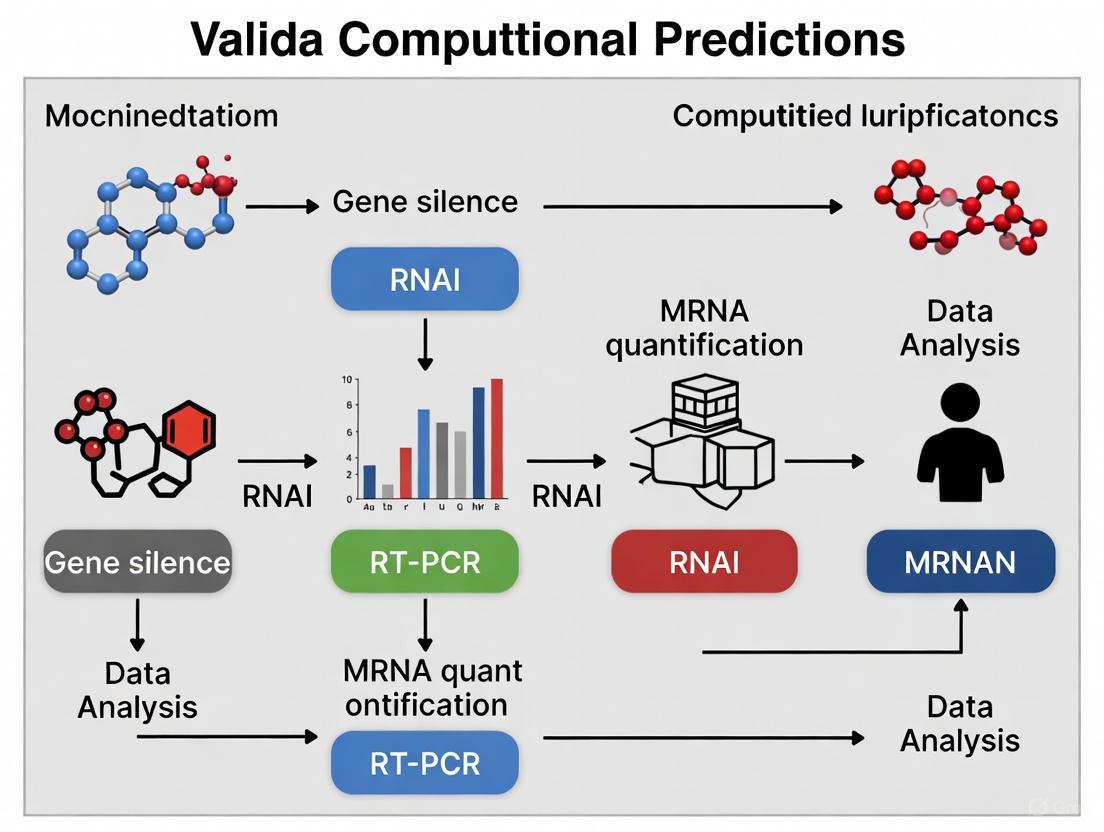
This article provides a systematic framework for researchers and drug development professionals to bridge computational predictions and experimental biology.
From In Silico to In Vitro: A Comprehensive Guide to Validating Computational Predictions with RNAi and RT-PCR
Abstract
This article provides a systematic framework for researchers and drug development professionals to bridge computational predictions and experimental biology. It covers the foundational principles of RNA interference (RNAi) and Reverse Transcription-Polymerase Chain Reaction (RT-PCR), detailing robust methodologies for designing and executing validation experiments. The guide addresses common troubleshooting scenarios and optimization strategies to enhance reliability and reproducibility. Furthermore, it presents rigorous validation and comparative analysis techniques to confirm gene silencing efficacy and specificity, ensuring that computational forecasts are accurately substantiated in the lab for applications in functional genomics and therapeutic development.
The Computational and Molecular Biology Foundation of RNAi Validation
The advent of RNA interference (RNAi) has revolutionized molecular biology and therapeutic development, offering a precise mechanism for gene silencing. Central to this mechanism are small interfering RNAs (siRNAs) and the RNA-induced silencing complex (RISC) pathway. This guide objectively compares key methodologies in siRNA design and experimental validation, framing the discussion within a broader thesis on corroborating computational predictions with empirical RNAi and RT-PCR research. For researchers and drug development professionals, bridging in-silico models with robust lab-based assays is critical for advancing reliable therapeutics [1]. The following sections provide comparative data, detailed protocols, and essential toolkits underpinning this integrative approach.
Comparative Analysis of siRNA Design and Validation Methodologies
The efficacy of an RNAi-based therapeutic or research tool hinges on the precision of siRNA design and the rigor of its validation. Below is a comparative summary of approaches highlighted in recent research.
Table 1: Comparison of siRNA Design & Screening Platforms
| Aspect | Computational siRNA Design (GPR10 Case Study) [1] | Allele-Specific RT-PCR Assay Design (SARS-CoV-2 Case Study) [2] [3] | Mechanistic PK/PD Modeling (siRNA Therapeutics) [4] |
|---|---|---|---|
| Primary Goal | Design high-affinity siRNA for specific gene (GPR10) silencing. | Design primer-probe sets for variant-specific viral RNA detection. | Model intracellular siRNA disposition to predict gene knockdown. |
| Starting Input | Target mRNA sequence (e.g., GPR10, NM_004248.3). | Genomic databases (GISAID, NCBI) of viral variants. | In vitro data on siRNA delivery, RISC loading, and mRNA kinetics. |
| Key Screening Metrics | Thermodynamic stability, off-target filtration, AGO2 docking affinity, predicted efficacy (>93.5%). | Mutation profile analysis (e.g., Spike protein RBD mutations). | Cell proliferation rate, mRNA turnover, RISC occupancy, target engagement. |
| Output | Shortlisted high-confidence siRNA candidates (e.g., siRNA8, siRNA12). | Allele-specific primer-probe sets for 9 mutations across Delta/Omicron. | Quantitative relationship for maximal mRNA knockdown. |
| Validation Anchor | Molecular Dynamics simulations for complex stability. | Analytical sensitivity (1x10² copies/mL) and 100% specificity testing [2] [3]. | Correlation of model predictions with in vitro knockdown data in MCF7/BT474 cells. |
Table 2: Performance Comparison of RNAi/Detection Assays
| Assay/Technology | Target | Sensitivity / Efficacy | Specificity / Key Advantage | Reference |
|---|---|---|---|---|
| Novel Multiplex RT-PCR | SARS-CoV-2 Delta/Omicron variants | ~100 copies/mL | 100% analytical specificity; detects 7 Omicron & 2 Delta mutations [2]. | [2] [3] |
| Computationally Designed siRNA | Human GPR10 mRNA | >93.5% predicted silencing efficacy | High binding affinity to AGO2; minimized off-target via layered in-silico refinement. | [1] |
| RNAiMAX-delivered siRNA | Various extrahepatic targets in vitro | Governed by mRNA half-life & cell proliferation | Model identifies determinants of knockdown extent & duration beyond liver. | [4] |
| Endogenous Plant ta-siRNA Pathway | Developmental patterning (e.g., ARF genes) | Amplified via transitivity & RDR6 | Systemic spreading and cell-to-cell movement as a regulatory advantage [5] [6]. | [5] [6] |
Detailed Experimental Protocols
This protocol details the computational pipeline for designing high-potency siRNAs, using the targeting of GPR10 for uterine fibroids as a case study.
- Target Sequence Retrieval: Obtain the complete coding DNA sequence (CDS) of the target mRNA (e.g., GPR10, NM_004248.3 from NCBI Nucleotide database).
- Initial Candidate Generation: Generate a library of all possible siRNA sequences (typically 21-23 nt) targeting the CDS. For GPR10, this resulted in 275 initial candidates.
- Layered In-Silico Refinement:
- Thermodynamic Assessment: Filter candidates based on optimal GC content and binding energy.
- Secondary Structure Modeling: Evaluate target mRNA accessibility and siRNA self-structure.
- Off-Target Filtration: Use sequence alignment tools to exclude candidates with significant homology to other transcripts in the relevant genome.
- Protein Interaction Docking: Dock the shortlisted siRNA duplexes into the crystal structure of the Argonaute 2 (AGO2) protein, the catalytic core of RISC. Assess binding affinity and conformational fit.
- Molecular Dynamics (MD) Simulation: Subject the top siRNA-AGO2 complexes to MD simulations (e.g., using CHARMM-GUI/CHARMM36m force field) to confirm structural stability and sustained interaction over time.
- Output: Select lead candidates (e.g., siRNA8, siRNA12) based on robust docking scores, high predicted silencing efficacy, and stable MD trajectories for subsequent in vitro testing.
This protocol outlines the creation of a molecular diagnostic assay, exemplified by SARS-CoV-2 variant detection, which serves as a validation tool for sequence-based predictions.
- In-Silico Sequence Analysis and Primer Design:
- Perform comparative analysis of viral genomic sequences from databases (GISAID, NCBI GenBank).
- Identify signature mutations for each variant (e.g., Ins214EPE, L452R for Omicron; D63G for Delta).
- Design allele-specific primers and TaqMan probes targeting these mutation sites within the Spike protein's RBD.
- Assay Optimization:
- Test primer-probe sets using synthetic RNA templates or plasmids containing target sequences.
- Optimize multiplex RT-PCR conditions (annealing temperature, primer concentration) to ensure specific amplification.
- Analytical Validation:
- Sensitivity: Perform limit of detection (LOD) experiments using serial dilutions of quantified viral RNA. The described assay achieved an LOD of ~1 x 10² copies/mL [2].
- Specificity: Test the assay against a panel of negative clinical samples and RNA from other respiratory pathogens to confirm 100% analytical specificity.
- Clinical Evaluation: Validate using a panel of leftover, characterized clinical samples (e.g., 160 archived VTM samples), comparing results to gold-standard Whole Genome Sequencing (WGS).
Visualization of Pathways and Workflows
Diagram 1: RISC Pathway for siRNA-Mediated Silencing
Diagram 2: siRNA Design and Experimental Validation Pipeline
The Scientist's Toolkit: Research Reagent Solutions
Table 3: Essential Reagents and Materials for Featured Research
| Research Reagent / Material | Primary Function / Role | Context of Use |
|---|---|---|
| Allele-Specific Primer-Probe Sets | Enable multiplex detection and differentiation of specific genetic mutations (e.g., SARS-CoV-2 variants) in RT-PCR assays. | Molecular diagnostics and validation of target sequences [2] [3]. |
| Chemically Modified siRNA Duplexes | Provide nuclease resistance, enhance stability, and improve RISC loading efficiency for therapeutic in vitro and in vivo applications. | siRNA therapeutic development and mechanistic studies [4] [1]. |
| RNAiMAX Transfection Reagent | A lipid-based delivery system for efficient siRNA transfection into a wide range of mammalian cell lines in vitro. | In vitro validation of siRNA-mediated gene knockdown [4]. |
| Recombinant Argonaute 2 (AGO2) Protein | Serves as the structural template for molecular docking studies to predict siRNA binding affinity and RISC compatibility. | Computational siRNA design and in-silico validation [1]. |
| Reference Viral RNA & Clinical Samples | Provide quantified, characterized templates for analytical validation (sensitivity/specificity) of molecular diagnostic assays. | RT-PCR assay development and clinical performance evaluation [2] [3]. |
| RDR6, DCL4, AGO1 (Plant Systems) | Key enzymes in the endogenous siRNA biogenesis and amplification pathway (transitivity) in plants. | Study of systemic RNAi and secondary siRNA generation [5] [6]. |
Reverse Transcription Polymerase Chain Reaction (RT-PCR) and quantitative Reverse Transcription PCR (qRT-PCR) are foundational molecular techniques for analyzing gene expression. RT-PCR combines reverse transcription of RNA into complementary DNA (cDNA) with amplification of specific DNA targets, enabling the detection of RNA expression patterns [8]. Its quantitative counterpart, qRT-PCR (also known as real-time quantitative PCR), allows for precise quantification of gene expression levels by measuring PCR product accumulation in real-time using fluorescent reporters [9]. These methodologies have become indispensable tools in biological research, medical diagnostics, and drug development, particularly for validating gene function in loss-of-function studies such as those involving RNA interference (RNAi) [10].
The fundamental process begins with RNA extraction from biological samples, followed by reverse transcription using viral reverse transcriptases to produce cDNA [8]. This cDNA then serves as the template for either conventional PCR amplification or quantitative real-time PCR analysis. In qRT-PCR, the fluorescence signal increases proportionally with the accumulated PCR product, allowing researchers to determine the initial quantity of the target transcript [9]. The point at which the fluorescence crosses a predetermined threshold is called the quantification cycle (Cq), with lower Cq values indicating higher starting amounts of the target nucleic acid [9].
Technical Comparison of RT-PCR and qRT-PCR
Fundamental Principles and Detection Methods
RT-PCR and qRT-PCR differ significantly in their detection capabilities and applications. Conventional RT-PCR is primarily qualitative, providing endpoint detection of amplified DNA typically through gel electrophoresis, while qRT-PCR offers quantitative data by monitoring DNA amplification in real-time [8] [9]. This fundamental difference dictates their respective applications in research and diagnostics.
The quantification capability of qRT-PCR stems from its use of fluorescent reporting systems. Two primary detection chemistries are employed: DNA-binding dyes and target-specific probes [9]. DNA-binding dyes like SYBR Green I fluoresce when bound to double-stranded DNA, providing a simple and cost-effective detection method. Conversely, probe-based systems such as hydrolysis probes (TaqMan) provide enhanced specificity through oligonucleotides that bind specifically to target sequences between the PCR primers [9]. This specificity is particularly valuable in diagnostic applications and when distinguishing between closely related gene sequences.
Performance Characteristics and Applications
qRT-PCR demonstrates superior performance for gene expression studies
qRT-PCR demonstrates superior performance for gene expression studies
| Performance Characteristic | RT-PCR | qRT-PCR |
|---|---|---|
| Quantification Capability | Semi-quantitative at best | Fully quantitative |
| Detection Method | End-point (gel electrophoresis) | Real-time (fluorescence) |
| Dynamic Range | Limited | 10-log range (single to ~10¹¹ copies) |
| Sensitivity | Moderate | High (detection of single copies possible) |
| Specificity | Moderate (primers only) | High (primers + probe options) |
| Throughput | Lower | Higher (96- or 384-well formats) |
| Risk of Contamination | Higher (post-PCR handling required) | Lower (closed-tube system) |
| Primary Applications | Target detection, cloning | Gene expression analysis, pathogen quantification, SNP genotyping |
| Data Output | Presence/absence | Quantification cycle (Cq), amplification efficiency, relative quantification |
The quantitative nature of qRT-PCR makes it particularly suitable for gene expression analysis, where it is used to compare transcript levels between different experimental conditions, tissues, or treatment groups [11] [9]. Its extensive dynamic range allows detection from single copies to approximately 10¹¹ copies in a single run, far exceeding the capabilities of conventional RT-PCR [9]. Furthermore, the closed-tube nature of qRT-PCR significantly reduces contamination risks compared to conventional RT-PCR, which requires post-amplification processing [9].
Advanced Quantitative Methodologies
Reverse Transcription Quantitative PCR (RT-qPCR)
RT-qPCR represents the most widely used approach for gene expression quantification and can be performed through one-step or two-step protocols [12]. In one-step RT-qPCR, reverse transcription and PCR amplification occur in a single tube using a unified buffer system, minimizing pipetting steps and potential contamination [12]. This approach is particularly suitable for high-throughput applications. Conversely, two-step RT-qPCR separates reverse transcription and amplification into discrete reactions, allowing for optimized conditions for each step and generating stable cDNA pools that can be used for multiple targets [12].
The reverse transcription step can be primed using different strategies, each with distinct advantages. Oligo(dT) primers target the poly(A) tails of mRNA, generating cDNA representative of coding regions [12]. Random primers anneal throughout the RNA transcript, useful for RNAs with secondary structure or without poly(A) tails. Gene-specific primers provide the highest specificity for particular targets [12]. Many protocols employ a combination of random and oligo(dT) primers to maximize coverage while maintaining representation of mRNA sequences.
Emerging Technologies: RT-droplet digital PCR
While RT-qPCR remains the gold standard for quantitative gene expression analysis, newer technologies like reverse transcription droplet digital PCR (RT-ddPCR) offer alternative capabilities, particularly for low-abundance targets [13]. Unlike qPCR's relative quantification, ddPCR provides absolute quantification of target molecules by partitioning samples into thousands of nanoliter-sized droplets and counting positive reactions [13].
Recent research demonstrates that RT-ddPCR shows equivalent performance to RT-qPCR in mid- and high-viral-load ranges but exhibits superior sensitivity for low-abundance targets [13]. This enhanced detection capability is particularly valuable for identifying persistent infections at low levels, as demonstrated in studies of SARS-CoV-2 where RT-ddPCR detected positive samples in exposed individuals that tested negative by RT-qPCR [13]. Additionally, ddPCR's absolute quantification eliminates the need for standard curves and shows greater tolerance to PCR inhibitors, potentially reducing interlaboratory variability [13].
Experimental Design and Protocols
Critical Experimental Considerations
Table 2: Essential research reagents for RT-PCR and qRT-PCR experiments
Table 2: Essential research reagents for RT-PCR and qRT-PCR experiments
| Reagent Category | Specific Examples | Function in Experimental Workflow |
|---|---|---|
| Reverse Transcriptase Enzymes | Moloney Murine Leukemia Virus (MMLV) RT, Avian Myeloblastosis Virus (AMV) RT | Synthesizes complementary DNA (cDNA) from RNA templates |
| DNA Polymerases | Taq polymerase, hot-start variants | Amplifies target DNA sequences during PCR |
| Fluorescent Detection Systems | SYBR Green, hydrolysis probes (TaqMan), molecular beacons | Enable real-time monitoring of amplification in qRT-PCR |
| Primers | Sequence-specific, oligo(dT), random hexamers | Define target regions and initiate cDNA synthesis or DNA amplification |
| RNA Extraction Reagents | TRIzol, column-based kits | Isolate and purify intact RNA from biological samples |
| Reference Genes | GAPDH, β-actin, ribosomal proteins, elongation factors | Normalize for technical variation in gene expression studies |
| Sample Collection & Storage | RNase-free swabs, RNA stabilization solutions | Maintain RNA integrity from collection to processing |
Proper experimental design is crucial for generating reliable RT-PCR and qRT-PCR data. The workflow encompasses multiple stages where variability can be introduced: sample collection, storage, RNA extraction, reverse transcription, and amplification [14]. Sample collection methods must preserve RNA integrity, with proper handling and storage conditions to prevent degradation [14]. RNA extraction should consistently yield high-quality, uncontaminated RNA, as the presence of inhibitors like heparin, hemoglobin, or ionic detergents can significantly impact PCR efficiency [8].
Primer design requires particular attention in qRT-PCR applications. Ideally, primers should span exon-exon junctions, with one primer potentially crossing an exon-intron boundary, to minimize amplification from contaminating genomic DNA [12]. When this design is not possible, treatment with DNase is recommended to remove genomic DNA contamination [12]. Including appropriate controls is also essential, with "no reverse transcriptase" controls (-RT) necessary to identify genomic DNA contamination that could lead to false positive results [12].
Reference Gene Validation
Accurate quantification in qRT-PCR depends on proper normalization using stable reference genes (housekeeping genes) to control for variations in RNA input, reverse transcription efficiency, and overall experimental variability [11] [15]. Traditional reference genes like GAPDH, β-actin, and 18S RNA were once widely used, but numerous studies have demonstrated that their expression can vary significantly under different experimental conditions [11].
Comprehensive studies now recommend systematic validation of reference genes for each experimental system. Statistical algorithms such as geNorm, NormFinder, and BestKeeper can evaluate expression stability and identify optimal reference genes for specific conditions [11] [15]. Research across various organisms, including plants, insects, and mammals, has demonstrated that the most stable reference genes differ depending on tissue type, developmental stage, and experimental treatment [11] [15]. Using multiple validated reference genes is now considered best practice for obtaining reliable gene expression data.
Applications in Validating Computational Predictions with RNAi
The integration of RT-PCR and qRT-PCR with RNA interference (RNAi) has created a powerful experimental paradigm for validating computational predictions of gene function. RNAi enables targeted silencing of gene expression, while qRT-PCR provides a quantitative method to verify knockdown efficiency and assess downstream transcriptional effects [10]. This combined approach is particularly valuable for functional genomics, where computational methods increasingly predict essential genes and potential therapeutic targets.
Recent applications demonstrate this methodology in action. Machine learning approaches like the CLassifier of Essentiality AcRoss EukaRyote (CLEARER) algorithm have been developed to predict essential genes across eukaryotic species [16]. These computational predictions require experimental validation, which is efficiently provided by RNAi-mediated gene knockdown followed by qRT-PCR analysis. For example, in the malaria vector Anopheles gambiae, computational predictions identified potential insecticidal targets that were subsequently validated using RNAi and qRT-PCR, revealing genes critical for mosquito survival and Plasmodium development [16].
The experimental workflow typically begins with computational identification of candidate genes through essentiality prediction algorithms or chokepoint analysis of metabolic networks [16]. RNAi is then employed to silence these candidates, followed by qRT-PCR to quantify knockdown efficiency and assess phenotypic consequences through expression analysis of related genes [16] [10]. This integrated approach accelerates the identification of promising therapeutic targets and essential genes for further development.
Performance Metrics and Diagnostic Applications
Analytical Performance Measures
The performance of RT-qPCR assays is characterized by specific metrics that determine their reliability and applicability. The limit of detection (LoD) defines the lowest concentration of target that can be reliably detected, while analytical specificity refers to the assay's ability to exclusively detect the intended target without cross-reacting with similar sequences [14]. These parameters are typically established during assay development under controlled laboratory conditions.
PCR efficiency is another critical parameter, representing the rate of product amplification per cycle. Ideal PCR efficiency is 100%, corresponding to a doubling of product each cycle [14]. Efficiency can be calculated from standard curves generated using serial dilutions of known standards, with the slope of the curve determining the efficiency value [14]. Maintaining high and consistent PCR efficiency is essential for both accurate quantification and reliable detection of low-abundance targets.
Comparative Performance in Diagnostic Applications
The diagnostic performance of RT-qPCR has been extensively evaluated, particularly during the COVID-19 pandemic. Comparative studies have assessed different RT-qPCR protocols, with the CDC (USA) protocol demonstrating superior accuracy in detecting SARS-CoV-2 compared to other molecular tests like RT-LAMP and serological assays [17]. This highlights the importance of protocol optimization even within the same technological platform.
Sample type and collection methods significantly impact test performance. Oro-nasopharyngeal swabs have proven more effective than saliva for SARS-CoV-2 detection, and samples from symptomatic individuals with multiple symptoms typically show higher viral loads [17]. Nevertheless, proper technique throughout the testing process—from sample collection to RNA extraction and amplification—remains essential for reliable results [14].
RT-PCR and qRT-PCR represent complementary technologies that have revolutionized gene expression analysis. While RT-PCR provides a robust method for target detection, qRT-PCR enables precise quantification with extensive dynamic range and high sensitivity. The integration of these methodologies with RNAi and computational predictions creates a powerful framework for functional genomics and target validation. As molecular technologies continue to evolve, emerging methods like RT-ddPCR offer enhanced capabilities for specific applications, particularly low-abundance targets. Nevertheless, proper experimental design, validation of reference genes, and attention to technical details remain fundamental to generating reliable data regardless of the specific platform employed.
The advent of RNA interference (RNAi) as a therapeutic modality has revolutionized targeted gene silencing, with small interfering RNAs (siRNAs) at its forefront. The efficacy and specificity of an siRNA therapeutic are not serendipitous but are engineered through meticulous computational design. This guide objectively compares the algorithms, rules, and tools that underpin modern siRNA design, framing the discussion within the critical thesis that in silico predictions must be rigorously validated through experimental RNAi and RT-PCR research to transition from digital models to viable therapeutics [18] [19].
Core Design Rules and Predictive Algorithms
The foundation of computational siRNA design rests on empirically derived rules that correlate sequence features with silencing efficiency and minimize off-target effects. Key rule sets include those established by Ui-Tei, Amarzguioui, and Reynolds [18] [20] [21]. These rules govern parameters such as nucleotide composition at specific positions, overall GC content, and thermodynamic stability. For instance, Ui-Tei's rules emphasize an adenine or uracil at the 5' end of the guide strand and a relatively unstable 5' terminus to ensure proper strand loading into the RNA-induced silencing complex (RISC) [19].
Machine learning (ML) models have superseded simple rule-based filtering by integrating multifaceted sequence and thermodynamic features to predict efficacy. These models range from linear regression to deep neural networks, trained on large datasets of experimentally validated siRNAs [22]. Sequence-level features are fundamental, but incorporating thermodynamic properties and predictions of target mRNA secondary structure significantly enhances prediction accuracy [22] [19]. Advanced tools now leverage these ML approaches to score and rank potential siRNA candidates, moving beyond binary pass/fail criteria [19].
Comparative Analysis of siRNA Design and Validation Workflows
A robust siRNA design pipeline integrates multiple computational stages, from target selection to final validation. The table below summarizes key quantitative data from recent studies employing such integrated approaches against viral and human disease targets.
Table 1: Comparative Data from Integrated siRNA Design Studies
| Study Target | # Initial Candidates | Key Filters Applied | Final Selected siRNAs | Reported In Vitro Knockdown Efficacy | Key Validation Assays | Citation |
|---|---|---|---|---|---|---|
| SARS-CoV-2 (NSP8, NSP12, NSP14) | 258 | Conservation (MSA), Huesken dataset (≥90% inhib.), Thermodynamics, Off-target BLAST | 4 (e.g., siRNA2, siRNA4) | 89%-97% reduction in viral S & ORF1b genes at 24 h.p.i. | Cytotoxicity, TCID50, RT-PCR | [18] |
| HSV-1 (UL15 gene) | N/A | Conservation (MSA), Rule-based (Ui-Tei, etc.), Off-target BLAST | 2 (siRNA1 & siRNA2) | ~78% predicted efficiency; 50% & 30% CPE inhibition in vitro | CPE assay, RT-PCR, MTT cytotoxicity | [21] |
| Human VEGF (Cancer) | N/A | GC content (30-52%), Rule-based, Thermodynamics | Multiple | Docking scores: -330 to -351 kcal/mol with Ago2 | Molecular Docking, MD Simulations | [20] |
| Human GPR10 (Uterine Fibroids) | 275 | Thermodynamics, Secondary structure, Off-target filtration | 10 (siRNA8 & siRNA12 leads) | >93.5% predicted silencing efficacy | Docking with Ago2, MD Simulations | [1] |
Experimental Protocols for Validation The transition from in silico prediction to biological reality necessitates standardized experimental validation. Key protocols include:
- Cytotoxicity Assay (e.g., MTT): Cells are transfected with siRNA candidates using lipid-based transfection reagents (e.g., X-tremeGENE). After incubation (e.g., 72 hours), MTT reagent is added and metabolically active cells reduce it to formazan crystals. Solubilized crystals are quantified spectrophotometrically at 570 nm to ensure siRNA treatments do not impair cell viability [21].
- Efficacy via RT-PCR: Following siRNA transfection and target challenge (e.g., viral infection), total RNA is extracted. Reverse transcription yields cDNA, which is used in quantitative PCR with primers for the target gene (e.g., viral S gene) and a housekeeping control. The relative fold change in target mRNA, calculated via the ΔΔCt method, quantifies knockdown efficiency [18].
- Functional Viral Assay (TCID50): For antiviral siRNAs, supernatant from infected, siRNA-treated cells is serially diluted and applied to fresh cell monolayers. The dilution that causes cytopathic effect (CPE) in 50% of wells is calculated, revealing the reduction in infectious viral titer due to siRNA treatment [18].
Visualization of siRNA Design and Mechanism
The following diagrams, generated using Graphviz DOT language, illustrate the standard siRNA design workflow and the core RNAi mechanism.
Diagram 1: Integrated siRNA Design & Validation Workflow
Diagram 2: RNAi Mechanism & siRNA Structure
The Scientist's Toolkit: Essential Research Reagents & Solutions
The following table details critical materials and tools required for executing the computational design and experimental validation pipeline.
Table 2: Key Research Reagent Solutions for siRNA Studies
| Item Category | Specific Tool/Reagent | Function & Explanation |
|---|---|---|
| Sequence Databases | NCBI Nucleotide / Virus Database | Primary source for retrieving target mRNA and viral genome sequences in FASTA format for design initiation [18] [1]. |
| Alignment & Conservation Tools | MAFFT, Clustal Omega, MEGAX | Perform Multiple Sequence Alignment (MSA) to identify evolutionarily conserved regions across variants, which are optimal siRNA targets [18] [21]. |
| siRNA Design Servers | siDirect, i-Score Designer, IDT SciTools | Apply rule-based and machine learning algorithms to generate and score potential siRNA sequences from an input target [20] [19] [21]. |
| Off-Target Screening | NCBI BLAST | Used to screen candidate siRNA sequences against the human (or host) genome/transcriptome to minimize homology-driven off-target effects [18] [21]. |
| Structure & Energy Prediction | RNAfold, DuplexFold | Predict secondary structure and thermodynamic stability (ΔG) of siRNA duplexes and siRNA-mRNA interactions, informing efficiency [23] [19] [21]. |
| 3D Structure Prediction | AlphaFold 3, RNAComposer | Model tertiary structures of larger RNAs or RNA-protein complexes (e.g., RISC) for advanced mechanistic and docking studies [23]. |
| Transfection Reagent | X-tremeGENE, Lipofectamine | Lipid-based formulations that encapsulate negatively charged siRNA, facilitating its delivery across the cell membrane into the cytoplasm [21]. |
| Cell Viability Assay | MTT Reagent | A colorimetric assay that measures mitochondrial activity; used to confirm siRNA and delivery vehicle cytotoxicity [21]. |
| Quantification Core | RT-qPCR Kit (Reverse Transcriptase, SYBR Green) | Essential for converting target mRNA to cDNA and quantifying its abundance post-siRNA treatment to measure knockdown efficacy [18]. |
The landscape of siRNA design is defined by a powerful synergy between sophisticated algorithms and rigorous experimental biology. While computational tools provide an indispensable starting point—enabling the high-throughput screening of candidates based on conservation, specificity rules, and thermodynamic profiles—their true value is only unlocked through in vitro and eventually in vivo validation [18] [21]. The ultimate measure of a design algorithm's success is not its prediction score, but the statistically significant reduction in target mRNA (via RT-PCR) and the resulting functional outcome (e.g., reduced viral titer) it produces in the laboratory. As machine learning models evolve and integrate more complex features, this iterative cycle of prediction and validation remains the cornerstone of developing specific, efficacious, and safe siRNA therapeutics.
The identification of essential genes—those crucial for the survival or reproductive success of an organism—represents a critical frontier in biomedical research and therapeutic development [16]. For researchers and drug development professionals, these genes are promising targets for novel intervention strategies, particularly in combating pathogens and diseases like malaria and cancer. The primary challenge lies in efficiently pinpointing these genes among thousands of candidates, a process historically dependent on costly and time-consuming experimental methods. Computational approaches have emerged as powerful tools to overcome this bottleneck, enabling the prioritization of candidate genes for downstream experimental validation.
Machine learning (ML) models, especially when integrated with feature selection techniques, have demonstrated remarkable efficacy in predicting essential genes from complex genomic data [24]. These methods leverage patterns learned from model organisms and known essential genes to generate predictions in less-studied species or contexts. The integration of these computational predictions with robust experimental validation frameworks, particularly RNA interference (RNAi) and reverse transcription polymerase chain reaction (RT-PCR), forms a cornerstone of modern functional genomics. This guide provides a comparative analysis of the dominant machine learning and feature selection methodologies used for essential gene prediction, detailing their performance characteristics, experimental validation protocols, and practical implementation requirements.
Comparative Analysis of Machine Learning Approaches
Core Machine Learning Algorithms and Performance
Multiple machine learning algorithms have been applied to the problem of essential gene prediction, each with distinct strengths, weaknesses, and performance profiles. The selection of an appropriate algorithm often depends on the specific dataset characteristics, available computational resources, and the desired balance between interpretability and predictive power.
Random Forest (RF) is a versatile ensemble method that constructs multiple decision trees during training and outputs predictions based on their collective decision [25] [26]. Its key advantage lies in its ability to capture complex interaction effects between genetic features without assuming strict additivity, making it particularly suitable for genetic architectures where epistasis (gene-gene interactions) plays a significant role [25]. In genomic prediction tasks, RF has demonstrated performance comparable to classical Bayesian methods while offering greater computational efficiency and robustness to overfitting [25]. Studies predicting residual feed intake in pigs have achieved Spearman correlation coefficients of approximately 0.27 between observed and predicted values using RF models [26].
Support Vector Machines (SVM) operate by finding the optimal hyperplane that separates classes (e.g., essential vs. non-essential genes) in a high-dimensional feature space [27]. SVMs are particularly effective in scenarios where the number of features exceeds the number of observations, a common characteristic in genomic studies [27]. When applied to pig genomic data for feed efficiency prediction, SVM models outperformed other learners, achieving a correlation of 0.28 between observed and predicted values with high stability [26]. Their performance can be further enhanced through appropriate kernel selection and hyperparameter tuning.
Elastic Net combines the variable selection properties of LASSO (L1 regularization) with the stability of ridge regression (L2 regularization) [28]. This combination allows it to handle correlated predictor variables effectively—a common challenge in genomic data due to linkage disequilibrium between nearby genetic variants [28]. In predicting CYP2D6-associated CpG methylation levels, Elastic Net models demonstrated superior performance compared to linear regression and XGBoost, particularly when integrating both genetic and non-genetic features [28]. Its ability to automatically select significant variables while managing collinearity makes it particularly valuable for high-dimensional genomic datasets.
XGBoost (Extreme Gradient Boosting) is an optimized implementation of gradient boosting that sequentially builds decision trees, with each new tree correcting errors made by previous ones [28]. This iterative approach often yields high prediction accuracy but requires careful hyperparameter tuning to prevent overfitting [28]. While XGBoost has shown excellent performance in various genomic prediction challenges, including cancer gene identification [29], its performance in predicting CYP2D6 methylation was marginally inferior to Elastic Net in some comparative studies [28].
Table 1: Comparison of Machine Learning Algorithms for Essential Gene Prediction
| Algorithm | Key Strengths | Limitations | Reported Performance | Best Suited For |
|---|---|---|---|---|
| Random Forest | Handles non-additive effects; Robust to overfitting; Provides feature importance metrics | Computationally intensive with many trees; Less interpretable than linear models | Spearman correlation: 0.27-0.28 in pig RFI prediction [26] | Genomic datasets with suspected epistatic interactions |
| Support Vector Machine (SVM) | Effective in high-dimensional spaces; Memory efficient; Versatile through kernel functions | Performance dependent on kernel selection; Limited interpretability | Spearman correlation: 0.28 in pig RFI prediction [26] | Transcriptomic and proteomic data with clear separation boundaries |
| Elastic Net | Handles correlated features; Automatic feature selection; More interpretable than black-box models | Linear assumptions may miss complex interactions; Requires regularization tuning | Superior to XGBoost and Linear Regression for CYP2D6 methylation prediction [28] | SNP datasets with high linkage disequilibrium |
| XGBoost | High predictive accuracy; Handles missing data well; Extensive customization options | Prone to overfitting without careful tuning; Computationally demanding | Excellent for cancer gene classification [29]; Mixed performance for methylation prediction [28] | Large-scale genomic datasets with complex hierarchical patterns |
Feature Selection Methods for Enhanced Prediction
Feature selection is a critical pre-processing step in genomic prediction that identifies and retains the most informative genetic variants while excluding irrelevant or redundant features [24]. This process improves model interpretability, reduces computational requirements, and enhances generalization performance by mitigating the "curse of dimensionality" common in genomic studies where the number of features (e.g., SNPs) far exceeds the number of samples [24].
Filter Methods represent the simplest approach to feature selection, ranking individual features based on statistical measures of association with the phenotype independently of the ML algorithm [26]. Common implementations include univariate methods like correlation coefficients (e.g., spearcor) and association testing (e.g., genome-wide association study p-values), as well as multivariate filters like minimum Redundancy Maximum Relevance (mRMR) that account for interactions between features [25] [26]. The primary advantage of filter methods is their computational efficiency and resistance to overfitting, though univariate approaches may miss features that are only informative in combination with others [26].
Embedded Methods integrate feature selection directly into the model training process [26]. Algorithms like LASSO and Elastic Net perform automatic feature selection through regularization penalties that shrink coefficients of uninformative features toward zero [28]. Tree-based methods like Random Forest and XGBoost provide native feature importance scores based on how much each feature improves model performance across all decision trees [26]. Embedded methods typically yield better performance than filter methods but are more computationally intensive and algorithm-specific.
Wrapper Methods evaluate feature subsets by training a model on each candidate subset and assessing its performance [26]. While potentially offering the best performance, wrapper methods are computationally prohibitive for genomic datasets with thousands of features and are consequently less commonly used in practice [26].
Incremental Feature Selection (IFS) represents a hybrid approach that progressively adds features to a model based on their association strength, typically derived from GWAS p-values [25]. This method begins with the top-ranked SNP and adds markers stepwise until model performance stabilizes or degrades [25]. Applied to genomic prediction in plants and animals, IFS has demonstrated the ability to achieve comparable performance to models using all available SNPs while utilizing a significantly reduced feature set—in some cases improving prediction accuracy substantially [25].
Table 2: Comparison of Feature Selection Methods in Genomic Studies
| Method Type | Examples | Advantages | Disadvantages | Reported Impact on Prediction |
|---|---|---|---|---|
| Filter Methods | Univ.dtree, Spearcor, CForest, mRMR [26] | Computationally efficient; Resistant to overfitting; Algorithm-independent | Univariate methods ignore feature interactions; May select redundant features | With 50-250 SNPs, huge impact on prediction quality; With 1000+ SNPs, minimal influence [26] |
| Embedded Methods | LASSO, Elastic Net, Random Forest feature importance [26] [28] | Model-specific optimization; Balances feature selection with model training; Handles interactions | Computationally intensive; Less interpretable; Algorithm-dependent performance | Elastic Net showed best performance for CYP2D6 methylation prediction [28] |
| Wrapper Methods | Recursive Feature Elimination, Evolutionary Algorithms [26] | Potentially optimal feature subsets; Considers feature interactions thoroughly | Computationally prohibitive for genomic data; High risk of overfitting | Limited use in genomic prediction due to computational constraints [26] |
| Incremental Feature Selection | GWAS-based ranking with stepwise addition [25] | Systematic approach; Balances performance and feature set size; Clear stopping point | Dependent on initial ranking quality; Computationally intensive for large datasets | Achieved comparable performance with substantially fewer SNPs in plant/animal datasets [25] |
Experimental Validation of Computational Predictions
RNA Interference (RNAi) Validation Protocols
RNAi serves as a powerful experimental technique for validating computational predictions of gene essentiality by enabling targeted gene silencing and observation of resulting phenotypic effects [16]. The standard RNAi validation workflow involves several critical steps that must be meticulously executed to ensure reliable results.
The process begins with dsRNA Design and Synthesis, where double-stranded RNA molecules are designed to complement specific target gene sequences [16]. For validation experiments, these typically range from 200-500 base pairs in length to ensure efficient processing into siRNAs by Dicer enzymes [30]. The designed dsRNA can be synthesized in vitro using phage RNA polymerases (T7, T3, or SP6) or produced endogenously in genetically modified organisms expressing hairpin RNA constructs [30].
Delivery Methods vary depending on the target organism. In mosquito studies validating essential genes for malaria control, dsRNA was typically delivered through microinjection into the thorax or abdomen of adult mosquitoes [16]. As an alternative, non-invasive delivery methods include soaking (for aquatic organisms), feeding, or viral vector-mediated introduction [30]. For cellular systems, transfection reagents like lipofectamine are commonly employed to introduce dsRNA into cells.
Following delivery, Knockdown Efficiency Validation is crucial using quantitative RT-PCR to measure transcript abundance reduction [16]. Successful experiments typically achieve knockdown efficiencies exceeding 60%, with high-performing targets reaching 75-91% reduction in transcript levels [16]. This quantification ensures that observed phenotypic effects correlate with intended gene silencing rather than off-target effects.
Phenotypic Assessment forms the core of the validation process, where researchers examine the biological consequences of gene knockdown. In essential gene studies for vector control, key phenotypic readouts include mosquito survival rates, longevity, fecundity, and for parasite-interaction genes, quantification of pathogen development (e.g., Plasmodium berghei oocyte counts in midguts) [16]. Experimental designs should include appropriate control groups—typically LacZ-injected or untreated controls—to account for injection trauma and natural phenotypic variation [16].
RT-PCR Protocols for Validation Studies
Reverse Transcription Polymerase Chain Reaction (RT-PCR) provides essential quantitative data on transcript abundance following gene perturbation, serving as a cornerstone for validating knockdown efficiency in RNAi experiments [16]. The standard workflow encompasses RNA extraction, cDNA synthesis, and quantitative PCR analysis.
RNA Extraction begins with sample homogenization using specialized buffers containing guanidinium thiocyanate to inactivate RNases [31]. Total RNA is typically purified using silica-membrane column-based kits (e.g., RNeasy Mini Kit), with recommended inputs of 30mg tissue or 1x10^6 cells per extraction [31]. RNA quality and concentration should be verified using spectrophotometry (A260/A280 ratio ~1.8-2.0) and integrity confirmed through agarose gel electrophoresis showing distinct 18S and 28S ribosomal RNA bands.
cDNA Synthesis converts purified RNA to stable complementary DNA using reverse transcriptase enzymes [31]. Standard 20μL reactions typically include 1μg total RNA, 4μL 5X reaction buffer, 1μL dNTP mix (10mM each), 2μL random hexamer or oligo(dT) primers (6pmol/μL), 1μL reverse transcriptase, and nuclease-free water to volume [31]. Reaction conditions generally involve priming at 25°C for 10 minutes, reverse transcription at 50°C for 30-60 minutes, and enzyme inactivation at 85°C for 5 minutes.
Quantitative PCR enables precise quantification of target transcript levels using sequence-specific detection. Typical 25μL reactions contain 1X PCR buffer, 2.5-3.5mM MgCl2, 0.2mM dNTPs, 0.5μM forward and reverse primers, 0.2μL DNA polymerase, 1μL cDNA template, and optional intercalating dyes (SYBR Green) or sequence-specific probes (TaqMan) [31]. Standard thermal cycling parameters include initial denaturation at 95°C for 3 minutes, followed by 35-40 cycles of denaturation (95°C for 30-45 seconds), annealing (primer-specific temperature for 45 seconds), and extension (72°C for 60 seconds) [31].
Data Analysis utilizes the comparative Cq (quantification cycle) method (2^(-ΔΔCq)) to calculate relative expression changes between experimental and control groups [16]. Normalization to reference genes (e.g., GAPDH, β-actin, ribosomal proteins) with stable expression under experimental conditions is essential for accurate quantification. Successful validation experiments typically demonstrate significant reduction (≥60%) in target transcript levels compared to controls, with statistical significance determined using t-tests or ANOVA with appropriate multiple testing corrections [16].
Case Study: Integrated Computational and Experimental Approach
A comprehensive study on malaria vector control exemplifies the powerful integration of machine learning prediction with experimental validation [16]. Researchers employed the CLassifier of Essentiality AcRoss EukaRyote (CLEARER), a machine learning algorithm trained on six model organisms (C. elegans, D. melanogaster, H. sapiens, M. musculus, S. cerevisiae, and S. pombe), to predict essential genes in Anopheles gambiae [16]. The classifier utilized 41,635 features derived from protein and gene sequences, functional domains, topological features, evolutionary conservation, subcellular localization, and Gene Ontology terms to generate predictions [16].
From 10,426 genes analyzed in An. gambiae, the algorithm identified 1,946 genes (18.7%) as predicted Cellular Essential Genes (CEGs), 1,716 (16.5%) as predicted Organism Essential Genes (OEGs), and 852 genes (8.2%) as essential in both categories [16]. For experimental validation, researchers selected the top three highly expressed non-ribosomal predictions—AGAP007406 (Elongation factor 1-alpha, Elf1), AGAP002076 (Heat shock 70kDa protein 1/8, HSP), and AGAP009441 (Elongation factor 2, Elf2)—along with arginase (AGAP008783), which was computationally inferred as essential through chokepoint analysis [16].
RNAi-mediated knockdown achieved efficiencies of 91% for arginase, 75% for Elf1, 63% for HSP, and 61% for Elf2 [16]. Phenotypic assessment revealed that HSP and Elf2 knockdown significantly reduced mosquito longevity (p<0.0001), while Elf1 and arginase knockdown had no effect on survival [16]. However, arginase knockdown significantly reduced P. berghei oocyte counts in mosquito midguts, indicating its importance for parasite development rather than mosquito survival [16]. This integrated approach successfully identified both mosquito survival genes (HSP, Elf2) and parasite development genes (arginase) as potential targets for vector control, demonstrating the power of combining computational prediction with targeted experimental validation.
Successful implementation of computational predictions with experimental validation requires access to specialized reagents, databases, and analytical tools. The following table summarizes key resources that support essential gene identification workflows.
Table 3: Essential Research Reagents and Resources for Essential Gene Studies
| Resource Category | Specific Examples | Primary Function | Application Context |
|---|---|---|---|
| Machine Learning Frameworks | scikit-learn, Ranger (R), XGBoost, TensorFlow | Implementation of ML algorithms for essential gene prediction | Model training, feature selection, and prediction generation [25] [26] |
| Feature Selection Tools | PLINK, MRMR, LASSO/Elastic Net implementations | Dimensionality reduction and identification of informative genetic features | Pre-processing of genomic data; selection of candidate genes [25] [26] [28] |
| Genomic Databases | STRING, OGEE, Database of Essential Genes | Source of training data and functional annotations | Feature generation; model training; functional interpretation of predictions [16] |
| RNAi Reagents | dsRNA synthesis kits (e.g., HiScribe), microinjection equipment | Experimental gene silencing | Validation of gene essentiality through targeted knockdown [16] [30] |
| qRT-PCR Reagents | RNA extraction kits, reverse transcriptase, SYBR Green/TaqMan assays | Quantification of gene expression changes | Validation of knockdown efficiency; expression profiling [16] [31] |
| Bioinformatics Tools | SeqinR, Protr, CodonW, rDNAse, DeepLoc | Generation of sequence-derived features for ML models | Computational feature extraction from genomic sequences [16] |
The integration of machine learning prediction with rigorous experimental validation represents a paradigm shift in essential gene identification. As demonstrated across multiple studies, computational approaches can dramatically accelerate target discovery by prioritizing candidates for downstream experimental investigation [16] [25]. The comparative analysis presented in this guide reveals that algorithm selection should be guided by dataset characteristics—with Random Forest and SVM excelling for complex genetic architectures, while Elastic Net provides superior performance for correlated SNP data [26] [28].
Feature selection emerges as a critical determinant of model performance, with incremental feature selection and multivariate filter methods offering particularly favorable balances between prediction accuracy and computational efficiency [25] [26]. The successful application of these computational approaches nevertheless remains dependent on robust experimental validation through RNAi and RT-PCR methodologies, which provide the essential biological confirmation of predicted gene-phenotype relationships [16].
For researchers embarking on essential gene identification projects, the recommended pathway involves: (1) appropriate algorithm selection based on data structure, (2) implementation of rigorous feature selection to enhance model generalizability, (3) careful design of validation experiments with proper controls, and (4) quantitative assessment of knockdown efficiency and phenotypic effects. This integrated approach maximizes the likelihood of identifying bona fide essential genes with potential therapeutic applications across diverse biological contexts.
Off-target effects represent a significant challenge in modern biomedical research, particularly in the development of therapeutic applications using advanced technologies like CRISPR-Cas9 genome editing and RNA interference (RNAi). These unintended effects occur when therapeutic molecules interact with non-target genes, transcripts, or proteins, potentially leading to confounding experimental results or adverse clinical consequences [32] [33]. In CRISPR systems, off-target effects typically involve DNA cleavage at genomic sites with sequence similarity to the intended target, while in RNAi applications, they involve the unintended silencing of genes with partial sequence complementarity to the designed RNA molecules [34]. The growing emphasis on precision medicine and targeted therapies has made the comprehensive assessment and mitigation of off-target activities a critical component of the drug development pipeline, necessitating robust bioinformatic strategies for risk prediction and experimental approaches for validation.
Bioinformatic Tools for Predicting Off-Target Effects
Bioinformatic prediction serves as the first line of defense against off-target effects in both genome editing and RNAi applications. These computational tools leverage algorithms to identify potential off-target sites based on sequence similarity, thereby enabling researchers to select optimal target sequences and design more specific reagents.
Table 1: Comparison of Major Bioinformatics Tools for Off-Target Prediction
| Tool Name | Primary Application | Prediction Basis | Key Features | Limitations |
|---|---|---|---|---|
| Cas-OFFinder | CRISPR-Cas9 | Sequence homology & PAM compatibility | Genome-wide off-target search, supports various Cas enzymes | Does not account for chromatin context [35] [32] |
| CRISPRseek | CRISPR-Cas9 | Sequence homology & PAM compatibility | Comprehensive off-target profiling | Limited to in silico prediction only [32] |
| CLEARER | RNAi | Machine learning classifier | Predicts essential genes across eukaryotes; trained on 6 model organisms [16] | Relies on orthology which may not capture species-specific essentiality [16] |
| CCTop | CRISPR-Cas9 | Sequence homology & PAM compatibility | User-friendly interface, ranked off-target list | Predictive only, requires experimental validation [34] |
| CRISPOR | CRISPR-Cas9 | Multiple algorithms combined | Integrates various scoring systems, user-friendly design | Computational predictions may not match cellular conditions [34] |
These bioinformatic tools employ distinct algorithms to quantify potential off-target risks. For CRISPR systems, the off-target score is a quantitative measure derived from factors including sequence homology between the guide RNA and potential off-target sites, protospacer adjacent motif (PAM) compatibility, and local sequence context [32]. Tools like CRISPOR and CCTop provide valuable insights by predicting off-target effects based on sequence complementarity and mismatches, allowing for more informed guide RNA design [34]. For RNAi applications, approaches like the CLEARER algorithm utilize machine learning classifiers trained on multiple model organisms to predict essential genes that might be susceptible to off-target effects, incorporating features such as protein and gene sequence characteristics, functional domains, topological features, evolutionary conservation, subcellular localization, and Gene Ontology sets [16].
Experimental Validation of Off-Target Effects
While bioinformatic predictions provide a crucial starting point, experimental validation remains essential for comprehensive off-target assessment. The integration of computational predictions with rigorous experimental testing represents the current gold standard in the field.
CRISPR Off-Target Validation Methods
For CRISPR-based applications, several experimental techniques have been developed to identify and quantify off-target effects:
Digenome-seq: This in vitro method involves treating purified genomic DNA with CRISPR-Cas9, followed by whole-genome sequencing to identify cleavage patterns. The approach provides comprehensive profiling of off-target modifications based on the cleavage pattern and can reveal potential off-target sites throughout the genome [32].
GUIDE-seq: This cellular method utilizes short double-stranded oligodeoxynucleotides that integrate into DNA double-strand breaks via the non-homologous end joining (NHEJ) pathway. The integrated tags then serve as markers for amplification and sequencing, allowing for genome-wide identification of off-target sites [34].
Amplicon Sequencing: For specific off-target sites identified through predictive models or experimental screens, targeted amplification via polymerase chain reaction (PCR) followed by next-generation sequencing (NGS) can confirm the presence and frequency of unintended edits. This targeted approach enables researchers to ascertain the frequency and nature of off-target mutations with high sensitivity [35] [32].
Whole Genome Sequencing (WGS): As the most comprehensive approach, WGS provides complete characterization of all mutations in edited cells. However, it remains expensive and computationally intensive for routine application, making it more suitable for final therapeutic validation rather than initial screening [34].
RNAi Validation Using RT-PCR
For RNAi applications, reverse transcription polymerase chain reaction (RT-PCR) serves as the analytical tool of choice for quantifying gene expression knockdown and validating target specificity [10]. The standard workflow involves:
- Delivery of RNAi triggers (siRNA or shRNA) to target cells
- RNA extraction after an appropriate incubation period
- Reverse transcription to generate complementary DNA (cDNA)
- Quantitative PCR amplification using gene-specific primers
- Analysis of threshold cycle (CT) values relative to control genes
This methodology provides sensitive and quantitative assessment of target gene silencing efficiency while also enabling detection of potential off-target effects on non-target genes through the use of additional primer sets. The high sensitivity of RT-PCR (capable of detecting as few as 100 copies/mL in optimized assays) makes it particularly valuable for comprehensive off-target profiling [3].
Workflow for Comprehensive Off-Target Assessment
Integrated Workflow for Off-Target Risk Assessment
A robust framework for off-target risk assessment integrates both computational and experimental approaches in a sequential manner. The common two-step verification method emerging from analysis of successful clinical applications involves: first, identifying numerous potential off-target loci using high-sensitivity detection methods and theoretical screens; and second, experimentally verifying these potential off-target effects using amplicon sequencing of the identified sites after nuclease treatment in biologically relevant models [36]. This integrated approach has become the standard for gene-editing therapeutic products that have successfully achieved investigational new drug (IND) clearance from regulatory authorities [36].
Strategies to Minimize Off-Target Effects
Several strategic approaches can significantly reduce the likelihood and impact of off-target effects in both research and therapeutic contexts:
CRISPR-Specific Mitigation Strategies
Guide RNA Optimization: Careful selection of target sequences with minimal homology to other genomic regions is fundamental. Using truncated gRNAs (17-18 nucleotides instead of standard 20 nucleotides) has been shown to improve specificity while maintaining sufficient on-target activity [32] [34].
High-Fidelity Cas Variants: Engineered Cas9 variants such as SpCas9-HF1, eSpCas9, HypaCas9, and evoCas9 have been developed to reduce off-target effects through enhanced specificity. These variants are designed to have reduced non-specific binding without compromising on-target efficiency [34].
Dual Nickase Approach: Utilizing two guide RNAs with Cas9 nickases (rather than a single nuclease) requires simultaneous binding at adjacent sites to create a double-strand break, dramatically reducing the probability of off-target mutations [34].
Alternative CRISPR Systems: Cas12 and Cas13 systems offer different target recognition mechanisms that can inherently reduce off-target effects due to their unique recognition properties [32].
RNAi-Specific Optimization Approaches
Seed Region Analysis: Careful examination of the 6-8 nucleotide "seed" region of siRNAs to minimize complementarity to non-target transcripts.
Chemical Modifications: Incorporation of specific chemical modifications in synthetic RNAi triggers can enhance stability and reduce off-target silencing.
Pooled Approaches: Using pools of multiple RNAi triggers against the same target at lower concentrations can reduce off-target effects while maintaining on-target efficacy.
Table 2: Comparison of Off-Target Mitigation Strategies Across Technologies
| Strategy Category | CRISPR Applications | RNAi Applications | Relative Effectiveness |
|---|---|---|---|
| Sequence Optimization | gRNA selection with minimal genome-wide homology | Seed region analysis & complementarity checking | High for both technologies |
| Reagent Engineering | High-fidelity Cas variants (eSpCas9, SpCas9-HF1) | Chemically modified siRNAs | Moderate to High |
| Delivery Optimization | Controlled expression systems, nanoparticle delivery | Lipid nanoparticles, controlled expression | Moderate |
| Alternative Systems | Cas12, Cas13 nucleases | miRNA mimetics, antisense oligonucleotides | Varies by application |
| Combination Approaches | Dual nickase system | Pooled siRNAs at lower concentrations | High |
The Scientist's Toolkit: Essential Research Reagents
Table 3: Essential Research Reagents for Off-Target Assessment
| Reagent/Category | Primary Function | Specific Examples | Application Context |
|---|---|---|---|
| High-Fidelity Cas Variants | Enhanced specificity genome editing | SpCas9-HF1, eSpCas9, HypaCas9, evoCas9 | CRISPR-based experiments [34] |
| gRNA Design Tools | Optimal target selection & off-target prediction | CRISPOR, Cas-OFFinder, CCTop | CRISPR experimental design [32] [34] |
| Essential Gene Predictors | Identification of potential sensitive targets | CLEARER algorithm | RNAi target validation [16] |
| Next-Generation Sequencers | Comprehensive off-target detection | Illumina, PacBio systems | GUIDE-seq, Digenome-seq, amplicon sequencing [35] |
| Quantitative PCR Systems | Gene expression quantification & validation | RT-PCR platforms | RNAi validation [10] [3] |
| RNAi Delivery Reagents | Efficient introduction of RNAi triggers | Lipid nanoparticles, lentiviral vectors | In vitro and in vivo RNAi studies [16] |
The evolving landscape of off-target effect assessment reflects a maturation in our approach to biological technologies with therapeutic potential. While significant progress has been made in both prediction and validation methodologies, the absence of standardized guidelines continues to create challenges for consistent implementation across studies [33]. The most effective approach combines robust bioinformatic prediction using multiple complementary tools with rigorous experimental validation in biologically relevant systems. As these technologies continue to advance toward clinical application, the development of increasingly sensitive detection methods and standardized reporting frameworks will be essential for comprehensive risk assessment and the realization of safe, effective therapeutic interventions.
Integrated Framework Combining Prediction and Validation
A Step-by-Step Protocol from siRNA Design to RT-PCR Analysis
The efficacy of RNA interference (RNAi) hinges on the careful design of small interfering RNA (siRNA) molecules. Computational tools have become indispensable for predicting siRNA sequences that offer high gene silencing potency and minimal off-target effects. These tools employ sophisticated algorithms based on established and empirical design rules, such as those pioneered by Tuschl and colleagues, to analyze target mRNA sequences and generate candidate siRNAs with a high probability of success [37] [38]. By integrating factors like thermodynamic stability, GC content, and specificity checks, in-silico methods provide a robust foundation for selecting high-potency siRNAs before costly laboratory validation begins [39] [20].
This guide objectively compares the performance of computationally designed siRNAs, using supporting data from published experimental workflows. The process is framed within the broader thesis of validating computational predictions through subsequent RNAi and RT-PCR research, a critical step for researchers and drug development professionals aiming to implement reliable gene-silencing strategies.
Core Design Principles and Criteria
The foundation of effective siRNA design rests on a set of well-established bioinformatic principles. These rules guide the selection of siRNA sequences that are efficiently loaded into the RNA-induced silencing complex (RISC) and specifically cleave their target mRNA.
The following table summarizes the key parameters and their ideal ranges for designing high-potency siRNAs.
Table 1: Key Criteria for Designing High-Potency siRNAs
| Parameter | Ideal Value/Range | Rationale |
|---|---|---|
| Length | 21-23 nucleotides with 2-nucleotide 3' overhangs | Standard structure for RISC incorporation and efficacy [1] [38]. |
| Target Site Sequence | Start with an AA dinucleotide [37] | Facilitates the creation of siRNAs with 3' UU overhangs, which are highly effective. |
| GC Content | 30-52% | siRNAs with 30-50% GC content are more active than those with higher G/C content [37] [20]. |
| Specificity Check | BLAST analysis with <16-17 contiguous base pairs of homology to other genes | Minimizes off-target effects by ensuring sequence uniqueness [37]. |
| Thermodynamic Profile | Low stability at the 5' end of the antisense (guide) strand | Promotes correct strand selection and loading into RISC, enhancing silencing efficacy [20]. |
| Internal Repeats | Avoid stretches of >4 T's or A's | Prevents premature transcription termination in vector-based systems [37]. |
Adherence to these criteria during the initial design phase significantly increases the likelihood of identifying functional siRNAs. For instance, Ambion researchers (now Thermo Fisher) have noted that using these guidelines results in approximately half of all designed siRNAs yielding a >50% reduction in target mRNA levels [37].
Computational Tools and Workflow
The practical application of design principles is enabled by specialized software and online platforms. These tools automate the screening of mRNA sequences and rank siRNA candidates based on a combination of the criteria outlined above.
Table 2: Common Computational Tools for siRNA Design
| Tool | Key Features | Underlying Algorithm/Rules |
|---|---|---|
| siDirect | Focuses on reducing off-target effects; provides functional, target-specific siRNA sequences [20]. | Implements rules from Ui-Tei, Amarzguioui, and Reynolds for sequence selection [20]. |
| i-Score Designer | Scores siRNA sequences based on regression-based models to predict efficacy. | Uses a linear regression model to correlate sequence features with silencing activity. |
| Ambion's Algorithm | Proprietary algorithm incorporating a stringent specificity check; used in Silencer Select siRNAs. | Developed by Cenix Bioscience; accurately predicts potent siRNA sequences [39] [37]. |
A typical computational workflow begins with retrieving the target mRNA sequence in FASTA format from databases like NCBI. This sequence is then input into one or more design tools, which generate a list of candidate siRNAs. These candidates are subsequently filtered based on GC content, off-target potential, and thermodynamic properties. Advanced workflows often integrate molecular docking to predict the binding affinity of the siRNA guide strand with the Argonaute-2 (AGO2) protein, a core catalytic component of RISC [1] [20]. Promising candidates are then subjected to molecular dynamics (MD) simulations to confirm the stability of the siRNA-AGO2 complex under physiological conditions, providing a final layer of in-silico validation before moving to wet-lab experiments [1].
The diagram below illustrates this integrated computational workflow for selecting high-potency siRNAs.
Experimental Validation Protocols
In-silico Validation and Molecular Dynamics
For candidates shortlisted from initial screening, rigorous in-silico validation is performed. Molecular docking simulates the interaction between the siRNA and the human Argonaute-2 (h-Ago2) protein. Docking scores, typically reported in kcal/mol, indicate the binding affinity; more negative scores (e.g., between -330 and -351 kcal/mol for anti-VEGF siRNAs) suggest stronger and more stable binding, which is predictive of efficient RISC loading [20].
Subsequent Molecular Dynamics (MD) Simulations assess the stability of the siRNA-AGO2 complex over time. Key metrics include:
- Root Mean Square Deviation (RMSD): Measures the stability of the complex. Values stabilizing around 2.1–2.6 Å indicate a stable complex formation [20].
- Root Mean Square Fluctuation (RMSF): Identifies flexible regions within the complex. Fluctuations are often localized to the PAZ and MID domains of AGO2, which is normal for functional complexes [1] [20].
These simulations, performed under force fields like CHARMM-GUI/CHARMM36m, provide atomic-level insights into the stability and conformational dynamics of the siRNA-RISC complex, offering high confidence in the selected candidates before biochemical testing [1].
In-vitro Validation with RT-qPCR
A critical step in validating computational predictions is measuring the knockdown of the target mRNA following siRNA delivery. Real-time quantitative PCR (RT-qPCR) is the most common method for this. However, a key technical consideration is the placement of the RT-qPCR amplicon.
A study investigating siRNA efficacy against Protein Kinase C-epsilon (PKCε) demonstrated that primers designed to amplify a region 3' to the siRNA cleavage site can fail to detect the knockdown. This is because the 3' mRNA fragment resulting from RISC-mediated cleavage may not be efficiently degraded and can still be reverse-transcribed, leading to false-negative results [40].
Protocol: RT-qPCR for siRNA Validation
- Transfection: Transfert cells with the candidate siRNA at low concentrations (<30 nM) to minimize off-target effects [39]. Use a scrambled sequence siRNA and a non-targeting control as negative controls.
- RNA Isolation: Extract total RNA 24-72 hours post-transfection using a kit such as the RNeasy mini kit.
- cDNA Synthesis: Synthesize cDNA from 1 μg of total RNA using M-MLV reverse transcriptase with either random hexamers or oligo(dT) primers.
- qPCR: Perform qPCR using a master mix like Power SYBR Green. Crucially, design primers to amplify a region 5' to or spanning the siRNA target site to ensure accurate detection of cleavage [40]. Normalize results to a housekeeping gene (e.g., β-actin).
- Data Analysis: Calculate the percentage of mRNA knockdown using the ΔΔCt method.
The inclusion of multiple siRNAs (≥2) targeting the same gene is a vital control. Different siRNAs with comparable silencing efficacy should induce similar phenotypic changes, increasing confidence that the observed effects are on-target [39].
Performance Comparison of Designed siRNAs
The ultimate test of computational design is the empirical performance of the siRNA candidates. The table below synthesizes data from multiple studies, comparing the in-silico predictions with experimental outcomes for siRNAs targeting different genes.
Table 3: Comparison of Computationally Designed siRNAs and Validation Data
| Target Gene / Study | Key Design Criteria | In-Silico Prediction | Experimental Validation |
|---|---|---|---|
| GPR10 [1] | Layered refinement from 275 candidates using thermodynamics, off-target filtration, and Ago2 docking. | siRNA8 & siRNA12 showed robust Ago2 binding and >93.5% predicted silencing efficacy. | MD simulations confirmed structural stability. (The article focuses on computational validation). |
| VEGF [20] | GC content (30-52%), thermodynamic stability, Ago2 docking. | Docking scores: -330 to -351 kcal/mol. MD simulations showed stable complexes (RMSD: 2.1-2.6 Å). | (The study is computational; experimental validation is implied as the next step). |
| General Guidelines [39] [37] | AA dinucleotide start, 30-50% GC content, specificity filter. | ~50% of siRNAs yield >50% mRNA reduction; ~25% yield 75-95% reduction. | Confirmed via RT-qPCR and/or protein-level analysis (Western blot). |
The data demonstrate that a rational, computationally-driven design process can consistently yield siRNA candidates with high predicted efficacy and stability. The close agreement between docking scores, MD simulation results, and final knockdown efficiencies underscores the reliability of these in-silico methods.
Essential Research Reagent Solutions
Translating computational designs into validated results requires a suite of reliable laboratory reagents. The following table details key solutions used in the experiments cited in this guide.
Table 4: Research Reagent Solutions for siRNA Experiments
| Reagent / Solution | Function / Application | Example Use Case |
|---|---|---|
| Silencer Select siRNAs (Thermo Fisher) | Pre-designed and validated siRNAs for gene silencing. | Guaranteed silencing reagents; designed with a proprietary algorithm for high potency [37]. |
| Lipofectamine RNAiMAX (Thermo Fisher) | Transfection reagent for introducing siRNA into mammalian cells. | Used to transfect HDMECs with siRNA at 1-10 nM concentrations [40]. |
| RNeasy Mini Kit (Qiagen) | For total RNA extraction from cell cultures, including siRNA-treated cells. | RNA extraction 24-72 hours post-transfection for downstream RT-qPCR analysis [40]. |
| Power SYBR Green Mastermix (Applied Biosystems) | Fluorescent dye for detection of PCR amplification in real-time qPCR. | Used for RT-qPCR to quantify mRNA knockdown levels post-siRNA treatment [40]. |
| pSilencer Vectors (Thermo Fisher) | siRNA expression vectors for long-term or stable gene silencing studies. | Used to clone and express hairpin siRNAs from RNA Pol III promoters (U6, H1) [37] [38]. |
| GeneArt Gene Synthesis (Thermo Fisher) | Synthesis of siRNA-resistant optimized genes for rescue controls. | Provides a definitive control to confirm siRNA specificity by rescuing the phenotype [39]. |
The integration of computational tools into the siRNA design workflow has dramatically streamlined the process of identifying high-potency silencing molecules. By adhering to established design rules and leveraging sophisticated in-silico validation through docking and dynamics, researchers can significantly increase their success rate. This guide has outlined a standardized pathway from sequence selection to experimental confirmation, emphasizing the critical need to validate computational predictions with rigorous experimental protocols, particularly RT-qPCR with carefully designed primers. As these methodologies continue to mature, they will undoubtedly accelerate the development of RNAi-based therapeutics and functional genomics research.
Comparative Analysis of siRNA Delivery Methods
Selecting the optimal delivery method is a critical step in any siRNA experiment, as it directly impacts gene silencing efficiency, cell viability, and the overall reliability of the results. The choice often involves balancing these competing factors based on the specific experimental needs and cell type used. The table below provides a structured comparison of the most common non-viral transfection techniques.
Table 1: Comparison of Key siRNA Transfection Methods
| Method | Mechanism | Transfection Efficiency | Cell Viability | Key Advantages | Key Limitations | Best Suited For |
|---|---|---|---|---|---|---|
| Lipofection (e.g., Lipofectamine RNAiMAX) | Cationic lipids form lipoplexes with siRNA, entering cells via endocytosis [41]. | High for many adherent cell lines [41]. | Moderate to High (dose-dependent) [42] [41]. | Simple protocol, high reproducibility, versatile for many cell types [41]. | Can be less effective in cells with low endocytic activity (e.g., some lymphocytes); potential cytotoxicity at high concentrations [41]. | High-throughput screening in standard cell lines (e.g., HeLa, HEK-293T) [43]. |
| Electroporation | Electrical pulses create temporary pores in the cell membrane for siRNA entry [41]. | Very High, including for hard-to-transfect cells [41]. | Low (high cytotoxicity if not optimized) [41]. | Effective for primary cells, stem cells, and immune cells; no vector required [41]. | Requires specialized equipment; complex parameter optimization; high toxicity [41]. | Transfection of primary cells and hard-to-transfect immune cells [41]. |
| Lipid Nanoparticles (LNPs) | LNPs encapsulate siRNA, protecting it and facilitating delivery into cells [41]. | Very High [41]. | High (lower cytotoxicity than electroporation) [41]. | Superior RNA stability and protection; tunable for cell-specific targeting; clinical potential [41]. | Formulation-dependent efficiency; challenges with endosomal release [41]. | In vivo applications and sensitive primary cell cultures [41]. |
| Cationic Polymers (e.g., PEI) | Polycationic agents like PEI form polyplexes with siRNA via electrostatic interactions [42]. | High (e.g., PEI 40k forms stable complexes) [42]. | Low (associated with higher cytotoxicity) [42]. | Cost-effective, high transfection efficiency for DNA/RNA [42] [44]. | Higher cytotoxicity, especially with higher molecular weight polymers [42]. | Cost-sensitive applications where high efficiency is needed and cytotoxicity can be managed [42]. |
Key Parameters for Maximizing Knockdown Efficiency
Beyond selecting a delivery method, fine-tuning specific parameters of the siRNA molecule and its target is essential for achieving maximal and specific gene silencing.
siRNA Structural Features: The design of the siRNA duplex itself is a primary determinant of success. Research in Drosophila S2 cells demonstrates that siRNAs shorter than 17 base pairs (bp) lose their knockdown effect, while 19 bp siRNAs with 2-nucleotide 3' overhangs show significantly enhanced efficacy compared to blunt-ended structures [45]. Furthermore, for therapeutic applications, the chemical modification pattern (e.g., the level of 2'-O-methyl content) has a significant impact on silencing efficiency, whereas structural features like symmetric versus asymmetric configurations play a less critical role [46].
Target mRNA Accessibility: The secondary structure and regional accessibility of the target mRNA are vital. An siRNA must bind to a region of the mRNA that is not occluded by complex folding or RNA-binding proteins [45]. The local context of the native mRNA, including factors like exon usage, polyadenylation site selection, and ribosomal occupancy, can partially explain the variability in siRNA performance against different target sites within the same transcript [46].
siRNA Concentration and Specificity: To minimize off-target effects, it is crucial to titrate the siRNA and use it at the lowest effective concentration, typically below 30 nM [39]. Using highly effective siRNAs designed with advanced algorithms allows for lower concentrations, reducing the risk of sequence-dependent off-target effects where the siRNA silences genes with partial complementarity [39] [47].
Experimental Protocols for siRNA Transfection
The following are standardized protocols for the two most common in vitro delivery methods.
Protocol 1: Lipofection of siRNA using Lipofectamine RNAiMAX
This protocol is optimized for high-throughput screening in 96-well plates [43] [48].
- Reverse Transfection Setup: Dilute Silencer Select or similar validated siRNAs and distribute them into a 96-well transfection plate. A plate map with dispersed biological replicates is recommended to control for positional effects [43].
- Complex Formation: Dilute Lipofectamine RNAiMAX reagent in serum-free Opti-MEM. Add the diluted reagent to the siRNA in each well, mix gently, and incubate for 5-20 minutes at room temperature to allow lipid-siRNA complexes to form [43] [48].
- Cell Seeding and Transfection: Seed cells directly into the complex-containing wells. For HeLa cells, a density of 4,000 cells per well is effective. Swirl the plate gently to mix [43].
- Incubation and Analysis: Incubate the cells for 24-72 hours. Change to serum-containing media 4 hours post-transfection if needed. Analyze knockdown efficiency at the mRNA or protein level at the desired timepoint [48].
Protocol 2: Electroporation of siRNA into Adherent Cells
This method is preferred for cell types refractory to lipid-based transfection [41].
- Cell Preparation: Harvest cells using trypsin and resuspend them in an appropriate electroporation buffer to create a single-cell suspension.
- Electroporation Mix: Combine the cell suspension with a defined amount of siRNA (e.g., 1-10 nM) in an electroporation cuvette [48].
- Electrical Pulse: Apply one or more electrical pulses using a square-wave electroporator. The optimal parameters (voltage, pulse length, number of pulses) must be determined empirically for each cell type to balance efficiency and viability [41].
- Recovery and Seeding: Immediately transfer the electroporated cells to pre-warmed culture media and seed them into culture plates. Allow the cells to recover for 24-48 hours before analysis.
Validation of Knockdown: An RT-PCR-Centric Workflow
Validating siRNA-induced mRNA knockdown is a critical step, but standard RT-qPCR can yield misleading results if not carefully designed [48]. The following workflow and diagram outline a robust validation strategy.
Diagram 1: siRNA Validation Workflow
- Critical RT-qPCR Design Consideration: A key pitfall in quantifying knockdown is the potential persistence of the 3' mRNA fragment after siRNA-mediated cleavage. This fragment can be reverse transcribed and amplified, leading to an underestimation of knockdown efficiency. To avoid this, RT-qPCR primers must be designed to amplify a region 5' to the siRNA binding site on the target mRNA [48].
- High-Throughput Validation Method: For large-scale screens, the RNA isolation step can be a major bottleneck. Using a TaqMan Gene Expression Cells-to-CT Kit enables cell lysis and subsequent cDNA synthesis directly in the assay plate, eliminating the need for RNA purification and streamlining the validation of hundreds of samples in a single week [43].
- Multi-Level Confirmation: While RT-qPCR is essential for measuring mRNA knockdown, it should be complemented with other controls. These include using multiple, distinct siRNAs against the same target to confirm the phenotype is not off-target, and western blotting to correlate mRNA reduction with a decrease in protein levels [39].
Essential Research Reagent Solutions
The table below lists key reagents and their functions for successfully executing and validating siRNA transfection experiments.
Table 2: Key Reagents for siRNA Transfection and Validation
| Reagent / Kit | Function / Application | Key Features |
|---|---|---|
| Lipofectamine RNAiMAX | Lipid-based transfection reagent for siRNA delivery [43] [48]. | High efficiency and low toxicity in a wide range of cell lines; optimized for reverse transfection. |
| Silencer Select siRNA | Chemically modified, pre-designed siRNAs [43]. | Validated for high knockdown efficiency; chemical modifications reduce off-target effects. |
| TaqMan Gene Expression Cells-to-CT Kit | Streamlined sample preparation for RT-qPCR [43]. | Enables direct cDNA synthesis from cell lysates, eliminating RNA isolation for high-throughput workflows. |
| TaqMan Gene Expression Assays | Pre-optimized primer-probe sets for specific mRNA targets [43]. | Highly specific and sensitive quantification of mRNA levels; no primer optimization required. |
| Linear PEI (25kDa/40kDa) | Cationic polymer for cost-effective transfection [42]. | A low-cost alternative to commercial reagents; forms stable polyplexes with nucleic acids. |
In molecular research, particularly in studies that bridge computational predictions with experimental validation, the integrity of RNA extraction and quality control directly determines the reliability of downstream applications like cDNA synthesis and quantitative PCR. High-quality RNA is the fundamental prerequisite for successfully validating computational models, such as those predicting small interfering RNA (siRNA) efficacy or circular RNA (ceRNA) networks, using experimental techniques including RNA interference (RNAi) and reverse transcription PCR (RT-PCR). This guide objectively compares established RNA extraction methodologies, presenting supporting experimental data to inform researchers and drug development professionals in selecting optimal protocols for their specific applications.
Comparison of RNA Extraction Methods and Yields
The choice of RNA extraction method significantly impacts the yield, quality, and subsequent utility of the RNA for cDNA synthesis. Different commercial kits and traditional methods offer varying advantages depending on the sample type and research goals.
Table 1: Comparison of RNA Extraction Methods from Various Sample Types
| Extraction Method | Sample Type | Average RNA Yield | Key Quality Indicators | Reference / Source |
|---|---|---|---|---|
| TRIzol (GITC-based) | Snake Venom (Liquid) | 59 ± 11 ng / 100 µL | Highest yield from venom samples [49] | |
| TRIzol (GITC-based) | Snake Venom (Lyophilized) | 27 - 119 ng / 10 mg | High intraspecific heterogeneity (CV: 15.7–78.0%) [49] | |
| High Pure RNA Kit | Snake Venom | 26 ± 9 ng / 100 µL or 10 mg | Statistically similar yield to GeneJET kit [49] | |
| GeneJET RNA Kit | Snake Venom | 24 ± 12 ng / 100 µL or 10 mg | Statistically similar yield to High Pure kit [49] | |
| Dynabeads mRNA DIRECT | Snake Venom | 5 ± 4 ng / 100 µL or 10 mg | Lowest yield, but purifies mRNA directly [49] | |
| EDTA-mixed thawing-Nucleospin (EmN) | Frozen Human EDTA Blood | 4.7 ± 1.9 µg / mL blood | High RIN (7.3 ± 0.21), 5x higher yield than PAXgene [50] | |
| PAXgene PreAnalytix (Reference) | Human Blood | 0.9 ± 0.2 µg / mL blood | High RIN (7.6), standard for blood RNA [50] |
RNA Quality Assessment and Quantification Platforms
Accurate quantification and integrity assessment are critical quality control steps before proceeding to cDNA synthesis. Different instrumentation platforms can report varying values from the same sample.
Table 2: Comparison of RNA Quantification and Quality Control Platforms
| Platform | Measurement Principle | Reported Concentration (from venom) | Key Advantages / Disadvantages |
|---|---|---|---|
| NanoDrop Lite | UV Spectrophotometry | 22.6 – 268.9 ng/µL | Highest reported values, high CV (43.1%), measures contaminants [49] |
| Qubit 2.0 Fluorometer | RNA-binding fluorescent dye | 2.1 – 50.6 ng/µL | High sensitivity, low CV (7.2%), RNA-specific quantification [49] |
| Agilent 2100 Bioanalyzer | Microfluidics / Electro-phoresis | 2.1 – 50.6 ng/µL | Provides RIN (RNA Integrity Number), assesses RNA fragmentation [49] |
cDNA Synthesis and Downstream Application Success
The ultimate test of RNA quality is its performance in cDNA synthesis and the amplification of target transcripts. The choice of reverse transcription system can influence cDNA yield and the successful detection of genes of interest.
Table 3: cDNA Synthesis Kit Performance and Downstream Application Success
| cDNA Synthesis Kit | RNA Source | cDNA Yield (ng cDNA/ng RNA) | Successful Amplification of Target Transcripts |
|---|---|---|---|
| SuperScript First-Strand + Dynabeads | Snake Venom | 4.8 ± 2.0 | Thrombin-like enzymes, P-I/P-III metalloproteinases, Acid/basic phospholipases A2, Disintegrins [49] |
| SuperScript First-Strand (Standard) | Snake Venom | 3.2 ± 1.2 | Thrombin-like enzymes, P-I/P-III metalloproteinases, Acid/basic phospholipases A2, Disintegrins [49] |
| Not Specified (RT-qPCR) | Endometrial Tissues | N/A | Validation of hsacirc0000439 and hsacirc0000994 in intrauterine adhesion studies [51] |
Detailed Experimental Protocols
Protocol 1: RNA Extraction from Complex Samples using TRIzol
This protocol is adapted from the method that demonstrated the highest RNA yield from snake venom samples [49].
- Homogenization: Add 1 mL of TRIzol reagent per 100 µL of liquid venom or 10 mg of lyophilized venom (resuspended in nuclease-free water).
- Phase Separation: Incubate for 5 minutes, then add 0.2 mL of chloroform per 1 mL of TRIzol. Shake vigorously for 15 seconds and incubate at room temperature for 2-3 minutes.
- Centrifugation: Centrifuge at 12,000 × g for 15 minutes at 4°C. The mixture separates into a lower red phenol-chloroform, an interphase, and a colorless upper aqueous phase containing the RNA.
- RNA Precipitation: Transfer the aqueous phase to a new tube. Precipitate the RNA by mixing with 0.5 mL of isopropyl alcohol per 1 mL of TRIzol used. Incubate for 10 minutes at room temperature.
- Wash: Centrifuge at 12,000 × g for 10 minutes at 4°C to form an RNA pellet. Remove the supernatant and wash the pellet with 75% ethanol.
- Redissolution: Air-dry the RNA pellet briefly and redissolve in nuclease-free water.
Protocol 2: RNA Extraction from Frozen EDTA Blood using the EmN Method
This novel protocol overcomes the challenge of obtaining high-quality RNA from frozen blood, which is crucial for working with clinical biobank samples [50].
- Lysis Before Thawing: Add 1.3 mL of Nucleospin (or PAXgene) lysis/stabilization buffer directly to a cryovial containing frozen EDTA blood.
- Thawing: Allow the blood to thaw completely in the presence of the buffer. This step is critical for stabilizing RNA and preventing degradation during thawing.
- Continue with Kit Protocol: Follow the manufacturer's instructions for the Nucleospin Blood RNA kit for the remainder of the extraction process.
- Optional Co-extraction: The lysate can be split to co-extract DNA using components from a DNA purification kit, maximizing the use of precious samples [50].
Protocol 3: cDNA Synthesis for Transcript Amplification
This is a generalized protocol for standard cDNA synthesis, foundational for downstream PCR validation [49] [51].
- DNAse Treatment: Treat 1 µg of total RNA with DNAse I to remove any contaminating genomic DNA.
- Priming: Combine the purified RNA with oligo(dT) and/or random hexamer primers.
- Reverse Transcription: Use the SuperScript First-Strand Synthesis System or an equivalent reverse transcriptase. The reaction typically includes:
- RNA-primer mix.
- dNTP mix.
- Reverse transcriptase enzyme.
- RNase inhibitor.
- Reaction buffer.
- Incubation: Incubate at 25°C for 10 minutes (primer annealing), followed by 50-60 minutes for cDNA synthesis. The reaction is inactivated by heating to 85°C.
- RNase H Treatment (Optional): Treat the product with RNase H to degrade the original RNA strand.
Workflow Diagram: From Sample to Validation
Diagram 1: RNA Workflow for Experimental Validation. This workflow outlines the critical steps from sample preparation to experimental validation of computational predictions, highlighting the essential quality control (QC) checkpoint.
The Scientist's Toolkit: Essential Research Reagents
Table 4: Key Reagent Solutions for RNA Extraction, QC, and cDNA Synthesis
| Reagent / Kit | Primary Function | Key Features / Applications |
|---|---|---|
| TRIzol Reagent | Monophasic lysis for simultaneous RNA/DNA/protein separation. | High-yield RNA from challenging samples like venom [49]. |
| Nucleospin Blood RNA Kit | Column-based RNA purification. | High yield and RIN from frozen EDTA blood when used with EmN protocol [50]. |
| Dynabeads mRNA DIRECT Kit | Magnetic bead-based purification of poly-A mRNA. | Direct mRNA isolation; useful for specific applications despite lower yield [49]. |
| SuperScript First-Strand Synthesis Kit | Reverse transcription for cDNA synthesis. | High cDNA yield; compatible with oligo(dT) and random primers [49]. |
| DNAse I (RNase-free) | Degradation of contaminating genomic DNA. | Critical for pre-treatment of RNA before cDNA synthesis to prevent false positives. |
| RNA Later Stabilization Solution | RNase inhibition for tissue preservation. | Maintains RNA integrity in tissues post-collection prior to extraction [51]. |
| Qubit RNA Assays | Fluorescent RNA quantification. | RNA-specific, highly sensitive quantification superior to UV absorbance [49]. |
| Agilent RNA Nano Kit | RNA integrity analysis via bioanalyzer. | Provides RIN number, essential for QC prior to RNA-seq [51] [50]. |
The data presented demonstrates that optimal RNA extraction is highly dependent on sample type. While TRIzol offers superior yield for complex samples like venom, specialized protocols like EmN are transformative for suboptimal but clinically rich sources like frozen EDTA blood. Rigorous quality control using fluorometric and integrity analysis (e.g., Qubit and Bioanalyzer) is non-negotiable for generating reliable cDNA. This ensures that downstream RT-PCR and RNAi experiments provide robust, reproducible data that can effectively validate computational predictions, closing the loop between in silico models and wet-lab experimentation.
Selecting the appropriate Reverse Transcription Polymerase Chain Reaction (RT-PCR) methodology is a critical step in experimental workflows aimed at validating computational predictions, particularly in RNA interference (RNAi) research. The choice between one-step and two-step protocols directly impacts the accuracy, sensitivity, and reproducibility of gene expression data used to confirm in silico findings. This guide provides an objective comparison of these two approaches, supported by experimental data and detailed protocols, to help researchers make an informed decision tailored to their specific validation needs.
Core Concepts and Workflow Diagrams
One-step RT-PCR combines the reverse transcription and PCR amplification steps in a single tube, using gene-specific primers for both reactions. In contrast, two-step RT-PCR physically separates these processes; RNA is first reverse transcribed into complementary DNA (cDNA) in one reaction, and an aliquot of this cDNA is then transferred to a separate tube for PCR amplification [52] [53] [54]. This fundamental distinction dictates their respective workflows, advantages, and limitations.
The logical sequence for selecting a method based on key experimental parameters is outlined below.
The choice between one-step and two-step systems significantly influences key performance metrics, including reaction efficiency, sensitivity, and linearity. The following table summarizes experimental findings from comparative studies.
Table 1: Experimental Performance Metrics of One-Step vs. Two-Step RT-PCR
| Performance Metric | One-Step RT-PCR | Two-Step RT-PCR | Experimental Context |
|---|---|---|---|
| Reaction Efficiency | 97.7% - 99.4% [55] | 98.0% - 102.6% [55] | SuperScript III kits, human tissue RNA [55] |
| Sensitivity (Ct for low-expressed gene) | ~5 cycles lower (more sensitive) for PolR2A [55] | ~5 cycles higher for PolR2A [55] | SuperScript III, low-expression gene PolR2A [55] |
| Sensitivity (Limit of Detection) | Detected up to 6th serial dilution [56] | Detected up to 6th serial dilution [56] | SARS-CoV-2 clinical samples, SYBR Green [56] |
| Linearity (R² Value) | ≥ 0.995 [55] | ≥ 0.995 [55] | Standard curve with housekeeping genes [55] |
| Diagnostic Sensitivity | 92-96% [56] | 88-92% [56] | Clinical SARS-CoV-2 detection [56] |
| Diagnostic Specificity | 86% [56] | 84-86% [56] | Clinical SARS-CoV-2 detection [56] |
Direct Comparative Analysis: Advantages and Disadvantages
A side-by-side comparison of the practical characteristics of each method elucidates their suitability for different experimental scenarios.
Table 2: Characteristics Comparison of One-Step vs. Two-Step RT-PCR
| Characteristic | One-Step RT-PCR | Two-Step RT-PCR |
|---|---|---|
| Workflow & Setup | Combined reaction in a single tube [52] [53] | Separate, optimized reactions for RT and PCR [52] [53] |
| Priming Strategy | Gene-specific primers only [52] [54] | Choice of oligo(dT), random hexamers, or gene-specific primers [52] [54] |
| Handling Time | Faster setup, less hands-on time [53] [57] | More time-consuming, multiple pipetting steps [53] [57] |
| Risk of Contamination | Lower (fewer open-tube steps) [53] [54] | Higher (multiple open-tube steps) [53] |
| Sample & cDNA Usage | All RNA is committed; no cDNA archive [53] | cDNA can be archived and used for multiple targets [52] [53] |
| Flexibility & Optimization | Limited; compromise conditions for both RT and PCR [52] [58] | High; individual optimization of RT and PCR steps [52] [53] |
| Ideal Application | High-throughput analysis of a few targets [52] [57] | Analyzing multiple targets from a single RNA sample [52] [57] |
Detailed Experimental Protocols
To ensure reproducibility, below are detailed methodologies for key experiments cited in the performance comparison tables.
Protocol 1: Comparative Efficiency and Sensitivity (from Wacker & Godard)
This protocol is adapted from the study that generated the efficiency and sensitivity data in Table 1 [55].
- RNA Source: Human skeletal muscle and whole brain total RNA.
- Housekeeping Genes: GAPDH (high expression), B2M (intermediate expression), PolR2A (low expression).
- One-Step Setup:
- Mastermix: 2× reaction mix, SuperScript III RT/Platinum Taq mix, MgSO₄ (5 mM final), gene-specific primer/probe mix.
- Thermal Cycling: Reverse transcription at 55°C for 20 min → PCR initial denaturation at 95°C for 3 min → 45 cycles of [95°C for 15 sec + 60°C for 45 sec].
- Two-Step Setup:
- Step 1 (RT): First-strand cDNA synthesis using a mix of random hexamers and oligo(dT) primers. Conditions: 25°C for 10 min → 55°C for 20 min → 85°C for 5 min.
- Step 2 (PCR): Mastermix: 2× Platinum Quantitative PCR Supermix-UDG, MgSO₄ (5 mM final), primer/probe mix. Thermal Cycling: 50°C for 2 min → 95°C for 3 min → 45 cycles of [95°C for 15 sec + 60°C for 45 sec].
- Standard Curves: Generated using 10-fold serial dilutions of total RNA (1000 ng to 0.1 ng). Efficiency (E) was calculated using the formula: E = [10^(-1/slope)] - 1 [55].
Protocol 2: Diagnostic Sensitivity and Specificity (from Takhshid et al.)
This protocol outlines the method used for the clinical SARS-CoV-2 detection study referenced in Table 1 [56].
- Sample Preparation: Nasopharyngeal/oropharyngeal swabs in viral transport media. RNA extraction using a commercial kit.
- Two-Step SYBR Green Method:
- Step 1 (cDNA Synthesis): Reverse transcription of extracted RNA using a cDNA synthesis kit.
- Step 2 (qPCR): Reaction Mix: 10 μL SYBR Green Master Mix, 0.6 μL each of forward and reverse primer (for S or N gene), 7.8 μL nuclease-free water, 1 μL cDNA. Thermal Cycling: 95°C for 35 sec → 40 cycles of [95°C for 5 sec + 62°C for 1 min].
- One-Step TaqMan Method (Comparator):
- Reaction Mix: 9 μL Master Mix, 1 μL primer/probe mix, 5 μL nuclease-free water, 5 μL RNA.
- Thermal Cycling: 50°C for 20 min (RT) → 95°C for 3 min (inactivation) → 40 cycles of [94°C for 10 sec + 55°C for 40 sec].
- Data Analysis: Sensitivity and specificity were calculated against a clinical reference standard. Receiver Operating Characteristic (ROC) analysis was performed to determine diagnostic power [56].
The Scientist's Toolkit: Essential Research Reagent Solutions
The following reagents are critical for successfully executing either RT-PCR protocol.
Table 3: Key Reagent Solutions for RT-PCR
| Reagent / Kit | Function / Application | Key Characteristics |
|---|---|---|
| SuperScript III Platinum Kits (Invitrogen) | One-step and two-step quantitative RT-PCR [55] | Uses SuperScript III RT (high thermal stability, reduced RNase H activity) and Platinum Taq (hot-start) for high specificity [55]. |
| Power SYBR Green RNA-to-CT Kits (Applied Biosystems) | One-step and two-step SYBR Green-based qPCR [58] | Integrated systems for direct RNA-to-CT analysis; optimized for SYBR Green chemistry. |
| Oligo(dT) Primers | Priming for two-step RT-PCR [54] | Primers that bind to the poly-A tail of mRNA; reverse transcribe only mRNA. |
| Random Hexamers | Priming for two-step RT-PCR [54] | Short, random sequences that prime from throughout the RNA population (mRNA, rRNA, tRNA). |
| Gene-Specific Primers (GSP) | Priming for one-step and two-step RT-PCR [54] | Designed to complement a specific RNA target; provide high specificity for the target transcript. |
| RNase Inhibitor | Protecting RNA templates during reaction setup | Prevents degradation of RNA templates by RNases, crucial for maintaining RNA integrity. |
Application in Validating Computational RNAi Predictions
The choice of RT-PCR method is particularly consequential when validating computational predictions of RNAi-induced gene silencing. Accurate measurement of mRNA levels following RNAi treatment is essential to confirm the silencing of intended targets and to detect potential off-target effects.
Validating On-Target Silencing: For high-throughput screens where numerous samples are treated with a single siRNA/dsRNA and only a few target genes need to be quantified, one-step RT-PCR offers an efficient and reproducible workflow [53] [57]. Its closed-tube system minimizes contamination and variability, which is critical for reliable confirmation of primary hits.
Investigating Off-Target Effects: Computational tools predict potential off-target sites based on sequence complementarity, but these predictions require empirical validation [30]. This often involves profiling the expression of dozens to hundreds of putative off-target genes from a single, often limited, RNA sample. Two-step RT-PCR is the unequivocal choice here, as the same cDNA archive can be used to test all potential off-targets, ensuring consistent template quality across assays and allowing for future analysis of new candidate genes [53] [59].
Furthermore, when investigating mechanisms like transcriptional gene silencing (TGS) that may involve complex epigenetic changes, the ability of two-step protocols to use random hexamers ensures a more complete representation of the entire transcriptome, including non-polyadenylated and structurally complex RNAs [30] [54].
Both one-step and two-step RT-PCR are powerful techniques for gene expression analysis. The decision is not a matter of which is universally better, but which is optimal for your specific experimental context. For high-throughput, targeted validation of a few genes, one-step RT-PCR provides speed and consistency. For discovery-driven research, such as comprehensive off-target profiling in RNAi studies where flexibility, sensitivity, and the ability to archive cDNA are paramount, two-step RT-PCR is the more powerful and appropriate approach. By aligning the method with the project's goals, researchers can robustly bridge the gap between computational prediction and experimental validation.
Confirming the efficacy of gene silencing is a critical step in RNA interference (RNAi) experiments, bridging the gap between computational predictions and observable biological effects. For researchers and drug development professionals, employing a multi-faceted validation strategy is paramount. Effective measurement requires a comprehensive approach that quantifies the reduction of the target messenger RNA (mRNA) and confirms the subsequent decrease in functional protein levels. This dual verification is essential because effective mRNA degradation does not always correlate directly with a sufficient reduction of the pre-existing protein, which may have a longer half-life. The choice of analytical technique, from rapid, high-throughput reporter assays to direct measurement of endogenous genes and proteins, depends on the experimental goals, required throughput, and the need for direct physiological relevance.
mRNA Quantification Methods
Quantifying the reduction in target mRNA levels is the most direct way to measure RNAi efficiency. The two primary methodologies are reporter assays, which offer convenience and high-throughput capabilities, and direct endogenous mRNA measurement, which provides the highest biological relevance.
Reporter Assays for High-Throughput Screening
Reporter assays use engineered constructs to indirectly measure silencing efficiency. A common and powerful approach involves dual-luciferase reporter systems. In this setup, a target sequence from the gene of interest is cloned into the 3' untranslated region (UTR) of a luciferase reporter gene [60]. When an siRNA silences this engineered target, the luciferase mRNA is degraded, leading to a quantifiable drop in luminescence.
Advanced systems use two distinct luciferases:
- Experimental Reporter (e.g., Firefly or NanoLuc Luciferase): Contains the siRNA target site, reflecting silencing efficiency.
- Control Reporter (e.g., Renilla Luciferase): Lacks the target site, serving as an internal control for normalization, accounting for variables like cell viability and transfection efficiency [61] [60].
The choice of luciferase matters. NanoLuc luciferase is particularly valuable due to its small size (~19kDa), high brightness, and ATP-independent activity, which allows for secretion assays [61] [60]. Furthermore, fusing luciferase proteins to PEST degradation sequences can destabilize them, reducing their half-life and coupling luminescence signals more tightly to real-time changes in mRNA stability, thereby enhancing assay sensitivity [60].
Table 1: Comparison of Luciferase Reporters for Silencing Assays
| Luciferase Reporter | Size (kDa) | Brightness | Half-life | Key Features |
|---|---|---|---|---|
| Firefly Luc (Fluc) | 61 | + | 3+ hours* | ATP-dependent; compatible with NanoLuc/Renilla [61] |
| NanoLuc (Nluc) | 19 | +++ | >6 hours* | Ultra-bright, ATP-independent; ideal for sensitive/HTP assays [61] [60] |
| Renilla (Rluc) | 36 | + | 3 hours | ATP-independent; compatible with Firefly [61] |
*Destabilized versions available.
Direct Endogenous mRNA Measurement
While reporter assays are efficient, directly quantifying the endogenous target mRNA provides the most biologically relevant data. Quantitative Reverse Transcription PCR (qRT-PCR) is the gold standard for this purpose. This method involves extracting total RNA from treated cells, reverse transcribing it into complementary DNA (cDNA), and then quantifying the target transcript using sequence-specific primers and fluorescent probes [62] [63]. The resulting data, expressed as a change (e.g., fold-reduction) relative to a control sample (e.g., treated with a non-targeting siRNA), provides a direct measure of mRNA knockdown.
Other direct mRNA analysis techniques include multiplexed RT-PCR assays analyzed by electrophoresis or sequencing [2] [60], and the QuantiGene branched DNA (bDNA) assay, which uses branched DNA probes and signal amplification to directly quantify mRNA from cell lysates without a reverse transcription step [46].
Protein-Level Analysis Methods
A successful RNAi experiment must ultimately demonstrate a reduction in the target protein, as mRNA knockdown does not guarantee a proportional decrease in protein levels. Several techniques are available for this confirmation.
Western Blotting is the most widely used method for detecting and semi-quantifying specific proteins. It involves separating proteins by gel electrophoresis, transferring them to a membrane, and probing with an antibody specific to the target protein. The intensity of the resulting band is quantified and compared to controls (e.g., non-targeting siRNA and housekeeping proteins like actin or GAPDH) to determine the level of protein knockdown [62].
Immunofluorescence is another antibody-based technique that provides spatial information within fixed cells and tissues. It allows researchers to visualize the distribution and abundance of the target protein, confirming silencing at a single-cell level and revealing potential cell-to-cell variability in siRNA efficacy [62].
For higher throughput and absolute quantification of proteins, advanced techniques like Liquid Chromatography-Mass Spectrometry (LC-MS) are employed. LC-MS is particularly valuable in mRNA therapeutic development for precise quantitation of proteins expressed from mRNA therapies, offering high sensitivity and specificity [64].
Table 2: Key Techniques for Protein-Level Analysis of Silencing
| Technique | Throughput | Key Advantage | Key Limitation |
|---|---|---|---|
| Western Blotting | Low to Medium | Widely accessible; semi-quantitative | Semi-quantitative; requires specific antibodies [62] |
| Immunofluorescence | Low | Provides subcellular localization | Qualitative to semi-quantitative [62] |
| LC-MS/MS | Medium to High | Absolute quantification; high specificity | Expensive; requires specialized expertise [64] |
Experimental Protocols for Key Assays
Protocol: Dual-Luciferase Reporter Assay (Lytic Format)
This protocol is adapted from high-throughput screening workflows for splicing modulators and standard lytic assay procedures [61] [60].
- Cell Seeding and Transfection: Seed appropriate cells (e.g., HEK293, HeLa) in a multi-well plate. Co-transfect cells with:
- The dual-luciferase reporter plasmid(s) containing the siRNA target site.
- The siRNA construct(s) of interest.
- A control plasmid for normalization if not using a built-in second luciferase.
- Incubation: Incubate cells for 24-48 hours to allow for gene silencing and reporter turnover.
- Cell Lysis: Aspirate the culture medium and lyse cells using a passive lysis buffer. Homogeneous "add-mix-measure" assays are available that simplify this step.
- Luminescence Measurement: a. Add the Firefly Luciferase substrate and measure the luminescence. b. Subsequently, add a reagent to quench the Firefly reaction and activate the Renilla Luciferase, and measure the Renilla luminescence.
- Data Analysis: Calculate the ratio of Firefly to Renilla luminescence for each well. Normalize this ratio to the average value from control siRNA-treated wells to determine the percentage of silencing.
Protocol: mRNA Quantification via qRT-PCR
This is a standard protocol for validating silencing by directly measuring endogenous mRNA levels [62] [63].
- RNA Extraction: Extract total RNA from siRNA-treated or control cells using a reagent like TRIzol. Treat samples with DNase to remove genomic DNA contamination.
- Reverse Transcription (RT): Use a high-quality Reverse Transcriptase kit to synthesize cDNA from equal amounts of total RNA (e.g., 500 ng - 1 µg).
- Quantitative PCR (qPCR): a. Prepare a reaction mix containing the cDNA template, gene-specific forward and reverse primers, and a fluorescent SYBR Green master mix. b. Run the qPCR reaction with appropriate cycling conditions (e.g., initial denaturation at 95°C for 2 minutes, followed by 40 cycles of 95°C for 15s and 60°C for 30s). c. Include technical replicates and no-template controls.
- Data Analysis: Calculate the threshold cycle (Ct) for the target gene and a reference housekeeping gene (e.g., GAPDH, β-actin) in each sample. Use the comparative ΔΔCt method to determine the relative fold-change in gene expression in siRNA-treated samples compared to controls.
The Scientist's Toolkit: Research Reagent Solutions
Table 3: Essential Reagents for Measuring Silencing Efficiency
| Reagent / Kit | Function | Example Use Case |
|---|---|---|
| Dual-Luciferase Reporter Assay System | Quantifies silencing of an engineered reporter construct in a normalized, high-throughput format [61] | Screening large siRNA libraries for effective candidates. |
| Nano-Glo Dual-Luciferase Reporter System (NanoDLR) | Provides ultra-bright NanoLuc and enhanced Firefly signals with glow-type stability for flexible reading [61] | Sensitive assays in multiwell plates without injectors. |
| TRIzol Reagent | Monophasic solution for the effective isolation of high-quality total RNA from cells and tissues [63] | Preparing RNA for downstream qRT-PCR analysis. |
| SYBR Green qPCR Master Mix | Fluorescent dye for detecting PCR products in real-time during qPCR amplification. | Quantifying levels of endogenous target mRNA. |
| Gene-Specific Primers | Oligonucleotides designed to amplify a specific region of the target mRNA for qRT-PCR. | Ensuring specific and efficient amplification of the gene of interest. |
| Primary Antibodies | Immunoglobulins that bind specifically to the target protein for detection. | Detecting protein knockdown via Western Blot or Immunofluorescence. |
Workflow and Pathway Diagrams
Solving Common Pitfalls and Enhancing Experiment Success
In RNA interference (RNAi) research, achieving high knockdown efficiency is a common hurdle whose success hinges on two pivotal phases: the in-silico design of the guiding molecules (siRNAs or ASOs) and the subsequent physical delivery of these molecules into cells, known as transfection [30] [18]. Failures in either phase can lead to poor experimental outcomes. This guide objectively compares strategies and products for optimizing RNAi experiments, framing the discussion within the broader thesis that robust scientific conclusions require the validation of computational predictions with rigorous empirical data, such as that obtained from RT-PCR [65] [18]. We present summarized quantitative data and detailed protocols to provide a clear comparison for researchers and drug development professionals.
Computational Design and In-Silico Prediction
The journey to effective knockdown begins at the computer. A well-designed siRNA or Antisense Oligonucleotide (ASO) is specific for its target and has physicochemical properties conducive to RNAi machinery engagement.
Key Design Criteria and Workflow
A systematic, multi-stage in-silico workflow is critical for filtering numerous potential sequences down to the most promising candidates. This process prioritizes sequences for high on-target efficiency and minimal off-target effects [18].
The logical flow from sequence selection to experimental validation is outlined below.
The first design criterion is target selection. For infectious disease research, this involves identifying evolutionarily conserved regions in a pathogen's genome, such as the NSP8, NSP12, and NSP14 regions in SARS-CoV-2, to ensure efficacy across different variants [18] [66]. In other applications, it involves ensuring the target transcript is expressed in the cell type of interest.
Subsequent filtration steps assess the candidate molecules themselves:
- Efficiency Filtration: Algorithms based on established criteria (e.g., Ui-Tei, Amarzguioui, Reynolds) predict the likelihood of high experimental inhibition. One study used the Huesken dataset to estimate a 90% probability of inhibition [18]. Thermodynamic properties are also critical; the stability of the siRNA duplex ends (measured by free energy, ΔG) should be asymmetric, with a less stable 5' end of the antisense strand favoring proper RISC loading [18].
- Specificity Filtration (Off-target Analysis): The final and crucial step is using BLASTn to check for sequence complementarity to non-target transcripts within the host genome (e.g., human). This minimizes unintended gene silencing [18]. Advanced AI-powered design pipelines for ASOs also actively avoid significant sequence complementarity to other mRNAs [67].
Comparison of Design Strategies and Outcomes
Different computational approaches yield candidates with varying levels of success, as shown by subsequent experimental validation.
Table 1: Comparison of Computationally Designed RNAi Candidates
| Candidate | Target | Key Design Feature | Reported Knockdown Efficiency | Experimental Validation |
|---|---|---|---|---|
| siRNA2 [18] | SARS-CoV-2 (NSP8) | Multi-stage filtration; Conserved region | 95% (S gene), 89% (ORF1b gene) at 24 h.p.i. | RT-PCR, TCID50 assay on viral strain |
| siRNA4 [18] | SARS-CoV-2 (NSP12) | Multi-stage filtration; Conserved region | 96% (S gene), 97% (ORF1b gene) at 24 h.p.i. | RT-PCR, TCID50 assay on viral strain |
| AI-Designed ASO [67] | Various mRNA | AI-powered pipeline to minimize off-targets | Typically 50-95% (mRNA level) | qRT-PCR, protein measurement (Western blot) |
| Conserved miRNA [66] | SARS-CoV-2 genome | Cross-species miRNA analysis from bats/humans | High predicted affinity | Computational analysis only |
Transfection Optimization and Delivery Platforms
Even a perfectly designed RNAi molecule is ineffective without efficient delivery into the cell. The choice of delivery platform can drastically influence knockdown efficiency, especially in difficult-to-transfect cells.
Transfection Platform Workflow
The process of transferring nucleic acids into cells requires careful preparation and optimization of the delivery complex.
Comparison of Delivery Platforms
The performance of delivery vehicles varies significantly based on their composition and the type of RNA cargo. A critical finding is that using complete media instead of serum-starved conditions during transfection can increase the efficiency of mRNA-LNP transfection by 4- to 26-fold across multiple cell lines [68].
Table 2: Comparison of RNAi Delivery Platforms and Methods
| Delivery Platform | Mechanism | Best For | Key Advantages | Reported Performance Data |
|---|---|---|---|---|
| Lipid Nanoparticles (LNP) [68] [69] | Lipid-RNA complexes fuse with cell membrane | In vivo delivery; difficult cell lines | High efficiency in vivo; tunable lipid composition | 4-26x higher in vitro transfection vs. serum-free method [68] |
| Self-Delivering ASOs (sdASO) [67] | Chemically modified for direct cellular uptake | Primary cells, tough cell lines, in vivo work | No transfection reagent needed; simple "add to cells" protocol | >70% mRNA knockdown typical for well-designed ASOs [67] |
| Transfection-Optimized ASOs (AUMsaver) [67] | Requires lipid-based transfection reagent | Easy-to-transfect cells (HEK293, HeLa); large screens | Cost-effective for screening many ASOs | High potency knockdown in permissive cell lines [67] |
| DOPE-containing LNPs [69] | Promotes membrane fusion and endosomal escape | siRNA delivery | Enhanced fusogenicity and gene silencing | 24-42% gene silencing in vitro lung model [69] |
| DSPC-containing LNPs [69] | Provides greater particle stability | mRNA delivery | More stable LNP structure; efficient protein expression | Superior transfection for mRNA cargo in lung model [69] |
The Scientist's Toolkit: Essential Research Reagents
Successful RNAi experiments require a suite of core reagents and tools. The following table details key materials and their functions based on the protocols analyzed.
Table 3: Essential Research Reagents for RNAi Experiments
| Reagent / Tool | Function / Application | Example Cell Lines / Models |
|---|---|---|
| Ionizable Lipid (e.g., SM-102) [68] | Key component of LNPs for encapsulating RNA and promoting endosomal escape | HEK293, Huh-7, HeLa, HepG2, primary cells |
| Helper Lipids (DOPE vs. DSPC) [69] | DOPE: enhances fusogenicity for siRNA. DSPC: provides stability for mRNA. Structural role in LNP. | In vitro air-liquid interface (ALI) lung models |
| PEG-lipid (e.g., DMG-PEG2000) [68] | Confers stability and reduces nanoparticle aggregation; modulates pharmacokinetics | Various cell lines and in vivo models |
| Self-Delivering ASOs (sdASO) [67] | Chemically modified oligonucleotides for transfection-free delivery; various types (AUMsilence, AUMblock, AUMskip) | Primary cells, neurons, immune cells, in vivo models |
| Commercial Transfection Reagents [67] | Lipid-based reagents for forming complexes with non-self-delivering nucleic acids (e.g., AUMsaver ASOs) | HEK293, HeLa, and other easy-to-transfect cell lines |
| Validated Control ASOs/siRNAs [67] | Scrambled or non-targeting sequences to account for non-sequence-specific effects | Essential for all RNAi experiments across all models |
| Reporter mRNAs (e.g., EGFP, Luciferase) [68] | Encapsulated in LNPs to quantitatively measure transfection efficiency via fluorescence or luminescence | Standard for LNP optimization and protocol validation |
Detailed Experimental Protocols
This protocol is critical for testing LNP performance and is adapted from a 2025 study that emphasizes the use of complete media.
- Cell Culture Preparation: Seed cells at an appropriate density in complete growth medium 24 hours before transfection to ensure 60-80% confluency at the time of transfection. Use standard cell culture conditions (37°C, 5% CO₂).
- mRNA-LNP Treatment:
- Critical: Do not use serum-starved medium. Perform the transfection in complete growth medium.
- Dilute the mRNA-LNP stock solution in pre-warmed complete medium.
- Gently aspirate the old medium from the cells and add the LNP-containing medium.
- Incubate the cells for the desired duration (e.g., 24-48 hours).
- mRNA Expression Level Quantification:
- After incubation, analyze transfection efficiency. For EGFP-encoding mRNA, use flow cytometry or fluorescence microscopy. For luciferase-encoding mRNA, measure bioluminescence using a microplate reader.
This protocol describes the integrated computational and experimental workflow used to develop highly effective siRNAs against SARS-CoV-2.
- Sequence Collection & Conservation Analysis: Retrieve all relevant nucleotide sequences (e.g., viral genomes from NCBI Virus). Perform Multiple Sequence Alignment (e.g., using MAFFT) to identify the most conserved genomic regions.
- In-Silico siRNA Design & Filtration:
- Initial Design: Input conserved sequences into reputable siRNA design web servers.
- Efficiency Filtration: Filter results based on published criteria (Ui-Tei, etc.) and thermodynamic properties (whole ΔG). Select siRNAs with high predicted inhibition scores.
- Specificity Filtration: Perform BLASTn analysis of final candidate siRNAs against the host genome (e.g., human) to eliminate those with significant off-target matches.
- Experimental Validation:
- Cytotoxicity Assay: Confirm that the selected siRNAs show no cellular toxicity at the working concentration (e.g., 100 nM).
- Functional Knockdown Assay: Transfect siRNAs into infected cells. At 24 hours post-infection (h.p.i.), harvest samples.
- RT-PCR Analysis: Quantify viral gene expression (e.g., of S and ORF1b genes) using RT-PCR to confirm knockdown efficiency.
- Plaque or TCID₅₀ Assay: Measure the reduction in viral titers in the culture supernatant to confirm biological impact.
Achieving robust RNAi knockdown efficiency is a multi-factorial challenge that requires excellence in both computational design and empirical delivery. As demonstrated, a systematic in-silico workflow can identify highly effective siRNA candidates with knockdown efficiencies exceeding 90% [18]. Concurrently, optimizing delivery conditions, such as using complete media for LNP transfection [68] or selecting the appropriate helper lipid for the RNA cargo [69], can yield order-of-magnitude improvements.
The central thesis of validating computational predictions with experimental data is paramount. The most promising bioinformatic candidates must be confirmed through rigorous RT-PCR and functional assays [65] [18]. By integrating the optimized strategies for primer design and transfection detailed in this guide, researchers can significantly enhance the reliability and impact of their RNAi research, accelerating the path from hypothesis to therapeutic application.
Managing Cytotoxicity and Off-Target Effects in RNAi Experiments
The therapeutic application of small interfering RNAs (siRNAs) represents a breakthrough in precision medicine, offering the potential to silence disease-causing genes with exceptional specificity. However, this promise is tempered by two significant technical challenges: cytotoxicity and off-target effects. These limitations pose substantial barriers to both experimental accuracy and clinical translation. Cytotoxicity can manifest through various mechanisms, including immune activation, saturation of the endogenous RNAi machinery, and non-specific cellular damage. Meanwhile, off-target effects primarily occur through miRNA-like partial complementarity to non-targeted mRNAs, particularly in the seed region (positions 2-8 of the guide strand), leading to unintended gene silencing and confounding experimental results [70].
Recent advances in computational prediction, chemical modification strategies, and experimental validation have yielded significant progress in addressing these challenges. This guide objectively compares the performance of current approaches, providing researchers with evidence-based criteria for selecting optimal strategies for their experimental designs. By systematically evaluating these methodologies within the context of validating computational predictions with RNAi and RT-PCR research, we aim to equip scientists with practical frameworks for enhancing the specificity and safety of RNAi experiments.
Computational Prediction Tools and Their Performance
Computational tools form the foundation of effective siRNA design by identifying sequences with optimal specificity and minimal risk profiles before synthesis. Current tools employ diverse algorithms to predict efficacy and minimize off-target potential, with significant variations in their underlying approaches and performance characteristics.
Table 1: Comparison of Computational Prediction Tools for siRNA Design
| Tool Name | Primary Approach | Off-Target Assessment | Therapeutic Application | Key Limitations |
|---|---|---|---|---|
| siDirect 2.0 [71] | Target accessibility and seed duplex stability evaluation | Tm value calculation for seed region (<21.5°C) | Validated against SARS-CoV-2 RBD target | Limited to basic thermodynamic parameters |
| siRNA Pred & siPred [21] | Application of Ui-Tei, Amarzguioui, and Reynolds rules | BLAST search against human transcriptome | HSV UL15 gene targeting with 78% inhibition efficiency | Does not incorporate chemical modification effects |
| OligoFormer [72] | Transformer-based deep learning with RNA embeddings | Integration of TargetScan and PITA for off-target assessment | Incorporates thermodynamic parameters | Limited public accessibility |
| Cm-siRPred & AttSiOff [72] | MACC-based molecular fingerprints & self-attention mechanisms | k-mer encoding and target site accessibility metrics | Specifically designed for chemically modified siRNAs | Computational intensity may limit accessibility |
| SeedMatchR [72] | R package for RNA-seq annotation | Flags genes with 6-8 mer seed matches | Open-source workflow for off-target analysis | Post-hoc analysis rather than predictive design |
The performance of these tools varies significantly based on their feature engineering approaches. Traditional tools like siDirect 2.0 employ rule-based algorithms focusing on thermodynamic properties, achieving reasonable accuracy for unmodified siRNAs but lacking sophistication for modified sequences [71]. In contrast, advanced machine learning frameworks like OligoFormer integrate multiple feature types, including pretrained RNA embeddings and thermodynamic parameters, enabling more robust predictions across diverse sequence contexts [72]. For chemically modified siRNAs, specialized tools like Cm-siRPred that incorporate molecular fingerprints (e.g., MACC-based) and 3D structural features demonstrate superior performance in predicting modification-specific behavior [72].
Strategic Modifications to Minimize Off-Target Effects
Chemical Modification Strategies
Chemical modifications serve as the cornerstone for enhancing siRNA stability and specificity, with different modification patterns distinctly influencing both on-target efficacy and off-target potential.
Table 2: Performance Comparison of Chemical Modification Strategies
| Modification Type | Impact on Off-Target Effects | Effect on Cytotoxicity | Recommended Application | Experimental Evidence |
|---|---|---|---|---|
| 2'-O-methyl (2'-OMe) [70] | Reduces miRNA-like off-target effects | Decreases immunogenicity | Guide strand, particularly seed region | 70-90% reduction in off-target silencing without compromising on-target activity |
| 2'-fluoro (2'-F) [46] | Moderate reduction in off-target effects | Increases stability and reduces non-specific immune activation | Alternating patterns in duplex | 40-60% improvement in specificity metrics in systematic screens |
| 5′-(E)-vinyl phosphonate (5′-(E)-VP) [70] | Indirect reduction via enhanced potency | Improves tissue accumulation and residence time | 5′-end of guide strand, especially in ss-siRNAs | 3-5-fold increase in potency enabling lower dosing |
| Phosphorothioate (PS) linkage [70] | Minimal direct impact on specificity | Increases nuclease resistance but excessive use increases toxicity | Terminal positions, limited frequency | >10-fold stability improvement, but >4 modifications increases cytotoxicity |
| 2'-O-methoxyethyl (2'-MOE) [73] | Significant reduction via structural distortion in seed region | Improved pharmacokinetic profile | Positions 2-5 of guide strand | Disrupts A-form duplex on Ago2, preventing stable off-target binding |
The strategic placement of modifications proves critical to their effectiveness. Recent research demonstrates that position-specific modification profoundly influences off-target potential. The siRMSD parameter (structural RMSD) quantifies distortion induced by chemical modifications, revealing that modifications at positions 2-5 significantly disrupt the A-form RNA duplex on argonaute 2, thereby preventing stable binding to off-target mRNAs [73]. In contrast, modifications at positions 6-8 show minimal impact on off-target effects resulting from thermodynamic stability changes, highlighting the importance of position-specific modification strategies [73].
Systematic analysis of modification patterns indicates that the level of 2′-O-methyl content significantly impacts efficacy, with optimal patterns achieving up to 80% reduction in off-target effects while maintaining >90% on-target silencing [46]. Furthermore, modification approaches must balance stability enhancements with potential interference with RISC loading and activity, as excessive modification, particularly in the seed region, can diminish silencing efficacy despite improving specificity [70].
Sequence Design and Formulation Approaches
Beyond chemical modifications, several design strategies contribute to reduced off-target effects and cytotoxicity:
Asymmetric Design: Exploiting thermodynamic asymmetry to promote preferential RISC loading of the guide strand through 5'-end destabilization of the passenger strand reduces off-target effects mediated by passenger strand incorporation [70]. Approaches include chemical modifications to destabilize the 5' end of the passenger strand or designing shorter passenger strands.
siRNA Pooling: Utilizing pools of multiple siRNAs targeting different regions of the same mRNA effectively reduces off-target effects while ensuring strong on-target silencing. By designing pools with distinct seed sequences, the effective concentration of any individual seed is reduced, thereby minimizing the risk of off-target silencing associated with seed sequence similarity [70]. This approach distributes the RNAi effect across multiple sequences, reducing reliance on any single siRNA.
Structure Optimization: Systematic evaluation of siRNA duplex structures reveals significant impacts on efficacy and specificity. While traditional asymmetric designs with 2-nt overhangs remain common, alternative structures including blunt designs and extended overhangs (5-nt) demonstrate tissue-dependent performance variations, enabling structure-specific optimization for different experimental or therapeutic contexts [46].
Experimental Validation Workflows
Comprehensive Off-Target Assessment
Validating computational predictions requires rigorous experimental assessment to identify and quantify off-target effects:
The experimental workflow begins with transcriptome-wide profiling using RNA sequencing (RNA-Seq) or microarray analysis to detect global gene expression changes following siRNA treatment [70]. Subsequent computational analysis using tools like SeedMatchR annotates RNA-seq data to flag differentially expressed genes harboring 6-8 mer seed matches, providing a systematic approach to identifying potential off-target candidates [72]. This integrated approach generates over 30,000 siRNA-gene data points for comprehensive model training and validation [72].
Differentially expressed genes identified through these methods require orthogonal validation using RT-PCR to confirm silencing magnitude and specificity. This multi-step approach ensures accurate identification of true off-target effects while filtering false positives arising from secondary cellular responses or experimental noise.
Cytotoxicity Assessment Protocols
Rigorous cytotoxicity assessment employs multiple complementary methods to capture different aspects of cellular health and function:
Cell Viability Assays: Standardized MTT assays quantify metabolic activity as a proxy for cell viability, with criteria typically requiring >70% cell viability relative to scramble controls for acceptable toxicity profiles [21]. Alternative approaches include ATP-based assays and resazurin reduction assays.
High-Content Microscopy: Automated imaging combined with DAPI staining enables simultaneous assessment of cell count, nuclear morphology, and membrane integrity, providing multi-parameter viability assessment in the context of siRNA screening [74].
Cell Titer Determinations: Direct cell counting following siRNA treatment, normalized to non-targeting controls, establishes absolute viability thresholds, with Z-score normalization identifying outliers beyond acceptable toxicity limits [74].
Morphological Analysis: Visual assessment of cytopathic effects in cultured cells, particularly in antiviral studies, provides qualitative but important insights into siRNA-mediated cellular stress [21].
Case Studies: Validating Computational Predictions
Anti-HSV siRNA Design with Experimental Validation
A comprehensive study targeting the conserved UL15 gene in Herpes Simplex Virus demonstrates the integrated computational-experimental approach. Researchers employed multiple prediction tools (siPred, siRNA Pred, and IDT) with specific filtering criteria including BLAST analysis against the human transcriptome to eliminate siRNAs with off-target potential [21]. From initial computational predictions, two lead siRNA candidates emerged with calculated inhibition efficiencies of approximately 78%.
Experimental validation revealed significant differences between predicted and actual performance. The in vitro cytopathic effect inhibition assay showed antiviral activity of 50% for siRNA1 and 30% for siRNA2 at 50 nM concentrations, despite similar computational predictions [21]. This discrepancy highlights the necessity of experimental confirmation. Further analysis demonstrated that the more effective siRNA1 formed a more stable complex with the target mRNA, with binding energies of -32.9 kcal/mol versus -17.9 kcal/mol for siRNA2, explaining the efficacy differences observed empirically [21].
SARS-CoV-2 siRNA Screening with Multi-Tier Validation
A separate investigation targeting SARS-CoV-2 employed siDirect 2.0 for initial prediction, applying stringent seed region Tm thresholds (<21.5°C) to minimize off-target potential [71]. From twenty-one predicted siRNAs, four candidates advanced to experimental testing based on comprehensive filtering criteria.
In vitro assessment in Vero E6 cells revealed no cytotoxicity for any tested siRNAs, confirming the computational safety predictions [71]. However, significant efficacy variations emerged, with only one candidate (siRNA3) demonstrating substantial antiviral activity based on qRT-PCR Ct values [71]. This case study underscores that while computational tools effectively screen for cytotoxicity, efficacy prediction remains challenging and requires experimental confirmation.
The Scientist's Toolkit: Essential Research Reagents
Table 3: Key Research Reagents for RNAi Experiments
| Reagent/Category | Specific Examples | Experimental Function | Considerations for Selection |
|---|---|---|---|
| Prediction Tools | siDirect 2.0, siPred, OligoFormer, Cm-siRPred | Computational screening for specificity and efficacy | Choose based on modification compatibility and algorithm sophistication |
| Chemical Modifications | 2'-OMe, 2'-F, 5'-(E)-VP, PS linkages | Enhance stability, reduce immunogenicity, improve specificity | Position-specific effects require strategic placement |
| Validation Assays | RNA-seq, Microarrays, QuantiGene, RT-PCR | Experimental confirmation of specificity and efficacy | Multi-platform approach recommended for comprehensive assessment |
| Cell Viability Assays | MTT, CellTiter-Glo, High-content microscopy | Cytotoxicity assessment | Multiple methods provide complementary data |
| Delivery Vehicles | GalNAc conjugates, Lipofectamine 2000, Lipid nanoparticles | Cellular siRNA delivery | Choice impacts efficiency and potential cytotoxicity |
| Specialized Databases | miRTarBase, miRTARGET | miRNA target prediction and validation | Essential for comprehensive off-target analysis |
Integrated Framework for Optimal siRNA Design
Based on comparative performance data across multiple studies, we propose an integrated framework for managing cytotoxicity and off-target effects:
Multi-Tool Computational Design: Combine complementary prediction tools (e.g., siDirect for basic parameters with Cm-siRPred for modified siRNAs) with strict filtering criteria including comprehensive BLAST analysis against relevant transcriptomes [21] [71].
Strategic Chemical Modification: Implement position-specific modification patterns emphasizing 2'-OMe modifications in the seed region (positions 2-5) to disrupt off-target binding while maintaining core functionality, supplemented with stability-enhancing modifications like 2'-F and limited PS linkages [70] [73].
Systematic Experimental Validation: Employ tiered validation beginning with reporter assays followed by native mRNA context evaluation using QuantiGene or RT-PCR, complemented by transcriptome-wide profiling (RNA-seq) for off-target assessment [72] [46].
Rigorous Cytotoxicity Screening: Implement multiple viability assessment methods (metabolic, morphological, and cell count-based) with strict viability thresholds (>70% relative to controls) before advancing candidates [74] [21].
This integrated approach, systematically validating computational predictions with rigorous experimental assessment, provides a robust framework for maximizing siRNA specificity while minimizing cytotoxicity across diverse research and therapeutic applications.
Ensuring RNA Integrity and Purity for Sensitive RT-PCR Detection
The accuracy of sensitive molecular techniques like RT-PCR is fundamentally dependent on the quality of the starting RNA material. RNA integrity and purity are paramount for obtaining reliable, reproducible results in gene expression analysis, pathogen detection, and validation studies. Working with compromised RNA can strongly compromise experimental outcomes, leading to inaccurate data interpretation and wasted resources [75] [76]. This is especially crucial in contexts such as validating computational predictions of essential genes via RNAi, where the precision of RT-PCR measurements directly impacts conclusions about gene function and essentiality [16].
The inherent chemical instability of RNA and its susceptibility to degradation by ubiquitous RNases present significant technical challenges. Furthermore, contaminants co-purified during extraction can inhibit enzymatic reactions in downstream applications. For drug development professionals and researchers, maintaining rigorous RNA quality standards is not merely optional but essential for generating clinically and scientifically valid data, particularly when working with challenging sample types like formalin-fixed paraffin-embedded (FFPE) tissues or clinical specimens for pathogen detection [77].
Foundational Principles of RNA Quality Assessment
Defining RNA Integrity and Purity
RNA quality encompasses two distinct but interrelated properties: integrity and purity. RNA integrity refers to the structural completeness of RNA molecules, particularly the preservation of mRNA regions targeted during reverse transcription and amplification. Total RNA extracts typically include rRNA subunits, mRNA, tRNA, and small RNAs, with mRNA being the primary target for gene expression studies [76]. RNA purity concerns the absence of contaminants in the sample, including genomic DNA (gDNA), proteins, or organic compounds from the extraction process that can interfere with downstream enzymatic reactions [76].
The reverse transcriptase enzyme catalyzes cDNA synthesis beginning at the polyA tails of mRNA molecules. If these tails are degraded or damaged, the corresponding transcripts will not be converted to cDNA and will be absent from subsequent analysis. This makes meaningful comparison of gene expression levels across different experimental conditions impossible when using degraded RNA [76].
Consequences of Compromised RNA Quality
Using substandard RNA in RT-PCR assays leads to several significant problems:
- Misrepresentation of Gene Expression: Degraded RNA results in skewed gene expression profiles due to preferential loss of certain transcripts or regions of transcripts [75] [76].
- Reduced Detection Sensitivity: The presence of inhibitors or degraded target molecules elevates detection thresholds, potentially resulting in false negatives [78].
- Poor Reproducibility: Variable RNA quality introduces uncontrolled variability, undermining experimental reproducibility [76].
- Amplification Bias: The reverse transcription step is particularly vulnerable to RNA quality issues, as damaged templates convert to cDNA with varying efficiencies [75].
For clinical diagnostics, where detection of low-abundance targets is often critical, compromised RNA quality can directly impact patient management decisions. In one study evaluating SARS-CoV-2 detection, the sensitivity of RT-PCR assays depended heavily on sample quality, with poor specimens potentially escaping detection [79].
Methodologies for RNA Quality Assessment
Established Assessment Techniques
Researchers employ several methods to evaluate RNA quality, each providing complementary information about the sample:
Agarose Gel Electrophoresis
This traditional method provides a visual assessment of RNA integrity through separation of ribosomal RNA subunits:
- Procedure: RNA samples are separated on denaturing agarose gels stained with fluorescent nucleic acid dyes (SYBR Green or ethidium bromide) [76].
- Interpretation: Intact RNA displays sharp, distinct 28S and 18S rRNA bands with intensity ratio of approximately 2:1. Degraded RNA shows smearing instead of discrete bands [76].
- Limitations: The method is qualitative, low-throughput, requires substantial RNA amounts, and does not detect mRNA directly since it constitutes only 1-5% of total RNA [76].
Spectrophotometry (NanoDrop)
UV spectrophotometry provides rapid assessment of RNA concentration and purity:
- Procedure: 1-2 μL of RNA sample is measured across UV spectrum (200-350 nm) [76].
- Key Metrics:
- 260/280 ratio: ~2.0 indicates pure RNA; lower values suggest protein contamination.
- 260/230 ratio: ~2.0-2.2 indicates minimal organic compound contamination [76].
- Advantages: Minimal sample consumption and rapid results.
- Limitations: Does not assess RNA integrity; accuracy requires relatively pure samples [76].
Automated Capillary Electrophoresis (Bioanalyzer, TapeStation)
This lab-on-a-chip technology represents the current gold standard for RNA quality assessment:
- Procedure: RNA samples are electrophoretically resolved in microfluidic chips with fluorescent detection [75] [76].
- Key Quality Metrics:
- Advantages: High sensitivity, small sample requirement, quantitative integrity assessment, and minimal influence of contaminants [76].
RNA Quality Standards for Different Applications
The required RNA quality threshold varies depending on the downstream application:
Table 1: RNA Quality Recommendations for Downstream Applications
| Application | Minimum Quality Standard | Ideal Quality Standard | Key Considerations |
|---|---|---|---|
| qRT-PCR | RIN >5 [75] | RIN >8 [75] | Smaller amplicons (<100 bp) more tolerant of degradation |
| Microarray | RIN >7 | RIN >8.5 | Requires long, intact transcripts for representative hybridization |
| RNA Sequencing | DV200 >30% (FFPE) [77] | DV200 >70% [77] | DV200 often correlates better with library prep success for degraded samples |
| Clinical SARS-CoV-2 Detection | Not specified | 89% sensitivity (meta-analysis) [79] | Quality affects detection sensitivity; high-quality extraction critical |
Experimental Protocols for RNA Quality Management
RNA Extraction from Challenging Sample Types
Different sample types present unique challenges for RNA preservation and extraction:
FFPE Tissue Samples
FFPE samples are invaluable resources for biomedical research but present significant RNA quality challenges due to formalin-induced cross-linking and degradation. A systematic comparison of seven commercial FFPE RNA extraction kits revealed substantial variation in RNA quantity and quality recovery [77].
Standardized Protocol:
- Deparaffinization: Use xylene or kit-provided deparaffinization solution [77].
- Proteinase K Digestion: Digest tissues to reverse formalin cross-links (incubation times vary by kit from 30 minutes to 16 hours) [77].
- RNA Purification: Bind RNA to silica columns, wash, and elute in small volumes (20-50 μL) [77].
- Quality Assessment: Analyze yield and quality using spectrophotometry and capillary electrophoresis [77].
Performance Comparison: In a systematic evaluation of 189 extractions from tonsil, appendix, and lymphoma samples, the Promega ReliaPrep FFPE Total RNA Miniprep System provided the best combination of quantity and quality, while the Roche kit consistently delivered superior RNA quality scores [77].
Clinical Nasopharyngeal Specimens
For sensitive pathogen detection, as demonstrated in SARS-CoV-2 research, RNA quality directly impacts detection sensitivity:
Optimal Workflow:
- Extraction Method: Automated systems (KingFisher Duo Prime with ThermoFisher MagMAX Viral/Pathogen Kit) or manual (Qiagen QIAamp Viral RNA Mini Kit) [78].
- Quality Control: Include human RNase P gene amplification as internal control for sample adequacy [78].
- Pooling Strategies: For high-throughput testing, 1:5 sample pooling is feasible without significant sensitivity loss when using high-sensitivity assays [78].
Performance Data: The ErbaMDx SARS-CoV-2 RT-PCR Kit demonstrated 100% positive percent agreement (PPA) with comparator assays using both pooled and non-pooled samples, achieving a limit of detection (LOD) of 5 genomic RNA copies/reaction [78].
RNA Quality Verification in Functional Studies
RNAi Validation Studies
In gene silencing experiments, RNA quality critically affects the interpretation of knockdown efficiency:
Protocol for RNAi Validation:
- Knockdown Efficiency Assessment: Use RT-qPCR to measure target gene expression reduction following RNAi treatment [16] [10].
- Quality Thresholds: Ensure high-quality RNA (RIN >7) to avoid artificial reduction in apparent expression due to degradation.
- Controls: Include appropriate controls (e.g., LacZ-injected controls) and measure housekeeping genes for normalization [16].
Experimental Evidence: A comprehensive analysis of 429 independent RNAi experiments found that 18.5% showed inadequate silencing efficiency (>0.7 fold change of down-regulation), highlighting the importance of proper validation [80]. Efficiency varied significantly by cell line, with MCF7 cells showing poorest performance (FC=0.59) and SW480 cells best performance (FC=0.30) [80].
Research Reagent Solutions for RNA Quality Management
Table 2: Essential Research Reagents for RNA Quality Preservation and Assessment
| Reagent/Category | Specific Examples | Function/Purpose | Performance Considerations |
|---|---|---|---|
| RNA Stabilization | RNAlater [75] | Stabilizes RNA immediately post-collection by inhibiting RNases | Critical for clinical samples; prevents degradation during transport |
| FFPE RNA Extraction Kits | Promega ReliaPrep FFPE [77], Roche FFPE Kit [77] | Specialized formulations to reverse cross-links and recover RNA | Performance varies by tissue type; Promega provided best quantity/quality ratio |
| General RNA Extraction Kits | Qiagen QIAamp Viral RNA Mini [78], ThermoFisher MagMAX [78] | Rapid purification from various sample types | Automated systems improve consistency; MagMAX showed 100% detection at 200 copies/mL |
| DNA Contamination Removal | DNase I Treatment [76] | Eliminates genomic DNA contamination | Essential for accurate gene expression analysis; prevents false positives |
| Quality Assessment Instruments | Agilent Bioanalyzer [76], Perkin Elmer Nucleic Acid Analyzer [77] | Capillary electrophoresis for RIN/RQS/DV200 | Provides quantitative integrity scores; minimal sample consumption |
| Spectrophotometers | NanoDrop [76] | Rapid concentration and purity assessment | Requires only 1-2 μL; effective purity screening but not integrity |
| High-Sensitivity RT-PCR Kits | ErbaMDx SARS-CoV-2 RT-PCR [78], DiaCarta QuantiVirus [78] | Detect low-abundance targets in clinical samples | ErbaMDx achieved LOD of 5 copies/reaction; suitable for pooled testing |
Impact of RNA Quality on Experimental Outcomes: Case Studies
Case Study 1: Validation of Computational Predictions in Malaria Vector
A study integrating computational prediction of essential genes with experimental validation in Anopheles gambiae mosquitoes demonstrates the critical role of proper RNA quality in functional genomics:
Experimental Design:
- Computational Prediction: Machine learning (CLEARER algorithm) identified essential genes in An. gambiae [16].
- Experimental Validation: RNAi-mediated knockdown of predicted essential genes followed by phenotypic assessment [16].
- Quality Control Measures: Knockdown efficiency verified by RT-PCR (61-91% efficiency across targets) [16].
Key Findings: High-quality RNA was essential for accurately measuring:
- Knockdown efficiency of target genes (Elongation Factor 2, Heat Shock Protein 70)
- Phenotypic consequences (reduced longevity)
- Pathogen development (reduced Plasmodium berghei oocytes after arginase knockdown) [16]
This integrated approach successfully identified HSP and Elf2 as important for mosquito survival and arginase as crucial for parasite development—potential targets for vector control [16].
Case Study 2: Clinical Detection of SARS-CoV-2
The COVID-19 pandemic highlighted how RNA quality affects diagnostic sensitivity:
Meta-Analysis Results: Pooled analysis of 25 different RT-PCR assays revealed an overall sensitivity of 89% (95% CI: 85.4-91.8%) for SARS-CoV-2 detection from nasopharyngeal specimens [79].
Factors Affecting Quality:
- Primer-Probe Mismatches: Mutations in target regions (e.g., C28290T in CDC-N1 assay) reduced detection sensitivity, necessitating updated primer-probe sets [81].
- Extraction Efficiency: The ErbaMDx kit maintained 100% sensitivity with 1:5 sample pooling through high-quality RNA recovery, achieving LOD of 5 copies/reaction [78].
- Sample Type: NP specimens provided superior sensitivity compared to other sample types when processed with high-quality extraction methods [78].
Maintaining RNA integrity and purity is not merely a technical consideration but a fundamental requirement for generating reliable, reproducible molecular data. As demonstrated across basic research and clinical applications, compromised RNA quality directly impacts experimental outcomes—from validation of computational predictions in disease vectors to sensitive detection of emerging pathogens. The systematic implementation of robust RNA quality control measures, including standardized extraction protocols, appropriate quality assessment metrics, and verification of suitability for specific downstream applications, provides the foundation for scientifically valid and clinically actionable results. As molecular techniques continue to evolve toward greater sensitivity and throughput, the principles of RNA quality management remain constant and essential for research and diagnostic excellence.
Inconsistent results in quantitative reverse transcription PCR (qRT-PCR) present a significant challenge in molecular biology, particularly when validating computational predictions or RNAi screening data. This variability can obscure true biological signals and lead to erroneous conclusions in critical areas like drug target validation. Achieving reliable data hinges on two fundamental pillars: robust normalization strategies to control for technical noise, and stringent replication practices to ensure statistical confidence. This guide objectively compares the performance of different normalization methods and instrumentation based on recent experimental studies, providing a framework for researchers to optimize their qRT-PCR workflows.
Comparative Analysis of Normalization Methods
The choice of normalization strategy significantly impacts the accuracy and reliability of qRT-PCR data, especially when dealing with subtle expression changes. The table below summarizes the performance characteristics of the most common approaches, drawing from recent comparative studies.
Table 1: Performance Comparison of qRT-PCR Normalization Methods
| Normalization Method | Principle | Best For | Key Advantages | Key Limitations | Experimental Coefficient of Variation (CV) |
|---|---|---|---|---|---|
| Global Mean (GM) | Uses the geometric mean of a large set (>55) of assayed genes [82]. | Large-scale gene profiling (>55 genes); RNAi validation studies. | Superior reduction of technical variance; No need for pre-validation of reference genes [82] [83]. | Requires profiling of many genes; Not suitable for small-target studies [82]. | Lowest mean CV across all tissues/conditions [82]. |
| Multiple Reference Genes (RGs) | Uses the geometric mean of several (e.g., 3-5) stable reference genes [83]. | Studies profiling a small number of target genes. | Well-established; MIQE guidelines compliant; Can be highly stable if properly validated [82]. | Requires rigorous stability validation (e.g., GeNorm, NormFinder); Stability is tissue and condition-specific [82] [83]. | Higher CV than GM in direct comparisons [82] [83]. |
| Algorithm-Only (NORMA-Gene) | Uses a least-squares regression on data from at least 5 genes to calculate a normalization factor [83]. | Studies with limited resources for RG validation; Various species and tissues. | Reduces variance effectively without required RG validation; Lower resource requirement [83]. | Less established method; Requires data from multiple genes [83]. | Better at reducing variance than multiple RGs in some studies [83]. |
| Single Reference Gene | Relies on a single housekeeping gene (e.g., GAPDH, ACTB). | - | Simple and inexpensive. | Highly discouraged; major source of bias and inaccurate results [82] [83]. | Highest variability and least reliable [83]. |
Key Experimental Evidence on Normalization Performance
Global Mean Superiority in Canine Tissue: A 2025 study directly compared normalization strategies in canine gastrointestinal tissues with different pathologies. The research found that the global mean (GM) expression of all 81 profiled genes was the best-performing method, resulting in the lowest coefficient of variation (CV) across tissues and conditions. The study also identified a panel of three stable reference genes (RPS5, RPL8, HMBS) for situations where GM is not feasible [82].
Algorithm vs. Reference Genes in Livestock: A 2025 study on sheep liver reached a similar conclusion, finding that the NORMA-Gene algorithm provided more reliable normalization than using reference genes (HPRT1, HSP90AA1, B2M). Crucially, the interpretation of the treatment effect on the GPX3 gene differed significantly between normalization methods, highlighting how the choice of method can alter biological conclusions [83].
Establishing Reliable Replication Strategies
Inconsistency in qRT-PCR data often stems from inadequate replication. The following workflow provides a robust experimental design to minimize technical and biological variability.
Experimental Protocol for Replication and Quality Control
Step 1: Biological Replication
- Use a minimum of 3-5 independent biological replicates per experimental condition. A biological replicate represents an independent source of RNA, processed separately through the entire workflow [82] [84]. This accounts for natural biological variation and is non-negotiable for statistical significance.
Step 2: Technical Replication in cDNA Synthesis
- Perform reverse transcription in duplicate or triplicate for each RNA sample. Pooling the resulting cDNA reactions before qPCR can help average out inefficiencies in the reverse transcription step, a known source of variability [82].
Step 3: Technical Replication in qPCR
- Run each cDNA sample in at least duplicate qPCR reactions. This controls for pipetting errors and well-to-well variability in the thermal cycler [85].
Step 4: Data Quality Control
- Calculate the Coefficient of Variation (CV) for the Ct values of all technical replicates for a given sample and gene. A CV below 5% is typically acceptable. Investigate any replicate with a cycle threshold difference greater than 0.5 cycles [82] [85].
- Ensure amplification efficiency for each assay is between 90-110%. Assays with low efficiency have reduced sensitivity and dynamic range [86].
Even with a sound experimental design, technical issues can arise. The table below outlines common problems and their evidence-based solutions.
Table 2: Troubleshooting Guide for Inconsistent qPCR Results
| Problem | Potential Causes | Solutions & Best Practices |
|---|---|---|
| High Technical Variation (Ct Variance) | Inconsistent pipetting, reagent mixing, or tube positioning [85]. | Use automated liquid handlers (e.g., I.DOT Liquid Handler); Master mixes; Develop consistent pipetting technique [85]. |
| Non-Specific Amplification | Primer-dimer formation; suboptimal annealing temperature; poor primer design [85]. | Redesign primers with specialized software; Optimize annealing temperature using a gradient cycler; Use probe-based chemistry (e.g., TaqMan) [85] [86]. |
| Low Yield/Sensitivity | Poor RNA quality, inefficient cDNA synthesis, suboptimal primer design [85]. | Check RNA Integrity Number (RIN > 8); Optimize cDNA synthesis conditions; Validate primer efficiency [85]. |
| Incorrect Biological Interpretation | Unstable reference genes; improper normalization method [82] [83]. | Validate reference gene stability with GeNorm/NormFinder; Consider Global Mean normalization for large gene sets [82] [83]. |
The Scientist's Toolkit: Essential Research Reagents and Platforms
Selecting the right tools is critical for success. The following table details key solutions used in the cited experiments and the broader field.
Table 3: Research Reagent and Platform Solutions for qRT-PCR
| Item Category | Specific Examples | Function & Application Notes |
|---|---|---|
| Stable Reference Genes | RPS5, RPL8, HMBS (Canine GI) [82]; HPRT1, HSP90AA1, B2M (Sheep Liver) [83]. | Used for normalization when profiling small gene sets. Must be validated for each specific tissue and experimental condition. |
| Automated Liquid Handler | I.DOT Non-Contact Dispenser [85]. | Improves accuracy and reproducibility by minimizing pipetting error and cross-contamination; handles low nanoliter volumes. |
| qPCR Instrumentation | Roche LightCycler PRO, Bio-Rad CFX Opus 384 [87]. | High-precision thermal cyclers with superior temperature uniformity and multiple optical channels for multiplexing. |
| Global Mean Normalization | Custom Gene Panels (>55 genes) [82]. | A bioinformatics approach that uses the mean expression of a large gene set as a normalization factor, outperforming RGs in large-scale profiling. |
| Validation Software | GeNorm, NormFinder, NORMA-Gene [82] [83]. | Algorithms to rank reference gene stability (GeNorm, NormFinder) or calculate normalization factors without RGs (NORMA-Gene). |
Instrument Selection for Reproducibility
The choice of qPCR platform can influence data consistency. Recent evaluations highlight systems with superior temperature uniformity, such as the Roche LightCycler PRO with its vapor chamber technology, as beneficial for reducing edge effects and well-to-well variation [87]. For high-throughput applications, systems like the Bio-Rad CFX Opus 384 offer rapid cycling and integrated cloud data management, reducing manual handling errors [87].
Validating computational predictions or RNAi screens with qRT-PCR requires a methodical approach to eliminate technical noise. The experimental data presented demonstrates that the Global Mean normalization method can significantly reduce variance compared to traditional reference genes in studies profiling many genes. For smaller panels, a panel of validated, stable reference genes is essential. Furthermore, a rigorous replication strategy encompassing both biological and technical replicates is fundamental for generating statistically sound data. By integrating these evidence-based strategies for normalization, replication, and troubleshooting, researchers can significantly improve the consistency and reliability of their qRT-PCR data, leading to more confident biological interpretations.
The therapeutic application of RNA molecules, including vaccines, gene silencing agents, and therapeutic oligonucleotides, represents one of the most transformative advances in modern medicine. However, the widespread clinical implementation of RNA-based therapeutics has been consistently hampered by two fundamental biological challenges: the inherent instability of RNA molecules under physiological conditions and their inefficient cellular uptake. Single-stranded RNA is particularly susceptible to degradation by ubiquitous nucleases, while its anionic nature and hydrophilic properties impede efficient crossing of biological membranes [88]. These limitations necessitate high dosing regimens, reduce therapeutic efficacy, and increase the risk of off-target effects.
In response to these challenges, two innovative technological paradigms have emerged: engineered RNA nanostructures that leverage programmable self-assembly for enhanced delivery, and chemically modified RNAs that incorporate structural alterations to resist degradation. RNA nanostructures, particularly self-assembled RNA nanostructures (SARNs), address delivery challenges through sophisticated architectural designs that protect payloads and facilitate cellular entry [88]. Meanwhile, strategic incorporation of modified nucleosides such as N1-methylpseudouridine, along with newly discovered stability-enhancing elements, significantly prolongs RNA half-life and reduces immunogenicity [89] [90]. This objective comparison examines the performance characteristics, experimental validation methodologies, and relative advantages of these complementary approaches within the broader context of advancing RNA therapeutics.
Technological Comparison: RNA Nanostructures versus Modified RNAs
The following analysis compares the core characteristics, performance metrics, and technological readiness of RNA nanostructures and modified RNA platforms based on current research findings.
Table 1: Comparative Analysis of RNA Stabilization and Delivery Platforms
| Feature | RNA Nanostructures (SARNs) | Base-Modified mRNA with Stability Elements |
|---|---|---|
| Core Approach | Programmable self-assembly of RNA into protective nanostructures [88] | Incorporation of modified nucleosides and viral-derived stability elements [90] |
| Primary Mechanism | Enhanced cellular uptake via designed morphology; sustained siRNA release [88] | Recruitment of TENT4 to extend poly(A) tail and prevent deadenylation [90] |
| Stability Enhancement | Superior nuclease resistance compared to dsRNA [88] | Enables linear mRNA to achieve stability comparable to circular RNA [90] |
| Production Method | Scalable bacterial transcription in E. coli [88] | Standard in vitro transcription compatible with modified nucleotides [90] |
| Payload Capacity | Can pool multiple siRNAs (3-5 per nanostructure) [88] | Compatible with various coding sequences without design constraints [90] |
| Efficiency Validation | Significantly higher gene silencing and mortality in insect models vs dsRNA [88] | Substantially higher and sustained protein expression in mouse liver vs circular RNA [90] |
| Technology Readiness | Laboratory-scale validation in agricultural pest models [88] | Preclinical demonstration in mammalian systems [90] |
Table 2: Quantitative Performance Benchmarks
| Performance Metric | RNA Nanostructures (SARNs) | Base-Modified mRNA with A7 Element | Traditional dsRNA/mRNA |
|---|---|---|---|
| Gene Silencing Efficiency | Significantly higher in T. castaneum and N. lugens [88] | Not applicable (protein expression platform) | Baseline efficiency [88] |
| Protein Expression Duration | Not applicable (silencing platform) | >2 weeks sustained expression in mouse liver [90] | Typically days [90] |
| Expression Level | Not applicable (silencing platform) | Higher than circular RNA platform [90] | Baseline expression [90] |
| Cellular Uptake | Enhanced due to programmable morphology [88] | Dependent on delivery vehicle (LNP) | Limited without delivery system [88] |
| Environmental Stability | Enhanced stability under environmental stressors [88] | Not reported | Poor stability [88] |
Experimental Validation: Methodologies and Protocols
RNA Nanostructure (SARN) Implementation and Testing
The development and validation of self-assembled RNA nanostructures follows a structured workflow from rational design to functional assessment in biological systems.
The experimental protocol for SARNs involves several critical phases:
Molecular Design and Component Selection: SARNs are constructed using naturally occurring RNA motifs including: (1) gene-specified siRNA duplexes for target silencing; (2) three-way and five-way junction scaffolds for structural integrity; (3) overhang motifs for specific molecular interactions; (4) 90°-kink elements derived from the hepatitis C virus IRES domain II; and (5) tRNA-like scaffolds for enhanced stability [88]. These components are assembled using a bottom-up strategy that enables precise control over the final architecture.
Scalable Production System: For large-scale synthesis, SARN constructs are transcribed in Escherichia coli HT115(DE3) bacterial systems. This approach enables cost-effective production suitable for both therapeutic and agricultural applications [88]. The RNA is extracted and purified using commercial kits such as the ZR small-RNA PAGE Recovery Kit, ensuring high-quality yields for downstream applications.
Efficacy Testing in Model Systems: SARN efficacy is validated in both chewing and piercing-sucking insect models. For Tribolium castaneum (red flour beetle, chewing mouthparts), researchers administer SARNs through artificial diet feeding and measure mortality rates and gene silencing efficiency of target genes including ecdysone receptor (TcEcR) and chitinase 10 (TcCht10). For Nilaparvata lugens (brown planthopper, piercing-sucking mouthparts), insects are reared on rice seedlings treated with SARNs, and similar endpoints are assessed for genes including NlEcR, NlFoxO, NlWhite, and NlYellow [88]. This dual-model approach demonstrates platform versatility across biological barriers.
Modified RNA with Stability Elements
The implementation of base-modified RNA with stability-enhancing elements involves a discovery and validation pipeline that identifies functional sequences and tests their performance in relevant biological contexts.
The experimental framework for validating modified RNAs includes:
Viral Element Screening and Identification: Researchers screened 196,277 viral sequences to identify RNA elements that enhance stability and translation. This large-scale approach identified eleven elements with strong performance characteristics, with particular focus on an element designated A7 that demonstrated robust performance across multiple parameters [90].
Mechanistic Studies: The stability-enhancing mechanism was elucidated through molecular biology techniques demonstrating that these viral elements recruit TENT4 to extend the poly(A) tail, thereby preventing deadenylation—a primary pathway of mRNA degradation [90]. This mechanism was confirmed through comparative analysis of poly(A) tail lengths in presence and absence of the stability elements.
Compatibility with Modified Nucleosides: Five of the identified elements demonstrated compatibility with N1-methylpseudouridine, a common nucleotide modification that reduces immunogenicity and improves translation efficiency [90]. This compatibility is essential for therapeutic applications where minimizing immune activation is critical.
In Vivo Performance Validation: The most promising candidate, the A7 element, was tested in mouse liver models. Base-modified mRNA incorporating both N1-methylpseudouridine and the A7 element demonstrated substantially higher protein levels than circular RNA controls, with sustained expression lasting over two weeks [90]. This represents a significant improvement over conventional mRNA platforms.
Research Reagent Solutions
Table 3: Essential Research Tools for RNA Therapeutic Development
| Reagent/Resource | Function/Application | Source/Example |
|---|---|---|
| E. coli HT115(DE3) | Bacterial production system for scalable RNA nanostructure synthesis [88] | Beyotime Biotechnology (Cat#D1045M) |
| T7 RiboMAX Express System | Large-scale RNA production via in vitro transcription [88] | Promega Biotech (Cat#P1320) |
| ZR small-RNA PAGE Recovery Kit | Purification of small RNA molecules after synthesis [88] | Zymo Research (Cat#R1070) |
| N1-methylpseudouridine | Modified nucleoside for reduced immunogenicity and enhanced translation [90] | Various commercial suppliers |
| Lipid Nanoparticles (LNPs) | Delivery vehicle for in vivo mRNA administration [90] | Custom formulations |
| 4S Green Plus Nucleic Acid Stain | Visualization of RNA during quality control assessment [88] | Sangon Biotech |
| Phanta Max Master Mix | High-fidelity PCR amplification for construct assembly [88] | Vazyme Biotech (Cat#P525-01) |
The comprehensive comparison of RNA nanostructures and base-modified RNA platforms reveals two sophisticated but complementary approaches to overcoming the fundamental challenges of RNA instability and inefficient delivery. RNA nanostructures, particularly the SARN platform, demonstrate exceptional potential for applications requiring targeted delivery of multiple siRNA payloads, with documented efficacy in challenging biological contexts including insects with piercing-sucking mouthparts [88]. The programmable nature of these systems offers unparalleled flexibility for architectural optimization. Meanwhile, base-modified mRNA with incorporated stability elements addresses the durability limitations of conventional mRNA therapeutics, achieving unprecedented sustained expression profiles while maintaining compatibility with existing manufacturing paradigms [90].
The validation of these technologies through rigorous experimental protocols, including scalable production systems and robust biological testing, provides researchers with clear roadmaps for implementation. The choice between these platforms ultimately depends on the specific application requirements: RNA nanostructures offer particular advantages for multi-target gene silencing applications, while base-modified mRNAs excel in protein replacement contexts requiring sustained expression. As both technologies continue to mature through further optimization and expanded validation, they represent significant milestones in the ongoing evolution of RNA therapeutics, bringing us closer to realizing the full potential of RNA-based medicines across diverse clinical and agricultural applications.
Rigorous Confirmation and Benchmarking of Silencing Results
Validating computational predictions in RNA interference (RNAi) research necessitates robust experimental correlation between messenger RNA (mRNA) reduction and corresponding protein knockdown. This process is foundational to therapeutic development, particularly for small interfering RNA (siRNA) and mRNA-based technologies. While quantitative polymerase chain reaction (qPCR) provides a sensitive measure of transcriptional regulation, Western blotting (WB) confirms the functional outcome at the protein level [91]. The integration of these methods offers a comprehensive framework for confirming target engagement and biological activity. However, the relationship between mRNA and protein is not always linear, influenced by a complex interplay of biological and technical factors [91]. This guide objectively compares the performance of these key assays and details the experimental protocols required to generate high-quality, interpretable data for research scientists and drug development professionals.
Fundamental Principles of mRNA-Protein Correlation
The central premise of RNAi validation is that introducing a sequence-specific siRNA will lead to the degradation of complementary mRNA, thereby preventing its translation into protein [21]. The core mechanism involves the RNA-induced silencing complex (RISC) loading the siRNA guide strand, which then binds to and cleaves the target mRNA [30]. This sequence-specificity is the basis for high-efficacy gene silencing with minimal off-target effects [21].
However, several key factors can disrupt the correlation between mRNA reduction measured by qPCR and protein knockdown measured by Western blot:
- Temporal Discrepancies: Gene expression is dynamic. Transcription (mRNA synthesis) precedes translation (protein synthesis). An mRNA peak detected by qPCR at 6 hours post-stimulation may not result in a detectable protein increase until 24 hours [91].
- Protein Stability and Degradation: Proteins have vastly different half-lives. Short-lived proteins (e.g., p53, cyclins) may be rapidly degraded by the ubiquitin-proteasome system, meaning that even high mRNA levels can yield weak WB signals. Conversely, structural proteins with long half-lives can persist for days, allowing WB detection long after their mRNA has decayed [91].
- Translational Regulation: Cellular mechanisms can repress translation independently of mRNA levels. MicroRNAs (miRNAs) can bind and inhibit mRNA, preventing protein production. Furthermore, cellular stress (e.g., hypoxia) can trigger global translational suppression [91].
- Post-Translational Modifications (PTMs): Western blot detects a protein's presence but not its functional state. Processes like phosphorylation, glycosylation, or ubiquitination can alter a protein's activity, localization, and stability without affecting its mRNA levels or total protein abundance detectable by standard WB [91].
The following diagram illustrates the core RNAi mechanism and key regulatory points that can affect the correlation between qPCR and Western blot results.
Quantitative Data Comparison
Empirical data from recent RNAi studies demonstrates the relationship between siRNA-induced mRNA reduction and the resulting functional protein knockdown. The correlation is influenced by target gene, siRNA design, and cellular context.
Table 1: Correlation between siRNA-Induced mRNA Reduction and Protein Knockdown
| Target Gene / Study | siRNA Description | mRNA Reduction (Method) | Protein Knockdown (Method) | Functional Outcome / Assay |
|---|---|---|---|---|
| SARS-CoV-2 NSP8 & NSP12 [18] | 4 designed siRNAs (e.g., siRNA2, siRNA4) | ~95-97% (RT-PCR) | N/D | Viral titer reduction (TCID50); highly significant efficacy (p ≤ 0.0001) [18] |
| HSV UL15 [21] | 2 designed siRNAs (siRNA1 & siRNA2) | Viral gene expression reduced to 1.7-2.0% (qPCR) | N/D | ~50-70% viral CPE inhibition; 10-log viral load reduction [21] |
| H. contortus Parasite Genes [92] | RNAi (dsRNA) targeting daf-9, bli-5, HCON_00083600 | Successful silencing confirmed (qPCR) | N/D | Compromised larval development/viability in vitro; marked reduction in egg count/worm burden in sheep [92] |
| General Molecular Biology [91] | N/A | Increased (qPCR) | Unchanged (WB) | Potential Causes: Translational repression, long protein half-life [91] |
| General Molecular Biology [91] | N/A | Unchanged (qPCR) | Increased (WB) | Potential Causes: Enhanced translation, reduced protein degradation [91] |
| General Molecular Biology [91] | N/A | Increased (qPCR) | Decreased (WB) | Potential Causes: Accelerated degradation (e.g., ubiquitination) [91] |
N/D: Not Directly Measured in the cited study; CPE: Cytopathic Effect.
The data shows that a high degree of mRNA reduction (≥95%) is frequently sufficient to elicit a strong functional response, such as antiviral effects or parasite growth inhibition. However, the absence of direct protein quantification in these studies highlights a common reliance on functional assays as a proxy for protein knockdown. Discrepancies between mRNA and protein data, as summarized in the general scenarios, underscore the necessity of a multi-faceted validation approach.
Experimental Protocols for Correlation Analysis
siRNA Design and In Silico Validation
The foundation of a successful RNAi experiment is careful siRNA design.
- Sequence Retrieval and Conservation Analysis: Obtain the complete coding sequence of the target gene from a reliable database (e.g., NCBI Nucleotide). Perform multiple sequence alignment (using tools like MAFFT or MEGAX) across different variants or strains to identify highly conserved regions for targeting, which is critical for overcoming resistance and ensuring broad efficacy [18] [21].
- siRNA Selection and Filtration: Use reputable web servers (e.g., siPred, siRNA Pred, IDT) to design siRNAs. Apply established design rules (Ui-Tei, Amarzguioui, Reynolds) [18] [21]. The initial filtration should select siRNAs with high predicted inhibition efficiency (>70-90%) [18].
- Off-Target Assessment: Perform a BLAST search of the candidate siRNA sequences against the host genome (e.g., human transcriptome) to identify and eliminate sequences with significant off-target similarity [18] [21]. This step is crucial for ensuring specificity and minimizing false positives in downstream assays.
- Thermodynamic and Structural Analysis: Evaluate the thermodynamic properties (e.g., whole ΔG) and target accessibility (e.g., total free energy of binding) of the siRNA [18]. Use programs like OligoCalc to check GC content and self-complementarity, and the DuplexFold program to predict the interaction strength between the siRNA guide strand and the target mRNA [21].
In Vitro Transfection and Functional Testing
After in silico design, siRNAs must be experimentally tested.
- Cell Culture and Transfection: Culture relevant cell lines (e.g., Vero cells for viral studies) in appropriate media. Transfect cells with the designed siRNAs using a suitable transfection reagent (e.g., X-tremeGENE, RNAiMAX) according to the manufacturer's protocol [21]. Include controls: non-targeting siRNA (negative control), siRNA against a known essential gene (positive control), and untransfected cells.
- Cytotoxicity Assay: Assess the cytotoxicity of the siRNA molecules prior to functional assays. At 48-72 hours post-transfection, measure cell viability using an MTT assay or similar method. This ensures that any observed functional effects are due to gene silencing and not general cytotoxicity [21].
- Functional Antiviral Assay (Example): For antiviral siRNA validation, infect transfected cells with the virus (e.g., HSV-1, SARS-CoV-2) at a predetermined TCID50. After a specified period (e.g., 12-48 hours post-infection), quantify the antiviral effect using a cytopathic effect (CPE) inhibition assay or by measuring viral titer reduction via TCID50 assay [18] [21].
mRNA Quantification via RT-qPCR
This protocol confirms the reduction in target mRNA levels.
- Total RNA Extraction: At designated time points post-transfection, lyse cells and extract total RNA using a commercial kit, ensuring strict RNase-free conditions to prevent degradation.
- cDNA Synthesis: Perform reverse transcription (RT) on 0.5-1 µg of total RNA using a reverse transcriptase enzyme and oligo(dT) or random hexamer primers.
- Quantitative PCR (qPCR): Amplify the target cDNA using gene-specific primers. The reaction mix typically contains: cDNA template, forward and reverse primers, and SYBR Green master mix. Run samples in technical triplicates.
- Data Analysis: Calculate the relative gene expression using the comparative 2^(-ΔΔCt) method. Normalize the Ct values of the target gene to those of a stable housekeeping gene (e.g., GAPDH, β-actin). Compare the normalized expression in siRNA-treated samples to the negative control.
Protein Knockdown Analysis via Western Blot
This protocol directly measures the reduction in target protein.
- Protein Extraction and Quantification: Lyse cells in RIPA buffer supplemented with protease and phosphatase inhibitors. Centrifuge the lysates to remove debris and quantify the protein concentration of the supernatant using a BCA or Bradford assay.
- Gel Electrophoresis and Transfer: Separate equal amounts of total protein (20-40 µg) by SDS-PAGE. Transfer the separated proteins from the gel onto a PVDF or nitrocellulose membrane.
- Immunoblotting: Block the membrane with 5% non-fat milk in TBST. Incubate with a primary antibody specific to the target protein overnight at 4°C. After washing, incubate with an HRP-conjugated secondary antibody. Detect the signal using a chemiluminescent substrate and image the blot.
- Data Analysis: Normalize the band intensity of the target protein to that of a loading control (e.g., β-actin, GAPDH). Compare the normalized intensity in siRNA-treated samples to the control to determine the percentage of protein knockdown.
The following workflow integrates these protocols into a coherent sequence for validating RNAi experiments from in silico design to final analysis.
The Scientist's Toolkit: Research Reagent Solutions
Successful correlation of mRNA reduction with protein knockdown relies on a suite of specific reagents and tools. The following table details key materials and their functions in RNAi experiments.
Table 2: Essential Research Reagents and Tools for RNAi Validation
| Category | Reagent / Tool | Specification & Function |
|---|---|---|
| siRNA Design | siRNA Prediction Tools (siPred, IDT) [18] [21] | Algorithms (Ui-Tei, Reynolds) for selecting high-efficacy, specific siRNA sequences with minimized off-target effects. |
| In Vitro Testing | Transfection Reagents (RNAiMAX, X-tremeGENE, Lipofectamine) [4] [21] | Facilitate the delivery of negatively charged siRNA molecules across the cell membrane. |
| In Vitro Testing | Cell Viability Assay Kits (MTT, MTS) [21] | Measure metabolic activity to rule out cytotoxic effects of siRNA or transfection reagents. |
| mRNA Analysis | qPCR Kits (SYBR Green / TaqMan) | Enable precise quantification of target mRNA levels. Requires reverse transcriptase and gene-specific primers. |
| mRNA Analysis | Housekeeping Genes (GAPDH, β-actin, 18S rRNA) [91] | Used as stable internal references for normalizing target mRNA expression in qPCR. |
| Protein Analysis | Primary Antibodies | Highly specific antibodies that bind the target protein of interest for Western blot detection. |
| Protein Analysis | Loading Control Antibodies (β-actin, GAPDH, Tubulin) [91] | Target constitutively expressed proteins to ensure equal protein loading across Western blot lanes. |
| Data Analysis | BLAST Suite [18] | Bioinformatics tool for checking siRNA sequence specificity against host genomes to predict off-target effects. |
Correlating mRNA reduction with protein knockdown is a critical, multi-faceted process in validating RNAi-based research and therapeutics. While qPCR and Western blotting are powerful complementary techniques, their results can be discordant due to biological complexities such as translational regulation, protein turnover, and temporal delays [91]. A robust validation strategy must therefore integrate in silico design, rigorous molecular assays (qPCR and WB), and relevant functional readouts [18] [92] [21]. The experimental protocols and toolkit detailed in this guide provide a framework for researchers to generate reliable, interpretable data, thereby strengthening the bridge between computational predictions of gene silencing and empirical evidence of functional protein knockdown.
In the evolving landscape of biological sciences and drug discovery, the approach to understanding gene function and therapeutic potential has significantly shifted. While target-based discovery dominated for decades, phenotype-based drug discovery (PDD) has re-emerged as a powerful alternative platform for identifying compounds of therapeutic value based on observable phenotypic perturbations, irrespective of their specific targets or mechanisms of action [93]. This paradigm shift acknowledges that cellular phenotypes represent the integrated output of complex biological systems, providing a more physiologically relevant context for validation [94] [93]. The convergence of sophisticated phenotypic screening with robust validation techniques like RNA interference (RNAi) and quantitative real-time PCR (RT-qPCR) has created a powerful framework for bridging computational predictions with biological reality [16] [95]. This guide objectively compares the performance of these methodological approaches within the broader thesis of validating computational predictions, providing researchers with experimental data and protocols to inform their study designs.
Phenotypic Screening: Model Systems and Applications
Defining the Phenotypic Screening Approach
Phenotypic screening operates on the fundamental principle that observable characteristics (phenotypes) of cells or organisms reflect their underlying molecular state. The "homeostatic phenotype" concept suggests that a cell's phenotype is not static but represents a dynamically changing yet characteristic pattern of gene/protein expression [94]. In practical terms, PDD identifies compounds based on their ability to modify these phenotypic states without requiring prior knowledge of their molecular targets [93]. This approach has led to a higher rate of first-in-class therapies compared to target-based approaches, with one analysis finding that 56% of first-in-class new molecular entities approved between 1999-2008 originated from phenotypic discoveries [95].
Comparison of Model Systems for Phenotypic Screening
The choice of model system significantly influences the depth and translational relevance of phenotypic screening outcomes. The table below compares the key characteristics of different model systems:
Table 1: Performance Comparison of Model Systems in Phenotypic Screening
| Model System | Throughput | Physiological Relevance | Key Applications | Limitations |
|---|---|---|---|---|
| Cell Lines | High | Moderate | Cytotoxicity screens, morphological profiling, mechanism of action studies [93] | Limited tissue context, adapted to culture conditions |
| Stem Cells | Moderate | High | Differentiation studies, disease modeling, developmental biology [94] | Complex culture requirements, variability between lines |
| Organoids | Moderate-High | High | Organ-specific disease modeling, developmental signaling studies [93] | Technical complexity, cost, maturation time |
| Small Animal Models | Low-Moderate | Very High | Efficacy and safety studies, tissue crosstalk evaluation [93] | Low throughput, high cost, ethical considerations |
Each model system offers distinct advantages depending on the research objectives. Cell-based models provide unparalleled throughput for initial screening phases, with recent advances enabling detailed morphological profiling of over 1,500 features [93]. For more physiologically complex questions, organoid models introduce sophistication by incorporating developmental signaling processes and tissue-specific functions [93]. Ultimately, small animal models remain indispensable for evaluating complex tissue crosstalk and systemic effects that cannot be recapitulated in vitro [93].
Integrating Computational Predictions with Experimental Validation
Computational Approaches for Target Identification
Computational methods have revolutionized target identification by enabling systematic prioritization of genes for experimental validation. Machine learning algorithms trained on multiple model organisms can predict essential genes with remarkable accuracy. For instance, the CLassifier of Essentiality AcRoss EukaRyote (CLEARER) algorithm was trained on six model organisms using 41,635 features encompassing protein and gene sequences, functional domains, topological features, evolutionary conservation, subcellular localization, and Gene Ontology sets [16]. When applied to Anopheles gambiae, this approach predicted 1,946 genes (18.7%) as Cellular Essential Genes (CEGs) and 1,716 (16.5%) as Organism Essential Genes (OEGs), with 852 genes identified as essential in both categories [16]. This computational pre-screening enables researchers to focus experimental efforts on the most promising targets.
RNAi for Experimental Validation of Computational Predictions
RNA interference (RNAi) serves as a powerful experimental bridge between computational predictions and biological validation. By enabling targeted gene silencing, RNAi allows researchers to test whether computationally predicted essential genes indeed contribute to vital biological processes or phenotypes. The experimental workflow for RNAi validation typically involves:
Target Selection: Genes identified through computational methods (e.g., machine learning, chokepoint analysis) are prioritized based on prediction scores and biological relevance [16].
dsRNA/siRNA Design: Specific double-stranded RNA (dsRNA) or small interfering RNA (siRNA) molecules are designed to target the gene of interest. Computational tools can optimize this process by evaluating GC content, free energy of folding, melting temperature, and efficacy prediction [96].
Delivery: Introduction of RNAi triggers into the model system via microinjection, transfection, or transgenic expression [16].
Phenotypic Assessment: Evaluation of resulting morphological, behavioral, or viability changes compared to controls [16].
A recent study validating computationally predicted essential genes in Anopheles gambiae demonstrated the power of this integrated approach. Following computational prediction, RNAi-mediated knockdown of Heat shock 70kDa protein (HSP) and Elongation factor 2 (Elf2) significantly reduced mosquito longevity (p<0.0001), confirming their essential nature and identifying them as potential vector control targets [16].
Table 2: RNAi Validation Results for Computationally Predicted Essential Genes in Anopheles gambiae
| Gene Target | Knockdown Efficiency | Effect on Survival | Biological Implications |
|---|---|---|---|
| Heat shock 70kDa protein (HSP) | 63% | Significant reduction (p<0.0001) | Potential target for vector control [16] |
| Elongation factor 2 (Elf2) | 61% | Significant reduction (p<0.0001) | Potential target for vector control [16] |
| Elongation factor 1-alpha (Elf1) | 75% | No significant effect | Essential for cellular functions but not organism survival [16] |
| Arginase | 91% | No effect on survival, but reduced P. berghei oocytes | Potential for reducing parasite transmission [16] |
Figure 1: Integrated Computational-Experimental Workflow for Target Validation. This diagram illustrates the sequential process from computational prediction to experimental validation using RNAi.
RT-qPCR: Methodological Considerations for Gene Expression Validation
The Critical Role of Reference Gene Validation
Quantitative reverse transcription PCR (RT-qPCR) serves as the gold standard for validating gene expression changes in phenotypic studies. However, its accuracy is critically dependent on the use of properly validated reference genes for data normalization. A fundamental challenge is that viral infections globally affect host gene expression, potentially destabilizing commonly used reference genes [97]. This problem extends beyond viral infection models, as reference gene stability can be compromised by various experimental conditions including temperature stress and developmental stages [98].
Recent studies demonstrate that the stability of reference genes varies significantly across experimental conditions, even when comparing infections by closely related viruses. Research evaluating 13 candidate reference genes in Nicotiana benthamiana infected with 11 different positive-sense single-stranded RNA viruses found that the most stably expressed genes differed significantly among viruses, even those from the same genus [97]. This highlights the necessity of empirical reference gene validation for each experimental system rather than relying on conventional choices.
Experimental Protocol for Reference Gene Validation
A robust protocol for reference gene validation involves multiple steps:
Candidate Selection: Identify potential reference genes from literature, with common candidates including elongation factor (EF), actin (ACT), β-tubulin (βTUB), ubiquitin conjugating enzyme (UBCE), ubiquitin (UBQ), histone H2A (HIS), 18S ribosomal RNA (18S rRNA), and peroxisomal membrane protein (PMP) [98].
Primer Validation: Verify primer specificity through melting curve analysis, agarose gel electrophoresis, and product sequencing. Ensure amplification efficiencies range between 90-110% with correlation coefficients (R²) > 0.9874 [97].
Expression Stability Analysis: Evaluate candidate genes using multiple algorithms:
- geNorm: Determines the most stable genes by stepwise exclusion of the least stable one [97] [98].
- NormFinder: Estimates expression variation and identifies best references [97] [98].
- BestKeeper: Uses raw Cq values to determine stability [97] [98].
- Delta Ct: Compares relative expression of pairs of genes [98].
- RefFinder: Integrates results from all above methods for comprehensive ranking [97] [98].
Experimental Confirmation: Validate selected reference genes using genes of known expression patterns under experimental conditions [98].
Table 3: Optimal Reference Genes Across Different Experimental Conditions
| Experimental Condition | Most Stable Reference Genes | Performance Metrics | Applications |
|---|---|---|---|
| Different Temperature Conditions (Bursaphelenchus xylophilus) | UBCE, EF1γ | Highest stability across 4°C to 35°C | Gene expression under thermal stress [98] |
| Different Developmental Stages (Bursaphelenchus xylophilus) | EF1γ, Actin | Consistent across L2 to adult stages | Developmental biology studies [98] |
| Viral Infections (Nicotiana benthamiana) | Virus-dependent | Significant variation even within same virus genus | Virus-host interaction studies [97] |
Figure 2: RT-qPCR Reference Gene Validation Workflow. This diagram outlines the sequential process for selecting and validating reference genes to ensure accurate gene expression normalization.
The Scientist's Toolkit: Essential Research Reagents and Solutions
Successful integration of phenotypic screening with computational predictions requires specific research tools and reagents. The following table details essential solutions for implementing these methodologies:
Table 4: Essential Research Reagents for Phenotypic Validation Studies
| Reagent Category | Specific Examples | Function | Application Notes |
|---|---|---|---|
| RNAi Reagents | dsRNA, siRNA, shRNA constructs | Gene silencing through RNA interference | Specificity and efficiency must be optimized; chemical modifications can enhance stability [16] |
| cDNA Synthesis Kits | Primescript RT reagent Kit with gDNA eraser | Reverse transcription of RNA to cDNA | Includes DNase treatment to remove genomic DNA contamination [98] |
| qPCR Master Mixes | SYBR Green, TaqMan probes | Fluorescence-based detection of amplified DNA | SYBR Green is cost-effective; TaqMan offers higher specificity [97] |
| Cell Viability Assays | MTT, Resazurin, ATP-based assays | Quantification of cell health and proliferation | Choice depends on cell type and readout equipment [93] |
| Imaging Reagents | Cell painting dyes, fluorescent antibodies | Morphological profiling and protein localization | Enable high-content screening with multiparameter analysis [93] |
| Bioinformatics Tools | CLEARER, geNorm, NormFinder, RefFinder | Computational prediction and data analysis | Essential for target prioritization and reference gene validation [16] [97] [98] |
The validation of computational predictions through phenotypic assessment in cellular and organismal models represents a powerful approach in modern biological research. Our comparison reveals that each methodology—phenotypic screening, RNAi validation, and RT-qPCR analysis—offers distinct strengths that complement each other when strategically integrated. The most robust research outcomes emerge from leveraging computational predictions to guide targeted experimental validation, while respecting the methodological considerations specific to each approach. Proper reference gene selection for RT-qPCR, appropriate model system choice for phenotypic screening, and rigorous validation of RNAi efficiency all contribute to the reliability and reproducibility of research findings. This methodological framework continues to evolve with technological advances, promising enhanced capability for bridging computational predictions with biological reality in future studies.
In the realm of molecular biology and therapeutic development, RNA interference (RNAi) has emerged as a powerful technique for sequence-specific gene silencing. This comparative guide focuses on three principal tools: small interfering RNA (siRNA), short hairpin RNA (shRNA), and artificial microRNA (amiRNA). The ability to precisely modulate gene expression is crucial for functional genomics and the development of targeted therapies, particularly for conditions like cancer and viral infections [99]. While siRNA provides transient silencing through direct cytoplasmic introduction, shRNA and amiRNA are expressed from DNA vectors, offering sustained silencing but differing significantly in their biosynthetic pathways, safety profiles, and practical applications [100]. This analysis objectively compares these platforms, emphasizing experimental data on their efficacy, specificity, and safety, with a specific focus on validating computational predictions through RNAi and RT-PCR methodologies. Understanding these distinctions enables researchers to select the optimal tool for their specific experimental or therapeutic context.
Molecular Mechanisms and Pathways
The core RNAi machinery is shared among siRNA, shRNA, and amiRNA, but their pathways diverge at the point of entry and processing, leading to significant functional differences. All three tools ultimately load into the RNA-induced silencing complex (RISC), which guides the silencing of complementary mRNA targets through cleavage or translational repression [100].
The following diagram illustrates the distinct pathways each molecule takes to achieve gene silencing:
A critical distinction lies in the specificity of targeting. siRNAs and shRNAs are designed for perfect complementarity with their mRNA targets, leading to endonucleolytic cleavage by the Ago2 component of RISC [100]. In contrast, artificial miRNAs, like their endogenous counterparts, often exhibit imperfect complementarity, particularly in the seed region (nucleotides 2-8), which can result in translational repression without significant mRNA degradation [100]. This fundamental difference influences not only the mechanism of silencing but also the potential for off-target effects.
Comparative Performance Analysis
Key Characteristics and Experimental Data
Extensive in vitro and in vivo studies have delineated the performance, safety, and applicability of these silencing tools. The following table synthesizes experimental data from key studies to provide a direct comparison.
Table 1: Comparative Analysis of siRNA, shRNA, and Artificial miRNA
| Feature | siRNA | shRNA | Artificial miRNA |
|---|---|---|---|
| Molecular Structure | ~21-23 nt double-stranded RNA with 2-nt 3' overhangs [100] | ~50-70 nt nuclear transcript forming a stem-loop structure [100] | Engineered pri-miRNA scaffold (up to 200 nt) with native-like stem-loop [101] |
| Mechanism of Action | Direct RISC loading; mRNA cleavage via perfect complementarity [100] | Processed by Dicer into siRNA; follows siRNA pathway [100] | Endogenous miRNA pathway (Drosha/Dicer processing); can induce degradation or translational repression [102] [100] |
| Duration of Effect | Transient (days to a week) [100] | Sustained (weeks to months) due to genomic integration [100] | Sustained (weeks to months); suitable for long-term expression [101] [102] |
| Silencing Efficiency | High, but depends on transfection efficiency and stability [96] | Highly potent; can yield abundant siRNA [102] [99] | High; modern scaffolds show up to 52% increased efficiency vs. earlier designs [101] |
| Specificity & Off-Targets | High risk of specific off-targets with ≥7 nt seed complementarity [103] | High risk due to abundant siRNA production; can be potent but less specific [102] | High precision; >98% accurate processing creates homogenous guide strands, minimizing off-targets [101] |
| Cytotoxicity/Toxicity | Lower direct toxicity, but off-targets can affect cell viability | High toxicity observed in vitro and in vivo (e.g., Purkinje cell death) [102] | Improved safety profile; minimal disruption to endogenous miRNA biogenesis [102] |
| Delivery Method | Direct transfection (e.g., lipofection) [100] | Viral vectors (lentivirus, adenovirus) for infection [100] | Viral vectors (rAAV, lentivirus) for stable, tissue-specific expression [101] [102] |
| Ideal Application | Rapid, transient knockdowns; target validation [96] | Long-term silencing in easy-to-transfect cells; functional genomics screens | Therapeutic applications (especially in sensitive tissues like brain); long-term studies requiring high safety [101] [102] |
Experimental Validation of Safety and Efficacy
A pivotal study directly compared the safety of shRNA and artificial miRNA platforms in vitro and in vivo [102]. In competition assays, robustly expressed shRNAs severely disrupted the biogenesis and function of co-expressed artificial miRNAs, leading to an accumulation of unprocessed precursors and loss of the mature form [102]. In contrast, artificial miRNAs expressed even at high doses caused minimal interference. This suggests shRNAs saturate endogenous RNAi machinery (Exportin-5, Dicer), whereas artificial miRNAs leverage this machinery more efficiently.
This toxic saturation had functional consequences. In differentiating C2C12 mouse myoblast cells, shRNA expression significantly inhibited the activation of the muscle-specific miRNA, miR-1, and disrupted myotube elongation [102]. Artificial miRNA expression had no such effect. Furthermore, shRNA expression led to a ~20% reduction in cell viability compared to controls, a toxicity not observed with artificial miRNAs [102].
The translational relevance of these findings was confirmed in vivo. Following delivery into mouse cerebella, shRNAs caused notable neurotoxicity and Purkinje cell loss [102]. Conversely, artificial miRNA expression was well-tolerated and achieved effective target gene silencing in Purkinje cells, establishing a superior therapeutic window for amiRNAs in sensitive tissues [102].
Recent advances in artificial miRNA design further enhance their utility. Engineering highly expressed primary miRNA scaffolds (e.g., Let7a, miR-26a) with specific sequence determinants can boost Drosha and Dicer processing efficiency and precision [101]. In one study, novel amiRNAs delivered via recombinant adeno-associated virus (rAAV) into mouse brains demonstrated superior silencing of a target gene (Ataxin-2) compared to an earlier-generation amiRNA (miRE), with minimal impact on the global transcriptome or endogenous miRome [101].
Experimental Protocols for Validation
The integration of computational prediction with experimental validation is critical for developing effective RNAi tools. Below is a generalized workflow for designing and validating these tools, emphasizing the role of RT-PCR in measuring silencing efficacy and specificity.
Computational Design and Off-Target Prediction
The process begins in silico to maximize the likelihood of success and minimize off-target effects.
- Target Sequence Selection: Identify a unique sequence within the target mRNA, ideally avoiding regions with high homology to other genes. For isoform-specific silencing, target exon-exon junctions (EEJs) unique to that isoform, a strategy successfully employed with CRISPR-Cas13d systems [104].
- siRNA/shRNA/amiRNA Design: Use established algorithms to design candidate silencing RNAs based on rules for efficacy (e.g., specific GC content, thermodynamic properties). For siRNA, tools like siDirect can be used [96]. For amiRNAs, engineer guide/passenger strands into endogenous pri-miRNA scaffolds (e.g., miR-155, miR-30) [101] [102].
- Off-Target Prediction: A critical and often overlooked step. Use computational tools like siRNA Scan to identify potential off-target genes that share contiguous regions of ≥21 nucleotides (or shorter seed regions, e.g., ≥7 nt) with the trigger sequence [103]. One study verified that up to 50% of computationally predicted off-targets were actually silenced in experimental plants, highlighting the importance of this step [103].
Experimental Verification via RNAi and RT-PCR
After computational design, rigorous experimental validation is required. The following protocol outlines a standard workflow using quantitative RT-PCR (RT-qPCR) to assess silencing.
Protocol: Validating Silencing Efficacy and Specificity
Key Reagent Solutions:
- RNAi Constructs: Plasmid or viral vectors (e.g., lentivirus, rAAV) expressing the shRNA or artificial miRNA [101] [102].
- Control Constructs: Include a non-targeting scramble shRNA/amiRNA and a positive control (e.g., siRNA against a known gene).
- Cell Line: An appropriate model (e.g., HEK293, U251, or iPSC-derived neurons) that expresses the target gene [101].
- Transfection/Transduction Reagent: Polyethyleneimine (PEI) for plasmids or viral particles for infection [101] [105].
- RNA Isolation Kit: For high-quality total RNA extraction.
- RT-qPCR Kit: A one-step or two-step kit for cDNA synthesis and qPCR, including a robust DNA polymerase and fluorescent dye (e.g., SYBR Green).
- Primers:
- Target Gene Primers: Designed to amplify a region within the targeted sequence.
- Off-Target Gene Primers: Designed for genes identified in the computational off-target prediction.
- Housekeeping Gene Primers: For normalization (e.g., GAPDH, ACTB).
Workflow:
- Cell Transfection/Transduction: Introduce the RNAi constructs and controls into the cell model. For stable expression, use viral vectors and potentially select with antibiotics.
- Incubation: Allow 48-96 hours for the silencing effect to mature.
- RNA Extraction: Isolate total RNA from treated and control cells. Treat with DNase to remove genomic DNA contamination.
- Reverse Transcription (RT): Synthesize cDNA from equal amounts of RNA using a reverse transcriptase enzyme.
- Quantitative PCR (qPCR): Amplify the target, off-target, and housekeeping genes from the cDNA template. Perform reactions in triplicate for statistical rigor.
- Data Analysis:
- Calculate the relative expression of the target gene using the 2^(-ΔΔCt) method, normalizing to the housekeeping gene and the non-targeting control.
- A successful knockdown shows a significant reduction (e.g., >70%) in target mRNA levels.
- To assess specificity, perform the same analysis on the predicted off-target genes. Significant silencing of these genes confirms computational off-target predictions [103].
The experimental workflow from design to validation is summarized below:
Research Reagent Solutions
Successful execution of RNAi experiments relies on a suite of reliable reagents and tools. The following table catalogs essential solutions for research in this field.
Table 2: Key Research Reagent Solutions for RNAi Studies
| Reagent / Solution | Function & Application | Key Characteristics |
|---|---|---|
| siRNA Design Tools (e.g., siDirect) | Computational design of effective and specific siRNA molecules [96]. | Considers GC content, off-target potential, and thermodynamic stability to predict efficacy. |
| Off-Target Prediction Tools (e.g., siRNA Scan) | Identifies potential off-target genes by scanning for sequence complementarity [103]. | Uses genome/transcriptome databases to find genes with contiguous ≥21-nt identity; crucial for specificity validation. |
| Adeno-Associated Virus (rAAV) Vectors | Delivery of shRNA and artificial miRNA constructs in vitro and in vivo [101] [105]. | Offers high transduction efficiency, low immunogenicity, and long-term expression; serotype 9 is common for CNS delivery [101]. |
| Lentiviral Vectors | Delivery for stable, long-term expression of shRNA/amiRNA, including in hard-to-transfect cells. | Integrates into the host genome, enabling persistent silencing and inheritance by daughter cells [100]. |
| High-Efficiency pri-miRNA Scaffolds | Engineered backbone (e.g., Let7a3, miR26a2) for artificial miRNA expression [101]. | Contains sequence determinants that enhance Drosha/Dicer processing efficiency and precision, boosting silencing potency. |
| Quantitative RT-PCR Kits | Gold-standard method for quantifying mRNA knockdown efficacy and verifying off-target silencing [104]. | Provides sensitive and accurate measurement of transcript levels; essential for validating computational predictions. |
| Small RNA-seq Library Prep Kits | For analyzing the precision of artificial miRNA processing and profiling endogenous miRNA expression [101]. | Confirms accurate Drosha/Dicer cleavage and assesses global impact on the miRome. |
The choice between siRNA, shRNA, and artificial miRNA is not one of inherent superiority but of strategic application. siRNA remains the tool of choice for rapid, transient knockdowns where immediate effects are desired without genomic integration. shRNA offers potent and sustained silencing, making it powerful for functional genomics screens, but its high potency comes with a significant cost of cellular toxicity and off-target effects, limiting its therapeutic potential. Artificial miRNA platforms strike a critical balance, offering effective and durable gene silencing with a markedly improved safety profile, as they are processed by the endogenous, high-fidelity miRNA biogenesis pathway without saturating it.
The convergence of computational prediction with rigorous experimental validation, particularly through RT-PCR and deep sequencing, is paramount for advancing the field. Modern design tools can predict efficacy and off-targets, while engineered miRNA scaffolds provide a robust and safer vehicle for long-term silencing. For researchers and drug developers, this evidence strongly supports the use of artificial miRNA platforms, especially for therapeutic applications where precision, efficacy, and long-term safety are non-negotiable.
The identification of essential genes in disease vectors is a critical step in developing novel vector control strategies. While wet-lab experiments are definitive, they are resource-intensive. Computational methods, particularly machine learning (ML), have emerged as powerful tools for in silico prediction of gene essentiality, prioritizing candidates for experimental validation [106] [107]. This case study, framed within a broader thesis on validating computational predictions, objectively compares the performance of ML models and details the experimental pipeline—utilizing RNA interference (RNAi) and reverse-transcription quantitative PCR (RT-qPCR)—required to confirm their predictions in the major malaria vector, Anopheles gambiae [16].
Machine Learning Models for Essential Gene Prediction: A Comparative Analysis
Several computational approaches have been developed to predict essential genes. The performance of key methods, particularly those applicable to non-model organisms like disease vectors, is summarized below.
Table 1: Comparison of Machine Learning Methods for Essential Gene Prediction
| Method Name | Core Algorithm | Key Features Used | Reported Performance (AUROC/Accuracy) | Organism Validated | Reference |
|---|---|---|---|---|---|
| CLEARER | Leave-one-organism-out classifier (Random Forest) | 41,635 features from sequence, domains, PPI topology, conservation, localization, GO terms | Not explicitly stated; used for prioritization | Anopheles gambiae (Case Study) | [16] |
| DeepHE | Deep Neural Network (DNN) | Sequence features (codon freq., CAI, etc.) + network embeddings from PPI | AUC >94%, Accuracy >90% | Homo sapiens | [106] |
| DeEPsnap | Snapshot Ensemble Deep Neural Network | Sequence, GO enrichment, PPI embeddings, protein complex, domain | AUROC 96.16%, Accuracy 92.36% | Homo sapiens | [107] |
| PreEGS*RF | Random Forest | Topological and gene expression features in a 5D vector | High accuracy vs. other methods; predicted leukemia genes | State-comparison (e.g., disease vs. normal) | [108] |
| Network-based ML | Not specified | Network-based features from Genome-Scale Metabolic Model | Accuracy 0.85, AuROC 0.70 | Plasmodium falciparum | [109] |
For disease vectors with limited prior essentiality data, cross-species prediction frameworks like CLEARER are particularly valuable. As demonstrated in the featured case study, CLEARER was trained on essentiality data from six model organisms (C. elegans, D. melanogaster, H. sapiens, M. musculus, S. cerevisiae, S. pombe) and used to predict essential genes in An. gambiae [16]. From 10,426 genes, it predicted 1,946 as Cellular Essential Genes (CEGs) and 1,716 as Organism Essential Genes (OEGs), with 852 overlapping [16].
Experimental Validation Protocol: FromIn SilicotoIn Vivo
The validation of computationally predicted essential genes requires a robust, multi-stage experimental workflow. The following protocol details the key steps from target selection to phenotypic assessment.
Stage 1: Target Selection & dsRNA Preparation
- Target Prioritization: Select top predicted essential genes based on ML score and expression profile (e.g., high expression in relevant life stages). The case study selected three highly expressed non-ribosomal predictions: AGAP007406 (Elongation factor 1-alpha, Elf1), AGAP002076 (Heat shock 70kDa protein, HSP), and AGAP009441 (Elongation factor 2, Elf2) [16].
- dsRNA Synthesis:
- Template Generation: Design PCR primers with T7 promoter sequences appended to amplify a 300-500 bp fragment from the target gene's cDNA.
- In Vitro Transcription: Purify the PCR product and use it as a template for T7 RNA polymerase in an in vitro transcription reaction to produce double-stranded RNA (dsRNA).
- Purification: Purify the synthesized dsRNA using phenol-chloroform extraction or commercial kits, and quantify via spectrophotometry.
Stage 2: Mosquito Delivery and Knockdown
- Microinjection: Anesthetize adult female An. gambiae (e.g., G3 strain) on a cold plate. Using a microinjector and fine glass needle, intrathoracically inject ~69 nL of dsRNA (e.g., 3 µg/µL) per mosquito [16]. Controls include dsRNA targeting a non-insect gene (e.g., LacZ) and uninjected mosquitoes.
- Rearing: Maintain injected mosquitoes under standard insectary conditions (27°C, 80% humidity) with access to 10% sucrose solution.
Stage 3: Validation of Knockdown Efficiency (RT-qPCR)
- Sample Collection: At a defined time post-injection (e.g., 3 days), sacrificially collect a subset of mosquitoes from each group.
- RNA Extraction & cDNA Synthesis: Homogenize mosquitoes and extract total RNA using TRIzol or column-based kits. Treat with DNase I. Synthesize cDNA using reverse transcriptase and oligo(dT) or random primers.
- Quantitative PCR: Perform qPCR using gene-specific primers for the target and a stable reference gene (e.g., RPS7). Use a SYBR Green master mix.
- Data Analysis: Calculate relative expression levels using the 2^(-ΔΔCt) method. Compare the target gene expression in the experimental group to the control groups. Knockdown efficiencies of 61-91% were reported in the case study [16].
Stage 4: Phenotypic Assessment
- Longevity/Survival Assay: Monitor the remaining injected mosquitoes daily, recording mortality. Perform statistical analysis (e.g., Log-rank test) to compare survival curves between groups. In the case study, knockdown of HSP or Elf2 significantly reduced longevity (p<0.0001), while Elf1 knockdown did not [16].
- Pathogen Development Assay (Optional): For genes implicated in vector competence, provide an infectious blood meal (e.g., with Plasmodium berghei) to injected mosquitoes. Dissect midguts at the oocyst stage, count parasites, and compare burden between groups. In the case study, knockdown of the computationally predicted gene arginase significantly reduced P. berghei oocyst counts [16].
Visualization of the Validation Workflow
Title: Workflow for Validating ML-Predicted Essential Genes in Mosquitoes
The Scientist's Toolkit: Key Research Reagent Solutions
Table 2: Essential Materials for RNAi Validation in Disease Vectors
| Item | Function/Description | Example/Note |
|---|---|---|
| dsRNA Synthesis Kit | For in vitro transcription and purification of high-quality, gene-specific dsRNA. | e.g., MEGAscript RNAi Kit or equivalent. Critical for consistent knockdown. |
| Microinjection System | Precision apparatus for delivering dsRNA into small arthropods. Includes microinjector, manipulator, and glass capillary needles. | Required for adult mosquito injection. |
| Total RNA Extraction Kit | For isolating high-integrity total RNA from whole mosquitoes or tissues. | Column-based kits (e.g., RNeasy) ensure RNA free of inhibitors for downstream RT-qPCR. |
| Reverse Transcription Kit | Converts mRNA into complementary DNA (cDNA) for PCR amplification. | Includes reverse transcriptase, buffers, and primers (oligo(dT) and/or random hexamers). |
| SYBR Green qPCR Master Mix | Contains all components (polymerase, dNTPs, buffer, dye) for real-time PCR quantification of target cDNA. | Enables relative quantification of gene expression knockdown. |
| Gene-Specific Primers | Oligonucleotides designed to amplify a unique fragment of the target and reference genes. | Must be validated for efficiency and specificity prior to experimental use. |
| CRISPR/Cas13d System | Alternative/Advanced Tool: RNA-targeting CRISPR system for potentially more efficient RNA knockdown. Can target exon-exon junctions for isoform specificity [104]. | Requires expression of Cas13d nuclease and design of guide RNAs (gRNAs). |
This case study demonstrates a synergistic approach where machine learning models like CLEARER effectively prioritize candidate essential genes from thousands of possibilities in a disease vector [16]. The subsequent validation pipeline, employing RNAi-mediated knockdown confirmed by RT-qPCR and rigorous phenotypic assays, provides a gold-standard framework for confirming computational predictions. The successful identification of genes like HSP and Elf2 as critical for mosquito survival, and arginase for parasite development, underscores the translational potential of this combined in silico and in vivo strategy for discovering novel targets in the fight against vector-borne diseases.
The rapid development of antiviral therapeutics demands innovative approaches that can accelerate traditional discovery pipelines. The integration of in silico (computational) design with in vitro (laboratory) experimental validation has emerged as a powerful paradigm for identifying and characterizing potential antiviral agents with enhanced efficiency. This approach is particularly valuable for addressing emerging viral threats, where time is a critical factor. By leveraging computational predictions, researchers can prioritize the most promising candidates from vast molecular libraries before committing resources to laboratory testing, thereby streamlining the drug discovery process [110] [111].
This case study examines this integrated pipeline within the specific context of a broader thesis on validating computational predictions through RNA interference (RNAi) and Reverse Transcription-Polymerase Chain Reaction (RT-PCR) research. We focus on two distinct antiviral strategies: the computational design of small interfering RNA (siRNA) molecules to silence viral genes, and the virtual screening of small molecules targeting essential viral components. The objective is to objectively compare the performance of these computationally identified agents through subsequent in vitro assessment, providing a structured comparison of their development pathways and experimental outcomes.
Computational Design Strategies for Antiviral Agents
Strategy 1: Designing siRNA for Gene Silencing
RNA interference (RNAi) is a naturally occurring mechanism that enables the sequence-specific silencing of gene expression. Small interfering RNAs (siRNAs) are synthetic, double-stranded RNA molecules, typically 20-25 base pairs in length, that harness this pathway. They are designed to be perfectly complementary to their target viral mRNA. Once incorporated into the RNA-induced silencing complex (RISC), the siRNA guide strand directs the complex to the target mRNA, leading to its cleavage and degradation [112]. This process effectively halts the production of specific viral proteins essential for replication.
A key study showcasing this strategy designed siRNAs targeting two critical genes of the SARS-CoV-2 virus: the nucleocapsid phosphoprotein (N) gene and the surface glycoprotein (S) gene [96]. The nucleocapsid protein is vital for viral RNA replication, while the surface glycoprotein facilitates the virus's entry into host cells. The computational workflow involved:
- Target Identification: Collecting 139 conserved SARS-CoV-2 genome sequences to identify stable, conserved target regions within the N and S genes.
- siRNA Design and Initial Screening: Using specialized algorithms to generate 78 candidate siRNA molecules targeting the conserved regions.
- Efficacy and Specificity Filtering: Applying stringent criteria to select the most promising siRNAs based on GC content, binding free energy, and melting temperature.
- Structural Validation: Using molecular docking to model the interaction between the selected siRNAs and the Argonaute protein (a key component of RISC), confirming their potential for functional loading [96].
Strategy 2: Screening Small Molecules Targeting Viral Components
An alternative antiviral approach involves identifying small molecules that can bind to and inhibit key viral proteins or genomic elements. This strategy often relies on virtual screening, a computational method that rapidly evaluates massive libraries of compounds for their potential to bind to a defined biological target.
A representative study employed this method to target conserved RNA structures within the SARS-CoV-2 genome [113]. The approach is summarized in the workflow below:
The study specifically targeted the viral RNA genome, a strategy that can be less susceptible to resistance caused by mutations in protein-coding genes [113]. The screening of 11 compounds from databases like RNALigands was based on predicted binding energy, with a threshold of -6.0 kcal/mol used to identify high-affinity binders.
In Vitro Experimental Validation & Performance Comparison
The true test of computational predictions lies in experimental validation. The following section details the laboratory methodologies and presents a quantitative comparison of the outcomes for the two aforementioned strategies.
Experimental Protocols for Antiviral Assessment
Cell Culture and Viral Infection
- Cell Line: Both studies utilized Vero E6 cells (a kidney epithelial cell line derived from African green monkeys), which are highly permissive to SARS-CoV-2 infection and widely used in antiviral research [113] [96].
- Viral Strain: Cells were infected with SARS-CoV-2 at a low Multiplicity of Infection (MOI of 0.01), meaning an average of 0.01 plaque-forming units per cell. This ensures that the infection is not overly synchronous and allows for observing inhibitory effects on viral spread [113].
Treatment Protocols and RNAi Analysis
A critical step in validating antiviral activity is assessing the treatment's effect on viral replication, often measured by the reduction in viral RNA. This is typically quantified using RT-PCR (Reverse Transcription-Polymerase Chain Reaction) or RT-qPCR (quantitative RT-PCR).
- Procedure: Total RNA is extracted from the infected and treated cells. This RNA is then reverse-transcribed into complementary DNA (cDNA), which is amplified using PCR with primers specific to a viral gene (e.g., the N or S gene). The amount of amplified product is directly proportional to the amount of viral RNA in the original sample.
- Data Analysis: The results are used to calculate the half-maximal inhibitory concentration (IC50), which is the concentration of a compound or siRNA required to reduce viral replication by 50%. A lower IC50 indicates greater potency.
For the small molecule study, different treatment timelines were evaluated to understand the mechanism of action:
- Pre-treatment: Compound added to cells before viral infection.
- Co-treatment: Compound added during viral inoculation.
- Post-treatment: Compound added after infection was established [113].
Quantitative Comparison of Antiviral Performance
The table below summarizes the key experimental findings from the in vitro validation of the computationally designed agents.
Table 1: In Vitro Performance Comparison of Computationally Designed Antiviral Agents
| Agent Type | Specific Agent / Target | Key Metric (IC50) | Cytotoxicity (CC50) | Therapeutic Index (CC50/IC50) | Experimental Outcome |
|---|---|---|---|---|---|
| Small Molecule | Riboflavin [113] | 59.41 µM | >100 µM | >1.68 | Significant viral replication reduction only during co-treatment. |
| Small Molecule | Remdesivir (Positive Control) [113] | 25.81 µM | Not fully specified | N/A | Used as a positive control; more potent than riboflavin. |
| siRNA | Anti-Nucleocapsid (N) gene siRNAs [96] | Not specified | Low (predicted) | N/A | Predicted high efficacy and specific cleavage of target mRNA. |
| siRNA | Anti-Surface Glycoprotein (S) gene siRNAs [96] | Not specified | Low (predicted) | N/A | Predicted high efficacy and specific cleavage of target mRNA. |
Analysis of Comparative Performance
The data reveals distinct profiles for the two antiviral strategies:
- Riboflavin (Small Molecule): Exhibited moderate antiviral activity at high micromolar concentrations (IC50 = 59.41 µM). Its activity was highly dependent on treatment timing, showing effect only when present during viral inoculation, which suggests it may target an early step in the viral life cycle, such as viral entry [113]. Its major advantage is a high cytotoxic concentration (CC50 >100 µM), resulting in a wide safety margin in vitro.
- siRNAs (Gene Silencing): While specific IC50 values were not provided in the search results, the computational design and docking studies predicted these agents to be highly effective and specific [96]. The selection process based on free energy of binding and RISC compatibility suggests strong potential for potent gene silencing. The primary advantage of siRNA is its high specificity for the viral genome, which can minimize off-target effects.
The Researcher's Toolkit: Essential Reagents & Solutions
Successful execution of an in silico to in vitro pipeline relies on a suite of specialized reagents and computational tools. The following table details key solutions used in the featured studies and the broader field.
Table 2: Key Research Reagent Solutions for Antiviral Development
| Reagent / Solution | Function in Research | Application Context |
|---|---|---|
| Vero E6 Cells | A mammalian cell line highly susceptible to infection by various viruses, including SARS-CoV-2; used as a model host system for in vitro antiviral assays. | Viral propagation and titration; assessment of antiviral agent efficacy and cytotoxicity [113]. |
| RT-PCR / qRT-PCR Kits | Enable the quantification of viral RNA levels in infected cells. This is the gold standard for measuring the extent of viral replication inhibition by a candidate agent. | Quantification of viral load (e.g., SARS-CoV-2 N gene RNA) to determine the IC50 of antiviral compounds or siRNAs [113]. |
| RNAiMAX Transfection Reagent | A lipid-based formulation that facilitates the delivery of siRNA molecules into the cytoplasm of cultured cells, which is essential for functional RNAi experiments. | In vitro transfection of designed siRNAs into target cells to assess gene silencing efficacy and antiviral activity [4]. |
| Molecular Docking Software (e.g., AutoDock Vina) | Computational tools that predict the preferred orientation and binding affinity of a small molecule (ligand) when bound to a target protein or RNA structure. | Virtual screening of compound libraries; structure-based drug design and optimization [113] [114]. |
| siRNA Design Algorithms (e.g., siDirect) | Bioinformatics tools that apply established rules (e.g., GC content, off-target avoidance) to design potent and specific siRNA sequences against a target mRNA. | De novo design of siRNA candidates for viral gene silencing, as demonstrated against SARS-CoV-2 N and S genes [96]. |
This case study demonstrates a robust and replicable framework for modern antiviral development, moving seamlessly from computational prediction to experimental validation. The comparative analysis highlights that the choice between siRNA and small molecule strategies involves a trade-off between high specificity and design flexibility (siRNA) and the potential for broader mechanisms and established chemistry (small molecules). The successful application of this integrated pipeline, supported by tools like RT-PCR for quantification and specialized reagents for cellular delivery, provides a powerful model for accelerating the development of therapeutics against current and future viral pathogens.
Conclusion
The integration of computational predictions with RNAi and RT-PCR validation forms a powerful, iterative pipeline that significantly accelerates functional genomics and therapeutic target discovery. This guide underscores that success hinges on a meticulous process—from rigorous in silico design and optimized experimental methodology to comprehensive multi-layered validation. Future directions point towards the increasing use of artificial intelligence to refine prediction models, the development of more sophisticated RNA delivery platforms like nanostructures, and the application of these combined techniques in personalized medicine for validating patient-specific therapeutic targets. By adhering to this structured approach, researchers can confidently translate digital hypotheses into biologically verified outcomes, paving the way for robust scientific advances and novel clinical applications.
References
- 1. Molecular dynamics simulations based siRNA design ... [https://www.nature.com/articles/s41598-025-16936-z]
- 2. Development and validation of novel RT-PCR assay for ... [https://pubmed.ncbi.nlm.nih.gov/40228568/]
- 3. Development and validation of novel RT-PCR assay for ... [https://www.sciencedirect.com/science/article/abs/pii/S1046202325000933]
- 4. Mechanistic intracellular PK/PD modeling to inform ... [https://www.sciencedirect.com/science/article/pii/S2162253125000708]
- 5. Biogenesis and Biological Activity of Secondary siRNAs in ... [https://pmc.ncbi.nlm.nih.gov/articles/PMC3820352/]
- 6. Ribosomes binding to TAS transcripts buffer ta-siRNA ... [https://www.frontiersin.org/journals/plant-science/articles/10.3389/fpls.2025.1561041/full]
- 7. The subcellular topology of the RNAi machinery is ... [https://www.nature.com/articles/s41598-025-09795-1]
- 8. Polymerase Chain Reaction (PCR) - StatPearls - NCBI - NIH [https://www.ncbi.nlm.nih.gov/books/NBK589663/]
- 9. Quantitative PCR Basics [https://www.sigmaaldrich.com/US/en/technical-documents/technical-article/genomics/qpcr/quantitative-pcr?srsltid=AfmBOorA2F5VXMRO5V0QDnUj6X0RADoY_hUQsi5uqygzrakybKo_2Npy]
- 10. Validation of RNAi by real time PCR [https://pubmed.ncbi.nlm.nih.gov/21125492/]
- 11. Validation of Reference Genes for Relative Quantitative ... [https://www.frontiersin.org/journals/plant-science/articles/10.3389/fpls.2016.00680/full]
- 12. Basic Principles of RT-qPCR [https://www.thermofisher.com/us/en/home/brands/thermo-scientific/molecular-biology/molecular-biology-learning-center/molecular-biology-resource-library/spotlight-articles/basic-principles-rt-qpcr.html]
- 13. Comparison of Reverse Transcription (RT)-Quantitative PCR ... [https://pmc.ncbi.nlm.nih.gov/articles/PMC10100669/]
- 14. RT-qPCR Testing and Performance Metrics in the COVID- ... [https://www.mdpi.com/1422-0067/25/17/9326]
- 15. Evaluation of Optimal Reference Genes for qRT-PCR ... [https://www.mdpi.com/2075-4450/13/1/97]
- 16. Combination of computational techniques and RNAi reveal ... [https://pmc.ncbi.nlm.nih.gov/articles/PMC11226046/]
- 17. Comparison of diagnostic performance of RT-qPCR, RT ... [https://pmc.ncbi.nlm.nih.gov/articles/PMC10170900/]
- 18. In Silico and In Vitro development of novel small interfering ... [https://pmc.ncbi.nlm.nih.gov/articles/PMC12008453/]
- 19. Mastering siRNA Design: Steps to Achieve Precision Gene ... [https://www.genscript.com/synthetic-biology-news/mastering-sirna-design-precision-gene-silencing.html]
- 20. Designing & Screening of siRNA molecules for silencing ... [https://www.sciencedirect.com/science/article/abs/pii/S147692712500369X]
- 21. Design and evaluation of siRNA molecules targeting ... [https://japsonline.com/abstract.php?article_id=4541&sts=2]
- 22. Machine learning for siRNA efficiency prediction [https://www.sciencedirect.com/science/article/pii/S2772632024000102]
- 23. Comparison of Three Computational Tools for the ... [https://www.mdpi.com/2311-553X/10/6/55]
- 24. A Review of Feature Selection Methods for Machine Learning ... [https://pmc.ncbi.nlm.nih.gov/articles/PMC9580915/]
- 25. Exploring the potential of incremental feature selection to ... [https://gsejournal.biomedcentral.com/articles/10.1186/s12711-023-00853-8]
- 26. Feature Selection Stability and Accuracy of Prediction ... [https://www.frontiersin.org/journals/genetics/articles/10.3389/fgene.2021.611506/full]
- 27. Machine learning approaches for biomarker discovery to ... [https://www.nature.com/articles/s41598-023-42338-0]
- 28. Comparing feature selection and machine learning ... [https://pmc.ncbi.nlm.nih.gov/articles/PMC10915285/]
- 29. Integrating AI and RNA biomarkers in cancer [https://pmc.ncbi.nlm.nih.gov/articles/PMC12512311/]
- 30. Classification of and detection techniques for RNAi ... [https://www.frontiersin.org/journals/plant-science/articles/10.3389/fpls.2025.1535384/full]
- 31. Prediction of single nucleotide polymorphisms of RNA ... [https://www.nature.com/articles/s41598-025-14436-8]
- 32. Comprehensive Analysis of CRISPR Off - Target - CD Genomics Effects [https://www.cd-genomics.com/resource-comprehensive-analysis-crispr-off-target-effects.html]
- 33. Off-target effects in CRISPR-Cas genome editing for ... [https://www.sciencedirect.com/science/article/pii/S2162253125001908]
- 34. CRISPR 101: Off-Target Effects [https://blog.addgene.org/crispr-101-off-target-effects]
- 35. Tools for experimental and computational analyses of off- ... [https://pmc.ncbi.nlm.nih.gov/articles/PMC8049448/]
- 36. Analysis of Off - target and Effects Leading from... Risk Assessment [https://link.springer.com/article/10.1007/s43441-022-00481-2]
- 37. siRNA Design Guidelines | Technical Bulletin #506 [https://www.thermofisher.com/us/en/home/references/ambion-tech-support/rnai-sirna/general-articles/-sirna-design-guidelines.html]
- 38. Vector-based siRNA delivery strategies for high-throughput ... [https://pmc.ncbi.nlm.nih.gov/articles/PMC2737198/]
- 39. Top 10 Ways to Validate Your RNAi Data [https://www.thermofisher.com/us/en/home/references/ambion-tech-support/rnai-sirna/general-articles/top-ten-ways-to-ensure-valid-rnai-data.html]
- 40. Detection of siRNA induced mRNA silencing by RT-qPCR [https://pmc.ncbi.nlm.nih.gov/articles/PMC2850347/]
- 41. RNA Transfection Methods: Comparative Overview [https://insidetx.com/resources/reviews/rna-transfection-methods-comparative-overview/]
- 42. A systematic comparison of in-house prepared transfection ... [https://pmc.ncbi.nlm.nih.gov/articles/PMC12603952/]
- 43. Screening siRNA Thousands... | Thermo Fisher Scientific - UK Validate [https://www.thermofisher.com/uk/en/home/references/ambion-tech-support/rnai-sirna/tech-notes/sirna-screening-validate-thousands-of-targets-in-a-single-week.html]
- 44. Comparing transfection methods for enhanced gene delivery [https://journals.gen.tr/index.php/jsp/article/view/2717]
- 45. Assessment of RNA interference effectiveness mediated by ... [https://www.sciencedirect.com/science/article/abs/pii/S0965174825001626]
- 46. Systematic analysis of siRNA and mRNA features impacting ... [https://pmc.ncbi.nlm.nih.gov/articles/PMC12205987/]
- 47. RNAi vs. CRISPR: Guide to Selecting the Best Gene ... [https://www.synthego.com/blog/rnai-vs-crispr-guide/]
- 48. Detection of siRNA induced mRNA silencing by RT -qPCR... [https://bmcresnotes.biomedcentral.com/articles/10.1186/1756-0500-3-53]
- 49. Comparison of Four Methods of RNA Extraction and cDNA ... [https://www.mdpi.com/1422-0067/24/13/11161]
- 50. Extraction of high quality and high yield RNA from frozen ... [https://www.nature.com/articles/s41598-024-58576-9]
- 51. Identification and experimental validation of circular RNA ... [https://www.frontiersin.org/journals/genetics/articles/10.3389/fgene.2025.1619698/full]
- 52. One-Step vs Two-Step RT-PCR [https://www.thermofisher.com/us/en/home/brands/thermo-scientific/molecular-biology/molecular-biology-learning-center/molecular-biology-resource-library/spotlight-articles/onestep-vs-twostep-rtpcr.html]
- 53. Starting with RNA—One-step or two-step RT-qPCR? [https://eu.idtdna.com/page/support-and-education/decoded-plus/one-step-two-step/]
- 54. RT-PCR | Reverse transcription PCR [https://www.qiagen.com/us/knowledge-and-support/knowledge-hub/bench-guide/pcr/real-time-rt-pcr/guidelines-for-rt-pcr]
- 55. Analysis of One-Step and Two-Step Real-Time RT-PCR ... [https://pmc.ncbi.nlm.nih.gov/articles/PMC2291734/]
- 56. Diagnostic power of one-step and two-step RT-qPCR methods ... [https://bmcinfectdis.biomedcentral.com/articles/10.1186/s12879-022-07478-0]
- 57. One-step vs. two-step RT-qPCR—tips for choosing the right ... [https://www.takarabio.com/about/bioview-blog/tips-and-troubleshooting/one-step-vs-two-step-rt-qpcr?srsltid=AfmBOop2SWgskrm930jGrPKbntJnkHBEWsDD8upY8j1EThE8j5eKJ8vc]
- 58. Two-Step Versus One-Step RNA-to-CT™ 2-Step and One- ... [https://pmc.ncbi.nlm.nih.gov/articles/PMC2700466/]
- 59. One-step vs. two-step RT-PCR: Which should you choose? [https://visikol.com/blog/2021/12/13/one-step-vs-two-step-rt-pcr/]
- 60. High-throughput sensitive screening of small molecule ... [https://www.nature.com/articles/s41467-024-50399-6]
- 61. An Easy Guide to Choosing a Luciferase Reporter Assay [https://bitesizebio.com/85774/choosing-a-uciferase-reporter-assay/]
- 62. Experimental validation of RNA interference technologies for ... [https://veterinaryresearch.biomedcentral.com/articles/10.1186/s13567-025-01633-6]
- 63. Differential RNAi efficacy of siRNA and dsRNA targeting ... [https://www.frontiersin.org/journals/insect-science/articles/10.3389/finsc.2025.1574585/full]
- 64. Executive Summary: Supporting mRNA Development With ... [https://www.chromatographyonline.com/view/executive-summary-supporting-mrna-development-with-quantitative-expression-analysis]
- 65. Bioinformatic prediction, annotation and experimental ... [https://pmc.ncbi.nlm.nih.gov/articles/PMC12344139/]
- 66. DisCoVering potential candidates of RNAi-based therapy ... [https://www.lifescience.net/publications/1638965/discovering-potential-candidates-of-rnai-based-the/]
- 67. Resources - AUM Biotech [https://www.aumbiotech.com/resources]
- 68. Protocol for in vitro transfection of mRNA-encapsulated ... [https://pmc.ncbi.nlm.nih.gov/articles/PMC12597280/]
- 69. The impact of lipid compositions on siRNA and mRNA ... [https://www.sciencedirect.com/science/article/pii/S0928098725001812]
- 70. Methods for reducing siRNA off-target binding [https://eclipsebio.com/eblogs/sirna-off-target-strategies/]
- 71. In silico prediction and experimental evaluation of potential ... [https://jksus.org/in-silico-prediction-and-experimental-evaluation-of-potential-sirnas-against-sars-cov-2-inhibition-in-vero-e6-cells/]
- 72. siRNA Features—Automated Machine Learning of 3D ... [https://pmc.ncbi.nlm.nih.gov/articles/PMC12296190/]
- 73. An siRMSD parameter of structural distortion induced by ... [https://www.sciencedirect.com/science/article/pii/S2162253125002471]
- 74. Global siRNA screen identifies human host factors critical ... [https://pmc.ncbi.nlm.nih.gov/articles/PMC12204624/]
- 75. RNA integrity and the effect on the real-time qRT-PCR ... [https://www.sciencedirect.com/science/article/abs/pii/S0098299705000944]
- 76. qPCR: RNA Quality and Why It Matters [https://bitesizebio.com/20778/the-importance-of-rna-quality/]
- 77. Systematic comparison of quantity and quality of RNA ... [https://translational-medicine.biomedcentral.com/articles/10.1186/s12967-024-05890-5]
- 78. Development of a high sensitivity RT-PCR assay for ... [https://www.nature.com/articles/s41598-022-09254-1]
- 79. Diagnostic sensitivity of RT-PCR assays on ... [https://caspjim.com/article-1-2969-en.html]
- 80. Validation of RNAi Silencing Efficiency Using Gene Array ... [https://www.sciencedirect.com/science/article/pii/S2162253117300859]
- 81. Sensitivity analysis of RT-qPCR and RT-ddPCR for SARS- ... [https://pubmed.ncbi.nlm.nih.gov/38916349/]
- 82. Evaluation of normalisation strategies for qPCR data ... [https://www.nature.com/articles/s41598-025-06657-8]
- 83. A comparison of normalization methods for the expression of ... [https://pmc.ncbi.nlm.nih.gov/articles/PMC12312509/]
- 84. An analysis and validation pipeline for large-scale RNAi- ... [https://www.nature.com/articles/srep01076]
- 85. qPCR Troubleshooting: How to Ensure Successful ... [https://dispendix.com/blog/qpcr-troubleshooting]
- 86. Introduction to Quantitative PCR (qPCR) Gene Expression ... [https://www.thermofisher.com/us/en/home/life-science/pcr/real-time-pcr/real-time-pcr-learning-center/gene-expression-analysis-real-time-pcr-information/introduction-gene-expression.html]
- 87. Best PCR Systems of 2025: Top Picks for Research ... [https://www.labx.com/resources/best-pcr-systems-of-2025-top-picks-for-research-clinical-industry-labs/4817]
- 88. Engineered RNA nanostructures for scalable and efficient ... [https://www.sciencedirect.com/science/article/abs/pii/S0167779925003129]
- 89. Advances in RNA-based therapeutics: current breakthroughs ... [https://pmc.ncbi.nlm.nih.gov/articles/PMC12592931/]
- 90. RNA stability enhancers for durable base-modified mRNA ... [https://pubmed.ncbi.nlm.nih.gov/41203992/]
- 91. Why qPCR and WB results are not consistent 2025- ... [https://www.antibodysystem.com/archive/380.html]
- 92. Experimental validation of RNA interference technologies ... [https://pmc.ncbi.nlm.nih.gov/articles/PMC12522317/]
- 93. Cell and small animal models for phenotypic drug discovery [https://pmc.ncbi.nlm.nih.gov/articles/PMC5500539/]
- 94. RNA: State Memory and Mediator of Cellular Phenotype [https://pmc.ncbi.nlm.nih.gov/articles/PMC2892202/]
- 95. The power of sophisticated phenotypic screening and ... [https://pmc.ncbi.nlm.nih.gov/articles/PMC4779180/]
- 96. A computational approach to design potential siRNA ... [https://www.sciencedirect.com/science/article/pii/S088875432032067X]
- 97. Selection and Validation of Reference Genes for RT-qPCR ... [https://www.mdpi.com/2223-7747/12/4/857]
- 98. Selection and Validation of Reliable Reference Genes for ... [https://www.mdpi.com/2076-3417/12/6/2880]
- 99. RNA-Targeting Techniques: A Comparative Analysis of ... [https://pmc.ncbi.nlm.nih.gov/articles/PMC12563179/]
- 100. How to Distinguish between siRNA, shRNA, and miRNA [https://rna.cd-genomics.com/resource/how-to-distinguish-sirna-shrna-mirna.html]
- 101. Engineered microRNA scaffolds for potent gene silencing ... [https://www.nature.com/articles/s41598-025-07061-y]
- 102. Improved Safety as Compared to shRNAs In vitro and In vivo [https://pmc.ncbi.nlm.nih.gov/articles/PMC2834985/]
- 103. Computational Estimation and Experimental Verification of ... [https://pmc.ncbi.nlm.nih.gov/articles/PMC1586062/]
- 104. Cas13d-mediated isoform-specific RNA knockdown with a ... [https://www.nature.com/articles/s41467-025-62066-5]
- 105. A human genome wide screen identifies miRNAs to ... [https://www.sciencedirect.com/science/article/pii/S1871678425001050]
- 106. DeepHE: Accurately predicting human essential genes based ... [https://pmc.ncbi.nlm.nih.gov/articles/PMC7521708/]
- 107. A deep ensemble framework for human essential gene ... [https://www.nature.com/articles/s41598-025-99164-9]
- 108. Prediction of Essential Genes in Comparison States Using ... [https://pubmed.ncbi.nlm.nih.gov/32991286/]
- 109. Machine learning methods for predicting essential metabolic ... [https://journals.plos.org/plosone/article?id=10.1371/journal.pone.0315530]
- 110. Editorial: New approaches toward understanding ... [https://pmc.ncbi.nlm.nih.gov/articles/PMC11402796/]
- 111. Computational approaches streamlining drug discovery [https://www.nature.com/articles/s41586-023-05905-z]
- 112. Computational Design of Artificial RNA Molecules for Gene ... [https://pmc.ncbi.nlm.nih.gov/articles/PMC4425273/]
- 113. In silico screening and experimental validation identify ... [https://www.nature.com/articles/s41598-025-16949-8]
- 114. Computational and In Vitro Experimental Investigations ... [https://www.mdpi.com/1424-8247/14/12/1216]