Module Identification in Biological Networks: Unraveling Disease Mechanisms for Drug Discovery
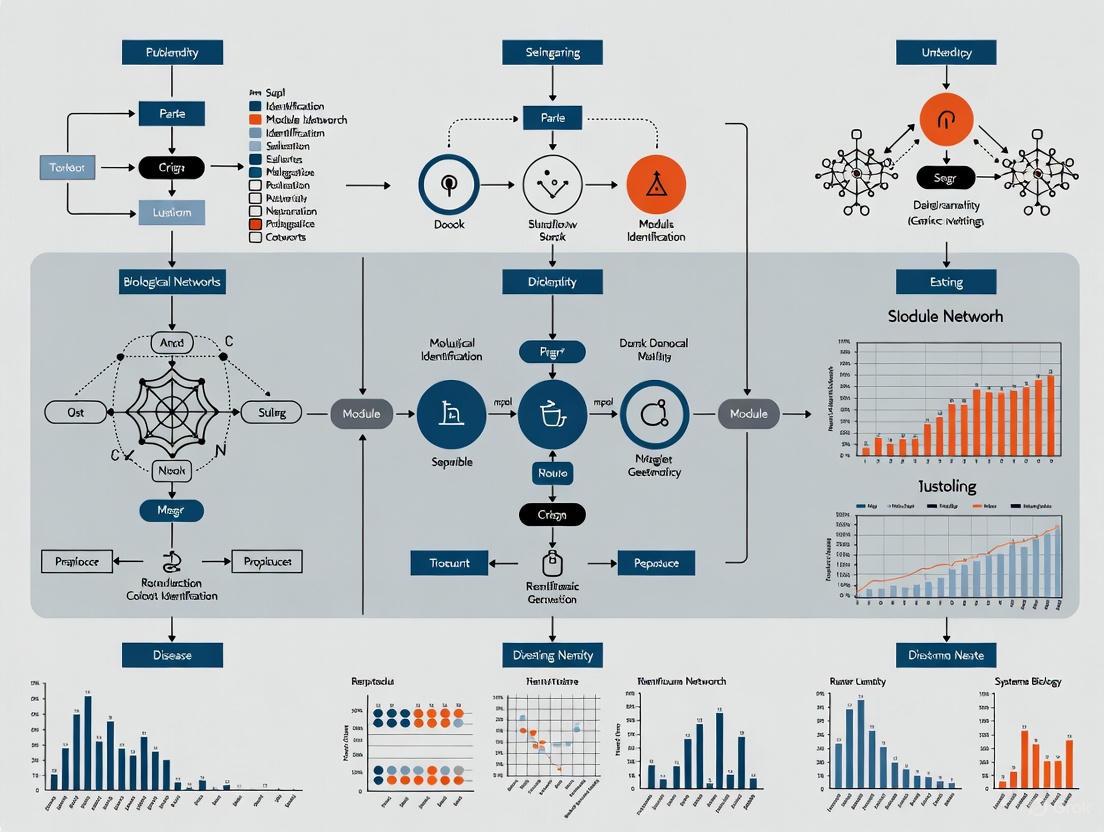
This article provides a comprehensive overview of module identification in biological networks and its pivotal role in understanding complex diseases.
Module Identification in Biological Networks: Unraveling Disease Mechanisms for Drug Discovery
Abstract
This article provides a comprehensive overview of module identification in biological networks and its pivotal role in understanding complex diseases. Aimed at researchers and drug development professionals, it explores the foundational principle that disease-associated genes cluster into functional modules within molecular interaction networks. The content covers key methodological approaches—from network-based and expression-based clustering to active module detection and integrated platforms like NeDRex. It addresses critical challenges such as network incompleteness, method selection, and validation, synthesizing findings from major community efforts like the DREAM Challenge. By illustrating applications in cancer and Alzheimer's disease, this guide serves as a resource for leveraging network medicine to uncover disease pathways and identify repurposable drug candidates.
Why Modules Matter: The Principles of Network Medicine in Disease Biology
Complex diseases, such as coronary artery disease (CAD), Alzheimer's disease (AD), and asthma, are rarely caused by the malfunction of a single gene but instead involve altered interactions between thousands of genes whose products operate in coordinated networks [1]. The discipline of systems medicine has emerged to address this complexity through network-based approaches that analyze high-throughput data alongside clinical variables. A fundamental principle governing these cellular networks is that functionally related genes tend to be highly interconnected and co-localize, forming disease modules [1]. These modules represent sets of functionally related genes or proteins whose disruptions can contribute to disease pathogenesis. The identification and analysis of these modules provide a powerful framework for understanding pathogenic mechanisms, identifying novel candidate genes, and discovering potential therapeutic targets.
The core hypothesis underlying this approach is that disease genes might associate through shared biological functions and pathways, even when they do not interact directly in molecular networks [2] [3]. By mapping disease-associated genes onto models of human protein-protein interaction (PPI) networks, researchers can identify these disease-risk modules and uncover how scattered disease genes associate with each other through prescribed communication protocols of common biological functions [3]. This approach has transformed our ability to gain both systems-level and molecular understanding of disease mechanisms, facilitating the transition from traditional reductionist approaches to more holistic network-based strategies in biomedical research.
Theoretical Foundation: Network Principles in Biology
Biological networks, particularly protein-protein interaction networks, exhibit specific design principles that enable the identification of disease modules. These networks display a "small world" property where all nodes are connected by a limited number of links, and they typically contain a fraction of highly connected nodes (hubs) while most nodes have few connections [1]. Functionally related nodes tend to cluster together in modules, creating distinct functional units within the larger network structure. When disease-associated genes identified through omics studies are mapped onto PPI networks, they frequently co-localize into these disease modules, reflecting their functional relatedness and involvement in common biological processes.
The neighborhood similarity principle serves as a key metric for identifying these functional relationships between genes. Proteins with higher neighborhood similarity, measured by indices such as the Jaccard index which quantifies the overlap of interacting neighbors, tend to share common or related biological functions [2] [3]. This principle enables the clustering of proteins into biological modules with similar functions, forming the basis for hierarchical network analysis and disease module identification. The hierarchical organization of biological networks further supports multi-scale analyses, from local complexes to global functional systems, providing comprehensive insights into disease mechanisms [4].
Table 1: Key Network Properties Relevant to Disease Module Identification
| Network Property | Description | Implication for Disease Research |
|---|---|---|
| Small World Property | All nodes connected by limited links | Pathogenic effects can propagate rapidly through network |
| Hub Nodes | Highly connected nodes with large effects | Potential key therapeutic targets with broad impact |
| Modularity | Functionally related nodes cluster together | Disease genes form coherent functional modules |
| Hierarchical Organization | Multiple levels of network organization | Enables multi-scale analysis from molecular to systems level |
| Neighborhood Similarity | Proteins with similar neighbors share functions | Identifies functionally related proteins and modules |
Methodologies and Experimental Protocols
Hierarchical Clustering of Protein Networks
The identification of disease modules begins with the construction of a hierarchical tree from protein-protein interaction data. This protocol utilizes the Jaccard index as a neighborhood similarity measurement to cluster proteins into biological modules with similar functions [2] [3]. The Jaccard index calculates the similarity between two protein sets by dividing the size of their intersection by the size of their union, producing values between 0 (no common neighbors) and 1 (identical neighbors).
Protocol Steps:
- Data Acquisition: Obtain human protein-protein interaction data from databases such as HPRD (Human Protein Reference Database). The largest connected component of the PPI network should be used for analysis to ensure network connectivity.
- Initialization: Initialize the hierarchy index (k=1), with each protein starting as a single module in the first hierarchy.
- Similarity Calculation: Compute neighborhood similarity values between every module pair in the current hierarchy using the Jaccard index.
- Module Merging: Identify module pairs with the maximum Jaccard index value and merge them into new modules.
- Hierarchy Advancement: Increment the hierarchy index and repeat steps 3-4 until all proteins merge into a single module.
- Tree Construction: Record module memberships and interactions at each hierarchy level to construct the complete hierarchical tree.
This bottom-up approach generates multiple representations of the network at different hierarchical levels, enabling the identification of functional modules at various scales of biological organization [2].
Disease Gene Interaction Pathway Identification
Once the hierarchical tree is constructed, disease gene interaction pathways can be identified through the following protocol:
Protocol Steps:
- Disease Gene Mapping: Map known disease genes to their corresponding proteins in the hierarchical tree. Disease genes can be compiled from databases such as Disease Ontology (DO), Online Mendelian Inheritance in Man (OMIM), and the Genetic Association Database (GAD) [2] [3].
- Disease-Risk Module Identification: Mark biological modules that contain disease proteins as disease-risk modules at each hierarchy level in the tree.
- Pathway Construction: Identify the hierarchy level where disease-risk modules can be connected through interaction relationships. If modules containing disease proteins interact, they are linked to form the disease gene interaction pathway.
- Pathway Validation: Evaluate the resulting pathway through functional annotations, pathway-wide analyses, and randomization tests comparing against pathways generated from random networks.
This approach successfully identified a disease gene interaction pathway for coronary artery disease (CAD) containing 46 disease-risk modules and 182 interaction relationships, connecting 61 known CAD genes that did not necessarily interact directly in the original network [2] [3].
Diagram 1: Workflow for Disease Module and Pathway Identification
Multi-Scale Module Kernel Approach
Recent advances have introduced multi-scale module kernel methods for disease-gene identification that leverage the hierarchical organization of biological networks [4]. This approach captures structural information from local to global scales within biomolecule networks.
Protocol Steps:
- Multi-Scale Module Extraction: Apply exponential sampling and multi-scale modularity optimization to extract modules at different scales from comprehensive interactome data.
- Profile Construction: Construct a multi-scale module profile containing structural information across different hierarchical levels.
- Kernel Generation: Preprocess the multi-scale module profile using relative information content and generate a multi-scale module kernel, followed by kernel sparsification to reduce computational requirements.
- Disease Gene Prediction: Incorporate the multi-scale module kernel using multiple schemes to discover potential disease-related genes based on their membership and positioning within multi-scale modules.
This method has demonstrated superior performance compared to other network-based approaches, showing the utility of multi-scale module structures for identifying disease genes in complex networks [4].
Research Reagent Solutions and Computational Tools
Table 2: Essential Research Resources for Disease Module Analysis
| Resource Category | Specific Tools/Databases | Function and Application |
|---|---|---|
| Protein Interaction Databases | HPRD (Human Protein Reference Database) | Provides curated protein-protein interaction data for network construction [2] [3] |
| Disease Gene Databases | OMIM, Disease Ontology, Genetic Association Database (GAD) | Sources of known disease genes for mapping to networks [2] [3] |
| Pathway Analysis Tools | PathFinder, BowTieBuilder, FASPAD, Pandora | Software for biological pathway discovery and analysis [2] [3] |
| Modularity Algorithms | Multi-scale modularity optimization methods | Identifies modules at different hierarchical levels in networks [4] |
| Contrast Checking Tools | WebAIM Color Contrast Checker, Firefox Developer Tools | Ensures accessibility and readability of visualizations [5] [6] |
Applications and Case Studies
Coronary Artery Disease Module Analysis
The application of disease module identification to coronary artery disease (CAD) has demonstrated the practical utility of this approach. Researchers analyzed 62 known CAD genes mapped onto a human PPI network comprising 9,048 proteins with 36,755 interactions [2] [3]. Through hierarchical clustering based on neighborhood similarity, they identified a comprehensive disease gene interaction pathway containing 46 disease-risk modules connected by 182 interaction relationships. This pathway revealed how CAD-associated genes that lack direct physical interactions can associate through shared biological functions and pathways, providing insights into the cooperative mechanisms underlying CAD pathogenesis. The resulting model demonstrated that disease genes interact with their neighbors cooperatively, associate through shared biological functions of disease-risk modules, and collectively cause dysfunctions across multiple biological processes in molecular networks.
Alzheimer's Disease Cell-Type Specific Modules
Recent research on Alzheimer's disease (AD) has leveraged single-nucleus RNA sequencing (snRNASeq) data from dorsolateral prefrontal cortex tissues to identify cell-type specific coexpression modules [7]. This study analyzed data from 424 participants and identified modules of co-regulated genes in seven major cell types, assigning them to coherent cellular processes. The research demonstrated that while coexpression structure was conserved in most modules across cell types, distinct communities with altered connectivity also existed, suggesting cell-specific gene co-regulation. Particularly noteworthy was the identification of astrocytic module 19 (ast_M19), associated with cognitive decline through a subpopulation of stress-response cells. Using a Bayesian network framework, researchers modeled directional relationships between modules and AD progression, providing cell-specific molecular networks that model the molecular events leading to AD.
Allergy and Asthma Module Discovery
Network-based analyses have identified disease modules relevant to allergy and asthma, leading to novel therapeutic discoveries. One approach identified an IL13-centered regulatory module by knocking down 25 putative IL13-regulating transcription factors and examining their downstream targets [1]. This revealed a module of highly interconnected genes containing both known allergy-relevant genes (IFNG, IL12, IL4, IL5, IL13 and their receptors) and novel candidate genes. The discovery of S100A4 within this module and its subsequent validation as a diagnostic and therapeutic target exemplifies how module-based approaches can identify novel candidates that might be missed through conventional single-gene studies. This approach is particularly valuable for addressing disease heterogeneity in asthma, where 10-20% of patients do not respond to common corticosteroid treatments, potentially due to variations in underlying disease mechanisms [1].
Table 3: Quantitative Results from Disease Module Studies
| Disease Area | Number of Genes Identified | Modules Identified | Key Findings |
|---|---|---|---|
| Coronary Artery Disease | 61 disease genes [2] [3] | 46 disease-risk modules [2] [3] | 182 interaction relationships connecting non-interacting genes [2] [3] |
| Alzheimer's Disease | Modules across 7 cell types [7] | ast_M19 associated with cognitive decline [7] | Cell-specific coexpression networks conserved across datasets [7] |
| Breast Cancer | Novel candidate HMMR [1] | Interaction module with BRCA1 [1] | Functionally and genetically validated module [1] |
| Rheumatoid Arthritis | Meta-analysis of 100,000 subjects [1] | Module-based drug discovery [1] | Identified novel therapeutic targets [1] |
Visualization and Data Presentation Standards
Effective visualization of disease modules and interaction pathways requires careful attention to design principles that enhance interpretability. The following standards ensure clarity and accessibility of network representations:
Color Contrast Guidelines:
- Text Contrast: Maintain a contrast ratio of at least 4.5:1 for normal text and 3:1 for large-scale text against background colors [5] [6].
- Node Design: Explicitly set text color (fontcolor) to ensure high contrast against node background colors (fillcolor) in all network diagrams.
- Enhanced Accessibility: Aim for contrast ratios of 7:1 for normal text and 4.5:1 for large text when targeting enhanced accessibility standards [5].
Network Visualization Principles:
- Hierarchical Layout: Arrange nodes to reflect different levels of biological organization, from molecular interactions to pathway-level connections.
- Functional Grouping: Cluster related nodes within defined boundaries to emphasize modular structure.
- Interaction Clarity: Use directed edges with arrowheads to indicate directionality in regulatory relationships where appropriate.
Diagram 2: Disease Gene Association Through Risk Modules
The identification and analysis of disease modules has established a powerful paradigm for understanding the complex mechanisms underlying human diseases. By mapping disease genes onto biological networks and identifying their functional modules, researchers can bridge the gap between scattered genetic associations and coherent pathological processes. The methodologies outlined—from hierarchical clustering based on neighborhood similarity to multi-scale module kernel approaches—provide robust protocols for identifying these modules and constructing meaningful disease gene interaction pathways.
Future developments in this field will likely focus on multi-layer network models that integrate diverse data types, including genetic variants, transcriptomic profiles, proteomic data, and environmental factors [1]. Such integrated approaches promise to address disease heterogeneity more effectively and support the development of personalized therapeutic strategies. Additionally, as single-cell technologies advance, cell-type specific module analyses will become increasingly important for understanding how disease processes manifest in particular cellular contexts, as demonstrated by the Alzheimer's disease study identifying astrocyte-specific modules associated with cognitive decline [7].
The translation of disease module discoveries into clinical applications represents the next frontier, with potential for identifying novel therapeutic targets, developing multi-marker diagnostic panels, and stratifying patients based on their underlying molecular network perturbations. As these network-based approaches mature, they will increasingly support clinical decision-making by providing comprehensive frameworks for understanding disease mechanisms and personalizing treatments.
Modularity as a Biological Design Principle in Evolution and Robustness
Modularity is a fundamental design principle observed across all scales of biological organization, from molecular networks to entire ecosystems. In biological networks, a module is generally defined as a set of tightly interconnected components—such as genes, proteins, or metabolites—where the density of connections within the module is significantly higher than the density of connections between different modules [8]. This organizational structure is not merely a topological curiosity; it is intrinsically linked to key biological properties, including evolutionary adaptability, functional specialization, and systemic robustness. Modularity confers robustness by localizing perturbations, thereby preventing the failure of one component from cascading and causing a total system collapse [8]. Furthermore, from an evolutionary perspective, modular organization allows for the modification of one function without disrupting others, facilitating the exploration of new evolutionary paths [8].
The emergence and preservation of modularity in biological systems are driven by a complex interplay of factors. Underlying mutational mechanisms, such as growth, duplication, and diversification of system components, can give rise to modular structures [8]. However, evolutionary pressures like natural selection and ecological factors including spatial distribution and population dynamics are also critical in shaping and maintaining modular architectures [8]. Understanding this principle is paramount for disease research, as complex diseases often arise from the perturbation of specific, functionally coherent modules within the broader cellular network [9] [10].
Key Principles and Definitions of Biological Modularity
Structural vs. Functional Modularity
A critical distinction must be made between structural and functional modularity, which, while related, are not synonymous.
- Structural Modularity: This refers to the physical or topological organization of a network into discrete, densely interconnected groups. It is a quantifiable property of the network's connectivity, often measured by metrics like the Q-metric, which assesses the extent to which a network can be divided into modules with stronger within-module than between-module connections [11].
- Functional Modularity: This describes the degree to which potential modules perform specialized and distinct functions [11]. A functionally modular system is characterized by:
- Domain Specificity: A module responds to and operates only on specific types of inputs.
- Information Encapsulation: A module has restricted access to information outside its own state.
- Separate Modifiability: The impairment of one module does not affect the functioning of another [11].
Crucially, structural modularity does not guarantee functional specialization. Research in artificial neural networks has shown that even under strict structural modularity, functional entanglement can occur unless the system is resource-constrained and the environmental tasks are meaningfully separable [11].
Quantitative Metrics for Modularity
The evaluation of modularity relies on robust quantitative measures. The most common metric, Newman's Modularity (Q), is calculated as follows:
Q = (1/(2m)) * Σ_ij [A_ij - (k_i * k_j)/(2m)] * δ(c_i, c_j)
Where:
A_ijis the adjacency matrix element (1 if nodes i and j are connected, 0 otherwise).k_iandk_jare the degrees of nodes i and j.mis the total number of edges in the network.c_iandc_jare the communities/modules of nodes i and j.δ(c_i, c_j)is the Kronecker delta function (1 if nodes are in the same module, 0 otherwise) [8] [11].
A higher Q value indicates a stronger modular structure. However, it is important to note that topological quality metrics like Q show only a modest correlation with biological relevance, underscoring the necessity for biologically interpretable validation of identified modules [9].
Application Notes: Disease Module Identification in Practice
The identification of disease-relevant modules from molecular networks is a primary strategy for elucidating pathogenic pathways and discovering potential drug targets [9] [12] [10]. The following protocols outline established and novel methodologies for this purpose.
Protocol 1: The Standard "Seed-Extend" Workflow using DIAMOnD
This protocol describes a classic approach for identifying a disease module starting from a set of known disease-associated genes (seed genes), as implemented in platforms like NeDRex [10].
Principle: The algorithm connects a set of seed genes into a coherent module by iteratively adding nodes in the network that have the most significant number of connections to the current module, under the hypothesis that disease proteins tend to interact closely in biological networks [10].
Inputs:
- A biological network (e.g., a Protein-Protein Interaction network from databases like IID or STRING).
- A list of seed genes associated with the disease of interest (e.g., from GWAS or DisGeNET).
- A stopping criterion (e.g., a predefined number of genes to add, often 100-200).
Procedure:
- Network Construction: Integrate a high-quality PPI network from sources like OmniPath or InWeb [9] [10].
- Seed Selection: Compile a list of seed genes from curated databases such as DisGeNET [10].
- Module Expansion: a. Initialize the disease module with the seed genes. b. For all nodes directly connected to the module, calculate the number of connections they have to the module. c. Identify the node with the most statistically significant number of connections (using a hypergeometric test). d. Add this top-ranking node to the disease module. e. Repeat steps b-d until the stopping criterion is met.
- Validation: Statistically validate the resulting module by calculating its enrichment for known disease genes and its association with GWAS signals using tools like Pascal [9].
Output: A connected subnetwork representing the putative disease module.
Limitations: This method can be biased toward well-studied seed genes and may struggle to identify globally dispersed disease modules that consist of multiple separate connected components [12].
Protocol 2: Unbiased Module Discovery via Network Representation Learning (N2V-HC)
This protocol leverages deep representation learning to overcome the biases of seed-based methods, enabling the unbiased discovery of scattered disease modules [12].
Principle: This method learns low-dimensional vector representations (embeddings) for all nodes in an integrated network that capture both their local network neighborhood and global structural role. Modules are then identified by clustering these node embeddings [12].
Inputs:
- An integrated biological network combining PPI, GWAS summary statistics, and eQTL data.
- Network embedding parameters (e.g., walk length, number of walks, embedding dimensions).
Procedure:
- Integrated Network Construction: a. Begin with a core PPI network. b. Incorporate disease-specific data by adding edges between GWAS index SNPs (or their LD proxy SNPs) and their target eQTL-regulated genes (egenes) [12]. c. This creates a heterogeneous network where edges can represent both physical protein interactions and functional genetic associations.
- Representation Learning with node2vec: a. Simulate biased random walks on the integrated network. These walks balance a depth-first (exploring structural equivalents) and breadth-first (exploring homophily) search strategy. b. Use the Skip-gram model (like Word2Vec) to learn an embedding vector for each node based on the sequences of nodes visited in the random walks [12].
- Hierarchical Clustering with Dynamic Tree Cut: a. Perform hierarchical clustering on the matrix of node embedding vectors. b. Apply a dynamic tree-cutting algorithm to the resulting dendrogram to automatically partition nodes into modules [12].
- Module Prioritization: a. Test each identified module for significant enrichment of predicted disease genes (e.g., egenes from the integrated data). b. Prioritize modules with the strongest enrichment scores as candidate disease modules.
Output: A set of non-overlapping gene modules, prioritized by their enrichment for disease-associated signals.
Comparative Analysis of Module Identification Methods
Robust community challenges, such as the Disease Module Identification DREAM Challenge, have provided empirical data to compare the performance of dozens of algorithms [9]. The table below summarizes key findings.
Table 1: Performance Comparison of Module Identification Method Categories from the DREAM Challenge
| Method Category | Key Principle | Example Algorithms | Relative Performance | Key Findings |
|---|---|---|---|---|
| Kernel Clustering | Uses diffusion-based distances and spectral clustering | Method K1 [9] | Top Performer | Achieved robust performance without network pre-processing. |
| Modularity Optimization | Maximizes Newman's modularity (Q) metric | Louvain, Leiden, Method M1 [9] [13] | Strong Performer | Performance can be improved with a resistance parameter to control granularity. |
| Random-Walk Based | Uses flow simulation and Markov chains | Infomap, Markov Clustering (MCL), Method R1 [9] [12] | Strong Performer | Adapting granularity locally helps balance module sizes. |
| Dynamic/Label Propagation | Simulates communication between nodes | SpeakEasy2 [13] | Robust & Scalable | Generally provides robust, scalable clusters across diverse data types. |
| Multi-Network Methods | Integrates information from multiple network types | Various integrated approaches [9] | No Added Power | In the DREAM challenge, did not outperform single-network methods. |
The DREAM challenge revealed that no single method is universally superior. The top-performing algorithms from different categories achieved comparable results, and importantly, they often identified complementary trait-associated modules [9]. Furthermore, the performance of a method was largely independent of the number or size of the modules it produced, and topological quality metrics like modularity (Q) were only modestly correlated with biological relevance (Pearson’s r = 0.45) [9]. Different types of biological networks also vary in their informativeness for disease module discovery; for example, signaling and co-expression networks were found to contain the highest density of trait-associated modules relative to their size [9].
Table 2: Suitability of Biological Network Types for Disease Module Identification
| Network Type | Description | Utility for Trait Modules |
|---|---|---|
| Signaling Network | Represents signaling pathways and regulatory relationships | Highest density of trait-associated modules [9] |
| Co-expression Network | Built from gene expression correlation across samples | High absolute number of trait modules [9] |
| Protein-Protein Interaction (PPI) | Maps physical interactions between proteins | High absolute number of trait modules [9] |
| Genetic Dependency | Derived from loss-of-function screens in cell lines | Fewer trait modules for complex traits [9] |
| Homology-Based Network | Built from phylogenetic patterns across species | Fewer trait modules for complex traits [9] |
The Scientist's Toolkit: Essential Reagents and Databases
Successful disease module identification relies on the integration of high-quality data and specialized computational tools. The following table catalogues essential resources.
Table 3: Key Research Reagent Solutions for Network-Based Disease Module Identification
| Resource Name | Type | Function in Analysis |
|---|---|---|
| NeDRexDB | Integrated Knowledgebase | Provides a unified graph database of genes, drugs, diseases, and interactions from 10+ sources (e.g., OMIM, DisGeNET, DrugBank) for building custom networks [10]. |
| OmniPath / InWeb / IID | Protein-Protein Interaction (PPI) Data | Source of curated physical molecular interactions that form the backbone of most biological networks used in module identification [9] [10]. |
| DisGeNET | Gene-Disease Association Database | Provides curated and inferred associations between genes and diseases, used for seed gene selection and module validation [10]. |
| GWAS Catalog / eQTL Data | Genetic Association Data | Source of disease-associated genetic variants and their target genes, used to build integrated networks and predict disease genes [12]. |
| Pascal | GWAS Scoring Tool | Aggregates trait-association p-values at the gene and module level, used for the independent statistical validation of predicted disease modules [9]. |
| Cytoscape with NeDRexApp | Network Visualization & Analysis Platform | An interactive platform to import networks from NeDRexDB, run module identification algorithms (MuST, DIAMOnD), and visualize results [10]. |
| node2vec | Network Embedding Algorithm | A tool for representation learning that converts network nodes into feature vectors, serving as input for clustering algorithms like N2V-HC [12]. |
Visualization of Workflows and Pathways
To facilitate understanding and implementation, the following diagrams illustrate the core logical and experimental relationships described in this article.
Disease Module Identification Workflow
Modularity as a Design Principle
The core hypothesis in network medicine posits that disease phenotypes arise from the perturbation of specific functional modules within complex biological networks, rather than from isolated defects in individual genes or proteins [10]. These modules, often representing pathways or protein complexes, are groups of molecules that work in concert to perform a biological function. When perturbed, these modules can lead to a loss of biological function and the emergence of disease states. The identification of these disease-relevant modules provides a powerful framework for understanding disease mechanisms and identifying potential therapeutic targets [9] [14]. This document outlines the experimental and computational protocols for validating this core hypothesis through module identification and analysis in biological networks.
Experimental Validation of the Core Hypothesis
The Disease Module Identification DREAM Challenge, a comprehensive community effort, provides robust empirical support for the core hypothesis by systematically evaluating 75 module identification methods across diverse molecular networks [9].
Key Findings from the DREAM Challenge
The challenge demonstrated that top-performing algorithms could identify network modules significantly associated with complex traits and diseases. The validation used a unique collection of 180 genome-wide association studies (GWAS), providing independent and biologically interpretable scoring of predicted modules [9].
Table 1: Performance of Module Identification Methods in the DREAM Challenge
| Metric | Description | Finding |
|---|---|---|
| Top Method Scores | Number of trait-associated modules (at 5% FDR) on holdout GWAS set | 55-60 trait-associated modules [9] |
| Network Utility | Trait-associated modules relative to network size | Highest in signaling networks [9] |
| Method Complementarity | Percentage of trait modules recovered by multiple methods | 46% in a given network; 17% across different networks [9] |
| Biological Relevance | Correspondence of top modules to known biology | Most modules corresponded to core disease-relevant pathways and therapeutic targets [9] |
Protocol: GWAS-Based Validation of Disease Modules
Purpose: To empirically test predicted network modules for association with complex traits and diseases using independent GWAS data. Input: A set of predicted network modules (genesets of size 3-100 genes).
- GWAS Data Curation: Compile a large collection of GWAS datasets (e.g., 180 studies) covering diverse molecular processes and diseases. Split the data into a leaderboard set for initial scoring and a holdout set for final evaluation to prevent overfitting [9].
- Trait Association Analysis: For each predicted module and each GWAS trait, calculate a module-level association score using a tool like Pascal, which aggregates trait-association P-values of single nucleotide polymorphisms (SNPs) at the level of genes and modules [9].
- Significance Thresholding: Apply a false discovery rate (FDR) correction (e.g., 5% FDR) to the module-trait association P-values to account for multiple testing. Modules that score significantly for at least one GWAS trait are designated as trait-associated modules [9].
- Scoring and Evaluation: The score for a module identification submission is the total number of its trait-associated modules. Performance is finalized based on the holdout GWAS set [9].
Computational Methodologies for Module Identification
Module identification, or community detection, is a class of algorithms that reduce complex networks into functionally coherent subnetworks. The DREAM Challenge revealed that top-performing methods come from different algorithmic categories, indicating no single superior approach [9].
Table 2: Categories of Module Identification Algorithms
| Algorithm Category | Description | Example Methods |
|---|---|---|
| Kernel Clustering | Uses diffusion-based distance metrics and spectral clustering | K1 (Top performer in DREAM) [9] |
| Modularity Optimization | Maximizes the density of connections within modules versus between them | M1 (Runner-up in DREAM) [9] |
| Random-Walk-Based | Uses flow simulation to identify densely connected regions | R1 (Markov clustering) [9] |
| Network Embedding | Maps network nodes into a vector space to identify clusters | AMINE (Node2vec-based) [15] |
| Multi-Steiner Trees | Finds optimal connecting subgraphs from seed genes | MuST (in NeDRex platform) [10] |
Protocol: Active Module Identification with AMINE
Purpose: To identify condition-specific active modules in a biological network by integrating gene activity scores (e.g., from transcriptomics) with network proximity [15].
- Input Data Preparation:
- Network: A biological interaction network (e.g., PPI, signaling) as an undirected graph.
- Node Weights: A gene activity score for each node (e.g., -log10(P-value) from differential expression analysis).
- Network Embedding: Use a network embedding method like Node2vec to generate a compact vector representation for each node in the network. This step projects the network into a low-dimensional space where geometric proximity reflects network proximity [15].
- Module Formation: Apply a greedy clustering algorithm in the embedded vector space. Nodes are sorted by their activity score. Starting with the most active node, iteratively add neighboring nodes in the embedding space to the module if they increase the module's aggregate activity score [15].
- Output: A set of active modules—groups of genes that are both highly active in the condition of study and proximate in the network embedding space.
From Modules to Therapeutics: Drug Repurposing
The core hypothesis directly enables therapeutic discovery. If a disease module is identified, drugs targeting its components should counteract the disease phenotype. The NeDRex platform operationalizes this principle for network-based drug repurposing [10].
Protocol: Drug Repurposing with the NeDRex Platform
Purpose: To identify repurposable drugs for a disease of interest by discovering disease modules and finding drugs that target them.
- Seed Gene Selection: Compile a list of seed genes known to be associated with the disease. These can be obtained from databases like DisGeNET or OMIM, integrated within NeDRexDB [10].
- Disease Module Detection: Use a network algorithm within NeDRexApp, such as MuST (Multi-Steiner Trees), to extract a connected disease module from an integrated biological network. MuST finds an optimal subnetwork that connects a high proportion of the seed genes while allowing for the inclusion of new connector genes that may be part of the disease mechanism [10].
- Drug Prioritization: Extract a list of drugs whose known targets (from DrugBank) are contained within the identified disease module or are in its immediate network vicinity. These drugs are predicted to counteract the disease by modulating the dysregulated module [10].
- Statistical Validation: Calculate empirical P-values to validate the significance of the disease module and the drug-module associations, guarding against false positives resulting from network connectivity properties [10].
The Scientist's Toolkit: Essential Research Reagents & Databases
Successful application of the protocols depends on key data resources and computational tools.
Table 3: Research Reagent Solutions for Network Perturbation Studies
| Resource Name | Type | Function in Analysis |
|---|---|---|
| STRING / InWeb | Protein-Protein Interaction Network | Provides physical interaction data for network construction [9] [14] |
| OmniPath | Signaling Network | Provides directed signaling interactions for network construction [9] |
| DisGeNET / OMIM | Gene-Disease Association Database | Sources for seed genes for a disease of interest [10] |
| DrugBank | Drug-Target Database | Provides known drug-target interactions for drug prioritization [10] |
| NeDRexDB | Integrated Knowledgebase | Harmonizes multiple data sources (genes, drugs, diseases, interactions) for analysis [10] |
| Pascal | GWAS Analysis Tool | Aggregates SNP-level trait associations to gene and module-level scores for validation [9] |
Molecular networks provide a foundational framework for understanding cellular organization and dysfunction in human disease. These networks are inherently modular, meaning they are organized into tightly connected subgroups of genes or proteins that often correspond to specific biological functions or pathways crucial for cellular activity [9]. The identification of these modules—groups of genes or proteins with between 3 and 100 members—is a critical step in systems biology, moving the focus from individual molecules to functional systems [9] [14]. Dysregulation within these functional modules is a fundamental mechanism underlying complex diseases, making their identification essential for uncovering disease mechanisms, potential drug targets, and biomarkers [9] [14].
The integration of diverse, complementary network types provides a more robust and complete picture of cellular machinery than any single network can offer. This integrated approach mitigates the limitations and noise inherent in individual datasets, allowing for the discovery of biologically and clinically relevant modules [9]. Key data sources for such integration include Protein-Protein Interaction (PPI) networks, which map physical bindings and stable complexes; signaling networks, which describe directed flows of cellular information; and co-expression networks, which infer functional relationships from coordinated gene expression patterns [9] [14]. The subsequent sections detail these core data sources, provide protocols for their integration and analysis, and demonstrate how this approach powerfully links network modules to human disease.
A robust integration protocol begins with an understanding of the distinct properties and origins of each network type. The table below summarizes the key characteristics of three primary biological networks used for module identification.
Table 1: Key Data Sources for Network Integration in Disease Module Identification
| Network Type | Nature of Interaction | Primary Data Sources | Node Representation | Edge Representation & Weight |
|---|---|---|---|---|
| Protein-Protein Interaction (PPI) | Physical or functional associations between proteins | STRING, InWeb, OmniPath [9] [14] | Proteins | Confidence scores from experimental evidence or computational predictions [9] |
| Signaling Network | Directed causal relationships in signal transduction | OmniPath [9] [14] | Genes/Proteins | Confidence scores from curated pathway databases [9] |
| Co-expression Network | Statistical correlation of gene expression across samples | Gene Expression Omnibus (GEO) [9] | Genes | Correlation scores (e.g., Pearson, Spearman) derived from transcriptomic data [9] |
Each network provides a unique lens on cellular function. PPI networks reveal the physical architecture of protein complexes. Signaling networks contextualize proteins within directional, often causal, pathways that control cell decisions. Co-expression networks imply functional coordination, capturing genes that respond to similar regulatory inputs or biological conditions. When integrated, these layers move beyond the limitations of a single data type, enabling the identification of modules that are coherent in their physical presence, regulatory logic, and functional output [9].
Experimental Protocol for Integrated Module Identification
This protocol outlines a comprehensive workflow for identifying disease-relevant modules from integrated PPI, co-expression, and signaling networks, adapting methodologies from successful community challenges and recent research [9] [14].
Data Acquisition and Preprocessing
Objective: To gather and standardize heterogeneous network data for integration. Materials & Reagents:
- Network Data: Processed network files from public databases (see Table 1).
- Computational Environment: A machine with sufficient memory (>=16 GB RAM recommended) and programming environment (R or Python).
Procedure:
- Data Download: Obtain network data in a standardized format (e.g., adjacency matrix, edge list).
- Gene Identifier Harmonization: Map all node identifiers (e.g., proteins, genes) across all networks to a common gene nomenclature system (e.g., official HGNC symbols). This is critical for multi-network integration [9].
- Network Sparsification (Optional): To reduce noise and computational complexity, preprocess networks by discarding edges with low confidence or correlation weights. Note: Some top-performing algorithms, like kernel-based methods, are robust and can operate on unsparsified networks [9].
Network Integration and Module Detection
Objective: To apply community detection algorithms to identify cohesive modules from the integrated network data.
Procedure:
- Choose an Integration & Analysis Strategy: The choice of strategy has a greater impact on biological interpretation than the specific network model used [16]. Two primary approaches are:
- Single-Network Analysis: Run module identification on each network individually and subsequently integrate the results [9].
- Multi-Network Analysis: Create a unified network representation by merging the six networks (using harmonized identifiers) and identify a single set of modules from this composite network [9].
- Select a Module Identification Algorithm: Choose from top-performing community detection methods. The DREAM Challenge revealed that no single approach is inherently superior, but methods from different categories perform well [9].
- Kernel Clustering (K1): A top-performing method using a diffusion-based distance metric and spectral clustering [9].
- Modularity Optimization (M1): Extends standard modularity with a resistance parameter to control module granularity [9].
- Random-Walk-Based (R1): Uses Markov clustering with locally adaptive granularity [9].
- Execute Algorithm: Run the selected algorithm, constraining output modules to a size between 3 and 100 genes, as this range is typical for functional biological pathways [9] [14].
The following workflow diagram illustrates the core steps of this protocol.
Workflow for Integrated Disease Module Identification
Validation and Biological Interpretation
Objective: To empirically assess predicted modules for association with complex traits and diseases.
Materials & Reagents:
- GWAS Data: A compiled collection of Genome-Wide Association Studies (e.g., 180 studies for robust testing) [9].
- Software Tool: Pascal tool for aggreg SNP-level association P-values to the gene and module level [9].
Procedure:
- Calculate Module Trait-Association: Use the Pascal tool or similar to test each predicted module for significant association with each complex trait or disease in the GWAS collection [9].
- Define Trait-Associated Modules: Apply a False Discovery Rate (FDR) threshold (e.g., 5%) to identify modules that are significantly trait-associated [9].
- Functional Enrichment Analysis: Input the genes from significant modules into functional annotation tools (e.g., Gene Ontology, KEGG pathway analysis) to interpret the biological functions and pathways captured by the module.
- Benchmark Performance: The final score of a module identification method can be defined as the total number of trait-associated modules it produces, providing a quantitative, biologically interpretable benchmark [9].
The Scientist's Toolkit: Research Reagents and Computational Solutions
Table 2: Essential Tools for Integrated Network Analysis
| Tool / Resource | Type | Primary Function | Key Features / Notes |
|---|---|---|---|
| STRING/InWeb | Database | Source for PPI data | Provides confidence scores; text-mining derived interactions can be excluded to reduce noise [14]. |
| OmniPath | Database | Source for signaling pathway interactions | Provides curated, directed relationships for signaling networks [9]. |
| Gene Expression Omnibus (GEO) | Data Repository | Source for transcriptomic data to build co-expression networks | Contains a vast array of sample data from diverse conditions [9]. |
| Pascal Tool | Software | Statistical genetics tool for module validation | Aggregates GWAS P-values to test module-level association with traits [9]. |
| K1 / M1 / R1 Algorithms | Algorithm | Top-performing module identification methods | Represent kernel, modularity optimization, and random-walk approaches, respectively [9]. |
| GWAS Catalog | Database | Collection of genome-wide association studies | Used as an independent data source for empirical validation of predicted modules [9]. |
Discussion and Advanced Analysis Strategies
The protocol outlined above provides a foundational approach. However, several advanced considerations can further enhance the discovery of disease-relevant biology.
First, the choice between node-based and community-based network analysis strategies has been shown to have the strongest impact on the resulting biological interpretation, even more so than the choice of network model itself [16]. Researchers should consider their biological question when choosing a strategy. Furthermore, while the described protocol focuses on non-overlapping modules, evidence suggests that overlapping community detection is a more biologically realistic approach, as genes often participate in multiple biological functions and can therefore be implicated in several disease modules [14].
Advanced computational methods are also being developed to refine this process. For example, the AMINE method uses a network embedding approach (Node2vec) to map nodes into a vector space, facilitating the identification of active modules based on both network proximity and gene activity scores from transcriptomic data [15]. Similarly, scNET leverages graph neural networks to integrate scRNA-seq data with PPI networks, learning context-specific gene embeddings that better capture functional annotations and pathway structures [17]. These methods represent the cutting edge in moving from static network integration to dynamic, condition-specific analysis.
In conclusion, the integration of PPI, co-expression, and signaling networks, followed by rigorous module identification and validation, is a powerful paradigm for elucidating the modular structure of human disease. By following standardized protocols and leveraging the growing toolkit of databases and algorithms, researchers can systematically uncover the functional pathways and complexes that drive disease pathogenesis.
A Practical Guide to Module Identification Methods and Their Applications
Module identification is a fundamental task in computational biology, aiming to decompose complex biological systems into functionally coherent subgroups. These modules often represent key functional units—such as groups of genes, proteins, or metabolites—that work in concert to carry out specific biological processes. Disruptions within these modules are frequently implicated in disease mechanisms, making their identification crucial for understanding pathogenesis and identifying novel therapeutic targets. Network-based approaches provide a powerful framework for this task by modeling biological data as graphs, where nodes represent biological entities and edges represent interactions, relationships, or similarities between them. Hierarchical clustering and graph algorithms serve as core computational techniques for detecting these modules, each offering distinct advantages for different biological contexts and data types.
The application of these methods spans multiple domains within disease research. In genomics, they help identify co-expressed gene sets in transcriptomic data. In proteomics, they reveal functional protein complexes within protein-protein interaction networks. In drug discovery, they facilitate the identification of drug-target communities and repurposing opportunities within knowledge graphs. The structured nature of these algorithms makes them particularly well-suited for biological data, which often exhibits inherent modularity and hierarchical organization—from molecular complexes to pathway-level interactions and system-level functionalities.
Clustering Algorithms for Network Analysis
Algorithm Comparison and Selection
Clustering methods group similar biological entities together, facilitating pattern recognition within complex datasets. Different algorithms offer distinct approaches suited to particular data structures and biological questions [18].
Table: Comparative Analysis of Clustering Algorithms for Biological Networks
| Algorithm Type | Key Characteristics | Optimal Use Cases | Advantages | Limitations |
|---|---|---|---|---|
| Hierarchical Clustering | Builds tree-like structure (dendrogram); No pre-specified K needed [18] | Gene expression analysis; Phylogenetics; Exploring relationships at multiple scales [18] | Reveals nested relationships; Intuitive visualization via dendrograms; No assumption of spherical clusters [18] [19] | Computational complexity O(n³) for agglomerative; Sensitive to noise and outliers; Once merged, clusters cannot be split [19] |
| K-means Clustering | Partitional method; Requires pre-specified K; Minimizes within-cluster variance [18] | Protein structure classification; Large-scale genomic datasets [18] | Computational efficiency O(n); Simple implementation; Works well with compact, spherical clusters [18] | Requires pre-specification of K; Assumes spherical cluster shapes; Struggles with non-globular clusters; Sensitive to initial centroid placement [18] |
| DBSCAN | Density-based; Identifies arbitrary shapes; Handles noise [18] | Single-cell RNA-seq analysis; Spatial transcriptomics; Protein interaction networks with outliers [18] | Discovers arbitrarily shaped clusters; Robust to outliers; Does not require pre-specified K [18] | Parameter sensitivity (ε, minPts); Struggles with varying densities; Difficulty with high-dimensional data [18] |
| Fuzzy Clustering | Probabilistic membership; Points belong to multiple clusters [18] | Genes with multiple functions; Protein partial structural similarities; Gradual cellular state transitions [18] | Handles uncertainty and overlapping clusters; Represents gradual biological transitions [18] | Computationally intensive; Membership interpretation can be challenging [18] |
Hierarchical Clustering Protocol for Gene Co-expression Analysis
Protocol Title: Identification of Co-expressed Gene Modules Using Hierarchical Agglomerative Clustering
Purpose: To identify groups of genes with similar expression patterns across experimental conditions or samples, potentially representing functionally related modules involved in disease mechanisms.
Experimental Workflow:
Data Preparation and Normalization
- Obtain gene expression matrix (rows = genes, columns = samples/conditions) from microarray, RNA-seq, or single-cell RNA-seq data.
- Apply appropriate normalization: TPM or FPKM for bulk RNA-seq; log-transformation and batch effect correction if needed.
- Filter lowly expressed genes (e.g., remove genes with counts <10 in >90% of samples).
- Standardize data (z-score normalization) per gene across samples if using correlation-based distance.
Distance Matrix Computation
- Calculate pairwise dissimilarity between all genes using:
- Euclidean distance: For magnitude-based differences
- Pearson correlation distance: 1 - |r| for pattern-based similarity
- Spearman correlation: For rank-based relationships
- Output: n×n symmetric distance matrix where n = number of genes.
- Calculate pairwise dissimilarity between all genes using:
Linkage Method Selection and Cluster Building
- Choose appropriate linkage criterion based on biological question:
- Complete linkage: Minimizes maximum distance between clusters; finds compact clusters.
- Average linkage: Uses average distance between all pairs; balanced approach.
- Ward's method: Minimizes within-cluster variance; creates spherical clusters.
- Implement agglomerative clustering algorithm:
- Initialize with each gene as singleton cluster.
- Iteratively merge two closest clusters based on linkage criterion.
- Update distance matrix after each merge.
- Continue until all genes belong to single cluster.
- Choose appropriate linkage criterion based on biological question:
Dendrogram Analysis and Module Definition
- Visualize clustering results as dendrogram (tree diagram).
- Identify robust modules by cutting dendrogram at appropriate height:
- Use elbow method of cluster dissimilarity vs. number of clusters.
- Apply dynamic tree cut algorithms to detect branches with high consistency.
- Extract gene members for each resulting module.
Validation and Biological Interpretation
- Assess module stability via bootstrapping or jackknifing.
- Perform functional enrichment analysis (GO, KEGG) on each module.
- Calculate module eigengenes (first principal component) for downstream analysis.
- Correlate module eigengenes with clinical traits to identify disease-relevant modules.
Troubleshooting Notes:
- Poor cluster separation: Try alternative distance metrics or normalization approaches.
- Computational limitations: For large datasets (>10,000 genes), use fast cluster packages (flashClust) or implement on HPC systems.
- Sensitivity to outliers: Consider using robust correlation measures (biweight midcorrelation) or outlier removal prior to clustering.
Hierarchical clustering workflow for gene modules.
Research Reagent Solutions for Transcriptomic Analysis
Table: Essential Research Reagents and Tools for Gene Co-expression Analysis
| Reagent/Tool | Function | Application Notes |
|---|---|---|
| RNA Extraction Kit (e.g., Qiagen RNeasy) | High-quality RNA isolation from tissues/cells | Ensure RNA Integrity Number (RIN) >8.0 for reliable expression data |
| RNA-seq Library Prep Kit (e.g., Illumina TruSeq) | Preparation of sequencing libraries | Use ribosomal RNA depletion for mRNA sequencing; Strand-specific protocols recommended |
| Clustering Software (e.g., R hclust, WGCNA) | Implementation of clustering algorithms | WGCNA provides specialized functions for weighted gene co-expression network analysis |
| Functional Enrichment Tools (e.g., clusterProfiler, DAVID) | Biological interpretation of gene modules | Identifies overrepresented GO terms, KEGG pathways in module gene lists |
| Normalization Packages (e.g., DESeq2, edgeR) | Processing of raw count data | Account for library size differences and composition bias in RNA-seq data |
Graph Algorithms for Biological Network Analysis
Graph Machine Learning Approaches
Graph algorithms extend beyond clustering to leverage the full relational structure of biological networks. Graph Machine Learning (GML), particularly Graph Neural Networks (GNNs), has emerged as a powerful framework for learning from interconnected biological data [20]. These methods iteratively update node features by propagating information from neighbors, effectively capturing both structural patterns and node attributes [20]. In drug discovery, GML applications range from target identification and molecule design to drug repurposing, with some models successfully progressing to in vivo validation [20].
Knowledge graphs (KGs) provide particularly valuable representations for biomedical knowledge, capturing complex relationships between drugs, targets, diseases, and biological processes [20] [21]. These structured networks enable sophisticated reasoning through link prediction—identifying missing connections that may represent novel drug-disease relationships or mechanism-of-action insights [21].
Table: Graph Algorithm Applications in Disease Research
| Algorithm Category | Representative Methods | Biological Applications | Key Advantages |
|---|---|---|---|
| Graph Neural Networks | GCN, GAT, Message Passing NN [20] [22] | Molecular property prediction; Drug-target interaction; Drug response prediction [20] [22] | Learns task-specific features; Incorporates network structure; Handles heterogeneous data [20] |
| Knowledge Graph Embedding | TransE, ComplEx, RotatE [20] [21] | Drug repurposing; Polypharmacy side effects; Target-disease association [20] [21] | Captures complex relational patterns; Integrates multi-modal data; Enables multi-hop reasoning [21] |
| Community Detection | Louvain, Leiden, Infomap | Protein complex identification; Functional module discovery in PPI networks | Reveals mesoscale organization; No prior knowledge of cluster number needed |
| Centrality Measures | Betweenness, Eigenvector, PageRank | Identification of essential proteins; Key regulatory genes; Drug target prioritization | Quantifies node importance; Identifies network bottlenecks and influencers |
Protocol: Knowledge Graph Construction for Drug Repurposing
Protocol Title: Building and Mining Biomedical Knowledge Graphs for Drug Repurposing Candidates
Purpose: To integrate heterogeneous biomedical data into a structured knowledge graph and apply graph algorithms to identify novel drug-disease associations for repurposing opportunities.
Experimental Workflow:
Data Collection and Entity Resolution
- Gather data from public databases:
- Drug information: DrugBank, ChEMBL (chemical structures, targets)
- Protein-protein interactions: STRING, BioGRID
- Disease associations: DisGeNET, OMIM
- Gene expression: CCLE, GDSC for cancer contexts [22]
- Define entity types: Drug, Protein, Disease, Biological Process, Side Effect
- Establish entity resolution rules to merge duplicates (e.g., by standardized drug names, UniProt IDs)
- Gather data from public databases:
Relationship Definition and Graph Schema Design
- Define relationship types with directionality and properties:
- (Drug)-TREATS→(Disease)
- (Drug)-BINDS→(Protein)
- (Protein)-INTERACTSWITH→(Protein)
- (Protein)-ASSOCIATEDWITH→(Disease)
- Implement normalized relationship semantics using biomedical ontologies (UMLS, MeSH)
- Define relationship types with directionality and properties:
Knowledge Graph Construction
- Select graph database platform: Neo4j, Amazon Neptune, or in-memory with Python networkx
- Implement ETL pipeline to load entities and relationships
- Create composite relationships (e.g., drug-drug similarities based on target profiles)
- Validate graph completeness and consistency with competency questions
Graph Algorithm Application for Link Prediction
- Apply embedding algorithms to learn latent representations:
- Translational models: TransE, DistMult for simple hierarchies
- Neural models: R-GCN, CompGCN for complex relational patterns
- Train supervised link prediction models:
- Generate negative samples by corrupting existing edges
- Use edge decoder (DistMult, ConvE) to score potential links
- Optimize model using margin-based or cross-entropy loss
- Alternative approach: Apply graph neural networks with message passing:
- Apply embedding algorithms to learn latent representations:
Candidate Validation and Prioritization
- Rank predicted drug-disease pairs by confidence scores
- Filter using biological constraints (tissue specificity, pathway context)
- Validate top candidates through:
- In silico docking studies for drug-target pairs
- Literature mining for indirect supporting evidence
- Experimental validation in disease-relevant cell lines [20]
Implementation Considerations:
- Scalability: Use sampling strategies (NeighborSampler) for large graphs
- Temporal validation: Train on earlier data, test on newly discovered relationships
- Explainability: Incorporate attention mechanisms or post-hoc interpretation to build trust in predictions [22]
Knowledge graph construction for drug repurposing.
Protocol: Explainable Graph Neural Networks for Drug Response Prediction
Protocol Title: Mechanism-Based Drug Response Prediction Using Explainable Graph Neural Networks
Purpose: To predict anti-cancer drug response levels while identifying salient molecular substructures and genes that contribute to the prediction, thereby revealing potential mechanisms of action.
Experimental Workflow:
Molecular Graph Representation
Cell Line Representation
Graph Neural Network Architecture
Model Interpretation and Explanation
Experimental Validation Design
- Select top drug-gene interactions identified by explanation methods
- Design in vitro experiments using gene knockout/knockdown in relevant cell lines
- Test hypothesis: perturbation of identified genes modulates drug sensitivity
Technical Notes:
- Data preprocessing: Standardize IC50 values using log-transformation; handle missing values appropriately
- Model training: Use stratified k-fold cross-validation by tissue type; implement early stopping to prevent overfitting
- Explanation reliability: Perform multiple explanation runs with different random seeds; aggregate results for robust feature importance
Research Reagent Solutions for Graph-Based Drug Discovery
Table: Essential Tools for Graph-Based Analysis in Drug Discovery
| Reagent/Tool | Function | Application Notes |
|---|---|---|
| Graph Database (e.g., Neo4j) | Storage and querying of knowledge graphs | Use Cypher query language for path finding and pattern matching |
| GNN Framework (e.g., PyTorch Geometric, DGL) | Implementation of graph neural networks | Provides pre-built layers for message passing and graph convolution |
| Molecular Processing (e.g., RDKit) | Conversion of SMILES to molecular graphs [22] | Generates node and edge features; handles stereochemistry and charges |
| Explanation Toolkit (e.g., GNNExplainer, Captum) | Interpretation of graph model predictions [22] | Identifies important nodes/edges; generates saliency maps for molecules |
| Biomedical Datasets (e.g., GDSC, DrugBank) | Source for drug response and drug-target data [22] | Ensure data consistency and proper licensing for commercial use |
Integrated Analysis and Visualization
Multi-scale Module Identification Framework
Biological systems operate across multiple scales, requiring integrated approaches that combine hierarchical clustering with graph algorithms. A typical workflow begins with hierarchical clustering to identify preliminary groups based on similarity, followed by graph-based community detection to refine modules based on connectivity patterns. This hybrid approach leverages the complementary strengths of both methodologies: the multi-resolution perspective of hierarchical methods and the structural focus of graph algorithms.
Validation of identified modules requires multiple lines of evidence. Statistical validation assesses module robustness through resampling techniques. Biological validation examines functional coherence via enrichment analysis. Topological validation evaluates whether modules exhibit properties expected of biological systems, such as dense intra-connections and sparse inter-connections. Disease relevance is then established by correlating module activity with clinical phenotypes and connecting module components to known disease genes through network proximity measures.
Visualization and Color Accessibility for Network Maps
Effective visualization is crucial for interpreting complex biological networks. When creating network maps, color selection should enhance readability and ensure accessibility [23].
Color Palette Guidelines:
- Use high-contrast color palettes specifically designed for network visualization [23]
- Select palettes appropriate for background colors (e.g., Dark2 palette for light backgrounds; Pastel1 for dark backgrounds) [23]
- Ensure sufficient contrast (minimum 3:1 ratio) for graphical elements and user interface components [24]
- Test color schemes for colorblind accessibility using simulation tools
Implementation Tips:
- Apply gradient color palettes to represent continuous data like centrality measures [23]
- Use distinct colors for different node types or communities while maintaining overall harmony
- Employ consistent color coding across multiple related network visualizations
- Include legends and documentation for color interpretations
The integration of hierarchical clustering and graph algorithms provides a powerful toolkit for module identification in biological networks. By following these detailed protocols and selecting appropriate algorithms based on biological questions and data characteristics, researchers can systematically uncover functionally relevant modules in disease contexts, accelerating therapeutic discovery and mechanistic understanding.
The analysis of molecular networks has become a cornerstone of modern computational biology, providing critical insights into the complex mechanisms underlying human disease. A fundamental problem in this field is module identification, the process of reducing large gene or protein networks into relevant subnetworks or modules comprising groups of genes or proteins with shared biological functions [9]. These modules often represent core disease-relevant pathways and can include potential therapeutic targets [9]. Among various approaches, expression-based methods for identifying co-expressed gene groups leverage transcriptomic data to infer functionally related gene sets, offering a powerful strategy for elucidating disease biology and identifying novel drug targets.
Available Tools and Methods for Module Identification
The field offers a diverse ecosystem of algorithms and software tools for module identification. A comprehensive assessment from the Disease Module Identification DREAM Challenge, which evaluated 75 methods, revealed that top-performing algorithms achieve comparable performance through different computational approaches [9]. These can be broadly categorized as follows:
Table 1: Categories of Module Identification Methods Assessed in the DREAM Challenge
| Method Category | Description | Representative Examples |
|---|---|---|
| Kernel Clustering | Uses diffusion-based distance metrics and spectral clustering | Top-performing method K1 [9] |
| Modularity Optimization | Extends quality functions with parameters to control module granularity | Method M1 with resistance parameter [9] |
| Random-Walk-Based | Employs Markov processes with adaptive granularity | Method R1 using Markov clustering [9] |
| Local Methods | Focuses on local network neighborhoods to identify modules | Various participants in DREAM Challenge [9] |
| Ensemble Methods | Combines multiple clustering approaches for robust results | Various participants in DREAM Challenge [9] |
Performance assessment using genome-wide association studies (GWAS) has shown that methods recovering complementary trait-associated modules provide the most comprehensive biological insights [9]. Notably, module similarity is primarily driven by the underlying molecular network (protein-protein interaction, signaling, co-expression, etc.) rather than the specific algorithm used [9].
Key Experimental Protocols
Standard Protocol for Gene Co-expression Network Construction
Principle: Co-expression networks model genes as nodes connected by edges representing significant similarity in their expression patterns across diverse conditions [25] [26].
Workflow Diagram: Co-expression Network Construction
Step-by-Step Methodology:
- Input Data Preparation: Provide a gene expression matrix (.csv format) with rows representing N genes and columns representing M experimental conditions [25].
- Data Preprocessing: Process input data based on technology and quality. Options include:
- Removing entries with zero values.
- Applying log2 rescaling of expression values (particularly for RNA-seq data).
- Normalizing columns by z-score to standardize across conditions [25].
- Correlation Calculation: Compute the Pearson Correlation Coefficient (PCC) between each pair of genes using the processed data. Save the result as an upper triangular matrix [25].
- Quality Control: Determine the number of paired, non-missing experimental conditions for every gene pair. Save this data as an additional upper triangular matrix [25].
- Stratification: Classify gene pairs into different bins/intervals based on their number of paired conditions. The user can specify the bin size [25].
- Edge Selection - Sliding Threshold:
- For each bin, select edges based on a user-defined cutoff value (e.g., top 0.5%, 1%, or 2% of PCCs in that bin).
- The sliding threshold is determined by fitting the curve:
f_thres(x) = α - 1/(η + λe^(-x/β)), wherexis the number of paired elements andα,η,λ,βare fitted parameters [25]. - GeCoNet-Tool automates the optimization of these four parameters, displaying the R-squared value of the fitted curve [25].
- Network Generation: Save the final list of edges representing the co-expression network. It is recommended to test multiple cutoff values to find one that maintains network connectivity while minimizing edge density [25].
Advanced Protocol: Active Module Identification with AMINE
Principle: This method identifies condition-specific, "active" gene modules by integrating transcriptomic data (e.g., differential expression p-values) with biological interaction networks using network embedding [15].
Workflow Diagram: Active Module Identification with Network Embedding
Step-by-Step Methodology:
- Input Data: Prepare a biological interaction network (e.g., protein-protein interaction) and node weights representing gene activity scores (e.g., -log10(p-values) from a differential expression analysis) [15].
- Network Embedding: Use a network embedding method like Node2vec to convert the complex graph topology into a compact vector representation for each gene. This step reduces noise and maps nodes to a space where distance reflects network proximity [15].
- Module Detection: In the embedded vector space, identify clusters of genes that are both close in the vector representation (indicating network proximity) and have high activity scores. The AMINE algorithm uses a greedy approach to build these clusters [15].
- Output: The resulting active modules are groups of genes strongly associated with the condition under study. Note that these modules may not be fully connected in the original graph, as the method prioritizes proximity in the informative vector space [15].
The Scientist's Toolkit
Table 2: Essential Research Reagents and Computational Tools
| Tool/Resource | Type | Primary Function | Application Notes |
|---|---|---|---|
| GeCoNet-Tool | Software Package | Constructs and analyzes gene co-expression networks from expression matrices. | Handles data with missing values; implements sliding PCC threshold [25]. |
| WGCNA | R Software Package | Performs weighted correlation network analysis for finding co-expression modules. | Standard for RNA-seq data; uses scale-free topology and module eigengenes [26]. |
| NetworkAnalyst | Web-based Platform | Statistical, visual, and network-based meta-analysis of expression data. | Integrates PPI, miRNA-gene, and TF-gene interactions; supports multiple species [27]. |
| AMINE | Software Tool | Identifies active modules by integrating expression data with interaction networks. | Uses network embedding (Node2vec); effective for condition-specific analysis [15]. |
| STRING | Database | Resource of known and predicted protein-protein interactions. | Commonly used source for molecular interaction networks in module identification [9]. |
| OmniPath | Database | Database of annotated human signaling pathways and interactions. | Source for signaling networks; includes PPI, miRNA-gene, and TF-gene interactions [9] [27]. |
| Pascal | Software Tool | Integrates GWAS p-values to assess trait association of gene sets or modules. | Used in DREAM Challenge for unbiased evaluation of predicted modules [9]. |
Performance Benchmarking and Practical Guidelines
Table 3: Benchmarking Module Identification Performance Across Networks
| Network Type | Total Trait-Associated Modules Recovered (Absolute) | Trait Modules Relative to Network Size | Biological Relevance for Complex Traits |
|---|---|---|---|
| Signaling Network | Moderate | Highest | Critical for many traits and diseases [9] |
| Co-expression Network | High | High | Reveals functionally related gene groups [9] [26] |
| Protein-Protein Interaction | High | High | Captures physical complexes and functional pathways [9] |
| Homology-Based Network | Low | Low | Less directly relevant for complex traits in GWAS [9] |
| Cancer Cell Line Network | Low | Low | Context-specific relevance [9] |
Key insights from community benchmarking include:
- No Single Best Algorithm: Top performers came from different methodological categories (kernel clustering, modularity optimization, random-walk), indicating performance depends on specific implementation rather than category superiority [9].
- Complementarity is Key: Different methods and network types recover distinct trait-associated modules. A multi-strategy approach is recommended as most trait modules are method- and network-specific [9].
- Structural ≠ Biological: Traditional topological quality metrics (e.g., modularity) show only modest correlation with biological relevance assessed by GWAS association. Biological validation is essential [9].
- Multi-Network Integration: Current multi-network methods that force a single modularization across different networks did not show significant performance improvement over single-network approaches in the DREAM Challenge [9].
Analytical Workflow for Downstream Interpretation
After identifying co-expressed gene modules, a typical downstream analysis workflow involves several steps to interpret the biological significance of the results, particularly in the context of disease research.
Workflow Diagram: Downstream Analysis of Identified Modules
This workflow enables researchers to move from a list of co-expressed genes to biologically and clinically meaningful insights, ultimately supporting the identification of novel disease mechanisms and therapeutic targets.
In the era of high-throughput biology, a central challenge is moving from lists of differentially expressed genes to a systems-level understanding of the molecular mechanisms underlying disease. Traditional differential expression analysis, which assesses genes individually, often fails to identify groups of genes whose coordinated, subtle changes are biologically crucial [15]. Active Module Detection (AMD) addresses this limitation by integrating gene expression data with the rich contextual information of biological interaction networks. The core premise is that genes do not act in isolation; they function in interconnected pathways and complexes. AMD methods systematically identify subnetworks (modules) that are not only highly connected but also show significant differential activity in a given condition, thereby pinpointing key functional systems perturbed in disease [28] [29]. This approach provides a powerful lens for uncovering the organized functional units that drive pathological processes, offering researchers and drug development professionals a robust framework for prioritizing candidate therapeutic targets and biomarkers.
Core Concepts and Definitions
An Active Module is a connected subnetwork within a larger biological network (e.g., a protein-protein interaction network) that is enriched for genes with high activity scores derived from experimental data, such as gene expression changes between healthy and diseased states [28] [29]. The identification of these modules rests on two foundational pillars:
Gene Activity Scores: Each gene or protein in the network is assigned a numerical value quantifying its association with a phenotype of interest. Common scores include:
- P-values from differential expression tests.
- Log2 Fold Changes in gene expression.
- Equivalent Change Index (ECI): A metric ranging from -1 to 1 that quantifies the degree to which a gene is similarly (positive values) or inversely (negative values) regulated between two different experiments, useful for comparative studies [28].
Network Topology: This refers to the structure of the biological network, describing how nodes (genes/proteins) are connected by edges (interactions). AMD leverages this structure under the "guilt-by-association" principle, which posits that functionally related genes are more likely to interact and exhibit coordinated activity [15].
The fundamental goal of AMD algorithms is to find a subset of connected nodes in the network that maximizes the aggregate activity score of the nodes, thereby revealing the functional epicenters of a biological response [28].
Established AMD Protocols
Below are detailed protocols for three distinct AMD methods, each representing a different algorithmic approach.
Protocol 1: Weighted Gene Co-expression Network Analysis (WGCNA)
WGCNA is a widely used framework for constructing co-expression networks and identifying modules from gene expression data without a pre-defined interaction network [30].
Workflow Overview:
Step-by-Step Methodology:
Network Construction
- Input: An
n x mgene expression matrix, wherenis the number of genes andmis the number of samples. - Similarity Calculation: Compute a co-expression similarity matrix
S = [s_ij], wheres_ijis the absolute value of the correlation coefficient between the expression profiles of genesiandj(e.g., Pearson or biweight midcorrelation).s_ij = |cor(x_i, x_j)|. [30] - Adjacency Matrix: Transform the similarity matrix into an adjacency matrix using a soft power threshold (
β) to emphasize strong correlations and suppress noise. The adjacencya_ijis defined asa_ij = |s_ij|^β. Theβvalue is chosen based on a scale-free topology criterion. [30]
- Input: An
Module Detection
- Topological Overlap Matrix (TOM): Calculate TOM to measure network interconnectedness.
TOM_ij = (Σ_u a_iu a_uj + a_ij) / (min(k_i, k_j) + 1 - a_ij), wherek_i = Σ_u a_iuis the node connectivity. - Hierarchical Clustering: Use
1 - TOMas a dissimilarity measure to cluster genes. Dynamic tree cutting is applied to the resulting dendrogram to identify modules of highly co-expressed genes, labeled by colors. [30]
- Topological Overlap Matrix (TOM): Calculate TOM to measure network interconnectedness.
Relate Modules to Traits
- Module Eigengene (ME): For each module, compute the first principal component of the standardized expression data of the module genes. The ME represents the module's overall expression profile.
- Module-Trait Association: Calculate the correlation between module eigengenes and external sample traits (e.g., disease status, survival time). Modules with highly significant ME-trait correlations are considered biologically important. [30]
Functional Analysis
- Gene Significance (GS): For each gene, calculate its association with a trait, e.g.,
GS_i = |cor(x_i, T)|, whereTis the sample trait. - Module Membership (MM): For each gene, calculate the correlation between its expression profile and the module eigengene. High
|MM|indicates the gene is a central element (hub) of the module. - Integration: Identify modules with high average gene significance. Within these modules, genes with high
GSand high|MM|are considered key drivers and candidate biomarkers. [30]
- Gene Significance (GS): For each gene, calculate its association with a trait, e.g.,
Protocol 2: The AMEND Algorithm
AMEND (Active Module identification using Experimental data and Network Diffusion) is designed to find a single, connected subnetwork of genes with large experimental values, such as a high ECI. [28]
Workflow Overview:
Step-by-Step Methodology:
Input Preparation
- Molecular Network: Obtain a protein-protein interaction (PPI) network from a database such as STRING.
- Gene Weighting: Calculate the Equivalent Change Index (ECI) for each gene if comparing two experiments. The ECI is defined as:
ECI_i = sign(β_i1 × β_i2) × (min(|β_i1|, |β_i2|) / max(|β_i1|, |β_i2|)) × (1 - max(p_i1, p_i2))whereβis the log2 fold change andpis the p-value from experiments 1 and 2. [28]
Network Diffusion via Random Walk with Restart (RWR)
- Process: Initialize a vector with the normalized activity scores (e.g., ECI). This vector is then diffused across the PPI network using RWR. The RWR process is iterative:
p_(t+1) = (1 - r) * T * p_t + r * p_0, wherep_tis the probability vector at stept,Tis the transition matrix of the network,p_0is the initial probability vector, andris the restart probability (a parameter, often set ~0.7). [28] - Output: The process converges to a steady-state probability vector, providing new, smoothed gene weights that incorporate both experimental data and network topology.
- Process: Initialize a vector with the normalized activity scores (e.g., ECI). This vector is then diffused across the PPI network using RWR. The RWR process is iterative:
Heuristic Solution to the Maximum-Weight Connected Subgraph (MWCS)
- Objective: Find a connected subgraph that maximizes the sum of the diffused node weights.
- Algorithm: AMEND uses a greedy heuristic. It starts with a seed node (e.g., the node with the highest weight) and iteratively adds neighboring nodes that provide the largest increase in the total score of the connected component, ensuring connectivity is maintained throughout the process. This iterative process continues until no significant improvement in the score is achieved. [28]
Protocol 3: The AMINE Algorithm Using Network Embedding
AMINE (Active Module Identification through Network Embedding) uses node2vec to map the network into a low-dimensional vector space, followed by clustering in that space to find active modules. [15]
Workflow Overview:
Step-by-Step Methodology:
Network Embedding with Node2vec
- Input: An unweighted or weighted PPI network.
- Process: Use the node2vec algorithm to generate a low-dimensional vector representation for each node. Node2vec uses biased random walks to explore a node's neighborhood and then applies a skip-gram model to learn embeddings that preserve network topology. This step effectively converts the graph structure into a set of vectors in
R^d. [15]
Clustering in Vector Space
- Process: Apply a clustering algorithm (e.g., k-means, hierarchical clustering, or a density-based method like DBSCAN) on the node2vec embeddings. This groups nodes that are close to each other in the embedded space, which corresponds to topological proximity in the original network. In contrast to other methods, modules identified this way may not be fully connected in the original graph but are topologically coherent. [15]
Module Scoring and Selection
- Process: For each cluster identified, calculate a module activity score. This can be done by aggregating the gene-level p-values (e.g., using Fisher's method) or by averaging the original activity scores of the member genes.
- Selection: Rank all clusters by their aggregate activity score. The top-ranking clusters are reported as the active modules. Statistical significance can be assessed by comparing the scores against a null distribution generated by permuting the gene labels. [15]
AMD Method Comparison and Selection Guide
The following table summarizes the key characteristics of the described AMD methods to aid in selection.
Table 1: Comparison of Active Module Detection Methods
| Method | Core Algorithm | Input Requirements | Key Output | Strengths | Best Suited For |
|---|---|---|---|---|---|
| WGCNA [30] | Correlation Network & Hierarchical Clustering | Gene Expression Matrix | Co-expression Modules | No pre-defined network needed; integrates module-trait correlation. | De novo module discovery from transcriptomic data; identifying modules correlated with clinical traits. |
| AMEND [28] | Network Diffusion (RWR) & MWCS | PPI Network, Gene Scores (e.g., ECI) | A Single Connected Subnetwork | Effective for finding coordinated changes between two experiments (via ECI). | Comparing two conditions (e.g., drug treatments) to find a core responsive module. |
| AMINE [15] | Network Embedding (node2vec) & Clustering | PPI Network, Gene p-values | Topologically Coherent Modules | Robust to noisy/incomplete networks; identifies proximal gene sets. | Large, complex networks where functional units may not be perfectly connected. |
| QuSAGE [31] | Probability Density Function (PDF) & Variance Inflation Factor (VIF) | Gene Expression Matrix, Gene Sets | Gene Set Activity PDF | Accounts for inter-gene correlations; provides confidence intervals. | Precise quantification and comparison of pre-defined gene set activity. |
| SIMBA [29] | Adapted Louvain with Attribute Similarity | PPI Network with p-value nodes | Communities (Modules) | Directly combines topology and node attributes in clustering. | Identifying communities that are both dense and statistically significant. |
Validation and Interpretation of Active Modules
Identifying a module is only the first step; rigorous validation and biological interpretation are crucial.
- Topology-Based Validation (TBA): Methods like the
Zsummarystatistic assess whether the identified module has a structure that is significantly more dense and connected than would be expected by chance in a random network. AZsummary > 2typically indicates a well-preserved module. [32] - Statistics-Based Validation (SBA): Resampling methods (e.g., permutation tests) calculate the probability of observing a module with a given aggregate activity score by random chance. The Approximately Unbiased (AU) p-value is one such measure. [32]
- Biological Interpretation:
- Functional Enrichment Analysis: Use tools like PANTHER or clusterProfiler to test for over-representation of Gene Ontology (GO) terms, KEGG pathways, or Reactome pathways within the module genes. An FDR < 0.05 is typically considered significant. [33]
- Trait Association: For co-expression modules, correlate module eigengenes with sample traits to link modules directly to clinical or phenotypic data. [30]
- Hub Gene Identification: Identify genes with high intramodular connectivity (e.g., high Module Membership in WGCNA). These hub genes are often potential key regulators or therapeutic targets. [30]
Application Notes in Disease Research
AMD has proven effective in elucidating disease mechanisms. In a study on Alzheimer's Disease using single-nucleus RNA-seq data, researchers identified cell-type-specific co-expression modules. They performed associations between these modules and AD traits (amyloid-β deposition, cognitive decline) and used Bayesian networks to model the direction of relationships, highlighting an astrocytic module associated with cognitive decline [7]. Another application constructed condition-specific active protein networks for Shewanella oneidensis MR-1 under different stress conditions. This analysis revealed dynamic functional modules and identified critical hub proteins (SO0225 and SO2402) essential for coordinating network dynamics, demonstrating how AMD can pinpoint central coordinators of biological responses [33].
The Scientist's Toolkit
Table 2: Essential Research Reagents and Resources for AMD
| Category | Item/Resource | Description and Function | Example Sources |
|---|---|---|---|
| Software & Packages | WGCNA R Package | A comprehensive tool for weighted correlation network construction and module detection. [30] | CRAN |
| QuSAGE R Package | Quantifies gene set activity with a full probability density function, correcting for inter-gene correlations. [31] | Bioconductor | |
| Cytoscape [33] | Open-source platform for visualizing molecular interaction networks and integrating with expression data. | Cytoscape App Store | |
| Interaction Databases | STRING Database | A database of known and predicted protein-protein interactions, including direct and indirect associations. [33] | string-db.org |
| MSigDB | A collection of annotated gene sets for performing gene set enrichment analysis. [31] | GSEA-MSigDB | |
| Experimental Reagents | High-Throughput RNA-seq | Technology for generating genome-wide gene expression data, the primary input for most AMD analyses. | N/A |
| qPCR Reagents | Used for validating the expression of key hub genes identified through AMD in independent samples. | N/A |
The identification of functional modules within biological networks is a cornerstone of modern computational biology, providing critical insights into disease mechanisms and potential therapeutic targets. Traditional module identification algorithms, such as DIAMOnD (Disease Module Detection) and MuST (Multi-Sample Technique), have paved the way for analyzing protein-protein interaction networks to uncover disease-associated genes. However, these methods often face limitations in handling the noisy, incomplete, and high-dimensional nature of modern biological data. The emergence of network embedding paradigms represents a significant methodological shift, transforming complex network structures into low-dimensional vector spaces that facilitate more robust analysis. This application note explores the evolution from established algorithms to the novel AMINE (Active Module Identification through Network Embedding) framework, detailing protocols and applications for disease research.
Foundational Algorithms
DIAMOnD operates on the "guilt-by-association" principle, employing a greedy approach to identify disease modules by starting with known disease-associated genes and iteratively adding genes with the most significant connectivity to the growing module. Its strength lies in its straightforward implementation and biological plausibility. MuST extends this concept to analyze multiple samples or conditions simultaneously, enabling the identification of consensus modules across different experimental contexts, which is particularly valuable for understanding common pathways in complex diseases.
Network Embedding Paradigm
Network embedding has emerged as a powerful paradigm for simplifying complex biological networks by representing nodes as vectors in a low-dimensional space while preserving key topological properties [34]. Unlike traditional methods that operate directly on the network structure, embedding techniques such as node2vec transform nodes into a vector space where geometric relationships reflect functional relationships [15]. This transformation facilitates the application of standard machine learning algorithms to biological networks and enhances robustness to network noise.
The AMINE algorithm specifically leverages this paradigm for active module identification. It utilizes node2vec to generate vector representations of genes that encapsulate both topological information and gene activity scores from transcriptomic experiments [15]. This approach enables the detection of functionally relevant gene modules that might be missed by methods relying solely on individual gene significance metrics.
Quantitative Performance Comparison
Table 1: Algorithm Performance on Benchmark Tasks
| Algorithm | Approach Type | Theoretical Basis | Execution Time | Module Connectivity | Key Advantage |
|---|---|---|---|---|---|
| DIAMOnD | Greedy network-based | Guilt-by-association | Moderate | Enforces connected modules | Simple interpretation |
| MuST | Multi-sample network | Consensus module detection | High | Enforces connected modules | Cross-condition stability |
| AMINE | Network embedding | Vector space representation | Low (30 min for 10,000 genes) | Does not require full connectivity | Identifies small, coherent gene sets with low individual scores [15] |
Table 2: Performance Evaluation on Simulated Data [15]
| Algorithm | Sparse Networks (Accuracy) | Dense Networks (Accuracy) | Parameter Sensitivity | Noise Robustness |
|---|---|---|---|---|
| DIAMOnD | Moderate | Low | High | Low |
| MuST | High | Moderate | Moderate | Moderate |
| MRF | High | Moderate | High | Moderate |
| AMINE | Outperformed MRF | Highest accuracy | No parameterization needed | High (embeddings reduce noise) |
AMINE Protocol for Active Module Identification
Experimental Workflow
The following diagram illustrates the complete AMINE workflow from data input to functional validation:
AMINE Workflow Diagram Title: From Data to Biological Validation
Step-by-Step Protocol
Input Data Preparation
- Gene Expression Matrix: Process RNA-seq or microarray data to generate P-values and fold changes for differential expression. Format as a tab-separated file with columns: GeneID, P-value, Log2FoldChange.
- Biological Network: Obtain protein-protein interaction data from STRING [35] or similar databases. Format as an edge list with columns: ProteinA, ProteinB, InteractionScore.
Network Embedding Generation
- Implement node2vec with the following parameters:
- Embedding dimensions: 128
- Walk length: 80
- Number of walks: 10
- Window size: 10
- p: 1.0 (return parameter)
- q: 1.0 (in-out parameter)
- Execute the embedding algorithm using the biological network as input
- Output: 128-dimensional vector representation for each gene
Integration of Activity Scores
- Normalize gene activity scores (P-values and fold changes) using z-score transformation
- Concatenate activity scores with embedding vectors to create enhanced feature representations
- Apply principal component analysis to reduce dimensionality if needed
Greedy Clustering in Vector Space
- Initialize with the gene having the highest activity score
- Iteratively add genes based on vector similarity (cosine distance) and activity scores
- Continue until module quality metric plateaus or reaches predetermined size limit
- Repeat process to identify multiple modules
Functional Validation
- Perform pathway enrichment analysis using tools like g:Profiler or Enrichr
- Conduct gene set enrichment analysis (GSEA) to verify biological relevance
- Design experimental validation based on top predictions (e.g., siRNA knockdown for identified genes)
Case Study: Application to Pancreatic Ductal Adenocarcinoma
In a study comparing PDAC with low and high metastatic potency, AMINE identified novel groups of genes corresponding to functions not revealed by traditional differential expression analysis [15]. The algorithm successfully predicted unexpected functions for BLIMP1/PRDM1, one of the most overexpressed genes in pro-metastatic cells, which were subsequently validated through in vitro experiments.
The Scientist's Toolkit: Research Reagent Solutions
Table 3: Essential Resources for Network-Based Module Identification
| Resource Category | Specific Tool/Database | Function in Analysis | Access Information |
|---|---|---|---|
| Interaction Databases | STRING Database [35] | Protein-protein interaction networks with confidence scores | https://string-db.org/ |
| Knowledge Graphs | PrimeKG [36] | Comprehensive biological relationships for 129,375 nodes across 30 relationship types | https://doi.org/10.1186/s12967-025-06789-5 |
| Embedding Algorithms | node2vec [34] [15] | Network representation learning for biological entities | https://github.com/snap-stanford/snap/tree/master/examples/node2vec |
| Specialized Implementations | AMINE Software [15] | Active module identification through network embedding | https://github.com/claudepasquier/amine |
| Clustering Libraries | CDLIB [35] | Community detection algorithms including Hierarchical Link Clustering | https://github.com/GiulioRossetti/cdlib |
Technical Implementation Details
Key Computational Considerations
Data Preprocessing: Biological networks require careful preprocessing to handle false positives and incomplete data. Implement confidence score thresholding (recommended: ≥0.7 for STRING interactions) and ensure proper identifier mapping between expression data and network nodes.
Parameter Optimization: While AMINE requires no parameterization, the underlying node2vec implementation benefits from optimization. The parameters listed in section 3.2.2 represent recommended starting points for biological networks, which typically exhibit scale-free properties with heterogeneous node degrees.
Scalability: The embedding process scales linearly with network size, making it suitable for genome-wide analyses. For networks exceeding 20,000 nodes, consider distributed computing implementations or sampling strategies.
Validation Framework Diagram
The following diagram illustrates the comprehensive validation strategy for identified modules:
Validation Framework Diagram Title: Multi-tier Module Validation Strategy
The evolution from traditional algorithms like DIAMOnD and MuST to network embedding approaches such as AMINE represents significant progress in biological module identification. AMINE's ability to identify functionally coherent gene modules that escape detection by conventional methods makes it particularly valuable for uncovering novel disease mechanisms. The integration of network topology with gene activity scores in a low-dimensional space enhances both robustness to data noise and biological interpretability. As demonstrated in the PDAC case study, this approach can reveal previously unrecognized gene functions and relationships, accelerating the discovery of potential therapeutic targets for complex diseases.
Traditional drug discovery is hampered by soaring costs and prolonged development timelines, facing a severe efficacy crisis [10]. Drug repurposing, which identifies new therapeutic uses for existing drugs, has emerged as a viable alternative strategy offering reduced financial risk, lower costs, and accelerated development pipelines [10] [37]. Network medicine provides a powerful framework for this endeavor by conceptualizing diseases not as consequences of single gene defects but as perturbations of localized subnetworks, or disease modules, that represent interconnected biological mechanisms [10]. The NeDRex (Network-based Drug Repurposing and exploration) platform directly addresses the critical need for adaptable, integrated tools that allow biomedical researchers to employ network-based drug repurposing approaches for their individual use cases [10]. It is the first generically applicable integrated platform for network-based disease module discovery and drug repurposing, enabling researchers to construct biological networks, mine them for disease modules, prioritize drugs targeting these modules, and perform statistical validation [10] [38].
Platform Architecture and Components
NeDRex features a modular architecture built upon three core components that work in concert to facilitate the drug repurposing workflow [10] [38].
Table 1: Core Components of the NeDRex Platform
| Component | Description | Access Method |
|---|---|---|
| NeDRexDB | An integrated knowledgebase consolidating data from ten biomedical sources covering genes, drugs, drug targets, disease annotations, and their relationships. | Neo4j endpoint (http://neo4j.nedrex.net/) or RESTful API (https://api.nedrex.net/) |
| NeDRexAPI | A RESTful application programming interface that provides programmatic access to the integrated data and algorithms. | https://api.nedrex.net/ |
| NeDRexApp | A Cytoscape application offering an interactive interface for constructing networks, running algorithms, and visualizing results. | Cytoscape App Store (https://apps.cytoscape.org/apps/nedrex) |
Data Integration in NeDRexDB
The power of NeDRex stems from its comprehensive data integration layer. NeDRexDB harmonizes information from multiple authoritative biomedical databases to construct heterogeneous biological networks [10]. Key integrated data sources include:
- Disease and Gene Associations: OMIM and DisGeNET for gene-disease associations (GDAs) with evidence scores [10] [37].
- Drug Information: DrugBank and DrugCentral for drug data, including targets and approval status [10].
- Protein Interactions: IID and Reactome for protein-protein interactions and pathway information [10].
- Disease Ontology: MONDO for a unified disease ontology and disorder hierarchy [10] [37].
- Gene and Protein Data: NCBI gene info and UniProt for gene and protein identifiers and functional information [10].
This integration enables the platform to represent distinct types of biomedical entities (e.g., diseases, genes, drugs, proteins, pathways) and the complex associations between them in a unified network [38].
Experimental Protocols and Workflows
A typical drug repurposing analysis using NeDRexApp follows a structured, three-step workflow [39]. The schematic below illustrates this overall process.
Protocol 1: Network Import and Seed Selection
Goal: To construct a project-specific heterogeneous network and define the initial gene set (seeds) for analysis [39].
Procedure:
- Install NeDRexApp: Within Cytoscape, navigate to
Apps > App Manager, search for "NeDRex," and install the application [37]. - Import Network: Go to
File > Import > Network from Public Databases. Select "NeDRex: network query from NeDRexDB" as the data source [39]. - Select Associations: In "Association Options," select the following association types relevant to drug repurposing [37]:
Gene-DisorderGene-ProteinProtein-ProteinDrug-ProteinDisorder-Disorder(to import the MONDO disease hierarchy)
- Configure Parameters: Apply specific filters [37]:
- Under
Gene-Disorder Options, select OMIM associations and DisGeNET associations. For DisGeNET, set a score cutoff (e.g., 0.5) to include associations with stronger evidence. - Under
Drug Options, include drugs with statuses:Approved,Experimental,Investigational,Vet_approved, andNutraceutical. - Set
Taxonomyto "Human."
- Under
- Execute Import: Provide a network name and initiate the import. This creates the foundational network in Cytoscape [37].
- Select Seeds:
- Option A (Disease-centric): Use
Apps > NeDRex > Quick Select. Choose "Disorder" as the node type and search for your disease by name or MONDO ID (e.g.,MONDO:0005252for heart failure). Select the disease node and use theGet Disease Genesfunction to obtain a subnetwork of associated genes. Select all or a subset of these genes as seeds [39]. - Option B (Gene-centric): Upload a custom gene set (e.g., differentially expressed genes from an experiment) via
Select Nodes > From File[39].
- Option A (Disease-centric): Use
Protocol 2: Disease Module Identification
Goal: To extract a connected subnetwork (disease module) from the larger biological network using the seed genes as starting points [10] [39]. The following diagram details the algorithmic choices for this critical step.
Procedure:
All algorithms are accessed via the Disease Module Identification menu in NeDRexApp after selecting the seed genes (except BiCoN) [39].
Multi-Steiner Trees (MuST):
- Principle: Finds optimal connective networks (Steiner trees) that link the seed genes, introducing connector nodes not in the original seed set [10] [39].
- Execution: Select
Disease Module Identification > Run MuST. It is recommended to selectReturn multiple Steiner treesfor a more robust result. AdjustThe number of Steiner treesandMax number of iterationsbased on available computational time [39]. - Output: A new network containing the seed genes and the connector genes identified by the algorithm.
Disease Module Detection (DIAMOnD):
- Principle: Uses a greedy algorithm to iteratively expand the disease module by adding genes with the most significant number of connections to the current module, based on a statistical model [10] [39].
- Execution: Select
Disease Module Identification > Run DIAMOnD. Set thenumber of iterations(recommended range: 20-200), which determines the final size of the module [39]. - Output: A new network containing the seed genes and the genes added by DIAMOnD.
Biclustering Constrained by Networks (BiCoN):
- Principle: Identifies disease modules by simultaneously clustering genes and patient samples based on gene expression data, while ensuring the resulting gene clusters form a connected subnetwork [10] [39].
- Execution: Select
Disease Module Identification > Run BiCoN. This algorithm does not require pre-selected seeds or an imported network. Instead, it requires a tabular file (e.g., .csv, .tsv) containing gene expression data with Gene IDs as rows and patient samples as columns [39]. - Output: A connected subnetwork (the union of two identified gene clusters) and patient grouping information.
Protocol 3: Drug Prioritization
Goal: To rank potential repurposable drugs based on their proximity to the identified disease module [39].
Procedure:
- Prepare Seeds: From the disease module network obtained in the previous step, select all or a subset of the genes to be used as seeds for drug ranking [39].
- Run Ranking Algorithm: Access algorithms via the
Drug Prioritizationmenu [39].- TrustRank: A network propagation algorithm that prioritizes drugs based on their proximity to the seed genes within the integrated network. Select
Rank drugs with TrustRankand specify the number of top-ranked drugs to return (recommended: below 200) [39]. - Closeness Centrality: Ranks drugs based on the average shortest path distance from a drug to all seed genes in the network. Select
Rank drugs with Closeness Centralityand specify the number of top drugs to return [39].
- TrustRank: A network propagation algorithm that prioritizes drugs based on their proximity to the seed genes within the integrated network. Select
- Output: The function returns a network containing the seed genes and the top-ranked drugs. Each drug node is annotated with a score and rank assigned by the method [39].
The Scientist's Toolkit: Research Reagent Solutions
Table 2: Essential Resources for NeDRex-Based Drug Repurposing
| Resource Name | Type | Function in Analysis | Key Features / Notes |
|---|---|---|---|
| Cytoscape [37] | Software Platform | Primary environment for running NeDRexApp, visualizing networks, and analyzing results. | Handles large-scale networks; provides high-quality visualizations and analytical tools; supports multiple operating systems. |
| NeDRexDB [10] | Integrated Knowledgebase | Provides the foundational data for constructing heterogeneous biological networks. | Integrates 10+ sources; covers genes, drugs, diseases, and interactions; accessible via API, Neo4j, and App. |
| MONDO Disease Ontology [37] | Ontology | Provides a unified, hierarchical classification of diseases for accurate disease node selection. | Essential for finding the correct disorder term and ID (e.g., MONDO:0005252 for heart failure). |
| DisGeNET [10] [37] | Gene-Disease Association Database | Provides evidence-scored gene-disease associations for seed selection and network building. | Associations have a score (0-1); a cutoff (e.g., 0.5) can filter for higher-confidence associations. |
| DrugBank [10] | Drug Database | Provides information on approved and investigational drugs, their targets, and other properties. | Used to annotate drug nodes in the network and filter for drugs of specific statuses. |
Use Case: Application to Ovarian Cancer
Objective: To identify a biologically meaningful disease module and associated pathways for ovarian cancer (OC) [10].
Method:
- Seeds: Eight OC-associated genes from NeDRexDB (AKT1, ALPK2, CDH1, CTNNB1, EPHB1, OPCML, PIK3CA, PRKN) were used as seeds [10].
- Module Identification: The MuST algorithm was applied to identify a connective disease module [10].
- Validation: The resulting module was analyzed using the g:Profiler enrichment tool with the KEGG pathway database to identify significantly enriched biological pathways [10].
Results:
- The derived disease module included the seed genes and novel connector genes (e.g., ATXN1, HTT, HSP90AA1, PDGFRB, NCK1, OLA1, DKK3) [10].
- Pathway enrichment analysis revealed the module was significantly enriched in pathways highly relevant to OC, including [10]:
- Progesterone-mediated oocyte maturation and the Estrogen signaling pathway (involved in oocyte maturation).
- The ErbB signaling pathway (involved in cancer cell growth, proliferation, and survival).
- Other cancer-related pathways, such as choline metabolism in cancer and EGFR tyrosine kinase inhibitor resistance.
- The connector gene PDGFRB was highlighted, which is deregulated in 40–80% of ovarian tumors and has been proposed as a therapeutic target [10].
This use case demonstrates NeDRex's capability to extract a compact yet biologically relevant disease module, revealing key pathways and potential therapeutic targets that might not be apparent from the seed list alone [10].
NeDRex represents a significant advancement in translational network medicine by providing an integrative, flexible, and interactive platform for disease module identification and drug repurposing. By consolidating disparate biological data into a unified network and integrating state-of-the-art algorithms within an accessible interface, it empowers researchers to generate mechanistically grounded hypotheses for drug repurposing. The platform's modular design ensures its applicability across a wide range of diseases, from common conditions like heart failure and ovarian cancer to newly emerging diseases. As such, NeDRex stands as a powerful tool in the arsenal of modern biomedical research, helping to bridge the gap between network biology and therapeutic discovery.
Application Note
Ovarian cancer remains the most lethal gynecological malignancy, characterized by high recurrence rates and the development of therapy resistance. A significant challenge in its treatment is tumor heterogeneity and the concurrent activation of multiple, redundant signaling pathways that promote growth, survival, and chemoresistance [40]. Conventional single-target therapies have shown limited efficacy, as inhibition of one pathway often leads to compensatory activation of another [41]. This biological complexity necessitates analytical approaches that can identify coherent, multi-protein functional modules within broader molecular interaction networks.
This application note details a methodology employing Multi-Steiner Trees, a network algorithm, to identify such dysregulated modules in ovarian cancer. The approach integrates multi-omics data onto biological networks to pinpoint key pathways and potential combinatorial drug targets. The core biological hypothesis is that simultaneously targeting multiple nodes within these identified modules—such as the STAT3, SRC, MAPK, and PI3K/AKT/mTOR pathways—will yield synergistic anti-tumor effects, overcoming the limitations of single-agent therapies [40] [41]. Furthermore, this method is crucial for interrogating the signaling networks of ovarian cancer stem cells (OCSCs), a cell population responsible for tumor relapse and drug resistance [42].
Key Pathway and Target Insights from Literature
Integrative analyses of multi-omics data have revealed several critical signaling pathways and targets in ovarian cancer. The table below summarizes quantitatively characterized targets and effective drug combinations from recent studies.
Table 1: Experimentally Validated Targets and Drug Combinations in Ovarian Cancer
| Target / Pathway | Experimental Compound/Drug | Key Finding / Effect | Cell Line / Model |
|---|---|---|---|
| STAT3, SRC, MAPK | Sunitinib + Dasatinib (SD Combination) | Strong synergy (CI<1); 5.5-fold decrease in IC75 for cell viability [40] | SKOV3, MDAH2774 |
| PI3K/AKT/mTOR | Addition of Everolimus to SD | Further increased anti-tumor activity beyond SD combination alone [40] | SKOV3, Mouse Xenograft |
| MAPK + PI3K/mTOR | Rigosertib + PI3K/mTOR inhibitor | Effectively obstructed tumour growth and blocked resistance mechanism [41] | 32 Human Cancer Cell Models |
| CSE1L (Stemness) | siRNA Knockdown of CSE1L | Inhibited cell viability, migration, and proliferation; reduced stemness [43] | SK-OV-3, A2780 |
| JAK-STAT, VEGF | CSE1L Targeting (Theoretical) | Amplification facilitates invasion via JAK-STAT and VEGF pathway activation [43] | OV Transcriptomic Datasets |
Beyond canonical pathways, novel mechanisms like intercellular mitochondrial transfer via tunneling nanotubes (TNTs) have been identified. TNT formation in ovarian cancer is regulated by the EGFR-MAPK cascade, and the mitochondrial adaptor protein Miro1 is pivotal for mitochondrial transport through these structures [44]. This represents a non-cell-autonomous pathway that can be modeled as an extendable network.
Computational Analysis Workflow
The following diagram outlines the core computational workflow for applying the Multi-Steiner Tree algorithm to identify dysregulated ovarian cancer modules.
Visualizing a Core Identified Signaling Pathway
The integrative analysis of OCSCs and bulk tumor data frequently implicates a core set of interconnected signaling pathways. The diagram below models a key dysregulated module, integrating pathways from STAT3, SRC, MAPK, to mTOR, which can be output by the Multi-Steiner algorithm.
Experimental Protocol
Protocol 1: In Vitro Validation of a Multi-Target Module
This protocol details the experimental validation of a synergistic drug combination targeting the network module identified computationally, such as the STAT3-SRC-MAPK-mTOR axis [40].
A. Cell Viability and Synergy Assay
Materials:
- Ovarian cancer cell lines (e.g., SKOV3, A2780).
- Drugs: Sunitinib, Dasatinib, Everolimus, Paclitaxel.
- Equipment: 96-well plates, CO2 incubator, plate reader.
- Reagent: Cell Counting Kit-8 (CCK-8).
Procedure:
- Plate cells in 96-well plates at a density of 2-5 x 10³ cells/well and incub overnight.
- Prepare serial dilutions of each drug alone and in combination at fixed molar ratios (e.g., 1:1 for Sunitinib:Dasatinib).
- Treat cells with the drug solutions for 72 hours.
- Add 10 µL of CCK-8 reagent to each well and incubate for 1-4 hours.
- Measure the absorbance at 450 nm (OD450) using a plate reader.
- Calculate the percentage of cell viability relative to the untreated control.
- Analyze drug synergy using the Chou-Talalay method to compute a Combination Index (CI). A CI < 1 indicates synergy.
B. Western Blot Analysis of Pathway Inhibition
Materials:
- RIPA lysis buffer.
- Primary antibodies: p-STAT3, STAT3, p-SRC, SRC, p-MAPK, MAPK, p-AKT, AKT, Alpha-Tubulin.
- Equipment: SDS-PAGE gel apparatus, PVDF membrane, chemiluminescence detector.
Procedure:
- Treat cells with single agents or combinations for 24 hours.
- Lyse cells using ice-cold RIPA buffer supplemented with protease inhibitors.
- Separate proteins by 10% SDS-PAGE and transfer to a PVDF membrane.
- Block the membrane with 5% skim milk for 2 hours.
- Incubate with primary antibodies overnight at 4°C.
- Incubate with appropriate secondary antibodies for 2 hours at room temperature.
- Detect protein bands using enhanced chemiluminescence reagents. Alpha-Tubulin serves as a loading control.
Protocol 2: Targeting Cancer Stemness Gene CSE1L
This protocol validates the role of a specific gene, CSE1L, identified from the stemness-associated module, in promoting ovarian cancer progression [43].
A. Gene Knockdown and Functional Assay
Materials:
- siRNA targeting CSE1L and scrambled control siRNA.
- Transfection reagent (e.g., Lipofectamine 3000).
- Equipment: Transwell plates, inverted microscope.
Procedure:
- Knockdown: Seed SK-OV-3 or A2780 cells and transfect with 50 nM CSE1L siRNA using the transfection reagent according to the manufacturer's protocol. Use a scrambled siRNA as a negative control.
- Cell Viability: 24 hours post-transfection, seed 2x10³ cells into a 96-well plate. Assess viability at 0, 24, 48, and 72 hours using the CCK-8 assay as described in Protocol 1A.
- Migration - Scratch Assay:
- Seed cells to achieve 100% confluence.
- Create a linear wound using a 10 µL pipette tip.
- Replace medium with serum-free medium.
- Capture images at 0 and 24 hours post-scratch using an inverted microscope.
- Quantify the migrated area.
- Migration - Transwell Assay:
- Suspend 4x10⁴ transfected cells in 200 µL of serum-free medium and seed into the upper chamber of a Transwell plate.
- Add 600 µL of medium with 10% FBS to the lower chamber.
- Incubate for 24-48 hours. Fix, stain, and count the cells that migrated to the lower side of the membrane.
The Scientist's Toolkit
Table 2: Essential Research Reagents and Resources
| Item Name | Function / Application | Example / Specification |
|---|---|---|
| SK-OV-3 & A2780 Cell Lines | Model systems for in vitro studies of ovarian cancer biology and drug response. | Human ovarian adenocarcinoma cell lines. |
| Sunitinib | Multi-targeted tyrosine kinase inhibitor; targets STAT3 among other pathways [40]. | FDA-approved; used in vitro at µM concentrations. |
| Dasatinib | SRC kinase inhibitor; used in combination to block compensatory survival pathways [40]. | FDA-approved; used in vitro at µM concentrations. |
| Everolimus | mTOR inhibitor; added to combinations to suppress PI3K/AKT/mTOR pathway activity [40]. | FDA-approved; used in vitro at nM concentrations. |
| CSE1L siRNA | Tool for gene knockdown to validate the function of a stemness-associated target gene [43]. | Synthetic siRNA; 50 nM transfection concentration. |
| CCK-8 Assay Kit | Colorimetric method for quantifying cell viability and proliferation in high-throughput format. | Measures metabolic activity; absorbance at 450 nm. |
| Transwell Plates | Assay system for measuring cell migration and invasion capabilities post-gene knockdown or drug treatment. | Membrane with 8.0 µm pores. |
Concluding Remarks
The application of Multi-Steiner Trees provides a powerful, rational framework for deciphering the complex signaling networks in ovarian cancer. By integrating multi-omics data, this method successfully identifies coherent functional modules whose simultaneous targeting leads to synergistic therapeutic effects, as demonstrated by the validation of combination therapies. This approach directly addresses the challenges of tumor heterogeneity, pathway redundancy, and OCSC-driven resistance, offering a structured path forward for developing more effective, multi-targeted treatment strategies.
Overcoming Challenges: Best Practices for Robust Module Detection
Addressing Network Noise and Incompleteness in Real-World Data
Biological networks constructed from real-world omics data are fundamental to identifying disease modules—subnetworks whose perturbation is linked to specific disease phenotypes [45]. However, these networks are invariably plagued by network noise (errors from measurement inaccuracies and sampling biases) and data incompleteness (missing values from technological limitations and data integration) [46] [47]. These issues obscure true biological signals, compromise the accuracy of derived modules, and ultimately hinder the identification of valid therapeutic targets. This Application Note provides detailed protocols to overcome these challenges, framed within the context of disease module identification for research and drug development.
Theoretical Foundations: Noise and Incompleteness
Network Noise in Biological Data
Network noise refers to errors in the observed interactions (edges) between biological entities (nodes). In genetic interaction networks, for instance, this noise manifests as false positives and false negatives, reducing the network's functional predictive power [46]. The core challenge in filtering this noise lies in the absence of a natural distance metric in network settings, distinguishing it from traditional signal processing tasks [46].
Data Incompleteness in Omics Profiles
Data incompleteness describes the ubiquitous presence of missing values in individual omics datasets. This problem is severely exacerbated when integrating multiple studies to achieve sufficient statistical power, a common practice in biomedical research [47]. The Missing Completely at Random (MCAR) and Missing Not at Random (MNAR) mechanisms complicate standard imputation methods, often leading to biased corrections [47].
Methodological Approaches and Protocols
This section outlines practical protocols for addressing these twin challenges.
Protocol 1: Filtering Edge Noise with a Generalized Wiener Filter
Principle: This method adapts the generalized Wiener filter for networks to denoise edge weights by exploiting the rich variance and covariance information in biological data [46].
Detailed Workflow:
- Input Preparation: Provide a weighted adjacency matrix of the biological network (e.g., a Genetic Interaction network with ~120,000 interactions).
- Covariance Estimation: Resolve the inherent distance metric problem by either:
- Uncovering the complete covariance structure of the network data.
- Employing a network-theoretic ansatz [46].
- Filter Application: Apply the network-version Wiener filter to adjust edge weights, suppressing spurious connections and reinforcing genuine ones.
- Output Analysis: The result is a filtered network exhibiting greater symmetry and reduced edge noise, which is more amenable to downstream analyses like gene function prediction [46].
Experimental Validation:
- Application: A global genetic interaction network for Saccharomyces cerevisiae yeast involving ~900 essential genes [46].
- Result: The filtered network showed improved clarity in regions associated with specific biological processes, such as microtubule nucleation, as visualized using SAFE (Systematic Functional Annotation and Visualization) [46].
Protocol 2: Integrating Incomplete Multi-Omic Profiles with BERT
Principle: The Batch-Effect Reduction Trees (BERT) algorithm is a high-performance, imputation-free method for integrating large-scale, incomplete omic profiles while correcting for technical batch effects [47].
Detailed Workflow:
- Input Data: Collect multiple omic datasets (e.g., transcriptomics, proteomics) with missing values. Define all categorical covariates (e.g., sex, disease status) and optionally specify reference samples.
- Pre-processing: BERT removes singular numerical values from individual batches (typically <1% of data) to meet the requirement of underlying correction models (ComBat/limma) for at least two values per feature per batch [47].
- Tree-Based Integration:
- The integration task is decomposed into a binary tree.
- At each level, pairs of batches are selected and corrected using ComBat or limma for features with sufficient data.
- Features with values from only one input batch are propagated without changes [47].
- Covariate and Reference Handling: User-defined covariates are passed to ComBat/limma at each tree level to preserve biological signals. For samples with unknown covariates, batch effects are estimated from reference samples and applied to all samples [47].
- Output: A fully integrated, batch-corrected dataset is returned in the original input format.
Experimental Validation: Simulation studies on datasets with 6000 features, 20 batches, and 50% missing values demonstrated that BERT retains virtually all numeric values, whereas alternative methods (e.g., HarmonizR) can lose up to 88% of data in some configurations. BERT also achieved up to an 11x runtime improvement [47].
Protocol 3: Multi-Omic Disease Module Detection with RFOnM
Principle: The Random-Field O(n) Model (RFOnM) integrates multiple omics data types with the human interactome to detect more biologically relevant disease modules than single-omics methods [45].
Detailed Workflow:
- Data Mapping: For a network with N nodes and n omics data types, each node i is assigned an n-component spin vector, σ⃗ᵢ. The component σᵢ(α) represents the tendency of node i to belong to the disease module based on omics data type α [45].
- Model Application: Apply the RFOnM (e.g., with n=2 for two data types) to map the disease-module detection to the ground-state problem of this statistical physics model.
- Module Extraction: Identify the disease module as the set of nodes with spin vectors aligned by the model's solution.
Experimental Validation:
- Application: RFOnM was applied to integrate gene-expression and GWAS data for complex diseases (Alzheimer's, asthma, COPD, diabetes) and mRNA-methylation data for five cancers [45].
- Performance: The connectivity of the resulting disease modules was highly significant. When evaluated against the Open Targets Platform, RFOnM outperformed single-omics methods like DIAMOnD and DOMINO in predicting disease-associated genes for most of the 12 diseases studied [45].
Table 1: Key Research Reagents and Computational Resources for Network Analysis.
| Resource Name | Type | Function in Analysis | Key Feature |
|---|---|---|---|
| Generalized Wiener Filter [46] | Algorithm | Filters edge noise in weighted biological networks. | Exploits second-moment statistics (variances/covariances). |
| BERT [47] | Software Package | Integrates incomplete omic profiles and reduces batch effects. | Imputation-free; uses tree-based integration for high performance. |
| RFOnM [45] | Computational Model | Detects disease modules by integrating multiple omics data types. | Based on statistical physics; maps problem to a ground-state search. |
| ComBat/limma [47] | Algorithm | Corrects for batch effects in gene expression data. | Used as the core correction engine within the BERT framework. |
| Open Targets Platform [45] | Knowledge Base | Provides reference data on target-disease associations for validation. | Used to benchmark and assess the biological relevance of findings. |
| Cytoscape [48] | Software Platform | Visualizes biological networks and annotates nodes/edges with data. | Enables creation of publication-quality network figures. |
Comparative Analysis of Method Performance
The following table summarizes the quantitative performance of the featured methods as reported in the literature.
Table 2: Comparative Performance of Methods for Addressing Network Noise and Incompleteness.
| Method | Primary Challenge Addressed | Key Performance Metric | Result |
|---|---|---|---|
| Network Wiener Filter [46] | Edge Noise | Functional Prediction & Symmetry | Produced a filtered GI network with greater symmetry, improving downstream analysis potential. |
| BERT [47] | Incompleteness & Batch Effects | Data Retention vs. HarmonizR | Retained up to 5 orders of magnitude more numeric values; 11x runtime improvement. |
| RFOnM [45] | Multi-Omic Integration | Connectivity (LCC Z-score) | Achieved the highest connectivity Z-score in 9 out of 12 complex diseases and cancers studied. |
Integrated Experimental Workflow and Visualization
The following diagram synthesizes the protocols into a coherent workflow for processing noisy and incomplete data to identify robust disease modules.
Addressing network noise and data incompleteness is not a preliminary step but a central component of robust disease module identification. The protocols detailed herein—employing a network Wiener filter for noise reduction, the BERT framework for scalable data integration, and the RFOnM for multi-omic module detection—provide a powerful, synergistic toolkit. By adopting these methods, researchers can significantly enhance the reliability of their biological networks, leading to more accurate disease modules and, consequently, more promising candidates for therapeutic intervention.
The identification of functional modules from biological networks has become a cornerstone of modern computational biology, providing critical insights into disease mechanisms and potential therapeutic targets. A functional module is a connected subnetwork of a larger biological network that can be linked to a specific cellular function or disease phenotype. The accurate identification of these modules helps researchers pinpoint new disease genes and pathways, ultimately aiding rational drug target identification [49]. The performance of module identification algorithms is not universal; it is profoundly influenced by the type of biological network being analyzed. Key network characteristics—including directionality, edge reliability, and data representation—directly determine the most appropriate and effective methodological approach [49] [50].
This application note provides a structured framework for selecting module identification algorithms based on network type. It includes performance comparisons, detailed experimental protocols for key methods, and standardized visualization tools to ensure that researchers can effectively apply these techniques to advance disease research.
Algorithm Selection Guide by Network Type
The following table summarizes the recommended algorithmic approaches for different types of biological networks, based on their structural properties and the nature of the available data.
Table 1: Algorithm Selection Guide Based on Biological Network Type
| Network Type | Defining Characteristics | Recommended Algorithm(s) | Key Application Contexts |
|---|---|---|---|
| Undirected & Deterministic | Symmetric interactions; edges are either present or absent with 100% certainty. | De Novo Network Enrichment (DNE)/Active Module Identification (e.g., ROBUST, DOMINO) [49]. | Identifying densely connected disease modules from protein-protein interaction (PPI) or genetic interaction networks [49]. |
| Directed & Probabilistic | Asymmetric interactions (e.g., signaling); edges have an associated probability or confidence score. | Directed Critical Probabilistic Minimum Dominating Set (DCPMDS) [50]. | Modeling signal transduction pathways, gene regulatory networks, and other systems with directional flow and interaction uncertainty [50]. |
| Co-Expression Networks | Nodes represent genes; edges represent statistical correlations in expression levels across samples. | Differential Co-expression Analysis; Graph Neural Networks (GNNs) [51] [49]. | Discovering condition-specific gene programs, biomarker identification, and patient subtyping [49]. |
Quantitative Performance of Module Identification Methods
To guide practical implementation, the table below compares the quantitative inputs, outputs, and computational aspects of prominent algorithms.
Table 2: Performance and Requirements of Key Algorithms
| Algorithm | Input Data Requirements | Key Output(s) | Computational Complexity | Key Advantages |
|---|---|---|---|---|
| DNE (e.g., ROBUST) | - Molecular profiles (e.g., transcriptomic, genomic)- Background molecular interaction network [49]. | A connected "active" subnetwork (disease module) highly enriched for input signals [49]. | Varies by heuristic; often efficient for large networks. | Data-driven; does not rely on predefined pathways, enabling novel discovery [49]. |
| DCPMDS | - Directed network with probabilistic edges.- A probability threshold (θ) [50]. | Categorization of nodes into Critical, Intermittent, and Redundant control categories [50]. | NP-hard; made practical for large networks via pre-processing and Integer Linear Programming (ILP) [50]. | Integrates directionality and interaction uncertainty; identifies robust control nodes present in all solutions [50]. |
| Graph Neural Networks (GNNs) | - Graph-structured data (node features, edge connections).- Task-specific labels for training [51]. | Node embeddings, graph-level predictions, or inferred subgraph structures. | High; requires significant data and computational resources for training. | Highly adaptable; can learn complex, non-linear patterns directly from graph topology and node features [51]. |
Experimental Protocols
Protocol 1: Disease Module Identification using De Novo Network Enrichment (DNE)
This protocol is designed for identifying condition-specific disease modules from undirected, deterministic networks like protein-protein interactions (PPIs).
Research Reagent Solutions
Table 3: Essential Materials for DNE Protocol
| Item | Function/Description | Example Source/Tool |
|---|---|---|
| Reference Interactome | A comprehensive network of molecular interactions serving as the search background. | Human Protein Reference Database (HPRD), STRING DB, BioGRID. |
| Condition-Specific Molecular Profiles | Experimental data quantifying molecular changes (e.g., gene expression) between conditions. | RNA-Seq or microarray data from case vs. control studies. |
| DNE Software | Algorithm implementation for scoring and extracting enriched subnetworks. | ROBUST [49], DOMINO [49], or Omics Integrator [49]. |
Step-by-Step Workflow
Data Preparation and Input
- Interactome: Obtain a relevant background network (e.g., a human PPI network) in a standard format (e.g., TSV with two columns for node pairs).
- Node Scores: Process your molecular profiling data (e.g., differential expression analysis of transcriptomic data) to assign a significance score (e.g., p-value or fold-change) to each gene/protein. Convert these scores into a format required by the chosen DNE tool.
Algorithm Execution
- Run the selected DNE algorithm (e.g., ROBUST). The core process involves:
- Projection: Overlaying the node scores onto the background interactome.
- Optimization: Using a heuristic (e.g., solving a Minimum-weight Steiner Tree problem) to identify a connected subnetwork where the aggregate node score is maximized [49].
- Example command for a typical tool:
run_robust --network ppi.txt --scores de_scores.txt --output module.txt
- Run the selected DNE algorithm (e.g., ROBUST). The core process involves:
Output and Validation
- The primary output is a list of genes/proteins forming the putative disease module.
- Perform functional enrichment analysis (e.g., using Enrichr) on this gene list to validate the biological relevance of the module, checking for over-representation of known disease-related pathways or Gene Ontology terms [50].
Diagram 1: DNE analysis workflow for disease module identification.
Protocol 2: Identifying Critical Control Nodes in Directed Probabilistic Networks
This protocol uses the DCPMDS algorithm to find critical control nodes in networks where interactions are directional and uncertain, such as signaling networks predicted by Bayesian models.
Research Reagent Solutions
Table 4: Essential Materials for DCPMDS Protocol
| Item | Function/Description | Example Source/Tool |
|---|---|---|
| Directed Probabilistic Network | A network with directed edges, each annotated with a probability of existence or reliability. | Bayesian-based predicted networks (e.g., intracellular signaling from literature) [50]. |
| DCPMDS Software | Implementation of the DCPMDS algorithm with Integer Linear Programming (ILP) solver. | Custom code as described in [50]. |
| ILP Solver | Software library to solve the optimization core of the DCPMDS problem. | CPLEX, Gurobi, or open-source alternatives. |
Step-by-Step Workflow
Network and Parameter Configuration
- Network Input: Prepare your directed network. Each directed edge from node vj to node vi must have an associated failure probability, ρji [50].
- Set Probability Threshold (θ): Define the parameter θ, which represents the minimum required probability that a node is controlled by at least one of its incoming edges. This tunes the controllability stringency [50].
Algorithm Execution via DCPMDS
- Run the DCPMDS algorithm, which operates in two key phases:
- Pre-processing: Apply mathematical propositions to the network to quickly classify a large fraction of nodes as critical or redundant, significantly reducing the problem size [50].
- ILP Resolution: Use Integer Linear Programming on the reduced network to resolve the control categories for all remaining nodes [50].
- Run the DCPMDS algorithm, which operates in two key phases:
Output Analysis and Biological Interpretation
- The algorithm outputs every node classified as Critical, Intermittent, or Redundant.
- Critical nodes are the highest priority for downstream analysis, as they are indispensable for network control. Validate these by investigating their known biological functions and their overlap with genes perturbed in human diseases (e.g., using enrichment analysis against repositories like Enrichr) [50].
Diagram 2: DCPMDS workflow for identifying critical control nodes.
Visualizing Algorithmic Concepts in Network Biology
To solidify understanding of how these algorithms interact with network structures, the following diagram illustrates the core concepts of different network control and module identification approaches.
Diagram 3: A conceptual comparison of network analysis approaches. The left panel shows DNE on an undirected network, finding a connected module of high-scoring (green) nodes. The right panel shows DCPMDS on a directed probabilistic network, where blue nodes are critical controllers and dashed edges have lower probability.
In the analysis of biological networks, module identification is a fundamental technique for reducing complexity and extracting functionally relevant subunits from large gene or protein interaction networks. A central and persistent challenge in this process is the Granularity Problem: how to balance the size of identified modules with their biological meaning and relevance to disease. Overly large modules become functionally incoherent and lack specificity, while overly small modules may fail to capture complete biological processes and pathways [52] [53]. This Application Note addresses this critical balancing act through standardized benchmarking and practical protocols, providing researchers and drug development professionals with frameworks for optimizing module identification in disease research.
Molecular networks exhibit a high degree of modularity—subsets of nodes that are more densely connected than expected by chance—and these modules often comprise genes or proteins involved in the same biological functions [52]. The movement toward gene module level analysis represents a paradigm shift from studying individual genes to investigating coordinated groups or modules, reflecting the actual organization of biological systems where complex diseases involve many interacting genes rather than single gene perturbations [53]. Successful navigation of the granularity problem enables researchers to identify core disease-relevant pathways that often comprise promising therapeutic targets [52].
Quantitative Landscape: Performance Metrics Across Methodologies
Comprehensive benchmarking, such as the Disease Module Identification DREAM Challenge, has revealed that no single module identification method consistently outperforms others across all network types and diseases. This community-driven effort assessed 75 module identification methods across diverse protein-protein interaction, signaling, gene co-expression, homology, and cancer-gene networks, evaluating predictions against 180 genome-wide association studies [52].
Table 1: Performance Comparison of Leading Module Identification Method Categories
| Method Category | Key Characteristics | Trait-Associated Modules Identified | Strengths | Limitations |
|---|---|---|---|---|
| Kernel Clustering | Uses diffusion-based distance metrics and spectral clustering | 55-60 (Top performer) | Robust performance without network pre-processing; captures complex relationships | Computational intensity for very large networks |
| Modularity Optimization | Extends modularity methods with resistance parameters for granularity control | 55-60 (Runner-up) | Explicit control over module size; strong theoretical foundation | Performance varies with network structure |
| Random-Walk Based | Markov clustering with locally adaptive granularity | 55-60 (Third rank) | Effective balance of module sizes; identifies natural community structure | Parameter sensitivity requires tuning |
| Multi-Network Integration | Leverages complementary information across network types | Marginal improvement over single-network | Potential for more comprehensive module discovery | Technical complexity; limited performance gain |
The benchmarking revealed that topological quality metrics such as modularity showed only modest correlation (Pearson's r = 0.45) with the biological relevance of modules as measured by trait associations, highlighting the necessity of biologically interpretable assessment beyond purely structural metrics [52]. Importantly, neither the number nor the size of submitted modules correlated with performance, indicating that no single optimal granularity exists for a given network [52].
Table 2: Network-Specific Module Recovery Rates in Benchmarking Studies
| Network Type | Absolute Number of Trait Modules | Trait Modules Relative to Network Size | Biological Relevance |
|---|---|---|---|
| Signaling Networks | Moderate | Highest | Core pathways for many complex traits |
| Co-expression Networks | High | High | Condition-specific functional units |
| Protein-Protein Interaction | High | Moderate | Physical complexes and functional partnerships |
| Cancer Cell Line Networks | Low | Low | Cancer-specific vulnerabilities |
| Homology-Based Networks | Low | Low | Evolutionarily conserved functions |
Experimental Protocols: Methodologies for Optimized Module Identification
Protocol 1: Single-Network Module Identification with Granularity Control
Purpose: To identify biologically relevant modules from a single molecular network with optimized granularity balancing module size and functional coherence.
Materials:
- Molecular network data (PPI, co-expression, signaling, etc.)
- Computational environment (R, Python, or specialized tools)
- Biological validation data (GWAS, expression profiling, functional annotations)
Procedure:
- Network Pre-processing: Sparsify the network by discarding weak edges, except when using kernel methods that may perform robustly without pre-processing [52].
- Method Selection: Choose one or more complementary approaches from top-performing categories:
- Multi-resolution Analysis: Apply selected methods across a range of granularity parameters to generate module sets at different resolution levels.
- Biological Validation: Test modules for association with complex traits and diseases using independent GWAS data [52].
- Granularity Optimization: Select the resolution level that maximizes trait associations while maintaining functional coherence.
Validation: Use the Pascal tool to aggregate trait-association P values of single nucleotide polymorphisms at the level of genes and modules, identifying modules that score significantly for at least one GWAS trait at 5% false discovery rate [52].
Protocol 2: Cross-Network Validation for Biological Relevance Assessment
Purpose: To validate identified modules across multiple network types and establish their biological relevance through independent data sources.
Materials:
- Module sets identified from Protocol 1
- Multiple molecular networks (minimum 3 different types)
- GWAS data compendium for trait associations
- Functional annotation databases (GO, KEGG, etc.)
Procedure:
- Cross-Network Mapping: Map identified modules across different network types (PPI, co-expression, signaling) using standardized gene identifiers.
- Overlap Analysis: Calculate pairwise similarity metrics between module predictions across different methods and networks [52].
- Trait Association Testing: Evaluate modules for association with complex diseases using independent GWAS data not used in the identification process [52].
- Functional Coherence Assessment: Annotate modules with functional information using gene ontology enrichment and pathway analysis.
- Complementarity Analysis: Identify modules that are method-specific versus those recovered by multiple approaches to capture both conserved and specialized biological processes.
Validation Criteria: Modules are considered biologically validated when they show: (1) significant trait associations (FDR < 5%), (2) functional coherence in pathway annotations, and (3) reproducibility across multiple network types or identification methods [52].
Table 3: Key Research Reagent Solutions for Module Identification Studies
| Reagent/Resource | Function | Application Context |
|---|---|---|
| STRING Database | Protein-protein interaction network resource | Network construction for module identification [52] |
| InWeb_IM | Protein-protein interaction network resource | Complementary network data source [52] |
| OmniPath | Signaling network resource | Pathway-focused network construction [52] |
| Gene Expression Omnibus (GEO) | Repository of expression datasets | Co-expression network construction [52] |
| Pascal Tool | GWAS aggregation and module scoring | Biological validation of identified modules [52] |
| GWAS Compendium | Collection of genome-wide association studies | Independent validation of disease relevance [52] |
| Cell Line Dependency Maps | Genetic dependency networks from loss-of-function screens | Cancer-specific module identification [52] |
Advanced Integration: Single-Cell Foundation Models for Enhanced Resolution
Recent advances in single-cell RNA sequencing have enabled unprecedented resolution in cellular analysis, with single-cell foundation models (scFMs) emerging as powerful tools for integrating heterogeneous datasets and exploring biological systems [54] [55]. These models present new opportunities for addressing the granularity problem through their ability to capture fine-grained cellular states and relationships.
The benchmarking of six prominent scFMs (Geneformer, scGPT, UCE, scFoundation, LangCell, and scCello) against established baselines reveals their particular utility in clinically relevant tasks such as cancer cell identification and drug sensitivity prediction [54]. Notably, these models employ innovative approaches to represent gene interactions that transcend simple sequential relationships, acknowledging that "genes can interact dynamically and are not ordered in a sequential manner like words in a sentence" [54].
Framework solutions like BioLLM provide standardized interfaces for integrating and applying diverse scFMs, supporting both zero-shot and fine-tuning approaches for benchmarking tasks [55]. Evaluation reveals distinct performance trade-offs across different scFM architectures, with scGPT demonstrating robust performance across diverse tasks, while Geneformer and scFoundation show particular strength in gene-level tasks [55].
Addressing the granularity problem in module identification requires a multifaceted approach that combines methodological diversity with rigorous biological validation. The protocols and data presented herein demonstrate that effective balancing of module size and biological relevance necessitates:
- Methodological Pluralism: Employing complementary approaches from different methodological categories to capture trait-associated modules at varying granularities [52].
- Cross-Network Validation: Leveraging multiple network types to distinguish robust biological modules from method-specific artifacts [52].
- Biological Grounding: Using independent functional and genetic data to validate module relevance beyond topological metrics [52].
- Resolution Flexibility: Recognizing that optimal granularity is context-dependent and varies across biological questions and network types [52].
The integration of advanced computational approaches, including single-cell foundation models, with established module identification frameworks provides a pathway toward more precise and biologically meaningful decomposition of complex networks in disease research. This strategic integration enables researchers to navigate the granularity problem effectively, identifying modules that serve as both meaningful functional units and therapeutic targets in complex diseases.
Benchmarking Insights from the DREAM Challenge on Algorithm Robustness
Within the broader scope of module identification in biological networks for disease research, the robustness of computational algorithms is paramount. The Dialogue for Reverse Engineering Assessment and Methods (DREAM) Challenges establish a rigorous, crowdsourced framework to benchmark predictive models and algorithms without bias [56]. These challenges have been instrumental in providing unbiased assessments of computational methods, fostering collaborative communities, and establishing benchmarks for a wide range of biomedical problems [9] [56]. For researchers and drug development professionals, understanding the insights from these challenges is critical for selecting and developing robust algorithms that can reliably identify disease-relevant modules from molecular networks, thereby accelerating therapeutic discovery.
Key Benchmarking Findings from DREAM Challenges
The Disease Module Identification DREAM Challenge serves as a seminal case study for benchmarking algorithm robustness. This community effort comprehensively assessed 75 module identification methods across diverse protein-protein interaction, signaling, gene co-expression, homology, and cancer-gene networks [9]. A primary insight was the development of a biologically interpretable scoring framework based on associations with complex traits and diseases using a large collection of 180 genome-wide association studies (GWAS) [9]. This provided an empirical ground truth for evaluating predicted modules, moving beyond purely topological metrics.
The challenge revealed that top-performing algorithms from different methodological categories—including kernel clustering, modularity optimization, and random-walk-based approaches—achieved comparable performance in identifying trait-associated modules [9]. This indicates that no single algorithmic approach is inherently superior; instead, performance depends on specific implementation details. The top-performing method (K1) employed a novel kernel approach using a diffusion-based distance metric and spectral clustering, while the runner-up (M1) extended modularity optimization with a resistance parameter to control module granularity [9]. Notably, these top methods were found to recover complementary, rather than overlapping, trait-associated modules, suggesting that different algorithms can reveal distinct aspects of disease biology [9].
Table 1: Top-Performing Algorithm Categories in the Disease Module Identification DREAM Challenge
| Method Category | Key Characteristics | Performance Insights | Representative Algorithms |
|---|---|---|---|
| Kernel Clustering | Uses diffusion-based distance metrics; often requires no network pre-processing | Most robust performance; highest score in leaderboard and final rounds [9] | K1 [9] |
| Modularity Optimization | Maximizes modularity function; controls granularity with parameters | Runner-up performance; effective granularity control [9] | M1 [9] |
| Random-Walk-Based | Uses flow simulation; adapts granularity locally | Third-ranking performance; balances module sizes effectively [9] | R1 [9] |
| Multi-Network Methods | Integrates information across multiple network types | Did not provide added power over single-network methods [9] | Various [9] |
A critical finding was that topological quality metrics like modularity showed only modest correlation (Pearson’s r = 0.45) with the biological relevance of modules as defined by GWAS enrichment [9]. This highlights a fundamental insight: structurally optimal modules are not necessarily biologically meaningful, underscoring the necessity for biologically-grounded validation in benchmarking exercises. Furthermore, multi-network module identification methods, which leveraged information across all six provided networks, did not demonstrate improved performance compared to the best single-network methods [9].
Experimental Protocols for Robust Benchmarking
The Model-to-Data (MTD) Protocol
The DREAM Challenges have pioneered the Model-to-Data (MTD) protocol to enable rigorous benchmarking while maintaining patient privacy and data security [57] [58]. This approach is particularly crucial for handling sensitive electronic health record (EHR) data, as demonstrated in the COVID-19 EHR DREAM Challenge and the Patient Mortality DREAM Challenge [57] [58]. In this protocol, participants never directly access the sensitive data; instead, they submit containerized models (e.g., Docker containers) to a secure environment where the models are trained and evaluated [58].
The workflow involves several key stages:
- Synthetic Data Provision: Challenge organizers provide a synthetic dataset with similar format and characteristics to the real data, allowing participants to develop and technically debug their models [57] [58].
- Containerized Submission: Participants build and submit their models as Docker containers to a secure computing environment [57].
- Remote Execution: Submitted models are transferred to a secure server hosting the sensitive data, where they are trained and evaluated without direct human access to the records [58].
- Performance Assessment: Models are evaluated using predefined metrics, with results returned to participants via a platform like Synapse [57] [58].
This protocol was successfully implemented in the COVID-19 EHR DREAM Challenge, which engaged 482 participants from 90 teams and 7 countries to predict COVID-19 diagnosis and hospitalization outcomes [58]. The MTD framework enables unbiased assessment of model generalizability while fully protecting patient confidentiality.
Prospective Validation Framework
The DREAM Challenges employ multi-phase prospective validation frameworks that closely mimic real-world clinical and biological scenarios. A representative structure, used in the EHR DREAM Challenge for mortality prediction, consists of three distinct phases [57]:
- Open Phase: A preliminary testing and validation phase using synthetic data (e.g., Synpuf synthetic OMOP data) where participants submit models that train and predict on split synthetic datasets. This phase allows participants to familiarize themselves with the submission system and provides organizers an opportunity to resolve pipeline issues [57].
- Leaderboard Phase: The prospective prediction phase conducted on real data (e.g., UW OMOP repository data) where participants submit models that train on a portion of the data and make predictions on all living patients who meet specific criteria (e.g., at least one visit in the previous month). In this phase, models predict outcomes such as whether patients will be deceased within six months by assigning probability scores [57].
- Validation Phase: The final evaluation phase where challenge administrators finalize model scores using a completely withheld gold standard benchmark dataset [57].
This phased approach rigorously tests model generalizability and prevents overfitting, ensuring that only robust algorithms perform well on truly unseen data.
The Scientist's Toolkit: Research Reagent Solutions
Table 2: Essential Research Reagents and Resources for Network Module Identification
| Reagent/Resource | Type | Function in Research | Example Sources/Implementations |
|---|---|---|---|
| Molecular Networks | Data | Provide the foundational interaction data for module identification | STRING, InWeb, OmniPath databases; co-expression networks from GEO [9] |
| GWAS Datasets | Data | Enable biological validation of predicted modules through trait associations | Compiled collections of 180 GWAS datasets [9] |
| Pascal Tool | Software | Aggregates trait-association P values of SNPs at gene and module levels | Used in DREAM Challenge for scoring module-trait associations [9] |
| Docker Containers | Tool | Containerize models for submission in Model-to-Data protocols | Enables secure execution on sensitive data without direct access [57] [58] |
| Synapse Platform | Platform | Hosts challenges, receives submissions, and maintains leaderboards | Open-science platform for collaborative competition [9] |
| Top Algorithms | Algorithm | Identify disease-relevant modules from network structures | Kernel clustering (K1), Modularity optimization (M1), Random-walk (R1) [9] |
Implementation Protocols
Protocol for Module Identification and Validation
Based on the benchmarking insights from the Disease Module Identification DREAM Challenge, the following protocol provides a standardized approach for identifying and validating disease-relevant modules in biological networks:
Network Preparation and Pre-processing
- Obtain molecular networks from curated databases (e.g., STRING for protein-protein interactions, GEO-derived co-expression networks) [9].
- Consider network sparsification by discarding weak edges, though note that some top-performing methods (e.g., kernel clustering) perform robustly without preprocessing [9].
- For multi-network analysis, ensure consistent gene identifiers across networks to enable cross-network integration [9].
Module Identification Algorithm Selection
- Select algorithms from different categories (kernel clustering, modularity optimization, random-walk) as each may recover complementary biological insights [9].
- Implement appropriate granularity controls, whether through resistance parameters (modularity optimization) or local adaptation (Markov clustering) [9].
- Allow for flexibility in module size (typically between 3-100 genes) to capture biological pathways at different scales [9].
Biological Validation Using GWAS Data
- Compile a diverse collection of GWAS datasets covering various complex traits and diseases to enable comprehensive module assessment [9].
- Use the Pascal tool to aggregate trait-association P values of SNPs at the level of genes and modules [9].
- Calculate statistical significance using false discovery rate (FDR) correction, with 5% FDR as a common threshold for defining trait-associated modules [9].
- Define the final score as the total number of trait-associated modules across all GWAS datasets [9].
Protocol for Participating in DREAM Challenges
For researchers interested in directly participating in future DREAM Challenges, the following protocol outlines the standard participation workflow:
Challenge Registration and Familiarization
Model Development and Local Validation
- Develop predictive models using the synthetic data, ensuring compatibility with the required input/output formats [58].
- For EHR challenges, focus on clinical prediction problems such as mortality, disease diagnosis, or hospitalization risk [57] [58].
- Implement appropriate machine learning techniques, noting that ensemble methods often perform well in these challenges [58].
Containerization and Submission
- Package the final model into a Docker container following the challenge-specific technical requirements [57] [58].
- Submit the containerized model to the validation system, which typically first runs against synthetic data in a cloud environment [58].
- Upon successful validation, the model is automatically transferred to the secure environment for execution on real data [58].
Performance Analysis and Iteration
The DREAM Challenges have established a robust paradigm for benchmarking algorithmic approaches in biomedical research, particularly for module identification in biological networks. Key insights reveal that algorithmic robustness depends more on specific implementation details and appropriate biological validation than on the choice of a particular methodological class. The Model-to-Data protocol and prospective validation frameworks represent significant advancements for enabling rigorous, privacy-preserving assessment of computational models. For researchers focused on disease module identification, these benchmarking efforts provide essential guidance for selecting methods that genuinely capture biological reality rather than merely optimizing mathematical abstractions. The continued evolution of these challenge frameworks will be crucial for developing increasingly sophisticated approaches to understanding human disease through network biology.
Incorporating Multi-Scale Information for Improved Module Resolution
The identification of functional modules—groups of biomolecules that interact to drive specific biological processes—is fundamental to deciphering complex disease mechanisms. Traditional methods often analyze biological data at a single scale, limiting their ability to capture the hierarchical organization of living systems. This protocol details a comprehensive framework for incorporating multi-scale information, from molecular interactions to pathway-level regulations, to significantly enhance the resolution and biological relevance of identified modules. Grounded in the broader thesis that network-based module identification accelerates disease research, this approach is designed to uncover regulatory architectures that remain obscured in single-scale analyses, providing researchers and drug development professionals with a powerful tool for target discovery and mechanistic elucidation.
Theoretical Foundation: Multi-Scale Biology and Module Identification
Biological systems are organized hierarchically, operating simultaneously across molecular, cellular, tissue, and organ scales [59]. Information processing at each scale follows canonical functions—sensing, coding, decoding, response, feedback, and learning—that are Universal across levels of organization [59]. In the context of module identification, a "module" is a functional subunit exhibiting strong internal connections and a specific biological function, often organized according to principles of modularity, criticality, and small-world topology [59].
Integrating information across these scales allows for the construction of models that move beyond simple gene lists to capture the functional interplay between entities. For instance, a regulatory module in a complex disease like Parkinson's may consist of transcription factors, their target genes, regulatory microRNAs (miRNAs), and the pathways they collectively influence [60]. The Cell Decoder methodology demonstrates the power of embedding multi-scale biological knowledge, including protein-protein interactions and gene-pathway maps, into graph neural networks to achieve superior cell-type identification [61]. This protocol adapts and extends this principle for the specific purpose of identifying higher-resolution functional modules in disease contexts.
Detailed Experimental Protocol
This protocol is divided into distinct phases: data acquisition and preprocessing, multi-scale network construction, model simulation, and validation.
Phase 1: Multi-Omics Data Collection and Preprocessing
Timing: 2-5 days
Step 1.1: Data Access and Integrity Verification
- Objective: Acquire high-quality, cohort-specific omics data.
- Procedure:
- Access the Parkinson's Progression Markers Initiative (PPMI) database or a relevant disease-specific database (e.g., via LONI at
www.ppmi-info.org) after obtaining necessary data use approvals [60]. - Download multi-omics data. For a transcriptomic-centric analysis, start with miRNA and mRNA expression datasets from relevant cohorts (e.g., Clinical PD, Prodromal PD, Control) [60].
- Verify dataset integrity by checking for missing values, inconsistent sample annotations, and data completeness. Critical: Inconsistent data can introduce significant bias in downstream analyses [60].
- Access the Parkinson's Progression Markers Initiative (PPMI) database or a relevant disease-specific database (e.g., via LONI at
Step 1.2: Differential Expression Analysis
- Objective: Identify significantly dysregulated biomolecules (e.g., miRNAs) as key inputs for network construction.
- Procedure:
- Software Setup: Install R (version ≥4.1.0) and the
DESeq2package via Bioconductor [60]. - Data Loading: Load the raw count matrix and sample metadata into R. The metadata must include a
conditioncolumn (e.g., Control vs. Disease) for differential analysis. - DESeq2 Analysis:
- Output: A filtered list of significantly dysregulated miRNAs (adjusted p-value < 0.05, |log2FC| > 1.5) for subsequent target analysis [60].
- Software Setup: Install R (version ≥4.1.0) and the
Phase 2: Multi-Scale Network Construction
Timing: 1-2 days
Step 2.1: miRNA Target Enrichment and Pathway Mapping
- Objective: Connect molecular regulators (miRNAs) to their target genes and downstream pathways.
- Procedure:
- Target Prediction: Use validated miRNA-target interaction databases (e.g., TargetScan, miRTarBase) to identify genes targeted by the significant miRNAs from Phase 1.
- Pathway Enrichment: Perform over-representation analysis (ORA) on the list of target genes using pathway databases such as KEGG and Reactome. Tools like
clusterProfilerin R can automate this. - Visualization Platform: Utilize the MINERVA platform (
https://pdmap.uni.lu/minerva/api/) or similar tools to visualize target genes and miRNAs within the context of established biological pathways, such as the Parkinson's Disease Map [60].
Step 2.2: Constructing a Boolean Network Model
- Objective: Integrate the multi-scale information into a computable model.
- Procedure:
- Define Network Components: Based on the enrichment analysis, select key entities: miRNAs, their target genes, and the pathways they influence.
- Establish Logic Rules: For each node in the network, define a Boolean logic rule that determines its state (ON/OFF) based on the states of its regulators.
- Example Rule:
Gene_A = (miRNA_1 AND NOT miRNA_2) OR Pathway_X. This denotes that Gene A is active if miRNA1 is present and miRNA2 is absent, or if Pathway_X is active.
- Example Rule:
- Model Formalism: The model can be represented using the Systems Biology Markup Language (SBML) qual format. Tools like CellDesigner and CaSQ can assist in creating and converting pathway maps to this format [60].
Phase 3: Model Simulation and Analysis
Timing: 1 day
Step 3.1: Software Environment Setup
- Objective: Prepare the environment for simulating the Boolean model.
- Procedure:
- Install Python (version ≥3.8) and the
pyMaBoSSpackage (version 2.0 or higher) via pip:pip install pyMaBoSS[60]. pyMaBoSSis a Python interface for MaBoSS, a tool that simulates Boolean models using a stochastic approach, allowing the estimation of node probabilities and network dynamics.
- Install Python (version ≥3.8) and the
Step 3.2: Simulating Regulatory Shifts
- Objective: Simulate the behavior of the Boolean model under different conditions (e.g., disease vs. control).
- Procedure:
- Model Initialization: Load the SBML qual model into
pyMaBoSS. - Define Mutations/Perturbations: Simulate disease states by locking specific nodes (e.g., a dysregulated miRNA) to their ON or OFF states.
- Run Simulations:
- Output Analysis: Identify nodes with the largest changes in probability between simulated conditions. These nodes represent core components of condition-specific regulatory modules.
- Model Initialization: Load the SBML qual model into
Phase 4: Model and Module Validation
Timing: 2-4 days
Step 4.1: In Silico Validation
- Objective: Assess the predictive power and robustness of the identified modules.
- Procedure:
- Perturbation Analysis: Systematically knock out/in each key node in the model and observe the impact on module activity and output pathways.
- Comparison to Ground Truth: Check if the members of your identified module are enriched for known disease-associated genes from independent datasets or literature.
Step 4.2: Experimental Validation
- Objective: Confirm the biological relevance of the predicted modules.
- Procedure:
- Prioritize Targets: Select the top 3-5 hub nodes from the validated modules for experimental follow-up.
- Functional Assays: Design experiments such as:
- qPCR/Western Blot: Confirm the dysregulation of mRNA/protein levels of key module components in patient-derived cells or tissue samples.
- Gene Knockdown/Overexpression: Modulate the expression of a key regulator (e.g., a hub miRNA) in a cell model and measure the subsequent impact on the expression of downstream module targets and the associated pathway activity, as detailed in the original protocol [60].
Workflow and Signaling Pathway Visualization
The following diagrams, generated with Graphviz using the specified color palette, illustrate the core conceptual and experimental workflows.
Diagram 1: Multi-Scale Network Framework
This diagram illustrates the hierarchical information flow in a multi-scale biological network, from molecular interactions to cellular-scale functions.
Diagram 2: Module Identification Workflow
This diagram outlines the end-to-end protocol for identifying regulatory modules using multi-scale information.
Research Reagent Solutions
The table below catalogues essential software, databases, and tools required to execute the protocol, along with their specific functions in the multi-scale module identification pipeline.
Table 1: Essential Research Reagents and Computational Tools for Multi-Scale Module Identification
| Tool/Reagent Name | Type | Function in Protocol | Key Features/Parameters |
|---|---|---|---|
| DESeq2 [60] | R Package | Differential expression analysis of omics data. | Normalizes raw counts; identifies significant miRNAs/mRNAs using adjusted p-value & log2FC thresholds. |
| PPMI Database [60] | Data Repository | Source of cohort-specific, clinical and omics data. | Provides miRNA expression profiles from blood-derived samples of PD, prodromal, and control cohorts. |
| MINERVA Platform [60] | Visualization Tool | Pathway enrichment and visualization. | Allows projection of significant molecules onto curated pathway maps (e.g., Parkinson's Disease Map). |
| CellDesigner [60] | Modeling Software | Pathway editing and model construction. | Creates structured, SBML-qual compatible diagrams of biological networks. |
| pyMaBoSS [60] | Python Package | Stochastic simulation of Boolean models. | Simulates node state probabilities; allows definition of mutations and perturbations. |
| Protein-Protein Interaction (PPI) Networks [61] | Biological Database | Provides gene-gene interaction data for network construction. | Informs the gene-gene graph layer in multi-scale models (e.g., used in Cell Decoder). |
| Gene-Pathway Maps [61] | Biological Database | Connects molecular entities to functional pathways. | Informs the gene-pathway and pathway-BP graph layers in multi-scale models. |
Data Presentation and Analysis
The following tables summarize quantitative benchmarks and key outcomes from the application of multi-scale methods, drawing from referenced studies.
Table 2: Performance Benchmark of a Multi-Scale Method (Cell Decoder) Against Established Methods for Cell-Type Identification [61]
| Method | Average Accuracy | Average Macro F1 Score | Key Strengths |
|---|---|---|---|
| Cell Decoder (Multi-Scale) | 0.87 | 0.81 | Superior performance, robustness to noise, handles imbalanced data. |
| SingleR | 0.84 | N/A | Common baseline method. |
| Seurat v5 | N/A | 0.79 | Popular, well-established toolkit. |
| ACTINN | <0.84 | <0.81 | Deep learning-based method. |
Table 3: Impact of Data and Graph Perturbations on Model Performance [61]
| Perturbation Type | Perturbation Rate | Observed Impact on Model Performance |
|---|---|---|
| Random Noise Injection (to test data) | Low (e.g., 10%) | Minimal performance decline. |
| High (e.g., 50%) | Significant decline in other models; Cell Decoder shows remarkable robustness. | |
| Biological Knowledge Removal (from graph) | 100% (edges fully removed) | Model performance decreases substantially. |
The successful application of this protocol will yield a set of high-resolution, biologically validated regulatory modules. These modules provide a systems-level view of disease mechanisms, pinpointing key drivers and vulnerabilities. For drug development professionals, this translates into a prioritized list of potential therapeutic targets within their functional context, thereby de-risking the early stages of drug discovery and fostering the development of targeted, network-correcting therapies.
Validating and Comparing Modules: From GWAS to Functional Analysis
Genome-wide association studies (GWAS) have revolutionized our understanding of the genetic architecture of complex traits and diseases by simultaneously testing hundreds of thousands of genetic variants across the genome for statistical associations with specific traits or disease phenotypes [62]. Within the context of identifying and validating modules in biological networks, GWAS provides a powerful statistical framework for gold-standard validation, connecting genetic architecture with higher-order network biology. The methodology has generated a myriad of robust associations for various traits and diseases, enabling researchers to move beyond simple variant identification to understanding the functional networks underlying disease pathogenesis [63].
The post-GWAS era has seen the development of sophisticated analytical approaches that use summary statistics—typically comprising per-allele SNP effect sizes (betas or log odds ratios) along with their standard errors or z-scores—to investigate the biological context of identified variants [63]. These summary statistics have become essential tools for various genetic analyses, including meta-analysis, fine-mapping, and risk prediction, making them particularly valuable for validating the biological relevance of identified network modules [63]. By integrating GWAS results with protein-protein interaction networks, co-expression modules, and pathway databases, researchers can determine whether computationally identified modules have genuine biological significance in human disease.
Table 1: Key GWAS Summary Statistics and Their Applications in Network Validation
| Statistic | Format | Application in Network Validation |
|---|---|---|
| Effect Size | Beta (β) or Odds Ratio (OR) | Quantifies direction and magnitude of variant effect on trait |
| P-value | Probability value | Measures statistical significance of association |
| Standard Error | SE(β) | Precision estimate of effect size measurement |
| Z-score | β/SE | Standardized measure of association strength |
| Minor Allele Frequency | Proportion | Frequency of less common allele in population |
| Imputation Quality | Info score | Reliability of imputed genotypes |
The analytical landscape for GWAS validation encompasses a diverse array of software tools and databases specifically designed for processing summary statistics and connecting genetic associations to biological networks. A recent systematic review identified 305 functioning software tools and databases dedicated to GWAS summary statistics analysis, each with unique strengths and limitations tailored to different aspects of biological validation [63]. This extensive toolkit enables researchers to apply various statistical approaches for determining whether identified network modules show enrichment for genuine genetic associations with disease-relevant traits.
The distribution of these tools across functional categories reflects the multi-stage nature of GWAS validation, with specialized software available for each analytical step. The largest sub-category consists of tools for pleiotropy analysis (12.46%), which is particularly relevant for network validation as it identifies variants influencing multiple traits—a key characteristic of hub genes in biological networks [63]. Other major categories include Mendelian randomization (10.16%), transcriptome-wide association studies (9.84%), gene-based tests (9.84%), gene set analysis (9.51%), and meta-analysis (9.51%), all of which contribute essential capabilities for comprehensive network module validation [63].
Table 2: Distribution of GWAS Tools by Functional Category for Network Validation
| Category | Sub-category | Number of Tools | Percentage | Application in Network Validation |
|---|---|---|---|---|
| Data | Database | 17 | 5.57% | Reference data for module context |
| Data | Quality Control | 13 | 4.26% | Data preprocessing and filtering |
| Single Trait | Gene-Based Tests | 30 | 9.84% | Aggregate signal at gene level |
| Single Trait | Gene Set Analysis | 29 | 9.51% | Pathway and module enrichment |
| Single Trait | Fine-mapping | 25 | 8.20% | Identify causal variants in modules |
| Multiple Trait | Pleiotropy | 38 | 12.46% | Detect cross-trait associations |
| Multiple Trait | MR | 31 | 10.16% | Causal inference between traits |
| Multiple Trait | TWAS | 29 | 9.84% | Integrate transcriptomic data |
From a technical implementation perspective, the majority of these tools are written in R (56.4%), with Python (12.5%) and C/C++ (8.2%) representing other significant platforms [63]. This distribution reflects the statistical nature of GWAS validation and ensures interoperability through common data formats and analysis environments. Most tools were published after 2015, indicating a rapidly evolving methodological landscape that continues to incorporate new statistical approaches and biological insights for network validation [63].
Experimental Protocols for GWAS-Based Module Validation
Stage 1: Study Design and Phenotype Definition
The first critical stage in GWAS-based module validation involves precise phenotype definition and cohort characterization. For dental caries and periodontal disease research, phenotypes can be derived from multiple sources including clinical examinations by calibrated examiners, clinical records, intra-oral photographs scored by trained evaluators or algorithms, administrative claims data, or self-reported questionnaires [64]. High-quality phenotypes are essential, as misclassification can reduce power to detect genuine genetic associations, even in large sample sizes. Heritability estimates for complex traits like dental caries and periodontitis typically range from 20-50%, with more severe or early-onset forms demonstrating higher heritability [64].
Sample Collection and DNA Extraction Protocol:
- Source Material Collection: Obtain biological samples using DNA Genotek Oragene DNA-500 kits for adults or OG-575 kits for young children, buccal swabs (e.g., iSWAB kit), or blood samples [64].
- DNA Extraction: Perform automated DNA extraction from whole blood using high-salt extraction methods or automated magnetic-bead extraction methods (e.g., PerkinElmer Chemagic MSM I robotic system) [64].
- Quality Assessment: Quantitate DNA using Nanodrop spectrophotometry, Quant-iT PicoGreen fluorometry, or Qubit fluorometry, assessing sample purity through 260:280 and 260:230 absorbance ratios [64].
Stage 2: Genotyping, Imputation, and Quality Control
High-density genotyping arrays (e.g., Illumina Infinium Omni5Exome-4 BeadChip array offering ~4.3 million variants) provide comprehensive genome-wide coverage [64]. The protocol proceeds with stringent quality control measures to ensure data reliability for subsequent network validation.
Genotyping and QC Protocol:
- Array Processing: Perform array scanning using Illumina iScan and variant calling with Illumina GenomeStudio [64].
- Quality Control Filters:
- Imputation: Perform genotype imputation using the University of Michigan Imputation Server with Eagle2 for phasing and Minimac4 for imputation, utilizing reference panels from the 1000 Genomes Project or TOPMed [64] [62].
Association testing forms the core analytical step for generating the summary statistics used in network module validation. For large-scale analyses, state-of-the-art tools like SAIGE, GCTA-fastGWA, and GATE (for time-to-event phenotypes) provide scalable mixed model approaches that account for population structure and relatedness [65].
Association Analysis Protocol:
- Model Selection:
- Covariate Adjustment: Include principal components to control for population stratification, along with relevant clinical covariates such as age, sex, and technical variables [65].
- Summary Statistics Generation: Output comprehensive results including SNP identifiers, chromosomal positions, allele information, effect sizes (beta or odds ratios), standard errors, p-values, and imputation quality metrics [63].
Stage 4: Post-GWAS Module Validation Analyses
The generated GWAS summary statistics serve as input for specialized downstream analyses that directly test the biological relevance of identified network modules.
Module Validation Protocol:
- Gene-Based Association Testing: Aggregate variant-level signals to gene-level associations using methods like VEGAS2 or MAGMA, which account for linkage disequilibrium between variants within a gene [64].
- Gene Set Enrichment Analysis: Test predefined network modules for enrichment of genetic associations using competitive or self-contained approaches in tools like MAGMA or MAGENTA [64].
- Transcriptome-Wide Association Studies (TWAS): Integrate gene expression reference panels to impute genetically regulated gene expression and test for associations between predicted expression and traits, identifying which genes in network modules show association at the transcriptomic level [63].
- Fine-mapping and Colocalization: Apply statistical fine-mapping (e.g., FINEMAP) to identify causal variants within association signals and colocalization analysis (e.g., COLOC) to determine whether GWAS signals and molecular QTLs share causal variants within network modules [63].
Table 3: Essential Research Reagents and Computational Tools for GWAS Validation
| Category | Resource | Function | Application in Validation |
|---|---|---|---|
| Genotyping Arrays | Illumina Infinium Omni5Exome-4 | High-density variant profiling | Comprehensive genome-wide coverage |
| Imputation Servers | Michigan Imputation Server | Genotype completion | Increases variant density using reference panels |
| Reference Panels | 1000 Genomes Project, TOPMed | Population genetic variation | LD reference for imputation and analysis |
| Association Software | PLINK, SAIGE, GCTA | Statistical association testing | Core GWAS analysis for summary statistics |
| Gene-Based Testing | VEGAS2, MAGMA | Variant to gene aggregation | Tests gene-level associations in modules |
| Pathway Analysis | MAGMA, MAGENTA | Gene set enrichment | Tests module enrichment for associations |
| Functional Annotation | ENCODE, Roadmap Epigenomics | Genomic context interpretation | Annotates associated variants with function |
| Visualization | LocusZoom, Manhattan plots | Results visualization | Communicates association patterns |
| Data Repositories | GWAS Catalog, dbGaP | Summary statistics access | Benchmarking and meta-analysis resources |
The GWAS Catalog represents a particularly valuable resource for validation studies, providing comprehensive access to summary statistics from published GWAS [66]. This enables researchers to benchmark their network modules against established genetic associations and perform cross-study validation. The majority of data in the catalog are made available through CC0 or EMBL-EBI's standard terms of use, facilitating accessibility and reuse for the research community [66].
Interpretation and Integration with Network Biology
The final stage of GWAS-based validation involves interpreting statistical results in the context of network biology and disease mechanisms. Successful validation occurs when candidate network modules show significant enrichment for genetic associations with relevant traits, supporting their biological importance. Integration with functional genomic data from resources like the GTEx Consortium (for tissue-specific expression patterns), ENCODE Project (for regulatory elements), and Roadmap Epigenomics Project (for chromatin states) provides mechanistic insights into how validated modules influence disease pathogenesis [64].
Beyond simple enrichment testing, multivariable methods like Mendelian randomization can test causal relationships between module activity and disease outcomes, while genetic correlation analysis can identify shared genetic architectures between different traits mediated by the same network modules [63]. These advanced applications position GWAS not merely as a discovery tool for individual variants, but as a comprehensive framework for validating the functional importance of systems-level network biology in human disease.
Biological Meaning Assessment with Gene Ontology (GO) Enrichment
Gene Ontology (GO) enrichment analysis is a fundamental bioinformatics method used to interpret gene lists, typically derived from high-throughput omics experiments, by identifying biological functions that are overrepresented. The Gene Ontology itself is a standardized framework comprising three structured vocabaries (ontologies) that describe gene products in terms of their associated Biological Processes (BP), Molecular Functions (MF), and Cellular Components (CC) [67] [68]. These ontologies are organized as directed acyclic graphs (DAGs), where terms have parent-child relationships, moving from general to specific concepts [68].
When presented with a list of genes of interest—such as differentially expressed genes from an RNA-seq experiment or candidate disease genes from a network module—GO enrichment analysis tests whether any GO terms are present in this list more often than would be expected by chance [69] [67]. This process helps researchers move from a simple gene list to a biologically meaningful interpretation, for instance, suggesting that a set of upregulated genes in a cancer sample is significantly involved in "cell cycle regulation" or "DNA repair" pathways [67]. This application is particularly powerful in the context of module identification in biological networks, as it allows for the functional characterization of groups of genes (modules) that may work together in a disease state [4] [29].
Key Concepts and Statistical Foundations
The Building Blocks of GO Analysis
A GO term is a precise description of a biological attribute. For example, the biological process term "apoptotic process" (GO:0006915) is defined as a programmed cell death process. GO annotations are the associations between specific genes or gene products and these GO terms, capturing existing knowledge about their functions [68]. The analysis relies on two key frequencies:
- Sample Frequency: The number of genes from your input list that are annotated to a specific GO term.
- Background Frequency: The number of genes from a reference set (e.g., the entire genome) that are annotated to that same term [69].
The core principle of enrichment analysis is to compare the sample frequency against the background frequency to determine if the observed occurrence is statistically significant [68].
Statistical Testing and Significance
The primary statistical question is: What is the probability of observing at least x number of genes out of the total n genes in the list annotated to a particular GO term, given the proportion of genes in the whole genome annotated to that term? [69] Common statistical tests used include:
- Hypergeometric Test: A standard test for over-representation analysis [67].
- Fisher's Exact Test: A robust alternative to the hypergeometric test [67].
Because thousands of GO terms are tested simultaneously, a multiple testing correction is essential to control the number of false positives. Common correction methods include the Bonferroni procedure and the less stringent Benjamini-Hochberg False Discovery Rate (FDR) [67] [70]. A significant result is typically indicated by an FDR-adjusted p-value (or q-value) of less than 0.05.
Common Methods for GO Enrichment Analysis
There are two primary methodological approaches for performing enrichment analysis, each suited to different types of input data.
- Over-Representation Analysis (ORA): This is the simplest and most common method. It requires a predefined list of significant genes (e.g., differentially expressed genes with a p-value below a threshold). ORA tests each GO term for over-representation in this list against a background set using the statistical tests described above [68].
- Functional Class Scoring (FCS): Methods like Gene Set Enrichment Analysis (GSEA) use a ranked list of all genes based on their association with a phenotype (e.g., by fold-change or correlation). They then determine if genes from a pre-defined GO term (gene set) are randomly distributed throughout the list or clustered at the top or bottom, which would indicate a coordinated change in that biological process [70] [68]. This approach can identify subtle but coordinated changes that ORA might miss.
Practical Protocol for GO Enrichment Analysis
This protocol provides a step-by-step guide for performing and interpreting a standard over-representation analysis, which is widely applicable for functional assessment of gene modules identified in disease networks.
Stage 1: Preparation of the Gene List and Background Set
- Input Gene List: Compile the list of genes you wish to analyze. This is typically a set of genes identified as a functional module within a biological network (e.g., a protein-protein interaction subnetwork) or a list of differentially expressed genes. Ensure the gene identifiers are consistent and supported by your chosen analysis tool (e.g., UniProt IDs, official gene symbols) [69] [70].
- Select a Reference/Background List: The background set should represent the pool of genes from which your input list was selected. For a list derived from an RNA-seq experiment, the background should be all genes detected in that experiment, not the entire genome. Using a custom background controls for technical biases and is highly recommended for accurate results [69].
Stage 2: Performing the Enrichment Analysis
- Tool Selection: Access an enrichment analysis tool. The GO Consortium website provides a direct link to the PANTHER classification system, which is maintained with up-to-date GO annotations [69].
- Parameter Configuration:
- Paste your gene list.
- Select the appropriate species.
- Choose the GO aspect (Biological Process, Molecular Function, or Cellular Component). Biological Process is often the most informative starting point.
- Upload or select your custom reference list [69].
- Submit and Run: Execute the analysis. The tool will return a results table.
Stage 3: Interpretation and Visualization of Results
- Review the Results Table: Examine the table for significant GO terms. Key columns include:
- GO Term: The specific term identifier and name.
- P-value / FDR: The raw and corrected p-values indicating statistical significance.
- Fold Enrichment: The ratio of the observed frequency to the expected frequency.
- Over/Underrepresentation: Often indicated by a '+' or '-' symbol [69].
- Visualize Results: Use visualization techniques to interpret the often long list of significant terms.
- Bubble Plots: Useful for showing the most significant terms, where bubble size represents the number of genes and color represents the significance level.
- Redundancy Reduction: Tools like REVIGO can cluster similar GO terms to simplify interpretation [67].
- Network Visualization: Tools like Cytoscape with the EnrichmentMap app can create network diagrams where nodes are GO terms and edges connect related terms, making thematic patterns clear [67] [70].
Integration with Network Module Identification
GO enrichment analysis is a critical downstream step after identifying disease-relevant modules in biological networks. Modern module identification algorithms, such as the Similarity Based Adapted Louvain Algorithm (SIMBA), are designed to detect "active modules"—subnetworks that are not only densely connected but also exhibit coordinated changes in activity (e.g., gene expression p-values) under specific conditions [29]. The functional interpretation of these computationally derived modules relies heavily on GO enrichment.
The process creates a powerful analytical pipeline:
- Network Construction: Build a comprehensive interactome (e.g., using protein-protein interaction data from databases like BioGRID, MIPS, or STRING) [71].
- Module Detection: Apply algorithms like SIMBA to find modules where genes have both high network connectivity and similar functional profiles (e.g., low p-values for differential expression) [29].
- Functional Assessment: Extract the gene members of each significant module and subject them to GO enrichment analysis. This step translates the topological module into a biologically understandable functional unit, potentially revealing the core processes driving a disease [4].
Important Considerations and Limitations
While powerful, GO enrichment analysis has limitations that researchers must consider to avoid misinterpretation.
- Annotation Bias: A well-documented bias exists where a large proportion of GO annotations are concentrated on a small fraction of well-studied genes. One study found that 58% of annotations were for only 16% of human genes [72]. This can cause analyses to overlook the roles of less-characterized genes.
- Evolution of the Ontology: Both the GO structure and its annotations are continuously updated. An enrichment analysis performed with an older version of GO may yield different results than the same analysis performed today, potentially affecting the reproducibility of biological interpretations over time [72].
- Choice of Background Set: As emphasized in the protocol, using an inappropriate background set (e.g., the whole genome when analyzing RNA-seq data) can lead to both false positives and false negatives [69].
- Redundancy and Specificity: Results often contain many redundant or very broad terms. It is important to focus on specific, informative terms and use redundancy reduction tools to aid interpretation [67].
A variety of software tools and databases are available to perform GO enrichment analysis and related tasks. The table below summarizes key resources.
Table 1: Key Software Tools for GO Enrichment Analysis
| Tool | Primary Function | Key Features | Best For |
|---|---|---|---|
| PANTHER [69] | GO Enrichment Analysis | Direct link from GO Consortium website, up-to-date annotations, supports custom background. | Standard, reliable ORA. |
| g:Profiler [70] | Functional Enrichment | Fast, web-based, supports multiple ID types and organisms. | Quick exploratory analysis. |
| GSEA [70] | Functional Class Scoring | Uses ranked gene lists, does not require a threshold, identifies subtle shifts. | Finding coordinated expression changes in pathways. |
| clusterProfiler [67] | GO Enrichment & Visualization | R package, high-throughput capabilities, integrated visualization (dot plots, emaps). | R users and high-throughput data analysis. |
| REVIGO [67] | Visualization & Redundancy Reduction | Summarizes long lists of GO terms by removing redundant terms. | Simplifying and interpreting results. |
| Cytoscape & EnrichmentMap [67] [70] | Visualization | Creates network views of enriched terms, revealing functional themes. | Visualizing thematic patterns in results. |
| GOCompare [73] | Comparative Analysis | R package to compare functional enrichment results between two species or conditions. | Comparative genomics studies. |
Table 2: Key Biological Databases for Annotations and Networks
| Database | Type of Data | Application in Module & GO Analysis |
|---|---|---|
| Gene Ontology (GO) [67] | Ontology Terms & Annotations | The primary source for functional annotations used in enrichment tests. |
| Molecular Signatures Database (MSigDB) [70] | Curated Gene Sets | A large collection of gene sets, including GO terms, for use with GSEA. |
| BioGRID [71] | Protein-Protein Interactions (PPIs) | Source data for reconstructing biological networks for module identification. |
| STRING [71] | Functional PPIs | Provides both known and predicted interactions, often with confidence scores. |
| Reactome [70] | Detailed Pathway Information | Source of curated pathway information for contextualizing enrichment results. |
The Scientist's Toolkit: Research Reagent Solutions
Table 3: Essential Reagents and Materials for Experimental Validation
| Item | Function/Brief Explanation |
|---|---|
| siRNA or shRNA Libraries | Used for high-throughput knockdown of genes identified in a significant GO-enriched module (e.g., "apoptosis") to validate their functional role in a disease phenotype. |
| CRISPR-Cas9 Knockout Kits | For precise gene editing to knock out candidate driver genes from a network module, allowing assessment of their necessity in a biological process. |
| Pathway-Specific Reporter Assays | e.g., Apoptosis luciferase reporter. Used to experimentally measure the activity of a biological process that was highlighted by GO enrichment. |
| Antibodies for Western Blot/IF | Target proteins encoded by genes in the module. Used to confirm changes in protein expression or localization (e.g., to a specific Cellular Component). |
| qPCR Primers | Designed for genes in the input list. Used to independently verify changes in gene expression (e.g., after a perturbation) in a targeted manner. |
The analysis of complex biological networks is fundamental to understanding the molecular underpinnings of human disease. A key challenge in this domain is the identification of functional units, or modules, within these networks that correspond to disease-relevant pathways. The Disease Module Identification DREAM Challenge was established as a community-driven initiative to comprehensively assess module identification methods across diverse molecular networks. This challenge provided robust evaluation of 75 algorithms for identifying disease-relevant modules from molecular networks, validated through association with complex traits and diseases using 180 genome-wide association studies (GWAS) [9]. The findings established biologically interpretable benchmarks, tools, and guidelines for molecular network analysis to study human disease biology, creating a foundational framework for comparative analysis of module identification methods.
The challenge provided participants with a panel of six diverse human molecular networks, each offering different perspectives on gene and protein relationships. Table 1 summarizes the key characteristics of these benchmark networks.
Table 1: DREAM Challenge Biological Network Resources
| Network Name | Type | Source | Nodes | Edges | Key Characteristics |
|---|---|---|---|---|---|
| PPI-1 | Protein-protein interaction | STRING v10.0 [14] | Not specified | Not specified | Physical interactions, text mining-derived interactions removed |
| PPI-2 | Protein-protein interaction | InWeb [14] | Not specified | Not specified | Interactions aggregated from primary databases and literature |
| Signaling Network | Signaling pathways | OmniPath [9] | Not specified | Not specified | Directed edges representing gene interactions for cellular functions |
| Co-expression Network | Functional | GEO repository [9] | Not specified | Not specified | Correlation patterns across 19,019 tissue samples |
| Cancer Network | Genetic dependencies | Project Achilles [14] | Not specified | Not specified | Essential genes for tumor survival across 216 cancer cell lines |
| Homology Network | Evolutionary | CLIME algorithm [14] | Not specified | Not specified | Phylogenetic patterns across 138 eukaryotic species |
Challenge Structure and Evaluation Framework
The challenge was divided into two distinct sub-challenges to address different methodological approaches:
- Sub-challenge 1: Single-network module identification where participants ran algorithms on each of the six networks individually [9]
- Sub-challenge 2: Multi-network module identification where participants identified a single set of non-overlapping modules by integrating information across all six networks [9]
A critical innovation of the challenge was the development of a biologically interpretable scoring framework based on trait associations. Since no ground truth of "correct" modules exists in molecular networks, the organizers compiled a unique collection of 180 GWAS datasets to empirically assess predicted modules [9]. The evaluation used the Pascal tool to aggregate trait-association P values of single nucleotide polymorphisms at the level of genes and modules [9]. Modules scoring significantly for at least one GWAS trait (at 5% false discovery rate) were classified as trait-associated, with the final score representing the total number of trait-associated modules [9].
Methodological Approaches and Performance Analysis
Algorithm Categories and Top Performers
The challenge attracted 42 single-network and 33 multi-network module identification methods, which were grouped into seven broad categories [9]. Table 2 summarizes the performance and characteristics of the top-performing approaches.
Table 2: Top-Performing Module Identification Methods in DREAM Challenge
| Method ID | Category | Key Algorithmic Approach | Performance Score | Key Innovations |
|---|---|---|---|---|
| K1 | Kernel clustering | Novel kernel approach with diffusion-based distance metric and spectral clustering [9] | 60 (best) | Robust performance without network preprocessing; locally adaptive granularity |
| M1 | Modularity optimization | Extended modularity optimization with resistance parameter for granularity control [9] | 55-60 | Resistance parameter controlling module granularity |
| R1 | Random-walk | Markov clustering with locally adaptive granularity [9] | 55-60 | Balance of module sizes through adaptive granularity |
| Not specified | Hybrid | Combination of multiple approaches | 55-60 | Ensemble strategies |
| Not specified | Core module identification | Heuristics to identify small, structurally well-defined core modules [14] | 50% improvement | Focus on compact modules; substantial performance improvement over traditional approaches |
The top five methods achieved comparable performance with scores between 55 and 60, with the K1 method demonstrating superior robustness across leaderboard and final rounds, varying FDR cutoffs, and subsamples of the GWAS holdout set [9]. Notably, four different methodological categories were represented among the top performers, indicating that no single approach is inherently superior for module identification [9].
Methodological Insights and Complementarity
Analysis of the challenge results revealed several important methodological insights:
- Preprocessing variations: Most top teams sparsified networks by discarding weak edges, though the top-performing K1 method achieved robust performance without any preprocessing [9]
- Granularity optimization: Neither the number nor size of submitted modules correlated with performance, indicating no single optimal granularity level exists for a given network [9]
- Structural vs. biological quality: Topological quality metrics such as modularity showed only modest correlation with challenge score (Pearson's r = 0.45), highlighting the need for biologically interpretable assessment [9]
- Method complementarity: Similarity of module predictions was primarily driven by the underlying network rather than the algorithm used, with top-performing methods not converging to similar module predictions [9]
A separate analysis revealed that adapting community detection algorithms to identify small, structurally well-defined "core modules" could achieve 50% performance improvement in identifying disease-relevant modules over classical approaches [14].
Network-Specific Performance Variations
The challenge revealed significant variations in the ability of different network types to yield trait-associated modules:
- Absolute numbers: Methods recovered the most trait-associated modules in co-expression and protein-protein interaction networks [9]
- Relative density: The signaling network contained the most trait modules relative to network size [9]
- Limited utility: Cancer cell line and homology-based networks comprised only a few trait modules for the traits in the GWAS compendium [9]
These findings highlight the importance of signaling pathways for many complex traits and diseases, while suggesting more specialized applications for cancer and homology networks.
Experimental Protocols and Implementation Guidelines
Protocol 1: Standardized Module Identification Workflow
Based on the top-performing approaches from the DREAM Challenge, the following protocol provides a standardized workflow for disease module identification:
Materials and Reagents
- Molecular network data (protein-protein interactions, signaling, co-expression, etc.)
- GWAS summary statistics for relevant traits
- Computational resources for network analysis
Procedure
- Network Preprocessing: Sparsify networks by removing weak edges (applies to most methods except kernel approaches)
- Algorithm Selection: Implement one or more of the top-performing approaches (kernel clustering, modularity optimization with resistance parameter, or random-walk with adaptive granularity)
- Module Extraction: Identify non-overlapping modules with size constraints (typically 3-100 genes)
- Trait Association Analysis: Calculate association between modules and traits using Pascal tool or similar approach
- Validation: Assess module significance using false discovery rate correction (recommended: 5% FDR)
Troubleshooting
- If modules show poor trait association, adjust granularity parameters or try alternative algorithm categories
- If biological interpretability is low, consider core module identification approaches [14]
- For networks with different topological properties, apply network-specific preprocessing
Protocol 2: Core Module Identification for Enhanced Performance
Adapted from post-challenge analysis, this protocol specifically targets the identification of compact, well-defined core modules:
Materials and Reagents
- Biological network data (any of the six DREAM challenge types)
- Known disease genes for validation (optional)
- Community detection algorithms (Louvain, Leiden, Infomap, etc.)
Procedure
- Initial Community Detection: Apply standard community detection algorithms to identify base modules
- Core Extraction: Apply heuristics to extract small, structurally well-defined submodules from base communities
- Structural Validation: Assess core modules using quality metrics (conductance, modularity)
- Biological Validation: Test core modules for disease association using GWAS data
- Comparison: Benchmark performance against standard module identification approaches
Notes This approach has been shown to identify 50% more disease-relevant modules compared to traditional community detection methods [14].
Visualization Frameworks
DREAM Challenge Evaluation Workflow
DREAM Challenge Evaluation Workflow
Algorithm Category Performance Comparison
Algorithm Performance Comparison
The Scientist's Toolkit: Research Reagent Solutions
Table 3: Essential Research Reagents and Resources for Disease Module Identification
| Resource | Type | Function in Research | Access Information |
|---|---|---|---|
| STRING Database | Protein-protein interaction network | Provides physical and functional protein interactions with confidence scores | https://string-db.org/ [9] [14] |
| InWeb_InBioMap | Protein-protein interaction network | Literature-curated physical interactions aggregated from multiple sources | Available through licensing [9] [14] |
| OmniPath | Signaling network | Provides directed signaling interactions with confidence scores | http://omnipathdb.org/ [9] |
| Gene Expression Omnibus (GEO) | Functional network data | Source of expression data for co-expression network construction | https://www.ncbi.nlm.nih.gov/geo/ [9] [14] |
| Project Achilles | Cancer dependency data | Essential gene data for constructing cancer-specific networks | https://depmap.org/portal/achilles/ [14] |
| CLIME Algorithm | Homology network tool | Identifies evolutionarily conserved gene modules across species | Algorithm described in Li et al., 2014 [14] |
| Pascal Tool | GWAS analysis | Aggregates SNP-level associations to gene and module-level scores | https://www2.unil.ch/cbg/index.php?title=Pascal [9] |
| DREAM Challenge Modules | Benchmark resource | Gold-standard set of disease modules for method validation | https://synapse.org/modulechallenge [9] |
The Disease Module Identification DREAM Challenge established a robust comparative framework for evaluating algorithms that identify disease-relevant modules in biological networks. Key lessons from this community effort include the importance of biologically-informed evaluation using GWAS data, the complementarity of different methodological approaches, and the value of specialized strategies such as core module identification. The challenge demonstrated that top-performing methods from different categories achieve comparable performance, with kernel clustering, modularity optimization with resistance parameters, and random-walk approaches with adaptive granularity showing particular promise.
Future directions in the field include the development of overlapping community detection methods that may better reflect biological reality where genes participate in multiple functions [14], network embedding approaches that can handle both topological and node-attributed information [15], and multi-network integration strategies that effectively leverage complementary information across different network types. The resources, benchmarks, and methodological insights from the DREAM Challenge provide a foundation for these future advances in disease module identification.
In the field of computational biology, the identification of functional modules within complex biological networks is crucial for elucidating disease mechanisms. Module identification algorithms generate candidate sets of biologically relevant genes or proteins, but determining which modules are truly significant requires robust performance evaluation. While statistical measures are fundamental for this assessment, the ultimate validation lies in biological interpretability—whether the identified modules correspond to coherent cellular processes and offer actionable insights for disease research and therapeutic development.
This document provides application notes and detailed protocols for evaluating the performance of module identification methods, with a specific focus on the interplay between computational metrics (Recall and Precision) and biological validation. The guidelines are framed within the context of disease research, particularly leveraging recent studies on Alzheimer's Disease, to provide a practical framework for researchers, scientists, and drug development professionals.
Core Performance Metrics: Definitions and Calculations
In the context of module identification, performance metrics evaluate how effectively an algorithm captures known biological entities (e.g., genes in a validated pathway) while minimizing false discoveries.
Recall: Comprehensiveness of Detection
Recall, also known as sensitivity, measures the ability of an algorithm to identify all relevant members of a biological module. It answers the question: "Of all the genes that truly belong to a pathway, what fraction did my method successfully recover?" [74]
The formula for recall is: Recall = True Positives (TP) / (True Positives (TP) + False Negatives (FN))
A high recall indicates that the method is thorough and misses few true members, which is critical in biological applications where overlooking a key gene or protein could lead to incomplete understanding of a mechanism.
Precision: Specificity of Predictions
Precision measures the accuracy of the positive predictions made by the algorithm. It answers the question: "Of all the genes my method assigned to this module, what fraction actually belongs to it?" [74]
The formula for precision is: Precision = True Positives (TP) / (True Positives (TP) + False Positives (FP))
A high precision indicates that the results are reliable and not contaminated with a large number of false positives, which is essential for efficiently allocating experimental resources for validation.
The Precision-Recall Trade-off and the F-Score
In practice, there is often a trade-off between recall and precision. A method can often achieve high recall at the expense of precision (by including many genes, some of which are incorrect), and vice versa. The F-score (or F1-score) is the harmonic mean of precision and recall and provides a single metric to balance these two concerns [74].
F-score = 2 * (Precision * Recall) / (Precision + Recall)
Table 1: Interpretation of Metric Values in a Biological Context
| Metric | High Value Indicates | Common Challenge in Biology |
|---|---|---|
| Recall | Comprehensive coverage of true module members. Risk of including false positives if pursued alone. | Incomplete gold standard datasets may make true recall calculation difficult. |
| Precision | Highly reliable, specific predictions. Risk of missing true members (false negatives) if too stringent. | Functionally pleiotropic genes/molecules may be incorrectly labeled as false positives. |
| F-score | A good balance between comprehensive coverage and prediction reliability. | May mask poor performance in one metric if the other is very high. |
A Framework for Biological Interpretability
Statistical performance is meaningless if the identified modules lack biological plausibility. Biological interpretability is the process of deriving meaningful biological insights from computational results.
Key Aspects of Biological Interpretability
- Functional Coherence: The genes/proteins within a module should be enriched for a unified biological function, process, or pathway.
- Cell-Type Specificity: As demonstrated in recent single-nucleus RNA sequencing (snRNASeq) studies, many disease-relevant processes are specific to particular brain cell types (e.g., astrocytes, microglia) [7]. A module's activity and relevance may be cell-type-dependent.
- Directional Relationships: Advanced network modeling, such as Bayesian networks, can help infer the direction of influence between modules and disease traits, moving beyond mere association to propose causal hierarchies [7].
Integrated Experimental Protocol for Metric Evaluation and Biological Validation
This protocol outlines a workflow for applying performance metrics and establishing biological interpretability for gene co-expression modules identified from transcriptomic data, such as those derived from snRNASeq.
Protocol: Multi-Stage Validation of Disease Modules
Objective: To identify, quantitatively evaluate, and biologically validate cell-type-specific gene modules associated with a disease trait (e.g., cognitive decline in Alzheimer's Disease).
Experimental Workflow:
The following diagram illustrates the key stages of this protocol, showing the integration of computational and biological validation steps.
Stage 1: Module Identification and Trait Association
- Data Input: Process single-nucleus RNA sequencing (snRNASeq) data from post-mortem brain tissues (e.g., dorsolateral prefrontal cortex). The example from de Paiva Lopes et al. (2025) uses data from 424 participants of the ROS/MAP studies [7].
- Cell Type Separation: Separate gene expression data by major cell types (e.g., neurons, astrocytes, microglia, oligodendrocytes).
- Co-expression Network Analysis: Within each cell type, use systems biology methods (e.g., weighted gene co-expression network analysis - WGCNA) to identify modules of co-regulated genes.
- Trait Association: Correlate the module eigengene (first principal component of a module) with key disease traits such as amyloid-β deposition, tau tangle density, and measures of cognitive decline. Identify modules with significant associations (p-value < 0.05, corrected for multiple testing).
Stage 2: Computational Performance Assessment
- Define a Gold Standard: Compile a set of genes known to be associated with the disease or a specific biological pathway from curated databases (e.g., GO, KEGG, DisGeNET).
- Calculate Metrics:
- For a specific module: Treat the genes in the module as the "predicted positives."
- Recall: Calculate the proportion of gold-standard genes that appear in the module.
- Precision: Calculate the proportion of genes in the module that are present in the gold-standard set.
- F-score: Compute the harmonic mean of the obtained precision and recall values.
- Benchmarking: Compare the metrics of your identified modules against those derived from baseline or alternative methods (e.g., modules from bulk RNASeq analysis).
Stage 3: Biological Interpretability and Validation
- Functional Enrichment: Perform over-representation analysis on the gene list of the target module(s) using Gene Ontology (GO) terms and Kyoto Encyclopedia of Genes and Genomes (KEGG) pathways. Tools like clusterProfiler or Enrichr can be used. Significant enrichment (FDR < 0.05) indicates the module corresponds to a coherent biological process [7].
- Independent Replication: Attempt to replicate the identified module and its trait associations in an independent snRNASeq dataset from a comparable cohort.
- Network Modeling: Use a Bayesian network framework on the replicated modules to model the direction of relationships between modules and disease progression. This helps hypothesize causality, for example, whether a specific astrocytic module's activity precedes and predicts cognitive decline [7].
- Cell Subpopulation Analysis: Investigate if the module signature is driven by a specific subpopulation of cells (e.g., a reactive astrocyte subtype) by examining the expression of module genes across cells.
Research Reagent Solutions
Table 2: Essential Materials and Reagents for Module Validation Studies
| Item Name | Function / Application | Example / Specification |
|---|---|---|
| snRNASeq Dataset | Primary data for cell-type-specific module discovery. Must be from relevant tissue and have sufficient sample size. | e.g., dorsolateral prefrontal cortex data from ROS/MAP cohorts (n=424) [7]. |
| Curated Biological Databases | Provide gold standard gene sets for metric calculation and functional enrichment analysis. | Gene Ontology (GO) [7], KEGG, DisGeNET. |
| Co-expression Network Tool | Software for identifying modules of highly correlated genes from expression data. | WGCNA (Weighted Gene Co-expression Network Analysis). |
| Functional Enrichment Tool | Statistically tests for over-representation of biological terms in a gene list. | clusterProfiler (R), Enrichr (web). |
| Independent Validation Cohort | A separate dataset used to test the robustness and generalizability of the identified modules. | A snRNASeq dataset from a separate brain bank or study. |
| Bayesian Network Software | Models directional influences between variables (e.g., modules and traits) to infer potential causality. | BNLearn (R package), other probabilistic graphical model tools. |
Case Study: Application in Alzheimer's Disease Research
A 2025 study by de Paiva Lopes et al. provides a concrete example of this framework in action [7]. The researchers analyzed snRNASeq data from the DLPFC of 424 older adults. They identified an astrocytic module (ast_M19) that was significantly associated with the rate of cognitive decline. The biological interpretability of this module was established through several steps:
- Functional Coherence: The module genes were enriched for coherent processes related to cellular stress response.
- Cell-Type and Subpopulation Specificity: The signature was linked to a specific subpopulation of stress-response astrocytes, highlighting the resolution gained by single-cell analysis.
- Directional Modeling: Using a Bayesian network, the authors modeled ast_M19 as a key element in the pathway leading to cognitive decline.
- Replication: The findings for ast_M19 were replicated in an independent dataset, strengthening the evidence for its role in Alzheimer's Disease pathogenesis. This module now represents a high-precision target for further mechanistic studies and therapeutic development.
Rigorous evaluation of module identification algorithms requires a dual approach: quantitative assessment using metrics like recall and precision, and qualitative validation through biological interpretability. The integrated protocol presented here, emphasizing cell-type-specific analysis and replication, provides a roadmap for researchers to move from computational predictions to biologically meaningful insights. As exemplified by the discovery of astrocytic module ast_M19, this approach is powerful for uncovering novel, therapeutically targetable systems in complex human diseases.
Alzheimer's Disease (AD) research is increasingly focused on understanding cell-type-specific pathological mechanisms. Single-nucleus RNA sequencing has enabled the identification of co-expressed gene modules within specific brain cell types, providing unprecedented resolution of AD pathophysiology. However, a significant challenge remains in validating that these computational modules represent biologically meaningful and reproducible systems rather than technical artifacts. This application note details a framework for constructing and validating cell-type-specific co-expression modules in AD, leveraging systems biology approaches to uncover novel therapeutic targets. The methodology is framed within a broader thesis on module identification in biological networks, emphasizing rigorous validation techniques essential for disease research.
Experimental Design and Workflow
The Module-Trait Network approach provides a systematic framework for identifying and validating cell-type-specific gene modules associated with AD traits. This comprehensive workflow integrates single-nucleus transcriptomic data with clinical-pathological traits to model directional relationships between molecular systems and disease progression.
Sample Cohort Characteristics
The study utilized data from the Religious Orders Study and Rush Memory and Aging Project (ROSMAP), a longitudinal clinical-pathologic cohort study of aging and dementia [75] [76]. The cohort provided comprehensive clinical, neuropathological, and molecular data essential for robust module validation.
Table 1: ROSMAP Cohort Characteristics for snRNA-Seq Analysis
| Characteristic | Overall Cohort (n=424) | Subset with snRNA-Seq |
|---|---|---|
| Mean Age at Enrollment | 80.8 years (SD: 7.0) | Similar to overall cohort |
| Mean Age at Death | 89.5 years (SD: 6.6) | Similar to overall cohort |
| Female Sex | ~70% | ~70% |
| Cognitive Status at Death | 35% NCI, 25% MCI, 40% Dementia | Similar distribution |
| Pathologic AD at Autopsy | 64% | 64% |
| LATE Neuropathology | 30% | 30% |
| Bulk RNA-Seq Available | 1,210 participants | N/A |
Detailed Experimental Protocols
Single-Nucleus RNA Sequencing Data Processing
Purpose: To generate normalized, cell-type-specific expression matrices from raw snRNA-Seq data for co-expression network construction.
Materials and Reagents:
- Processed and annotated snRNA-Seq data from DLPFC tissues (Accession: syn31512863)
- Computational resources for large-scale bioinformatic analysis
- Speakeasy network construction algorithm [75] [76]
Procedure:
- Quality Control and Normalization: Filter low-quality nuclei and normalize expression counts using standard single-cell processing pipelines
- Cell Type Annotation: Assign each nucleus to one of seven major cortical cell types (astrocytes, endothelial cells, excitatory neurons, inhibitory neurons, microglia, oligodendrocytes, OPCs) using established markers
- Pseudo-bulk Matrix Creation: Create participant-level normalized pseudo-bulk matrices for each cell type by aggregating counts within individuals
- Batch Effect Correction: Apply appropriate statistical methods to account for technical variability across sequencing batches
Validation Metrics:
- Scale-free topology fit index for co-expression networks should approach 1.0
- Mean connectivity should follow a power law distribution
Co-expression Network Construction and Module Detection
Purpose: To identify modules of co-regulated genes within each cell type that represent coherent molecular systems.
Procedure:
- Network Construction: Apply Speakeasy algorithm to pseudo-bulk expression matrices for each cell type separately
- Module Detection: Identify groups of highly interconnected genes using community detection algorithms
- Module Refinement: Filter modules to include only those with at least 30 genes to ensure biological interpretability
- Hub Gene Identification: Identify hub genes within each module based on intramodular connectivity measures
Expected Outcomes:
- Approximately 193 modules across seven cell types (26 astrocyte, 26 endothelial, 29 excitatory neuron, 24 inhibitory neuron, 30 microglial, 30 oligodendrocyte, 28 OPC modules)
- Modules demonstrating scale-free topology with few hub genes having many connections
Module Preservation Analysis
Purpose: To validate whether modules identified in single-nucleus data represent robust biological signals preserved across methodological approaches and datasets.
Procedure:
- Bulk RNA-Seq Comparison: Compare single-nucleus modules with modules derived from bulk RNA-Seq datasets (n=478 and n=1,210 samples)
- Preservation Statistics: Calculate Zsummary preservation statistics with thresholds: Zsummary < 2 (not preserved), Zsummary ≥ 2 (moderately preserved), Zsummary ≥ 10 (highly preserved)
- Cross-Cell Type Comparison: Assess module preservation across different cell types using normalized mutual information metrics
- Functional Enrichment Correlation: Examine relationship between module preservation and strength of functional enrichment signals
Table 2: Module Preservation Across Analytical Contexts
| Cell Type | Total Modules | Modules Not Preserved in Bulk RNA-Seq (Zsummary < 2) | Example Non-Preserved Modules |
|---|---|---|---|
| Microglia | 30 | 9 | micM16, micM34, micM45, micM46, micM50, micM52, micM55, micM64, mic_M65 |
| Excitatory Neurons | 29 | 11 | extM2, extM4, extM5, extM7, extM10, extM23, extM26, extM27, extM28, extM29, ext_M30 |
| Astrocytes | 26 | 6-11 (cell type range) | Specific identifiers not provided |
| Oligodendrocytes | 30 | 6-11 (cell type range) | Specific identifiers not provided |
| All Cell Types Combined | 193 | 56 | Various |
Validation Framework
Functional Validation of Modules
Purpose: To establish biological relevance of identified modules through functional enrichment and cell-type-specific pathway analysis.
Procedure:
- Gene Ontology Enrichment: Perform GO enrichment analysis for biological processes, molecular functions, and cellular components
- Pathway Analysis: Conduct KEGG pathway enrichment to identify dysregulated signaling pathways in AD
- Cell-Type-Specific Marker Enrichment: Validate modules using established cell-type-specific markers from independent datasets
- Subpopulation Association: Test whether modules capture signatures of cellular subpopulations within broader cell types
Expected Results:
- Ubiquitous cellular functions (mitochondrial respiration, ribosomal biogenesis) enriched across all cell types
- Cell-type-specific functions (immune response in microglia, synaptic organization in neurons) enriched in corresponding modules
- Stronger functional enrichment in preserved modules compared to non-preserved modules
Module-Trait Association Analysis
Purpose: To identify modules significantly associated with key AD clinical and neuropathological traits.
Procedure:
- Trait Selection: Focus on core AD traits: global cognitive decline, tangle density, and amyloid-β deposition
- Association Testing: Calculate correlations between module eigengenes (first principal component of module expression) and AD traits
- Statistical Adjustment: Apply multiple testing correction for the number of modules tested across all cell types
- Directionality Assessment: Determine whether module expression increases or decreases with AD progression
Key Findings:
- Microglia module mic_M46 significantly associated with tangle density [75]
- Astrocyte module ast_M19 significantly associated with cognitive decline [75] [76]
- Bayesian network modeling suggests directional relationships between specific modules and AD progression
Independent Replication and Meta-Analysis
Purpose: To address reproducibility challenges in single-cell transcriptomic studies of AD through rigorous cross-dataset validation.
Procedure:
- Dataset Compilation: Compile data from 17 independent snRNA-seq studies of AD prefrontal cortex
- Cross-Dataset Mapping: Use Azimuth toolkit with Allen Brain Atlas reference for consistent cell type annotation
- Reproducibility Assessment: Evaluate how many DEGs from individual studies reproduce in other datasets
- Meta-Analysis Implementation: Apply SumRank method to identify DEGs with reproducible signals across datasets
Critical Consideration: Standard differential expression analysis shows limited reproducibility, with over 85% of DEGs from individual AD datasets failing to reproduce in other studies [77]. This highlights the importance of meta-analytical approaches for robust target identification.
The Scientist's Toolkit: Research Reagent Solutions
Table 3: Essential Research Resources for Cell-Type-Specific Module Analysis
| Resource/Reagent | Function/Purpose | Specifications/Alternatives |
|---|---|---|
| ROSMAP Cohort Data | Longitudinal clinical-pathological data with molecular profiling | 4,000+ participants, 2,000+ brain autopsies; Alternative: AD Knowledge Portal datasets |
| snRNA-Seq from DLPFC | Cell-type-specific transcriptomic profiling | 424 participants, 7 major cell types; Alternative: target enrichment from bulk tissue |
| Speakeasy Algorithm | Co-expression network construction | Identifies modules in large-scale networks; Alternative: WGCNA |
| Azimuth Toolkit | Cell type annotation standardization | Maps to Allen Brain Atlas reference; Alternative: manual annotation with marker genes |
| Bulk RNA-Seq Data | Module preservation benchmarking | 1,210 samples; Alternative: public repositories (GTEx, BrainSpan) |
| Pseudobulk Framework | Statistical analysis at subject level | Accounts for within-individual correlations; Alternative: mixed models |
| Human Protein Atlas | Independent validation of cell-type specificity | Proteomic and transcriptomic data; Alternative: CellMarker database |
| SumRank Meta-Analysis | Cross-dataset reproducibility assessment | Non-parametric method; Alternative: inverse variance weighting |
Critical Validation Considerations
Addressing Reproducibility Challenges
Recent meta-analyses of single-cell AD transcriptomic studies have revealed significant reproducibility challenges, with most differentially expressed genes from individual studies failing to replicate across datasets [77]. This framework incorporates several strategies to address this critical issue:
- Module-Based vs. Single-Gene Approaches: Co-expression modules aggregate signals across multiple genes, potentially increasing robustness compared to individual DEGs
- Preservation Analysis: Quantitative assessment of whether modules identified in one dataset recur in independent data
- Multi-Level Validation: Functional enrichment, trait associations, and independent replication provide converging evidence for biological significance
- Bayesian Network Modeling: Modeling directional relationships between modules and traits helps prioritize causal pathways
Technical Considerations for Experimental Design
The module validation workflow highlights several factors influencing reproducibility and reliability of cell-type-specific findings in AD research:
This detailed protocol provides a comprehensive framework for constructing and validating cell-type-specific gene modules in Alzheimer's disease research. The multi-level validation approach—incorporating module preservation analysis, functional enrichment, trait associations, and independent replication—addresses significant reproducibility challenges in single-cell transcriptomics. The identification of key modules like microglial micM46 (associated with tangle density) and astrocytic astM19 (associated with cognitive decline) demonstrates how this framework can prioritize specific cellular systems and pathways for therapeutic targeting. By implementing these rigorous validation methodologies, researchers can increase confidence in computational findings and accelerate the translation of network-based discoveries into meaningful biological insights and therapeutic strategies for Alzheimer's disease.
Conclusion
Module identification has emerged as a powerful paradigm for deciphering the complex mechanisms of human disease, moving beyond single-gene analyses to a systems-level understanding. The integration of diverse biological networks with sophisticated algorithms allows for the discovery of disease-relevant pathways that often comprise potential therapeutic targets. Key takeaways include the complementary nature of different methodological approaches, the importance of robust biological validation beyond topological metrics, and the demonstrated utility of platforms like NeDRex for translational drug repurposing. Future directions will likely involve refining methods to handle single-cell and multi-omics data, improving the resolution of cell-type-specific modules, and standardizing validation frameworks to accelerate the translation of network-based discoveries into clinical applications, ultimately paving the way for more effective and personalized therapeutic strategies.
References
- 1. Modules, networks and systems medicine for understanding ... [https://pmc.ncbi.nlm.nih.gov/articles/PMC4254417/]
- 2. A Potential Framework for How Disease Genes Associate ... [https://pmc.ncbi.nlm.nih.gov/articles/PMC3167857/]
- 3. Disease Gene Interaction Pathways - Research journals - PLOS [https://journals.plos.org/plosone/article?id=10.1371/journal.pone.0024495]
- 4. Incorporating multi-scale module kernel for disease-gene ... [https://www.sciopen.com/article/10.26599/TST.2025.9010088?issn=1007-0214]
- 5. Text has enhanced contrast | ACT Rule | WAI [https://www.w3.org/WAI/standards-guidelines/act/rules/09o5cg/]
- 6. Color contrast - Accessibility - MDN Web Docs - Mozilla [https://developer.mozilla.org/en-US/docs/Web/Accessibility/Guides/Understanding_WCAG/Perceivable/Color_contrast]
- 7. Gene module-trait network analysis uncovers cell type specific ... [https://pubmed.ncbi.nlm.nih.gov/41189021/]
- 8. Modularity in Biological Networks [https://www.frontiersin.org/journals/genetics/articles/10.3389/fgene.2021.701331/full]
- 9. Assessment of network module identification across complex ... [https://pmc.ncbi.nlm.nih.gov/articles/PMC6719725/]
- 10. Network medicine for disease module identification and ... [https://www.nature.com/articles/s41467-021-27138-2]
- 11. Dynamics of specialization in neural modules under ... [https://www.nature.com/articles/s41467-024-55188-9]
- 12. Disease Module Identification Based on Representation ... [https://www.frontiersin.org/journals/bioengineering-and-biotechnology/articles/10.3389/fbioe.2020.00418/full]
- 13. Robust, scalable, and informative clustering for diverse ... [https://genomebiology.biomedcentral.com/articles/10.1186/s13059-023-03062-0]
- 14. Adapting Community Detection Algorithms for Disease ... [https://www.frontiersin.org/journals/genetics/articles/10.3389/fgene.2019.00164/full]
- 15. A network embedding approach to identify active modules ... [https://www.life-science-alliance.org/content/6/9/e202201550]
- 16. Comparing gene-gene co-expression network approaches for ... [https://pmc.ncbi.nlm.nih.gov/articles/PMC12266514/]
- 17. scNET: learning context-specific gene and cell ... [https://www.nature.com/articles/s41592-025-02627-0]
- 18. | Bioinformatics Class Notes | Fiveable | Fiveable Clustering algorithms [https://fiveable.me/bioinformatics/unit-8/clustering-algorithms/study-guide/bpJJDtAKaUwYaJvx]
- 19. in Machine Learning - GeeksforGeeks Hierarchical Clustering [https://www.geeksforgeeks.org/machine-learning/hierarchical-clustering/]
- 20. Utilizing graph machine learning within drug discovery and ... [https://pmc.ncbi.nlm.nih.gov/articles/PMC8574649/]
- 21. The use of knowledge graphs for drug repurposing [https://www.sciencedirect.com/science/article/pii/S0010482525012247]
- 22. Drug discovery and mechanism prediction with explainable ... [https://www.nature.com/articles/s41598-024-83090-3]
- 23. Make Your Network Maps Shine with 16 New Analyzer ... [https://visiblenetworklabs.com/2025/03/06/make-your-network-maps-shine-with-16-new-analyzer-color-palettes/]
- 24. Understanding Success Criterion 1.4.11: Non-text Contrast [https://www.w3.org/WAI/WCAG21/Understanding/non-text-contrast.html]
- 25. GeCoNet-Tool: a software package for gene co-expression ... [https://bmcbioinformatics.biomedcentral.com/articles/10.1186/s12859-023-05382-1]
- 26. - Gene Network Analysis Co expression [https://pubmed.ncbi.nlm.nih.gov/35037216/]
- 27. NetworkAnalyst [https://www.networkanalyst.ca/]
- 28. AMEND: active module identification using experimental data ... [https://bmcbioinformatics.biomedcentral.com/articles/10.1186/s12859-023-05376-z]
- 29. A new Similarity Based Adapted Louvain Algorithm (SIMBA ... [https://www.nature.com/articles/s41598-025-95749-6]
- 30. WGCNA: an R package for weighted correlation network ... [https://bmcbioinformatics.biomedcentral.com/articles/10.1186/1471-2105-9-559]
- 31. Quantitative set analysis for gene expression: a method to ... [https://pmc.ncbi.nlm.nih.gov/articles/PMC3794608/]
- 32. Quantitative assessment of gene expression network ... [https://www.nature.com/articles/srep15258]
- 33. Active Protein Network Analysis Reveals Coordinated ... [https://pmc.ncbi.nlm.nih.gov/articles/PMC12191902/]
- 34. Network Embedding as a Paradigm in Computational Biology [https://pmc.ncbi.nlm.nih.gov/articles/PMC6504708/]
- 35. Advancing edge-based clustering and graph embedding ... [https://pubmed.ncbi.nlm.nih.gov/40619812/]
- 36. Bind: large-scale biological interaction network discovery ... [https://translational-medicine.biomedcentral.com/articles/10.1186/s12967-025-06789-5]
- 37. Bioinformatics tools for drug repurposing: a tutorial using heart ... [https://pmc.ncbi.nlm.nih.gov/articles/PMC12221655/]
- 38. Introduction — NeDRexApp Tutorial documentation [https://nedrex.net/tutorial/intro.html]
- 39. Typical Steps for Drug Repurposing [https://nedrex.net/tutorial/typicalSteps.html]
- 40. Synergistic Anti-Tumor Activity by Targeting Multiple ... [https://pmc.ncbi.nlm.nih.gov/articles/PMC7564386/]
- 41. Targeting MAPK and PI3K/mTOR pathways halts ovarian ... [https://www.drugtargetreview.com/news/177726/targeting-mapk-and-pi3k-mtor-pathways-halts-ovarian-cancer-growth/]
- 42. Core signaling pathways in ovarian cancer stem cell revealed ... [https://journals.plos.org/plosone/article?id=10.1371/journal.pone.0196351]
- 43. Multi-omics analysis and experiments uncover the link ... [https://pmc.ncbi.nlm.nih.gov/articles/PMC12095155/]
- 44. Unveiling the power of mitochondrial transfer in cancer ... [https://ovarianresearch.biomedcentral.com/articles/10.1186/s13048-024-01560-8]
- 45. A statistical physics approach to integrating multi-omics data ... [https://pmc.ncbi.nlm.nih.gov/articles/PMC12570349/]
- 46. Noise Filtering in Biological Networks [https://www.nitmb.org/noise-filtering-in-biological-networks]
- 47. High performance data integration for large-scale analyses ... [https://www.nature.com/articles/s41467-025-62237-4]
- 48. Ten simple rules to create biological network figures for ... [https://journals.plos.org/ploscompbiol/article?id=10.1371/journal.pcbi.1007244]
- 49. Network-based approaches for modeling disease ... [https://pmc.ncbi.nlm.nih.gov/articles/PMC9841310/]
- 50. A practically efficient algorithm for identifying critical control ... [https://www.nature.com/articles/s41540-024-00411-y]
- 51. Top 10 Deep Learning Algorithms in 2025 [https://www.geeksforgeeks.org/deep-learning/top-deep-learning-algorithms/]
- 52. Assessment of network module identification across ... [https://www.nature.com/articles/s41592-019-0509-5]
- 53. Gene module level analysis: identification to networks and ... [https://www.sciencedirect.com/science/article/abs/pii/S0958166908000888]
- 54. Biology-driven insights into the power of single-cell ... [https://pmc.ncbi.nlm.nih.gov/articles/PMC12492631/]
- 55. Article BioLLM: A standardized framework for integrating ... [https://www.sciencedirect.com/science/article/pii/S2666389925001746]
- 56. Advances in systems biology modeling: 10 years of ... [https://www.sciencedirect.com/science/article/pii/S2405471221002015]
- 57. data2health/DREAM-Challenge: EHR ... [https://github.com/data2health/DREAM-Challenge]
- 58. A Continuously Benchmarked and Crowdsourced Challenge ... [https://pmc.ncbi.nlm.nih.gov/articles/PMC8506231/]
- 59. Multiscale information processing in the immune system [https://www.frontiersin.org/journals/immunology/articles/10.3389/fimmu.2025.1563992/full]
- 60. Protocol to identify regulatory modules in Parkinson's ... [https://pmc.ncbi.nlm.nih.gov/articles/PMC12136812/]
- 61. Cell Decoder: decoding cell identity with multi-scale ... [https://pmc.ncbi.nlm.nih.gov/articles/PMC12536527/]
- 62. Genome-wide association studies [https://www.nature.com/articles/s43586-021-00056-9]
- 63. The goldmine of GWAS summary statistics: a systematic ... [https://pmc.ncbi.nlm.nih.gov/articles/PMC11375927/]
- 64. Protocols, methods and tools for genome-wide association ... [https://pmc.ncbi.nlm.nih.gov/articles/PMC6613560/]
- 65. The GWAS pipeline [https://re-docs.genomicsengland.co.uk/gwas/]
- 66. GWAS Catalog [https://www.ebi.ac.uk/gwas/downloads/summary-statistics]
- 67. Comprehensive Guide to Gene Ontology (GO) Analysis ... [https://www.cd-genomics.com/blog/gene-ontology-go-analysis-comprehensive-guide/]
- 68. What is Gene Ontology (GO) [https://advaitabio.com/faq-items/understanding-gene-ontology/]
- 69. GO enrichment analysis [http://geneontology.org/docs/go-enrichment-analysis/]
- 70. Pathway enrichment analysis and visualization of omics data ... [https://pmc.ncbi.nlm.nih.gov/articles/PMC6607905/]
- 71. Review of Biological Network Data and Its Applications [https://pmc.ncbi.nlm.nih.gov/articles/PMC3897847/]
- 72. Interpretation of biological experiments changes with ... [https://www.nature.com/articles/s41598-018-23395-2]
- 73. GOCompare: An R package to compare functional ... [https://www.sciencedirect.com/science/article/pii/S0888754322002737]
- 74. Accuracy vs. precision vs. recall in machine learning [https://www.evidentlyai.com/classification-metrics/accuracy-precision-recall]
- 75. Gene module-trait network analysis uncovers cell type specific ... [https://pmc.ncbi.nlm.nih.gov/articles/PMC11838413/]
- 76. Gene module-trait network analysis uncovers cell type specific ... [https://pmc.ncbi.nlm.nih.gov/articles/PMC12584222/]
- 77. Improving reproducibility of differentially expressed genes ... [https://www.nature.com/articles/s41467-025-62579-z]