From Single-Omics to Multi-Omics: A Comprehensive Guide to High-Resolution Biological Insights and Clinical Translation
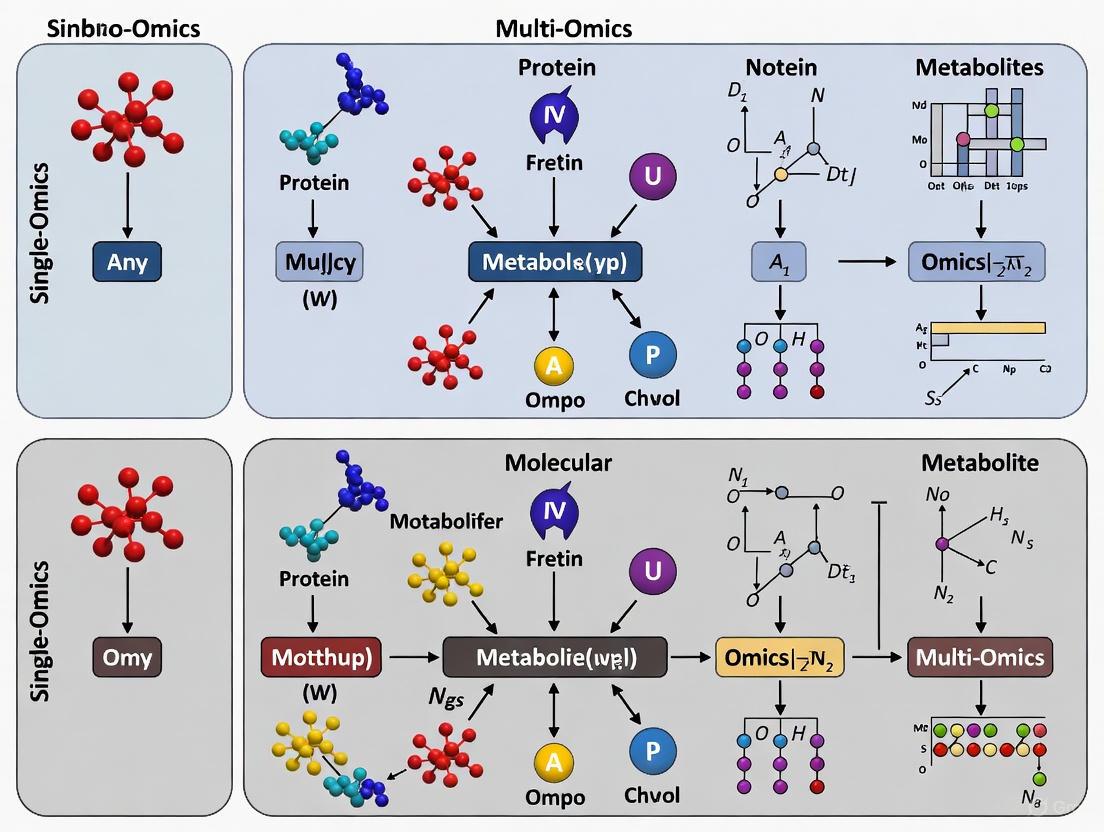
This article provides a thorough comparison of single-omics and multi-omics approaches, tailored for researchers and drug development professionals.
From Single-Omics to Multi-Omics: A Comprehensive Guide to High-Resolution Biological Insights and Clinical Translation
Abstract
This article provides a thorough comparison of single-omics and multi-omics approaches, tailored for researchers and drug development professionals. It begins by exploring the fundamental limitations of single-omics methods in capturing cellular heterogeneity and the paradigm shift towards integrated analysis. The content then delves into the advanced methodologies and real-world applications of multi-omics in drug discovery and clinical diagnostics, highlighting its power to uncover complex disease mechanisms. Subsequently, it addresses the significant computational challenges and emerging solutions for robust data integration. Finally, the article offers a critical evaluation of multi-omics performance through benchmarking studies and validation frameworks, synthesizing key takeaways and future directions for precision medicine.
The Single-Omics Limitation: Why Multi-Layered Analysis is Revolutionizing Biology
Bulk omics technologies have long been the workhorse of molecular profiling, providing population-averaged data across entire tissue samples or cell populations. However, this averaging effect obscures a fundamental biological truth: cells within a population are individuals. Cellular heterogeneity drives critical biological processes in development, disease progression, and treatment response, yet remains invisible to conventional bulk approaches [1]. The emergence of single-cell and multi-omics technologies has revolutionized our capacity to resolve this heterogeneity, revealing complex cellular landscapes where rare but influential cell populations dictate disease outcomes and therapeutic efficacy. This comparison guide examines how bulk omics masks cellular heterogeneity and how single-cell resolution technologies provide the necessary lens to observe the true complexity of biological systems.
Bulk vs. Single-Cell Omics: Fundamental Technical Differences
Core Principles and Workflows
Bulk omics analyzes nucleic acids or proteins extracted from thousands to millions of cells simultaneously, yielding averaged measurements that represent the dominant signals while concealing cell-to-cell variations [2]. In contrast, single-cell omics maintains cell identity throughout the analytical process, enabling individual cellular profiling within heterogeneous populations [3].
The table below summarizes the fundamental differences between these approaches:
Table 1: Fundamental Comparison of Bulk and Single-Cell Omics Approaches
| Feature | Bulk Omics | Single-Cell Omics |
|---|---|---|
| Resolution | Population-level average | Individual cell level |
| Cellular Heterogeneity | Masked | Revealed |
| Rare Cell Detection | Limited (>1% typically) | Excellent (down to 0.1% or lower) |
| Required Input Material | High | Low (single cells) |
| Primary Workflow | Tissue → RNA/DNA extraction → Library prep → Sequencing | Tissue → Single-cell suspension → Cell partitioning & barcoding → Library prep → Sequencing |
| Data Complexity | Lower | Higher (dimensionality, technical noise) |
| Cost Per Sample | Lower | Higher |
| Key Applications | Differential expression, biomarker discovery, pathway analysis | Cell type identification, rare population detection, developmental trajectories, tumor heterogeneity |
The Single-Cell Revolution: Technical Foundations
Single-cell RNA sequencing (scRNA-seq) technologies employ sophisticated cell partitioning systems to isolate individual cells. Platforms like 10X Genomics Chromium use microfluidic chips to create Gel Beads-in-emulsion (GEMs), where each droplet contains a single cell, a barcoded gel bead, and reaction reagents [2]. Each bead contains oligonucleotides with unique cell barcodes and unique molecular identifiers (UMIs) that enable precise tracking of transcript origin and quantification while mitigating PCR amplification biases [3].
This cell barcoding strategy forms the technological foundation for high-throughput single-cell analysis, allowing thousands of cells to be processed simultaneously while maintaining each cell's unique molecular identity throughout sequencing and analysis.
The Heterogeneity Masking Effect: Evidence from Direct Comparisons
Experimental Evidence of Masked Heterogeneity
A compelling demonstration of bulk omics limitations comes from cancer cell line studies. When 42 human cancer cell lines were analyzed using scRNA-seq, researchers discovered significant transcriptomic heterogeneity within individual cell lines, with 57% showing discrete subpopulations and 43% exhibiting continuous variation patterns [4]. This intra-cell-line heterogeneity, driven by copy number variation, epigenetic diversity, and extrachromosomal DNA distribution, would be entirely undetectable using bulk approaches [4].
In therapeutic contexts, bulk sequencing often misses rare subpopulations that drive treatment resistance. Single-cell multi-omics can detect these rare clones at frequencies as low as 0.1% of the population, enabling researchers to identify drug-resistant subclones early and understand their molecular characteristics [5].
Quantifying the Averaging Problem
The "averaging problem" can be visualized through a comparative analysis of how each technology interprets a heterogeneous sample:
This conceptual diagram illustrates how bulk approaches merge signals from distinct cell types, while single-cell technologies preserve and resolve this biological complexity.
Single-Omics vs. Multi-Omics: Expanding the Analytical Dimensions
From Correlation to Causation
While single-cell transcriptomics reveals cellular heterogeneity, it cannot establish causal relationships between molecular layers. Multi-omics approaches simultaneously measure multiple molecular dimensions within the same cell—such as genome, transcriptome, epigenome, and proteome—enabling direct observation of how genetic variations influence gene expression and protein translation [1] [6].
The experimental workflow for generating multi-omics data integrates complementary technologies:
Multi-Omics Applications in Oncology
In cancer research, multi-omics approaches have demonstrated particular value for:
- Clonal Evolution Mapping: Tracking how different subclones emerge and evolve under therapeutic selective pressures [5]
- Therapeutic Resistance Mechanisms: Identifying specific genetic and phenotypic changes in individual cells that confer drug resistance [4]
- Tumor Microenvironment Characterization: Simultaneously profiling cancer, immune, and stromal cells to understand cellular crosstalk [6]
Experimental Protocols and Data Generation
Representative Single-Cell RNA-seq Protocol
The following table outlines key methodologies for single-cell transcriptomic profiling:
Table 2: Single-Cell RNA Sequencing Methodologies and Applications
| Method | Principle | Throughput | Key Applications | Strengths | Limitations |
|---|---|---|---|---|---|
| 10X Genomics Chromium [2] [3] | Microfluidic droplet-based | High (10,000+ cells) | Cell atlas construction, heterogeneity analysis | High cell throughput, user-friendly workflow | 3' bias, limited full-length transcript recovery |
| SMART-seq3 [1] | Plate-based, full-length | Low-medium (hundreds of cells) | Alternative splicing, isoform detection | Full-length transcript coverage, high sensitivity | Lower throughput, higher cost per cell |
| MARS-seq [1] | Combinatorial indexing | High (thousands of cells) | Large-scale studies, developmental biology | Cost-effective for large cell numbers, minimal batch effects | Lower sequencing depth per cell |
| SPLiT-seq [1] | Combinatorial barcoding | High (thousands of cells) | Fixed tissue samples, archived specimens | Compatible with fixed cells, low equipment requirements | Lower mRNA recovery efficiency |
Multi-Omics Integration and Analysis Workflow
The analytical pipeline for single-cell multi-omics data involves several critical stages:
- Quality Control: Filtering cells based on detected genes, mitochondrial content, and other quality metrics [6]
- Normalization and Batch Correction: Addressing technical variations between experiments using methods like Mutual Nearest Neighbors (MNN) or Harmony [6]
- Dimension Reduction: Principal Component Analysis (PCA) followed by visualization with UMAP or t-SNE [4]
- Cluster Identification and Annotation: Cell clustering based on transcriptional similarity and cell type identification using marker genes [7]
- Multi-Omics Data Integration: Computational alignment of different molecular modalities from the same cells [6]
Essential Research Reagent Solutions
The table below outlines key reagents and tools essential for implementing single-cell and multi-omics studies:
Table 3: Essential Research Reagents and Platforms for Single-Cell and Multi-Omics Research
| Reagent/Platform | Function | Application Context |
|---|---|---|
| 10X Genomics Chromium [2] [3] | Microfluidic cell partitioning | Single-cell RNA-seq, ATAC-seq, multi-ome applications |
| Cell Hashing Antibodies [6] | Sample multiplexing | Pooling multiple samples in one run, reducing batch effects |
| Template Switching Oligos (TSO) [1] | cDNA synthesis | Full-length transcript capture in SMART-seq protocols |
| Feature Barcoding Oligos | Surface protein detection | Simultaneous RNA and protein measurement (CITE-seq) |
| Chromatin Accessibility Kits | Epigenomic profiling | scATAC-seq for mapping open chromatin regions |
| V(D)J Enrichment Reagents | Immune receptor sequencing | T-cell and B-cell receptor repertoire analysis |
| Gel Beads with Barcodes [3] | Cell and molecule labeling | Cell identity preservation in droplet-based methods |
| Cell Preservation Media | Sample integrity maintenance | Viable cell suspension preparation for sensitive assays |
The averaging problem inherent to bulk omics approaches has profound implications for biological discovery and therapeutic development. Single-cell technologies resolve this limitation by exposing the cellular heterogeneity that drives development, disease progression, and treatment outcomes. Multi-omics approaches further enhance this resolution by enabling causal inferences across molecular layers within individual cells.
While bulk omics remains valuable for population-level studies and differential expression analysis in homogeneous samples, single-cell approaches are indispensable for characterizing complex tissues, identifying rare cell populations, and understanding cellular dynamics. The integration of these complementary perspectives—bulk and single-cell, single-omics and multi-omics—provides the most comprehensive understanding of biological systems, ultimately accelerating biomarker discovery, therapeutic target identification, and precision medicine implementation.
The completion of the human genome project marked a pivotal moment in biological research, yet it quickly became clear that the genetic blueprint alone cannot fully explain the complexity of life. This realization has propelled the rise of omics technologies that probe molecular events downstream of the genome. Transcriptomics, proteomics, and metabolomics have emerged as powerful disciplines that provide distinct yet complementary insights into biological systems. While transcriptomics measures RNA expression patterns, proteomics identifies and quantifies proteins, and metabolomics focuses on small-molecule metabolites. Individually, each approach offers a unique perspective on cellular function; together, they form a comprehensive framework for understanding biological complexity. This guide examines the distinct roles of these three omics technologies, their experimental methodologies, and how their integration in multi-omics approaches is transforming biological research and drug development.
Single-Omics Approaches: Core Principles and Applications
Transcriptomics: Mapping the Blueprint's Expression
Transcriptomics involves the systematic study of an organism's complete set of RNA transcripts, known as the transcriptome. This approach captures dynamic gene expression patterns, revealing which genes are actively being transcribed under specific conditions.
Key Technologies and Workflows:
- RNA Sequencing (RNA-Seq): The dominant technology uses high-throughput sequencing to catalogue and quantify RNA populations. The standard workflow begins with RNA extraction, followed by cDNA library preparation, sequencing on platforms like Illumina NovaSeq, and computational analysis for alignment and differential expression detection [8].
- Data Output: Identifies differentially expressed genes (DEGs) with statistical significance, typically using thresholds like log2 fold change ≥2 and adjusted p-value ≤0.05 [9].
Strengths and Limitations: Transcriptomics provides a comprehensive view of gene regulation and can detect novel transcripts and splicing variants. However, it represents a intermediate layer between genotype and phenotype, with mRNA levels often correlating poorly with protein abundance due to post-transcriptional regulation [10].
Proteomics: From Genetic Instruction to Functional Effectors
Proteomics characterizes the entire protein complement of a biological system, including expression levels, post-translational modifications, and protein-protein interactions.
Key Technologies and Workflows:
- Mass Spectrometry (MS): The cornerstone technology, typically coupled with liquid chromatography (LC-MS/MS). Proteins are extracted, digested into peptides, separated by LC, and analyzed by MS. Tandem MS fragments peptides to determine amino acid sequences [10] [11].
- Data Output: Identifies and quantifies thousands of proteins, revealing differentially expressed proteins (DEPs) and their modifications.
Strengths and Limitations: Proteomics directly analyzes functional effectors, capturing post-translational modifications that profoundly regulate protein activity. Challenges include the technical difficulty of analyzing low-abundance proteins, the dynamic complexity of the proteome, and the high cost of instrumentation [11].
Metabolomics: The Dynamic Metabolic Phenotype
Metabolomics focuses on the comprehensive analysis of small-molecule metabolites (<1,500 Da) that represent the end products of cellular processes.
Key Technologies and Workflows:
- Mass Spectrometry and NMR: LC-MS and GC-MS are widely used for their sensitivity and broad metabolite coverage. Nuclear Magnetic Resonance (NMR) spectroscopy offers structural elucidation and absolute quantification but lower sensitivity [12].
- Spatial Metabolomics: Emerging mass spectrometry imaging technologies like MALDI-MS and DESI-MS enable spatial resolution of metabolite distribution within tissues [12].
- Metabolic Flux Analysis: Uses stable isotope tracers (e.g., ¹³C-glucose) to track metabolic pathway activities dynamically [12].
Strengths and Limitations: Metabolomics most closely reflects phenotypic status and can detect rapid biochemical changes. However, metabolite coverage is challenged by extreme chemical diversity and dynamic range limitations [12].
Table 1: Comparative Analysis of Single-Omics Technologies
| Feature | Transcriptomics | Proteomics | Metabolomics |
|---|---|---|---|
| Analytical Target | RNA transcripts | Proteins and peptides | Small-molecule metabolites |
| Key Technologies | RNA-Seq, microarrays | LC-MS/MS, protein arrays | LC/GC-MS, NMR |
| Temporal Resolution | Medium (minutes-hours) | Medium-hours (minutes for modifications) | High (seconds-minutes) |
| Coverage Depth | ~20,000 coding genes in humans | >10,000 proteins in deep profiling | 100s-1,000s of metabolites |
| Biological Insight | Regulatory potential | Functional effectors & modifications | Functional phenotype & pathway activity |
| Primary Limitations | Poor correlation with protein levels | Analytical complexity, dynamic range | Chemical diversity, annotation challenges |
Multi-Omics Integration: A Systems Biology Perspective
While single-omics analyses provide valuable insights, they offer fragmented views of biological systems. Multi-omics integration simultaneously analyzes multiple molecular layers, revealing interconnected networks and providing mechanistic understanding.
Integration Methodologies and Workflows
Successful multi-omics studies require careful experimental design and computational integration:
Experimental Design:
- Sample Collection: Matched samples from the same biological source processed in parallel [13] [8].
- Data Generation: Separate omics data generation followed by computational integration.
Computational Integration:
- Concatenation-Based Integration: Combines features from different omics layers into a single dataset for multivariate analysis [14].
- Network-Based Integration: Maps multiple omics datasets onto shared biochemical networks to identify dysregulated pathways [15].
- BERT Algorithm: A recently developed method for batch-effect reduction in incomplete multi-omics datasets, addressing technical variations across studies [16].
Revealing Biological Mechanisms Through Integration
Multi-omics approaches have uncovered novel biological insights across diverse fields:
Plant Biology Applications: In tomato plants exposed to salt stress, integrated transcriptomics and proteomics revealed that carbon-based nanomaterials restored expression of 358 proteins and 144 molecular features across both omics levels, identifying activation of MAPK and inositol signaling pathways as key protective mechanisms [10].
In Brasenia schreberi, triple-omics integration (transcriptomics, proteomics, metabolomics) revealed only moderate correlation between transcript and protein levels (r=0.50), highlighting the importance of post-transcriptional regulation in mucilage disappearance and identifying specific metabolites (epicatechin, catechin) and genes (MYB5, MUCI70) as key regulators [13].
Medical Research Applications: In radiation research, integrated transcriptomics and metabolomics of irradiated mice identified coordinated dysregulation of 2,837 genes and multiple metabolite classes (amino acids, phospholipids, carnitines), revealing disruptions in amino acid, carbohydrate, and lipid metabolism that would be missed by single-omics approaches [9].
In gastric cancer classification, the MASE-GC framework integrated exon expression, mRNA expression, miRNA expression, and DNA methylation data using autoencoders and ensemble learning, achieving superior classification accuracy (0.981) compared to single-omics models [14].
Table 2: Multi-Omics Integration Approaches and Applications
| Integration Strategy | Key Methodology | Advantages | Representative Application |
|---|---|---|---|
| Concatenation-Based | Feature merging before analysis | Simple implementation, works with standard classifiers | MASE-GC for gastric cancer classification [14] |
| Network-Based | Mapping omics data onto biochemical networks | Reveals pathway-level dysregulation | Radiation response mechanisms in mice [9] |
| Tree-Based Algorithms | Batch-effect reduction trees (BERT) | Handles missing data, improves cross-study integration | Large-scale proteomics and transcriptomics integration [16] |
| Autoencoder Fusion | Dimension reduction before integration | Handles high dimensionality, reduces noise | Multi-omics cancer subtyping [14] |
The Scientist's Toolkit: Essential Research Reagents and Platforms
Cutting-edge omics research requires specialized reagents and platforms for accurate molecular profiling:
Table 3: Essential Research Solutions for Omics Studies
| Reagent/Platform | Function | Application Examples |
|---|---|---|
| TriZol Reagent | Simultaneous RNA/protein extraction from same sample | Transcriptomic & proteomic pairing in rice studies [8] |
| Illumina Sequencing Platforms | High-throughput RNA/DNA sequencing | RNA-Seq for transcriptome profiling [8] |
| Q-Exactive Mass Spectrometer | High-resolution LC-MS/MS analysis | Proteomic and metabolomic profiling [10] [12] |
| HILIC/RP Chromatography Columns | Metabolite separation prior to MS analysis | Comprehensive polar/non-polar metabolite coverage [12] |
| Stable Isotope Tracers | Metabolic flux analysis | [1-¹³C]-glucose for tracing glycolytic flux [12] |
| HarmonizR/BERT Algorithms | Batch-effect correction for data integration | Multi-study omics data integration [16] |
Experimental Protocols for Multi-Omics Studies
Integrated Transcriptomics and Proteomics Protocol
This protocol is adapted from studies on plant salt tolerance [10] and rice carbohydrate metabolism [8]:
Sample Preparation:
- Grow biological replicates under controlled conditions (e.g., n=3-5 per group)
- Apply experimental treatment and collect matched samples
- Flash-freeze in liquid nitrogen and store at -80°C
RNA Extraction and Transcriptomics:
- Homogenize tissue in TriZol reagent
- Extract total RNA and assess quality (RIN >8.0)
- Prepare cDNA library using Illumina TruSeq kit
- Sequence on Illumina NovaSeq 6000 (PE150)
- Align reads to reference genome (HISAT2) and identify DEGs (log2FC ≥2, adj. p-value ≤0.05)
Protein Extraction and Proteomics:
- Extract proteins from same starting material
- Digest with trypsin and desalt peptides
- Analyze by LC-MS/MS using Q-Exactive instrument
- Identify proteins against reference database
- Quantify differential expression (≥1.5-fold change, p-value ≤0.05)
Data Integration:
- Map DEGs and DEPs to KEGG pathways
- Identify concordant and discordant features
- Perform joint pathway enrichment analysis
Integrated Metabolomics and Transcriptomics Protocol
This protocol is adapted from radiation research in murine models [9]:
Sample Collection:
- Collect plasma/serum at multiple time points post-treatment
- Process samples immediately or store at -80°C
Metabolite Profiling:
- Extract metabolites using methanol:acetonitrile:water
- Analyze by LC-MS in both positive and negative ionization modes
- Identify metabolites against standard libraries (HMDB, METLIN)
- Perform multivariate analysis (PCA, PLS-DA) to identify DAMs
Transcriptome Profiling:
- Extract RNA from same animals' blood or tissues
- Perform RNA-Seq as described above
- Identify DEGs and perform GO enrichment
Multi-Omics Integration:
- Use Joint-Pathway Analysis to integrate metabolite and gene changes
- Construct interaction networks (STITCH, BioPAN)
- Identify key regulatory nodes and metabolic enzymes
Visualizing Multi-Omics Workflows and Relationships
Multi-Omics Data Relationships and Workflow
The field of omics technologies is rapidly evolving, with several trends shaping its future. Artificial intelligence and machine learning are revolutionizing multi-omics data analysis, enabling pattern recognition in complex datasets that exceeds human capability [17] [15]. Single-cell multi-omics is revealing cellular heterogeneity at unprecedented resolution, while spatial omics technologies are mapping molecular distributions within tissue architectures [15]. Liquid biopsy approaches are expanding beyond oncology to integrate cell-free DNA, RNA, proteins, and metabolites for non-invasive disease monitoring [17] [15].
The distinction between transcriptomics, proteomics, and metabolomics remains fundamental to understanding biological systems, as each provides unique and non-redundant information. Transcriptomics reveals regulatory potential, proteomics identifies functional effectors, and metabolomics captures dynamic phenotypic status. While single-omics approaches continue to offer valuable insights, their integration through multi-omics frameworks provides the most comprehensive understanding of biological complexity. As these technologies become more accessible and computational integration methods more sophisticated, multi-omics approaches will increasingly drive discoveries in basic research, clinical diagnostics, and therapeutic development, ultimately fulfilling the promise of systems biology and personalized medicine.
The fundamental premise of multi-omics is that biological complexity cannot be fully captured by studying a single molecular layer in isolation [18]. Traditional single-omics approaches, such as genomics or transcriptomics alone, provide a deep but narrow view, often described as "what could happen" (genetic potential) [19]. In contrast, multi-omics seeks to integrate this with data from transcriptomics, proteomics, metabolomics, and epigenomics to reveal "how it is happening" – the dynamic, functional state of the cell or tissue [1] [20]. This guide objectively compares the performance and value of single-omics versus multi-omics approaches within biomedical research and drug discovery, supported by experimental data and benchmarking studies.
Comparative Analysis: Single-Omics vs. Multi-Omics Approaches
The following table summarizes the core differences in capabilities and outputs between single-omics and integrated multi-omics strategies, highlighting the transformative shift in biological insight.
Table 1: Core Capabilities and Limitations of Single-Omics vs. Multi-Omics Approaches
| Aspect | Single-Omics Approach | Multi-Omics Integrated Approach |
|---|---|---|
| Primary Focus | Deep profiling of one molecular layer (e.g., genome, transcriptome) [18]. | Simultaneous or integrated profiling of multiple molecular layers (e.g., genome, transcriptome, proteome, epigenome) [1] [20]. |
| Resolution of Heterogeneity | Can reveal cellular heterogeneity but only within one dimension (e.g., transcriptomic cell types) [1]. | Reveals multi-dimensional heterogeneity, linking genetic variation to functional states across omics layers within the same cell or sample [1] [21]. |
| Biological Insight | Identifies associations (e.g., gene expression changes with disease) but cannot establish causality or mechanism [18]. | Elucidates causal relationships and regulatory networks (e.g., how a genetic variant influences chromatin accessibility, gene expression, and protein function) [1] [20]. |
| Key Limitation | Averages signals across cell populations, obscuring rare cells and nuanced states; provides a fragmented view of biology [1] [19]. | Technical and computational complexity in data generation, integration, and interpretation [22] [20] [19]. |
| Primary Output | Lists of differentially expressed genes, genetic variants, or metabolites [18]. | Unified models of disease mechanisms, predictive biomarkers from combined layers, and prioritized therapeutic targets [20] [19] [23]. |
Benchmarking Multi-Omics Integration Methods: Performance Data
The utility of multi-omics data hinges on effective computational integration. A 2025 benchmark study evaluated 40 methods across tasks like dimension reduction, clustering, and feature selection [22]. Furthermore, direct comparisons of statistical versus deep learning-based integration for specific diseases provide concrete performance metrics.
Table 2: Performance Comparison of MOFA+ (Statistical) vs. MoGCN (Deep Learning) for Breast Cancer Subtype Classification [23]
| Evaluation Metric | MOFA+ (Statistical Integration) | MoGCN (Deep Learning Integration) | Implication |
|---|---|---|---|
| Best F1 Score (Nonlinear Model) | 0.75 | 0.70 | MOFA+ selected features yielded superior subtype classification accuracy. |
| Number of Relevant Pathways Identified | 121 | 100 | MOFA+ uncovered a broader range of biologically relevant pathways. |
| Key Pathways Implicated | Fc gamma R-mediated phagocytosis; SNARE pathway | – | Highlights potential immune response and tumor progression mechanisms. |
| Clustering Quality (Calinski-Harabasz Index) | Higher score indicates better separation. | Lower score compared to MOFA+. | MOFA+ generated latent factors that more effectively distinguished subtypes. |
| Feature Selection Basis | Loadings from latent factors explaining shared variance across omics. | Importance scores from autoencoder weights combined with feature variance. | Statistical method prioritized stable, interpretable cross-omics signals. |
The broader benchmark confirms that method performance is highly dataset- and modality-dependent, with tools like Seurat WNN, Multigrate, and Matilda also performing well for specific integration tasks [22].
Experimental Protocols for Key Multi-Omics Integration Studies
The following detailed methodology is synthesized from a representative study comparing integration methods for breast cancer subtyping [23] and general principles from benchmarking protocols [22].
Protocol: Multi-Omics Integration for Disease Subtype Classification
1. Data Collection and Preprocessing:
- Source: Download multi-omics data (e.g., transcriptomics, epigenomics/methylation, microbiomics) from public repositories like cBioPortal (TCGA) [23].
- Batch Effect Correction: Apply appropriate batch correction methods for each data type (e.g., ComBat for transcriptomics, Harman for methylation data) using packages like
svain R [23]. - Filtering: Remove features with excessive zeros (e.g., expression in <50% of samples) to reduce noise [23].
2. Data Integration Using Comparative Methods:
- Statistical Integration (MOFA+):
- Use the
MOFA+R package. - Train the model on normalized multi-omics matrices to infer Latent Factors (LFs).
- Set convergence criteria (e.g., 400,000 iterations) and select LFs that explain >5% variance in at least one data type [23].
- Perform feature selection by extracting the top N features (e.g., 100 per omics layer) based on absolute loadings from the most explanatory LF [23].
- Use the
- Deep Learning Integration (MoGCN):
- Implement the MoGCN framework, which uses separate autoencoders for each omics layer for dimensionality reduction.
- Configure autoencoder architecture (e.g., hidden layers with 100 neurons, learning rate of 0.001).
- Train the model and calculate feature importance scores by multiplying absolute encoder weights by the feature's standard deviation.
- Select the top N features per omics layer based on this importance score [23].
3. Downstream Evaluation:
- Clustering Assessment: Generate embeddings from integrated features or factors. Apply t-SNE for visualization and calculate internal validation metrics like the Calinski-Harabasz Index (higher is better) and Davies-Bouldin Index (lower is better) [23].
- Supervised Classification: Use the selected features to train supervised classifiers (e.g., Support Vector Classifier with linear kernel, Logistic Regression) with 5-fold cross-validation. Use the F1 score to evaluate subtype prediction performance, especially for imbalanced classes [23].
- Biological Validation: Perform pathway enrichment analysis (e.g., using IntAct database via OmicsNet 2.0) on selected transcriptomic features to assess biological relevance (P-value < 0.05) [23].
Visualizing the Workflow and Hypothesis
Diagram 1: The Central Hypothesis of Multi-Omics Integration
Diagram 2: Experimental Workflow for Multi-Omics Comparison Study
The Scientist's Toolkit: Key Research Reagent Solutions
This table details essential platforms, reagents, and software tools critical for executing single and multi-omics research, as derived from the search results.
Table 3: Essential Toolkit for Single-Cell and Multi-Omics Research
| Item Name | Category | Primary Function | Key Reference |
|---|---|---|---|
| 10x Genomics Chromium | Platform | Enables high-throughput single-cell RNA-seq, ATAC-seq, and multiome (RNA+ATAC) profiling using droplet-based microfluidics. | [1] [21] |
| CITE-seq / REAP-seq | Assay/Reagent | Allows simultaneous measurement of single-cell transcriptomes and surface protein abundance (via antibody-derived tags - ADTs). | [22] |
| Primary Template-directed Amplification (PTA) | Reagent/Method | A whole-genome amplification method for single cells offering higher accuracy and uniformity for genomic analysis. | [1] |
| Smart-seq3 | Assay/Reagent | A plate-based scRNA-seq method for full-length transcript coverage, enabling isoform and splicing analysis. | [1] |
| MOFA+ | Software | A statistical, unsupervised tool for integrating multi-omics data by inferring latent factors that capture shared and specific variations. | [22] [23] [24] |
| Single-cell analyst | Software Platform | A user-friendly, web-based platform for comprehensive analysis of six single-cell omics types and spatial data without coding. | [25] |
| Seurat WNN | Software Algorithm | A method for vertical integration of multi-modal data (e.g., RNA + ADT) to construct weighted nearest neighbor graphs for joint analysis. | [22] |
| Mass Spectrometry Imaging (MSI) | Platform/Technique | Enables spatial metabolomic and proteomic profiling within intact tissue sections, crucial for spatial multi-omics. | [26] |
The field of biomedical research is undergoing a fundamental transformation, moving from a reductionist approach that studies biological components in isolation to a holistic, systems-based methodology. This shift is characterized by the transition from single-omics investigations to integrated multi-omics analyses, enabled by technological advances that allow researchers to simultaneously measure multiple molecular layers within the same biological sample [15]. Where traditional "bulk" analysis averaged signals across millions of cells, effectively masking critical cell-to-cell variations, modern single-cell multi-omics now enables direct measurement of individual signals from each cell, significantly enhancing our ability to unveil biological heterogeneity [5] [27].
This paradigm shift is revolutionizing how researchers investigate complex biological systems, moving beyond observational correlations toward understanding causal relationships between different molecular layers. By integrating data from genomics, transcriptomics, epigenomics, and proteomics, researchers can now achieve a comprehensive understanding of how genetic variations influence gene expression and protein function within individual cells [5]. This approach has proven particularly valuable for understanding complex diseases like cancer, where different subclones can drive resistance or metastasis, and for advancing cell and gene therapies, where the single cell is the drug product itself [5].
The Multi-Omics Landscape: Key Technologies and Methodologies
Fundamental Omics Layers and Their Roles
Multi-omics integration combines data from multiple biological "omes" to provide a more complete picture of cellular function and dysfunction. Each biological layer offers distinct but complementary information [5]:
- Genomics: Focuses on the structure, function, evolution, mapping, and editing of an organism's DNA, revealing genetic variations such as single nucleotide variants (SNVs), copy number variants (CNVs), insertions-deletions (INDELs), and translocations.
- Transcriptomics: Involves the study of the complete set of RNA transcripts produced by the genome, reflecting gene expression and cellular activity at a given time.
- Proteomics: Evaluates protein expression for better understanding of cellular function and prediction of therapeutic responses.
- Epigenomics: Examines heritable changes in gene expression activity caused by factors other than DNA changes, such as DNA methylation or chromatin accessibility.
Single-Cell Multi-Omics Technologies
Recent advances in single-cell technologies have revolutionized cellular analysis, enabling comprehensive exploration of cellular heterogeneity, developmental trajectories, and disease mechanisms at unprecedented resolution [28]. Single-cell RNA sequencing (scRNA-seq) has evolved from sequencing a single mouse blastomere in 2009 to currently profiling tens of thousands of cells in a single experiment [21] [27].
The key technological innovation enabling this progress has been the development of microfluidic-based systems for single-cell isolation and library preparation. Droplet-based microfluidics, such as 10X Genomics' Chromium system, significantly improved cell capture rates and throughput to thousands of cells per sample [27]. A crucial technical advancement has been the incorporation of unique molecular identifiers (UMIs), which enable accurate quantification of original molecule abundance before amplification by detecting and correcting artifacts introduced during the aggressive amplification process required for single-cell sequencing [27].
Computational Integration Approaches
The technological revolution in measurement capabilities has necessitated parallel advances in computational methods for integrating multi-omics datasets. Current integration strategies can be categorized into four prototypical approaches based on input data structure and modality combination [22]:
- Vertical Integration: Combining different modalities (e.g., RNA, ADT, ATAC) measured on the same set of cells
- Diagonal Integration: Integrating datasets with partial feature overlap
- Mosaic Integration: Aligning datasets that do not measure the same features by leveraging shared cell neighborhoods
- Cross Integration: Transferring information across different experimental batches or conditions
Table 1: Computational Methods for Multi-Omics Integration
| Integration Category | Representative Methods | Primary Applications | Performance Highlights |
|---|---|---|---|
| Vertical Integration | Seurat WNN, sciPENN, Multigrate, Matilda | Dimension reduction, clustering, feature selection | Generally better biological variation preservation; top-performing for RNA+ADT and RNA+ATAC datasets [22] |
| Foundation Models | scGPT, scPlantFormer, Nicheformer | Cross-species annotation, perturbation modeling, spatial context prediction | scGPT pretrained on 33M+ cells demonstrates zero-shot cell type annotation; scPlantFormer achieves 92% cross-species accuracy [28] |
| Multimodal Alignment | PathOmCLIP, StabMap, GIST | Histology-gene mapping, non-overlapping feature alignment | Robust integration under feature mismatch; enables 3D tissue modeling [28] |
Experimental Comparison: Single-Omics vs. Multi-Omics Performance
Benchmarking Study Design and Metrics
A comprehensive registered report published in Nature Methods (2025) systematically categorized and benchmarked 40 integration methods across 64 real datasets and 22 simulated datasets [22]. The study evaluated methods across seven common computational tasks: dimension reduction, batch correction, clustering, classification, feature selection, imputation, and spatial registration. Performance was assessed using tailored evaluation metrics for each task, with methods ranked based on their overall grand rank scores across different modality combinations [22].
For survival prediction benchmarking, a large-scale study evaluated all 31 possible combinations of five genomic data types (mRNA, miRNA, methylation, DNAseq, and copy number variation) using 14 cancer datasets from TCGA [29]. Predictive performance was measured using Harrell's C-index and integrated Brier Score, with statistical testing conducted for key results to ensure robustness [29].
Performance Across Biological Applications
The benchmarking results reveal that multi-omics integration consistently outperforms single-omics approaches for most biological discovery tasks, though with important nuances:
Table 2: Multi-Omics vs. Single-Omics Performance Comparison
| Application Domain | Single-Omics Limitations | Multi-Omics Advantages | Key Evidence |
|---|---|---|---|
| Cell Type Identification | Limited resolution of heterogeneous populations; averaging effects | Precise cell state characterization; identification of rare subpopulations | Vertical integration methods (e.g., Seurat WNN, Multigrate) effectively preserve biological variation of cell types across modalities [22] |
| Survival Prediction | mRNA alone often sufficient but incomplete for some cancers | mRNA + miRNA ± methylation optimal for most cancers; more types hinder performance | For most cancer types, using only mRNA data or combining mRNA and miRNA was sufficient; adding more data types often decreased performance [29] |
| Clinical Impact | Assisting physicians with diagnoses only | Comprehensive health profiling; targeted treatments for rare diseases | Integration enables medical geneticists to direct patients with rare diseases to physicians who can offer targeted treatments [15] |
| Cellular Heterogeneity | Inferred clonal architecture from bulk sequencing | Direct measurement of clonal heterogeneity; detection of rare subclones down to 0.1% | Identifies subtle differences in gene expression and responses to stimuli critical for understanding cancer and other diseases [5] |
Experimental Protocols for Multi-Omics Integration
Vertical Integration Protocol for Dimension Reduction and Clustering
The benchmarked vertical integration workflow involves [22]:
- Data Preprocessing: Normalize each modality separately using standard approaches (e.g., log transformation for RNA, centered log-ratio for ADT)
- Feature Selection: Identify highly variable features for each modality
- Method Application: Implement integration methods (e.g., Seurat WNN, Multigrate) following author specifications
- Embedding Generation: Create low-dimensional representations for downstream analyses
- Evaluation: Assess performance using metrics including iF1, NMIcellType, ASWcellType, and iASW
Foundation Model Pretraining Protocol
Advanced foundation models like scGPT employ a multi-stage training approach [28]:
- Self-Supervised Pretraining: Train on large-scale datasets (33+ million cells) using masked gene modeling objectives
- Multitask Finetuning: Adapt model to specific downstream tasks (cell type annotation, perturbation response prediction)
- Zero-Shot Evaluation: Assess cross-dataset generalization without task-specific training
- Biological Validation: Confirm that model outputs align with established biological knowledge
Visualization of Multi-Omics Workflows and Relationships
Conceptual Shift from Single-Omics to Multi-Omics Research
Single-Cell Multi-Omics Experimental Workflow
The Scientist's Toolkit: Essential Research Reagents and Platforms
Successful implementation of single-cell multi-omics research requires specialized reagents, platforms, and computational resources. The following toolkit outlines essential components for designing and executing multi-omics studies:
Table 3: Essential Research Toolkit for Single-Cell Multi-Omics
| Tool Category | Specific Tools/Platforms | Primary Function | Key Considerations |
|---|---|---|---|
| Single-Cell Isolation Platforms | 10X Genomics Chromium, Fluidigm C1, Mission Bio Tapestri | High-throughput cell capture and barcoding | Throughput (hundreds to thousands of cells), multiplet rates, cell capture efficiency [21] [27] |
| Library Preparation Kits | CITE-seq, SHARE-seq, TEA-seq | Simultaneous profiling of multiple molecular layers | Compatibility with downstream sequencing platforms, coverage (3'/5' vs full-length), UMI incorporation [22] [27] |
| Computational Platforms | Galaxy single-cell & spatial omics (SPOC), BioLLM, DISCO, CZ CELLxGENE | Data analysis, integration, and visualization | User accessibility, reproducibility, tool diversity (175+ tools in Galaxy), training resources [28] [30] |
| Foundation Models | scGPT, scPlantFormer, Nicheformer | Cross-task generalization, zero-shot annotation | Pretraining corpus size, model architecture, interpretability features [28] |
| Integration Methods | Seurat WNN, Multigrate, Matilda, MOFA+ | Vertical integration of multiple modalities | Performance in dimension reduction, feature selection, batch correction [22] |
The transition from siloed single-omics data to holistic multi-omics integration represents more than just a technical advancement—it constitutes a fundamental shift in how we approach biological research. This paradigm shift enables researchers to move beyond observational correlations to understanding causal relationships between different molecular layers within individual cells [5]. The evidence from comprehensive benchmarking studies indicates that while multi-omics approaches generally provide superior biological insights, the strategic selection of modalities is crucial, as adding more data types does not automatically improve performance and may even hinder it in predictive applications [29].
As the field continues to evolve, several emerging trends are shaping the future of multi-omics research. Foundation models pretrained on millions of cells are enabling zero-shot cell type annotation and perturbation response prediction [28]. Spatial multi-omics technologies are adding geographical context to molecular measurements, providing insights into cellular organization and communication [30]. Federated computational platforms are facilitating global collaboration while addressing data privacy concerns [28]. Most importantly, the clinical translation of multi-omics approaches is accelerating, with applications in diagnostics, patient stratification, and personalized treatment showing significant promise [15] [5].
To fully realize the potential of this conceptual shift, researchers must continue to develop standardized protocols, robust computational infrastructure, and analytical frameworks that can handle the complexity and scale of multi-omics data. By embracing this holistic approach to biological systems, the scientific community can unravel the intricate networks underlying health and disease, ultimately leading to more effective therapies and improved patient outcomes.
Multi-Omics in Action: Methodologies Driving Discoveries in Drug Development and Disease Research
The evolution of single-cell technologies has revolutionized our understanding of cellular heterogeneity, transitioning research from bulk tissue analysis to single-cell resolution and more recently, to multi-modal characterization. While single-omics approaches like scRNA-seq have been instrumental in revealing cellular diversity, they fundamentally lack the ability to simultaneously profile multiple molecular layers from the same cell. This limitation has driven the development of integrated multi-omics technologies that can co-profile different molecular types within individual cells while preserving crucial spatial context.
Multi-omics technologies represent a paradigm shift in biological research by enabling the correlated analysis of different molecular modalities from the same biological sample. CITE-seq (Cellular Indexing of Transcriptomes and Epitopes by Sequencing) allows for simultaneous measurement of transcriptome and surface protein expression in single cells. SHARE-seq (Simultaneous Hybridization and Release by Elution sequencing) enables coupled profiling of transcriptome and chromatin accessibility. Spatial transcriptomics technologies capture gene expression patterns within the context of tissue architecture, preserving the spatial relationships between cells that are lost in dissociated single-cell approaches. This comparative guide examines the technical capabilities, performance characteristics, and experimental considerations of these core multi-omics platforms to inform researchers' technology selection.
Technical Specifications and Data Output
Table 1: Core Multi-Omics Technologies Comparison
| Technology | Molecular Modalities | Spatial Resolution | Throughput (Cells) | Key Applications |
|---|---|---|---|---|
| CITE-seq | Transcriptome + Surface Proteins (10-500 markers) | Not spatially resolved | 10,000-100,000+ | Immune profiling, cell type validation, surface marker identification |
| SHARE-seq | Transcriptome + Chromatin Accessibility | Not spatially resolved | 10,000-100,000+ | Gene regulation studies, lineage tracing, epigenetic dynamics |
| Spatial Transcriptomics | Genome-wide transcriptome | 0.5 μm - 100 μm (platform-dependent) | Tissue area-based | Tissue architecture analysis, cellular neighborhoods, spatial gene expression |
Table 2: Spatial Transcriptomics Platform Performance Comparison
| Platform | Technology Type | Spatial Resolution | Genes Detected | Key Performance Findings |
|---|---|---|---|---|
| 10X Visium | Sequencing-based (SISB) | 55 μm spots | Whole transcriptome | High correlation with scRNA-seq; robust for tissue domain identification |
| Stereo-seq | Sequencing-based (SISB) | 0.5 μm bins | Whole transcriptome | Highest capturing capability; regular array size up to 13.2 cm [31] |
| 10X Xenium | Imaging-based (SISS) | Subcellular | 5001 genes (Xenium 5K) | Superior sensitivity for marker genes; higher transcript counts without sacrificing specificity [32] [33] |
| Nanostring CosMx | Imaging-based (SISH) | Subcellular | 6175 genes (CosMx 6K) | High-plex protein and RNA detection; detects higher total transcripts than Xenium but with lower correlation to scRNA-seq [33] |
| Vizgen MERSCOPE | Imaging-based (SISH) | Subcellular | Custom panels (~1000 genes) | Direct probe hybridization with signal amplification via transcript tiling [32] |
Performance Benchmarking Insights
Recent systematic benchmarking studies reveal critical performance differences across platforms. In a comprehensive evaluation of imaging-based spatial transcriptomics (iST) platforms on FFPE tissues, Xenium consistently generated higher transcript counts per gene without sacrificing specificity, while both Xenium and CosMx demonstrated strong concordance with orthogonal single-cell transcriptomics data [32]. All commercial iST platforms could perform spatially resolved cell typing with varying sub-clustering capabilities, with Xenium and CosMx identifying slightly more clusters than MERSCOPE, though with different false discovery rates and cell segmentation error frequencies [32].
For sequencing-based spatial transcriptomics (sST) platforms, comparative analysis of 11 methods revealed significant variability in molecule-capture efficiency and effective resolution across different tissues [31]. Stereo-seq demonstrated the highest capturing capability, while Slide-seq V2 showed higher sensitivity than other platforms in mouse eye tissue when sequencing depth was controlled [31]. Probe-based Visium and DynaSpatial also exhibited high sensitivity in hippocampal tissue [31].
Experimental Protocols and Methodologies
CITE-seq Workflow and Protocol
CITE-seq Experimental Workflow
The CITE-seq protocol begins with preparation of a single-cell suspension from fresh tissue or cultured cells. Cells are stained with a cocktail of DNA-barcoded antibodies targeting surface proteins of interest. These antibodies contain a unique DNA barcode sequence that serves as a proxy for protein abundance. After staining and washing, cells are loaded into a microfluidic device for single-cell partitioning, typically using droplet-based systems. Within each droplet, individual cells are co-encapsulated with barcoded beads that capture both mRNA transcripts and antibody-derived tags (ADTs). Following reverse transcription and library preparation, separate sequencing libraries are generated for transcriptome and protein markers, which are subsequently sequenced and computationally integrated.
Key to successful CITE-seq experiments is antibody validation and titration to ensure specific binding and optimal signal-to-noise ratio. A typical experiment can profile 10,000-100,000+ cells simultaneously with panels ranging from 10-500 surface protein markers. The methodology has been successfully applied to immune cell characterization, where surface protein expression complements transcriptional profiles for precise cell type identification [34].
Spatial Transcriptomics Experimental Approaches
Spatial Transcriptomics Method Categories
Spatial transcriptomics methodologies fall into four main categories based on their underlying technical approaches [35]:
Spatial In Situ Hybridization (SISH): Representative technologies include seqFISH, MERFISH, and STARmap. These methods use labeled probes applied directly to tissue sections to capture spatial positions of specific RNA molecules along with sequence information through multiple rounds of hybridization and imaging.
Spatial In Situ Sequencing (SISS): Representative technologies include FISSEQ and 10X Xenium. These approaches perform sequencing directly on fixed tissue sections, typically using padlock probes and rolling circle amplification for signal generation.
Spatial Barcoding (SISB): Representative technologies include Slide-seq, DBiT-seq, 10X Visium, and Stereo-seq. These methods use arrays of DNA oligonucleotide capture probes with poly(T) sequences to bind mRNA, which then receive spatial barcodes for subsequent localization and quantification after bulk sequencing.
Spatial Isolation or Microdissection: Representative technologies include Tomo-seq, DSP, and GEO-seq. These approaches physically isolate or label specific tissue regions for subsequent DNA or RNA extraction and analysis.
Recent advancements have enabled multi-omi cs integration in spatial contexts. Spatial-CITE-seq, for example, extends the CITE-seq principle to spatial applications by using a cocktail of 200-300 antibody-derived tags (ADTs) stained on a tissue slide followed by deterministic in-tissue barcoding of both DNA tags and mRNAs for spatially resolved high-plex protein and transcriptome co-profiling [36].
The Scientist's Toolkit: Essential Research Reagents and Materials
Table 3: Key Research Reagent Solutions for Multi-Omics Technologies
| Reagent/Material | Function | Technology Applications |
|---|---|---|
| DNA-barcoded Antibodies (ADTs) | Convert protein detection to DNA sequencing signal; contain poly-A tail, UMI, and antibody-specific sequence | CITE-seq, REAP-seq, Spatial-CITE-seq |
| Barcoded Beads | Capture mRNA and ADTs with cell-specific barcodes during single-cell partitioning | CITE-seq, SHARE-seq, droplet-based single-cell methods |
| Padlock Probes | Circularizable probes for targeted in situ amplification; enable spatial transcript detection | ISS-based methods, 10X Xenium, STARmap |
| Spatial Barcode Arrays | Oligonucleotide arrays with spatial coordinates for capturing mRNA from tissue sections | 10X Visium, Stereo-seq, Slide-seq |
| Permeabilization Reagents | Control tissue accessibility for mRNA capture; critical for data quality optimization | All spatial transcriptomics methods |
| Nuclease-Free Water | Prevent RNA degradation during sample preparation and processing | All RNA-based multi-omics technologies |
| Indexing PCR Primers | Add sample indices and sequencing adapters during library preparation | All sequencing-based multi-omics methods |
Applications and Biological Insights
Multi-omics technologies have enabled significant advances across diverse biological domains. In immunology research, CITE-seq has proven particularly valuable for comprehensive immune cell profiling. The technology's ability to simultaneously measure transcriptomic states and surface protein expression enables precise identification of immune cell subsets that might be indistinguishable using transcriptomics alone [34]. Supervised machine learning frameworks like MMoCHi have been developed specifically to leverage this multimodal data for accurate cell-type classification across lineages and tissues [34].
In clinical and translational research, spatial multi-omics approaches have revealed novel biological insights into disease mechanisms and therapeutic responses. A study of ulcerative colitis patients undergoing vedolizumab therapy employed single-cell transcriptomic and proteomic analyses alongside spatial multi-omics to identify previously unappreciated effects on mononuclear phagocyte subsets and fibroblast populations [37]. Spatial transcriptomics of archived clinical specimens identified epithelial-, mononuclear phagocyte-, and fibroblast-enriched genes related to treatment responsiveness, highlighting the power of these approaches to uncover spatial biomarkers [37].
Spatial-CITE-seq applications in human tissues have demonstrated the value of high-plex protein mapping, revealing spatially distinct patterns of immune organization in tonsil tissue and early immune activation at COVID-19 mRNA vaccine injection sites [36]. The technology's capacity to map 273 proteins alongside the whole transcriptome enabled identification of spatially restricted germinal center reactions and previously uncharacterized protein localization patterns, such as CD171 restriction to the dark zone of germinal centers [36].
The rapid evolution of multi-omics technologies continues to transform biological research by enabling increasingly comprehensive molecular profiling with enhanced spatial context. CITE-seq, SHARE-seq, and spatial transcriptomics each offer unique strengths for specific research applications, with choice of technology dependent on the biological questions, required resolution, and molecular features of interest.
Future developments in the field are likely to focus on several key areas. Throughput and multiplexing capacity continue to expand, with newer spatial platforms now offering whole transcriptome coverage at subcellular resolution. Multi-omics integration will become increasingly sophisticated, enabling simultaneous profiling of transcriptome, proteome, epigenome, and other molecular layers within the same spatial context. Computational methods development will be crucial for extracting maximal biological insight from these complex multimodal datasets. Finally, efforts to reduce costs and simplify workflows will be essential for broader adoption across the research community.
As these technologies mature and become more accessible, they will continue to drive fundamental discoveries in basic biology while enabling new approaches in translational research and clinical diagnostics. The complementary nature of these platforms underscores the importance of selecting appropriate technologies based on specific research goals, with multi-omics integration providing a more comprehensive understanding of biological systems than any single modality alone.
Linking Cellular Heterogeneity to Drug Response and Resistance Mechanisms
Cellular heterogeneity is a fundamental characteristic of cancer, driving diverse patient responses to therapy and the eventual emergence of treatment resistance [38] [39]. For decades, research relied on single-omics approaches—analyzing genomics, transcriptomics, or proteomics in isolation. While these methods identified key driver mutations and expression signatures, they often failed to capture the complex, multilayer interactions within the tumor ecosystem [38]. The advent of multi-omics integration represents a paradigm shift, enabling a systems-level view that links genetic alterations to downstream functional consequences across molecular layers [40] [38]. This guide compares these two research frameworks, evaluating their methodologies, experimental outputs, and utility in elucidating drug response and resistance mechanisms.
Comparative Methodologies: Experimental Protocols and Data Integration
Single-Omics Approaches: Targeted but Limited
Traditional single-omics studies focus on one molecular layer. A typical genomics protocol involves:
- Sample Processing: Extraction of DNA from tumor tissue or cell lines.
- Sequencing: Whole-exome sequencing (WES) or targeted panel sequencing (e.g., Tempus xT assay) to identify somatic mutations, copy number variations, and fusions [38] [41].
- Analysis: Variant calling, annotation, and association with drug response phenotypes (e.g., progression-free survival). For instance, identifying ESR1 or RB1 mutations in breast cancer resistant to CDK4/6 inhibitors [41]. The primary limitation is the inability to connect a genomic alteration to its functional transcriptional, proteomic, or metabolic outcome, offering a correlative but not mechanistic insight [38].
Multi-Omomics Integration: A Holistic Workflow
Multi-omics studies require coordinated profiling and sophisticated computational integration. A representative protocol from a recent real-world study on CDK4/6 inhibitor resistance includes [41]:
- Sample Cohort: Collection of paired pre-treatment and post-progression tumor biopsies from a defined patient population (e.g., HR+/HER2- metastatic breast cancer).
- Multi-Modal Profiling:
- DNA Sequencing: Targeted DNA sequencing (e.g., Tempus xT) on all samples to derive genomic alteration frequencies.
- RNA Sequencing: Whole-transcriptome sequencing (e.g., Tempus RS) to calculate gene expression signatures, pathway scores, and molecular subtypes.
- Bioinformatics Pipeline:
- Feature Extraction: Generation of three feature types: genomic alterations, gene expression signatures (e.g., Hallmark pathways), and analytically derived features (e.g., proliferation indices).
- Integrative Clustering: Application of machine learning (e.g., non-negative matrix factorization) on combined genomic and transcriptomic data to identify molecular subgroups.
- Trajectory Inference: Use of algorithms (e.g., pseudotime analysis) on multi-omics data to model the evolution of resistance.
- Validation: In vitro or in vivo experimental validation of predicted therapeutic dependencies (e.g., CDK2 inhibition in ER-independent resistant models) [41].
Advanced computational models like PASO and HGACL-DRP further exemplify this integrative approach. PASO processes multi-omics data (gene expression, mutation, copy number) to compute pathway-based difference features, combines them with drug SMILES sequences, and uses a deep learning architecture (transformer encoder, multi-scale CNN, attention) to predict drug response [42]. HGACL-DRP constructs a heterogeneous graph from multi-omics features and drug data, employing graph attention networks and contrastive learning for prediction [43].
Experimental Data and Performance Comparison
The superiority of multi-omics integration is demonstrated through quantitative gains in prediction accuracy and biological discovery.
Table 1: Comparative Analysis of Omics Approaches in Key Studies
| Study / Model | Approach | Primary Data Types | Key Performance Metric | Key Biological Insight |
|---|---|---|---|---|
| PASO Model [42] | Multi-omics Integration | Gene expression, mutation, CNV pathways; Drug SMILES | Higher accuracy vs. state-of-the-art methods (Precily, PathDSP, HiDRA) | Identified PARP inhibitors as sensitive in SCLC; Highlights relevant pathways & drug substructures. |
| Real-World CDK4/6i Resistance [41] | Multi-omics Integration | Targeted DNA-seq, RNA-seq (Pre/Post biopsies) | Identified 3 resistance subgroups; ER-independent prevalence increased from 5% (Pre) to 21% (Post). | Revealed bifurcated evolution: ER-dependent (ESR1 mut) vs. ER-independent (TP53 mut, CCNE1 amp). |
| scDEAL Model [42] | Multi-omics Transfer Learning | Bulk & single-cell RNA-seq | Enables drug response prediction at single-cell resolution. | Addresses intra-tumor heterogeneity by leveraging single-cell data. |
| Traditional Genomics Study (Implied) [38] [41] | Single-Omics (Genomics) | DNA sequencing only | Can identify mutation frequency changes (e.g., ESR1: 15%→41.9%). | Lacks functional context; cannot define integrative subgroups or evolutionary trajectories. |
Table 2: Key Experimental Datasets and Model Performance
| Dataset / Resource | Use Case | Key Metric from Multi-Omics Studies | Reference |
|---|---|---|---|
| GDSC / CCLE | Drug response prediction benchmarking | HGACL-DRP achieved mean AUC of 98.99% (GDSC) and 95.48% (CCLE). [43] | [42] [43] |
| Tempus Real-World Database | Profiling clinical resistance | Pre/Post analysis of 427 samples identified significant increase in RB1 alterations (3%→13.2%). [41] | [41] |
| TCGA Clinical Data | Model validation | PASO model predictions correlated significantly with patient survival outcomes. [42] | [42] |
Visualization of Pathways and Workflows
Table 3: Key Research Reagent Solutions for Multi-Omics Studies
| Item | Function in Research | Example/Supplier |
|---|---|---|
| Tempus xT & xR Assays | Integrated targeted DNA and whole-transcriptome RNA sequencing from formalin-fixed paraffin-embedded (FFPE) tumor samples for real-world evidence studies. | Tempus Labs [41] |
| 10x Genomics Chromium Platform | Enables high-throughput single-cell multi-omics profiling (scRNA-seq, scATAC-seq) for dissecting tumor heterogeneity. | 10x Genomics [39] |
| CCLE & GDSC Databases | Public repositories providing harmonized multi-omics data (genomics, transcriptomics) and drug sensitivity measurements for hundreds of cancer cell lines. | Broad Institute, Sanger Institute [42] [43] |
| Pathway Databases (e.g., KEGG, Reactome) | Provide curated biological pathway knowledge used to compute pathway-level features from raw omics data. | Kanehisa Labs, EMBL-EBI [42] |
| Graph Neural Network Frameworks (e.g., PyTorch Geometric) | Software libraries essential for building and training advanced integration models like HGACL-DRP that use heterogeneous graph structures. | PyTorch [43] |
| Unique Molecular Identifiers (UMIs) | Short nucleotide barcodes used in single-cell sequencing to accurately label and quantify individual RNA molecules, reducing technical noise. | Integrated in platforms like 10x Genomics [39] |
In the evolving landscape of biological research, a fundamental thesis contrasts single-omics approaches with multi-omics strategies. Single-omics studies, focusing on isolated molecular layers like the genome or transcriptome, offer a partial view of biological systems and often fail to capture the complex, cross-layer regulatory mechanisms that define cellular function and disease [44] [5]. Multi-omics integration emerges as a transformative paradigm, seeking a holistic understanding by simultaneously analyzing multiple biological data layers [15] [45]. A critical frontier within multi-omics is network integration, where diverse molecular entities (genes, proteins, metabolites) are mapped onto shared biochemical pathways and interaction networks [15] [45]. This guide compares methodologies that enable this mapping, evaluates their performance against single-omics and alternative multi-omics tools, and details the experimental protocols that empower researchers to move from correlation to causation.
Methodological Comparison: From Single-Layer Inference to Multi-Layer Integration
The core challenge lies in transitioning from analyzing static correlations within one data type to inferring dynamic, causal interactions across omics layers. The following table summarizes and compares key approaches.
Table 1: Comparison of Network Inference and Integration Methods
| Method Name | Approach Type | Omic Layers Integrated | Key Innovation | Primary Output | Key Limitation |
|---|---|---|---|---|---|
| Traditional GRN Inference (e.g., ARACNe) [45] | Single-Omic, Data-Driven | Transcriptomics only (bulk or single-cell) | Uses mutual information or correlation to infer gene-gene regulatory interactions. | Gene Regulatory Network (GRN). | Limited to intra-layer (gene-gene) interactions; overlooks regulation from other molecular layers. |
| Knowledge-Driven Integration [45] | Multi-Omic, Prior Knowledge-Based | Genomics, Transcriptomics, Proteomics, Metabolomics | Maps measured molecules onto curated interaction databases (e.g., KEGG, BioGRID). | Hybrid network combining data with known interactions. | Reliant on existing, often incomplete, knowledge; cannot discover novel, context-specific interactions. |
| MINIE [44] | Multi-Omic, Dynamical Model-Based | Transcriptomics (single-cell) & Metabolomics (bulk) | Uses Differential-Algebraic Equations (DAEs) to model timescale separation; Bayesian regression for causal inference. | Causal regulatory network with intra- and inter-layer interactions (e.g., gene-metabolite). | Currently validated on transcriptome-metabolome pairs; requires time-series data. |
| netOmics Framework [45] | Multi-Omic, Hybrid & Longitudinal | Flexible (e.g., Transcriptomics, Proteomics, Metabolomics) | Integrates data-driven inference, prior knowledge, and longitudinal modeling (clustering of time profiles). | Time-aware, hybrid multi-omics networks and functional modules. | Complexity in interpreting large, multi-layered networks. |
| Vertical Integration Methods (e.g., Seurat WNN, MOFA+) [22] | Multi-Modal, Alignment-Based | Paired modalities from same cells (e.g., RNA+ADT, RNA+ATAC) | Aligns different data types to create a unified cell embedding for clustering and visualization. | Integrated cell embeddings, cell type clusters, and correlated features. | Focuses on cell state rather than mechanistic biochemical pathways; infers correlations, not causality. |
Supporting Performance Data: Benchmarking studies highlight the advantages of purpose-built multi-omics integration. The MINIE method demonstrated "accurate and robust predictive performance across and within omic layers" and outperformed state-of-the-art single-omic methods in network inference tasks [44]. In comprehensive benchmarks of single-cell multimodal integration, methods like Seurat WNN and Multigrate performed well on tasks like dimension reduction and clustering for paired RNA and protein (ADT) data [22]. However, these vertical integration tools are optimized for cell typing, not for reconstructing inter-omic biochemical pathways. The netOmics approach, through case studies, identified "new multi-layer interactions involved in key biological functions that could not be revealed with single omics analysis" [45], directly supporting the thesis that multi-omics network integration provides superior mechanistic insight.
Detailed Experimental Protocols
Successful network integration requires rigorous, multi-step analytical workflows. Below are detailed protocols for two representative methodologies.
Objective: To build and interpret a multi-layer interaction network from longitudinal multi-omics data.
- Sample Preparation & Data Generation: Collect biological samples (e.g., tissue, cell culture) across multiple time points. For each sample, perform parallel extraction and sequencing/assaying for at least two omics layers (e.g., RNA-seq, Proteomics via Mass Spectrometry, Metabolomics).
- Pre-processing & Normalization: Process raw data per standard pipelines for each omic type. Filter out low-abundance molecules. Normalize counts to account for technical variation within each dataset (block).
- Longitudinal Modeling & Clustering: For each molecule across time points, fit a Linear Mixed Model Spline to capture its expression/abundance trajectory. Cluster molecules (within and across omics layers) based on similar longitudinal profiles using multi-block Projection on Latent Structures (PLS). This results in kinetic clusters of co-behaving molecules.
- Network Reconstruction:
- Data-Driven Layer: Apply inference algorithms specific to each data type. For gene expression, use GRN inference (e.g., ARACNe) on time-course data to predict transcription factor-target interactions [45].
- Knowledge-Driven Layer: For each measured molecule, query curated databases to retrieve known interactions:
- Network Integration & Propagation: Merge the data-driven and knowledge-driven interactions into a single, heterogeneous multi-omics network. Optionally, create sub-networks for each kinetic cluster. Apply a random walk with restart algorithm from a set of seed nodes (e.g., known disease-associated genes) to propagate signals through this hybrid network and identify novel, high-proximity candidate genes or metabolites associated with the phenotype.
- Validation & Interpretation: Perform enrichment analysis on network modules. Validate top predictions using orthogonal experimental methods (e.g., CRISPR knockdown followed by metabolomics).
Objective: To infer a causal regulatory network integrating single-cell transcriptomics and bulk metabolomics.
- Experimental Design: Conduct a time-course experiment, perturbing the system if desired. At each time point, collect samples for both single-cell RNA sequencing (scRNA-seq) and bulk metabolomic profiling.
- Data Input Preparation: Process scRNA-seq data to obtain a gene expression matrix (cells x genes) per time point. Process metabolomics data to obtain a concentration matrix (samples x metabolites) per time point.
- Transcriptome-Metabolome Mapping (Step 1): Model the fast metabolic dynamics at quasi-steady state using the algebraic equation:
0 ≈ A_mg * g + A_mm * m + b_m. Employ sparse regression constrained by a curated database of human metabolic reactions [44] to infer the interaction matricesA_mg(gene→metabolite) andA_mm(metabolite→metabolite). - Regulatory Network Inference via Bayesian Regression (Step 2): Model the slow transcriptomic dynamics using the differential equation:
dg/dt = f(g, m, b_g; θ) + ρ(g, m)w. Use the mapped metabolite datamfrom Step 1. Within a Bayesian regression framework, infer the parametersθthat define the regulatory network, identifying causal interactions from genes and metabolites to target genes. - Network Evaluation: Validate the inferred network using simulated data with known ground truth. Apply to experimental data (e.g., Parkinson's disease model) and triangulate high-confidence interactions with existing literature [44].
The Scientist's Toolkit: Essential Research Reagent Solutions
Table 2: Key Resources for Multi-Omics Network Integration
| Item Name | Type | Function in Network Integration | Example/Source |
|---|---|---|---|
| Curated Interaction Databases | Knowledge Base | Provide the scaffold of known biochemical relationships (PPI, metabolic pathways, regulatory interactions) for mapping and constraining models. | KEGG Pathway [45], BioGRID [45], Reactome. |
| Multi-Omic Time-Series Datasets | Primary Data | The essential input for inferring dynamic, causal relationships. Requires coordinated sampling across layers. | Public repositories (GEO, PRIDE, Metabolomics Workbench) or custom experiments. |
| Network Inference & Modeling Software | Computational Tool | Implements algorithms for data-driven interaction prediction and integration. | MINIE (DAE/Bayesian framework) [44], netOmics R package [45], ARACNe [45]. |
| Single-Cell Multi-Omic Platforms | Experimental Technology | Generates intrinsically linked multi-layer data (e.g., genome, transcriptome, proteome) from the same cell, reducing inference ambiguity. | CITE-seq, SHARE-seq, TEA-seq [22]. |
| Benchmarking Datasets & Pipelines | Validation Resource | Enables objective comparison of method performance on tasks like clustering, feature selection, and network recovery. | Simulated networks, curated gold-standard interactions (e.g., lac operon) [44], benchmark studies [22]. |
Visualizations: Workflows and Logical Relationships
Multi-Omics Network Integration Workflow
MINIE: Inferring Causal Cross-Omic Interactions
Liquid biopsy has emerged as a transformative, minimally invasive tool in oncology, capable of detecting circulating biomarkers such as cell-free DNA (cfDNA), circulating tumor DNA (ctDNA), and proteins. The evolution from analyzing single-omics biomarkers to integrating multi-omics data represents a paradigm shift, aiming to overcome the inherent limitations of any single analyte [46] [47]. This guide objectively compares the performance of single-omics versus multi-omics liquid biopsy approaches, framed within the broader thesis that integrated models provide superior clinical utility for early cancer detection and precise patient stratification [15] [48].
Performance Comparison of Single-Omics vs. Multi-Omics Approaches
The clinical performance of liquid biopsy biomarkers varies significantly based on the analyte type and the cancer stage. The table below summarizes key performance metrics from recent studies, highlighting the complementary nature of different omics layers.
Table 1: Performance Metrics of Single and Multi-Omics Liquid Biopsy Models
| Omics Approach | Biomarker Class | Study / Model | Sensitivity (Range/Overall) | Specificity | Key Application & Notes | Source |
|---|---|---|---|---|---|---|
| Single-Omics | ctDNA Mutations | DETECT-A Study | 27.5% (low in early stage) | 95.3% | Multi-cancer detection; Limited sensitivity for early-stage gynecological cancers. | [46] |
| Single-Omics | cfDNA Methylation | CCGA3 Study (Validation) | Ovary: 83.1%; Uterus: 80%; Cervix: 28% | 99.5% | Multi-cancer early detection (MCED); Tissue of Origin (TOO) accuracy varied (35%-91%). | [46] |
| Single-Omics | cfDNA Methylation | OvaPrint Classifier | 84.2% | 96% | Differentiating high-grade serous ovarian cancer from benign pelvic masses. | [46] |
| Single-Omics | Protein Markers | PERCEIVE-I (Protein Model) | Not explicitly stated; lower than methylation | Similar to methylation | Used eight serum tumor protein markers (e.g., CA125, HE4). | [46] |
| Single-Omics | cfDNA Methylation | PERCEIVE-I (Methylation Model) | 77.2% | 96.9% (similar to protein) | Gynecological cancer detection; outperformed protein and mutation models. | [46] |
| Multi-Omics | Methylation + Proteins | PERCEIVE-I (Combined Model) | 81.9% | 96.9% | Gynecological cancer detection; achieved improved sensitivity while maintaining high specificity. | [46] |
| Multi-Omics | cfDNA Methylation (CSO) | Forouzmand et al., AACR 2025 | N/A | N/A | Cancer Signal of Origin (CSO) prediction for 12 tumor types: 88.2% top prediction accuracy. | [49] |
| Multi-Omics | Hybrid-capture Methylation | AACR 2025 (MCED Test) | 59.7% (Overall); 84.2% (late-stage); 73% (cancers without standard screening) | 98.5% | Multi-cancer early detection; high sensitivity for aggressive cancers (pancreatic, liver, esophageal). | [49] |
The data clearly demonstrates that while single-omics approaches like methylation can offer high sensitivity or specificity, they have limitations. Mutation-based detection shows high specificity but poor sensitivity for early-stage disease [46]. Methylation alone shows variable sensitivity across cancer types (e.g., 28% for cervical cancer in CCGA3) [46]. Integrating complementary omics layers, as in the PERCEIVE-I combined model, yields a synergistic improvement in sensitivity without compromising specificity, providing a more robust tool for early detection [46].
Detailed Experimental Protocol: The PERCEIVE-I Study
The PERCEIVE-I study serves as a seminal example of a rationally designed multi-omics validation study. The methodology is detailed below [46].
1. Study Design & Cohort:
- Objective: Develop and validate Gynecological Malignancies Early Detection (GMED) models for ovarian, uterine, and cervical cancers.
- Cohort: 249 gynecological cancer cases and 249 age-matched non-cancer controls.
- Randomization: Cases were randomly divided into training and test sets at a 1:1 ratio, stratified by cancer type and age. Controls were then age-matched (±3 years) to cases in each set.
2. Sample Collection & Processing:
- Blood Collection: Blood was drawn into Cell-Free DNA BCT tubes (Streck) to stabilize nucleated cells and prevent background cfDNA release.
- Plasma Separation: Double centrifugation was performed to obtain cell-free plasma.
- cfDNA Extraction: cfDNA was isolated from plasma for downstream sequencing.
- Serum Protein Measurement: Levels of eight tumor protein markers (CA125, CA153, CA19-9, CEA, FERR, AFP, HE4, SCCA) were obtained from medical records.
3. Multi-Omics Assay Profiling:
- Methylation Sequencing: cfDNA was subjected to ELSA-seq (Enzymatic Methyl-seq), targeting approximately 490,000 CpG sites across 40,359 predefined genomic blocks.
- Mutation Sequencing: A targeted panel sequencing of 168 genes was performed to identify somatic mutations in ctDNA.
- Protein Analysis: Quantification of the eight serum protein biomarkers.
4. Bioinformatics & Model Construction:
- Feature Selection:
- Cancer-Specific DMBs: Differentially Methylated Blocks (DMBs) were identified by comparing cancer tissues vs. adjacent normal tissues for each cancer type (meandiff >0.2, adjusted p<0.05). An optimal set of 8,000 DMBs was selected using Random Forest.
- Tissue-Specific DMBs: For Tissue of Origin (TOO) prediction, DMBs were identified by pairwise comparisons between different tissue types (cancer + adjacent).
- Model Training:
- Methylation Model: A Support Vector Machine (SVM) with a linear kernel (C=0.1) was trained on the 8,000 cancer-specific DMBs using 5-fold cross-validation on the training set.
- Protein Model: Constructed using the eight protein markers.
- Combined Model: An integrated model was built using features from both the methylation and protein assays.
- Validation & Evaluation: All models were locked and evaluated on the independent test set. Primary outcomes were sensitivity, specificity, and TOO accuracy.
The Multi-Omics Integration Workflow for Patient Stratification
The power of multi-omics extends beyond detection to dynamic patient stratification, influencing therapy selection and monitoring. The following diagram illustrates this integrated clinical pathway.
Diagram 1: Multi-Omics Liquid Biopsy in Cancer Management. This workflow illustrates how integrated multi-omics data guides the patient journey from early detection through adaptive therapy.
Key Research Reagent Solutions for Multi-Omics Liquid Biopsy
The following toolkit is essential for conducting robust multi-omics liquid biopsy research, as exemplified by the PERCEIVE-I and similar studies.
Table 2: Essential Research Reagent Solutions
| Item / Solution | Function & Role in Workflow | Example / Note |
|---|---|---|
| Cell-Free DNA BCT Tubes | Preserves blood sample integrity by stabilizing nucleated cells to prevent leukocyte lysis and background wild-type cfDNA release, ensuring accurate tumor-derived signal. | Streck Cell-Free DNA BCT tubes are widely used. |
| ELSA-seq or Bisulfite Conversion Kits | For cfDNA methylation profiling. Enzymatically or chemically converts unmethylated cytosines to uracil, allowing for sequencing-based mapping of methylated CpG sites. | ELSA-seq is a enzymatic method cited in PERCEIVE-I [46]. |
| Targeted Sequencing Panels | Enrich for and detect somatic mutations in a predefined set of cancer-associated genes from low-abundance ctDNA. Panels balance depth, cost, and coverage. | PERCEIVE-I used a 168-gene panel [46]. Guardant360 CDx is an FDA-approved example [50]. |
| Multiplex Immunoassay Kits | Enable simultaneous quantification of multiple serum protein biomarkers (e.g., CA-125, HE4) from a small sample volume, crucial for proteomic input. | Used for the 8-protein panel in PERCEIVE-I [46]. |
| UMI (Unique Molecular Identifier) Adapters | Critical for error correction in NGS. Tags each original DNA molecule with a unique barcode to distinguish true low-frequency variants from sequencing artifacts. | Essential for ultrasensitive ctDNA mutation and MRD assays [49] [50]. |
| Bioinformatics Pipelines for DMB Calling | Software to identify Differentially Methylated Blocks (DMBs) by statistically comparing methylation beta-values between case and control groups. | Custom pipelines or tools like methylKit or DSS. |
| Machine Learning Frameworks | Libraries (e.g., scikit-learn, TensorFlow) used to train and validate integrated prediction models (e.g., SVM, Random Forest) on multi-omics features. | PERCEIVE-I used SVM with grid search [46]. |
The Role of Multi-Omics in Advanced Patient Stratification
Beyond detection, integrated liquid biopsy data is pivotal for dynamic patient stratification. In minimal residual disease (MRD) monitoring, combining ctDNA mutation tracking with fragmentomic or epigenetic analyses increases sensitivity and predicts recurrence earlier than imaging [49] [51]. For example, in the VICTORI colorectal cancer study, 87% of recurrences were preceded by ctDNA positivity [49]. In breast cancer, the SERENA-6 trial demonstrated that modifying therapy based on early detection of ESR1 mutations via ctDNA monitoring improved outcomes, showcasing "adaptive therapy" [51]. Furthermore, multi-omics profiling of circulating biomarkers can identify distinct molecular subtypes within a single cancer type, predicting response to targeted therapies or immunotherapies and guiding clinical trial enrollment [49] [48].
Diagram 2: PERCEIVE-I Multi-Omics Model Development. This flowchart details the stepwise experimental and computational workflow for building the integrated early detection model.
The transition from single-omics to multi-omics liquid biopsy is fundamentally enhancing clinical impact. While individual biomarkers provide valuable signals, their integration delivers superior sensitivity and specificity for early cancer detection, as evidenced by direct comparative data [46]. More importantly, this integrated approach unlocks powerful capabilities for accurate cancer signal origin prediction and, crucially, for dynamic patient stratification. By concurrently monitoring genomic, epigenomic, and proteomic landscapes, multi-omics liquid biopsies guide adaptive therapy decisions, monitor treatment efficacy, and detect resistance mechanisms in near real-time, thereby solidifying their role as an indispensable tool in modern precision oncology [49] [48] [51].
Navigating the Multi-Omics Maze: Overcoming Data Integration and Analysis Hurdles
The integration of multi-omics data promises a holistic view of biological systems, crucial for advancing precision medicine and drug discovery [52] [19]. However, this approach introduces significant computational hurdles: data heterogeneity, technical noise, pervasive batch effects, and missing values [52] [53]. A central thesis in modern biomedical research is whether the complexity of multi-omics integration yields sufficiently superior insights to justify its cost and analytical challenges over single-omics approaches. This guide objectively compares the performance of single versus multi-omics strategies by synthesizing recent, large-scale benchmark studies, providing researchers with a clear framework for experimental design.
Empirical Performance: When Does Multi-Omics Add Value?
Recent high-powered studies offer nuanced answers. A 2025 study evaluating Graph Neural Networks (GNNs) for cancer classification on 8,464 samples across 31 cancer types demonstrated a clear incremental benefit from data integration [54]. The Graph Attention Network model with LASSO feature selection (LASSO-MOGAT) achieved its peak accuracy (95.9%) when integrating mRNA, miRNA, and DNA methylation data, outperforming models using any single omics type [54].
Table 1: Performance of LASSO-MOGAT Model with Different Omics Inputs [54]
| Omics Data Combination | Classification Accuracy |
|---|---|
| DNA Methylation Only | 94.88% |
| mRNA + DNA Methylation | 95.67% |
| mRNA + miRNA + DNA Methylation | 95.90% |
Conversely, a comprehensive 2024 benchmark on survival prediction using 14 TCGA cancer datasets presented a more cautionary perspective [29]. This study evaluated all 31 possible combinations of five omics types (mRNA, miRNA, methylation, DNAseq, CNV) and found that for most cancers, using only mRNA or mRNA with miRNA was sufficient. Adding more data types often decreased performance, as measured by the C-index and Integrated Brier Score (IBS) [29].
Table 2: Benchmark of Omics Combinations for Survival Prediction (Representative Findings) [29]
| Cancer Type | Top-Performing Omics Combination | Key Finding |
|---|---|---|
| Most Cancers (e.g., BRCA, LUAD) | mRNA alone or mRNA + miRNA | Additional omics layers did not improve, and sometimes hindered, prediction. |
| Specific Cancers (e.g., KIRC, LGG) | mRNA + miRNA + Methylation | Methylation data provided complementary prognostic value for some cancers. |
| Pan-Cancer Trend | mRNA is the most predictive single block | Supports reconsidering the automatic inclusion of all available data types. |
The divergence in conclusions highlights a critical context: the optimal strategy depends heavily on the predictive task (classification vs. survival outcome) and the specific biological context (cancer type). Multi-omics integration excels in detailed phenotypic classification, while for time-to-event prediction, simpler models may be more robust and cost-effective [54] [29].
Experimental Protocols: Deciphering the Benchmarks
This study's protocol provides a blueprint for complex integration:
- Data & Preprocessing: 8,464 samples from TCGA, encompassing mRNA, miRNA, and DNA methylation data. Features were scaled, and LASSO regression was used for dimensionality reduction and feature selection.
- Graph Construction: Two graph structures were built to model relationships between biological entities:
- Correlation-based Graphs: Sample correlation matrices captured shared patient signatures.
- Knowledge-based Graphs: Protein-Protein Interaction (PPI) networks provided prior biological knowledge.
- Model Architecture: Three GNN models were implemented:
- Graph Convolutional Network (GCN): Aggregates features from a node's neighbors.
- Graph Attention Network (GAT): Uses attention mechanisms to weight the importance of neighboring nodes.
- Graph Transformer Network (GTN): Employs transformer architecture to handle long-range dependencies.
- Training & Validation: Models were trained for multi-class cancer classification, with performance validated using standard accuracy metrics.
Graph-Based Multi-Omics Integration Workflow
This study established a rigorous framework for comparing omics combinations:
- Data Curation: 14 cancer datasets from TCGA with overall survival outcomes and five omics blocks. Datasets with low event rates or missing blocks were excluded.
- Feature Selection: To manage ultra-high dimensionality, feature selection was performed within cross-validation on training sets. For blocks with >2,500 features, Random Forest Variable Importance (RF-VI) was used to select the top 2,500 predictors.
- Model Training & Comparison: Five survival prediction methods (machine learning and statistical) were applied to all 31 possible omics combinations. Clinical covariates were included and up-weighted in each model.
- Performance Assessment: Predictive performance was evaluated using Harrell's C-index and the Integrated Brier Score (IBS) via repeated cross-validation. A bootstrap analysis assessed the robustness of findings.
Benchmarking Omics Combinations for Survival Prediction
Successful navigation of single- and multi-omics studies requires a curated set of computational and data resources.
Table 3: Key Reagents & Resources for Omics Comparison Studies
| Resource | Function & Relevance | Source/Example |
|---|---|---|
| TCGA/ICGC Data Portals | Provide standardized, multi-platform omics data (genomics, transcriptomics, epigenomics) linked to clinical phenotypes, enabling large-scale benchmark studies. | The Cancer Genome Atlas [29] [53] |
| LASSO Regression | A feature selection method critical for managing high-dimensional omics data (e.g., 20,000 genes) by penalizing non-informative features, improving model generalizability. | Used in GNN study for dimensionality reduction [54] |
| Graph Neural Network (GNN) Architectures | Advanced deep learning models (GCN, GAT, GTN) designed to learn from graph-structured data, such as biological networks or sample correlations, capturing complex relationships. | PyTorch Geometric; LASSO-MOGAT/GCN/GTN models [54] |
| Random Forest Variable Importance (RF-VI) | A robust feature selection metric used in survival benchmarks to rank and select informative features from high-dimensional blocks within cross-validation. | ranger R package [29] |
| Similarity Network Fusion (SNF) | A network-based integration method that fuses patient similarity networks from each omics layer into a single network, useful for subtyping and clustering. | Used as an intermediate integration strategy [52] [53] |
| Multi-Omics Factor Analysis (MOFA+) | An unsupervised integration tool that disentangles shared and specific sources of variation across omics layers, aiding in exploratory analysis and dimensionality reduction. | Commonly used for latent factor discovery [22] [53] |
| Single-Cell Multimodal Reference Atlases | Large-scale integrated datasets (e.g., from CITE-seq, SHARE-seq) that serve as training grounds for foundation models and benchmarks for integration method development. | Human Cell Atlas; Cz CELLxGENE Discover [28] [22] |
The journey from heterogeneous data to biological insight is fraught with technical challenges. The evidence suggests a move away from a "more is always better" dogma in multi-omics research. For tasks like molecular classification where defining a detailed phenotype is key, integrated multi-omics approaches leveraging advanced models like GATs can provide superior performance [54]. However, for clinical outcome prediction such as survival, the incremental gain from additional data types may be marginal or even detrimental, advocating for a parsimonious approach starting with mRNA [29]. Researchers must therefore tailor their strategy to the specific biological question, weighing the analytical complexity and cost against the anticipated gain in predictive power or biological insight. The continued development of standardized benchmarks, robust integration methods, and shared computational ecosystems will be vital in taming data heterogeneity for actionable discovery [28] [22].
The advent of high-throughput technologies has enabled the comprehensive characterization of biological systems across multiple molecular layers, or "omics," including genomics, transcriptomics, epigenomics, proteomics, and metabolomics [55]. While single-omics analyses provide valuable insights into one specific layer, they offer only a partial view of the complex, interconnected mechanisms driving biological processes and disease states [56]. The broader thesis framing this comparison is that multi-omics approaches are essential for capturing this complexity, as they enable researchers to uncover relationships across different biological layers that are not detectable when analyzing each layer in isolation [53].
To address the challenges of multi-omics data integration—including high-dimensionality, heterogeneity, and technical noise—numerous computational methods have been developed [55]. This guide objectively compares three prominent solutions: two established statistical frameworks, MOFA+ (Multi-Omics Factor Analysis) and DIABLO (Data Integration Analysis for Biomarker discovery using Latent cOmponents), and the emerging deep learning approach represented by scGPT (single-cell Generative Pre-trained Transformer), a foundation model for single-cell multi-omics [28] [57]. We evaluate their performance, applications, and suitability for different research scenarios through experimental data and methodological analysis.
Core Computational Paradigms
MOFA+ is an unsupervised factor analysis method that uses a probabilistic Bayesian framework to identify the principal sources of variation across multiple omics datasets [53]. It decomposes each omics data matrix into a set of shared latent factors and data-specific weight matrices, effectively providing a low-dimensional interpretation of the data [56] [58].
DIABLO is a supervised integration method that employs multiblock sparse Partial Least Squares Discriminant Analysis (sPLS-DA) to integrate datasets in relation to a known categorical outcome or phenotype [53] [55]. It identifies shared latent components across omics datasets that are predictive of the outcome while performing feature selection [58].
scGPT represents a paradigm shift toward foundation models in biology. As a generative pre-trained transformer, it is pre-trained on massive-scale single-cell data (over 33 million cells) and can be adapted to various downstream tasks through transfer learning [28] [57]. It treats cells as sentences and genes as words, using self-supervised learning to capture fundamental biological principles [59].
Experimental Benchmarking Methodology
To ensure a fair comparison between statistical and deep learning approaches, we analyze a standardized benchmarking protocol from a recent study that compared MOFA+ and MOGCN (a graph convolutional network) for breast cancer subtyping [56]. The study utilized:
- Dataset: 960 breast cancer patient samples from TCGA with three omics layers (transcriptomics, epigenomics, and microbiomics) [56].
- Preprocessing: Batch effect correction using ComBat and Harman methods, followed by filtering of low-expression features [56].
- Feature Selection: Top 100 features per omics layer selected for each method based on model-specific importance scores [56].
- Evaluation Metrics:
- Classification performance using F1-score with linear (Support Vector Classifier) and nonlinear (Logistic Regression) models
- Biological relevance through pathway enrichment analysis
- Clustering quality using Calinski-Harabasz Index and Davies-Bouldin Index [56]
Table 1: Performance Comparison in Breast Cancer Subtyping
| Method | F1-Score (Nonlinear Model) | Enriched Pathways Identified | Calinski-Harabasz Index | Key Strengths |
|---|---|---|---|---|
| MOFA+ | 0.75 | 121 | Higher (Better) | Superior feature selection, biological interpretability |
| MOGCN (Deep Learning) | 0.68 | 100 | Lower | Automated feature learning, pattern recognition |
Performance Analysis and Experimental Findings
Predictive Performance and Biological Interpretability
In direct comparative studies, the statistical approach MOFA+ has demonstrated superior performance in specific tasks. In breast cancer subtyping, MOFA+ achieved an F1-score of 0.75 with a nonlinear classification model, outperforming the deep learning approach (MOGCN) which scored 0.68 [56]. MOFA+ also identified 121 biologically relevant pathways compared to 100 for MOGCN, with key pathways including Fc gamma R-mediated phagocytosis and the SNARE pathway, both implicated in immune responses and tumor progression [56].
In a chronic kidney disease study utilizing both MOFA and DIABLO, both methods successfully identified complement and coagulation cascades, cytokine-cytokine receptor interaction, and JAK/STAT signaling as key pathways associated with disease progression [58]. This demonstrates how complementary unsupervised and supervised approaches can validate findings across integration methods.
Task-Specific Capabilities and Applications
Each method excels in different applications based on its computational framework:
Table 2: Method Capabilities Across Applications
| Application Domain | MOFA+ | DIABLO | scGPT |
|---|---|---|---|
| Cell Type Annotation | Moderate | Limited | Excellent (Zero-shot capability) |
| Biomarker Discovery | Good | Excellent | Good |
| Multi-omics Integration | Excellent | Excellent | Excellent |
| Perturbation Prediction | Limited | Limited | Excellent |
| Data Imputation/Denoising | Limited | Limited | Excellent |
| Batch Effect Correction | Good | Moderate | Excellent |
scGPT's key advantage lies in its versatility across multiple task types without requiring retraining from scratch. The foundation model can perform zero-shot cell type annotation, predict cellular responses to genetic perturbations, infer gene regulatory networks, and integrate multi-omic data through transfer learning [28] [57].
Technical Requirements and Computational Considerations
Table 3: Technical Specifications and Resource Requirements
| Parameter | MOFA+ | DIABLO | scGPT |
|---|---|---|---|
| Learning Framework | Unsupervised | Supervised | Self-supervised + Transfer Learning |
| Data Requirements | Moderate (~10s-100s samples) | Moderate (~10s-100s samples) | Large (Millions of cells for pretraining) |
| Computational Intensity | Moderate | Moderate | High (pretraining) / Moderate (finetuning) |
| Interpretability | High | High | Moderate (Black-box nature) |
| Primary Output | Latent factors + Weights | Latent components + Feature selection | Cell/gene embeddings + Task-specific outputs |
Experimental Protocols and Methodologies
Standardized Workflow for Method Comparison
The following diagram illustrates a standardized experimental workflow for comparing multi-omics integration methods, derived from published benchmarking studies [56] [58]:
MOFA+ Implementation Protocol
- Data Preparation: Format each omics dataset as a features × samples matrix with consistent sample ordering [56] [58].
- Model Training: Train the model with appropriate convergence thresholds (typically 400,000 iterations) and determine the optimal number of factors using the model's built-in guidelines [56].
- Factor Selection: Select factors that explain a minimum amount of variance (e.g., 5%) in at least one data type [56].
- Result Extraction: Extract feature loadings from factors explaining the highest shared variance across omics layers [56].
- Validation: Assess association between factors and clinical outcomes using survival analysis where applicable [58].
DIABLO Implementation Protocol
- Data Preparation: Similar to MOFA+, but with phenotype labels for supervised learning [58].
- Model Configuration: Set the number of components and apply sparsity parameters to control feature selection [53].
- Cross-Validation: Use k-fold cross-validation to optimize parameters and avoid overfitting [58].
- Component Interpretation: Examine selected features across omics layers that drive component separation between phenotypic groups [58].
- Validation: Assess predictive performance using held-out test sets or independent cohorts [58].
scGPT Implementation Protocol
- Tokenization: Convert gene expression values into tokens combining gene identifiers and expression values, often with special tokens for modality and batch information [59] [57].
- Model Setup: Utilize pre-trained weights from large-scale training (33+ million cells) as starting point [57].
- Transfer Learning: Fine-tune on target dataset with task-specific objectives (cell type annotation, perturbation prediction, etc.) [28].
- Inference: Extract cell and gene embeddings from the model for downstream analysis [59].
- Interpretation: Apply attention analysis to identify genes with strong influences on predictions [59].
Signaling Pathways and Biological Mechanisms
Key Pathways Identified Through Multi-Omics Integration
Multi-omics integration methods have successfully uncovered core pathways driving disease mechanisms across various conditions. The following diagram illustrates key pathways commonly identified through multi-omics studies in cancer and chronic diseases [56] [58] [40]:
Table 4: Key Research Reagents and Computational Resources
| Resource Type | Specific Examples | Function/Purpose | Availability |
|---|---|---|---|
| Data Resources | TCGA/ICGC [55], CZ CELLxGENE [59], Human Cell Atlas [59] | Provide large-scale, annotated multi-omics datasets for analysis and model training | Publicly available |
| Preprocessing Tools | ComBat [56], Harman [56], Surrogate Variable Analysis (SVA) | Batch effect correction and data normalization | R/Python packages |
| Integration Algorithms | MOFA+ [56], DIABLO [58], scGPT [57] | Core integration methods for multi-omics data analysis | Open-source implementations |
| Benchmarking Platforms | BioLLM [28], Omics Playground [53] | Standardized frameworks for method evaluation and comparison | Some open-source, some commercial |
| Visualization Tools | t-SNE, UMAP [57] | Visualization of high-dimensional multi-omics data in 2D/3D | Various open-source libraries |
Based on comparative experimental data and methodological analysis:
- MOFA+ is recommended for unsupervised exploration of multi-omics datasets, particularly when biological interpretability is prioritized and for studies with moderate sample sizes [56] [58].
- DIABLO excels in supervised biomarker discovery tasks where the goal is to identify multi-omics features predictive of specific phenotypes or clinical outcomes [58] [53].
- scGPT and other foundation models represent the future of multi-omics integration, offering unparalleled flexibility across diverse tasks, especially when large-scale pretraining data is available and multiple downstream applications are anticipated [28] [57].
The choice between classical statistical approaches (MOFA+, DIABLO) and emerging foundation models (scGPT) ultimately depends on the specific research question, data characteristics, and computational resources available. As foundation models continue to evolve and become more accessible, they are poised to become the default approach for multi-omics integration, particularly for researchers seeking a unified framework for multiple analytical tasks.
The advent of single-cell technologies has revolutionized biological research by enabling high-resolution molecular profiling of individual cells. These technologies have evolved from single-omics approaches that measure one type of molecule (e.g., RNA) to multi-omics methods that simultaneously measure multiple molecular layers (e.g., RNA, ATAC, and protein) within the same cell [1] [21]. This progression has created unprecedented opportunities to understand complex biological systems but has also introduced significant computational challenges. Data integration—the process of combining datasets from different experiments, conditions, or technologies—is essential for drawing robust biological conclusions from single-cell studies.
Data integration methods must accomplish two primary objectives: removing technical artifacts (batch effects) that arise from differences in sample processing, sequencing technologies, or experimental conditions, while preserving meaningful biological variation that reflects true cellular heterogeneity, cell states, and biological processes [60]. The fundamental challenge lies in distinguishing technical artifacts from biological signals, particularly when integrating data across different laboratories, platforms, or experimental designs. As single-cell technologies continue to advance and generate increasingly complex datasets, selecting appropriate integration methods has become critical for researchers across biological disciplines, from basic developmental biology to translational drug development.
Frameworks for Benchmarking Integration Methods
Performance Metrics and Evaluation Strategies
Systematic benchmarking studies employ standardized metrics to quantitatively assess integration method performance. These metrics generally evaluate two key aspects: batch correction effectiveness and biological conservation. Common metrics include:
- Average Silhouette Width (ASW): Measures both batch mixing (ASWbatch) and biological conservation (ASWlabel), with scores ranging from -1 to 1, where higher values indicate better performance [61].
- Clustering metrics: Normalized Mutual Information (NMI) and Adjusted Rand Index (ARI) assess how well cell-type clusters are preserved after integration [22].
- Integration metrics: iLISI and iASW scores evaluate how well batches are mixed while maintaining biological separation [22].
Benchmarking frameworks typically test methods on diverse datasets with known ground truth (e.g., simulated data or well-annotated biological datasets) to objectively measure performance [60] [62]. These evaluations consider datasets of varying sizes, complexities, and technologies to assess method robustness across different scenarios.
Categorizing Integration Scenarios
Integration methods can be categorized based on the data structures they handle:
- Vertical Integration: Combines different molecular modalities (e.g., RNA + ATAC, RNA + ADT) measured within the same cells [22].
- Horizontal Integration: Aligns datasets of the same modality (e.g., scRNA-seq) across different batches, experiments, or conditions [60].
- Diagonal Integration: Integrates datasets with partially shared features across different batches and modalities [22].
- Spatial Integration: Aligns or integrates spatial transcriptomics datasets while preserving spatial relationships [62].
Table 1: Categories of Single-Cell Data Integration
| Integration Type | Data Structure | Primary Challenge | Example Methods |
|---|---|---|---|
| Vertical | Different modalities from same cells | Connecting complementary molecular views | Seurat WNN, Multigrate, MOFA+ |
| Horizontal | Same modality across different batches | Removing batch effects while preserving biology | Harmony, Scanorama, scVI, BERT |
| Diagonal | Partial feature overlap across batches/modalities | Handling missing features across datasets | Matilda, SCALEX |
| Spatial | Spatial transcriptomics with location data | Preserving spatial relationships while integrating | PASTE, STAligner, SPIRAL |
Benchmarking Single-Omics Integration Methods
Deep Learning Approaches for scRNA-seq Integration
Recent benchmarking of 16 deep learning methods within a unified variational autoencoder framework revealed important insights about single-omics integration [60]. These methods were evaluated across three levels of supervision:
- Level 1: Uses only batch labels to remove technical effects through constraints like adversarial learning (GAN), Hilbert-Schmidt Independence Criterion (HSIC), or mutual information minimization [60].
- Level 2: Incorporates cell-type labels to preserve biological variation using supervised contrastive learning or invariant risk minimization [60].
- Level 3: Jointly utilizes both batch and cell-type information for simultaneous batch effect removal and biological conservation [60].
The benchmarking results demonstrated that current metrics often fail to adequately capture intra-cell-type biological conservation, potentially oversimplifying the evaluation of integration quality [60]. To address this limitation, researchers have proposed enhanced benchmarking metrics (scIB-E) that better account for fine-grained biological variation beyond discrete cell-type labels [60].
High-Performance Methods for Large-Scale Data Integration
As single-cell datasets grow in size and complexity, computational efficiency becomes increasingly important. Batch-Effect Reduction Trees (BERT) represents a high-performance approach designed for large-scale integration tasks involving thousands of datasets [61]. BERT decomposes integration tasks into binary trees of batch-effect correction steps, efficiently handling incomplete data profiles common in real-world applications.
Compared to other methods like HarmonizR, BERT demonstrates significant advantages:
- Retains up to five orders of magnitude more numeric values in incomplete datasets [61]
- Provides up to 11× runtime improvement through parallelization [61]
- Effectively handles severely imbalanced or sparsely distributed conditions [61]
Table 2: Performance Comparison of Single-Omics Integration Methods
| Method | Approach | Strengths | Limitations | Recommended Use |
|---|---|---|---|---|
| scVI | Probabilistic variational autoencoder | Models technical noise, scalable | Requires GPU for large datasets | Large-scale scRNA-seq integration |
| Harmony | Iterative clustering and correction | Fast, preserves fine-grained structure | Struggles with highly complex batches | Integration with strong batch effects |
| BERT | Tree-based decomposition | Handles missing data, highly scalable | Newer method with less validation | Large-scale integration with incomplete profiles |
| Scanorama | Mutual nearest neighbors | Preserves rare cell types | Computational cost increases with dataset size | Integrating datasets with rare populations |
| BBKNN | Graph-based | Fast, memory efficient | Limited complex batch effect removal | Quick preprocessing for visualization |
Benchmarking Multi-Omics Integration Methods
Comprehensive Evaluation of Multimodal Integration
A recent Registered Report in Nature Methods provides the most comprehensive benchmarking of single-cell multimodal omics integration methods to date, evaluating 40 integration methods across 4 data integration categories on 64 real datasets and 22 simulated datasets [22]. This extensive evaluation assessed performance across seven key tasks: dimension reduction, batch correction, clustering, classification, feature selection, imputation, and spatial registration.
For vertical integration (combining different modalities from the same cells), the benchmarking revealed:
- For RNA+ADT data (13 datasets), Seurat WNN, sciPENN, and Multigrate demonstrated generally better performance in preserving biological variation [22].
- For RNA+ATAC data (12 datasets), UnitedNet, Multigrate, and Seurat WNN performed well across evaluation metrics [22].
- For trimodal data (RNA+ADT+ATAC), Matilda, Multigrate, and Seurat WNN showed robust performance [22].
A key finding was that method performance is both dataset-dependent and modality-dependent, with no single method outperforming all others across all scenarios [22]. This underscores the importance of selecting methods based on specific data characteristics and analysis goals.
Feature Selection in Multi-Omics Data
Feature selection—identifying molecular markers associated with specific cell types—is particularly challenging in multi-omics data. Among vertical integration methods, only Matilda, scMoMaT, and MOFA+ support feature selection from single-cell multimodal omics data [22]. Each employs distinct approaches:
- Matilda and scMoMaT identify distinct markers for each cell type, enabling cell-type-specific signature discovery [22].
- MOFA+ selects a single cell-type-invariant set of markers for all cell types, providing a unified view of important features [22].
Evaluation of selected features revealed that markers identified by scMoMaT and Matilda generally led to better clustering and classification of cell types, while MOFA+ generated more reproducible feature selection results across different data modalities [22].
Specialized Integration Scenarios
Spatial Transcriptomics Integration
Spatial transcriptomics technologies present unique integration challenges due to the additional spatial dimension. Recent benchmarking evaluated 16 clustering methods, 5 alignment methods, and 5 integration methods on 10 spatial transcriptomics datasets comprising 68 slices [62]. The evaluation considered technologies including 10x Visium, Slide-seq v2, Stereo-seq, STARmap, and MERFISH.
For spatial clustering, graph-based deep learning methods (SpaGCN, SEDR, STAGATE) generally outperformed statistical methods, particularly in capturing complex spatial patterns [62]. For multi-slice alignment and integration, methods demonstrated varying strengths:
- PASTE and PASTE2 excel at aligning consecutive tissue sections using optimal transport algorithms [62].
- STAligner and SPIRAL effectively integrate multiple slices while preserving spatial relationships through graph neural networks with adversarial learning [62].
- PRECAST provides a unified framework for embedding estimation, spatial clustering, and alignment across multiple spatial datasets [62].
Handling Complex Experimental Designs
Real-world data integration often involves complex experimental designs with imbalanced conditions, unique covariates, or partially overlapping features. Advanced methods address these challenges through specialized approaches:
- Reference-based integration: Using samples with known covariates (e.g., specific cell types or conditions) as references to guide the integration of samples with unknown covariates [61].
- Covariate-aware integration: Explicitly modeling biological conditions in the integration process to distinguish covariate effects from batch effects [61].
- Tree-based integration: Decomposing complex integration tasks into hierarchical correction steps to handle severely imbalanced designs [61].
Experimental Protocols for Method Evaluation
Standardized Benchmarking Workflow
Comprehensive benchmarking follows standardized protocols to ensure fair method comparison. A typical workflow includes:
- Dataset Curation: Collecting diverse datasets with known ground truth, including simulated data and well-annotated experimental data [60] [22] [62].
- Data Preprocessing: Applying consistent quality control, normalization, and feature selection across all datasets [22] [62].
- Method Application: Running each integration method with optimized parameters, typically using automated hyperparameter tuning [60].
- Performance Quantification: Calculating multiple metrics assessing batch correction and biological conservation [60] [22].
- Visualization: Generating low-dimensional embeddings (UMAP/t-SNE) for qualitative assessment [60] [22].
Figure 1: Standard workflow for benchmarking integration methods, illustrating the sequential process from data collection to result interpretation.
Key Metrics and Their Interpretation
Benchmarking studies employ complementary metrics to assess different aspects of integration quality:
- Batch Correction Metrics: ASWbatch, iLISI, and PCA-based batch variance quantify how effectively technical artifacts are removed [60] [61] [22].
- Biological Conservation Metrics: ASWcellType, NMI, ARI, and cell-type classification accuracy measure how well biological variation is preserved [60] [22].
- Specific Task Metrics: For spatial data, spatial continuity and alignment accuracy; for multi-omics, modality alignment and feature importance [22] [62].
Optimal integration achieves low batch metric scores (indicating good batch mixing) and high biological metric scores (indicating preserved biological structure). The balance between these objectives depends on the specific analysis goals.
Computational Tools and Frameworks
Table 3: Essential Computational Tools for Single-Cell Data Integration
| Tool Category | Representative Tools | Primary Function | Resource Location |
|---|---|---|---|
| Comprehensive Suites | Seurat, Scanpy, BERT | End-to-end analysis pipelines | Bioconductor, GitHub, CRAN |
| Batch Correction | Harmony, scVI, ComBat | Remove technical variation | Python/R packages |
| Multi-Omics Integration | Multigrate, Seurat WNN, MOFA+ | Integrate multiple modalities | Specialized packages |
| Spatial Integration | PASTE, STAligner, PRECAST | Align and integrate spatial data | GitHub repositories |
| Benchmarking | scIB, scIB-E | Evaluate method performance | GitHub repositories |
Experimental Design Considerations
Effective integration begins with appropriate experimental design:
- Reference Samples: Include shared biological controls across batches to facilitate integration [61].
- Balanced Designs: Distribute biological conditions across batches to avoid confounding effects [61].
- Metadata Collection: Document comprehensive experimental metadata to inform integration strategies [63].
- Quality Control: Implement rigorous QC before integration to remove low-quality cells and genes [63].
Method Selection Guidelines
Based on comprehensive benchmarking studies, we provide the following recommendations for selecting integration methods:
- For standard scRNA-seq integration, scVI and Harmony provide robust performance for most applications [60].
- For large-scale or incomplete data, BERT offers superior handling of missing values and computational efficiency [61].
- For RNA+protein multi-omics, Seurat WNN, sciPENN, and Multigrate generally perform well [22].
- For RNA+ATAC multi-omics, UnitedNet, Multigrate, and Seurat WNN are recommended [22].
- For spatial transcriptomics, graph-based methods (STAGATE, SpaGCN) excel at clustering, while PASTE and STAligner perform well for alignment and integration [62].
Emerging Trends and Future Directions
The field of single-cell data integration continues to evolve rapidly. Promising directions include:
- Task-specific benchmarking: Evaluating methods based on performance for specific downstream analyses (e.g., differential expression, trajectory inference) [22].
- Automated method selection: Developing tools to recommend optimal integration methods based on data characteristics [22] [62].
- Multi-task methods: Creating unified frameworks that simultaneously address multiple integration tasks [22].
- Scalable algorithms: Developing methods capable of handling millions of cells while accommodating complex experimental designs [60] [61].
As single-cell technologies progress toward measuring more modalities at higher resolution, robust data integration will remain essential for extracting meaningful biological insights from these complex datasets. The benchmarking frameworks and recommendations provided here offer guidance for navigating this rapidly evolving landscape, empowering researchers to select appropriate integration strategies for their specific research questions.
The field of multi-omics is undergoing a transformative shift, moving from a highly siloed collection of specialized technologies to a mainstream, integrated approach for understanding complex biological systems [15]. This integration of genomics, transcriptomics, proteomics, metabolomics, and other omics layers provides an unprecedented 360-degree view of disease pathways, enabling researchers to identify treatments for historically intractable diseases from incurable genetic disorders to cancer [15]. However, this revolutionary potential hinges on a critical, often unseen foundation: robust computational infrastructure and rigorous standardization. The massive data output of multi-omics studies presents monumental challenges in storage, harnessing, and analysis, echoing the early days of the next-generation sequencing (NGS) revolution but at a vastly expanded scale [15]. The central thesis of this guide is that while multi-omics approaches offer profound advantages over single-omics analyses, their superiority is not automatic; it is contingent upon the computational backbone that supports them. This article provides an objective comparison of the performance capabilities of multi-omics against single-omics approaches, detailing the essential infrastructure, experimental protocols, and standardization required to realize its full potential.
Performance Comparison: Single-Omics vs. Multi-Omics
Quantitative Performance Benchmarks
The transition from single-omics to multi-omics analysis is driven by tangible improvements in predictive accuracy and biological insight. The tables below summarize key performance metrics from controlled benchmarking studies, highlighting the specific advantages of integrated approaches.
Table 1: Cancer Classification Performance of Single-Omics vs. Multi-Omics Using Graph Neural Networks
| Data Modality | Model Architecture | Accuracy (%) | Key Findings |
|---|---|---|---|
| DNA Methylation (Single) | LASSO-MOGAT | 94.88 | Multi-omics integration consistently outperforms single-omics approaches [54]. |
| mRNA + DNA Methylation (Multi) | LASSO-MOGAT | 95.67 | Performance improves with the addition of complementary omics layers [54]. |
| mRNA + miRNA + DNA Methylation (Multi) | LASSO-MOGAT | 95.90 | Best overall performance achieved by integrating three omics types [54]. |
| mRNA + miRNA + DNA Methylation (Multi) | LASSO-MOGCN | 94.10 | Graph Attention Networks (GAT) outperformed Graph Convolutional Networks (GCN) in this task [54]. |
Table 2: Benchmarking Results of Single-Cell Multi-Omics Integration Methods
| Integration Task | Top-Performing Methods | Key Performance Metrics | Observations |
|---|---|---|---|
| Vertical (RNA+ADT) | Seurat WNN, sciPENN, Multigrate | Effective preservation of biological variation (ASW_cellType, iF1, NMI) | Method performance is dataset and modality dependent [22]. |
| Vertical (RNA+ATAC) | Seurat WNN, Multigrate, Matilda, UnitedNet | Superior dimension reduction and clustering accuracy | No single method outperforms all others across all datasets [22]. |
| Feature Selection | Matilda, scMoMaT | Identified cell-type-specific markers with higher expression in target cells | Selected markers led to better clustering and classification than non-specific methods [22]. |
Insights from Large-Scale Survival Prediction Studies
Contrary to the "more is always better" assumption, a large-scale benchmark study on survival prediction using The Cancer Genome Atlas (TCGA) data offers a nuanced perspective. The study evaluated 31 possible combinations of five omics data types (mRNA, miRNA, methylation, DNAseq, and CNV) across 14 cancer types [29].
- Sufficiency of Key Data Types: For most cancer types, using only mRNA data or a combination of mRNA and miRNA was sufficient for optimal survival prediction. The inclusion of more data types often resulted in a performance decline [29].
- Context-Dependent Value: In some specific cancers, the addition of methylation data did lead to improved predictions, indicating that the optimal combination can be disease-specific [29].
- Practical Implication: These findings challenge the prevailing notion that incorporating as many data types as possible is inherently beneficial. A targeted approach, selecting the most informative omics layers for a specific biological question, can yield optimal performance while conserving resources [29].
The Computational Infrastructure Challenge
The performance benefits of multi-omics are inextricably linked to the computational infrastructure that supports it. The challenges are not merely about scale but also about complexity and heterogeneity.
Data Heterogeneity and Scale
Multi-omics data is characterized by its volume and wild diversity. Each biological layer—genomics (DNA blueprint), transcriptomics (dynamic RNA expression), proteomics (functional proteins), and metabolomics (cellular metabolites)—tells a different part of the story in a different "language" and format [52]. This creates a high-dimensionality problem with far more features than samples, which can break traditional analytical methods and increase the risk of spurious correlations [52].
Analytical and Workflow Bottlenecks
- Siloed Analytical Pipelines: Scientists often struggle with analytical tools designed for single data types. Moving data back and forth across multiple, siloed workflows is not a robust model for a multi-omics future [15].
- Data Harmonization: Data generated from different labs and platforms possess unique technical characteristics (batch effects) that can mask true biological signals. Sophisticated normalization and harmonization techniques, such as ComBat, are required to make datasets comparable [52].
- Missing Data: It is common for datasets to have missing omics layers for some samples. Handling this without introducing bias requires robust imputation methods like k-nearest neighbors (k-NN) or matrix factorization [52].
Methodologies for Multi-Omics Integration
The choice of computational methodology for integration is critical and typically falls into one of three strategies, defined by the timing of integration.
Integration Strategies
Table 3: Core Multi-Omics Data Integration Strategies
| Strategy | Timing | Advantages | Challenges |
|---|---|---|---|
| Early Integration | Before analysis | Captures all cross-omics interactions; preserves raw information. | Extremely high dimensionality; computationally intensive [52]. |
| Intermediate Integration | During change | Reduces complexity; incorporates biological context (e.g., networks). | Requires domain knowledge; may lose some raw information [52]. |
| Late Integration | After individual analysis | Handles missing data well; computationally efficient. | May miss subtle cross-omics interactions [52]. |
State-of-the-Art Machine Learning Techniques
- Graph Neural Networks (GNNs): Methods like Graph Convolutional Networks (GCNs) and Graph Attention Networks (GATs) have emerged as powerful tools for analyzing relational biological data. They model complex interactions in biological networks, such as protein-protein interactions, to improve tasks like cancer classification [54]. As shown in Table 1, GATs can leverage an attention mechanism to weight the importance of neighboring nodes, leading to superior performance.
- Autoencoders (AEs) and Variational Autoencoders (VAEs): These unsupervised neural networks compress high-dimensional omics data into a lower-dimensional "latent space." This compression makes integration computationally feasible while preserving key biological patterns for downstream analysis [52].
- Matrix Factorization: Methods like MOFA+ decompose complex omics data matrices into lower-dimensional representations, capturing shared and specific sources of variation across modalities [22]. This approach provides a clear interpretation of the factors driving heterogeneity.
The following diagram illustrates the typical workflow for a multi-omics analysis, from raw data to biological insight, highlighting the role of the different integration strategies.
Standardization and Reproducibility
The advancement of multi-omics research relies on addressing critical challenges in standardization and reproducibility.
- Method Standardization: The lack of standardized methodologies and robust protocols for data integration poses a significant barrier to reproducibility and reliability [15]. The field requires established benchmarks, such as the recent Registered Report in Nature Methods that systematically categorized and evaluated 40 integration methods [22].
- Federated Computing and Data Privacy: To analyze sensitive data without centralizing it, federated computing models are emerging. These platforms allow for the analysis of data across multiple institutions while preserving privacy, which is crucial for clinical application [15] [52].
- Collaborative Ecosystems: Addressing these challenges requires collaboration among academia, industry, and regulatory bodies to drive innovation, establish standards, and create frameworks that support the clinical application of multi-omics [15].
The Scientist's Toolkit: Essential Research Reagent Solutions
Navigating the computational multi-omics landscape requires a suite of tools and resources. The table below details key solutions for building a robust analytical environment.
Table 4: Essential Computational Tools for Multi-Omics Research
| Tool Category | Example Tools | Function and Application |
|---|---|---|
| End-to-End Workflow Orchestration | CellarioOS, Nextflow | Manages and reproduces complex multi-step analytical pipelines, connecting disparate platforms through unified data management [64] [52]. |
| Multi-Omics Integration & Analysis | Seurat WNN, MOFA+, Multigrate, Matilda | Comprehensive toolkits for vertical integration of single-cell multi-omics data (e.g., RNA + ATAC), performing tasks from dimension reduction to feature selection [22]. |
| Graph-Based Machine Learning | PyTorch Geometric, Deep Graph Library | Specialized libraries for implementing GNN models (GCN, GAT, GTN) to analyze biological network data for classification and discovery [54]. |
| Benchmarking & Method Selection | Published Benchmarking Studies [22] | Provides much-needed guidelines for selecting the most appropriate integration method based on the data modalities and study goals. |
The transition from single-omics to multi-omics represents a paradigm shift in biomedical research, offering a more comprehensive understanding of biology and disease. The experimental data clearly demonstrates that multi-omics integration can yield superior performance in key tasks like disease classification. However, this superiority is not guaranteed and is critically dependent on a robust, standardized computational infrastructure. The "unseen backbone" of high-performance computing, sophisticated AI-driven analytical methods, and rigorous standardization protocols is what ultimately transforms the chaotic deluge of multi-omics data into reliable, actionable insights. As the field matures, the focus must remain on building this foundational capacity, fostering collaboration, and developing scalable, reproducible frameworks to ensure that the promise of multi-omics is fully realized in both research and clinical care.
Proof and Performance: Systematically Validating and Comparing Multi-Omics Insights
The rapid advancement of high-throughput technologies has generated vast amounts of biological data, creating a critical need for robust computational methods that can extract meaningful patterns from high-dimensional datasets. In biomedical research, this challenge manifests distinctly in two parallel approaches: single-omics analysis, which focuses on one data modality such as transcriptomics or proteomics, and multi-omics integration, which simultaneously analyzes multiple molecular layers to provide a more comprehensive view of biological systems. The fundamental distinction between these approaches lies in their analytical goals—single-omics methods aim to understand specific molecular mechanisms, while multi-omics approaches seek to reveal how these mechanisms interact across biological layers.
As noted in a 2025 benchmarking review published in Nature Methods, "Integrating modalities of data generated from single-cell multimodal omics technologies is essential and greatly impacts the utility of such data for downstream biological interpretation" [22]. This technological evolution has propelled the development of numerous computational methods for dimensionality reduction and clustering, creating a critical need for systematic evaluation frameworks to guide researchers in selecting the most appropriate analytical tools for their specific research contexts and data modalities.
Performance Comparison of Dimension Reduction and Clustering Methods
Quantitative Benchmarking Across Dataset Types
Comprehensive benchmarking studies provide crucial empirical evidence for selecting appropriate dimensionality reduction and clustering methods. The performance of these methods varies significantly based on data modality, with multi-omics data presenting unique integration challenges compared to single-omics datasets.
Table 1: Performance Comparison of Clustering Algorithms With and Without UMAP Preprocessing [65]
| Clustering Algorithm | Dataset | Baseline Accuracy | UMAP + Algorithm Accuracy | Improvement |
|---|---|---|---|---|
| k-means | MNIST | 0.5278 | 0.9054 | 0.3776 |
| k-means | Fashion-MNIST | 0.4750 | 0.5865 | 0.1115 |
| k-means | UMIST Face | 0.4348 | 0.7409 | 0.3061 |
| k-means | Pen Digits | 0.7028 | 0.8843 | 0.1815 |
| k-means | USPS | 0.6678 | 0.8105 | 0.1427 |
| Agglomerative | MNIST | 0.5751 | 0.8918 | 0.3167 |
| Agglomerative | USPS | 0.6834 | 0.9584 | 0.2750 |
| HDBSCAN | USPS | 0.3176 | 0.9176 | 0.6000 |
| GMM | MNIST | 0.5018 | 0.8476 | 0.3458 |
Table 2: Multi-Omics Integration Method Performance Across Tasks (2025 Benchmark) [22]
| Integration Method | Data Modality | Dimension Reduction | Clustering | Batch Correction | Feature Selection |
|---|---|---|---|---|---|
| Seurat WNN | RNA+ADT | High | High | Medium | N/A |
| Multigrate | RNA+ATAC | High | High | High | N/A |
| sciPENN | RNA+ADT | High | Medium | Medium | N/A |
| Matilda | RNA+ADT+ATAC | Medium | Medium | Medium | High |
| scMoMaT | RNA+ATAC | Medium | Medium | High | High |
| MOFA+ | RNA+ADT+ATAC | Medium | Medium | Medium | Medium |
The performance data reveals several critical patterns. First, applying UMAP as a preprocessing step consistently enhances clustering performance across all algorithms and datasets, with improvement rates ranging from 11% to a remarkable 60% [65]. Second, method performance is highly dependent on data modality, with no single approach dominating across all data types [22]. For single-omics analysis, UMAP-augmented clustering demonstrates superior performance, while for multi-omics data, methods like Seurat WNN and Multigrate show particular strength for dimension reduction and clustering tasks.
Computational Efficiency Scaling
The computational demands of dimensionality reduction methods vary significantly, an important practical consideration for large-scale omics studies.
Table 3: Computational Scaling of Dimension Reduction Methods on MNIST Dataset [66]
| Method | 1,600 Samples (s) | 6,400 Samples (s) | 12,800 Samples (s) | 51,200 Samples (s) | Scaling Complexity |
|---|---|---|---|---|---|
| PCA | 0.1 | 0.3 | 0.8 | 3.2 | O(n²) |
| UMAP | 2.1 | 6.5 | 18.4 | 98.7 | O(n¹·²) |
| MulticoreTSNE | 8.7 | 45.2 | 210.5 | 1,250.8 | O(n²) |
| SpectralEmbedding | 12.4 | 98.7 | 625.3 | >2,000 | O(n³) |
PCA demonstrates superior computational efficiency, making it suitable for initial data exploration. However, UMAP provides a favorable balance between computational efficiency and performance preservation, scaling significantly better than t-SNE variants for large datasets [66]. For multi-omics data, where dimensionality is substantially higher, these scaling differences become increasingly important in method selection.
Experimental Protocols for Benchmarking Studies
Standardized Evaluation Workflow
Rigorous benchmarking requires standardized protocols to ensure fair method comparison. The registered report published in Nature Methods outlines a comprehensive evaluation framework for single-cell multimodal omics integration methods [22]. This protocol specifies seven common computational tasks that methods are designed to address: (1) dimension reduction, (2) batch correction, (3) clustering, (4) classification, (5) feature selection, (6) imputation, and (7) spatial registration.
The evaluation employs panels of tailored metrics for each task. For dimension reduction and clustering, key metrics include:
- ASW_cellType (Average Silhouette Width): Measures separation between known cell types
- iF1 (integrated F1-score): Assesses clustering accuracy against ground truth
- NMI_cellType (Normalized Mutual Information): Quantifies clustering quality relative to known labels
- iASW (integrated Average Silhouette Width): Evaluates batch mixing while preserving biological variation
For multi-omics integration, the protocol defines four integration categories based on input data structure: 'vertical' (paired measurements), 'diagonal' (overlapping features), 'mosaic' (different cells, different modalities), and 'cross' integration (transfer learning across datasets) [22].
Diagram 1: Benchmarking Workflow
UMAP-Enhanced Clustering Protocol
The remarkable improvements in clustering accuracy achieved through UMAP preprocessing warrant detailed methodological description [65]. The experimental protocol consists of:
Data Standardization: Features are standardized to zero mean and unit variance to ensure equal contribution to distance calculations.
UMAP Projection: Application of UMAP with the following key hyperparameters:
- n_neighbors: 15 (balances local vs. global structure)
- min_dist: 0.1 (controls cluster compactness)
- n_components: 2-50 (based on dataset complexity)
- metric: Euclidean distance
Clustering Application: Standard clustering algorithms (k-means, HDBSCAN, GMM, Agglomerative) applied to the UMAP embedding.
Performance Validation: Evaluation using accuracy (ACC) and Normalized Mutual Information (NMI) metrics against ground truth labels.
The effectiveness of UMAP stems from its foundation in Riemannian geometry and algebraic topology, which allows it to preserve both local and global data structure more effectively than linear methods like PCA or locally-focused methods like t-SNE [65].
Computational Efficiency and Scalability Analysis
Algorithmic Complexity and Practical Considerations
Computational efficiency represents a critical factor in method selection, particularly for large-scale omics studies. Benchmarking experiments reveal significant differences in scaling behavior across dimension reduction methods [66].
Diagram 2: Method Selection Guide
The scaling tests performed on the MNIST dataset demonstrate that PCA maintains the fastest computation time, followed by UMAP, with both methods scaling reasonably to large sample sizes [66]. In contrast, t-SNE and particularly SpectralEmbedding face significant challenges with larger datasets. For multi-omics integration, methods must additionally handle the complexity of integrating disparate data types, with considerable variation in computational efficiency observed across integration approaches [22].
Benchmarking Contamination and Reproducibility Challenges
Recent research has highlighted critical methodological challenges in benchmarking, particularly regarding data contamination and reproducibility. Studies of LLM benchmarks have revealed that "models that dominate leaderboards often underperform in production" due to benchmark saturation and data contamination [67]. Similar issues affect omics benchmarking, where preprocessing decisions and parameter settings can significantly impact results.
The 2025 multi-omics benchmarking study addresses these concerns through a registered report methodology, with the protocol peer-reviewed and accepted before data collection [22]. This approach ensures methodological rigor and reduces potential biases in evaluation design. For single-omics analyses, contamination-resistant benchmarking through techniques like cross-validation and dataset rotation helps maintain evaluation integrity [67].
Essential Research Reagent Solutions
Table 4: Key Computational Tools for Dimension Reduction and Clustering
| Tool/Method | Type | Primary Function | Application Context |
|---|---|---|---|
| UMAP | Algorithm | Non-linear dimension reduction | Single-omics data visualization and clustering preprocessing |
| Seurat WNN | Software package | Multi-omics integration | Weighted nearest neighbor analysis for CITE-seq, SHARE-seq data |
| Multigrate | Algorithm | Multi-omics integration | Joint modeling of RNA+ATAC and RNA+ADT+ATAC data |
| MOFA+ | Algorithm | Multi-omics integration | Factor analysis for vertical integration of multiple modalities |
| scMoMaT | Algorithm | Multi-omics integration | Matrix factorization for feature selection in multimodal data |
| Matilda | Algorithm | Multi-omics integration | Vertical integration with cell-type-specific feature selection |
| PCA | Algorithm | Linear dimension reduction | Baseline method for data exploration and denoising |
| t-SNE | Algorithm | Non-linear dimension reduction | Single-omics visualization (being superseded by UMAP) |
| SCORPIUS | Algorithm | Trajectory inference | Single-cell pseudotime analysis from reduced dimensions |
| scVI | Algorithm | Probabilistic modeling | Single-cell RNA-seq batch correction and dimension reduction |
The toolset encompasses both general-purpose dimension reduction algorithms and specialized methods designed specifically for multi-omics integration. UMAP serves as a versatile tool for single-omics analysis and as a preprocessing step for clustering algorithms [65]. For multi-omics data, methods like Seurat WNN, Multigrate, and MOFA+ provide specialized integration capabilities, with performance varying across different modality combinations and analytical tasks [22].
Systematic benchmarking reveals that method selection for dimension reduction and clustering must be guided by specific research contexts and data characteristics. For single-omics analyses, UMAP consistently enhances clustering performance across diverse algorithms and datasets, providing an optimal balance between computational efficiency and analytical performance [65]. For multi-omics integration, no single method dominates across all data modalities and tasks, with Seurat WNN and Multigrate performing well for dimension reduction and clustering, while Matilda and scMoMaT excel at feature selection tasks [22].
The integration of multi-omics data presents distinct computational challenges that extend beyond single-omics analysis, requiring methods capable of harmonizing disparate data types while preserving biologically meaningful patterns. As the field advances, benchmarking methodologies must also evolve to address contamination risks and ensure reproducible evaluations. Future methodological development should focus on scalable integration approaches, improved benchmarking practices, and tools that effectively balance analytical performance with computational efficiency across the diverse landscape of omics research.
In the quest to understand complex diseases and identify therapeutic targets, biological research has traditionally relied on single-omics approaches—studying individual layers of biological information, such as the genome or transcriptome, in isolation. While these methods have yielded significant insights, they provide a fragmented view of disease mechanisms, akin to reading random pages of a novel and missing the full story. [52] The inherent complexity of diseases like cancer, driven by dynamic interactions across genomic, transcriptomic, proteomic, and metabolomic strata, demands a more holistic investigative framework. [68] Multi-omics integration represents this paradigm shift, combining data from multiple molecular layers to construct a comprehensive model of disease biology. This guide objectively compares the performance of single-omics versus multi-omics approaches, demonstrating through experimental data and case studies why multi-omics has become the gold standard for target identification and validation in precision oncology.
Single-Omics vs. Multi-Omics: A Comparative Framework
Single-omics analyses focus on one type of biological data at a time. The table below summarizes the core components and inherent limitations of these approaches.
Table 1: Core Single-Omics Approaches and Their Limitations in Isolation
| Omics Layer | Primary Focus | Key Strengths | Major Limitations in Isolation |
|---|---|---|---|
| Genomics [69] [70] | DNA sequence and variation (SNPs, CNVs, mutations) | Foundational; identifies inherited and somatic mutations. | Static; does not reflect dynamic gene expression or protein activity. |
| Transcriptomics [69] [70] | RNA expression levels (mRNA, lncRNA, miRNA) | Captures dynamic gene expression changes; high sensitivity. | mRNA levels often poorly correlate with functional protein abundance. [68] |
| Proteomics [69] [70] | Protein abundance, post-translational modifications | Directly measures functional effectors and drug targets. | Technically challenging; the proteome is larger and more complex than the genome. |
| Epigenomics [69] [70] | Heritable gene regulation (DNA methylation, histone mods.) | Links environment and gene expression; identifies regulatory drivers. | Tissue-specific and highly dynamic, complicating analysis. |
| Metabolomics [69] [70] | Small-molecule metabolites (lipids, sugars, etc.) | Direct link to phenotype; captures real-time physiological status. | Highly dynamic and influenced by numerous external factors. |
In contrast, multi-omics integration synergizes these layers, overcoming their individual limitations. The quantitative advantages are evident in diagnostic and prognostic performance.
Table 2: Performance Comparison: Single-Omics vs. Multi-Omics
| Performance Metric | Single-Omics Approach | Multi-Omics Approach | Experimental Support & Context |
|---|---|---|---|
| Diagnostic Accuracy | Lower specificity (e.g., radiomics alone may misclassify benign inflammation as cancer). [68] | Superior specificity; AUCs of 0.81–0.87 for early-detection tasks. [68] | Combining imaging features with plasma cfDNA methylation signatures enhances specificity for cancer detection. [68] |
| Prognostic Power | Limited; based on single-layer data (e.g., genomic TMB for immunotherapy). [70] | Enhanced; identifies integrative subtypes with distinct clinical outcomes. [71] [70] | Multi-omics models like the "mitochondrial cell death index" in hepatocellular carcinoma offer novel prognosis insights. [72] |
| Target Validation | Identifies candidate genes without functional context (e.g., gene expression alone). | Causal inference; links genetic variation to epigenetic regulation, gene expression, and phenotype. [71] | Mendelian Randomization and colocalization analyses establish causal pathways from metabolite to CRC risk via immune mediators. [71] |
| Biomarker Discovery | Single-molecule biomarkers (e.g., MGMT methylation). [70] | Multi-molecule & cross-omics panels (e.g., 10-metabolite plasma signature for gastric cancer). [70] | Integrated biomarker panels provide a more robust and reliable signature for diagnosis and treatment prediction. |
| Understanding Heterogeneity | Limited resolution on cellular subtypes and microenvironment. | High-resolution deconvolution of tumor microenvironment and cellular states. [40] [73] | Single-cell and spatial multi-omics technologies enable the mapping of cellular neighborhoods and immune contexture. [70] |
How Multi-Omics Works: Key Methodologies and Workflows
Multi-omics integration employs sophisticated computational strategies to fuse disparate data types. The choice of strategy depends on the biological question and data structure.
Table 3: Core Multi-Omics Data Integration Strategies
| Integration Strategy | Description | Advantages | Challenges | Common Tools/Algorithms |
|---|---|---|---|---|
| Early Integration | Merging raw or pre-processed features from all omics layers into a single dataset before analysis. [52] | Potentially captures all cross-omics interactions. | Extremely high dimensionality; computationally intensive; susceptible to noise. | Simple data concatenation. |
| Intermediate Integration | Transforming each omics dataset and then combining the transformed representations. [52] | Reduces complexity; can incorporate biological context through networks. | May lose some raw information; requires careful method selection. | MOFA [53], SNF [53] [52], DIABLO [53] |
| Late Integration | Analyzing each omics type separately and combining the results or predictions at the final stage. [52] | Robust to missing data; computationally efficient; leverages method specialization. | May miss subtle, non-linear cross-omics interactions. | Ensemble methods, weighted averaging. |
A powerful application of multi-omics is the identification of causal pathways, moving beyond mere association to demonstrable mechanism. A seminal study on colorectal cancer (CRC) provides a robust experimental workflow for this. [71]
Diagram 1: Multi-Omics Causal Pathway Workflow. This workflow, demonstrated in a colorectal cancer study, integrates genetic causal inference with epigenetic and transcriptomic data to pinpoint and validate targets like SLC6A19. [71]
Detailed Experimental Protocols from the CRC Case Study
The integrative multi-omics study linking omega-3 fatty acids to colorectal cancer risk provides a template for robust target identification and validation. [71] Below are the detailed methodologies for the key experiments cited.
1. Genetic Causal Inference and Mediation Analysis
- Objective: To assess whether circulating metabolites causally influence CRC risk and if immune traits mediate this effect.
- Methodology:
- Data Sources: Genome-wide association study (GWAS) data for 233 metabolites (n=136,016), 731 immune traits (n=3,757), and CRC (8,801 cases; 345,118 controls) from FinnGen. [71]
- Mendelian Randomization (MR): Used genetic variants as instrumental variables to test for causal effects. SNPs were filtered for independence (r² < 0.001 within 10 Mb windows) and strength (F-statistic > 10). The TwoSampleMR package (v0.6.14) in R was used for analysis. [71]
- Mediation Analysis: A two-step framework identified immune cell traits that were both associated with CRC risk and influenced by causal metabolites, quantifying the proportion of the total effect mediated. [71]
2. Epigenetic Mapping and Colocalization
- Objective: To identify metabolite-driven DNA methylation changes that could mechanistically link exposure to disease.
- Methodology:
- Epigenome-Wide Association Study (EWAS): Analyzed associations between genetically-instrumented metabolites and DNA methylation levels at CpG sites across the genome. [71]
- Colocalization Analysis: Tested whether the same genetic variant influenced both metabolite levels and CRC risk, providing evidence for a shared causal variant (posterior probability PP.H4 ≈ 0.97 was considered strong evidence). [71]
3. Functional Validation In Vitro and In Vivo
- Objective: To experimentally confirm the tumor-suppressive role of the identified target gene, SLC6A19.
- Cell Lines: Used NCM460 (normal colon) and CRC cell lines (HCT116, SW480, CACO2). [71]
- CCK-8 Assay: Measured cell proliferation after SLC6A19 overexpression. [71]
- Wound Healing Assay: Quantified cell migration capacity. [71]
- Transwell Assay: Assessed cell invasion through a Matrigel-coated membrane. [71]
- In Vivo Xenograft Model: Monitored tumor growth in mice implanted with CRC cells overexpressing SLC6A19. Results showed that overexpression significantly reduced tumor growth. [71]
The Scientist's Toolkit: Essential Research Reagents and Solutions
The following table details key reagents and computational tools essential for conducting multi-omics research, as featured in the cited experiments and the broader field.
Table 4: Essential Research Reagents and Solutions for Multi-Omics
| Item Name / Solution | Function / Application | Specific Example / Context |
|---|---|---|
| Next-Generation Sequencing (NGS) | High-throughput profiling of genome (WGS, WES), transcriptome (RNA-seq), and epigenome (ChIP-seq, WGBS). [69] [48] | Foundation for genomics and transcriptomics data in TCGA and CPCGA. [69] [70] |
| Mass Spectrometry (LC-MS/MS) | High-sensitivity identification and quantification of proteins (proteomics) and metabolites (metabolomics). [68] [70] | Used by CPTAC to reveal functional proteomic subtypes in breast and ovarian cancers. [70] |
| TCGA & CPTAC Databases | Publicly available, curated multi-omics datasets for various cancer types, serving as a foundational resource for validation. [71] [70] | Used to validate SLC6A19 downregulation in COAD/READ and correlate it with poor survival and CD4+ T cell infiltration. [71] |
| TwoSampleMR R Package | Statistical tool for performing Mendelian Randomization analysis to infer causality between exposure and outcome using GWAS data. [71] | Key software used to establish causal effects of metabolites on CRC risk. [71] |
| MOFA+ (R/Python) | Unsupervised integration tool that uses factor analysis to disentangle shared and specific sources of variation across omics layers. [53] | Ideal for exploratory analysis of multi-omics datasets to identify major axes of variation. |
| scECDA | A novel deep learning method for aligning and integrating single-cell multi-omics data (e.g., from CITE-seq, 10X Multiome). [73] | Addresses limitations of previous methods like sensitivity to noise, outperforming eight other state-of-the-art methods in cell clustering accuracy. [73] |
| CRC Cell Lines (HCT116, SW480) | In vitro models for functional validation of candidate genes using genetic manipulation (overexpression/knockdown). [71] | Used to demonstrate that SLC6A19 overexpression suppresses proliferation, migration, and invasion. [71] |
| Immunodeficient Mouse Models | In vivo xenograft models for studying tumor growth and response to genetic or therapeutic intervention in a live organism. [71] | Confirmed that SLC6A19 overexpression significantly reduces CRC tumor growth. [71] |
Visualizing a Multi-Omics-Derived Signaling Pathway
The integrative analysis of colorectal cancer revealed a novel causal pathway linking a circulating metabolite to increased cancer risk through an immune-mediated mechanism and epigenetic regulation. [71] The following diagram synthesizes this pathway.
Diagram 2: Multi-Omics Reveals a Causal CRC Pathway. This pathway, discovered through integrated analysis, shows how omega-3 fatty acids influence CRC risk partially via immune cells and epigenetically-regulated gene SLC6A19, a relationship invisible to single-omics. [71]
The evidence from methodological comparisons and concrete experimental case studies makes a compelling case. Single-omics approaches, while foundational, are insufficient to capture the interconnected nature of biological systems and disease. They risk identifying bystanders rather than drivers, and their biomarkers and diagnostic models lack the robustness required for reliable clinical application.
Multi-omics integration, as demonstrated by the discovery and validation of SLC6A19 in colorectal cancer, provides a superior framework. [71] It enables researchers to:
- Move beyond association to causation using genetic tools like Mendelian Randomization. [71]
- Uncover complete mechanistic pathways linking exposure to epigenetic change, gene regulation, immune response, and clinical phenotype. [71]
- Achieve higher accuracy in diagnosis and prognosis through integrated models that reflect biological complexity. [68] [70]
- Identify highly specific, validated therapeutic targets with functional evidence across molecular layers and model systems.
For researchers and drug development professionals, the choice is clear. While single-omics remains a useful tool for focused questions, multi-omics is the undisputed gold standard for the holistic identification and validation of novel therapeutic targets and biomarkers, ultimately accelerating the development of precise and effective treatments.
The challenge of drug resistance remains a defining obstacle in oncology, contributing to disease relapse and poor patient outcomes [74]. For years, researchers have relied on single-omics approaches—studying individual molecular layers such as the genome or transcriptome in isolation. While valuable, these methods provide a fragmented view of cellular processes, as they analyze different molecular classes from separate cell populations, inevitably masking crucial cellular heterogeneity [5].
The emergence of single-cell multi-omics technologies represents a paradigm shift, enabling simultaneous profiling of genomic, transcriptomic, epigenomic, and proteomic information from the same individual cells [28] [5]. This integrated approach moves beyond statistical correlations to establish causal relationships between different molecular layers, directly revealing how a DNA mutation impacts gene expression and subsequent protein translation within the same cellular context [5]. This case study examines how single-cell multi-omics approaches are revolutionizing our understanding of drug resistance mechanisms by providing unprecedented resolution into cellular heterogeneity, clonal evolution, and the tumor microenvironment's role in treatment failure.
Technological Foundations: From Single-Omics to Multi-Omics Profiling
Key Omics Layers and Their Biological Significance
Table 1: Key Omics Technologies in Cancer Research
| Omics Layer | Measured Molecules | Biological Insight | Single-Cell Technology Examples |
|---|---|---|---|
| Genomics | DNA sequences | Genetic variations (SNVs, CNVs, INDELs), driver mutations | scDNA-seq, Whole Genome Sequencing |
| Epigenomics | Chromatin accessibility, DNA methylation, histone modifications | Regulatory elements, gene expression potential | scATAC-seq, scCUT&Tag |
| Transcriptomics | RNA transcripts | Gene expression levels, cellular activity states | scRNA-seq |
| Proteomics | Protein abundances | Functional effectors, surface markers, signaling activity | CITE-seq, Antibody-derived tags |
Each omics layer provides distinct but complementary information. Single-omics approaches analyze these layers in isolation from different cell populations, creating challenges in linking observations across molecular types. In contrast, single-cell multi-omics simultaneously captures multiple layers from the same cell, enabling direct observation of regulatory relationships and mechanistic insights [5] [75].
The Multi-Omics Advantage in Resolving Heterogeneity
Cancer drug resistance frequently emerges from rare subpopulations that constitute as little as 0.1% of the tumor population—populations often missed by conventional bulk sequencing [5]. Single-cell multi-omics excels at detecting and characterizing these rare cell populations, which can be disproportionately important in therapeutic response. For instance, multi-omics analysis can identify rare subclones possessing genetic mutations coupled with specific epigenetic states and protein expressions that confer resistance phenotypes, enabling researchers to understand disease relapse and identify minimal residual disease (MRD) with precision unattainable with single-omics approaches [5].
Experimental Design for Drug Resistance Studies
Core Methodologies and Workflows
Table 2: Experimental Protocols for Single-Cell Multi-Omics Studies
| Protocol Step | Key Considerations | Recommended Technologies |
|---|---|---|
| Sample Preparation | Preservation method (fresh vs. frozen), viability requirements, cell throughput | Cryopreservation with DMSO, viability staining |
| Single-Cell Profiling | Modality combination (RNA+ATAC, RNA+ADT, tri-omics), coverage depth | 10x Genomics Multiome (RNA+ATAC), CITE-seq (RNA+protein), TEA-seq |
| Library Preparation | Unique molecular identifiers (UMIs), amplification bias, batch effects | Commercial kits (10x Genomics, Parse Biosciences) |
| Sequencing | Read depth, gene saturation, cost optimization | Illumina platforms (NovaSeq, NextSeq) |
| Computational Analysis | Data integration, batch correction, dimensionality reduction | Seurat, Scanny, scMODAL, scGPT |
A typical single-cell multi-omics experiment begins with sample acquisition from patient tumors or models, followed by processing into single-cell suspensions. Cells are then loaded onto specialized platforms that enable co-profiling of multiple molecular layers, with subsequent library preparation and sequencing. The critical computational analysis phase involves integrating the different data modalities to derive biologically meaningful insights [22] [76].
Computational Integration Strategies
The computational integration of multimodal single-cell data presents unique challenges. Methods are systematically categorized based on their integration approach:
- Vertical Integration: Aligns different modalities (e.g., RNA and protein) measured in the same cells [22].
- Diagonal Integration: Aligns datasets with different features and different cells, typically using known feature relationships [22] [76].
- Mosaic Integration: Combines datasets with non-overlapping features by leveraging shared biological structures [22].
- Cross Integration: Harmonizes data across different technologies or species [22].
Recent benchmarking studies evaluating 40 integration methods revealed that performance is highly dependent on both dataset characteristics and the specific biological question. Methods such as Seurat WNN, Multigrate, and scMODAL have demonstrated robust performance across diverse datasets and modalities [22] [76].
Comparative Analysis: Single-Omics vs. Multi-Omics in Drug Resistance Research
Performance Benchmarking Across Methodologies
Table 3: Performance Comparison of Single-Omics vs. Multi-Omics Approaches
| Analysis Capability | Single-Omics | Multi-Omics | Key Supporting Evidence |
|---|---|---|---|
| Rare Cell Detection | Limited to ≥1% prevalence | Detects subpopulations as rare as 0.1% | Clinical validation in AML and multiple myeloma [5] |
| Causal Inference | Indirect correlation | Direct mechanistic links | Simultaneous measurement of DNA mutation → RNA → protein in same cell [5] |
| Cell Type Annotation | 70-85% accuracy | 92% cross-species accuracy | scPlantFormer achieves 92% accuracy with phylogenetic constraints [28] |
| Batch Effect Correction | Moderate (ASW: 0.4-0.6) | High (ASW: 0.7-0.9) | scMODAL shows superior batch mixing metrics [76] |
| Resistance Mechanism Resolution | Individual molecular events | Integrated regulatory networks | Identification of coordinated genetic-epigenetic programs [28] [74] |
The performance advantages of multi-omics approaches are particularly evident in complex biological scenarios such as tracking clonal evolution and understanding non-genetic resistance mechanisms. Where single-omics methods might identify a transcriptional signature associated with resistance, multi-omics can directly link this signature to underlying epigenetic drivers and surface protein expressions, providing a more comprehensive therapeutic targeting strategy.
Application in Cancer Therapy Resistance
Single-cell multi-omics has revealed unprecedented insights into the molecular foundations of therapy resistance:
- Tumor Heterogeneity: Multi-omics profiling has uncovered extensive intratumoral heterogeneity at genetic, epigenetic, and protein levels, revealing how distinct subclones employ diverse strategies to survive treatment pressures [74].
- Non-Genetic Resistance: Beyond mutational resistance, multi-omics has identified epigenetic plasticity and cell state transitions that enable transient drug tolerance without genetic alterations [74].
- Microenvironment Interactions: Integrated analysis of tumor cells and their microenvironment has revealed how stromal and immune cells create niches that support resistant cell survival [77] [74].
Large-scale resources like CellResDB—containing nearly 4.7 million cells from 1391 patient samples across 24 cancer types—provide comprehensive annotations of tumor microenvironment features linked to therapy resistance, enabling systematic investigation of resistance mechanisms across diverse cancer types and treatments [77].
Advanced Computational Tools and Foundation Models
Next-Generation Analytical Frameworks
The complexity and scale of single-cell multi-omics data have driven the development of specialized computational frameworks:
- scGPT: A generative pretrained transformer foundation model trained on over 33 million cells, demonstrating exceptional capabilities in zero-shot cell type annotation, perturbation response prediction, and gene regulatory network inference [28].
- scMODAL: A deep learning framework that uses neural networks and generative adversarial networks to align cell embeddings while preserving feature topology, showing state-of-the-art performance in integrating modalities with weak relationships [76].
- Nicheformer: A transformer-based model trained on 53 million spatially resolved cells that explicitly models spatial cellular niches and their role in drug resistance [28].
These foundation models represent a paradigm shift from traditional single-task models, utilizing self-supervised pretraining objectives including masked gene modeling, contrastive learning, and multimodal alignment to capture hierarchical biological patterns [28].
Benchmarking Integration Performance
Systematic benchmarking of multimodal integration methods reveals significant variation in performance across different data types and analytical tasks. For vertical integration of paired RNA and protein data, methods like Seurat WNN, sciPENN, and Multigrate demonstrate generally better performance in preserving biological variation of cell types [22]. For diagonal integration of different modalities from different cells, scMODAL and MaxFuse show advantages when integrating modalities with weak feature relationships, such as gene expression and protein abundance [76].
The Scientist's Toolkit: Essential Research Reagents and Platforms
Table 4: Key Research Reagent Solutions for Single-Cell Multi-Omics
| Reagent/Platform | Function | Application in Drug Resistance |
|---|---|---|
| 10x Genomics Multiome | Simultaneous scRNA-seq + scATAC-seq | Links transcriptional changes to regulatory alterations in resistant cells |
| CITE-seq Antibody Panels | Protein surface marker quantification | Identifies resistant subpopulations by surface protein signatures |
| CellPlex Cell Multiplexing | Sample multiplexing with lipid tags | Reduces batch effects in longitudinal resistance studies |
| Feature Barcoding Kits | CRISPR perturbation tracking | Links genetic perturbations to molecular phenotypes |
| CellResDB Database | Patient-derived scRNA-seq resource | 4.7M cells across 24 cancer types with response annotation [77] |
| scGPT Foundation Model | Pretrained transformer for single-cell data | Zero-shot prediction of perturbation responses [28] |
| scMODAL Package | Deep learning integration framework | Aligns modalities with weak feature relationships [76] |
The experimental toolkit for single-cell multi-omics studies continues to expand, with integrated commercial platforms providing standardized workflows and specialized computational tools enabling sophisticated analysis. These resources collectively lower the barrier to implementing multi-omics approaches in drug resistance research.
Single-cell multi-omics approaches represent a transformative advancement over traditional single-omics methods for understanding cancer drug resistance. By simultaneously capturing multiple molecular layers from the same cells, these technologies enable researchers to move beyond correlative observations to mechanistic understanding of resistance pathways. The integration of genomic, transcriptomic, epigenomic, and proteomic data provides unprecedented resolution into tumor heterogeneity, clonal evolution, and microenvironmental interactions that drive treatment failure.
As computational methods continue to evolve—particularly through foundation models like scGPT and sophisticated integration frameworks like scMODAL—the field is poised to extract even deeper insights from multi-omics data. These advances, combined with growing reference resources like CellResDB, will accelerate the translation of single-cell multi-omics insights into clinical applications, ultimately enabling the development of more effective combination therapies that preempt or overcome resistance mechanisms in cancer treatment.
The demonstrated superiority of multi-omics approaches in identifying rare resistant subclones, elucidating causal mechanisms, and providing comprehensive cellular profiling establishes them as essential tools in the ongoing battle against cancer therapy resistance.
Translational validation represents the critical bridge between computational findings and clinical actionability, ensuring that biological discoveries culminate in tangible improvements in human health [78]. For researchers, scientists, and drug development professionals, the fundamental challenge lies in selecting analytical approaches that maximize predictive accuracy while maintaining biological fidelity across the validation pipeline. The evolution from single-omics to multi-omics methodologies marks a paradigm shift in how we conceptualize and investigate disease mechanisms [5]. Where single-omics provides a focused but limited view of individual molecular layers, multi-omics integration offers a systems-level perspective that more accurately reflects the interconnected nature of biological systems [69].
This comparison guide objectively evaluates the performance and translational utility of both approaches through systematic benchmarking of experimental data. The transition to multi-omics is driven by the recognition that complex diseases like cancer operate through dynamic interactions across genomic, transcriptomic, proteomic, and epigenomic strata [68]. Biological complexity arises from these multilayered interactions, where alterations at one level propagate cascading effects throughout the cellular hierarchy [68]. Traditional single-omics approaches, while valuable for targeted investigation, inevitably miss these emergent properties that only become visible through integrated analysis [79].
Performance Benchmarking: Single-Omics vs. Multi-Omics Across Translational Applications
Technical Performance and Data Completeness
Rigorous benchmarking studies provide critical insights into the operational characteristics of omics integration methods. A comprehensive 2025 Registered Report in Nature Methods systematically evaluated 40 integration methods across 64 real datasets and 22 simulated datasets [22]. The study established four prototypical integration categories—vertical, diagonal, mosaic, and cross integration—and assessed performance across seven computational tasks: dimension reduction, batch correction, clustering, classification, feature selection, imputation, and spatial registration [22].
Table 1: Benchmarking Performance of Multi-Omics Integration Methods for Key Tasks
| Integration Task | Top-Performing Methods | Key Performance Metrics | Limitations and Considerations |
|---|---|---|---|
| Vertical Integration (Paired RNA+ADT) | Seurat WNN, sciPENN, Multigrate | Effective biological variation preservation; superior clustering accuracy | Performance varies by data modality combination |
| Vertical Integration (RNA+ATAC) | Seurat WNN, Multigrate, UnitedNet | Robust dimension reduction | Dataset complexity significantly affects performance |
| Feature Selection | Matilda, scMoMaT | Identifies cell-type-specific markers | MOFA+ selects cell-type-invariant markers |
| Multi-task Performance | Seurat WNN, MIRA, scMoMaT | Excellence across multiple tasks | Graph-based outputs limit some metric applications |
Translational Accuracy and Clinical Predictive Value
The ultimate test of any omics approach lies in its ability to generate clinically actionable insights. Multi-omics integration has demonstrated superior performance in critical areas of translational research, particularly for complex diseases like cancer where molecular heterogeneity complicates diagnosis and treatment selection [68].
Table 2: Clinical Predictive Performance of Single-Omics vs. Multi-Omics Approaches
| Clinical Application | Single-Omics Performance | Multi-Omics Performance | Evidence Quality |
|---|---|---|---|
| Early Cancer Detection | Moderate (AUC ~0.70-0.75) | Superior (AUC 0.81-0.87) | Multiple validation studies [68] |
| Tumor Subtyping | Limited resolution of heterogeneity | Comprehensive cellular hierarchy mapping | Single-cell multi-omics validation [5] |
| Drug Response Prediction | Incomplete mechanistic insights | Identifies resistance pathways | Proteogenomic validation [69] |
| Biomarker Discovery | Single-dimensional markers | Multi-dimensional biomarker signatures | Integrated classifiers [68] |
Multi-omics approaches significantly enhance prognostic accuracy through integrated classifiers that leverage complementary information across molecular layers. For difficult early-detection tasks in oncology, multi-omics classifiers achieve AUCs of 0.81-0.87 compared to moderate performance (AUC ~0.70-0.75) for single-omics approaches [68]. This improved performance stems from the ability to capture system-level signals such as spatial subclonality and microenvironment interactions that are typically missed by single-modality studies [68].
Experimental Protocols and Methodologies
Single-Cell Multi-Omics Workflow Integration
The revolution in single-cell technologies has enabled unprecedented resolution in cellular analysis, moving beyond the averaging effect of bulk sequencing that masks differential contributions from heterogeneous cell populations [21]. Single-cell multi-omics methodologies now allow parallel profiling of genomic, epigenetic, and transcriptomic readouts at single-cell resolution [21].
Diagram 1: Single-Cell Multi-Omics Translational Workflow. This workflow illustrates the integrated pipeline from clinical sampling to computational analysis and clinical application, highlighting the multi-omics profiling layers and AI integration methods that enable translational validation.
Advanced microfluidic-based techniques like the C1 Fluidigm system enable automatic isolation of single cells into individual reaction chambers within integrated fluidic circuits, allowing for microscopic examination of viability, surface markers, or reporter genes before lysis and sequencing preparation [21]. For translational validation, the critical innovation lies in simultaneous measurement of multiple biomolecular layers within the same cell, enabling direct observation of how specific DNA mutations impact gene expression and subsequent protein translation [5].
AI-Driven Data Integration Strategies
Artificial intelligence has become the essential scaffold bridging multi-omics data to clinical decisions, with sophisticated ML and DL algorithms enabling scalable, non-linear integration of disparate omics layers [68]. Several architectural approaches have emerged for multi-omics data integration:
Early Integration merges all features into one massive dataset before analysis, potentially preserving all raw information and capturing complex interactions between modalities but facing computational intensity from high dimensionality [52].
Intermediate Integration transforms each omics dataset into a more manageable form before combination, with network-based methods constructing biological networks that are then integrated to reveal functional relationships and disease-driving modules [52].
Late Integration builds separate predictive models for each omics type and combines their predictions, offering robustness and computational efficiency while potentially missing subtle cross-omics interactions [52].
Foundation models pretrained on massive cellular datasets have emerged as particularly powerful tools. For example, scGPT pretrained on over 33 million cells demonstrates exceptional cross-task generalization capabilities, enabling zero-shot cell type annotation and perturbation response prediction [80]. Similarly, scPlantFormer integrates phylogenetic constraints into its attention mechanism, achieving 92% cross-species annotation accuracy [80].
The Scientist's Toolkit: Essential Research Reagents and Platforms
Successful translational validation requires carefully selected reagents and platforms that ensure reproducibility and clinical relevance. The following essential tools represent the current state-of-the-art in multi-omics research:
Table 3: Essential Research Reagent Solutions for Multi-Omics Translation
| Tool Category | Specific Solutions | Function in Translational Pipeline | Key Applications |
|---|---|---|---|
| Single-Cell Platforms | 10x Genomics, C1 Fluidigm, ApoStream | Single-cell isolation and profiling | Cellular heterogeneity analysis, rare cell detection [79] [21] |
| Sequencing Technologies | Next-Generation Sequencing (NGS), HiFi Sequencing | Comprehensive genomic and transcriptomic profiling | Whole genome, exome, and transcriptome analysis [79] [81] |
| Spatial Multi-Omics | Spatial Transcriptomics, Multiplex Immunohistochemistry | Tissue context preservation with molecular profiling | Cellular neighborhood analysis, tumor microenvironment [68] |
| AI Integration Platforms | scGPT, scPlantFormer, BioLLM | Cross-modal data integration and interpretation | Cell type annotation, perturbation modeling [80] |
| Analytical Suites | Seurat WNN, Multigrate, MOFA+ | Multimodal data integration and visualization | Dimension reduction, feature selection, clustering [22] |
ApoStream technology exemplifies specialized platforms addressing critical translational challenges, enabling capture of viable whole cells from liquid biopsies while preserving cellular morphology and enabling downstream multi-omic analysis when traditional biopsies aren't feasible [79]. This technology has been utilized to isolate and profile circulating tumor cells in patients with non-small cell lung cancer, enabling identification of antibody drug conjugate targets such as folate receptor alpha while meeting regulatory requirements and global compliance standards [79].
For computational integration, Seurat WNN and Multigrate have demonstrated generally better performance in benchmark studies, effectively preserving biological variation of cell types across diverse datasets [22]. The selection of appropriate integration methods must consider both dataset characteristics and analytical tasks, as performance is both dataset-dependent and modality-dependent [22].
The evidence from comparative studies clearly demonstrates that multi-omics approaches provide substantial advantages over single-omics methods for translational validation, particularly through enhanced accuracy in clinical prediction and superior resolution of disease mechanisms. The integration of diverse molecular data—genomics, transcriptomics, proteomics, epigenomics, and metabolomics—enables construction of a comprehensive understanding of disease biology that aligns with real-world biological complexity [79] [69].
For researchers and drug development professionals, strategic implementation of multi-omics requires careful consideration of several factors: selection of integration methods matched to specific data modalities and research questions, incorporation of AI-driven analytical frameworks that capture non-linear relationships across biological layers, and adoption of single-cell technologies when cellular heterogeneity is clinically significant. The translational workflow must maintain rigorous validation at each stage, from experimental design through computational analysis to clinical correlation, ensuring that computational findings translate to genuine clinical actionability.
As multi-omics technologies continue to evolve—with advances in single-cell resolution, spatial context preservation, and AI-powered integration—their capacity to bridge the gap between computational discovery and clinical implementation will only strengthen. By adopting these integrated approaches, researchers can accelerate the development of personalized therapies, refine patient stratification strategies, and ultimately deliver more effective precision medicine interventions to patients.
Conclusion
The transition from single-omics to multi-omics represents a fundamental evolution in biomedical research, moving from a fragmented view to a systems-level understanding of biology and disease. While single-omics provides valuable but limited snapshots, multi-omics integration delivers a dynamic, multi-layered narrative that is essential for unraveling complex mechanisms, such as those underlying drug response and resistance. Despite persistent challenges in data harmonization and computational analysis, advancements in AI, foundation models, and robust benchmarking are rapidly paving the way for clinical adoption. The future of multi-omics lies in the continued development of scalable, interpretable, and accessible computational ecosystems. This will ultimately accelerate the translation of high-resolution molecular profiles into personalized diagnostic strategies and targeted therapeutics, solidifying its role as the cornerstone of next-generation precision medicine.
References
- 1. Advances in single-cell omics and multiomics for high- ... [https://www.nature.com/articles/s12276-024-01186-2]
- 2. Bulk vs. single cell RNA-seq: Experimental differences and ... [https://www.10xgenomics.com/blog/bulk-vs-single-cell-RNA-seq-experimental-differences-and-advantages-of-single-cell-resolution]
- 3. From bulk, single-cell to spatial RNA sequencing [https://www.nature.com/articles/s41368-021-00146-0]
- 4. Single cell multi-omics reveal intra-cell-line heterogeneity ... [https://www.nature.com/articles/s41467-023-43991-9]
- 5. What is single-cell multi-omics? [https://missionbio.com/company/blog/what-is-single-cell-multi-omics/]
- 6. Single-cell sequencing to multi-omics - PubMed Central - NIH [https://pmc.ncbi.nlm.nih.gov/articles/PMC11438019/]
- 7. Statistical and Bioinformatics Analysis of Data from Bulk and ... [https://pmc.ncbi.nlm.nih.gov/articles/PMC7771369/]
- 8. Integrated Transcriptomic, Proteomic, and Metabolomic ... - Rice [https://thericejournal.springeropen.com/articles/10.1186/s12284-025-00826-z]
- 9. Metabolomics and transcriptomics based multi-omics ... [https://www.nature.com/articles/s41540-023-00305-5]
- 10. Integration of transcriptomics and proteomics data for ... [https://pubs.rsc.org/en/content/articlehtml/2025/en/d5en00327j]
- 11. Using Proteomics to Improve the Drug Development Process [https://www.metwarebio.com/using-proteomics-to-improve-the-drug-development-process/]
- 12. Metabolomics in drug research and development: The recent ... [https://pmc.ncbi.nlm.nih.gov/articles/PMC10465962/]
- 13. Combined analysis of metabolomic, transcriptomic and ... [https://www.sciencedirect.com/science/article/pii/S0926669025007241]
- 14. Frontiers | MASE-GC: a multi - omics autoencoder and stacking... [https://www.frontiersin.org/journals/cell-and-developmental-biology/articles/10.3389/fcell.2025.1704237/full]
- 15. Trends: Multiomics [https://www.genengnews.com/topics/omics/2025-trends-multiomics/]
- 16. High performance data integration for large-scale analyses ... [https://pmc.ncbi.nlm.nih.gov/articles/PMC12318123/]
- 17. Challenges and Future Trends in Biomarker Analysis for Clinical... [https://blog.crownbio.com/challenges-and-future-trends-in-biomarker-analysis-for-clinical-research-whats-ahead-in-2025]
- 18. Applications of multi‐omics analysis in human diseases - PMC [https://pmc.ncbi.nlm.nih.gov/articles/PMC10390758/]
- 19. Advancing drug discovery through multiomics [https://www.ddw-online.com/advancing-drug-discovery-through-multiomics-37448-202510/]
- 20. Multi-Omics Integration for the Design of Novel Therapies and ... [https://pmc.ncbi.nlm.nih.gov/articles/PMC10594525/]
- 21. Current and Future Perspectives of Single-Cell Multi-omics ... [https://pmc.ncbi.nlm.nih.gov/articles/PMC11974510/]
- 22. Multitask benchmarking of single-cell multimodal omics ... [https://www.nature.com/articles/s41592-025-02856-3]
- 23. Comparative analysis of statistical and deep learning-based ... [https://translational-medicine.biomedcentral.com/articles/10.1186/s12967-025-06662-5]
- 24. Multi-omics data integration tools and methods [https://frontlinegenomics.com/multi-omics-data-integration-tools-and-methods/]
- 25. Comprehensive analysis of multi‐omics single‐cell data ... [https://pmc.ncbi.nlm.nih.gov/articles/PMC12130572/]
- 26. How multi-omics may transform drug development [https://www.astrazeneca.com/content/astraz/what-science-can-do/topics/disease-understanding/new-era-multi-omic-data-analysis-oncology.html]
- 27. Emerging technologies of single-cell multi-omics [https://haematologica.org/article/view/11928]
- 28. Transformative advances in single-cell omics - PubMed Central [https://pmc.ncbi.nlm.nih.gov/articles/PMC12560279/]
- 29. Does combining numerous data types in multi-omics data ... [https://bmcmedinformdecismak.biomedcentral.com/articles/10.1186/s12911-024-02642-9]
- 30. Galaxy single-cell & spatial omics community update [https://www.sciencedirect.com/science/article/pii/S2666979X25002617]
- 31. Systematic comparison of sequencing-based spatial ... [https://www.nature.com/articles/s41592-024-02325-3]
- 32. Systematic benchmarking of imaging spatial ... [https://www.nature.com/articles/s41467-025-64990-y]
- 33. Systematic benchmarking of high-throughput subcellular ... [https://www.nature.com/articles/s41467-025-64292-3]
- 34. Multimodal hierarchical classification of CITE-seq data ... [https://www.sciencedirect.com/science/article/pii/S266723752400328X]
- 35. Technologies: Classification of Spatial ... Omics Transcriptomics [https://www.metwarebio.com/spatial-omics-technologies-classification/]
- 36. - Spatial - CITE : seq resolved high-plex protein and whole... spatially [https://pmc.ncbi.nlm.nih.gov/articles/PMC8978952/]
- 37. -cell and Single - spatial highlight... | Nature Communications multi omics [https://www.nature.com/articles/s41467-024-45665-6?error=cookies_not_supported&code=f6f92e71-878d-4f8f-8543-b3294df1ac28]
- 38. Harnessing multi-omics approaches to decipher tumor ... [https://pmc.ncbi.nlm.nih.gov/articles/PMC12590604/]
- 39. Single-cell multi-omics in cancer immunotherapy: from tumor ... [https://molecular-cancer.biomedcentral.com/articles/10.1186/s12943-025-02426-3]
- 40. Multi-omics advances in understanding cancer drug ... [https://www.sciencedirect.com/science/article/pii/S2949723X25000510]
- 41. Real-world clinical multi-omics analyses reveal bifurcation ... [https://www.nature.com/articles/s41467-025-55914-x]
- 42. Anticancer drug response prediction integrating multi-omics ... [https://journals.plos.org/ploscompbiol/article?id=10.1371/journal.pcbi.1012905]
- 43. HGACL-DRP: Heterogeneous Graph Attention Dual ... [https://www.medrxiv.org/content/10.1101/2025.09.22.25336318v1.full-text]
- 44. Multi-omic network inference from time-series data [https://www.nature.com/articles/s41540-025-00591-1]
- 45. Interpretation of network-based integration from multi-omics ... [https://pmc.ncbi.nlm.nih.gov/articles/PMC8934642/]
- 46. Performance of Liquid Biopsy‐Based Multi‐Omics ... [https://pmc.ncbi.nlm.nih.gov/articles/PMC12120774/]
- 47. Liquid biopsy in cancer: current status, challenges and ... [https://www.nature.com/articles/s41392-024-02021-w]
- 48. Genomics and multiomics in the age of precision medicine [https://www.nature.com/articles/s41390-025-04021-0]
- 49. Cancer in a Drop: Liquid biopsy insights from AACR 2025 [https://pmc.ncbi.nlm.nih.gov/articles/PMC12223554/]
- 50. Liquid Biopsy | September Round-Up 2025 [https://www.decibio.com/insights/liquid-biopsy-september-round-up-2025]
- 51. SABCS 2025 to highlight dynamic landscape of liquid biopsy [https://www.sabcsmeetingnews.org/sabcs-2025-to-highlight-dynamic-landscape-of-liquid-biopsy/]
- 52. Integrating Multi-Omics for Precision Medicine: 2025 Guide [https://lifebit.ai/blog/integrating-multi-modal-genomic-and-multi-omics-data-for-precision-medicine/]
- 53. Multi-Omics: Challenges and Solutions [https://bigomics.ch/blog/key-challenges-in-multi-omics-data-integration/]
- 54. Comparative Analysis of Multi-Omics Integration Using ... [https://pmc.ncbi.nlm.nih.gov/articles/PMC11928009/]
- 55. A technical review of multi-omics data integration methods [https://pmc.ncbi.nlm.nih.gov/articles/PMC12315550/]
- 56. Comparative analysis of statistical and deep learning-based ... [https://pmc.ncbi.nlm.nih.gov/articles/PMC12210783/]
- 57. scGPT – towards building a foundation model for single- ... [https://www.rna-seqblog.com/scgpt-towards-building-a-foundation-model-for-single-cell-multi-omics-using-generative-ai/]
- 58. Leveraging complementary multi-omics data integration ... [https://pmc.ncbi.nlm.nih.gov/articles/PMC11949029/]
- 59. Single-cell foundation models: bringing artificial ... [https://www.nature.com/articles/s12276-025-01547-5]
- 60. Benchmarking deep learning methods for ... - Genome Biology [https://genomebiology.biomedcentral.com/articles/10.1186/s13059-025-03869-z]
- 61. High performance data integration for large-scale analyses ... [https://www.nature.com/articles/s41467-025-62237-4]
- 62. Benchmarking clustering, alignment, and integration methods ... [https://genomebiology.biomedcentral.com/articles/10.1186/s13059-024-03361-0]
- 63. A Guide to Single-Cell Multiomics Data Analysis [https://www.bdbiosciences.com/en-us/learn/science-thought-leadership/blogs/single-cell-multiomics-data-analysis-guide]
- 64. Building the Precision Medicine Infrastructure of Tomorrow [https://highresbio.com/blog/building-the-precision-medicine-infrastructure-of-tomorrow-a-meta-analysis-of-current-state-and-future-trajectory]
- 65. Considerably Improving Clustering Algorithms Using ... [https://pmc.ncbi.nlm.nih.gov/articles/PMC7340901/]
- 66. Performance Comparison of Dimension Reduction ... - UMAP [https://umap-learn.readthedocs.io/en/latest/benchmarking.html]
- 67. LLM benchmarks in 2025: What they prove and what your ... [https://www.lxt.ai/blog/llm-benchmarks/]
- 68. AI-driven multi-omics integration in precision oncology [https://pmc.ncbi.nlm.nih.gov/articles/PMC12634751/]
- 69. Navigating Cancer Complexity: Integrative Multi-Omics ... [https://pmc.ncbi.nlm.nih.gov/articles/PMC12553891/]
- 70. Multi-omics strategies for biomarker discovery and application ... [https://pmc.ncbi.nlm.nih.gov/articles/PMC12638490/]
- 71. Integrative multi-omics identification and functional ... [https://www.frontiersin.org/journals/immunology/articles/10.3389/fimmu.2025.1649788/full]
- 72. The State Of: Multi-Omics [https://frontlinegenomics.com/the-state-of-multi-omics/]
- 73. Multi-omics single-cell data alignment and integration with ... [https://pmc.ncbi.nlm.nih.gov/articles/PMC12543095/]
- 74. Unveiling the mechanisms and challenges of cancer drug ... [https://biosignaling.biomedcentral.com/articles/10.1186/s12964-023-01302-1]
- 75. Omics approaches to study and model cell-cell interactions ... [https://www.frontiersin.org/journals/chemical-engineering/articles/10.3389/fceng.2025.1629455/full]
- 76. scMODAL: a general deep learning framework for ... [https://www.nature.com/articles/s41467-025-60333-z]
- 77. Deciphering cancer therapy resistance via patient-level ... [https://www.nature.com/articles/s42003-025-08457-2]
- 78. Editorial: The Application of Multi-omics Analysis in ... [https://www.frontiersin.org/journals/medicine/articles/10.3389/fmed.2025.1744814/full]
- 79. Lost in Translation: Turning Multi-omic Chaos into Clinical ... [https://www.precisionformedicine.com/blog/lost-in-translation-turning-multi-omics-chaos-into-clinical-clarity]
- 80. Transformative advances in single-cell omics: a ... [https://translational-medicine.biomedcentral.com/articles/10.1186/s12967-025-07091-0]
- 81. Omics-Based Clinical Trials Research Report 2025: Market to [https://www.globenewswire.com/news-release/2025/11/04/3180501/28124/en/Omics-Based-Clinical-Trials-Research-Report-2025-Market-to-Reach-44-1-Billion-by-2029-as-Personalized-Medicine-and-Multi-Omics-Adoption-Accelerate-Global-Long-term-Forecast-to-2034.html]